AI and Blockchain in Fintech M&A

AI and Blockchain in Fintech M&A
AI and blockchain are reshaping fintech mergers and acquisitions (M&A) by driving efficiency, improving valuations, and transforming deal-making processes. Here's what you need to know:
- AI's Role: AI is automating due diligence, forecasting synergies, and enhancing compliance. Companies using AI tools are achieving higher valuation multiples - up to 14x EBITDA compared to the fintech average of 4.2x–4.7x.
- Blockchain's Impact: Blockchain ensures data accuracy, reduces reconciliation needs, and facilitates instant settlements. Stablecoin platforms and tokenized assets are particularly attractive, with blockchain-related transactions reaching $11.98 billion in 2025.
- Combined Potential: Together, AI and blockchain create "Hybrid Institutions", blending AI-driven analytics with blockchain-based infrastructure for regulated markets. This synergy is shaping the next phase of fintech innovation.
Key drivers include regulatory advances like the U.S. GENIUS Act and Europe's MiCA framework, which have lowered risks for acquiring crypto-native firms. High-profile deals, such as Coinbase's $2.9 billion acquisition of Deribit and Capital One's $5.15 billion purchase of Brex, highlight this trend. While challenges like data quality and regulatory differences remain, the combined use of AI and blockchain is setting new benchmarks in the fintech space.
What Fintech Will Look Like in 5 Years - Steve McLaughlin (FT Partners)
sbb-itb-ba142f6
1. AI in Fintech M&A
AI has become a key player in fintech mergers and acquisitions (M&A). Buyers are now focusing on AI-native platforms - those designed with automation at their core. By 2025, AI adoption had doubled, with 45% of executives relying on it and 17%–20% of Q1 2026 fintech deals incorporating AI strategies [1][6].
AI is transforming the deal-making process in practical ways. For example, AI tools can now analyze thousands of contracts to identify risky clauses - such as change-of-control provisions or indemnity exposure - saving significant time during due diligence [2]. When Kraken acquired NinjaTrader, a retail trading startup, for $1.5 billion in March 2025, they used an AI platform called Termina to process extensive data sets. This allowed them to generate a complete due diligence report in just 24 hours, a task that would normally take weeks for a six-person team [10]. Robert Moore, Kraken's VP of Strategy and Corporate Development, compared AI to an extension of his team:
"It [AI] is almost like an outsourced piece of my core team" [10].
This efficiency in due diligence translates into better valuation outcomes. Companies leveraging AI for compliance and analytics are achieving higher valuation multiples. For instance, while standard custodians may trade at 8x EBITDA, AI-enhanced companies often command 12x to 14x multiples [3]. A notable example occurred in January 2026, when Capital One acquired Brex for $5.15 billion (a mix of cash and stock). Brex's AI-driven infrastructure, which automates financial workflows for 25,000 businesses, played a pivotal role in the deal. The acquisition also included AI-powered tools like "Chat Concierge" and an "Agent Servicing Platform", which support 20,000 customer service agents with advanced data retrieval capabilities [7][8][9]. Capital One's Chairman, Richard Fairbank, remarked:
"Our founding goal was building a payments company at technology's frontier. Acquiring Brex accelerates that journey" [9].
AI doesn't just speed up individual tasks - it optimizes the entire transaction process. Generative AI has helped M&A teams cut costs by roughly 20% [5], while 40% of dealmakers report that AI has shortened deal cycles by 30% to 50% [5]. The technology also enhances forecasting capabilities. For instance, companies can now predict labor synergies with up to 90% accuracy, comparing forecasts to actual outcomes post-acquisition [6]. In February 2026, UiPath acquired WorkFusion to integrate advanced AI agents specializing in financial crime compliance. These agents automate processes like AML and KYC alert reviews, enabling banks to handle large transaction volumes while maintaining a clear audit trail for regulators [11].
However, the benefits of AI come with certain risks. Experts, like those at Spencer Fane, caution that advanced dashboards can create a misleading sense of certainty. They note that "AI is already changing which deals are pursued, how quickly transactions progress, and how much value survives after closing" [4]. Regulators have also emphasized that AI does not absolve boards and senior management of accountability. Poor data quality can lead to "elegant but misleading conclusions" [4]. For companies looking to sell, it's crucial to evaluate their AI scalability and proprietary strengths, as these are now top priorities for buyers during due diligence [1].
From accelerating due diligence to driving higher valuations and improving operational efficiency, AI is fundamentally reshaping how fintech M&A deals are executed and valued.
2. Blockchain in Fintech M&A
Blockchain technology is making waves in fintech M&A by ensuring data accuracy and streamlining processes like contract execution. By offering a secure, unchangeable ledger, blockchain eliminates the need for manual reconciliation. It also enables real-time data feeds for tasks like AML/KYC checks, helping to flag risks such as wash trading and liquidity manipulation [3][13].
The efficiency improvements are hard to ignore. Take the example of Fireblocks, which acquired TRES Finance in January 2026 for $130 million. This acquisition allowed Fireblocks to integrate audit-ready tools, enabling over 200 institutional clients to manage their entire digital asset lifecycle on one platform [14][15]. Michael Shaulov, Fireblocks' CEO, highlighted the impact:
"By bringing TRES into the Fireblocks ecosystem, customers can now run both their operations and their back-office finance on one secure, compliant, and scalable stack" [15].
The financial upside is clear, too. Blockchain assets in Q1 2026 commanded revenue multiples ranging from 5.5x to 7.5x. When paired with AI, these valuations could climb even higher, echoing trends seen in AI-driven deals [1][3]. For instance, in May 2025, Coinbase acquired Deribit, a derivatives platform, for $2.9 billion. This move wasn’t just about growth - it secured a MiCA-compliant license in Europe and provided ready-to-use infrastructure for regulated futures trading. Instead of building from scratch, Coinbase opted to "buy compliance", a strategy becoming increasingly common as firms seek to bypass long regulatory approval timelines [12].
That said, blockchain M&A isn’t without challenges. On-chain data can be inconsistent, with some projects inflating metrics like Total Value Locked (TVL) or liquidity pools to appear more valuable. Without advanced analytics, these manipulations can go unnoticed [3]. Acquiry has pointed out that:
"Traditional due diligence in blockchain is broken" due to fragmented reporting, opaque governance, and unpredictable token economics [3].
Adding to the complexity, global regulatory differences pose risks for cross-border deals. For example, the EU’s MiCA framework contrasts sharply with the U.S.'s enforcement-heavy approach, making asset transfers and integrations more complicated [12][1].
Still, blockchain is reshaping how deals are structured and executed. Smart contracts now automate key elements like escrow releases, title transfers, and earn-out triggers [13]. A great example is the December 2025 acquisition of Swarm by Inveniam. By merging Swarm’s tokenization platform with Inveniam’s data capabilities, the two created a framework for managing $200 billion in private market assets. This setup allows AI agents to handle valuations and portfolio management. Philipp Pieper, Co-Founder of Swarm, remarked:
"The combination of Swarm's infrastructure with Inveniam's data capabilities means we can take traditionally opaque and illiquid private markets and make them a transparent, investable reality for institutions worldwide" [16].
Blockchain and AI together are redefining how value is created in fintech M&A, shaping the future strategies of this evolving space.
Advantages and Disadvantages
As fintech mergers and acquisitions (M&A) continue to evolve, understanding the strengths and challenges of AI and blockchain is critical for making informed decisions. Each technology offers distinct advantages, but they also come with specific limitations that influence their role in deal-making.
AI stands out for its speed and automation. It can reduce the time needed to identify and evaluate target companies by more than 50%, completing due diligence in hours instead of weeks [17]. AI's ability to perform predictive analytics is another game-changer, offering up to 90% accuracy in forecasting labor synergies [6]. However, AI isn't without flaws. One major issue is the risk of "hallucinations" - confident but incorrect outputs - especially when there’s no human oversight [4]. As Spencer Fane aptly noted:
"AI is fast, persuasive, and wrong just often enough to cause serious problems if people stop thinking critically" [4].
Moreover, AI's reliance on high-quality data means that biased or flawed datasets can lead to inaccurate valuations [21].
Blockchain, on the other hand, excels in transparency and data integrity. Its immutable ledger acts as a "single source of truth", eliminating the need for third-party verification and cutting intermediary fees [22]. Features like smart contracts streamline processes such as escrow releases and title transfers, while tokenization allows for instant settlements and fractional ownership [17]. In the first half of 2025 alone, $23 billion worth of real-world assets were tokenized and traded digitally [17]. However, blockchain has its own challenges. On-chain data can sometimes be noisy or manipulated, with projects inflating metrics like Total Value Locked [3]. Security is another concern, as crypto-related hacks and fraud led to $3 billion in losses by mid-2025 [17]. Additionally, regulatory uncertainty complicates adoption, with frameworks like MiCA in the EU conflicting with the U.S.'s enforcement-heavy stance [12].
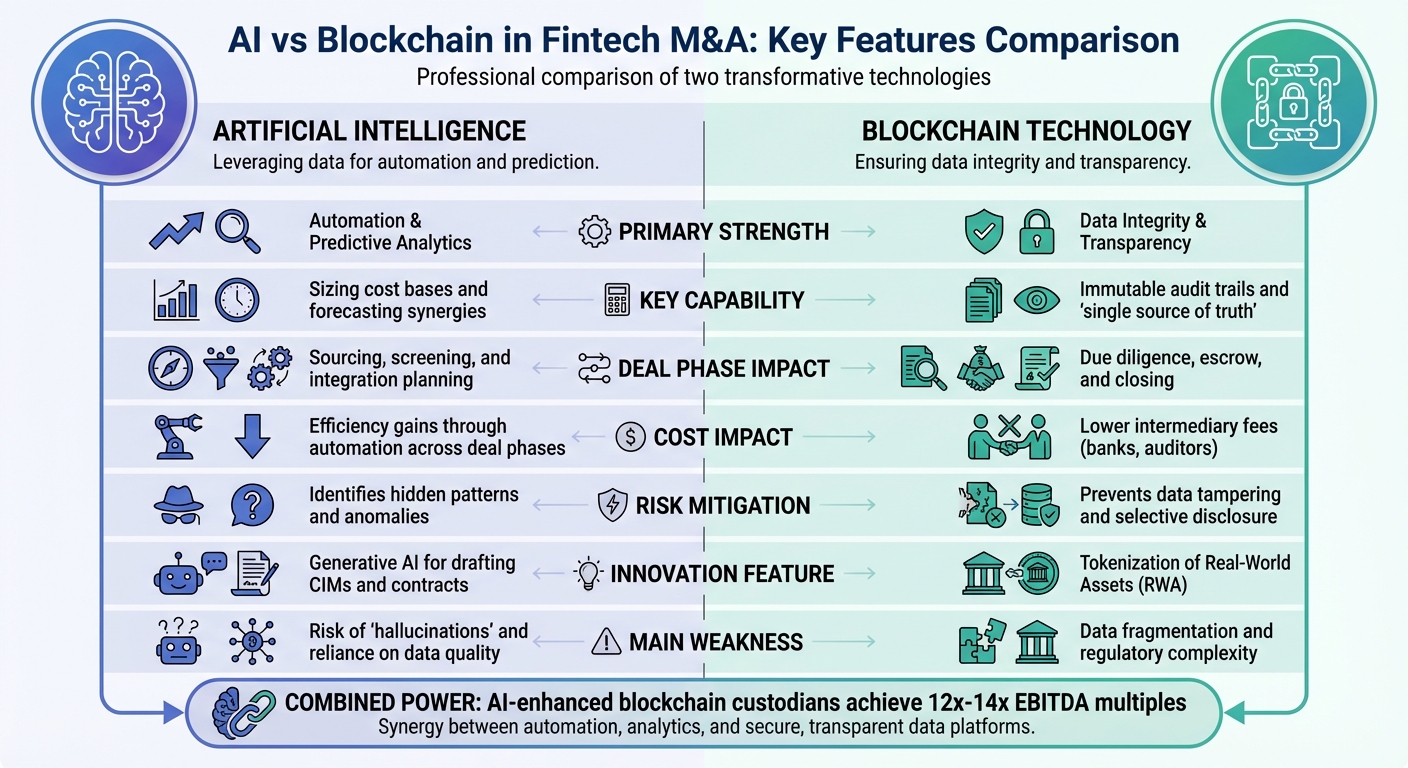
The table below compares the key features of AI and blockchain in fintech M&A:
| Feature | AI in Fintech M&A | Blockchain in Fintech M&A |
|---|---|---|
| Primary Strength | Automation & predictive analytics | Data integrity & transparency |
| Key Capability | Sizing cost bases and forecasting synergies [6] | Immutable audit trails and "single source of truth" [18] |
| Deal Phase Impact | Sourcing, screening, and integration planning [6] | Due diligence, escrow, and closing [17][18] |
| Cost Impact | Efficiency gains through automation across deal phases [20] | Lower intermediary fees (banks, auditors) [22] |
| Risk Mitigation | Identifies hidden patterns and anomalies [3] | Prevents data tampering and selective disclosure [18] |
| Innovation Feature | Generative AI for drafting CIMs and contracts [19] | Tokenization of Real-World Assets (RWA) [17] |
| Main Weakness | Risk of "hallucinations" and reliance on data quality [4] | Data fragmentation and regulatory complexity [3][12] |
The combined use of AI and blockchain offers even greater potential. For example, AI-enhanced blockchain custodians have achieved EBITDA multiples of 12x–14x [3]. Chainalysis, valued at $8.6 billion, uses AI-powered blockchain monitoring for real-time fraud detection and compliance [3]. This synergy is giving rise to a new category of "Hybrid Institutions", which blend AI-driven underwriting, regulated banking charters, and blockchain-based settlement systems [20]. As Acquiry aptly put it:
"Intelligence on the chain is now the defining currency of blockchain M&A" [3].
Conclusion
In the world of fintech mergers and acquisitions, AI and blockchain have proven to be a powerful duo, driving efficiency and innovation in tandem. AI brings the ability to perform predictive valuations, automate due diligence, and detect fraud, while blockchain offers a secure and unchangeable infrastructure that ensures transparency and data integrity [20][22].
The results of this collaboration are impressive. For example, integrating these technologies can reduce banking operational costs by up to 40% [20], and firms that combine AI-driven compliance with blockchain systems often achieve valuation premiums of 12×–14× EBITDA [3].
This strategic evolution is reshaping the industry. Hybrid institutions are now using AI for faster underwriting processes and blockchain for instant settlements [20]. As Banks & Bankers aptly put it:
"The future of financial services belongs to hybrid institutions that leverage AI for efficiency, use blockchain for settlement, and operate under full banking regulation" [20].
This combination is particularly effective in highly regulated sectors. Blockchain, enhanced by tools like Zero-Knowledge Proofs, can handle confidential transactions while remaining compliant with regulations such as MiCA and PSD3 [20].
Platforms like MyReadyMade are a testament to how these advancements are being applied. By integrating AI-powered analytics for business valuation with blockchain-secured data rooms for confidential document sharing, MyReadyMade supports the entire M&A process - from initial screening to final settlement. With features like license transfers across 50+ jurisdictions and an average close time of just 30–45 days, it demonstrates how AI and blockchain can streamline even the most complex transactions in regulated industries.
The focus in fintech M&A has shifted from speculative projects to building solid, proven solutions. Acquirers are now prioritizing companies that have successfully integrated AI and blockchain technologies [1]. Whether through AI agents executing smart contracts on their own or tokenized assets providing immediate liquidity, this partnership is setting new benchmarks for what’s achievable in the fintech space.
FAQs
How do buyers verify an AI platform’s data quality in due diligence?
During the due diligence process, buyers analyze an AI platform's data quality by utilizing tools designed for fraud detection, compliance monitoring, and predictive valuation. These techniques play a key role in assessing risks and verifying data integrity, offering a more transparent view of the platform's dependability and overall worth.
What blockchain signals indicate real traction versus inflated on-chain metrics?
Blockchain metrics that genuinely reflect traction include transaction volume, active wallets, stablecoin flows, exchange balances, and whale movements. These indicators offer clear, verifiable insights and often hint at market trends before they fully unfold. On the other hand, metrics like total value locked (TVL) or liquidity pools can be artificially inflated, making them less dependable for evaluating real market activity.
How do U.S. and EU crypto rules change cross-border fintech M&A risk?
Crypto regulations in the U.S. and EU play a major role in shaping the risks involved in cross-border fintech mergers and acquisitions. In the U.S., initiatives like the GENIUS Act are designed to simplify digital asset transactions, aiming to reduce friction in the process. Meanwhile, Europe’s MiCA regulation offers a unified legal framework, setting clear standards for digital assets across member states.
That said, the differences between these regulatory systems - and their constant evolution - can complicate matters. Legal uncertainties and rising compliance costs are just a couple of the hurdles businesses must address when navigating cross-border deals in this space. These challenges demand a strategic approach to ensure successful transactions.
Related Articles

Ultimate Guide to Earnout Negotiations in M&A
Structure and negotiate earnouts in regulated M&A with clear metrics, anti-manipulation covenants, and acceleration or escrow protections.
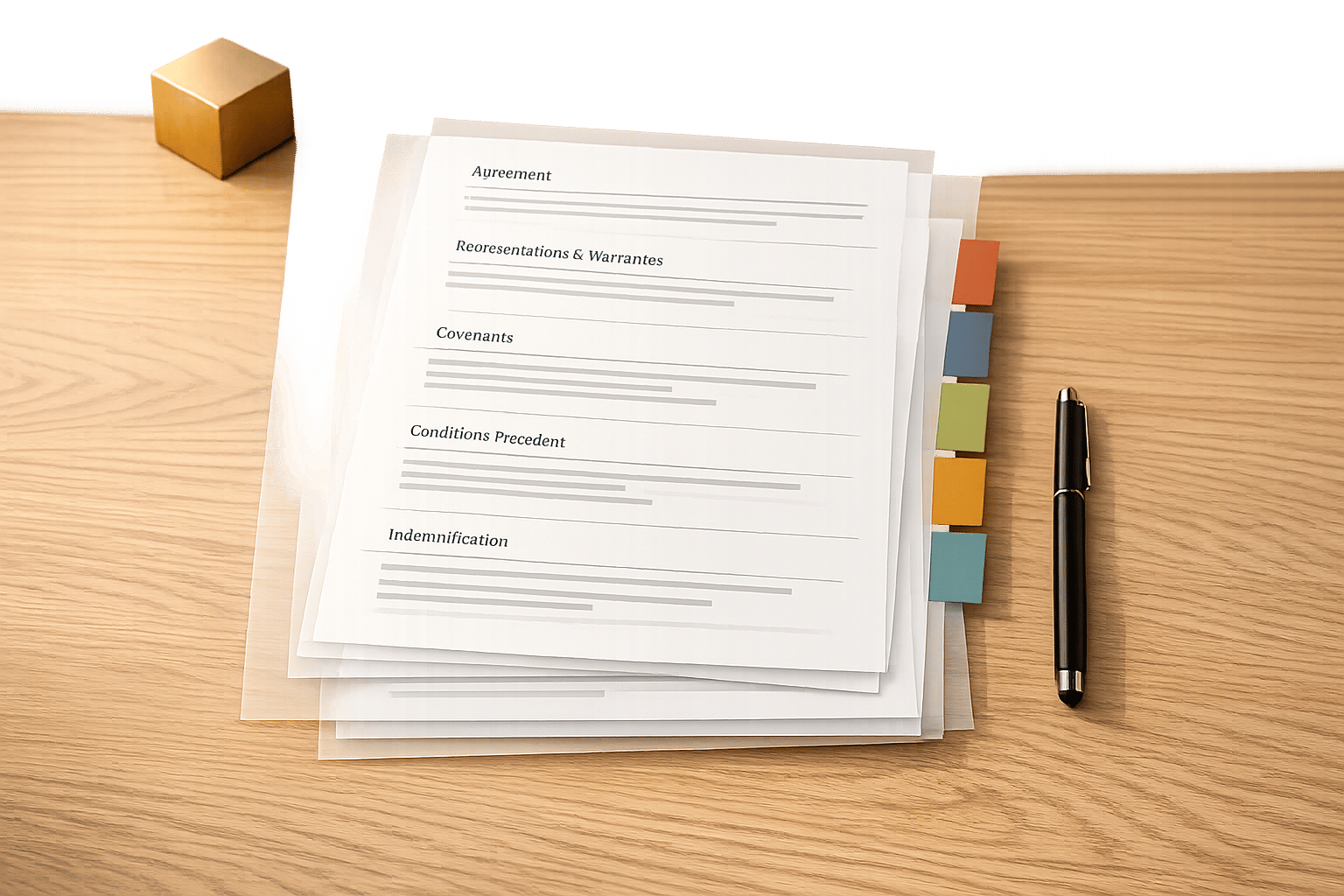
How to Draft M&A Definitive Agreements
Guide to drafting M&A definitive agreements covering deal structure, reps & warranties, indemnities, payment terms, and regulatory compliance.

How IP Affects Tokenization Valuation
How tokenizing patents, copyrights, and trademarks adds liquidity and market value—plus legal, regulatory, and valuation steps.
Looking to Buy or Sell?
Get in touch with our team for personalized assistance