Checklist for AML Compliance in Fintech M&A

Checklist for AML Compliance in Fintech M&A
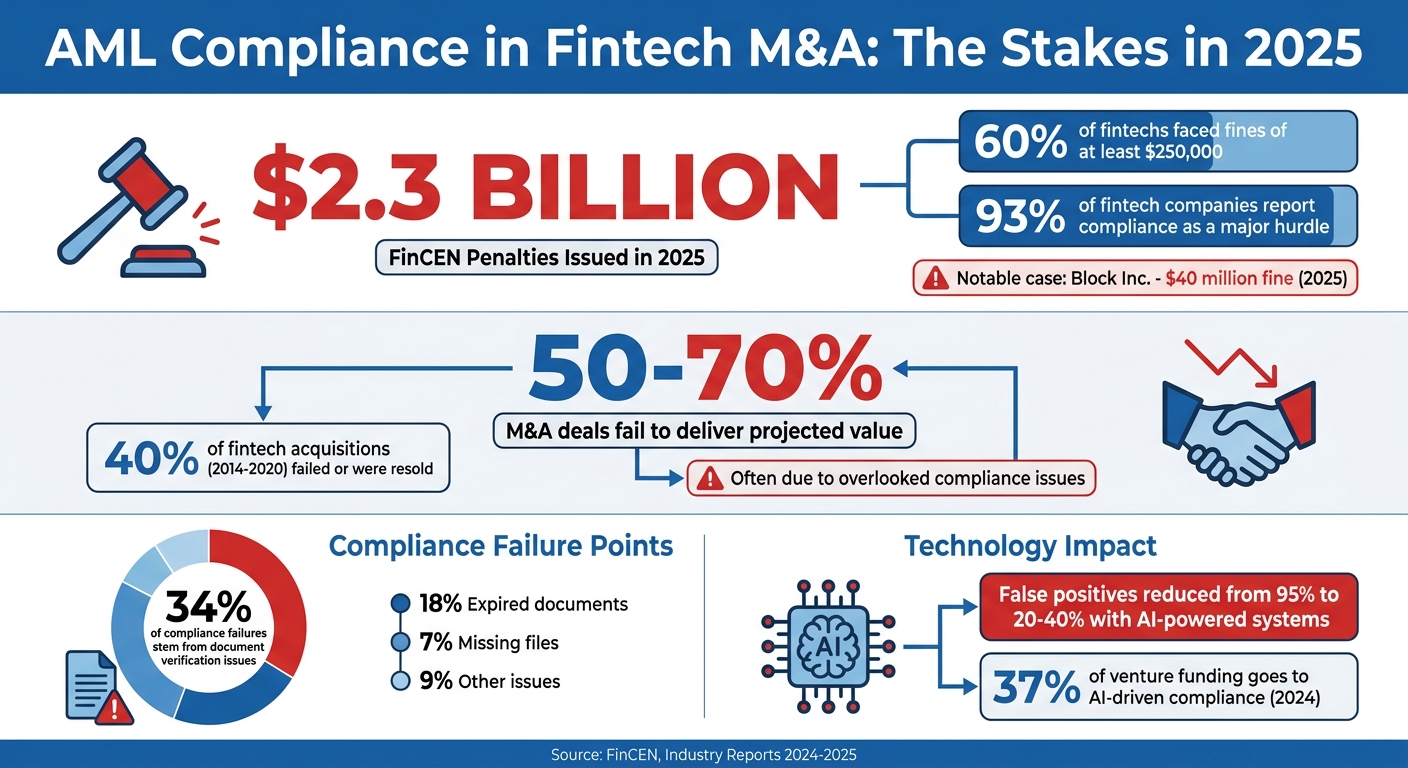
Merging with a fintech company? AML compliance is non-negotiable. Here’s why: In 2025, FinCEN issued $2.3 billion in penalties, and 60% of fintechs faced fines of at least $250,000 for compliance failures. Non-compliance risks include license losses, regulatory fines, and even deal failure.
To avoid these pitfalls, focus on three critical areas during M&A:
- Pre-M&A Due Diligence: Verify AML policies, review KYC/UBO documentation, and assess transaction monitoring systems.
- Post-Merger Integration: Conduct AML health checks, centralize monitoring systems, and address compliance gaps within 90 days.
- Documentation & Audit Trails: Maintain detailed records, secure data, and ensure compliance with global regulations.
The stakes are high, but a solid compliance framework protects your investment and ensures regulatory approval.
7 Steps to Build an Effective AML Compliance Program That Works
Pre-M&A Due Diligence Checklist
Before finalizing any deal, it's crucial to address all compliance risks. Due diligence is often where M&A deals falter - between 50% and 70% of transactions fail to deliver their projected value, frequently because key compliance issues were overlooked or underestimated [6]. Alex Lubyansky, an M&A Attorney at Acquisition Stars, puts it plainly:
"Due diligence is the single most expensive failure mode in M&A. Every major post‐closing dispute... traces back to something that was missed or underweighted before signing." [6]
This is especially true in the fintech sector. By 2025, 93% of fintech companies reported compliance as a major hurdle, with 60% incurring fines of at least $250,000 - often due to lapses in customer due diligence or transaction monitoring [2]. This is why your pre-M&A checklist must go beyond surface-level reviews, particularly when evaluating the target's Anti-Money Laundering (AML) framework. Below are the key areas to focus on.
Verify AML/CFT Policies and Procedures
Start by confirming that the target has well-documented AML/CFT policies tailored to its operations. This includes compliance with the Bank Secrecy Act (BSA), AML regulations, and Office of Foreign Assets Control (OFAC) guidelines [4][5]. Generic templates won’t cut it - these policies must reflect the company’s size, risk profile, and specific use cases.
Check whether the target applies a risk-based approach to Customer Due Diligence (CDD) and Enhanced Due Diligence (EDD). This means the level of scrutiny should vary depending on the risk level of each customer, rather than using a uniform process for all.
Ensure a qualified Chief Compliance Officer (CCO) or AML Officer is in place, with relevant experience and direct reporting lines to senior management [3][5]. Request documentation of independent third-party AML audits to verify that compliance has been objectively assessed [4][5]. Also, evaluate the company’s employee training program - review the curriculum, how often it’s updated, and how completion is tracked to confirm that staff are well-versed in their AML responsibilities [4][5].
Review KYC and UBO Documentation
Dive into the target’s Know Your Customer (KYC) and Know Your Business (KYB) records, requesting at least three to five years’ worth of documentation [6]. Examine how the company collects identification, verifies identities, and conducts background checks to ensure compliance with relevant standards like MiCA (EU), FCA (UK), or MAS (Singapore) [7].
Pay close attention to Ultimate Beneficial Ownership (UBO) structures. Review cap tables, stock ledgers, and shareholder agreements to uncover any hidden equity holders or unresolved ownership disputes [6]. This step is essential to avoid the risk of shell companies being used for money laundering [5].
Ensure that KYC and UBO data complies with data privacy regulations like GDPR or CCPA, to prevent inheriting legal liabilities [6]. Additionally, confirm that the software and data licenses tied to KYC/AML systems are transferable after the acquisition [6]. During this process, management interviews can reveal whether compliance systems are self-sufficient or overly reliant on personal relationships [6].
Screen for PEPs, Sanctions, and Adverse Media
Effective screening protocols are critical for detecting financial crimes and maintaining proper transaction monitoring. Verify that the target screens for Politically Exposed Persons (PEPs), global sanctions lists, and adverse media reports [5][7]. These checks should be ongoing, not just limited to customer onboarding [5]. As Signzy emphasizes:
"Transactions with Politically Exposed Persons (PEPs) also require unconditional monitoring." [5]
Evaluate the data sources used for screening, such as LexisNexis, Experian, or government sanctions lists, and confirm the use of specialized APIs and liveness detection tools [2][5]. Leveraging AI-powered automation can streamline reviews by cutting manual work by 30% while improving risk detection accuracy [2].
Ensure the company monitors high-risk jurisdictions - countries with poor compliance records or weak money-laundering laws [5]. Be alert to warning signs like high-frequency transactions just below reporting thresholds (structuring/smurfing), large cash transactions, or abrupt changes in customer behavior [5]. To go a step further, consider an independent external review of the target’s AML practices to uncover any blind spots [5].
Evaluating Transaction Monitoring and Reporting Systems
Once AML policies and KYC files are confirmed, the next step is reviewing the transaction monitoring system. Past enforcement actions have shown that weak transaction monitoring can lead to severe regulatory penalties [1]. These systems are central to AML enforcement, and any gaps here can put the merged entity at risk.
Audit Transaction Monitoring Logs
A detailed review of 12–18 months of monitoring logs is essential to gauge how well the system's alert settings are configured. Effective systems typically rely on 15–20 core monitoring rules tailored to specific risks, such as differences between retail and commercial transactions or domestic versus international activity. These rules should also address key typologies like structuring (e.g., splitting transactions to stay below the $10,000 CTR threshold), rapid fund cycling, and geographic risks [1][9].
False positive rates are a critical metric for evaluating system efficiency. Older systems often produce false positives as high as 95%, creating unnecessary work for analysts. In contrast, AI-powered systems can reduce false positives to 20–40%, significantly enhancing efficiency [1][9]. If the system generates excessive low-quality alerts, it may need recalibration or even an upgrade.
Ensure the system is independently tested every 12–18 months and complies with BSA regulations, including maintaining a five-year record retention policy for alerts and filings [9]. The system should also align with FinCEN's national AML priorities, such as combating cybercrime, corruption, and human trafficking [9].
Once the system's alert efficiency is assessed, move on to reviewing SAR processes.
Validate Suspicious Activity Reporting (SAR) Processes
The next step is to examine SAR procedures. Start by verifying that filings are completed within the required timeframes: 30 days (or 60 days if no suspect is identified) and 120 days for continuing SARs [9]. Missing or late SARs can result in civil penalties of up to $1 million per day [9].
Pay attention to the quality of SAR narratives. Regulators expect these to be thorough, detailing the "who, what, when, where, why, and how" of suspicious transactions [9]. Vague or incomplete narratives may indicate weak investigation practices. Additionally, check whether the entity has adopted FinCEN's October 2025 SAR FAQs, which encourage focusing on genuine threats instead of filing blanket reports for low-risk activity [9]. This reflects a shift toward meaningful compliance rather than simply meeting technical requirements.
Ensure strict controls are in place to prevent "tipping off", which is the unauthorized disclosure of a SAR to the subject - a federal crime [9]. Finally, evaluate the alert-to-SAR conversion ratio. If the system generates thousands of alerts but results in very few SARs, it could signal issues with rule calibration or investigative follow-through.
Once SAR practices are confirmed to be robust, shift the focus to ensuring the transaction monitoring framework is risk-based.
Assess Risk-Based AML Documentation
Verify that the target employs a risk-based approach, prioritizing high-risk transactions and flagging activity that deviates from a customer's usual behavior rather than relying on uniform thresholds [8][10]. For instance, a sudden increase in monthly transfers from $5,000 to $50,000 should trigger an alert.
Request documentation explaining the rationale behind the monitoring rules, and confirm that the BSA/AML officer has direct access to the board [1]. As FinCEN highlighted in a 2024 advisory:
"Partnering with a bank does not outsource your compliance obligations. It creates shared obligations." [1]
This is especially relevant for fintech companies involved in Banking-as-a-Service (BaaS) partnerships, as regulators are increasingly holding fintechs accountable for AML lapses [1]. Lastly, confirm that the monitoring system can scale to handle increased transaction volumes after the merger. It should also include key features like case management, sanctions screening, and checks for PEPs (politically exposed persons) and adverse media [1][10]. These steps are crucial for ensuring AML compliance and operational readiness post-merger.
Risk Assessment and Post-Merger Integration
Post-merger integration is just as crucial as the due diligence process. Addressing compliance gaps swiftly helps maintain regulatory compliance and protects the value of the deal. These gaps often become more apparent after the merger, increasing potential risks. A well-structured approach to risk assessment and system integration is key to avoiding failures like BNP Paribas' $8.9 billion settlement in June 2014 for transactions involving sanctioned entities in Sudan, Iran, and Cuba [11].
Conduct AML Health Checks
Building on the groundwork laid during pre-merger due diligence, immediate post-merger reviews are a must. A comprehensive compliance review should be conducted within the first 90 days of post-merger operations. This "90-day health check" helps identify integration challenges and assess risks across products, customer segments, and geographic regions using a mix of quantitative and qualitative data [11].
Direct involvement from business lines is critical during this process. Product owners and relationship managers bring firsthand insights into customer behaviors and product usage that compliance teams might miss [11]. Performance benchmarking is also essential. For example, top fintech companies can onboard customers in around four days, while underperforming programs may take up to ten days. Such delays might point to deeper control environment issues [11].
It may also be worthwhile to bring in an independent AML audit. An external review offers an unbiased evaluation of the merged entity's controls, ensuring the organization relies on a dynamic, data-driven defense system rather than outdated checklists.
Centralize Transaction Monitoring Systems
After completing initial health checks, the next step is to streamline transaction monitoring systems for unified oversight. Fragmented systems can lead to inefficiencies, especially when compliance data is scattered across multiple platforms. Analysts often waste time piecing together customer histories - a delay commonly referred to as "time-to-context" [12]. Consolidating workflows into a single platform minimizes manual effort and speeds up investigations.
Start by standardizing critical data fields, such as customer IDs, risk scores, screening statuses, and case outcomes. Establish clear data governance protocols to designate one system as the primary source for these fields [12]. Use API integrations to bridge legacy systems during the transition, ensuring seamless data exchange and synchronization [12].
Some major firms have successfully centralized their systems by adopting adaptive monitoring technologies and machine learning to cut down on false positives and accelerate investigations [11]. By calibrating monitoring rules with historical SAR data and testing the system with synthetic scenarios, companies can better measure and reduce "time-to-context" delays [12].
Identify and Mitigate Financial Crime Risks
Post-merger, the combined entity faces a wider range of financial crime risks. Start by categorizing customers based on geography, transaction behaviors, and business types. Apply Enhanced Due Diligence (EDD) to high-risk profiles [11]. Watch for warning signs like smurfing, unusual transaction patterns, and interactions with high-risk jurisdictions or Politically Exposed Persons (PEPs).
Sanctions screening should be integrated at all critical points, including customer onboarding, transaction processing, and periodic reviews. Automate daily updates from sources like OFAC, the UN, the EU, and HM Treasury to ensure your screening processes stay current [11].
Finally, align the board-approved risk appetite statement with the merged entity’s new business strategy. This ensures that strategic goals do not unintentionally increase compliance risks. By transforming compliance into a proactive, data-informed function, organizations can better manage risks in the post-merger landscape [11].
Documentation and Audit Trail Best Practices
After conducting a thorough review of AML policies and transaction monitoring systems, meticulous documentation becomes a critical step to ensure compliance throughout the merger process. This level of detail is essential for regulatory adherence, as it creates a transparent, traceable record of every compliance-related decision, customer interaction, and risk evaluation. For example, in 2025, Block Inc. faced a $40 million fine from the New York Department of Financial Services due to failures in monitoring controls, delayed suspicious activity reporting, and insufficient customer screening [14].
Compile and Review Critical Compliance Documents
Begin by confirming that all corporate governance records are accurate and up to date. These typically include articles of incorporation, LLC operating agreements, bylaws, shareholder registers, and at least five years’ worth of board meeting minutes [2][13]. For AML-specific documentation, ensure that AML/CFT policies, Customer Due Diligence (CDD) records, and Ultimate Beneficial Ownership (UBO) data are complete and meet the required standards for your jurisdiction. Retain customer and transaction records for a minimum of five years, making them accessible for regulatory inquiries [2][13][14].
"Due diligence is the single most expensive failure mode in M&A. Every major post-closing dispute... traces back to something that was missed or underweighted before signing." - Alex Lubyansky, M&A Attorney and Senior Counsel, Acquisition Stars [13]
In addition, collect all regulatory and licensing documents, including industry-specific permits and communications with regulators, to avoid delays in the acquisition process [2][13]. Operational compliance logs, transaction monitoring records, and SAR (Suspicious Activity Report) procedures should also be included. On the legal front, review key contracts with change-of-control clauses, intellectual property agreements, and non-disclosure agreements. Addressing discrepancies in foundational documents, like articles of incorporation, early on can prevent complications during the acquirer’s review [2].
Maintain Detailed Audit Trails
Rely on automated systems rather than manual processes like spreadsheets or email threads. Use tools that log and timestamp every compliance action, including identity verification, eligibility checks, payment methods, and internal approvals [15][16]. Ensure that all alerts, overrides, and SAR filings are thoroughly documented with context. This level of traceability is invaluable for regulatory reviews and smooth post-merger integration [16].
"Every decision, alert, override, and SAR is logged and timestamped automatically. This creates a complete audit trail, ready for internal review or regulatory inspection." - Validat [16]
Interestingly, 34% of compliance failures stem from issues during document verification, such as expired documents (18%) or missing files (7%) [17]. To address this, perform a gap analysis by comparing the merged entity’s documentation against the FFIEC BSA/AML Examination Manual. This helps identify outdated policies or monitoring thresholds that need adjustments [17].
Secure Data and Access Controls
Protecting sensitive AML data during the M&A process requires robust security measures. Start with AES-256 encryption for data at rest as a baseline [2]. Store all sensitive compliance, financial, and legal documents in secure Virtual Data Rooms (VDRs) that allow for efficient searching, bookmarking, and real-time updates to ensure all parties have access to the latest information [18].
Check that your partners or acquisition targets hold certifications like ISO 27001 or PCI-DSS [2]. Additionally, implement incident-response protocols and DDoS mitigation plans to ensure operational stability [2]. Maintain a reporting schedule with weekly KPI dashboards, and ensure major incidents are reported within a four-hour window [2]. Every review step should be documented, and risk ratings updated whenever regulations or business models evolve, creating a defensible audit trail [2].
Enhancing AML Systems Post-Merger
After thorough pre-merger due diligence and post-merger risk assessments, the next critical step is integrating and improving Anti-Money Laundering (AML) systems across the newly combined entity. This stage is where the groundwork laid earlier either solidifies into a strong compliance framework or falters under regulatory pressure. The goal is to turn due diligence insights into a cohesive and effective AML structure.
Retrain Employees on Unified AML Framework
Introduce the unified AML framework to key executives, ensuring strategic alignment and operational readiness. The CEO should oversee the overall strategy, the Chief Risk Officer (CRO) should focus on policy updates, and the CIO/CTO should validate technical adjustments. Updated compliance guides should be distributed digitally for immediate access and implementation.
As Qubit Capital emphasizes:
"Treat compliance like a product feature. Show clear AML, KYC, privacy, and licensing coverage, with ownership and escalation paths." [2]
Simulated exercises, such as stress tests for regulatory changes or cybersecurity breaches, can help refine escalation protocols. For instance, incidents like cloud outages might need to be reported within four hours. These simulations not only clarify response procedures but also ensure that every step is documented, keeping the organization audit-ready and demonstrating a proactive approach to risk management.
Upgrade AML Technologies and Tools
Modernizing AML tools is essential for managing the complexities of a merged entity. Transitioning from outdated, rule-based systems to AI/ML-powered monitoring can significantly reduce false positives - from as high as 80–90% down to 20–40%. This shift also increases analyst efficiency, enabling them to handle between 10,000 and 50,000 accounts compared to just a few hundred previously [1].
To streamline operations, adopt an API-first approach for key processes like Identity Verification (IDV), Politically Exposed Persons (PEP) screening, and Ultimate Beneficial Ownership (UBO) checks. Upgraded systems should include AI-driven automation, robust API integrations, and cloud-based failover strategies to handle transaction volume spikes efficiently.
Centralized case management tools are indispensable for tracking investigations, maintaining documentation, and ensuring consistent regulatory reporting. Start with a focused set of 15–20 core transaction monitoring rules, refining them based on the quality of alerts generated. Sahil Kataria, CEO of FluxForce AI, advises:
"The optimal rule set generates 50–100 alerts per analyst per day - any more and quality suffers." [1]
To ensure system security and resilience, conduct regular vulnerability scans, penetration tests, and stress-testing simulations on newly integrated applications [4][2].
Verify Regulatory Approvals and Compliance
Regulatory approvals are the backbone of the unified compliance framework. Ensure all licenses - such as EMV-certified card-issuing permits - are active and properly documented. Confirm alignment with FDIC, Federal Reserve, and OCC guidelines, and ensure full compliance with AML regulations and data privacy laws like GDPR and CCPA. Certifications such as PCI-DSS or ISO 27001 should be verified, along with encryption standards and incident-response protocols.
Additionally, review corporate documents, including articles of incorporation and intellectual property assignments, to ensure they reflect the new post-merger ownership structure. Evaluate fourth-party risks by assessing the vendors of your suppliers, as these can expose hidden vulnerabilities. Notably, 93% of fintech companies find regulatory compliance challenging, and between 2014 and 2020, 40% of acquired fintechs either failed or were sold post-acquisition - often due to inadequate compliance evaluations [2].
Conclusion
AML compliance in Fintech M&A is not a one-time task - it’s an ongoing responsibility that demands vigilance throughout the entire merger process. As Feedzai points out:
A key mistake that many banks and financial institutions (FIs) make is to think of anti-money laundering (AML) compliance as a one and done activity. [3]
The risks are real: last year, 60% of fintech companies faced compliance fines of at least $250,000. These penalties were largely due to gaps in transaction monitoring and customer due diligence [2].
A strong due diligence process lays the groundwork, but effective post-merger integration requires a flexible, risk-based approach. This includes carefully scrutinizing high-risk partners while streamlining procedures for lower-risk relationships. It’s also essential to assess fourth-party risks - those introduced by the vendors of the acquired company. Between 2014 and 2020, 40% of fintech acquisitions failed or were resold, often due to poor evaluation practices [2].
Three key elements are essential for robust compliance: appointing an experienced Chief Compliance Officer, implementing centralized transaction monitoring systems, and maintaining detailed audit trails. Qubit Capital underscores this point:
Fintech due diligence is not a one-time checklist. It is a living system that proves you can operate safely at scale. [2]
These elements create the backbone of a resilient compliance framework. Operational resilience also depends on reliable technical infrastructure, disaster recovery plans, and strong controls. Regular health checks - like vulnerability scans, penetration tests, and independent third-party reviews - can uncover weaknesses and ensure your AML practices remain effective [4][5].
As mentioned earlier, modern AML tools are transforming the landscape. In 2024, AI-driven compliance accounts for 37% of venture funding and 17% of fintech deals [2]. Companies that treat compliance as a strategic asset - leveraging advanced technology, comprehensive training, and stress-tested systems - are better positioned for long-term success in today’s complex regulatory environment. Beyond safeguarding compliance, this approach enhances transactional value and prepares organizations for future challenges.
For more insights on navigating Fintech M&A, visit MyReadyMade (https://myreadymade.com).
FAQs
What AML red flags can kill a fintech M&A deal?
When it comes to fintech mergers and acquisitions, anti-money laundering (AML) red flags can pose serious risks. These warning signs often surface in the form of suspicious transaction patterns, and failing to address them early can lead to compliance issues or even derail the deal entirely.
Here are some common AML red flags to watch out for:
- Structured transactions: These are deliberately broken into smaller amounts to avoid detection or reporting thresholds.
- Third-party payment mules: Involvement of intermediaries who move funds on behalf of others can indicate illicit activity.
- Unusual cash movements: Large, unexplained cash transactions or sudden changes in transaction behavior can be a major warning sign.
- Use of crypto mixers: These tools are often employed to obscure the origin of cryptocurrency, raising significant compliance concerns.
- Connections to high-risk jurisdictions: Transactions or entities tied to regions with weak AML regulations can signal potential risks.
Spotting and addressing these issues early in the process is essential. It not only ensures compliance with regulatory standards but also helps prevent last-minute disruptions to the deal.
How do we test if the target’s transaction monitoring actually works?
To ensure a transaction monitoring system works as intended, it's essential to test how well it identifies suspicious activities and generates alerts promptly. Methods like scenario testing or creating test transactions can be used to check if the system catches potential red flags and aligns with AML standards. Regular validation is key to maintaining accuracy, adapting to emerging threats, and ensuring the system operates effectively.
What should be fixed in the first 90 days after closing?
The initial 90 days after finalizing a Fintech merger or acquisition are crucial for aligning compliance processes. This period sets the stage for a seamless transition and ensures that regulatory standards are met.
Key areas to focus on include:
Integrating AML Measures: Combine systems for customer verification, transaction monitoring, and reporting to ensure anti-money laundering protocols are consistent across the organization.
Meeting Regulatory Requirements: Address licensing obligations, AML/KYC standards, and data privacy laws to avoid compliance gaps.
Establishing Leadership and Risk Frameworks: Appoint compliance officers, define the organization’s risk appetite, and set up systems for ongoing monitoring to maintain regulatory adherence.
By prioritizing these steps, you can create a strong foundation for compliance and operational success.
Related Articles

Ultimate Guide to Earnout Negotiations in M&A
Structure and negotiate earnouts in regulated M&A with clear metrics, anti-manipulation covenants, and acceleration or escrow protections.

How to Draft M&A Definitive Agreements
Guide to drafting M&A definitive agreements covering deal structure, reps & warranties, indemnities, payment terms, and regulatory compliance.

How IP Affects Tokenization Valuation
How tokenizing patents, copyrights, and trademarks adds liquidity and market value—plus legal, regulatory, and valuation steps.
Looking to Buy or Sell?
Get in touch with our team for personalized assistance