How to Assess Legal Liabilities in M&A
How to Assess Legal Liabilities in M&A
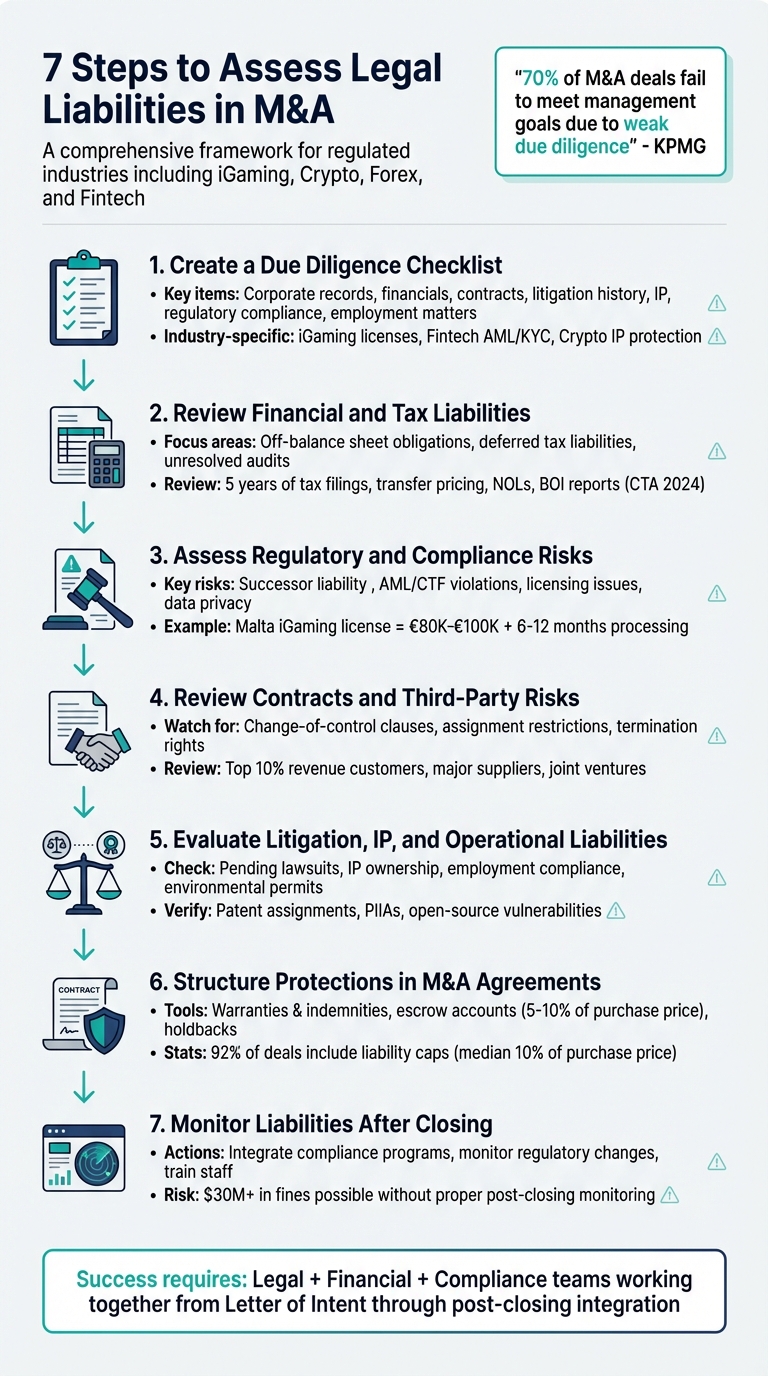
When acquiring a business, you’re not just buying its assets - you’re also taking on its legal liabilities. This includes regulatory violations, tax issues, pending lawsuits, and even operational risks. Ignoring these can lead to fines, license revocations, or operational shutdowns, especially in regulated industries like iGaming, Crypto, Forex, and Fintech. Here’s how to assess and manage these risks effectively:
- Due Diligence Checklist: Review corporate records, financials, contracts, tax filings, litigation history, intellectual property, and regulatory compliance.
- Financial and Tax Liabilities: Identify off-balance sheet obligations, deferred taxes, and unresolved audits.
- Regulatory Risks: Understand licensing requirements, AML protocols, and compliance with laws like GDPR or the Corporate Transparency Act.
- Contracts: Look for change-of-control clauses, hidden liabilities, and third-party risks.
- Litigation and Intellectual Property: Review past lawsuits, ensure clear IP ownership, and check for open-source vulnerabilities.
- Safeguards in Agreements: Use warranties, indemnities, escrow accounts, and holdbacks to protect against future liabilities.
- Post-Closing Monitoring: Implement compliance systems, monitor liabilities, and stay updated on regulatory changes.
Success hinges on thorough preparation, expert guidance, and proactive risk management. Legal, financial, and compliance teams are essential to avoid costly surprises.
What Lawyers Look for in M&A Due Diligence (Insider's Guide)
Step 1: Create a Due Diligence Checklist
A due diligence checklist is a must-have for spotting hidden legal risks. This document should cover all the essentials: corporate records, financial statements, tax filings, contracts, litigation history, intellectual property, regulatory compliance, and employment matters. As the U.S. Department of Justice states, "The extent to which a company subjects its acquisition targets to appropriate scrutiny is indicative of whether its corporate compliance program is... able to effectively enforce its internal controls and remediate misconduct" [5].
A survey by KPMG revealed that 70% of M&A deals fail to meet management goals due to weak due diligence [5]. With 47% of directors across industries in 2025 identifying M&A as a key strategic priority for board meetings [11], getting this step right is more crucial than ever.
What to Include in Your Checklist
Here’s a breakdown of the key items to include for a thorough review:
- Corporate Records: Request articles of incorporation, bylaws, meeting minutes (last five years), organizational charts, and lists of officers, directors, and shareholders.
- Financials: Collect 3–5 years of audited financial statements, budgets, debt instruments, and all tax filings - federal, state, local, and foreign. Don’t overlook tax sharing agreements, pending audits, and deferred tax liabilities.
- Contracts: Review customer and supplier agreements, joint ventures, and partnership deals. Pay close attention to "change-of-control" clauses that could lead to contract termination if ownership changes.
- Litigation: Identify pending, threatened, or settled cases, along with bankruptcy filings, unpaid judgments, and Uniform Commercial Code (UCC) lien searches.
- Intellectual Property: Verify ownership of patents, trademarks, copyrights, and trade secrets. Also, review licensing agreements, cybersecurity audits, and compliance with data privacy regulations like GDPR and CCPA.
- Employment Matters: Include employment contracts, compensation plans, retirement benefits, labor disputes, and non-compete agreements.
- Operational Risks: Request Phase I and II environmental assessments, supply chain maps, inventory reports, and real estate deeds or leases. Starting in 2024, ensure compliance with the Corporate Transparency Act (CTA) for beneficial ownership reporting.
Customize the Checklist for Regulated Industries
If the company operates in a highly regulated sector, your checklist will need extra tailoring to address specific risks.
- iGaming: Check for jurisdiction-specific licenses from authorities like the Malta Gaming Authority (MGA) or UK Gambling Commission (UKGC). Verify adherence to responsible gaming policies and confirm the ability to secure banking and payment service provider (PSP) connections.
- Fintech and Forex: Focus on oversight from agencies such as the SEC, FINRA, or OCC. Conduct detailed reviews of Anti-Money Laundering (AML) protocols, Know Your Customer (KYC) procedures, and credit portfolio risk.
- Crypto: Prioritize the protection of intellectual property for blockchain systems and proprietary algorithms. Ensure strong data privacy compliance and digital asset security.
Jessica Donohue, Senior Specialist at Diligent, emphasizes: "Acquiring a private company carries even more risks because they haven't stood the test of the markets, and buyers have less access to information from public sources" [11].
This is especially critical in regulated industries, where even a small compliance gap can lead to major disruptions. To keep everything organized, use a Virtual Data Room (VDR) to securely store and search documents. Additionally, perform "bring-down" searches close to closing to identify any new liabilities that may have surfaced.
Step 2: Review Financial and Tax Liabilities
Financial and tax liabilities can quietly chip away at deal value if left unchecked. Issues like off-balance sheet obligations, deferred tax liabilities, and unresolved audits often lurk beneath the surface. As Bylaw Law Firm puts it, "Due diligence can make or break a merger or acquisition because it reveals whether the seller is financially sound, a good strategic fit, and free of hidden deal-breakers" [9].
Find Off-Balance Sheet Liabilities
Start by recasting the target company's balance sheet to uncover hidden liabilities. Look closely at contingent obligations, including litigation reserves, pension underfunding, operating leases, and guarantees made on behalf of third parties [9]. Transactions involving related parties, such as insider loans or deals with family-affiliated entities, should also raise concerns [3].
For smaller businesses that lack audited financial statements, a forensic review is essential to identify unrecorded obligations [3]. Conduct preliminary searches like UCC filings, bankruptcy records, and lien checks to expose any undisclosed debts [10]. Additionally, review vendor and landlord contracts for change-of-control clauses that could trigger unexpected liabilities [9].
| Category | Common Off-Balance Sheet & Hidden Liabilities |
|---|---|
| Financial | Contingent obligations, guarantees, pension underfunding, operating leases [9]. |
| Tax | Unresolved audits, disputed assessments, deferred tax liabilities, transfer pricing risks [3][9]. |
| Legal/Regulatory | Threatened litigation, environmental remediation costs, employment-related claims [3][10]. |
| Contractual | Change-of-control penalties, joint venture commitments, undisclosed related-party loans [3][9]. |
Check Tax Compliance and Risks
Request the target's federal, state, local, and foreign tax filings for the past five years to spot any patterns of non-compliance [14][3]. Review financial statement tax notes for deferred tax assets (DTAs) and deferred tax liabilities (DTLs), which can indicate future tax obligations or benefits [14]. Examine past audit reports and correspondence with tax authorities to identify unresolved disputes or pending assessments [14].
For industries like iGaming, Fintech, Forex, and Crypto, pay close attention to transfer pricing arrangements and nexus issues, as these are common problem areas. Companies with significant digital operations often overlook state-level sales tax obligations in states where they have employees or physical operations [13]. Confirm that workers are classified correctly as employees or independent contractors and that payroll tax obligations are fully met [10][13]. Also, check the usability of Net Operating Losses (NOLs) and R&D tax credits, as these benefits can be limited under IRC Section 382 following an ownership change [15].
Starting in 2024, ensure the target has filed required Beneficial Ownership Information (BOI) reports under the Corporate Transparency Act (CTA). Failing to comply can result in penalties [10]. Using a Virtual Data Room (VDR) can streamline this process by centralizing tax documents and automatically notifying your legal team of updates [3][9].
Thoroughly addressing financial and tax liabilities now will prepare you for tackling regulatory and compliance risks in the next phase.
Step 3: Assess Regulatory and Compliance Risks
Regulatory and compliance risks can significantly impact the value of a deal, especially in industries like iGaming, Crypto, Forex, and Fintech. One major concern is successor liability, where the DOJ and SEC often hold the acquiring company accountable for the target's prior violations, particularly under the Foreign Corrupt Practices Act (FCPA) [6]. As McDermott Will & Schulte LLP cautions, "Buyers can acquire unintended and potentially very damaging liabilities together with target business or assets" [6].
Regulatory Challenges by Industry
Each regulated industry presents its own compliance hurdles. For instance, in iGaming, licensing requirements and capital thresholds differ by jurisdiction. In Malta, obtaining a license requires €80,000–€100,000 and a processing period of 6–12 months, while the UK Gambling Commission imposes no fixed capital minimum but is known for its strict regulatory standards [2]. Crypto and Forex companies often face scrutiny over Anti-Money Laundering (AML) controls and hidden ownership structures, especially in regions flagged by the Financial Action Task Force (FATF) [4]. Meanwhile, Fintech acquirers must ensure compliance with the SAFE Act, which mandates that mortgage loan originators are registered in the national directory within 60 days of an employer change [17].
| Risk Type | Verification Method | Potential Penalties |
|---|---|---|
| AML/CTF | UBO checks, source of funds verification, transaction analysis | Heavy fines, criminal charges, loss of banking access |
| Licensing | Validity audits, jurisdictional reviews | Cease and desist orders, product seizures, market exit |
| Consumer Protection | Review of Reg E (EFT) opt-ins, Reg Z disclosures | Civil penalties, class action lawsuits, reputational harm |
| Data Privacy | HIPAA/GDPR compliance checks, data security audits | Significant fines, withdrawal of product approvals |
To mitigate these risks, conduct thorough audits of the target's transaction monitoring, record-keeping, and staff training. Look for red flags such as unexplained cross-border transfers or large offshore cash flows [4]. For gambling or crypto-related acquisitions, implement Enhanced Due Diligence (EDD) measures like source of funds verification, biometric checks, and continuous monitoring [16]. Additionally, review third-party vendor agreements to identify any inherited compliance issues [17].
These challenges highlight the importance of a comprehensive approach to compliance, particularly when dealing with multiple jurisdictions.
Manage Compliance Across Multiple Jurisdictions
Managing compliance becomes even more complex when a business operates across various jurisdictions. Start by developing a compliance risk map that evaluates risks tied to the sector, jurisdiction, and counterparties to pinpoint the target's exposure [6]. Pay close attention to whether the target operates in tax havens, FATF-listed countries, or regions with weak AML enforcement [4].
Be mindful of regulatory threshold triggers. For example, in Fintech and banking M&A, crossing certain thresholds - like becoming an "Intermediate Small Bank" - can subject the acquirer to stricter reporting and community development requirements [17]. The DOJ's 2023 guidance stresses that the level of scrutiny applied to acquisition targets reflects the effectiveness of a company’s compliance program. They note that proper oversight can prevent misconduct and enforce internal controls [5]. If pre-close due diligence is insufficient, plan for a post-closing review and disclose any compliance issues promptly [6].
For companies operating in numerous regulated markets, platforms like MyReadyMade (https://myreadymade.com) offer specialized M&A advisory services. These tools can assist buyers with license transfers in over 50 jurisdictions, simplifying the complexities of multi-jurisdictional compliance during transactions.
Step 4: Review Contracts and Third-Party Risks
Contracts and third-party relationships can conceal liabilities that surface after the deal closes. One major red flag to watch out for? Change-of-control clauses. These clauses allow counterparties to terminate agreements, renegotiate terms, or impose penalties when a company changes ownership. If overlooked, they can quickly chip away at the value of your acquisition [7][19][20].
Examine Key Contracts and Agreements
Focus on contracts that are central to the company’s operations and revenue. Start by reviewing agreements with customers who contribute to the top 10% of revenue, major suppliers, and joint venture partners [12][19]. Pay close attention to assignment restrictions, which may require third-party consent to transfer contracts, and termination rights that allow key parties to exit agreements at will [19].
Other critical areas to review include:
- Exclusivity and non-compete clauses: These could limit your ability to operate other business units post-acquisition.
- Most-favored-nation pricing clauses: These may restrict your pricing flexibility.
- Indemnification provisions: Understand the scope of the target’s obligations to third parties and whether liability caps are in place.
- Employment agreements: Look for clauses that could trigger significant post-closing expenses, such as retention bonuses or severance pay [19].
For instance, leveraging automated third-party risk management tools can help speed up the contract review process and reduce delays.
| Contract Type | Key Review Focus | Potential Risk |
|---|---|---|
| Customer/Supplier | Revenue stability, pricing terms, termination clauses | Contract termination upon change-of-control [19] |
| Joint Venture | Profit-sharing, management duties, exit provisions | Decision-making deadlocks, hidden liabilities [19] |
| Employment | Retention clauses, non-competes, severance obligations | Loss of key talent, unexpected cash outlays [19] |
| Lease/Property | Maintenance costs, renewal options, landlord consent | Early termination penalties, non-transferable leases [10] |
To stay organized, use a Virtual Data Room (VDR) to centralize contracts and amendments [3]. Additionally, secure Good Standing certificates from tax authorities to confirm the target company’s legal capacity to maintain its contracts [10].
Once contracts are reviewed, it’s time to assess their impact on third-party liabilities.
Identify Third-Party Liabilities
After reviewing key contracts, shift your focus to dependencies and third-party obligations that could affect the acquisition’s value.
Heavy reliance on a single supplier or a few major customers introduces dependency risks. If these parties terminate their agreements post-acquisition, your revenue streams could take a hit [8][19]. Similarly, investigate joint venture and partnership agreements for hidden liabilities, such as undisclosed profit-sharing or intellectual property ownership issues [7][19]. For example, in one case, a manufacturing company’s ROI dropped by 15% due to off-balance sheet lease obligations that weren’t disclosed upfront [7].
Intellectual property (IP) licensing is another area that requires close attention. Third-party licenses might include exclusivity clauses or restrictions that could lead to infringement claims or delay product launches [7][20]. To avoid ownership disputes, verify the chain of title for all IP assignments and transfers [20]. Cybersecurity risks in third-party relationships can also wreak havoc - consider how Verizon negotiated a $350 million price reduction in its Yahoo acquisition following the disclosure of data breaches [20].
"Due diligence can make or break a merger or acquisition because it reveals whether the seller is financially sound, a good strategic fit, and free of hidden deal-breakers." - Bylaw Law Firm [9]
To mitigate risks, secure pre-closing waivers or consents for contracts with change-of-control provisions. Develop contingency plans for critical suppliers or distributors in case key agreements aren’t transferable [20]. You may also want to set up escrow accounts, holdbacks, or special indemnities to address potential liabilities from third-party disputes or contingent obligations [7][18]. For acquisitions in regulated industries like iGaming, Crypto, or Fintech, platforms such as MyReadyMade (https://myreadymade.com) offer expert M&A advisory to navigate these complex third-party relationships and contractual issues across multiple jurisdictions.
Step 5: Evaluate Litigation, IP, and Operational Liabilities
Once you've completed the third-party risk reviews, it's time to turn your attention inward. Internal liabilities - like unresolved legal disputes, intellectual property (IP) issues, and operational challenges - can quietly undermine the value and success of your acquisition.
Review Litigation History
Start with a deep dive into the target's litigation history. This includes past, pending, and even threatened legal actions such as lawsuits, government investigations, or arbitration cases. Begin by searching public databases for bankruptcy filings, unpaid judgments, liens, and preliminary Uniform Commercial Code (UCC) searches. If the target operates in multiple states or regions, make sure to conduct these searches in all relevant jurisdictions.
Go beyond public records and examine internal documents. Look for warning letters, citations, and regulatory correspondence with agencies like the FDA or DOJ. These can reveal potential regulatory risks, including litigation or product seizures. Review insurance policies - such as Directors & Officers (D&O), Errors & Omissions (E&O), and general liability coverage - and analyze past claims history to spot recurring legal issues or gaps in coverage. Dig into board meeting minutes, legal department files, and financial reserves for any known but undisclosed risks.
"The extent to which a company subjects its acquisition targets to appropriate scrutiny is indicative of whether its corporate compliance program is... able to effectively enforce its internal controls and remediate misconduct." - U.S. Department of Justice, Evaluation of Corporate Compliance Programs (March 2023)
The DOJ now expects acquirers to conduct thorough pre-M&A due diligence to uncover misconduct. Skipping this step could reflect poorly on your own compliance program. Beyond identifying past issues, check if the target has made long-term changes to its Standard Operating Procedures (SOPs) to address prior legal findings. Also, review employment agreements for clawback clauses, which are increasingly recommended to mitigate risks tied to executive misconduct.
Verify Intellectual Property Assets
Once you've assessed litigation risks, shift your focus to intellectual property. Start by cataloging all patents, trademarks, copyrights, and trade secrets owned or used by the target. Confirm that these assets are properly registered and maintained in all applicable jurisdictions. Check patent assignments and recording records to ensure a clear chain of ownership from the inventor to the company.
Employment and consulting contracts are critical here. Scrutinize Proprietary Information and Invention Assignment Agreements (PIIAs) for all employees, founders, and consultants - both current and former. Look for language that explicitly assigns rights to the company (e.g., "hereby assigns") rather than vague future promises like "will assign", which may not automatically transfer ownership of future inventions.
For software assets, it's wise to hire a third-party vendor to scan for open-source vulnerabilities or "copyleft" issues that could force the target to disclose proprietary source code. Also, check if any IP was developed using government grants or university resources, as these often come with ownership or licensing rights that favor the funding entity. Finally, review inbound and outbound licenses for any change-in-control provisions that might require licensor approval to maintain the license after the merger.
"Patent due diligence is not merely a checkbox item in the M&A process; it is integral to the overall success of the transaction." - Proskauer Rose LLP [21]
Check Operational Liabilities
Operational liabilities can become a costly headache after the deal closes, so it's crucial to address them upfront. Begin by reviewing employee classifications (employee vs. independent contractor), wage and overtime compliance, union agreements, and any pending HR complaints or labor disputes. Misclassified employees can lead to legal penalties and disrupt day-to-day operations.
Environmental compliance is another key area to investigate. Examine permits, hazardous waste disposal practices, and potential liabilities related to Superfund sites or asbestos exposure - these can result in hefty remediation costs. Conduct physical site visits to evaluate the condition of machinery and facilities. Don’t rely solely on inventory reports; site visits can reveal maintenance backlogs or capacity limitations that may require immediate investment post-closing.
Lastly, assess the target's vendor relationships and supply chain resilience. Map out critical vendors to identify risks like geographic concentration or single-source dependencies that could hinder scalability. Review lease terms for any change-of-control clauses, maintenance obligations, or liens on property. Keep in mind that a KPMG survey found nearly 70% of mergers and acquisitions fail to meet management's goals [5], often due to overlooked operational issues and integration challenges. Addressing these risks early can help ensure a smoother path forward.
Step 6: Structure Protections in M&A Agreements
Once liabilities have been identified, it's time to build legal safeguards into the purchase agreement. While due diligence helps uncover potential risks, it’s impossible to foresee every post-closing issue. That’s where contractual protections step in, ensuring clarity around payment responsibilities for any surprises that might arise later.
Use Warranties and Indemnities
Representations and warranties act as the first layer of defense. These are statements about the target company - covering areas like ownership structure and regulatory compliance - and they shift financial risks to the seller if proven false. For context, over 92% of M&A deals include a liability cap, with the median cap set at roughly 10% of the purchase price in transactions without representation and warranty insurance [22].
To match the specific risks of your deal, representations are often categorized into three tiers, each with different survival periods:
- Fundamental reps (e.g., title to assets, capitalization): Typically survive 3–5 years.
- Regulatory reps (e.g., tax compliance, environmental matters): Usually last 30–60 days beyond the statute of limitations.
- Non-fundamental reps (e.g., general business matters): Commonly survive for 12–24 months [22].
For industries with heavy regulations, like iGaming or Fintech, consider extending survival periods for compliance-related representations to address ongoing regulatory risks.
"Reps and warranties are not only about what is and is not. They reflect the parties' understanding of which party will bear the burden of losses that arise from certain events or circumstances." - Erik Lopez, Partner, Jasso Lopez PLLC [23]
Baskets and thresholds are another critical consideration. About 95% of deals include baskets, with the median basket size being 0.5% of the purchase price [22]. A "tipping basket" benefits the buyer since, once losses exceed the threshold, the seller pays from the first dollar. On the other hand, a "true deductible" only covers amounts above the threshold. Importantly, always exclude fraud, gross misconduct, and intentional misrepresentation from any caps or baskets to ensure full recovery in cases of bad faith [22].
To further strengthen your position, consider materiality scrapes and sandbagging provisions. Materiality scrapes eliminate qualifiers like "material" or "Material Adverse Effect" when calculating damages, closing loopholes that could allow sellers to avoid smaller but cumulative claims [22]. In states like Delaware and New York, which are pro-sandbagging jurisdictions, buyers can bring indemnity claims even if they were aware of the breach before closing [22]. Additionally, if there are multiple sellers, aim for joint and several liability, allowing you to recover the full claim from any one seller, regardless of their ownership stake [22].
Set Up Escrow and Holdback Arrangements
To ensure enforceability of indemnification rights, consider securing funds through escrow or holdback arrangements. These mechanisms provide a practical way to recover losses without chasing down the seller for payment. Currently, about 50% of deals use indemnity escrow, though its usage is declining as representation and warranty insurance gains popularity [22].
With escrow, a portion of the purchase price is set aside in a third-party account at closing. If a breach is discovered during the survival period, you can draw from this fund to cover your losses. Escrow amounts typically range between 5% and 10% of the total purchase price, with funds held for 12 to 18 months - aligning with the survival period for non-fundamental representations [22].
Make sure your agreement includes offset rights, allowing you to deduct indemnifiable losses from any remaining payments to the seller, including escrow funds, holdback amounts, or seller notes [22].
"The Purchaser shall have the right to offset any indemnifiable Losses against, in each case on a dollar-for-dollar basis, from any other payment due to the Seller or its respective Affiliates, including, without limitation, the Note." - Margaret M. Salinas, Attorney, Chuhak & Tecson, P.C. [22]
For risks tied to specific industries - such as an FDA audit or a known environmental issue - negotiate tailored indemnities that are not subject to standard caps or baskets [22]. Also, include mitigation provisions requiring the buyer to take reasonable steps to limit damages before drawing on escrow funds [24]. This ensures fairness for the seller while giving you access to funds for legitimate claims.
Step 7: Monitor Liabilities After Closing
Closing a deal doesn’t mean the work is done. In fact, the post-closing phase is where hidden liabilities - like past regulatory violations or successor liability risks - can rear their heads. Even if the ink is dry on the contract, legacy issues might still pose threats unless you’ve secured explicit exemptions from regulators beforehand.
The financial consequences of overlooking this step can be severe. Take, for example, a U.S. medical device company that faced over $30 million in fines due to insufficient regulatory due diligence [1]. To avoid such costly mistakes, it’s crucial to implement structured monitoring processes that can detect and address emerging issues early. This phase also underscores why thorough due diligence before closing is so important.
Set Up Liability Monitoring Processes
After the deal closes, it’s time to dig into the details. Start by reviewing the target company’s compliance systems to ensure they align with current regulatory standards. Many businesses, especially smaller or less sophisticated ones, may have outdated risk protocols or lack proper vendor monitoring systems, which could expose you to unnecessary risks [1].
Integrating your compliance program into the newly acquired business should be a top priority. This includes rolling out your company’s code of conduct and anti-bribery policies. Research shows that clear communication during this process can reduce observed misconduct by up to 73% and foster a stronger culture of integrity [6]. Assigning a compliance manager to oversee this integration and serve as a resource for new employees can make the transition smoother and help establish a foundation for ongoing risk monitoring [6].
Here’s a practical example: In 2025, TE Connectivity accelerated its M&A integration by automating its due diligence processes. Under the leadership of Business Partner Program Manager Brian Risser, the company adopted Diligent Third-Party Risk Management software. This tool helped them identify bottlenecks, standardize procedures, and implement automated alerts to keep stakeholders informed during the monitoring phase [3]. Leveraging similar Governance, Risk, and Compliance (GRC) tools can streamline your own monitoring efforts and ensure consistency [3].
It’s also essential to keep an eye on changes that could introduce new risks, such as shifts in leadership, evolving third-party relationships, or geopolitical developments [1]. If any non-compliance issues surface during your review, act quickly. Self-disclosing to regulators like the DOJ or SEC can often result in leniency or credit for taking proactive steps [1].
"Just because no risks were apparent at the acquisition's onset doesn't mean new risks won't surface months or years down the road." - Tom Hollobone, Kroll [1]
Stay Updated on Regulatory Changes
Staying on top of regulatory developments is just as important after closing as it was during due diligence. As the acquired business becomes part of your operations, your regulatory obligations may shift. For example, financial institutions might see changes in reporting requirements under laws like the Home Mortgage Disclosure Act (HMDA) or the Community Reinvestment Act (CRA) due to changes in asset size or geographic reach [17]. Similarly, businesses operating in the U.S. will need to ensure compliance with the Corporate Transparency Act (CTA), which requires detailed reporting on beneficial ownership for each entity in your corporate structure [10].
To manage this, allocate resources to monitor regulatory updates and adjust your compliance strategy as needed. This is especially critical in industries like iGaming, Cryptocurrency, Forex, and Fintech, where regulations can change rapidly across jurisdictions. Update public files and registrations - such as CRA public files or SAFE Act registries - within 60 days of any significant changes [17].
Don’t forget to train your new staff on any industry-specific rules to ensure compliance. For properties with environmental concerns, for instance, long-term monitoring of groundwater or soil contamination may be necessary to meet legal standards [25]. Keep in mind, if compliance issues persist under your ownership, you could be held accountable for failing to address them [6].
"The post-transaction period provides a unique opportunity to renew focus on compliance and implement a range of compliance improvements." - McDermott Will & Emery [6]
Conclusion
Navigating legal liabilities in M&A can mean the difference between a smooth acquisition and a financial disaster. Many M&A failures boil down to missed legal or regulatory risks. This is especially true in tightly regulated fields like iGaming, Cryptocurrency, Forex, and Fintech, where successor liability could leave you responsible for violations that occurred before you even took ownership [5].
To avoid these pitfalls, it’s essential to approach risk management right from the start. As Patrick T. Strubbe aptly puts it:
"Risk mitigation in M&A or regulatory compliance must be proactive and done on the front end, rather than as an afterthought, to unlock its full benefits" [18].
This involves assembling a team of legal, financial, and compliance professionals early in the process - ideally before you sign a Letter of Intent. These experts can help you conduct in-depth due diligence across key areas like financial obligations, regulatory compliance, contracts, litigation, intellectual property, and operational issues.
Having expert guidance is non-negotiable. A thorough investigation can uncover risks that might otherwise remain hidden [5]. The Department of Justice underscores this point:
"The extent to which a company subjects its acquisition targets to appropriate scrutiny is indicative of whether its corporate compliance program is... able to effectively enforce its internal controls and remediate misconduct" [5].
Specialized advisors bring a comprehensive perspective, helping you identify potential blind spots. This is especially critical when dealing with complex cross-border deals or navigating the transfer of licenses. Their expertise ensures that no stone is left unturned, reducing your exposure to unforeseen liabilities.
FAQs
What should be included in a due diligence checklist for M&A?
A well-rounded due diligence checklist for mergers and acquisitions (M&A) should dig into all crucial aspects of the target company to identify risks and confirm its value. Start with corporate and governance documents - things like incorporation certificates, bylaws, and shareholder agreements. These will help verify ownership details and ensure the company is following proper regulations.
Next, move on to financial and tax reviews. Dive into financial statements, cash flow, debts, and tax records to spot any potential warning signs. For legal due diligence, examine contracts, intellectual property, regulatory licenses, and any ongoing or potential litigation that could impact the deal.
It’s also important to evaluate the company’s operations and market position. Look at its business model, customer base, and supply chain to get a clear picture of its competitive standing. On the workforce side, review employment matters, including employee agreements, compliance with labor laws, and benefit plans.
Don’t forget to assess technology and cybersecurity. Ensure the company has solid IT systems and proper data security measures in place. Lastly, investigate industry-specific risks, which are especially critical in sectors like iGaming, cryptocurrency, forex, and fintech, where regulations can be complex.
Covering these areas thoroughly helps buyers uncover liabilities, negotiate better terms, and move forward with more confidence in the transaction.
What impact do regulatory and compliance risks have on M&A deals?
Regulatory and compliance risks play a major role in shaping the outcome of M&A deals, particularly in tightly regulated industries like pharmaceuticals, financial services, iGaming, cryptocurrency, and fintech. One critical factor is successor liability, where buyers can inherit responsibility for the target company's previous violations. These could include breaches of anti-bribery laws, anti-money laundering regulations, or sanctions, which might lead to hefty fines, reputational harm, or even criminal charges.
In industries with strict regulatory oversight, such as pharmaceuticals, failing to meet specific requirements - like FDA standards - can seriously disrupt deals. Regulatory reviews can stretch on for as long as two years, creating uncertainty around financing, valuations, and integration strategies. In extreme cases, regulatory bodies may block transactions altogether if compliance standards aren’t met.
To address these challenges, MyReadyMade offers a specialized marketplace tailored for buying and selling businesses in regulated and high-risk sectors. With verified listings, professional M&A advisory services, and support for license transfers across more than 50 jurisdictions, the platform helps buyers manage due diligence, reduce risks, and simplify regulatory approvals, ensuring that deal value is safeguarded.
What legal protections can help reduce liability risks in M&A transactions?
To reduce liability risks in mergers and acquisitions, agreements often include a range of legal protections. A few key ones stand out: representations and warranties, which require the seller to provide accurate details about the business, and indemnification clauses, which shield the buyer from specific losses after the deal is finalized. Additionally, many transactions rely on escrow accounts or hold-back arrangements to set aside funds for addressing potential claims.
Other safeguards frequently used are survival periods for representations and warranties, allowing claims to be made within a specified timeframe, and sandbagging provisions, which let buyers pursue claims even if they were aware of an issue before closing. There's also the use of successor liability carve-outs, which help limit a buyer’s responsibility for debts or obligations incurred before the deal.
These strategies are particularly important in industries like iGaming, Cryptocurrency, and Fintech, where liabilities can be more intricate due to regulatory and operational complexities. In such sectors, platforms like MyReadyMade provide expert M&A advisory services, making it easier for buyers and sellers to navigate these legal challenges.
Related Articles

Ultimate Guide to Earnout Negotiations in M&A
Structure and negotiate earnouts in regulated M&A with clear metrics, anti-manipulation covenants, and acceleration or escrow protections.

How to Draft M&A Definitive Agreements
Guide to drafting M&A definitive agreements covering deal structure, reps & warranties, indemnities, payment terms, and regulatory compliance.

How IP Affects Tokenization Valuation
How tokenizing patents, copyrights, and trademarks adds liquidity and market value—plus legal, regulatory, and valuation steps.
Looking to Buy or Sell?
Get in touch with our team for personalized assistance