How Background Checks Impact M&A Deals

How Background Checks Impact M&A Deals
When companies merge or acquire others, skipping background checks can lead to financial penalties, reputational harm, or even deal failure. Here's why background checks are critical in M&A:
- Successor Liability: Buyers inherit regulatory violations, such as anti-money laundering (AML) or bribery issues, from the acquired company.
- Regulatory Risks: Missing compliance checks can result in fines, license loss, or operational shutdowns.
- Reputational Damage: Fines are costly, but reputational fallout can cost 4.5x more.
- Deal Failures: Poor due diligence is a leading cause of M&A failures, with up to 70%-90% of deals failing to meet goals.
The process involves three phases:
- Pre-Negotiation Screening: Identifying deal-breakers early through public data.
- Transaction Due Diligence: Reviewing contracts, compliance policies, and internal controls.
- Post-Closing Examination: Testing internal systems to catch hidden risks.
Key areas covered include verifying licenses, regulatory compliance, legal history, financial records, and reputations of key personnel. Tools like MyReadyMade streamline these checks, particularly in regulated industries like Fintech and iGaming.
Skipping these steps isn't worth the risk. Hidden liabilities can lead to fines, canceled deals, and long-term damage. A thorough background check can save millions and protect your investment.
Best Practices in M&A Due Diligence
sbb-itb-ba142f6
What Background Checks Cover in M&A
This section breaks down the key areas examined during background checks, aligning with the phased due diligence process.
Regulatory Compliance and License Verification
One of the first steps in M&A background checks is confirming that the target company has the necessary licenses to operate. This involves verifying over 300 license types across 8,300 jurisdictions [8]. For industries like iGaming, Forex, and Fintech, operating without the proper licenses can bring operations to a standstill.
The verification process includes checking general licenses (such as payroll forms and sales tax registrations), regulatory permits (for sectors like banking, telecommunications, and defense), and occupational licenses (for gaming, insurance, and financial services) [8]. Each license must be valid, up-to-date, and transferable under the terms of the deal.
Beyond licenses, checks also focus on anti-corruption compliance, ensuring adherence to the Foreign Corrupt Practices Act (FCPA) and the proposed Foreign Extortion Prevention Act (FEPA). This is critical because of successor liability - where the buyer inherits any past violations [1][3]. The process includes verifying Ultimate Beneficial Owners (UBOs) and screening for connections to sanctioned individuals or Politically Exposed Persons (PEPs) [1][4]. In highly regulated industries, even one link to a sanctioned party can jeopardize deals worth millions.
New U.S. regulatory requirements can add 121 hours of additional disclosure preparation for complex transactions [6]. Compliance costs large firms approximately $10,000 per employee annually, while the cost of non-compliance can be three times higher [7]. Furthermore, 14% of deals valued at over $1 billion are canceled annually due to antitrust issues alone [8].
These checks are essential to avoid inheriting regulatory or reputational risks.
Legal and Financial History Review
Once licenses and compliance are verified, a thorough review of the company’s legal and financial history is conducted.
This review helps identify potential liabilities, as the buyer assumes responsibility for any past violations [1][3]. The process examines cases of fraud, bribery, money laundering, and market manipulation [4]. It also evaluates financial policies, including revenue recognition methods and adherence to GAAP or IFRS accounting standards [4]. This step ensures the buyer can adjust the valuation if revenue streams are tied to unethical practices, preventing overpayment for assets that may not withstand regulatory scrutiny [5].
Statistics show that 70% to 90% of M&A deals fail, often due to poor due diligence or compliance issues [8]. Around 26% of companies abandon half or more of their deals when compliance problems emerge during background checks [8]. A single data breach can cost an average of $4.45 million, while failing to file IRS-required forms can lead to penalties of up to $3 million [8].
The DOJ’s M&A Safe Harbor Policy provides some relief. Companies that uncover and disclose criminal misconduct within six months of closing and complete remediation within one year may avoid prosecution [4]. Even without self-disclosure, cooperating with the DOJ can reduce enforcement fines by up to 25% [3]. Post-closing audits are especially important, as they allow access to internal systems that were unavailable during pre-deal diligence [1][9].
Reputation and Professional Background Checks
Beyond legal and regulatory reviews, assessing the credibility and reputation of the target company’s leadership is equally important.
Background checks on executives and board members help identify unethical behavior, conflicts of interest, or ties to sanctioned individuals [1][4]. In sectors like healthcare and finance, a damaged reputation can erode customer trust, leading to declining sales and falling stock prices after the acquisition [1][10].
The financial impact of reputational damage can be severe. Research shows that reputational penalties cost organizations 4.5 times more than regulatory fines [1][10][11]. For example, a U.S. medical device company faced over $30 million in fines after neglecting proper regulatory due diligence [1][11]. Studies consistently show that reputational damage often outweighs regulatory penalties.
Professional background checks also ensure that UBOs are not PEPs or linked to sanctioned individuals [1][10]. Additionally, they assess the target’s whistleblower systems and investigative processes. A lack of reports in high-risk sectors may indicate a suppressed or ineffective compliance culture [4][5]. Regulators like the French Anti-Corruption Agency (AFA) are now publishing guidelines for anti-corruption checks during M&A, emphasizing the importance of leadership’s role in maintaining compliance [2][4].
These checks are vital for identifying risks tied to both regulatory and reputational issues.
Risks of Skipping Background Checks in M&A
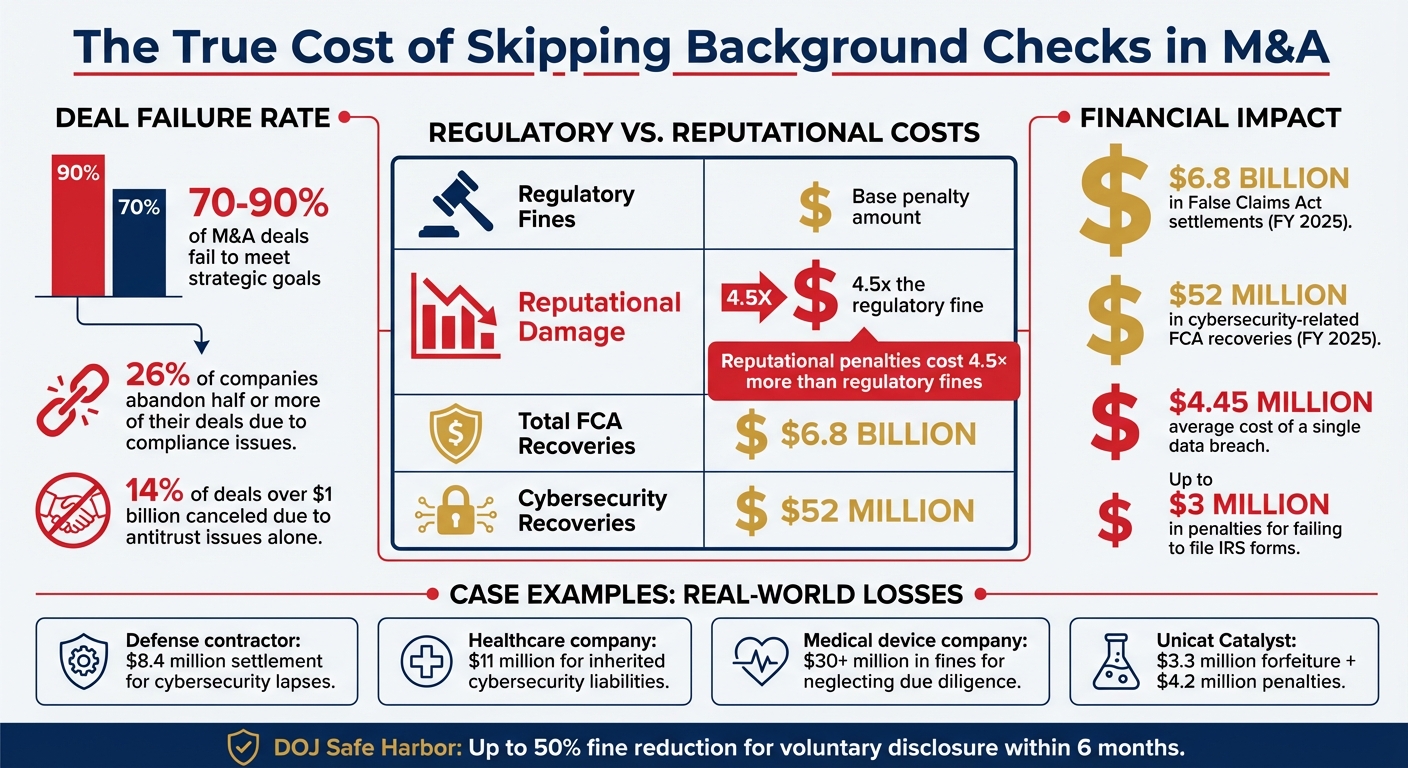
Skipping background checks during mergers and acquisitions (M&A) can lead to costly consequences - financially, operationally, and reputationally. Often, problems that are overlooked before the deal come to light after the transaction closes, making them far more expensive and challenging to address.
Regulatory Penalties and Fines
When acquiring a company, you also inherit its past regulatory violations. This concept, known as successor liability, means any unresolved violations - whether related to anti-bribery corruption (ABC), anti-money laundering (AML), or sanctions - become the responsibility of the buyer. History shows that skipping due diligence can result in hefty penalties. For example, in 2025, a defense contractor's subsidiary, along with its corporate parents, agreed to pay $8.4 million to settle False Claims Act allegations tied to cybersecurity lapses between 2015 and 2021. These liabilities followed the company through a 2024 reorganization and sale [13].
The financial impact doesn’t stop at initial fines. If misconduct is uncovered post-transaction, it can increase penalties for future violations - even unrelated ones. The Department of Justice (DOJ) reported $6.8 billion in False Claims Act settlements in fiscal year 2025, with $52 million tied to cybersecurity issues alone [13]. Companies that voluntarily disclose violations within six months of closing can reduce fines by as much as 50% under the DOJ Corporate Enforcement Policy [3]. This underscores the importance of a thorough due diligence process.
Reputational Damage
Regulatory fines are often just the tip of the iceberg. The damage to a company’s reputation can be far more severe, costing an estimated 4.5 times the actual fines [1]. When a company faces investigations for corruption or compliance failures, the ripple effects are significant - stock prices drop, sales decline, and customer trust erodes.
In industries like iGaming, Fintech, and healthcare, bad press can have permanent consequences. Even the buyer’s reputation can suffer by association with a target company’s past misdeeds, especially if the issues involve executive leadership or compliance failures [1]. For companies relying on federal contracts or government programs, the stakes are even higher, as exclusion from these programs can cripple operations [12].
The DOJ evaluates the depth of pre-M&A due diligence as a key measure of a company’s compliance program. Skipping background checks not only exposes a company to hidden risks but also signals to regulators that its compliance framework may be weak [12].
Deal Failure and Financial Losses
Overlooked risks can unravel an acquisition entirely. Studies show that nearly 70% of M&A deals fail to meet the acquiring company’s strategic goals, often due to insufficient due diligence [12].
Take the case of White Deer Management LLC, a private equity firm that faced sanctions violations tied to its portfolio company, Unicat Catalyst Technologies. While White Deer avoided prosecution by voluntarily disclosing the violations, Unicat had to forfeit $3.3 million in revenue and pay over $4.2 million in penalties [14]. Similarly, a healthcare company that acquired a contractor in 2016 ended up paying $11 million to resolve cybersecurity liabilities inherited through the acquisition [13].
"Ignorance of cybersecurity practices is not a defense." – Kelsey M. Hayes, Partner, Burr & Forman LLP [13]
The financial fallout doesn’t end with fines. When compliance failures or corruption come to light, the market reacts. Stock prices fall, sales plummet, and for companies in regulated industries, the loss of licenses or regulatory standing can grind operations to a halt [4].
| Penalty Type | Estimated Financial Impact |
|---|---|
| Regulatory Fines | Base penalty amount |
| Reputational Damage | 4.5x the regulatory fine [1] |
| FCA Cybersecurity Recoveries | $52 million (FY 2025) [13] |
| Total FCA Recoveries | $6.8 billion (FY 2025) [13] |
"What you don't know can at times hurt you, but the risk of pain significantly increases when you do know but don't take steps to fix the inherited problems." – Morgan Lewis [5]
Background Checks in Regulated Industries
Challenges in Regulated Sectors
Mergers and acquisitions (M&A) in regulated industries come with a unique set of challenges. Sectors like iGaming, Cryptocurrency, Forex, and Fintech often carry the risk of inheriting past regulatory violations from acquired companies [1][3].
To stay compliant, companies must navigate a maze of over 300 license types across 8,300 jurisdictions and thoroughly vet Ultimate Beneficial Owners (UBOs) for any connections to Politically Exposed Persons (PEPs) or sanctioned individuals. Missing even one verification could result in hefty penalties or prevent the acquired entity from operating after the deal closes [1][8].
Adding to the complexity is data privacy. Industries like Fintech and iGaming handle massive amounts of sensitive data, making them vulnerable to fines under regulations such as GDPR (up to €20 million or 4% of annual turnover) or CCPA if past data breaches or non-compliant practices are overlooked [8][2]. In the U.S., evolving regulatory requirements can add up to 121 extra hours of disclosure work for intricate M&A transactions [6].
"The purchaser absorbs any regulatory transgressions of its target company - aptly named successor liability... even if they occurred before the sale." – Tom Hollobone, Kroll [1]
These risks are a major reason why compliance issues lead to a significant number of abandoned deals in regulated industries [8]. Platforms like MyReadyMade, which operate across more than 50 jurisdictions, integrate rigorous background checks and license verification into their processes, helping buyers sidestep these costly pitfalls.
The stakes highlight the need for meticulous post-acquisition reviews, as illustrated in the following case study.
Case Studies: Successful Deals Through Thorough Screening
A clear example of the importance of thorough screening comes from a recent Department of Justice (DOJ) decision. In June 2025, the DOJ decided not to prosecute White Deer Management LLC, a private equity firm based in Texas, after its 2020 acquisition of Unicat Catalyst Technologies LLC. Between 2014 and 2021, Unicat had conducted 23 illegal sales to sanctioned countries, including Iran, Venezuela, Syria, and Cuba. However, White Deer was protected under the DOJ's M&A Safe Harbor policy.
The firm’s new CEO discovered the violations in June 2021, promptly canceled a pending Iranian transaction, and voluntarily disclosed the misconduct to the National Security Division within a month. While Unicat faced consequences - losing $3.3 million in revenue and paying over $4.2 million in penalties - White Deer avoided criminal charges thanks to its swift post-closing actions and adherence to the Safe Harbor guidelines [14].
"While contractual representations and warranties from a seller are critical, they are not a substitute for a properly tailored, risk-based review of the target's business, customer base and geographic footprint." – Proskauer Rose LLP [14]
This case underscores the value of having full access to a target company’s internal records after the deal closes. Such access enables a deeper dive into third-party risks, undisclosed affiliations, and past dealings with sales agents - key sources of reputational and sanctions-related risks [1][14]. It serves as a powerful reminder that both pre- and post-closing due diligence are essential, especially in highly regulated industries.
Best Practices for Background Checks in M&A
Phased Due Diligence Approach
Background checks in M&A work best when they align with the deal's natural progression. Start with publicly accessible information during the early stages, dig deeper as you access the data room, and wrap up with thorough internal audits after signing the purchase agreement [3]. This step-by-step method allows for early detection and resolution of potential issues.
Engage compliance teams right from the start, rather than waiting for legal documents to be finalized [1]. This early involvement provides time to renegotiate terms or restructure the deal if problems arise. It's worth noting that around 60% of senior executives blame deal failures on inadequate due diligence that overlooked critical risks [15].
Collaboration across departments is key. "Clean teams" - which combine legal, compliance, and technical experts - are particularly effective for analyzing sensitive areas like customer overlaps and procurement spending. These teams ensure that potential risks are identified while adhering to legal protocols, catching issues that siloed reviews might miss [15].
Even after the deal closes, ongoing verification is vital. Testing internal compliance measures and addressing previously identified risks ensures long-term success [1][5].
This structured approach lays the groundwork for using specialized platforms to make compliance checks more efficient.
Using Expert Platforms like MyReadyMade

Specialized platforms, like MyReadyMade, take phased due diligence to the next level by streamlining compliance checks and documentation [1][3]. These platforms are especially useful in regulated sectors like iGaming, Cryptocurrency, Forex, and Fintech, where navigating complex regulatory landscapes can be daunting.
The stakes are high - regulatory and reputational risks can severely impact deals. Platforms like MyReadyMade help mitigate these risks with robust license verification processes. Operating across 50+ jurisdictions, MyReadyMade integrates background checks and license verifications directly into transactions. By providing access to verified business listings with pre-screened compliance, these platforms cut down the time needed for initial reviews. Additionally, M&A advisors guide both parties through jurisdiction-specific regulations, identifying potential issues like successor liability before they become deal-breakers.
One of the toughest hurdles in regulated industries is license transfers. MyReadyMade simplifies this by connecting buyers with specialists familiar with the documentation and approval processes required by various regulatory bodies. This expertise minimizes delays, which is crucial given that 45% of dealmakers cite data privacy reviews as the most time-consuming and expensive part of the process [16].
Integrated Virtual Data Rooms (VDRs) further enhance efficiency by organizing checklists and Q&A processes. This prevents critical issues, like unlicensed operations or expired permits, from being overlooked [6]. With half of all M&A deals now taking at least six months to close [16], well-organized documentation is essential for maintaining momentum.
Comparison Table: Background Check Outcomes
The table below highlights how targeted background checks help mitigate risks at different stages of a deal:
| Check Type | Risk Mitigated | Study Example | Outcome Impact |
|---|---|---|---|
| Reputational Due Diligence | Successor liability for ABC/AML violations | A U.S. medical device company paid over $30 million in fines [1] | Prevents market value decline and brand damage; reputational penalties cost 4.5× actual fines [1] |
| Clean Team Analysis | Integration and synergy overestimation | 60% of senior executives cite poor due diligence as a key factor in deal failures [15] | Enables faster realization of synergies through accurate baseline data |
| Cybersecurity Review | Data breaches and privacy fines (GDPR/CCPA) | 97% of M&A professionals now prioritize cyber maturity screening [16] | Avoids post-deal regulatory penalties and operational disruptions |
| UBO/Sanctions Screening | Legal penalties and blocked transactions | – | Ensures compliance with international trade laws; DOJ offers up to 50% fine reduction [3] |
Conclusion
Key Takeaways for M&A Professionals
Background checks are a critical part of any M&A process, protecting your investment from unexpected liabilities. In these transactions, successor liability means that any past regulatory violations of the target company become the buyer's responsibility[1][3]. Beyond regulatory fines, the damage to reputation can amplify financial losses by as much as 4.5 times[1].
The DOJ Safe Harbor Policy offers a compelling incentive for early action. By disclosing misconduct within six months and addressing it within a year, companies can see fines reduced by up to 50%. This underscores the importance of involving compliance teams from the very beginning of the deal process[3][4].
For industries with heavy regulations, tools like MyReadyMade simplify the verification process across more than 50 jurisdictions. These platforms reduce risks by providing pre-screened compliance documents, expert M&A advisory services, and support for complex license transfers. This approach helps avoid penalties or disruptions that could jeopardize the deal.
Thorough due diligence not only reduces risks but also creates a foundation for stronger post-deal relationships.
Building Trust Through Due Diligence
Thorough background checks do more than mitigate risk - they foster trust and ensure accurate valuations. Evaluating the track record of founders and key management can reveal the leadership qualities needed for post-acquisition success.
"Getting human due diligence right is surfacing more than ever as a critical component of every M&A process"
- Michael Karran, Managing Director at Mintz Group[17].
Research on 40 M&A deals found that 90% of successful acquirers retained essential talent identified during due diligence, while 30% of failed deals pointed to cultural issues as a key factor[17]. Background checks act as an early warning system for these challenges, giving buyers the opportunity to renegotiate terms, adjust acquisition costs, or determine who will handle potential remediation efforts[1][5].
FAQs
What risks does successor liability create for buyers?
Successor liability can expose buyers to the risk of inheriting non-indemnifiable criminal penalties stemming from a target company’s previous misconduct. This isn’t just a legal headache - it can result in substantial financial losses, damage the buyer’s reputation, and make it harder to sustain the business’s market position. The stakes are even higher in regulated industries, where lapses in compliance can trigger serious legal issues and disrupt operations.
When should background checks happen in an M&A deal?
Background checks are best conducted early in the M&A process, particularly during the due diligence phase. Doing so helps uncover and address potential risks tied to founders, management, or regulatory obligations. This approach not only streamlines the transaction but also minimizes unexpected complications down the line.
How can buyers reduce penalties if misconduct is found after closing?
Buyers can reduce penalties by voluntarily reporting misconduct within the six-month safe harbor window, cooperating fully with DOJ investigations, and implementing corrective measures. These steps include addressing issues promptly, offering restitution, and returning any ill-gotten gains (disgorgement). Taking swift action is critical to benefiting from the DOJ's leniency, which may even lead to the presumption of no prosecution.
Related Articles

Ultimate Guide to Earnout Negotiations in M&A
Structure and negotiate earnouts in regulated M&A with clear metrics, anti-manipulation covenants, and acceleration or escrow protections.

How to Draft M&A Definitive Agreements
Guide to drafting M&A definitive agreements covering deal structure, reps & warranties, indemnities, payment terms, and regulatory compliance.

How IP Affects Tokenization Valuation
How tokenizing patents, copyrights, and trademarks adds liquidity and market value—plus legal, regulatory, and valuation steps.
Looking to Buy or Sell?
Get in touch with our team for personalized assistance