Business Valuation in High-Risk Industries: Q&A

Business Valuation in High-Risk Industries: Q&A
Valuing businesses in high-risk industries like cryptocurrency, iGaming, forex, and fintech is complex due to extreme volatility, regulatory uncertainty, and limited transparency. Traditional valuation methods often fall short, requiring specialized approaches that account for rapid market changes and unique risks. Key challenges include:
- Volatility: Asset prices can swing dramatically (e.g., Ethereum's 15% change in 48 hours), impacting ROI and valuation multiples.
- Regulatory Uncertainty: Evolving laws, like the 2025 CLARITY and GENIUS Acts, can reshape compliance costs and risks.
- Financial Opacity: Many ventures lack audited financials, making due diligence and accurate valuation difficult.
Effective valuation combines methods like Discounted Cash Flow (DCF), market comparables, and asset-based approaches, adjusted for industry-specific risks. Tools like AI-powered platforms and expert advisors help navigate these challenges, ensuring more accurate assessments and reducing potential losses.
Too Big a Risk? Catastrophic Risks in Business and Investing
Valuation Methods for High-Risk Industries
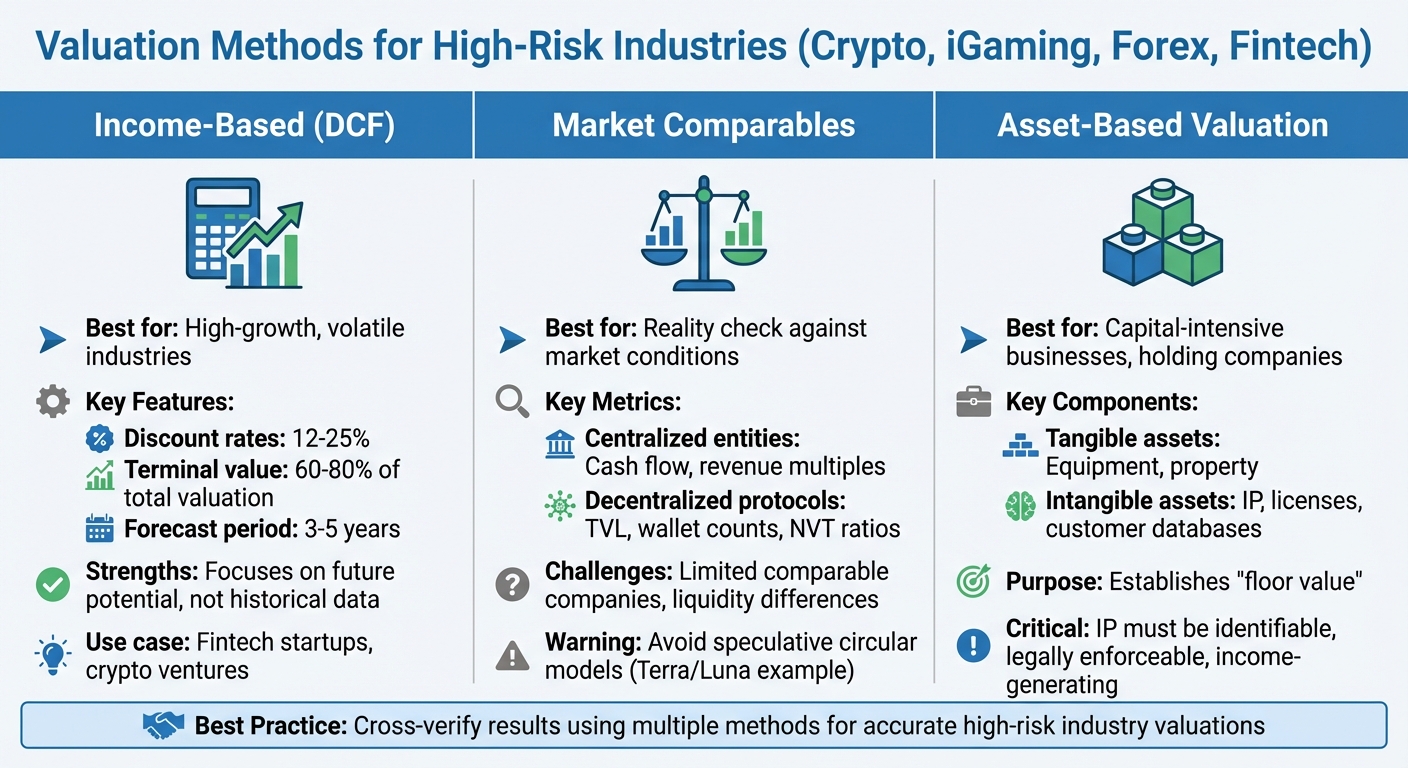
Valuing businesses in high-risk sectors is no simple task. These industries often grapple with extreme volatility, regulatory hurdles, and limited financial transparency, making traditional valuation models less effective. To navigate these challenges, analysts often use a mix of methods tailored to the company’s stage, cash flow predictability, and the availability of comparable data. Instead of relying on a single approach, cross-verifying results through multiple methods is a common practice.
Income-Based Valuation Methods
When it comes to high-growth, volatile industries like fintech or crypto, Discounted Cash Flow (DCF) analysis is a go-to method. Unlike models that lean heavily on historical data, DCF focuses on future economic potential, making it particularly useful where past performance isn't a reliable guide. Transaction Capital LLC highlights this approach:
"The Income Approach Valuation ASC 820 method stands as the gold standard for determining fair value when market data is scarce or unavailable." [5]
Getting the input parameters right is critical. For high-risk private companies, discount rates often range between 12% and 25%, and even small tweaks can dramatically shift the terminal value - an element that can account for 60% to 80% of the total valuation [5]. To handle uncertainty, scenario modeling with base, upside, and downside cases is useful. Weight these scenarios by probability to create a balanced forecast. In highly unpredictable sectors like crypto or iGaming, shorter forecast periods (typically 3–5 years) are more reliable. Additionally, normalizing financial statements - by adjusting items like salaries and expenses to market rates - can provide a clearer view of future performance [6].
For more mature businesses with steady cash flows, the Capitalization of Earnings method is often a better fit. This approach applies a single capitalization rate to a representative year of earnings, assuming consistent future performance [5].
Market Comparables and Industry Benchmarks
Market multiples can offer a helpful reality check, but finding suitable comparables in high-risk industries is often tricky. Publicly traded peers may be scarce, and differences in scale, liquidity, and exposure to risks like political instability or inflation can complicate the analysis. To address these challenges, analysts frequently use risk-adjusted multiples [7].
In the digital assets space, valuation methods vary based on the entity type. Centralized entities often rely on equity-centric models that focus on cash flow and revenue, while decentralized protocols use token-specific metrics like Total Value Locked, wallet counts, or Network Value to Transactions ratios [1]. However, caution is essential. The Terra/Luna collapse serves as a stark warning against speculative, circular valuation models. Avoiding such pitfalls requires cross-verifying market multiples with DCF results to ensure they align with current market conditions.
Control premiums also play a role in transaction comparables. Buyers often pay higher premiums for controlling stakes due to factors like asset scarcity, competitive dynamics, or strategic synergies. On the other hand, financial sponsors may offer less than trade buyers, who prioritize strategic fit [8]. In regulated industries, understanding the nuances of different types of sales is crucial. For instance, the SEC v. Ripple Labs case (2020–2024) showed how distinguishing between institutional and programmatic sales can significantly alter a company’s financial outlook [1].
For companies in highly regulated and volatile industries, asset-based valuation provides an alternative method to establish a baseline value.
Asset-Based Valuation in Regulated Industries
Asset-based valuation focuses on a company’s tangible and verifiable assets, offering a "floor value" that can be particularly useful in sectors where financial projections are challenging. This method is especially relevant for capital-intensive businesses, holding companies, or those consistently operating at a loss. As CBIZ explains:
"This method sets a 'floor value' of the business based on the amount that would be realized upon a sale of a company's assets and satisfaction of its liabilities." [10]
In some cases, intangible assets like intellectual property (IP) can hold more value than tangible ones. To include IP in a valuation, it must meet specific criteria: it should be identifiable, legally enforceable, supported by tangible evidence (e.g., contracts or registrations), and capable of generating income [9]. Examples include proprietary software platforms, customer databases, gaming licenses, and brand assets.
The real value of intellectual property lies in its exclusivity and its potential to generate future income through licensing or other means. As WIPO explains:
"The value of an IP asset essentially comes from the right the owner of that asset has to exclude competitors from using it." [9]
An IP audit is essential to ensure that intangible assets are documented, legally protected, and transferable. The Celsius Network bankruptcy in July 2025 illustrates the risks of neglecting these legal structures. Many token holders found they had no enforceable claims, leaving their holdings valued at zero [1]. In regulated industries, the absence of legal enforceability can quickly erode perceived value.
Key Risks That Affect Valuation in High-Risk Markets
Assessing the value of businesses in high-risk industries means navigating a maze of regulatory, internal, and market challenges. Companies in sectors like iGaming or cryptocurrency might look profitable at first glance, but hidden risks can quickly chip away at their value. Understanding these risks is crucial for buyers and investors to make sound decisions and avoid unexpected losses. Let’s break these risks down into three main categories: regulatory, internal, and market-driven factors.
Regulatory Risks and Their Impact on Multiples
Regulatory challenges often pose the biggest threat to valuations in high-risk industries. Businesses in these sectors face hefty compliance expenses, including hiring specialized officers, implementing advanced transaction monitoring systems, and undergoing frequent third-party audits. On top of that, financial institutions often subject these businesses to Enhanced Due Diligence (EDD), a process that adds layers of scrutiny, slows down operations, and increases administrative headaches.
One particularly damaging risk is "de-risking", where banks restrict or completely cut off crucial financial services. This might include blocking account openings, halting international transfers, or denying lines of credit. Geographic exposure adds another layer of complexity. Operating in or transacting with regions flagged by the FATF "grey list" or areas with weak anti-money laundering (AML) laws can significantly lower valuation multiples. As Team FOCAL explains:
"A high-risk business is not just defined by its size, industry, or location, but by how it adapts to a rapidly changing global market where regulations often struggle to keep pace with innovation." [4]
Regulatory uncertainty also complicates valuation models. For example, new legislation like the U.S. CLARITY Act and GENIUS Act, introduced in 2025 to regulate stablecoins and digital assets [1], creates unpredictability. This often forces analysts to apply higher discount rates. In one case, a higher discount rate tied to industry risk (27.47% vs. 18.94%) resulted in a company being valued nearly 50% lower than a competitor with the same earnings ($860,982 compared to $1,633,332) [12].
Real-world cases highlight these risks. The SEC v. Ripple Labs case showed how token distribution methods could dramatically alter regulatory exposure and financial projections [1]. Similarly, Canfor Corporation suffered a sharp valuation drop when the Softwood Lumber Agreement between Canada and the U.S. expired, leading to increased legal costs, duties, and even sawmill closures [11].
| Risk Factor | Impact on Valuation | Mitigation Strategy |
|---|---|---|
| Regulatory History | Non-compliance results in higher discount rates | Strengthen KYC/AML protocols and conduct audits |
| Geographic Exposure | Operating in "grey-listed" countries lowers multiples | Diversify operations across safer jurisdictions |
| Ownership Transparency | Opaque structures raise risk profiles | Disclose Ultimate Beneficial Owners (UBOs) |
| Financial Complexity | High-volume international transfers invite scrutiny | Use automated AI compliance tools |
Internal Business Risks in High-Risk Industries
Internal challenges can be just as damaging to valuations as external pressures. Analysts often account for these risks by reducing projected cash flows or applying higher discount rates. In industries like digital assets, internal risks frequently stem from poor transparency or unreliable financial disclosures, making traditional valuation methods less effective [1][2].
Operational missteps - such as a weak capital structure, ineffective management, or unenforceable stakeholder claims - can lead to disputes and financial losses. For businesses relying on blockchain or AI infrastructure, system failures or cybersecurity breaches can quickly shake investor confidence.
The Celsius Network bankruptcy in July 2025 is a stark example. Token holders discovered they had no enforceable claims, resulting in a complete loss of value [1][2]. This underscores the importance of robust internal controls, especially since approximately 51% of organizations reported experiencing fraud within a two-year span [4]. Automated AI monitoring tools can cut manual compliance efforts by up to 80% [4], but these systems only work if leadership prioritizes their implementation. Sensitivity analyses can also help assess how factors like technological reliability or management quality impact a company’s valuation [1].
Market and Competitive Risks
Market dynamics add another layer of complexity to valuing businesses in volatile industries. Constant price fluctuations and asset volatility are ever-present threats. For example, the global cryptocurrency market capitalization hit $4.0 trillion in mid-August 2025 [1], but market sentiment can shift these figures dramatically.
A major competitive risk is the overemphasis on hype over fundamentals. Investors may focus on unconventional metrics like website traffic, "price per eyeball", or Total Value Locked (TVL) instead of traditional measures like revenue and profitability [1][2]. This speculative approach is reminiscent of the dot-com bubble, during which the Nasdaq index plummeted 77% in seven months and took 15 years to recover [1][2].
Tokenized ecosystems also face the danger of circular valuation logic. Some rely on interdependent asset values, where the collapse of one asset drags down others within the same ecosystem.
Market fragmentation further complicates things. In industries like equity trading, the division between national exchanges, alternative trading systems (ATS), and over-the-counter (OTC) markets makes it harder to evaluate market share and competitive positioning [13]. Competitive risks also rise when companies show user growth without clear plans for monetization or long-term capital retention [1].
As Ankura Consulting Group cautions:
"The disruptive nature of these businesses can also attract a proliferation of unconventional and unsound valuation approaches, many of which mirror some of the more speculative methods seen during the dot-com bubble." [1]
To navigate these challenges, investors should stick to proven frameworks like Discounted Cash Flow (DCF) and Guideline Public Company Methods (GPCM). They should also perform detailed sensitivity tests and verify the actual economic rights being offered to avoid falling into "Ponzi-style" traps [1].
sbb-itb-ba142f6
How to Get Accurate Valuations and Reduce Risk
Navigating regulatory uncertainties and market volatility requires a precise approach to valuations, especially in high-risk sectors like iGaming, cryptocurrency, and fintech. These industries face unique challenges that can skew value estimates. Here's how businesses can ensure accuracy and minimize risk.
Leveraging MyReadyMade's AI-Powered Valuation Tools

AI tools are reshaping how businesses evaluate value in unpredictable markets. These platforms identify financial irregularities and normalize non-recurring items, offering a clearer picture of a business's true worth [4] [16].
Take real-time cost intelligence tools, for example. Platforms like CloudZero track key metrics like cost per customer and unit economics, helping businesses discern sustainable growth from wasteful spending. In October 2025, lending platform Upstart used such insights to optimize its cloud architecture, slashing $20 million in cloud costs and boosting EBITDA margins [17].
MyReadyMade's AI-driven valuation tools go a step further by enabling what-if scenario modeling. This feature allows users to predict how changes in factors like regulatory costs, market shifts, or operational adjustments might impact margins and overall business value [17] [1]. By adhering to established frameworks like Discounted Cash Flow (DCF) and EBITDA multiples, these tools help investors avoid speculative metrics. As Ankura Consulting Group puts it:
"The standard valuation toolkit remains foundational to a rigorous valuation analysis" [1].
Even with advanced tools, thorough due diligence is a non-negotiable part of the process.
The Importance of Rigorous Due Diligence
Thorough due diligence ensures that valuations are grounded in reality. This process involves reviewing at least three years of tax returns, income statements, and audit reports to separate hype from actual value [18]. As DealRoom aptly states:
"Don't mistake a sale pitch for due diligence" [18].
For regulated industries like gambling or fintech, assessing risks such as anti–money laundering (AML) and counter–terrorist financing (CTF) is critical. This includes verifying the sources of funds for major transactions and ensuring transparency in ownership structures [19]. In the digital asset space, due diligence should go beyond surface metrics like user growth or Total Value Locked (TVL). Instead, it should focus on capital retention, protocol monetization, and the rights of token holders [1].
Analyzing Prospective Financial Information (PFI) is another key step. Calculating the internal rate of return (IRR) relative to industry discount rates helps validate projected cash flows [15]. Sensitivity analyses can further test how variables like asset price changes or interest rate fluctuations impact valuations [1]. As Jordan Lampos, Director of M&A at Duff & Phelps, advises:
"The sooner the due diligence phase of your transaction starts, the better" [18].
Using tools like Virtual Data Rooms (VDRs) early in the process can enhance organization, transparency, and efficiency [18].
The Role of Expert Advisors
While technology and due diligence lay the groundwork, expert advisors bring the essential human touch. High-risk industries often require specialized knowledge. Advisors with experience in iGaming licenses, cryptocurrency regulations, or fintech compliance can identify risks that automated tools might overlook. They also help buyers and sellers navigate complex license transfers across MyReadyMade's 50+ supported jurisdictions, ensuring all regulatory requirements are met.
Expert advisors offer critical objectivity. As James Faulkner, Managing Director at Vala Capital, explains:
"There is still a huge amount of art involved, because the financial model [for valuing the company] will depend entirely on subjective inputs: estimates for everything from the rate of sales growth to the company's salary costs for the next five years" [3].
These professionals challenge overly optimistic projections, ensure valuations reflect market realities rather than internal synergies [15], and weigh non-financial factors like ownership structures, key personnel, and facility capacity [14].
MyReadyMade combines expert M&A advisory with its platform, offering 24/7 deal support and guidance. With an average close time of 30–45 days, this blend of technology and expertise helps prevent overpayment or undervaluation in volatile markets.
Conclusion: Managing Valuation Challenges in High-Risk Industries
Valuing businesses in fields like iGaming, cryptocurrency, forex, and fintech goes far beyond applying standard formulas. These industries require tailored approaches that integrate traditional valuation frameworks with adjustments for the unique risks they present. Consider this: the global cryptocurrency market surged past $4.0 trillion in mid-August 2025 [1] [2], yet fintech firms saw their valuations nosedive by 70% in 2022 [20]. Such dramatic fluctuations highlight the importance of basing decisions on solid analysis rather than getting swept up in market hype.
The most effective valuation strategies blend established methods - like Discounted Cash Flow analysis and precedent transactions - with adjustments for factors like regulatory uncertainty, asset volatility, and technological disruption [1] [2]. Steering clear of speculative metrics is essential; relying on untested measures can lead to long-term setbacks.
Technology plays a vital role in enhancing these strategies. For instance, MyReadyMade's AI-powered valuation tools enable scenario modeling and sensitivity analysis to test assumptions against real-world conditions [1]. As Robert Nowlin, Jr., Senior Managing Director at Ankura, aptly points out:
"Valuing digital asset businesses requires a careful balance of adaptation and discipline" [2].
Experienced advisors also add significant value by providing objectivity, especially when evaluating subjective factors like growth projections and regulatory risk premiums.
Achieving success in these high-risk industries demands disciplined execution. This means conducting thorough due diligence, separating sustainable revenue from speculative figures, and recognizing how regulatory compliance impacts value. Whether you're acquiring an iGaming platform with an MGA license or selling a fintech startup, the goal remains the same: accurate valuations rooted in genuine business fundamentals rather than fleeting market trends. By combining rigorous analysis with advanced tools, buyers and sellers can ensure smoother, more reliable transactions.
MyReadyMade's platform exemplifies this approach, merging AI-driven tools with expert advisory to achieve an average deal close time of just 30–45 days.
FAQs
How do laws like the CLARITY and GENIUS Acts influence the valuation of businesses in high-risk industries?
Currently, there isn’t much information available about how the CLARITY Act or the GENIUS Act might influence the valuation of businesses in high-risk industries like iGaming, crypto, forex, or fintech. Without specific details about these regulations, it’s tough to pinpoint their direct impact on market value.
That said, regulatory changes often play a big role in shaping how businesses in these sectors are valued. They can influence market confidence, increase or decrease operational costs, and impose new compliance requirements. If you have any detailed insights or materials about these acts, we’d be glad to dive deeper and provide a more tailored analysis.
How do AI-powered tools improve the accuracy of business valuations in high-risk industries?
AI-driven tools are transforming how valuations are conducted in high-risk industries. By processing massive amounts of constantly changing data - like market trends, regulatory changes, and economic indicators - these tools leverage machine learning to deliver real-time insights. This not only reduces the likelihood of human error and bias but also ensures consistent cash flow forecasts, which are essential for valuation methods such as discounted cash flow or comparable company analysis.
On top of that, AI simplifies complex tasks like creating financial statements, performing sensitivity analyses, and spotting risk signals. With the ability to continuously update models as fresh data comes in, these tools adapt to rapid changes in revenue, costs, and regulations. The result? Valuations that more accurately reflect the risk-adjusted value of businesses in fast-moving sectors like iGaming, cryptocurrency, forex, and fintech.
Why is due diligence essential for valuing businesses in high-risk industries?
Due diligence plays a crucial role in evaluating businesses within high-risk, heavily regulated industries like iGaming, cryptocurrency, forex, and fintech. These sectors often grapple with challenges such as evolving regulations, intricate financial setups, and unpredictable income patterns. A comprehensive review can reveal hidden risks - such as potential fines, licensing complications, or operational weaknesses - that might drastically affect a company’s valuation.
By scrutinizing financial forecasts, verifying the validity of licenses, and pinpointing liabilities, due diligence ensures that valuations are both precise and justifiable. This process not only helps buyers assess the reliability of earnings and the potential for growth but also allows sellers to address any gaps that could diminish their business’s value. In these high-risk industries, due diligence is essential for preventing inflated valuations and fostering trust among all parties involved.
Related Articles

Ultimate Guide to Earnout Negotiations in M&A
Structure and negotiate earnouts in regulated M&A with clear metrics, anti-manipulation covenants, and acceleration or escrow protections.

How to Draft M&A Definitive Agreements
Guide to drafting M&A definitive agreements covering deal structure, reps & warranties, indemnities, payment terms, and regulatory compliance.

How IP Affects Tokenization Valuation
How tokenizing patents, copyrights, and trademarks adds liquidity and market value—plus legal, regulatory, and valuation steps.
Looking to Buy or Sell?
Get in touch with our team for personalized assistance