How to Buy an iGaming Business: 7 Steps to Success

How to Buy an iGaming Business: 7 Steps to Success
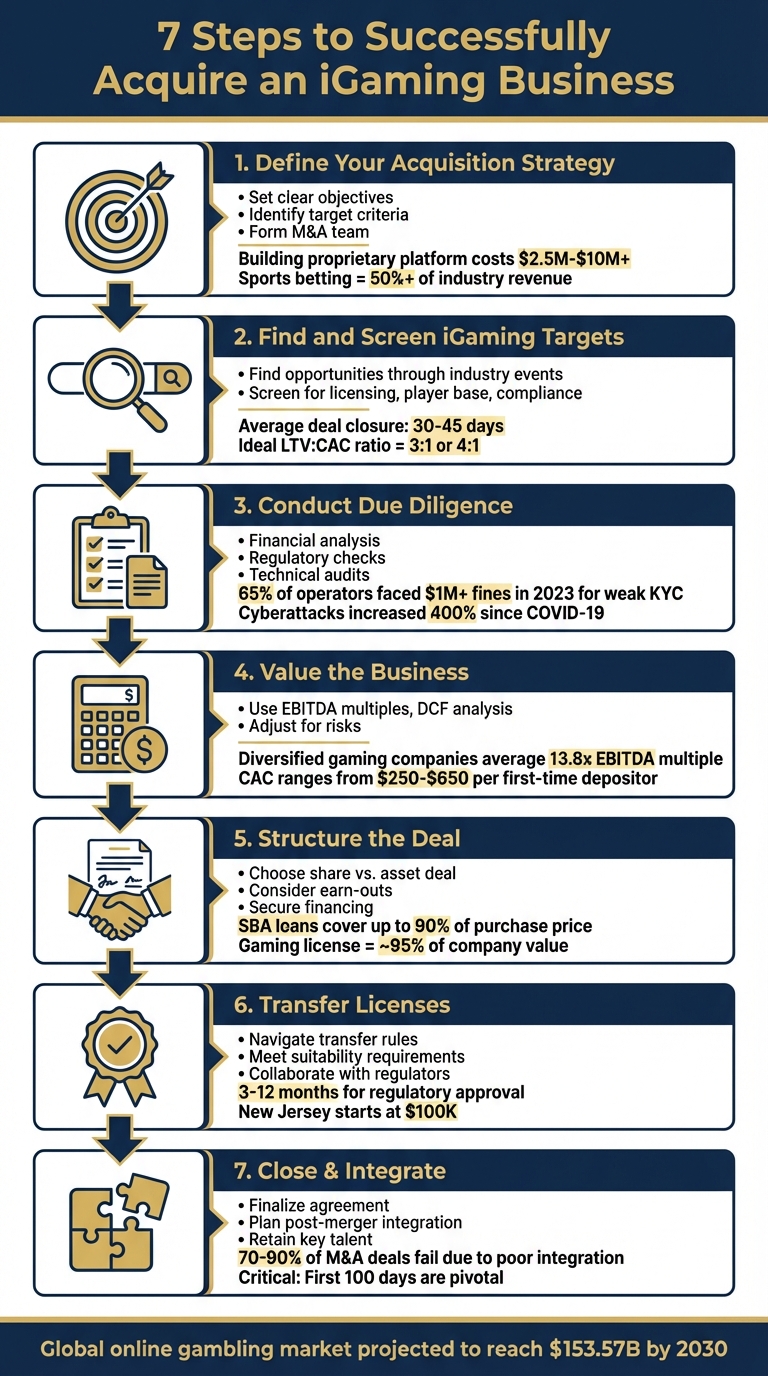
Acquiring an iGaming business is complex but rewarding if done right. Here's the process in 7 steps:
- Define Your Strategy: Set clear goals - whether entering new markets, acquiring licenses, or gaining technology. Identify what aligns with your business needs.
- Screen Targets: Focus on businesses with strong licenses, sustainable revenue, and reliable operations. Licensing jurisdiction and player metrics like Net Gaming Revenue (NGR) are key.
- Conduct Due Diligence: Review financials, licensing, compliance, and technical infrastructure to uncover risks or liabilities.
- Value the Business: Use methods like EBITDA multiples or Discounted Cash Flow (DCF) while adjusting for risks like regulatory challenges or player churn.
- Structure the Deal: Decide between share or asset deals, and consider options like earn-outs or vendor financing to close the gap between buyer and seller expectations.
- Transfer Licenses: Work closely with regulators to meet requirements for license transfers, ensuring smooth operations post-sale.
- Integrate Operations: Plan for post-merger integration early, focusing on technology, compliance, and player retention to ensure success.
The global online gambling market is projected to reach $153.57 billion by 2030. With the right approach, you can navigate the regulatory and operational challenges to secure a profitable investment.
Step 1: Define Your Acquisition Strategy
Before diving into target evaluations, it's crucial to outline your acquisition goals with precision. The best iGaming acquisitions begin with well-defined strategic objectives that align seamlessly with your overall business ambitions. Are you aiming to break into a regulated market like Sweden or France? Do you need cutting-edge technology to sidestep the hefty $2,500,000 to $10,000,000+ expense of building a proprietary platform from scratch [7]? Or perhaps you're seeking an established player base and brand recognition that would otherwise take years to cultivate organically. This clarity sets the stage for thorough screening and due diligence later.
Set Clear Objectives
Your acquisition goals - whether expanding market access, acquiring technology, executing acqui-hiring, or entering adjacent markets - will guide every decision you make. Take the example of DraftKings, which acquired BetInsight in October 2024 to harness advanced analytics for better player engagement [11].
"Pursue acquisitions in fields that are logical extensions of the company's current business." - Bruce Nolop, Executive Vice President and CFO, Pitney Bowes [9]
Acquisitions can also help streamline operations, reduce overhead, and diversify your offerings. For instance, adding a sportsbook to an existing casino operation not only spreads risk but also capitalizes on the fact that sports betting now accounts for over 50% of the industry's total revenue [4]. Unsurprisingly, many casino operators are targeting sportsbook acquisitions to claim a piece of that market.
Identify Target Criteria
Once your objectives are clear, translate them into specific criteria for evaluating potential targets. One key factor is license jurisdiction. A business operating under a UK Gambling Commission (UKGC) license holds far more credibility and value than one in unregulated "grey" markets. Operating in black or grey markets can lead to "bad actor" provisions, which may block licensing opportunities in tightly regulated regions like the US or EU [10].
Revenue quality is another critical metric. Focus on Net Gaming Revenue (NGR) rather than Gross Gaming Revenue (GGR). NGR gives a clearer picture of financial health by excluding bonuses, taxes, and fees [8]. Also, examine player demographics and traffic sources - organic SEO traffic is far more valuable than paid advertising because it’s sustainable and cost-effective. For affiliate targets, pay attention to returning visitor ratios and search engine rankings [3].
Technology is equally important. Evaluate whether the target uses proprietary software, turnkey solutions, or white-label platforms. While proprietary technology can add significant value, it requires detailed technical due diligence to uncover potential "tech debt" or scalability problems that might demand costly fixes post-acquisition [12]. With over 60% of online gamblers using mobile devices to place bets in 2024 [4], mobile-readiness is no longer optional - it’s a must.
Form Your M&A Team
Acquiring an iGaming business requires specialized expertise beyond standard M&A skills. Your team should include financial auditors to assess profit and loss statements, legal experts familiar with multi-jurisdictional regulations and AML/KYC standards, and technical experts to evaluate platform stability, security, and scalability [3][6]. A seasoned CTO with at least 15 years of experience, including 7+ years in iGaming, can be instrumental in identifying technical risks [14].
Compliance and regulatory experts are especially critical. They must ensure the target meets standards like GLI, SOC 2, ISO 27001, and GDPR across all relevant jurisdictions [14]. A single compliance failure can derail a deal or result in hefty fines after the acquisition. Additionally, consider engaging specialized iGaming talent acquisition partners to assess the strength of the target's leadership team [13] - the people driving the business are often as important as the business itself.
For larger acquisitions, it’s wise to include acquisition strategy managers. These professionals oversee the game plan, manage budgets, and evaluate new ventures. While their salaries range from $118,000 to $161,700 [15], their expertise can prevent costly mistakes, potentially saving millions during the process.
With a solid strategy and a highly skilled team, you’ll be well-positioned to identify and evaluate potential acquisition targets effectively.
Step 2: Find and Screen iGaming Targets
Once your acquisition strategy is set, the next big step is pinpointing the right iGaming businesses to target. This isn't about picking just any operator - it’s about finding one that aligns with your goals, holds reputable licenses, and maintains consistent player engagement. A solid screening process helps you weed out risky candidates early, saving both time and avoiding potential legal headaches. Let’s break this down into two key parts: finding opportunities and thoroughly vetting potential targets.
Find Acquisition Opportunities
The search for the perfect iGaming business requires tapping into multiple channels. Industry events like ICE London and the SBC Summit are great places to connect with potential partners. For a broader reach, platforms such as The Gambling Cockpit provide tools to monitor buyers and sellers across the industry.
"At The Gambling Cockpit, we have a strong Intelligence Tool allowing us to be in touch with buyers and sellers within the industry" [3].
Another useful resource is MyReadyMade, which offers verified listings of iGaming businesses spanning over 50 jurisdictions. It also facilitates NDA-protected communications and provides expert M&A advisory. With an average deal closure time of just 30–45 days, platforms like this can significantly speed up your search - whether you’re eyeing a sportsbook in New Jersey or a casino operator in Malta.
Once you’ve identified potential candidates, it’s time to dive deeper with a rigorous screening process.
Screen Target Businesses
Your screening process should align with your acquisition strategy. Not every iGaming business will meet your criteria, so focus on key factors:
Licensing: A license from respected regulators like the UK Gambling Commission (UKGC) or the Malta Gaming Authority (MGA) is a strong indicator of credibility. Keep in mind that in many jurisdictions, gaming licenses can’t be transferred. This often means a stock purchase is necessary to ensure the business continues operating smoothly. For example, Caesars Entertainment structured its 2024 acquisition of William Hill's U.S. assets as a stock purchase to avoid licensing interruptions across multiple states [16].
Player Base: Evaluate metrics like First-Time Deposits (FTDs) and compare Lifetime Value (LTV) to Player Acquisition Cost (PAC). Ideally, a sustainable business should have an LTV-to-CAC ratio of 3:1 or 4:1 [18][19].
For instance, online casino operator Unicorn365 saw a 200% boost in Net Gaming Revenue (NGR) and gained over 30,000 players in just three months by optimizing partner marketing and using real-time analytics to tailor promotions [5].
Compliance: Look for strong Know Your Customer (KYC) completion rates - ideally between 85% and 95%. A lower rate might signal issues in the onboarding process. Check for a clean regulatory history, as any breaches are major red flags. Fraud detection rates should fall between 0.2% and 1.5% of transactions, while chargeback rates should ideally stay between 0.1% and 1% [8].
Marketing Models: Organic SEO traffic tends to be more sustainable compared to paid media. If the business relies heavily on affiliate-driven models, make sure metrics like returning visitor ratios and search engine rankings are stable [3]. Also, with mobile searches now accounting for over 50% of Google searches [5], ensure the site is mobile-friendly.
Compare Targets Using Metrics
Once you’ve narrowed down your options, it’s time to compare them using hard data. Focus on metrics that provide a clear picture of the business's performance:
- Net Gaming Revenue (NGR): This is a better indicator of actual cash flow than Gross Gaming Revenue (GGR) [8].
- EBITDA Multiples: Adjust these for risks like regulatory exposure, player churn, or outdated technology.
- Player Engagement: Analyze the DAU/MAU ratio (Daily Active Users to Monthly Active Users). A strong candidate should have a 30-day retention rate of 70% to 80% and a monthly churn rate below 5% [18].
- Compliance Metrics: Verify that the business maintains a Regulatory SLA Compliance rate of 98% to 100% and that its Responsible Gambling (RG) tool usage rate is within the 10% to 20% range [8].
Additionally, look at how the business segments its player base. Effective operators typically classify 3% to 10% of their players as high-risk for concerns like fraud, anti-money laundering, or responsible gambling issues [8]. If a target’s segmentation falls outside this range, it could signal inefficiencies or regulatory vulnerabilities.
Step 3: Conduct iGaming Due Diligence
Once you've narrowed down your acquisition targets, it's time to dig deep into their operational and financial details. In the iGaming world, due diligence goes beyond just reviewing financial records. It involves verifying everything - from revenue streams and licensing history to the technical infrastructure that powers the platform. With strict regulations and licensing standards in place, a detailed review is essential to avoid costly surprises. This phase builds on earlier target screening by ensuring no hidden risks remain.
Financial Analysis
Start by examining the core financial documents: the Income Statement, Balance Sheet, and Cash Flow Statement. These will give you a clear picture of revenue generation, liability management, and cash flow. Pay special attention to Net Gaming Revenue (NGR), which accounts for bonuses, taxes, and fees, as it provides a more accurate measure of earnings [8][20].
Look into bonus conversion rates, aiming for a rate above 35%. This indicates players find promotions worthwhile. Rates below 20% could signal issues like unclear terms or abuse from duplicate accounts and bots [8]. Additionally, confirm that player funds are segregated. This is a regulatory requirement in most jurisdictions and helps safeguard against insolvency risks [10].
For consistency, standardize financial data to USD for easier cross-currency comparisons. Also, review the Return to Player (RTP) percentages for slots. A range of 95% to 96.5% is ideal. While RTPs above 97% may attract players, they can also eat into profit margins over time [8].
Regulatory and Licensing Checks
After reviewing financials, shift your focus to regulatory compliance to avoid legal pitfalls. Verify the target's licensing status through official databases like the UK Gambling Commission [22]. Check for any enforcement actions, fines, or infringement notices. In 2023, 65% of iGaming operators faced fines exceeding $1 million due to weak Know Your Customer (KYC) protocols [23]. You’ll want to avoid inheriting such liabilities.
Investigate whether the business has operated in "black" or "grey" markets. Doing so can trigger "bad actor" provisions, potentially jeopardizing future licensing opportunities in newly regulated markets [10].
"A sensible and fully informed decision to purchase a company can only be made if all the rewards, risks and liabilities are understood before proceeding with taking them over." - David Schollenberger, Head of Gaming, Healys [10]
Examine the target's Anti-Money Laundering (AML) and KYC procedures. Confirm that they screen for Politically Exposed Persons (PEPs) and maintain transaction records for at least five years, as required by European and U.S. regulations [21][23]. Additionally, review affiliate contracts. Under certain licenses, such as in the UK, operators can be held accountable for the actions of their affiliates [10].
Technical and Compliance Audits
The technical audit ensures the platform can operate securely and reliably. Begin with a Vulnerability Assessment and Penetration Testing (VAPT) to identify weaknesses in the system. This step is more critical than ever, as cyberattacks in the gaming industry have surged by 400% since the COVID-19 pandemic [25].
Evaluate the platform's architecture, firewalls, intrusion detection systems, secure coding practices, and third-party license compliance [10]. Ensure that Multi-Factor Authentication (MFA) is mandatory for all privileged access points, a requirement in jurisdictions like Ontario [23].
Review the platform's data protection measures. Check for encryption standards such as AES-256 for both data at rest and in transit. Audit the disaster recovery and business continuity plans to ensure swift restoration of operations in case of disruptions. For example, MGM Resorts suffered over $100 million in losses during a 10-day cyberattack in September 2023, underscoring the importance of robust recovery systems [24][26].
Finally, if the target handles card payments, verify compliance with PCI DSS 4.0 standards. Payment security breaches can lead to severe financial and reputational damage [23].
Step 4: Value the iGaming Business
Once due diligence is complete, the next step is determining the true value of the target business. Valuing an iGaming company requires a customized approach, factoring in regulatory challenges and player behavior. The insights gained from financial, regulatory, and technical audits play a critical role in shaping this valuation. Getting it right not only prevents overpayment but also ensures the deal reflects the balance between risk and reward.
Common Valuation Methods
After completing due diligence, accurately assessing value becomes essential to structuring a fair deal. Instead of relying on a single method, it’s better to combine a few approaches. Some of the most widely used methods include revenue multiples, EBITDA-based valuations, and Discounted Cash Flow (DCF) analysis.
- Revenue multiples provide a quick reference point but can be risky in the iGaming space due to the industry’s reliance on volatile launch cycles and hit-driven dynamics. As Daniel Faloppa, Founder of Equidam, points out:
"A dollar of revenue from a sustainable live-service game differs fundamentally from revenue generated through unsustainable user acquisition spending." [27]
EBITDA multiples are a better fit for companies with steady, recurring revenue. For example, diversified gaming companies currently average a forward EBITDA multiple of 13.8x, while Western mobile developers tend to hover around 4.7x. [27]
DCF analysis works well for studios with predictable cash flows but must account for the industry’s high failure rate, which is roughly 90%. [27]
For iGaming businesses, player base economics often drive valuation. Key metrics like the ratio between Customer Acquisition Cost (CAC) and Lifetime Value (LTV) are critical. Ideally, an LTV should be 3 to 4 times greater than the CAC. In established markets, acquisition costs typically range from $250 to $650 per first-time depositor, while monthly marketing returns generally fall between 2.5% and 5.6%. [18][28][27]
Another important metric is Net Gaming Revenue (NGR), which adjusts for bonuses, taxes, and fees. [8][30] These valuation methods provide a foundation, but adjustments must be made for risks unique to the iGaming sector.
Adjust for Risk Factors
Valuations should account for risks uncovered during the due diligence process. Here are some areas where adjustments may be necessary:
Whale Dependency: If more than 80% of revenue comes from a single game or a small group of VIP players, apply a significant discount. [27]
Bonus Conversion and Abuse: Healthy bonus conversion rates are above 35%, while rates below 20% or bonus abuse above 2% indicate potential problems and warrant downward adjustments. [8]
Churn and Retention: A strong Monthly Active User (MAU) churn rate should stay under 15%, and a solid 30-day Player Retention Rate (PRR) typically falls between 70% and 80%. [8][18]
Regulatory Risk: This is a major factor in the iGaming industry. In 2023, 65% of operators faced fines exceeding $1 million due to inadequate Know Your Customer (KYC) protocols. Notable examples include Genesis Global, fined $5.0 million, BetVictor, fined $2.6 million, and 888 UK Limited, which faced a $12.4 million penalty for anti-money laundering and social responsibility failures. [2][23]
Use Benchmarking Tools
AI-powered tools can enhance valuation accuracy by comparing market prices and simulating deal scenarios. These tools analyze comparable transactions and apply industry-specific multiples, helping to position the target business within the current market landscape.
For instance, in November 2024, Plarium, a mid-core game developer, was sold by Aristocrat to Modern Times Group (MTG) at an enterprise value based on a 4.5x EV/EBITDA multiple. Similarly, Keywords Studios was acquired for $2.8 billion in 2024. [29]
AI tools also identify anomalies in player behavior that could impact valuation. As Ingi, Editor at iGamingToday, explains:
"The blunt-force '50 free spins for everyone' era is over. AI in 2025 isn't a slide - it's core infrastructure." [28]
sbb-itb-ba142f6
Step 5: Structure the Deal and Secure Financing
Once you've nailed down the valuation, the next steps - structuring the deal and securing financing - become crucial. The way you structure the deal can influence everything from tax outcomes to licensing processes, and it plays a key role in how smoothly the transaction moves forward. Below, we'll break down the main deal structures and financing options to help you navigate this phase effectively.
Share vs. Asset Deals
When structuring a deal, you’ll need to decide whether to purchase the entire company (a share deal) or focus on acquiring specific assets (an asset deal). Each option comes with its own set of benefits and risks.
In a share deal, you’re buying all the shares of the company. This means the iGaming license remains with the business, simplifying the process since you'll only need regulatory approval for the change in ownership. However, there’s a catch: you also take on all the company’s past liabilities, including any unresolved compliance issues or legal disputes.[32]
An asset deal, on the other hand, lets you cherry-pick the assets you want - like the player database, software, or branding - while leaving behind unwanted liabilities. The downside? Since iGaming licenses are generally non-transferable, you’ll need to apply for new licenses, which can significantly delay the process.[32]
If the license represents around 95% of the company’s value, the transaction might be classified as an asset acquisition. This impacts how goodwill is recognized and how the purchase price is allocated.[1]
"Gaming laws are based upon declarations of public policy designed to ensure that gaming is conducted honestly, competitively and free of criminal and corruptive elements." - Caesars Entertainment Corporation[32]
Both types of deals require thorough suitability investigations. Regulators will scrutinize the backgrounds, financial stability, and integrity of the new owners and key executives to ensure compliance with gaming laws.
Earn-Outs and Vendor Financing
Sometimes, bridging the gap between what a seller wants and what a buyer is willing to pay requires creative solutions. Two popular approaches are earn-outs and vendor financing.
Earn-outs allow the seller to receive additional payments based on the business hitting specific performance targets, like GGR (Gross Gaming Revenue) or EBITDA. These agreements can resolve valuation disagreements, but it’s essential to clearly define the metrics upfront to avoid disputes later.[3][33]
"An earn-out is a deferred payment structure where the seller receives additional compensation based on future business performance. While it can increase overall deal value, it also carries risk if post-sale performance declines." - Pierric Blanchet, CEO of The Gambling Cockpit[3]
Vendor financing is another option where the seller accepts a promissory note for part of the purchase price. This approach is particularly useful in regulated industries like iGaming, where securing traditional bank loans can be slow. Vendor financing can cover anywhere from 10% to 40% of the purchase price and keeps the seller invested in the business’s future success.[35] If structured as a 'full standby' loan - where no payments are required during the loan term - it may even count as part of the buyer’s equity injection for SBA financing.[35]
Secure Financing
Getting the right financing in place is just as important as structuring the deal. iGaming acquisitions often require a combination of equity, debt, and seller financing. Traditional venture capital is rare in this space due to regulatory complexities, so you’ll likely need to turn to industry-specific angel investors, strategic partners, or SBA loans.[36]
"There are no venture capitalists specializing in online gambling, nor are professional VCs willing to get involved in the complex world of iGaming business." - Affnook[36]
SBA 7(a) loans are a popular choice for financing acquisitions. These loans can cover up to 90% of the purchase price, typically requiring just a 10% down payment. Interest rates usually fall between 8% and 10%, and lenders often expect a Debt Service Coverage Ratio (DSCR) of at least 1.25x.[34][35][38]
To qualify, you’ll need to come prepared with:
- Three years of tax returns
- A formal business valuation
- A detailed post-acquisition business plan
- A personal credit score above 680.[34][35][37]
Lenders often prefer asset deals because they provide a "cleaner" slate without the baggage of historical liabilities.[37]
Finally, any major financing transactions must be reported to and approved by gaming authorities.[32] Make sure to account for the time needed for these approvals and keep enough working capital on hand to cover post-merger integration, license renewals, and unexpected regulatory expenses.
Step 6: Transfer Licenses and Meet Regulatory Requirements
Once you've structured your deal and secured financing, the next big hurdle is managing license transfers and meeting regulatory requirements. This step is crucial to ensuring your investment complies with legal standards. In most cases, obtaining regulatory approval involves a "change of control" process, which typically takes anywhere from 3 to 12 months. It’s worth noting that iGaming licenses generally aren’t transferable; instead, regulators must approve the acquisition through this process to keep everything above board[32].
Navigating License Transfer Rules
Regulators take license transfers seriously, especially in the U.S., where they carefully examine the backgrounds and financial health of key stakeholders. This process can stretch over several months, depending on the jurisdiction[32].
- New Jersey: The Division of Gaming Enforcement (DGE) requires a detailed application process, with fees starting at $100,000. This process usually takes 3–6 months, but any red flags during background checks can extend the timeline. For payment service providers, you’ll also need a Money Transmitter License (MTL) or an exemption letter from the Department of Banking and Insurance before vendor registration is considered[40][41].
- Malta: The Malta Gaming Authority (MGA) offers a pathway to global operations but involves a rigorous approval process that can take 6–12 months[39].
- Curacao: Known for its lighter regulatory framework, approvals here are quicker, typically taking 4–6 months[39].
- U.S. States with Reciprocity: Some states, like Connecticut, allow a streamlined application process if you already hold licenses in at least three other states. Similarly, West Virginia requires at least one existing U.S. gaming credential before reviewing applications[41].
In many states, including Arizona, Indiana, and Maryland, you’ll need to complete a preliminary inquiry form before submitting a formal application. This step helps regulators identify which licenses are required and who needs to submit disclosures. Skipping this step could lead to filing incorrect paperwork and cause unnecessary delays[41].
| Jurisdiction | Key Regulator | Typical Timeline | Application Fee | Notable Requirement |
|---|---|---|---|---|
| New Jersey | Division of Gaming Enforcement (DGE) | 3–6 months | $100,000+ | MTL or DOBI exemption for payment providers[40][41] |
| Nevada | Nevada Gaming Control Board | 3–6 months | $500,000+ | Extensive financial and background checks[40] |
| Malta | Malta Gaming Authority (MGA) | 6–12 months | Varies | High regulatory standards[39] |
| Curacao | Curacao Gaming Authority (CGA) | 4–6 months | Lower | Lighter oversight[39] |
| Michigan | Michigan Gaming Control Board (MGCB) | 3–6 months | ~$150,000 | State-specific compliance audits[40] |
Suitability Requirements You Must Meet
If you’re acquiring more than 5% of voting securities, you’ll need to undergo a suitability review. This involves comprehensive background checks covering financial stability, integrity, criminal history, and reputation. The burden of proof lies with the applicant, so ensure all documentation, particularly proof of source-of-funds, is thorough and transparent[32][39].
For institutional investors, many regulators allow the acquisition of up to 15% of voting securities without a full suitability review, as long as the investment is passive and doesn’t influence management or policy decisions[32].
In Kansas, vendor registration requires an executed contract with a licensed operator before regulators will proceed. Additionally, unresolved tax liens, such as property or sales-and-use taxes, can delay the process, so it’s wise to address these issues early[41].
If your services are on tribal lands, dual certification is often required. For example, in Washington, operators working with the Tulalip Tribes must secure a license from both the Washington State Gambling Commission and the relevant tribal gaming authority[41].
Collaborating with Regulators
Engaging with regulators early and submitting complete, accurate documentation can save you from unnecessary setbacks. For instance, in Arizona and Indiana, skipping the preliminary inquiry form can lead to delays, as regulators may require you to complete this step while reviewing your application package[41].
"Applicants who skip the inquiry form in Arizona and Indiana may be required to complete that step while their application package is under review."
– Jeffrey Hamlin, Attorney, Ifrah Law[41]
Federal Anti-Money Laundering (AML) compliance is another critical requirement. Operators must maintain robust internal controls, including systems to track and report currency transactions over $10,000. Suspicious Activity Reports (SARs) must also be filed as required by law. Some jurisdictions even mandate logs for cash transactions starting at $3,000[32].
Technical standards also come into play. Regulators will audit software and hardware to ensure compliance with local rules, including Random Number Generator (RNG) verification and cybersecurity protocols[39][40]. Additionally, some jurisdictions require a physical presence, such as local offices or resident compliance specialists, which can add complexity and cost to your operations[39].
For situations where a security holder’s application is still under review, New Jersey allows securities to be placed in trust with an approved trustee. This arrangement lets operations continue while the qualification process is completed[32].
Step 7: Close the Deal and Integrate Operations
With your acquisition strategy in place and financing secured, it's time to finalize the deal and ensure a smooth transition. Closing the deal and integrating operations are critical steps in realizing the full potential of your acquisition. Studies show that 70% to 90% of M&A transactions fail to meet their expected value due to poor integration efforts [43]. Treat these stages as interconnected to maximize success.
Finalize the Purchase Agreement
The purchase agreement should clearly define key elements like regulatory conditions, escrow arrangements, and transition timelines. It should also include "Day One" readiness requirements, such as operational merchant accounts (which depend on a valid gaming license), compliant technical systems, and clearly identified key employees. Running readiness simulations before closing can help address any last-minute hurdles [47].
Once the agreement is finalized, focus shifts to ensuring a seamless integration process.
Plan Post-Merger Integration
Start planning for integration as soon as the deal is close to being finalized. This early preparation is essential for capturing synergies [46]. Establish an Integration Management Office (IMO) led by a seasoned professional with deep experience in iGaming operations. This team will oversee critical workstreams across IT, HR, and Finance, while also managing cross-departmental challenges and maintaining open communication through regular updates [44][47].
"While acquisitions create the potential for value, successful Post-Merger Integration (PMI) is what unlocks it."
– The Gambling Cockpit [42]
The first 100 days are pivotal. Concentrate on three main areas: People, Processes, and Systems. For people, prioritize retaining key talent and aligning organizational cultures. For processes, focus on streamlining operations. And for systems, work on consolidating technology stacks. In the iGaming industry, this often involves tackling issues like integrating separate platforms, managing overlapping affiliate websites, and merging software licenses. Notably, 88% of successful M&A deals fully integrate IT functions, compared to only 54% of less successful ones [43].
Player retention is another critical factor. Launch VIP continuity programs immediately to keep high-value players engaged, especially given the rising costs of player acquisition [17]. Use the "TIME" model to evaluate your combined application portfolio: Tolerate (keep as is), Invest (enhance), Migrate (move to a new platform), or Eliminate (phase out) [45].
Use Support Resources
Take advantage of tools and resources tailored for closing documentation, escrow management, and integration planning. These include templates for purchase agreements, Day One readiness checklists, and frameworks designed to ensure compliance with the gaming industry's regulatory requirements.
"PMI is as critical as finding the right opportunity in M&A, since a bad integration will only lead to extra costs, tech issues and legal difficulties."
– Pierric Blanchet, CEO, The Gambling Cockpit [3]
You may also want to bring in external M&A advisors with expertise in the iGaming sector. These professionals can assist with final negotiations and transition planning. Research shows that 80% of executives who achieved or exceeded their deal expectations started the integration process early [47].
Conclusion: Key Takeaways for iGaming Acquirers
Acquiring an iGaming business is no ordinary M&A transaction - it comes with its own set of regulatory and operational hurdles. With the global online gambling market projected to hit $153.57 billion by 2030 [4], the potential is massive. But success in this space demands careful navigation of its complexities. Here’s a look at the essential strategies for making a successful iGaming acquisition.
Start by defining clear objectives. Are you looking to expand into new regions, secure critical gaming licenses, or grow a loyal customer base? Your goals will shape the entire acquisition process [48]. It’s also crucial to understand that gaming licenses don’t automatically transfer with ownership. Many jurisdictions will require you to reapply or get updated approvals [48]. As David Schollenberger, Head of Gaming at Healys, aptly states:
"A sensible and fully informed decision to purchase a company can only be made if all the rewards, risks and liabilities are understood before proceeding with taking them over" [10].
Once your objectives are in place, they’ll guide your due diligence and risk assessment. This includes evaluating technical and compliance factors that could impact future licensing [10][31]. Remember, a gaming license can account for up to 95% of the total fair value of the assets being acquired [1]. Also, pay close attention to affiliate contracts - operators can be held accountable for any illegal activities carried out by their affiliates under certain license conditions [10].
Financial transparency is another cornerstone of success. With customer acquisition costs skyrocketing by 60% since 2015 [17], retaining high-value players must be a top priority [48].
Finally, prioritize effective post-merger integration. Bring in experts with iGaming experience, adhere strictly to KYC, AML, and Responsible Gambling protocols, and treat regulatory compliance as an ongoing responsibility rather than a one-and-done task. This ongoing commitment to compliance and operational excellence is what sets successful acquirers apart.
The iGaming industry rewards those who approach acquisitions with meticulous planning, thorough execution, and a steadfast focus on regulatory requirements.
FAQs
What should I focus on when determining the value of an iGaming business?
When assessing the value of an iGaming business, several important elements come into play. One of the most crucial is revenue streams - not just their size, but how steady and varied they are over time. A business with stable, diversified income is generally more appealing and less risky.
Another key consideration is regulatory compliance. The iGaming industry is heavily regulated, and staying within legal boundaries is essential for both profitability and long-term survival.
You should also take a close look at the company’s intellectual property, such as proprietary software or exclusive game offerings. These assets can add significant weight to the business’s overall value. Lastly, don’t overlook market trends and the company’s potential for growth. Understanding these factors ensures the investment aligns with your broader goals and expectations.
What are the differences in licensing requirements when acquiring an iGaming business in various regions?
Licensing rules for iGaming businesses vary significantly across the globe, often depending on the specific region. In Europe, each country has its own regulatory body and licensing process for activities like online gaming, sports betting, and lotteries. A license obtained in one European country doesn’t automatically grant permission to operate in others, so businesses must comply with the unique requirements of each nation.
In the United States, licensing operates at the state level. Each state sets its own standards and has its own licensing authorities, which means businesses must handle a patchwork of regulations to operate across state lines. Over in Asia, local authorities like PAGCOR in the Philippines or Singapore’s Gambling Regulatory Authority enforce strict compliance measures, including technical audits, as part of their licensing requirements.
To navigate licensing across multiple regions, businesses need to meet each jurisdiction's legal, financial, and operational criteria. This often includes adhering to AML (Anti-Money Laundering) and KYC (Know Your Customer) regulations, which are critical for ensuring compliance and maintaining trust.
What challenges should I expect when integrating an acquired iGaming business?
Integrating an iGaming business presents a distinct set of challenges that require careful planning and execution. One of the biggest obstacles is dealing with regulatory requirements. This includes transferring licenses and ensuring that all operations comply with local laws. These steps often involve intricate processes and can take a significant amount of time to complete.
Another critical issue is merging technological systems. Aligning platforms while keeping downtime to a minimum is no small feat. On top of that, blending customer bases while maintaining a smooth and consistent user experience adds another layer of complexity. There's also the matter of managing differences in workplace cultures - both within the team and across various markets - which demands thoughtful handling to keep operations running smoothly.
Lastly, delays in securing necessary approvals or resolving legal matters can stall the integration process. To address these challenges effectively, it's essential to plan ahead and collaborate with professionals who have experience navigating these complexities.
Unlock Profitable Acquisition Opportunities
Discover how myreadymade.com streamlines the process of buying an iGaming business for sustained success.
Learn MoreRelated Articles

Ultimate Guide to Earnout Negotiations in M&A
Structure and negotiate earnouts in regulated M&A with clear metrics, anti-manipulation covenants, and acceleration or escrow protections.

How to Draft M&A Definitive Agreements
Guide to drafting M&A definitive agreements covering deal structure, reps & warranties, indemnities, payment terms, and regulatory compliance.

How IP Affects Tokenization Valuation
How tokenizing patents, copyrights, and trademarks adds liquidity and market value—plus legal, regulatory, and valuation steps.
Looking to Buy or Sell?
Get in touch with our team for personalized assistance