Buying vs Building a Forex Brokerage: Which Wins?

Buying vs Building a Forex Brokerage: Which Wins?
Should you buy or build a Forex brokerage? Here's the quick answer:
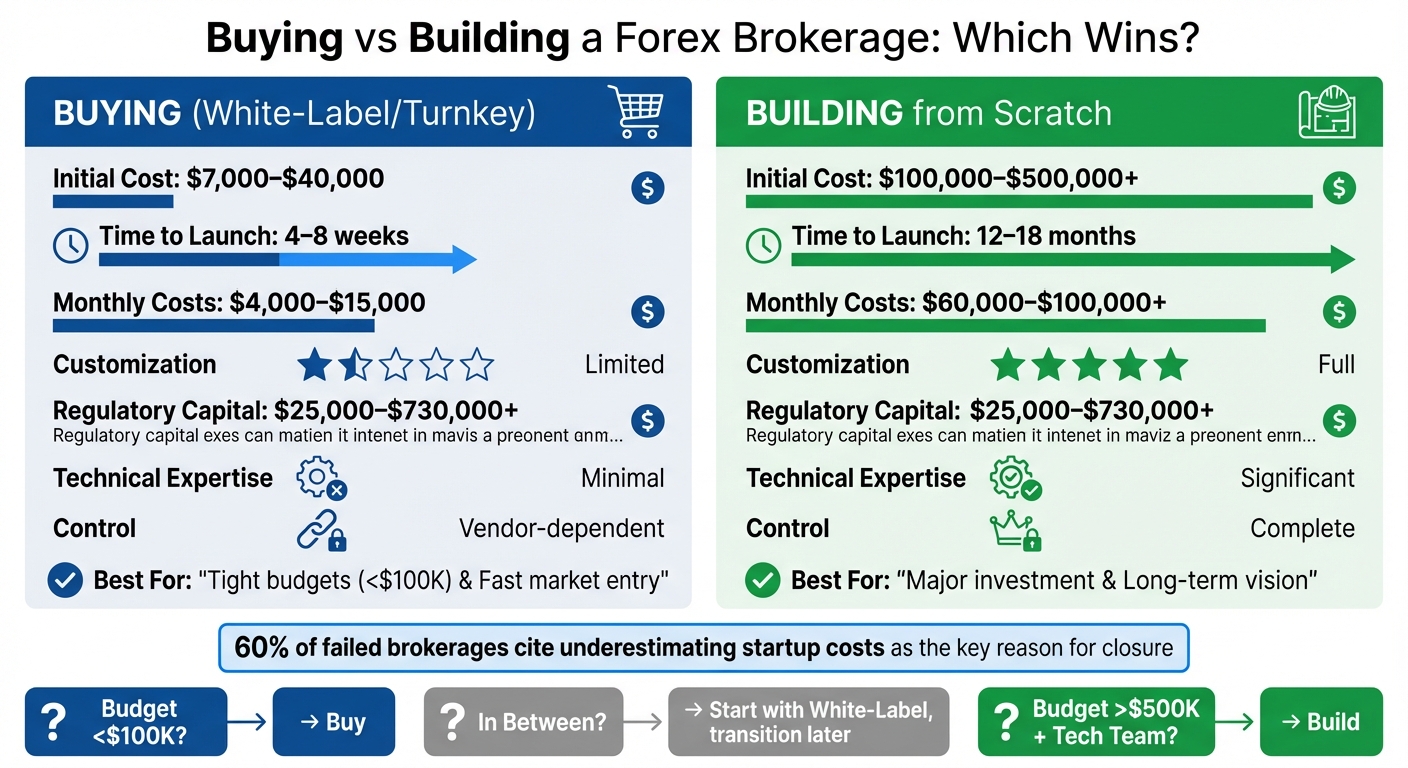
- Buying (White-Label/Turnkey): Lower upfront costs ($7,000–$40,000), faster launch (4–8 weeks), and minimal technical expertise needed. However, expect ongoing monthly fees and limited customization.
- Building from Scratch: High upfront costs ($100,000–$500,000+), longer timelines (12–18 months), but complete control over technology, branding, and operations. This option requires significant funding and technical expertise.
Key Takeaways:
- Budget: Buying is better for smaller budgets (<$100,000). Building requires major investment.
- Time to Market: Buying gets you up and running in weeks. Building takes over a year.
- Control & Customization: Building gives you full control, while buying involves vendor dependencies.
- Regulatory Costs: Both options require locked capital for licenses ($25,000–$730,000+ depending on jurisdiction).
Quick Comparison Table:
| Criteria | Buying (White-Label) | Building from Scratch |
|---|---|---|
| Initial Cost | $7,000–$40,000 | $100,000–$500,000+ |
| Time to Launch | 4–8 weeks | 12–18 months |
| Monthly Costs | $4,000–$15,000 | $60,000–$100,000+ |
| Customization | Limited | Full |
| Regulatory Capital | $25,000–$730,000+ | $25,000–$730,000+ |
Bottom Line:
If you're on a tight budget or need a fast market entry, buying a white-label solution makes sense. But if you have the resources and long-term vision, building your own brokerage can provide more control and potentially higher returns.
Cost Comparison: What You'll Actually Spend
Initial Investment and Hidden Fees
The upfront costs for starting your brokerage vary significantly depending on your approach. Building from scratch demands a hefty initial investment - over $500,000 - before you even onboard your first client [7][9]. This covers custom technology development, rigorous security audits, vendor certifications, and paying an engineering team during the pre-revenue phase.
On the other hand, opting for a white-label or turnkey solution is far less expensive upfront. Setup fees typically range between $15,000 and $50,000, which include technology integration and platform configuration [7][9].
But don’t forget about the hidden costs. Regulatory capital requirements are a major factor, as these funds must remain locked on your balance sheet and cannot be used for daily operations [7]. For example, obtaining a Tier-1 license from regulators like the FCA or CySEC requires locked capital of €125,000 to €730,000+, while Tier-2 jurisdictions such as Mauritius or Seychelles need $25,000 to $100,000 [7].
You’ll also need a $50,000 to $100,000 liquidity margin deposit to access institutional-grade pricing and execution [7][9]. Payment processing integration can add another $500 to $2,500 per provider, with transaction fees ranging from 1.5% to 5% of volume [4][9]. Additionally, setting up an offshore corporate bank account may cost several thousand dollars in agent fees [4].
Marketing expenses are another area that’s often underestimated. Launch campaigns can cost $15,000 to $50,000 in the first month alone, and marketing can account for 15% to 20% of your total startup budget [2][9]. Alarmingly, over 60% of failed brokerages cite underestimating these startup and operational costs as a key reason for their closure [2].
Understanding these costs is critical to aligning your strategy with your budget and growth plans. Next, let’s look at the recurring expenses that will continue to shape your operating budget.
Recurring Monthly and Annual Expenses
Monthly operational costs also differ widely based on your approach. If you’re building from scratch, expect to spend $60,000 to $100,000+ per month on staffing alone, which includes engineers, DevOps specialists, and solution architects [4]. Add $3,000 to $9,000 per month for hosting fees, and your technology-related expenses easily exceed $60,000 monthly [4][5].
With a white-label solution, these costs are streamlined into predictable monthly fees, typically ranging from $4,000 to $15,000. This covers hosting, security, platform updates, and technical support [4][9].
Some costs are shared across both models. For example, liquidity providers charge monthly minimum fees starting at $2,500 [4], while compliance consulting costs $2,000 to $5,000 per month [9]. Annual regulatory audits add another $10,000 to $25,000 to your compliance budget [9]. Trading platform licenses vary too - MetaTrader 4/5 Main Labels can cost upwards of $7,500 per month, while options like cTrader start at about $3,000 [4].
"Infrastructure shouldn't consume your calendar. When the vendor runs upgrades, hosting, and monitoring, your team can focus on content, partnerships, and VIP retention."
– Alexander Shishkanov, B2Broker [9]
Factoring in these recurring expenses is essential for maintaining a sustainable operation.
Total Cost Breakdown Table
Here’s a side-by-side comparison of the key cost categories for each approach:
| Cost Category | White Label / Turnkey | Building from Scratch |
|---|---|---|
| Initial Investment | $10,000 – $100,000 | $500,000+ |
| Technology Setup | $15,000 – $50,000 | $100,000+ |
| Regulatory Capital (Locked) | $25,000 – $100,000 (Tier-2) | €125,000 – €730,000+ (Tier-1) |
| Liquidity Margin Deposit | $50,000 – $100,000 | $50,000 – $100,000 |
| Monthly Technology Costs | $4,000 – $15,000 | $60,000 – $100,000+ (staffing) |
| Monthly Liquidity Fees | $2,500+ | $2,500+ |
| Monthly Compliance | $2,000 – $5,000 | $2,000 – $5,000 |
| Annual Audits | $10,000 – $25,000 | $10,000 – $25,000 |
| Time to Market | 4 – 8 weeks | 9 – 18 months |
It’s also wise to maintain a contingency fund of $50,000 to $150,000 to cover 6–12 months of operating costs. This can help you weather potential regulatory delays or market downturns [7][5]. For white-label operators, budgeting for both the setup fee and 3 to 6 months of operating expenses is crucial while your business stabilizes and revenue begins to flow [9].
Starting A Forex Broker In 2024
Time-to-Market: How Fast Can You Launch?
Speed to market isn't just about saving time - it's a critical factor in shaping your competitive position.
Acquisition Timeline: From Deal to Operations
Acquiring an existing brokerage generally takes 3–6 months from identifying your target to activating your first client[5]. This timeline includes key steps like due diligence, negotiating the purchase agreement, and transferring the regulatory license to your ownership.
In jurisdictions such as the UK (regulated by the FCA) or Malta (overseen by the MFSA), transferring a license typically takes 2–4 months. This period involves regulatory reviews to assess financial stability, management qualifications, and compliance measures[11].
Once the license transfer is approved, things move quickly. You gain access to an established tech infrastructure, relationships with liquidity providers, and often a trained team. This setup allows you to onboard clients within 2 to 4 weeks after the transfer is complete.
Build Timeline: From Concept to Launch
Starting from scratch is a longer journey, typically taking 12–18 months to develop technology, secure licenses, and set up operations[7].
Licensing is one of the most time-intensive steps. For Tier-1 jurisdictions like the UK (FCA) or Australia (ASIC), approvals can take 7–18 months, while Tier-2 jurisdictions such as Cyprus (CySEC) may only require 3–6 months[11]. During this time, you can’t onboard clients, so expenses pile up without any incoming revenue.
Platform development runs alongside licensing and is often described as a "mammoth technological undertaking" by industry insiders[3]. Building proprietary trading infrastructure demands substantial resources, both in time and manpower. On top of that, hiring and training a complete team - spanning engineering, DevOps, compliance, sales, and support - can add several more months[10]. Additional delays often arise from integrating payment service providers and securing corporate banking relationships, which can take 3–6 months of negotiations and technical setup[5].
"A white label brokerage can be launched in as little as 3–4 weeks. This lets you capitalize on market trends quickly, without spending 12–18 months on development and integration." - B2Broker[7]
Launch Timeline Comparison Table
| Phase | Acquisition | Building from Scratch |
|---|---|---|
| Planning & Incorporation | 1–2 months | 1–2 months |
| Licensing Approval | 2–4 months (transfer review) | 6–12+ months (new application) |
| Platform Development | Already operational | 12+ months |
| Banking & PSP Setup | Inherited relationships | 3–6 months |
| Team Hiring & Training | Existing team in place | 3–6 months |
| Total Time to Launch | 3–6 months | 12–18 months |
Jurisdiction plays a big role in how fast you can launch. Offshore options like Seychelles can issue licenses in 2–6 months, while unregulated jurisdictions such as St. Vincent might process incorporation in as little as 5–10 business days[11]. However, these faster jurisdictions often lack credibility with institutional clients and liquidity providers. To balance speed and reputation, some brokers adopt a dual-license strategy - starting in an offshore jurisdiction for immediate revenue while working toward a Tier-1 license for long-term trust and recognition[10].
These timeline differences directly shape your market entry strategy and regulatory planning.
sbb-itb-ba142f6
Regulatory and Compliance Requirements
Regulatory challenges play a crucial role in shaping your market entry strategy, influencing both the complexity and cost of your approach. Whether you decide to acquire an existing brokerage or start your own, understanding these requirements is essential.
License Transfer for Acquired Brokerages
Purchasing an existing brokerage can streamline the regulatory process, saving significant time. Under U.S. regulations (17 CFR § 240.15b1-3), the registration of a broker-dealer remains valid for up to 45 days after acquisition, provided you file a successor application on Form BD within 30 days of the transition [13][17]. For minor structural changes - like altering the state of incorporation or modifying partnership details - you can amend the predecessor’s Form BD instead of submitting a new application [17].
However, this shortcut comes with responsibilities. You must conduct thorough due diligence to review any pending legal issues and verify current risk disclosures [12][14]. Any unresolved compliance violations or regulatory concerns from the previous owner become your responsibility once the transfer is finalized.
This expedited process stands in stark contrast to the extensive steps required for establishing a new brokerage.
New License Applications for Startups
Starting fresh involves registering with the National Futures Association (NFA) and, if necessary, the Commodity Futures Trading Commission (CFTC). You’ll need to file Form 7‑R for your firm and Form 8‑R for each principal, which includes fingerprinting for all new principals [12][16]. Approval requires demonstrating that your firm meets all capital and operational standards [14][16]. Additionally, at least one principal must be registered as an Associated Person (AP) and approved as a forex AP before your firm can operate as a forex brokerage [12].
"No Member may be approved as a forex firm unless at least one of its principals is registered as an AP and approved as a forex AP."
- NFA [12]
You’ll also need a U.S. office to maintain required financial records [12]. Opening corporate bank accounts can present challenges, as brokerages are often labeled "high risk" by banks [18]. Securing a forex brokerage license in the U.S. can cost several hundred thousand dollars, and the approval process involves comprehensive NFA and CFTC reviews that can delay your launch [15][16].
Compliance Obligations and Monitoring Costs
Once licensed, both acquired and newly established brokerages must meet rigorous compliance and monitoring standards. A designated principal must serve as the Chief Compliance Officer (CCO) and certify an annual compliance report within 90 days of the fiscal year-end [12]. Daily requirements include providing written confirmations of all account activities - such as trades, rollovers, and adjustments - and notifying clients of any price changes or cancellations within 15 minutes of execution [12]. Firms must also contact customers annually to verify the accuracy of their personal and financial information [12].
Brokerages are required to maintain books, records, and promotional materials for five years, ensuring accessibility during the first two years [12]. Additionally, a principal registered as an AP must annually certify that the firm’s electronic trading system meets NFA standards for security, capacity, and risk management [12].
| Obligation Type | Details | Frequency |
|---|---|---|
| Customer Reporting | Written confirmations of account activity | Daily/Monthly |
| CCO Annual Report | Certification of compliance accuracy | Annual (within 90 days) |
| System Certification | Certification of trading platform integrity | Annual |
| Recordkeeping | Maintenance of transaction and promotional data | 5 Years |
| KYC Verification | Verification of customer information | Annual |
Acquiring an existing brokerage offers an advantage here, as you inherit established compliance frameworks, supervisory procedures, and trained personnel. This reduces initial costs for compliance management systems, legal consultations, and hiring specialized staff. In contrast, startups must build these systems from scratch, which can be a costly and time-intensive process [19].
"Purchasing an existing forex company can also be a quicker alternative, ensuring compliance and a seamless transition."
Regardless of the entry method, operational compliance costs remain consistent. These include subscriptions to compliance tools, external audits, regulatory reporting systems, and salaries for specialized roles. Additionally, firms using the B‑Book model - where they act as counterparties to client trades - often face stricter regulatory scrutiny due to potential conflicts of interest, which can result in higher monitoring expenses compared to the A‑Book model [19].
Technology and Operations Setup
Once you've evaluated costs, timelines, and compliance, it’s time to focus on your technology and operations strategy. Whether you choose to acquire an existing brokerage or build one from the ground up will heavily influence your tech and operational approach. Acquiring an existing setup provides immediate functionality but comes with certain constraints. On the other hand, creating a custom infrastructure offers full control but requires more time and investment.
Inherited Systems in Acquisitions
Acquiring an existing brokerage means you’re stepping into a ready-made system that includes trading platforms, CRM tools, liquidity bridges, and operational workflows. This allows you to start generating revenue in just a few weeks, bypassing the 12 to 18 months typically required for custom development [7]. Additionally, you gain instant access to established liquidity provider relationships and pre-integrated payment systems [10].
However, inherited systems aren’t without drawbacks. They often come with restrictions tied to the vendor’s framework, limiting customization options and platform features. If the previous owner relied on a white label solution, you might face vendor lock-in and outdated technology that struggles with high-speed execution or high-frequency trading [10]. Conduct thorough due diligence to ensure the tech stack supports essential features like IB modules and automated KYC/AML processes [7].
Another upside of this approach is the reduced need for technical staff. The technology provider typically handles server hosting, security updates, and feature rollouts. This allows you to focus on core business activities like marketing and client acquisition, rather than managing an extensive IT team [7].
Still, if customization and scalability are priorities, building your own system might be the better option.
Building Custom Infrastructure
Developing proprietary technology gives you complete control over your operations. This allows for service differentiation, a unique brand identity, and potentially higher profit margins since you won’t be paying recurring platform fees. Custom systems also enable advanced features like modern matching engines capable of processing up to 3,000 requests per second with 99.9% uptime - essential for thriving in fast-paced, high-volatility markets [10].
That said, custom development is a major investment, often starting at $100,000 and potentially exceeding $500,000 [7]. You’ll need to build or integrate key components such as a matching engine, liquidity bridges, CRM, and trader’s room. Deploying infrastructure in global financial hubs like Equinix LD4 in London or NY4 in New York is also critical to minimize latency [7]. This route requires assembling a skilled team of IT engineers and DevOps experts to handle updates, security, and ongoing maintenance [7].
"A brokerage is a tech business. The right CRM, liquidity bridge, trading terminal, and hosting setup define your ability to scale."
- Alexander Shishkanov [7]
Additionally, building custom infrastructure means forming partnerships with Tier-1 liquidity providers. This involves developing custom API connectivity and implementing smart order routing algorithms from scratch [10].
Growth and Expansion Capabilities
The scalability of your brokerage depends on whether you opt for inherited systems or custom-built infrastructure. White label or inherited systems offer immediate scalability, as the provider handles performance upgrades, feature additions, and infrastructure management. This makes it easier to expand into new markets or add more trading instruments without needing additional engineering resources [7].
Custom-built systems, on the other hand, provide unmatched long-term flexibility. You’re not tied to a vendor’s technology roadmap or standard business models, enabling you to implement any execution model - A-Book (STP/ECN routing), B-Book (internalization), or a Hybrid approach. You can also tailor your platform to meet the specific needs of your clients [7]. However, scalability will depend on your internal development team and the resources you allocate for continuous improvement.
A practical approach might involve starting with a white label solution to gain market experience and generate revenue. As your brokerage grows and your needs evolve - whether for enhanced security, privacy, or customization - you could transition to proprietary technology [3]. Some vendors even offer source code buyouts, allowing established brokerages to move in-house, reduce vendor reliance, and increase their valuation [1].
Which Option Fits Your Situation?
Key Decision Factors: Budget, Speed, and Risk Tolerance
Deciding whether to build or buy boils down to three main factors: how much money you can invest, how quickly you need to launch, and how much risk you're prepared to handle.
If your budget is under $100,000, a white-label solution is your best bet. These options come with significantly lower upfront and ongoing costs compared to building from scratch, which can easily exceed $100,000 upfront and demand $60,000 to $100,000 monthly in operational expenses [2].
Need to start generating revenue quickly? White-label or acquisition strategies can get your business up and running in as little as 2 to 8 weeks. On the other hand, building your platform from the ground up typically takes 6 to 18 months - and that’s if you don’t encounter regulatory hurdles or technical setbacks [2].
Building your own platform also comes with higher risks, such as cost overruns, project delays, or losing key team members. In fact, over 60% of failed brokerages point to underestimating startup and operational costs as their downfall [2]. Buying a solution, however, uses proven technology to reduce technical risks. The trade-off? You might face vendor lock-in and dependence on their development roadmap [21].
These considerations are crucial in determining the right operational model for your business.
Real-World Scenarios and Recommendations
Scenario 1: The Startup Entrepreneur with $50,000 and No Tech Team
If you’re working with limited funds (under $50,000) and don’t have a tech team, a white-label solution is the way to go. You can launch in just 4 to 8 weeks [2][3].
Scenario 2: The Established Financial Firm with $500,000+ and Long-Term Vision
For companies with a budget of $500,000 or more and access to technical resources, building your own platform makes sense. This route gives you full control over your technology, intellectual property, and business model [3]. While it might take 12 to 18 months to launch, you’ll avoid recurring vendor fees and can tailor every aspect of your platform, including execution models (A-Book, B-Book, or Hybrid) and proprietary order types [20]. Be prepared to cover at least a year of operational expenses to establish a strong customer base [8].
Scenario 3: The Entrepreneur Seeking a Balanced Approach
If you have a moderate budget ($100,000 to $250,000), consider starting with a white-label solution, then transitioning to proprietary technology. Some vendors even offer source code buyouts, which allow you to bring development in-house, reduce reliance on third parties, and increase your company’s valuation [1].
Final Recommendations
Considering the factors of cost, time, and risk, your choice should align with your business goals. If you’re working with limited resources or need to enter the market quickly, buying or partnering is the more practical route. However, if you have the capital, technical expertise, and a vision for a unique platform, custom development can yield greater long-term rewards - so long as you’re prepared to navigate the extended timeline and potential risks.
"The obvious attractions of buying software are faster time-to-market, a likely lower initial investment, and lower likelihood of complete project failure"
In a market where the average Forex broker earns between $500,000 and $1 million annually [6], getting to profitability quickly can often outweigh having complete control from day one.
FAQs
What unexpected costs should I plan for when starting a Forex brokerage?
Starting a Forex brokerage might seem straightforward when you consider the obvious costs like technology licenses or initial licensing fees. However, once operations kick off, hidden expenses can quickly add up. These can include ongoing regulatory fees, such as application and renewal costs, compliance audits, legal counsel, and maintaining reserves for risk management.
Beyond that, there are recurring costs to keep your business running smoothly. Think infrastructure expenses like server hosting, cybersecurity tools, and software updates. Add to that payment processing fees, marketing efforts (such as SEO campaigns and affiliate programs), and salaries for key team members, including IT staff, compliance officers, and client support specialists. Don’t forget operational insurance and liquidity provider spreads, which can also take a bite out of your budget.
To steer clear of financial surprises, it’s smart to plan ahead. Set aside funds for these recurring costs and create a contingency fund - aim for 20–30% of your estimated monthly expenses. This cushion can help you handle those often-overlooked but essential expenditures with ease.
What are the regulatory differences between buying an existing brokerage and starting one from scratch?
Regulatory requirements differ greatly depending on whether you’re buying an existing brokerage or starting one from scratch.
When you buy an existing brokerage, much of the groundwork is already done. The business usually holds the necessary licenses, which means you can skip the lengthy licensing process. However, there’s a catch: you’ll need to dig deep into the brokerage’s compliance history. Make sure it has a clean record, meets capital requirements, and adheres to client fund protection rules. Additionally, you’ll have to handle ownership transfer filings as required by regulators like the CFTC or NFA in the U.S.
On the other hand, if you’re starting a brokerage from scratch, be prepared for a more time-intensive process. You’ll need to apply for a new license, which can take months - or even years. This involves choosing a regulatory jurisdiction, such as the NFA in the U.S., FCA in the U.K., or ASIC in Australia. You’ll also need to meet strict requirements, including minimum capital thresholds, client fund segregation, and robust cybersecurity measures. While this route is more expensive and time-consuming, it gives you the freedom to build a compliance framework tailored to your business model.
Should I buy an existing Forex brokerage or build one from scratch?
Deciding whether to purchase a ready-made Forex brokerage or build one from scratch comes down to a few essential considerations:
Cost: If you're looking for a more budget-friendly option upfront, a white-label solution might be the way to go. These typically cost $4,000 to $8,000 per month. On the flip side, creating your own brokerage is a significant financial commitment, with monthly costs ranging from $60,000 to $100,000, not including expenses for staffing.
Time-to-Market: Speed is a major advantage of white-label solutions. You can often get your brokerage up and running in just a few weeks. Building your own platform, however, involves months of development and testing, which can delay your market entry.
Control and Customization: Owning your platform means you have complete control over the technology and can tailor features to your exact needs. In contrast, white-label solutions often come with limitations on customization and intellectual property ownership.
Your decision should reflect your budget, how quickly you want to launch, your understanding of regulatory requirements, and your long-term business objectives.
Related Articles

Ultimate Guide to Earnout Negotiations in M&A
Structure and negotiate earnouts in regulated M&A with clear metrics, anti-manipulation covenants, and acceleration or escrow protections.

How to Draft M&A Definitive Agreements
Guide to drafting M&A definitive agreements covering deal structure, reps & warranties, indemnities, payment terms, and regulatory compliance.

How IP Affects Tokenization Valuation
How tokenizing patents, copyrights, and trademarks adds liquidity and market value—plus legal, regulatory, and valuation steps.
Looking to Buy or Sell?
Get in touch with our team for personalized assistance