Checklist for Finding High-Value Acquisition Targets

Checklist for Finding High-Value Acquisition Targets
Finding the right acquisition target in regulated industries can be tough. The best targets combine strong financials, compliance with regulations, and scalable operations. Here's what you need to focus on:
- Regulatory Compliance: Ensure licenses are valid, transferable, and cover all jurisdictions. Check for unresolved regulatory issues or pending investigations.
- Financial Health: Analyze 3–5 years of financials, focusing on EBITDA, revenue trends, and customer concentration. Use AI tools for valuation but verify data accuracy.
- Operational Scalability: Review leadership, infrastructure, and technology. Outdated systems or over-reliance on key personnel are red flags.
- Market Position: Assess market share, competitive advantages, and revenue models. Look for synergies with your current operations.
- Legal Risks: Scrutinize contracts, litigation history, and compliance with laws like the Corporate Transparency Act.
Thorough due diligence is critical - nearly 50% of acquisitions fail due to overlooked risks. Platforms like MyReadyMade can streamline the process by offering pre-vetted business listings and expert support for regulated sectors.
How Does A Due Diligence Checklist Apply To M&A? - BusinessGuide360.com
Verify Regulatory Compliance and Licensing
Making sure all licenses are valid, current, and transferable is crucial to avoid operational hiccups. Many businesses require multiple levels of authorization, including federal, state, and local permits. In highly regulated industries such as iGaming, Forex, or Fintech, even a single missing license can stall operations or lead to expensive reapplications after the deal is finalized.
Confirm Valid Licenses
Start by gathering a comprehensive list of all jurisdictions where the target operates. Secure a Certificate of Good Standing for each incorporated jurisdiction. Pay special attention to transferability: acquiring shares typically allows you to keep existing licenses, while asset purchases often mean applying for new permits [8].
In regulated industries, verify specific certifications like iGaming licenses, banking charters, or AML (Anti-Money Laundering) certifications. Ensure these cover the necessary jurisdictions and review any correspondence with regulatory agencies for signs of pending investigations or compliance issues. Additionally, the Corporate Transparency Act (CTA) now requires most U.S. entities to file Beneficial Ownership Information reports with FinCEN. Check whether the acquisition changes the target's filing status from "exempt" to "reporting" [8].
Once licenses are confirmed, the next step is to dig into the target's regulatory history.
Review Regulatory History
Examine audit reports, inspection records, and regulatory proceedings from the past three to five years. Public databases, like the OCC Enforcement Action Search, can reveal prior violations, fines, or consent decrees [10][11]. Look for unresolved judgments or UCC filings that might indicate business assets are tied up as collateral for debt [9][11].
Request a disclosure schedule from the seller that outlines any liabilities not covered in standard due diligence. Review board meeting minutes for discussions about potential litigation or regulatory warnings. To safeguard against undisclosed debts or tax issues, consider negotiating a purchase price holdback, where a portion of the payment is deferred for 6–12 months after closing [9].
With a clear understanding of the target's compliance history, you can move on to evaluating antitrust risks.
Assess Antitrust and Approval Risks
Given the DOJ and FTC's increased focus on antitrust enforcement, identifying risks early is more important than ever. Acquisitions can inherit liability for past noncompliance, which might lead to criminal charges or product recalls [12]. The DOJ’s updated 2023 Evaluation of Corporate Compliance Programs emphasizes the role of pre-M&A due diligence in assessing internal controls [12].
"The extent to which a company subjects its acquisition targets to appropriate scrutiny is indicative of whether its corporate compliance program is... able to effectively enforce its internal controls and remediate misconduct."
- Criminal Division, U.S. Department of Justice [12]
Ensure that industry-specific licenses, such as FINRA registrations for broker-dealers or FDA approvals for pharmaceuticals, are valid and transferable. If noncompliance is discovered, explore whether self-disclosure could help reduce penalties [12].
Evaluate Financial Performance and Business Valuation
Once regulatory compliance is addressed, the next step is to dive into the company's financial performance and valuation to determine its investment potential. Start by gathering three to five years of financial records, including income statements, balance sheets, and cash flow reports. Cross-check these documents with bank statements and tax filings to confirm that reported revenues align with actual cash inflows [14].
Analyze Key Financial Metrics
Focus on key metrics like EBITDA margins and historical sales growth to gauge profitability and market demand [13]. Examine liquidity ratios and debt levels to understand the company’s ability to manage its financial obligations after the acquisition. Pay attention to revenue concentration - if a single customer accounts for over 20% of sales, it could pose a risk to the business's stability [13][11]. Additionally, assess customer churn rates and the reliability of recurring revenue streams, as these are strong indicators of whether the business can maintain a consistent income over time [15].
Adjust earnings to reflect sustainable profit by removing one-time items, such as legal settlements or the sale of equipment, and aligning owner compensation with market standards [14]. Also, verify inventory and receivables to identify any inflated assets or debts that may be uncollectible [14].
Assess Revenue and Profitability Trends
Convert the financial data from the past five years into trend analyses to evaluate long-term performance [15]. Look for patterns of steady growth, consistent profitability, and an increase in high-value customer accounts over the last two years [11][15]. Compare expense ratios against revenue trends to identify operational inefficiencies [15]. Additionally, review the monthly backlog over the past year - any decline could signal weakening short-term revenue potential [15].
Use AI-Powered Valuation Tools
Leverage AI tools like PrometAI and Clearly Acquired to obtain industry-specific EBITDA multiples and benchmark comparisons [14][16]. For example, manufacturing businesses often trade at 4.48x EBITDA, while restaurants typically average 3.04x [14]. When applying Discounted Cash Flow (DCF) models for small to medium-sized businesses, include a risk premium of 3% to 6% in the discount rate to account for operational uncertainty [14]. However, always verify AI-generated outputs against trusted databases such as DealStats or BizMiner [14]. Courts have previously penalized experts for relying on unverifiable or inaccurate data [17].
This detailed financial evaluation lays the groundwork for a more in-depth analysis of the company's operations and market position.
Assess Operational Scalability and Technology
Once the financial assessment is complete, the next step is to evaluate how well a business's operations and technology can support growth after an acquisition. A company's ability to scale often hinges on its operational structure and technological foundation. These elements determine whether the business can handle increased demand without requiring excessive capital or a complete overhaul.
Evaluate Organizational Structure and Resources
Start by analyzing the company's leadership and organizational setup. Is the business heavily reliant on a single owner-operator, or does it have a well-rounded leadership team? According to Team Acquira:
"If there is a strong leadership team with standard operating procedures and definite job titles, it can be a lot easier to take over. It's much more of a turn-key operation" [18].
Next, take a close look at production capacity, lead times, and the state of facilities and equipment. Outdated or inefficient machinery can create bottlenecks, limiting scalability and demanding significant investments for upgrades. Examine the supply chain for vulnerabilities, such as over-reliance on a single supplier, which can stifle expansion efforts. Also, identify key employees who manage daily operations. If these employees hold critical customer relationships, their departure could pose a risk to the business.
With these operational insights, the focus can shift to assessing the company's technology and intellectual property.
Review Technology and IP Ownership
Confirm that all intellectual property, including patents, trademarks, copyrights, and trade secrets, is legally owned by the company. Review employee agreements and patent clearance documentation to ensure there are no gaps or disputes.
Audit the IT systems to determine whether they are modern and scalable. Look at tools like ERP, CRM, and inventory management systems - are they up to date, or are they legacy systems that require costly maintenance? Assess the technical debt, which refers to the future costs of fixing quick, short-term solutions that may not be sustainable. Also, evaluate whether the software architecture is designed to grow with the business. As AccountingTools notes:
"A company with a simple product line or service is an excellent acquisition target. An overly complex business might indicate that the existing management team has no idea of the strategic direction of the business" [15].
Finally, securing the technological foundation also involves addressing cybersecurity concerns.
Check Cybersecurity and Compliance
Cybersecurity is a critical part of IT due diligence. Confirm the presence of documented incident response plans, regular security audits, and penetration test results. Investigate the company's history of data breaches and assess whether it uses encryption for data at rest and in transit, as well as role-based access controls. Umbrex highlights the importance of this step:
"Cybersecurity is one of the most important aspects of IT due diligence, as breaches or weaknesses in security can have serious financial, legal, and reputational consequences" [19].
Ensure the business complies with data protection regulations like GDPR and CCPA. Verify that it has robust policies for data retention and destruction. Additionally, review the disaster recovery plan to ensure operations can continue during system failures. Finally, examine the security measures and service-level agreements of third-party vendors to address risks across the supply chain.
sbb-itb-ba142f6
Analyze Market Position and Fit
After evaluating compliance, financials, and operations, the next step is to assess the target's market dynamics and its alignment with your strategic goals. Understanding the target's position in the market helps determine whether it can sustain its competitive edge and meet your expected returns.
Assess Market Share and Competitive Landscape
Commercial due diligence is essential for analyzing the target's market position, share, and growth potential [2][22]. Start by identifying the company’s current market share and comparing it to both established competitors and potential new entrants. Consider factors like market size, growth trends, and opportunities for expansion [2].
One critical factor to examine is barriers to entry in the industry. High barriers often create conditions for stronger profitability, while low barriers can lead to intensified competition and shrinking margins [15]. Industries with frequent new entrants tend to experience declining profit margins, making them riskier for acquisitions. Pinpoint the target's competitive niche and how it differentiates itself from major players in the industry [15].
It's also important to verify the target's ability to execute effectively. Compare the company’s actual performance over the past 3–5 years with its historical business plans. This comparison can reveal whether the management team has been able to sustain or grow its market share [15]. Additionally, assess the distribution of its customer base to gauge market stability. As Mark Meloche, Director at BDC, notes:
"If one customer represents 80% of sales, that risk is likely impossible to mitigate" [21].
This analysis of the market landscape provides a foundation for evaluating revenue generation and potential synergies.
Examine Revenue Models and Synergies
Ensure that the target's revenue model aligns with your business strategy. Identify any baseline recurring revenue streams [15][4]. For companies offering multiple products or services, break down the revenue contributions to determine which segments are the most profitable [13].
Look for synergies that could strengthen your existing portfolio. These might include opportunities for market expansion (e.g., entering the U.S. market), access to advanced technology or equipment, or the acquisition of skilled employees to enhance your workforce [23]. Evaluate the target's pricing strategy - whether it’s cost-plus, value-based, or competitor-matching - and determine if it complements your current operations [15]. Additionally, review the monthly order backlog over the past year; trends in this data can provide insight into near-term revenue expectations [15][4].
Be mindful of emerging threats that could undermine the target’s market position. In 2025, factors like geopolitical tensions, trade restrictions, and sanctions have become significant risks that may limit market access and disrupt operations [1]. Similarly, technological advancements pose a constant challenge, as new innovations could render the target's existing processes or products obsolete [1][15]. Conduct a SWOT analysis to benchmark the target against industry standards and uncover specific strengths or vulnerabilities, such as proprietary technology, supply chain reliability, or brand loyalty [1].
Conduct Risk and Legal Due Diligence
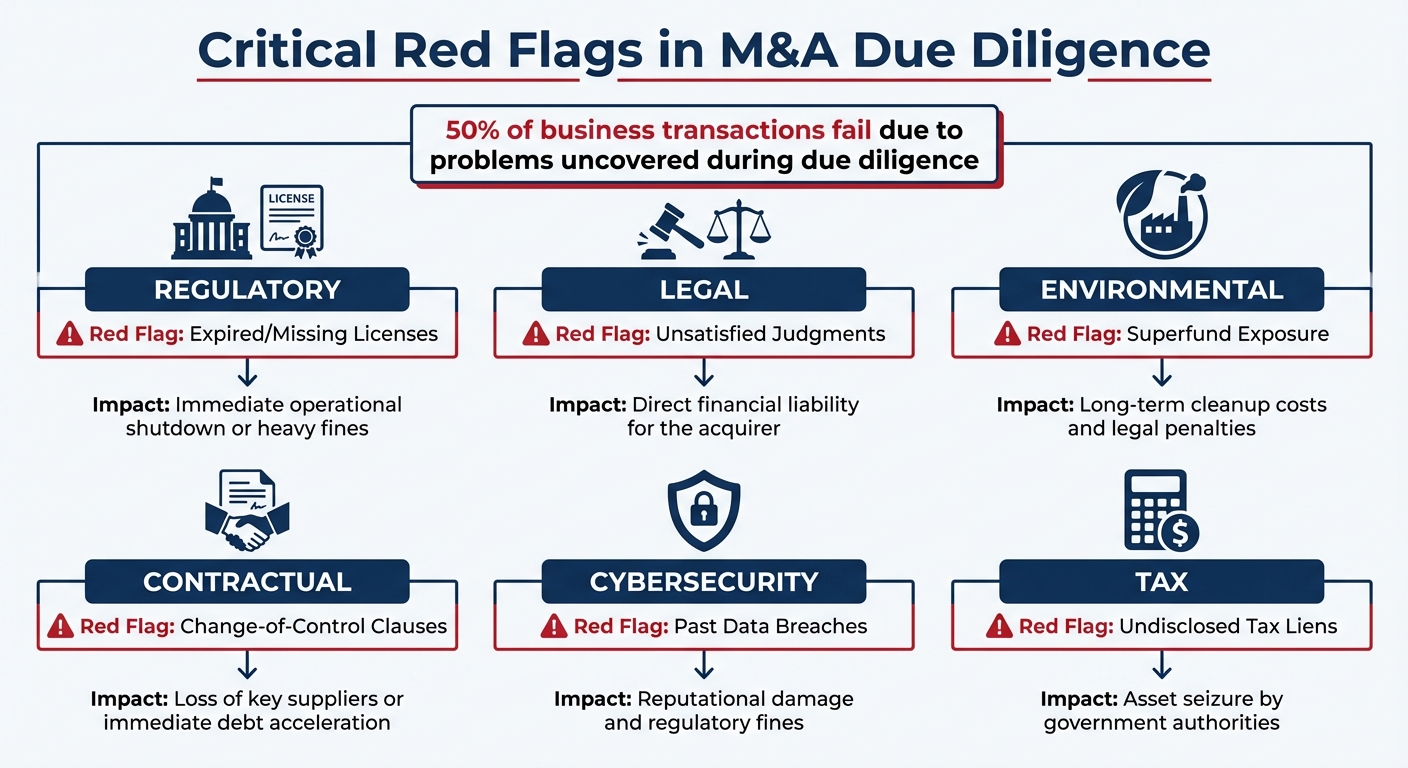
After evaluating market fit and operational aspects, the next step is to identify potential legal and compliance risks that could jeopardize the transaction. This phase is critical for protecting your investment by ensuring all contractual, litigation, and regulatory issues are thoroughly examined. It's worth noting that nearly 50% of business transactions fail due to problems uncovered during due diligence [25].
Review Contracts and Agreements
Carefully review all financial agreements, including loans, promissory notes, lines of credit, and guarantees [25]. Pay special attention to change-of-control clauses that might trigger debt acceleration or give lenders the right to terminate agreements [4].
Examine key contracts with the top 10–20 suppliers and customers to identify potential revenue concentration risks or unfavorable termination terms. Check commercial real estate leases and equipment agreements for assignment clauses that may require third-party approval. Employment agreements, non-compete clauses, and NDAs should also be reviewed to assess risks related to retaining key personnel [8][25]. For intellectual property, verify ownership through licensing agreements and "work-for-hire" contracts, and identify any licenses nearing expiration [25].
"The main goal of legal due diligence is to discover hidden liabilities – whether historical or pending – that could compromise the transaction" - CT Corporation Staff [8]
Additionally, supplement seller-provided disclosures with a UCC-1 search and title examination to confirm asset clarity [8].
Check Litigation and Compliance History
Request a detailed litigation schedule covering all pending, threatened, or settled lawsuits. This should include information about the parties involved, the nature of the proceedings, and estimated costs [4]. Unresolved legal issues, such as unsatisfied judgments or tax liens, could result in creditors seizing business assets even after the ownership transition [9]. Review correspondence from the past five years with agencies like the DOJ, FTC, SEC, IRS, and OSHA to uncover any "threatened" actions that haven't escalated to formal litigation [26].
The Cascade International case demonstrates the dangers of overstating assets and failing to conduct proper verification [26].
Conduct independent bankruptcy, UCC, and lien searches at both state and local levels instead of relying solely on seller representations [8]. Starting in 2024, ensure compliance with the Corporate Transparency Act (CTA) by verifying that the target company has filed the required beneficial ownership reports with FinCEN. This step helps avoid inheriting federal penalties [8]. Include a "representations and warranties" clause, requiring the seller to personally guarantee the accuracy and completeness of all litigation and compliance disclosures [9].
Once you have all litigation details, focus on issues that could immediately disrupt operations.
Identify Key Red Flags
Pinpoint critical issues that could threaten the acquisition. In regulated industries, expired, terminated, or missing licenses could result in an operational shutdown [4]. Investigate ongoing regulatory probes or disputes with agencies like the SEC, IRS, or EPA [4]. Undisclosed tax liens may lead to government asset seizures, and environmental liabilities, such as superfund sites, can result in costly, long-term cleanup obligations [4].
Assess the company's cybersecurity history for past data breaches or non-compliance with GDPR or CCPA regulations [4]. High employee turnover or unresolved labor disputes could signal deeper operational challenges [4]. To mitigate risks, consider implementing a purchase price holdback - withholding a portion of the transaction payment for 6 to 12 months after closing. This ensures funds are available for indemnification if undisclosed liabilities arise [9]. Perform a final "bring-down" search for lien filings and verify the company's good standing certificates as close to the closing date as possible to catch any last-minute surprises [26].
Below is a summary of the most critical red flags:
| Risk Category | Priority Red Flag | Potential Impact |
|---|---|---|
| Regulatory | Expired/Missing Licenses | Immediate operational shutdown or heavy fines [4][3] |
| Legal | Unsatisfied Judgments | Direct financial liability for the acquirer [4][11] |
| Environmental | Superfund Exposure | Long-term cleanup costs and legal penalties [4][6] |
| Contractual | Change-of-Control Clauses | Loss of key suppliers or immediate debt acceleration [5][6] |
| Cybersecurity | Past Data Breaches | Reputational damage and regulatory fines [4] |
| Tax | Undisclosed Tax Liens | Asset seizure by government authorities [4][27] |
Use Specialized Marketplaces like MyReadyMade

Once you've tackled the regulatory, financial, and operational considerations, the next step is finding acquisition targets that fit your criteria. This is where specialized marketplaces like MyReadyMade can make all the difference. Unlike traditional brokers, these platforms are tailored to regulated sectors, offering a more focused and efficient way to identify high-quality opportunities.
Access Verified Business Listings
Platforms like MyReadyMade simplify your search by offering pre-verified business listings. You can filter these listings using criteria like EBITDA, industry type, and jurisdiction, ensuring that potential targets align with your acquisition goals. This saves time by reducing the need for extensive upfront due diligence. Plus, since the listings meet regulatory and financial standards, you can focus on opportunities that match your operational and financial capabilities.
This efficiency is particularly critical in regulated industries, where competition for acquisitions is fierce. In fact, 47% of directors have identified M&A as a strategic priority for 2025, underscoring the growing demand for quality targets [1].
Get Expert M&A Advisory
Navigating license transfers and regulatory approvals can often delay deals. MyReadyMade connects you with advisors experienced in handling these complexities across over 50 jurisdictions. These experts assist with multi-jurisdictional licensing reviews, ensure that government permits can be transferred to you as the buyer, and scrutinize regulatory correspondence to flag any potential issues.
"iGaming is highly regulated. Thoroughly investigate the seller's licensing status across multiple jurisdictions, ensuring compliance with all applicable laws and responsible gambling practices." - CasinosBroker.com [3]
The platform also provides a secure environment for transactions, with NDA-protected processes and centralized document management. This setup ensures confidentiality while helping you manage the high volume of contracts and filings typical in regulated industries.
Close Deals Efficiently
In acquisitions, speed matters. Traditional due diligence methods are often too slow to keep up with the pace of modern deals. MyReadyMade addresses this with an average closing time of 30–45 days for verified listings - far faster than the 6–24 months often seen with unstructured searches [7]. By using standardized processes and automation, the platform helps identify and resolve bottlenecks quickly.
As Brian Risser, Business Partner Program Manager at TE Connectivity, observed:
"It was clear that our process was taking too long. So, we needed to understand where the major delays were and how we could make this process easier for our stakeholders" [1].
With 24/7 deal support and AI-powered valuation tools, MyReadyMade enables you to act swiftly on promising opportunities. At the same time, it maintains the thoroughness required for acquisitions in regulated sectors, combining speed with diligence to streamline the entire process.
Conclusion
Pursuing acquisitions in regulated sectors requires meticulous and multi-layered due diligence. It’s essential to dive deep into regulatory, financial, and operational aspects to separate genuine opportunities from potential pitfalls.
The stakes in these sectors are undeniably high. As Davis Business Law aptly puts it:
"The due diligence process is like a magnifying glass, allowing you to scrutinize every aspect of the target company." [20]
This level of scrutiny is non-negotiable, as it uncovers hidden risks like pending lawsuits, cybersecurity vulnerabilities, or regulatory breaches that could surface after the deal is closed. Using a detailed checklist that spans commercial, financial, operational, tax, IT, and HR assessments ensures valuations are stress-tested and potential red flags are identified before they derail the deal [24][1].
Traditional due diligence timelines, often stretching from 6 to 24 months, can lead to seller fatigue and missed opportunities. Tools like MyReadyMade tackle this issue by offering verified listings, expert guidance across 50+ jurisdictions, and streamlined processes that cut closing times to just 30–45 days. This blend of speed and thoroughness is critical, especially in a market where 47% of directors have flagged M&A as a strategic focus for 2025 [1]. By balancing efficiency with rigor, businesses can zero in on targets that promise both short-term wins and sustainable growth.
FAQs
What financial metrics should you analyze when evaluating a potential acquisition target?
When considering a potential acquisition, it's crucial to zero in on financial metrics that reveal the company's performance and growth prospects. Key areas to examine include:
- Valuation metrics: Tools like EV/EBITDA can help you determine the company’s market value.
- Revenue stability: A consistent revenue stream signals reliable earnings.
- EBITDA margin: This is a solid indicator of how profitable the business is.
- Cash flow health: Ensures the company generates enough liquidity to sustain operations.
- Debt-to-equity ratio: A measure to understand the company’s financial leverage.
- Working capital trends: A reflection of operational efficiency and short-term financial health.
These metrics provide a clear picture of the company’s financial stability and its potential to generate long-term value. For buyers navigating regulated industries, platforms like MyReadyMade can simplify the process by offering access to pre-vetted, high-quality businesses.
How can I verify that a business's licenses are valid and transferable before acquisition?
When evaluating a business's licenses, it's essential to ensure they are both valid and transferable. Begin by thoroughly reviewing all permits and regulatory documents associated with the business. Cross-check these with the relevant regulatory authorities to confirm they meet current industry standards and are free of any compliance issues. This precaution helps avoid unexpected complications that might interfere with operations after the acquisition.
Additionally, assess whether the licenses are linked to specific individuals or entities, as this can directly affect their ability to be transferred. To navigate these complexities, consult with legal and industry professionals who can interpret the licensing agreements and identify any potential restrictions or conditions. Addressing these matters early in the due diligence process can reduce risks and help ensure a seamless transition once the acquisition is complete.
What are the key steps to evaluate if a business can scale effectively before acquiring it?
To gauge whether a business is ready to scale, start with a thorough operational review. This means digging into the company’s processes, systems, and management to see if they’re efficient and capable of handling growth. The goal is to spot any weaknesses that could lead to disruptions or high costs as demand increases.
Next, take a close look at the technology infrastructure and cybersecurity measures. These need to be robust enough to support expansion. Also, evaluate the organizational structure and leadership team to ensure they have the skills and capacity to manage growth effectively.
Lastly, pinpoint potential bottlenecks, examine the reliability of the supply chain, and determine if operations are flexible enough to handle scaling. By addressing these areas, you can identify challenges early and ensure the business is set up to meet your long-term objectives.
Related Articles

Ultimate Guide to Earnout Negotiations in M&A
Structure and negotiate earnouts in regulated M&A with clear metrics, anti-manipulation covenants, and acceleration or escrow protections.

How to Draft M&A Definitive Agreements
Guide to drafting M&A definitive agreements covering deal structure, reps & warranties, indemnities, payment terms, and regulatory compliance.

How IP Affects Tokenization Valuation
How tokenizing patents, copyrights, and trademarks adds liquidity and market value—plus legal, regulatory, and valuation steps.
Looking to Buy or Sell?
Get in touch with our team for personalized assistance