Checklist for Post-M&A Transition in Regulated Markets
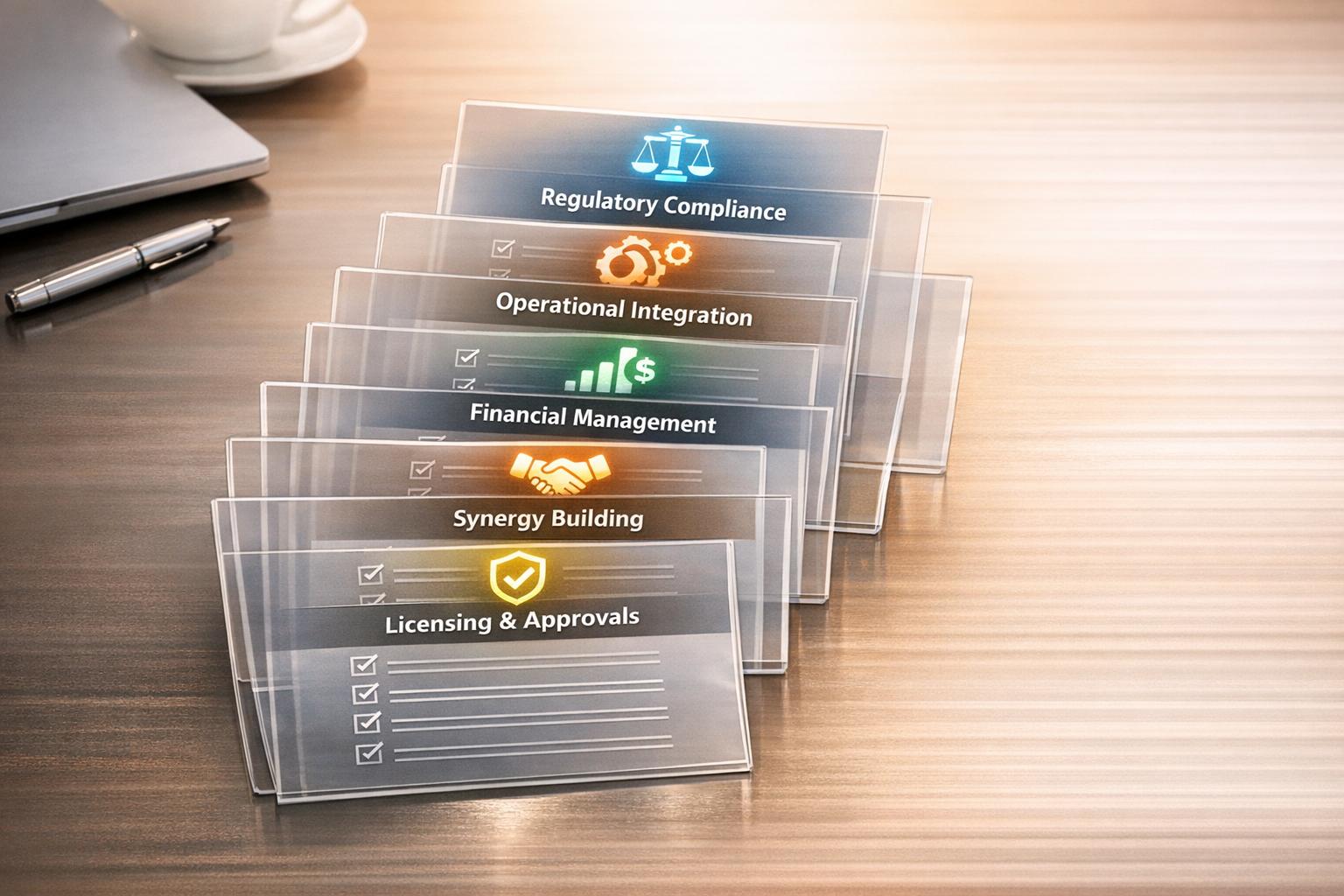
Checklist for Post-M&A Transition in Regulated Markets
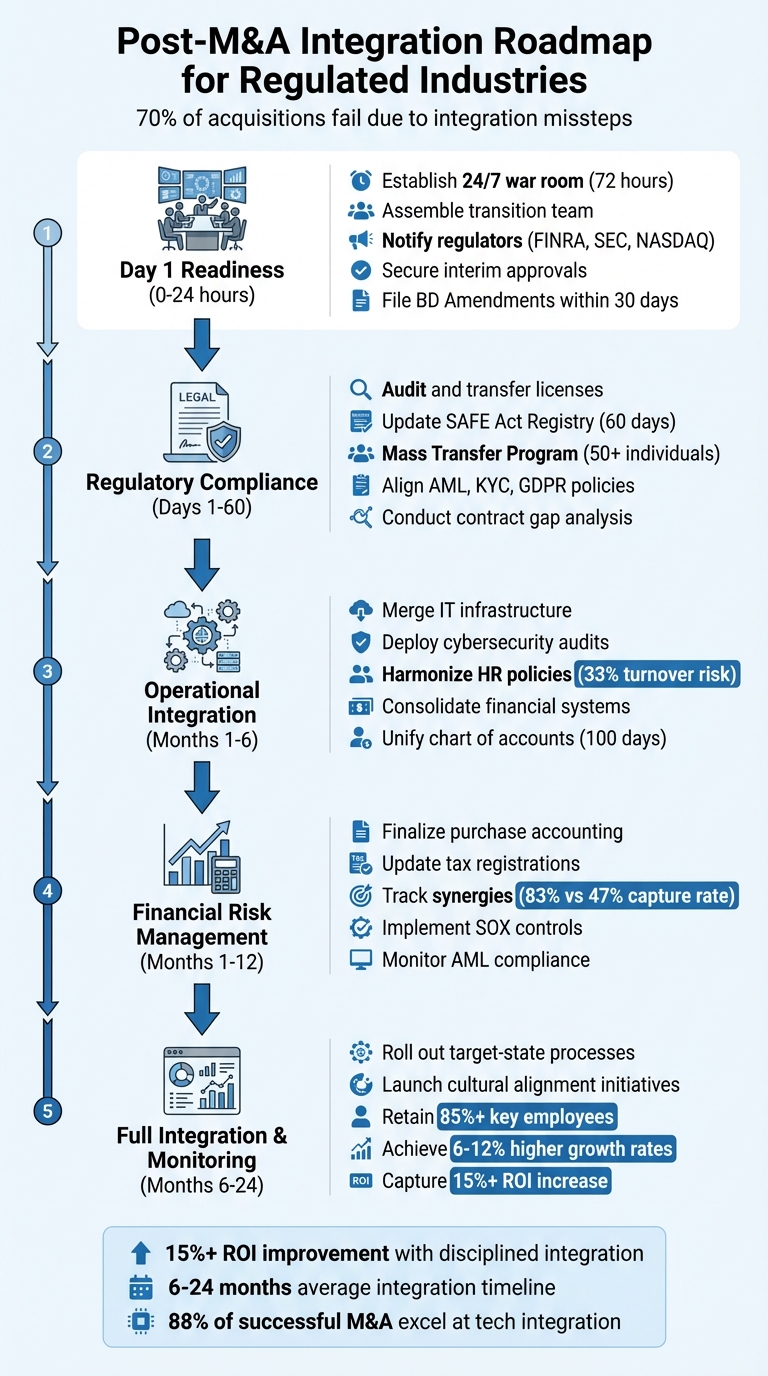
Closing a merger or acquisition is just the start - success depends on what happens next. Over 70% of acquisitions fail to deliver value, often due to integration missteps. This is especially true in regulated industries like iGaming, Cryptocurrency, Forex, and Fintech, where compliance and operational challenges can derail progress.
Here’s a quick breakdown of the key phases to ensure a smooth post-M&A transition:
- Day 1 Readiness: Establish a war room, assign regulatory leads, notify authorities, and secure interim approvals to maintain licenses.
- Regulatory Compliance: Audit and transfer licenses, align compliance policies, and address potential regulatory risks.
- Operational Integration: Merge IT systems, HR policies, and financial processes while mitigating cybersecurity risks.
- Financial Risk Management: Finalize purchase accounting, reconcile balances, and update tax registrations.
- Full Integration Monitoring: Align processes, unify teams, and track synergies to maximize ROI.
Key stat: Companies that follow a disciplined integration plan can improve first-year ROI by over 15%.
This guide provides actionable steps for each phase, helping you tackle compliance, maintain operations, and deliver on promises to stakeholders.
Episode 6: The Art of Integration – Making M&A Work Post Close
Day 1 Readiness Checklist
Within the first 24 hours, establish a 24/7 war room with three rotating 8-hour shifts for a total of 72 hours. This setup ensures any issues are addressed within 10 minutes [14]. It's a crucial foundation for managing all key integration tasks effectively.
Assemble Transition Team and Assign Regulatory Leads
Build a transition team that includes an Incident Commander, Functional Liaisons (from departments like Legal, Compliance, HR, IT, Finance, and Operations), a Data Analyst to monitor real-time KPIs, a Communications Lead, and a Scribe to document incidents. The Scribe should record details like unique IDs, timestamps, and assigned owners. Each role must have a backup for adjacent shifts. To prevent errors, require a written log of open tickets during each shift handoff [14].
Identify regulated "controlled functions" that need prior approval and bring in external advisors to fill gaps in in-house expertise [5][8].
Notify Regulators and Submit Initial Filings
On Day 1, notify key regulatory bodies such as FINRA, SEC, NASDAQ, MSRB, and relevant state regulators. File necessary forms like BD Amendments, BDW, U4, or U5, or leverage the Mass Transfer Program if transferring 50 or more representatives. Update FINRA systems (FCS, TRACE, OATS) within 30 days, deactivate unnecessary accounts, and revise SAFE Act registries within 60 days [2][1].
Secure Interim Approvals for License Continuity
Ensure interim approvals are in place to maintain uninterrupted licensing. Confirm "hold-separate" or "clean-team" conditions with legal counsel. Activate corporate registrations and banking signatories immediately to keep operations running smoothly [14]. Create detailed step-by-step plans for regulatory-dependent tasks to maintain a logical workflow [8].
"Regulatory approval and filing requirements should be built into the planning process itself, and not be left to the implementation phase, with particular focus on avoiding road-blocks that might otherwise delay or frustrate the realization of integration goals in many jurisdictions." - Baker & McKenzie [8]
During due diligence, conduct joint technology and regulatory audits to spot any critical issues or licensing gaps before the deal is finalized [10][8].
Regulatory and Compliance Checklist
Once your Day 1 operations are running smoothly, it's time to turn your attention to regulatory and compliance tasks. These are critical to ensuring your newly merged entity remains in good standing across all jurisdictions. Achieving this requires close collaboration between your legal, compliance, and operations teams to prevent any delays or penalties.
Audit Licenses and Initiate Transfers
Start by verifying the target company's registered status and identifying the relevant regulators, such as the FCA, PRA, FINRA, SEC, or EEA [2][5]. Confirm that the target holds the necessary permissions for its activities and that individuals in roles like "controlled functions" or "approved persons" are properly registered [5].
If ownership changes are involved, submit applications as early as possible. Double-check all documentation, including certified translations and currency conversions to U.S. dollars, to avoid rejections or losing filing fees [2].
For cases involving 50 or more qualified individuals, take advantage of mass transfer programs to shift registrations from the predecessor to the successor firm without filing individual Form U4 or U5 documents [2]. Additionally, update specialized registries and notify relevant third parties, such as market systems (e.g., TRACE, OATS) and insurance bodies like FEMA, about the changes [2][1].
"Under no circumstances should the parties knowingly complete a transaction that requires FCA change in control approval before such approval has been granted." - FSREG [5]
| Regulatory Area | Key Task | Timing/Threshold |
|---|---|---|
| Broker-Dealer | Submit Continuing Membership Application (CMA) | 30 days prior to change [2] |
| Mortgage Licensing | Update SAFE Act Registry | Within 60 days [1] |
| UK Financial Services | Change in Control Approval | Thresholds at 10%, 20%, 33% [5] |
| General Registration | Mass Transfer Program (Individuals) | Minimum 50 individuals [2] |
Update Compliance Policies
Once licenses are secured, shift your focus to aligning internal compliance policies with the new organizational structure. Compare the policies of both the acquirer and the target to spot discrepancies in areas like pricing, underwriting, and risk management [1]. Update key policies, including Anti-Money Laundering (AML), Know Your Customer (KYC), and data protection regulations like GDPR, CCPA, and GLBA, to reflect the merged entity's structure and customer base [1][13].
Determine whether the merger changes your compliance reporting obligations. For instance, a larger asset size could reclassify your bank as an "intermediate small bank", requiring a Community Reinvestment Act (CRA) "Community Development Test" after two consecutive years [1]. Similarly, if the merger introduces new products like HELOCs or specialized insurance, ensure policies are expanded to cover these areas, including staff training and monitoring requirements [1].
If changes are made to deposit or loan products, issue "Change in Terms" notices to customers, especially if payment structures, fees, or features are adjusted [1]. Update regulatory registries for licensed staff, such as Mortgage Loan Originators under the SAFE Act, within 60 days [1]. Finally, conduct risk assessments on inherited vendors to ensure their contracts align with your compliance standards [1][13].
"Successful execution of mergers and acquisitions among financial institutions requires significant attention to detail, to ensure that the systems of the surviving institution function in a way that is consistent with laws, regulations, and safe-and-sound banking practice." - FDIC [1]
Conduct Gap Analysis on Contracts and IP
Building on the license and policy updates, it's essential to assess contracts and intellectual property (IP) to identify potential risks. Gather all patents, trademarks, copyrights, licensing agreements, and key contracts into a secure Virtual Data Room (VDR) [13]. Carefully review material contracts for "change-of-control" clauses that might trigger termination or renegotiation during the merger [13][15]. Highlight any agreements that could negatively impact the company if terminated.
Confirm that all intellectual property, including source code, is properly registered and free from encumbrances like open-source licensing risks [13]. For tech-heavy mergers, evaluate software assets for open-source issues that could compromise proprietary code [13]. Also, review non-compete and non-solicit agreements for key personnel to protect intellectual property post-integration [13].
In U.S.-based acquisitions, conduct an internal audit of inherited I-9 forms and address any issues while employee cooperation is still readily available to avoid potential penalties [11]. Additionally, create an inventory of AI/ML model usage to ensure sensitive data is being handled appropriately [9]. Keep in mind that a significant portion of digital data - about 90% - is unstructured, which can complicate efforts to manage and secure it during the merger process [9].
"You cannot protect what you don't know you have. A comprehensive data inventory is essential for understanding the target's data footprint." - Congruity360 [9]
The cost of non-compliance can be nearly three times higher than adhering to regulations, making a thorough gap analysis a worthwhile investment [12].
Navigating the regulatory landscape after a merger, especially in highly regulated industries, can be challenging. Using expert advisory services like those offered by MyReadyMade (https://myreadymade.com) can help simplify license transfers and ensure a seamless compliance process.
Operational Integration Checklist
Once regulatory and compliance measures are in place, the next step is merging the operational frameworks of both organizations. This phase is just as critical as regulatory compliance and license transfers. A well-executed operational integration ensures the merger progresses smoothly, while missteps can quickly undermine its value. By systematically addressing key functional areas like IT, HR, and financial systems, organizations can create a seamless transition and drive operational success.
Align IT Infrastructure and Cybersecurity
Start by cataloging all applications, databases, licenses, and infrastructure from both companies to establish a baseline for integration [16][6]. Identify and prioritize the protection of your "crown jewels" - the digital assets critical to revenue and core operations [17][6].
Cybersecurity risks are heightened immediately after a transaction. Evaluate the seller’s networks, cloud systems, and data storage for vulnerabilities, and assess their ability to respond to threats [17]. Go beyond standard security scans by deploying aggressive threat hunting and penetration testing on inherited systems [17]. To minimize risks, temporarily restrict payment approvals and communications right after the deal closes, as disruptions during this period can create opportunities for cyberattacks [17].
"The potential for a cybersecurity breach can be highest in the days immediately after a transaction." - Bank of America [17]
Operate legacy and new systems in parallel rather than rushing into a full transition on Day One. This approach allows for data validation and user training, reducing the likelihood of errors [6]. Implement formal change management processes to oversee network and software modifications during the integration [16]. Maintain strict Identity and Access Management (IAM) protocols, and carefully vet any specialists who require access to critical systems during the transition [17].
Once IT systems are stabilized, turn your focus to workforce integration to address talent-related risks.
Harmonize HR and Employee Policies
Standardize compensation and benefits to create a unified, fair system [6][3]. This step is essential to prevent disparities that could lead to employee dissatisfaction and turnover. Acquired companies often see up to 33% of hires leave within the first year, compared to 12% for independently hired employees [19]. Retain key talent by offering targeted retention packages, which can include both financial incentives and non-financial benefits [6].
Ensure compliance with local labor laws by reviewing the classification of workers, such as employees versus contractors, using criteria like the US Department of Labor's six-factor test [19]. Merge and validate all HR systems, including HRIS, payroll, and performance management platforms, to deliver a consistent employee experience [6].
Within the first 90 days, implement high-visibility HR initiatives, such as improved tools or clear career development paths, to build trust and demonstrate progress [6]. Align Health, Safety, and Environmental (HSE) policies to meet local and national regulations [18], and audit employment contracts for "change of ownership" clauses that could trigger renegotiations or terminations [4].
Consolidate Financial and CRM Systems
Create a cross-functional team, led by the CFO, to map out all financial processes and decide which systems will be retained [6]. Ensure the finance team has access to the acquired company’s bank accounts and financial systems on Day One to avoid interruptions [7]. Focus on mission-critical systems like ERP and CRM, and conduct mock closes to identify potential failures before they disrupt live reporting [6].
Adopt a unified chart of accounts within the first 100 days to streamline financial reporting across the organization [6]. In the first 30 days, prioritize maintaining cash flow by ensuring smooth operations for billing, accounts payable, and accounts receivable [7].
Plan data migration and cleansing carefully, assigning data owners to ensure accuracy and avoid the pitfalls of poor data quality [6]. Segment customers and develop tailored communication plans to address questions about service changes and new points of contact [6]. Depending on the size of the companies involved, consolidating financial systems can take anywhere from six to 24 months [7].
"If culture is the soul, technology is the central nervous system. A bungled IT integration cripples operations, corrupts data, and creates massive security vulnerabilities." - Usypchuk [6]
Review and renegotiate vendor contracts for software and financial services to capitalize on economies of scale and cut costs [18]. Consolidate bank accounts and implement unified cash management controls on Day One to maintain oversight of all cash positions [6].
Financial and Risk Management Checklist
Once operational integration is steady, the next critical step is setting up a strong financial framework. This involves wrapping up purchase accounting, managing financial risks, and keeping track of the value promised during deal negotiations. Did you know that over 70% of acquisitions fail to create value [6]? Often, the culprit is rushing or neglecting financial integration. Taking a thorough, step-by-step approach to financial reconciliation and risk management helps safeguard the investment and ensures accurate reporting right from Day One.
Finalize Purchase Accounting and Reconcile Balances
To complete the purchase price allocation (PPA), assess the value of all identifiable assets and liabilities [7][21]. Map the acquired company’s chart of accounts (COA) to your system, creating mirror entities for accurate financial roll-ups [20]. Unifying the chart of accounts within the first 100 days is key for consistent financial reporting [6].
Review all accounting policies and address differences in critical areas like revenue recognition, cost of sales, capitalization, and impairment [20]. Prepare closing financial statements for both entities, then open a consolidated balance sheet for the transition period [7]. Before the first live reporting cycle, conduct mock closes to test systems and uncover potential issues [6]. Treasury functions should also be consolidated - identify signing authorities for new bank accounts and verify that cash on hand meets regulatory standards [20][6].
Set a one-year SOX integration plan with interim controls to ensure compliance [21][6]. List all off-balance sheet commitments, such as operating leases or project expansions, and audit the acquired company’s historical financial data to ensure it meets your standards [7]. Establish strict data retention protocols to maintain transparency and accountability.
"A post-merger integration checklist can help your finance and accounting team ensure they cover all of the bases at each stage of the integration process." - Pablo Martell, Founder and CEO, Alpine Mar [7]
Mitigate Financial Risks and Update Tax Registrations
If your business operates in high-risk sectors like Fintech or Crypto, pay close attention to Anti-Money Laundering (AML) policies, sanctions, customer screening, and transaction monitoring [25]. Ensure cash levels meet regulatory minimums and adjust for any surplus [20]. Financial risks often show up as undisclosed liabilities, inaccurate financial statements, or overvaluation, all of which can drain resources after the transaction closes [24].
Between 70% and 90% of M&A deals fail annually, with overvaluation being a leading cause [23]. Address tax risks by filing stub-period returns and registering for new sales, income, and FICA taxes [22][26]. Review pending tax matters, audits, and extensions, ensuring payroll, sales, and franchise taxes are properly handled [21]. Update property tax valuations to reflect the new ownership structure [20].
Centralize treasury, banking, and investments under your control, and close pre-transaction bank accounts to prevent unauthorized wire transfers [20]. For high-risk industries, use automated tools for real-time transaction monitoring and sanctions screening against global lists [27]. If the merger changes the legal name, address, or beneficial owners, file an updated Beneficial Ownership Information Report (BOIR) with FinCEN. Failing to do so could result in penalties of $591 per day for non-compliance [22].
Update public records for both surviving and non-surviving entities to prevent identity theft, fines, or issues with contract enforcement [22]. With 53% of companies experiencing cybersecurity problems during M&A processes, phased IT integration with strong security protocols is a must to avoid vulnerabilities [23].
"Buy the business, inherit the risk." - FTI Consulting [25]
These steps help protect financial integrity and ensure regulatory compliance throughout the post-deal phase.
Track Synergies and Cost Savings
Appoint a finance lead to oversee synergy tracking [20][6]. Quantify each synergy's value, including its direct financial impact and the resources needed to achieve it, then validate these estimates against historical data [28]. Create a detailed plan for each synergy, outlining specific actions, responsibilities, timelines, and performance metrics [28].
Tie synergies to departmental budgets and adjust those budgets to reflect expected savings, ensuring accountability [20]. Early on, develop standardized templates for synergy tracking and status reporting to maintain consistency [20]. Use key performance indicators (KPIs) like employee retention, customer churn, and system uptime to measure integration success alongside financial metrics [6].
Disciplined integrations that hit key functional milestones can increase ROI by over 15% in the first year [6]. Companies that succeed in their integrations realize over 83% of anticipated synergies, while others capture less than 47% [23]. Web-based program management tools can help track cross-functional progress, synergy outcomes, and RAID (risk, action, issue, decision) logs [3]. Keep an eye on operational, market, and regulatory risks to ensure synergy goals are met [28].
Launch visible, high-impact initiatives within the first 90 days to build trust and momentum [6]. Look for immediate cost-saving opportunities like vendor consolidation, volume discounts, and SKU rationalization [21]. Set up a system for regular updates and adjust synergy estimates as new information emerges during the integration process [20][28].
These financial controls lay the foundation for ongoing monitoring and long-term success.
Full Integration and Monitoring Checklist
Once financial controls are established, the final stage of integration zeroes in on locking in target-state processes, uniting teams under a cohesive culture, and setting up systems to monitor performance over time. This phase is all about sustaining earlier improvements and creating long-term value. On average, post-merger integration takes 6 to 24 months, depending on the complexity of the deal [4][7]. Companies that excel in this phase often see growth rates 6% to 12% higher than those that don't [29]. By building on the operational and financial controls already in place, this step ensures that integration gains are secured and performance is consistently reviewed.
Roll Out Target-State Processes
Introduce Ready Checkpoints (RCPs) to evaluate workstreams and end-to-end processes, minimizing risks during the go-live phase. During the transition, run legacy and target systems side by side - especially for IT, ERP, and finance platforms. This approach helps validate data accuracy, train users effectively, and conduct mock month-end and quarter-end closes before fully switching over.
Examine service delivery processes from both entities to design a higher-performing standard for the combined organization. Use a RACI (Responsible, Accountable, Consulted, Informed) matrix to define roles clearly and avoid internal conflicts. Maintain an Integration Management Office (IMO) to oversee workstream roadmaps, manage interdependencies, and ensure smooth business operations. When integrations are executed with discipline and hit critical functional checkpoints, companies can see a 15% or more ROI increase in the first year [6].
Launch Cultural Alignment Initiatives
Once systems are in place, the focus shifts to aligning cultures and bringing teams together. Cultural misalignment is a common pitfall - over 70% of acquisitions fail to create value, often due to talent loss and uncoordinated teams [6]. Create joint integration teams with representatives from both organizations to ensure all perspectives are considered and to show commitment to a shared future. Executive teams must align on a unified vision and deliver consistent messages about values and goals to reduce uncertainty.
Choose an integration model that fits the desired outcome, whether it’s Preservation (maintaining independence), Holding (operating as a conglomerate), Symbiosis (partial integration), or Absorption (full integration). For regulated industries, develop a unified compliance program tailored to the risk profile of the combined entity, rather than simply merging outdated policies. Assign a dedicated change management lead to support employee morale and uncover hidden organizational insights. Deliver key initiatives within the first 90 days to build trust, and maintain open communication through regular updates, town halls, and clear Q&A channels.
"Deals die on the human level, not the balance sheet. Cultural disconnect isn't a soft problem; it's a primary driver of value destruction." - Kison Patel, CEO, DealRoom [6]
Establish Performance Reviews and Reporting Cadence
To ensure that earlier efforts in regulatory compliance and operational efficiency translate into lasting results, robust monitoring is essential. Use digital, web-based program management tools to centralize updates, synergy reports, and RAID logs. Track key financial metrics like ROI validation, synergy realization, and market share growth. Keep an eye on operational metrics such as efficiency, customer satisfaction, and churn rates. For workforce metrics, monitor employee engagement and the retention of critical talent - keeping more than 85% of key employees in the first 30 days is often a strong indicator of stability [10].
In compliance and risk management, regularly review the status of permits, licenses, regulatory filings, and any instances of non-compliance. Automate regulatory deadline alerts with compliance software and hold weekly CEO-led meetings to align priorities and address inefficiencies. Conduct regular post-close security audits to ensure the integrated technology environment meets unified cybersecurity standards. Interestingly, 88% of successful M&A organizations excel at integrating technology and extracting value from it, compared to just 42% of others [10].
Finally, establish formal channels to collect ongoing feedback from employees, customers, and investors to identify weak points in the integration. Companies that succeed in this phase capture over 83% of expected synergies, while those that fall short capture less than 47% [23]. This final step transforms a merger from a signed agreement into a fully operational and compliant organization geared for long-term success.
Conclusion
After breaking down the key phases of the checklist, it’s clear that a disciplined approach can turn M&A challenges into genuine growth opportunities.
Mergers and acquisitions in regulated markets require precision and careful planning. The line between a deal that creates value and one that falls short often boils down to execution. Over 70% of acquisitions fail to meet expected returns, largely due to oversights like skipping critical compliance steps, rushing system integrations, or underestimating cultural clashes [6]. By sticking to a structured checklist, teams can break down the complexity into actionable steps - from preparing for Day 1 to achieving full integration - ensuring no detail is overlooked.
In industries such as iGaming, Fintech, and Forex, compliance isn’t just a box to check - it’s the cornerstone of protecting your investment. Missing a regulatory filing or delaying a license transfer can lead to sanctions, operational shutdowns, or lawsuits that wipe out projected synergies. Companies that establish Ready Checkpoints (RCPs) and centralize oversight through an Integration Management Office often see a return on investment increase of over 15% within the first year [6]. Regulatory processes, like change in control filings, can extend timelines by six to eight weeks [5], making early and meticulous planning a non-negotiable.
Success ultimately depends on balancing speed with attention to detail. Focus on critical accounts, secure top talent, and maintain consistent communication with stakeholders. Running parallel systems during transitions minimizes disruptions and ensures data accuracy before a full cutover. This checklist serves as a guide to systematically navigate each phase, helping businesses achieve the compliance and operational efficiencies they’ve promised to stakeholders.
For companies managing acquisitions in regulated sectors, MyReadyMade (https://myreadymade.com) offers support with license transfers across 50+ jurisdictions and expert M&A advisory tailored to high-risk industries. Whether your focus is on iGaming, Cryptocurrency, or Fintech, having the right infrastructure and expert guidance from the start can make the difference between seamless compliance and costly setbacks. This streamlined approach ensures that every step - from Day 1 preparations to full integration - delivers the compliance and operational gains essential for long-term success.
FAQs
What are the key steps to ensure regulatory compliance after an M&A deal in a regulated industry?
Ensuring compliance with regulations after a merger or acquisition in a regulated industry demands meticulous planning and execution, both before and after the deal is completed.
The first step is thorough due diligence. This means identifying all relevant regulators, licenses, and compliance requirements tied to the transaction. Check if you’ll need to file documents like change-of-control approvals or license transfer applications. Engaging with regulators early in the process can help address any concerns and make the approval process smoother.
After securing the necessary approvals, the focus shifts to updating licenses, public records, and internal policies to reflect the new ownership structure. Post-transaction, it’s crucial to maintain compliance through measures such as regular monitoring, staff training, and timely reporting. For businesses in high-risk fields like iGaming, cryptocurrency, forex, or fintech, MyReadyMade provides expert M&A advisory services, simplifying license transfers across over 50 jurisdictions to help navigate these complexities with ease.
What steps can companies take to manage cybersecurity risks during post-M&A integration?
Managing cybersecurity risks during post-M&A integration begins with a detailed pre-close assessment. Both parties should closely examine the target company’s security framework, history of breaches, and third-party risks. This early evaluation helps identify vulnerabilities, estimate potential remediation costs, and avoid surprises that could affect the deal’s value.
Once the integration process begins, appoint a senior leader - such as a Chief Information Security Officer (CISO) or an experienced project manager - to supervise data transfer operations. Ensure that temporary network connections are secured, implement strict access controls, and harmonize security policies and incident-response strategies between the two companies. It’s also critical to back up essential data before migration and perform background checks on personnel handling sensitive tasks.
After the deal closes, companies should prioritize continuous monitoring using threat detection tools and regular vulnerability scans to address new risks as they arise. Incorporating these practices into the integration timeline helps protect digital assets, maintain operational security, and preserve the deal’s overall value.
How can companies align cultures after a merger to retain key talent?
Bringing two company cultures together after a merger is key to keeping top talent and ensuring a seamless transition. Research consistently highlights that mismatched cultures are one of the biggest reasons mergers fail, making it essential to address cultural alignment early in the process. Start by conducting a thorough cultural assessment to understand differences in management styles, decision-making processes, and employee expectations. This analysis can help you build a shared cultural framework that outlines core values, identifies key contributors, and sets measurable goals.
Turning this framework into reality requires actionable steps. Consider hosting joint workshops to define a unified vision and establish shared goals. Open communication channels, like town halls or employee surveys, can also help bridge gaps and foster collaboration. Celebrating quick wins along the way can boost morale and keep the momentum going.
To further support the integration, appoint "integration champions" who embody the desired culture and can guide others during the transition. Offering targeted retention strategies, such as stay bonuses or leadership development opportunities, can help keep critical team members motivated and engaged. For mergers in regulated industries, tools like MyReadyMade can provide expert assistance in aligning cultures while managing complex license transfers across various jurisdictions.
Related Articles

Ultimate Guide to Earnout Negotiations in M&A
Structure and negotiate earnouts in regulated M&A with clear metrics, anti-manipulation covenants, and acceleration or escrow protections.

How to Draft M&A Definitive Agreements
Guide to drafting M&A definitive agreements covering deal structure, reps & warranties, indemnities, payment terms, and regulatory compliance.

How IP Affects Tokenization Valuation
How tokenizing patents, copyrights, and trademarks adds liquidity and market value—plus legal, regulatory, and valuation steps.
Looking to Buy or Sell?
Get in touch with our team for personalized assistance