Common NDA Mistakes in M&A and How to Avoid Them
Common NDA Mistakes in M&A and How to Avoid Them
In mergers and acquisitions (M&A), Non-Disclosure Agreements (NDAs) are the first line of defense for protecting sensitive information. But even small errors in drafting or execution can lead to data breaches, disputes, or failed deals. Here’s what you need to know:
- Why NDAs Matter: They safeguard trade secrets, proprietary technologies, and compliance-sensitive data - especially in regulated industries like Cryptocurrency, iGaming, Forex, and Fintech.
- Types of NDAs: Choose between unilateral (one-way) or mutual (two-way) NDAs depending on the nature of the transaction.
- Top Mistakes:
- Using the wrong NDA type for the deal.
- Vague definitions of "confidential information."
- Weak protection standards or overly broad non-solicitation clauses.
- Missing term limits or destruction requirements.
- Execution errors, such as improper signatures or incomplete schedules.
Key Takeaway: A well-crafted NDA protects not just the data but also the integrity of the deal. Avoid common pitfalls by defining terms clearly, ensuring proper execution, and tailoring the NDA to the transaction’s specifics.
Mastering M&A Step 1 | NDAs: Key Clauses, Mistakes & Negotiation Strategies
5 Common NDA Mistakes and How to Fix Them
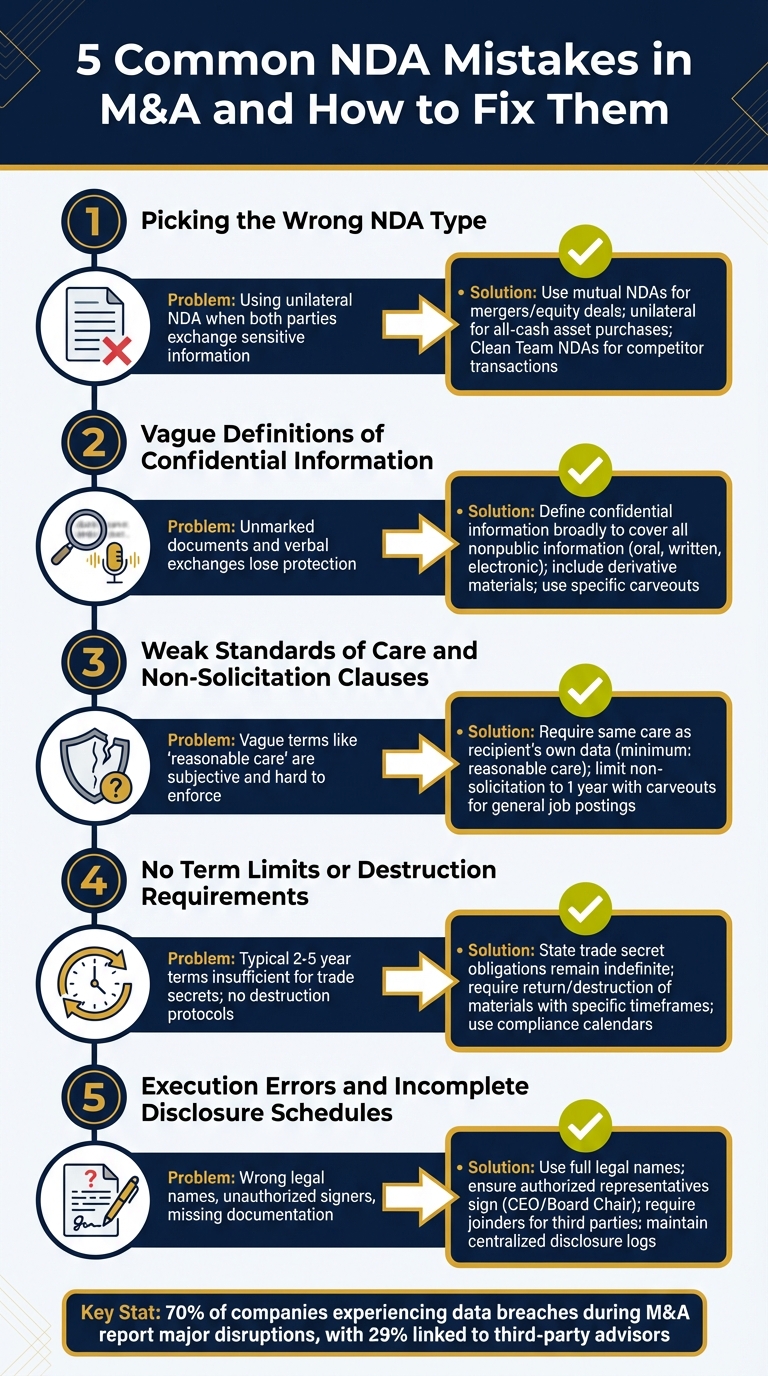
Drafting errors in NDAs can lead to leaked confidential information, disputes, or even failed transactions. Let’s break down five frequent mistakes and how to avoid them.
Mistake 1: Picking the Wrong NDA Type
The type of NDA you choose - unilateral or mutual - determines whose information gets protected. A unilateral NDA binds only the recipient (often the buyer), which can leave the disclosing party vulnerable when both sides need to share sensitive details. This becomes a problem in deals involving equity or financing disclosures.
For situations where both parties exchange critical information - like stock valuations or financing structures - opt for a mutual NDA. Use unilateral NDAs for simpler cases, like all-cash asset purchases where only the seller shares data. For transactions between competitors, Clean Team NDAs are a better fit, as they limit data access and address antitrust concerns.
Even with the right type, an NDA needs clear definitions to ensure it effectively safeguards sensitive data.
Mistake 2: Vague Definitions of Confidential Information
NDAs often require confidential information to be marked as such, but in fast-moving negotiations, verbal exchanges or unmarked documents can slip through the cracks, losing their protection.
"A party could disclose confidential information it believes is covered by the NDA, but if not documented properly, the disclosing party could inadvertently lose the protection for which it negotiated."
– Morgan Lewis & Bockius LLP
To prevent this, define confidential information broadly. Cover all nonpublic information, whether it’s shared orally, in writing, or electronically, and regardless of labels. Include "Derivative Materials", such as internal analyses or notes based on the original data. Use carveouts for publicly available information, data already in the recipient’s possession, information from legitimate third parties, or independently developed knowledge. For highly sensitive data - like source code or pricing algorithms - consider a separate NDA with stricter terms.
Mistake 3: Weak Standards of Care and Non-Solicitation Clauses
The strength of your NDA also depends on enforceable protection standards. Vague terms like "reasonable care" are subjective and hard to uphold, and overly broad non-solicitation clauses can create issues, especially in competitive hiring markets.
Be specific. Require recipients to protect confidential information with at least the same care they use for their own data - no less than reasonable care. For non-solicitation terms, a one-year limit is standard. Add carveouts for general job postings or candidates who apply on their own.
Mistake 4: No Term Limits or Destruction Requirements
Typical NDA terms (2–5 years) might not be enough to protect trade secrets, which require indefinite safeguards. Without clear language distinguishing trade secrets from other confidential information, you risk losing protection once the NDA expires.
Make sure the NDA explicitly states that confidentiality obligations for trade secrets remain in effect indefinitely. Also, include destruction requirements: recipients should return or certify the destruction of all confidential materials within a specific timeframe after the deal closes or negotiations end. Compliance calendars with automated reminders can help enforce these deadlines.
Mistake 5: Execution Errors and Incomplete Disclosure Schedules
Even small technical mistakes during NDA execution can render the agreement unenforceable. For example, using a trade name instead of a full legal name (like omitting "Inc." or "LLC") can cause issues.
"Even a small typo, like forgetting to include 'Inc.' after the legal name of the NDA party may result in an unenforceable agreement."
– iDeals
Ensure NDAs are signed by authorized representatives, such as CEOs or Board Chairs. Signatures from staff without proper authority can be challenged later. For third-party representatives like consultants, require them to sign a joinder to be personally bound by the NDA’s terms. Maintaining centralized disclosure logs and using restricted-access folders can also help manage and protect sensitive data.
How to Negotiate NDAs Effectively
Negotiating NDAs effectively is about steering clear of common mistakes while ensuring the agreement sets the right tone for the transaction. As Jacob Orosz, President of Morgan & Westfield, explains:
"The NDA is the first document to be signed in a transaction and sets the tone for negotiations" [2].
A thoughtfully crafted NDA not only protects both parties but also establishes a professional foundation for further discussions.
When to Use Mutual vs. Unilateral NDAs
Deciding between a mutual or unilateral NDA depends on the nature of your transaction. For all-cash asset purchases where only the seller discloses information, a unilateral NDA is usually sufficient. On the other hand, when both parties need to share confidential information - like in mergers or equity-based transactions - a mutual NDA is more appropriate.
| Feature | Unilateral NDA | Mutual NDA |
|---|---|---|
| Primary Use Case | All-cash deals, standard acquisitions | Mergers, joint ventures, equity-based transactions |
| Obligation | Only the receiving party is bound | Both parties are bound by confidentiality |
| Information Flow | One-way (Seller to Buyer) | Two-way (Both parties share data) |
| Complexity | Easier to negotiate; focuses on seller protection | More complex; balances protections for both sides |
In some cases, buyers may push for a mutual NDA to keep their interest in the deal confidential, particularly if they want to avoid alerting competitors to their market activities. For deals between competitors, Clean Team NDAs can restrict sensitive information to authorized individuals only, ensuring competitive boundaries are respected.
Once the appropriate NDA type is determined, take the time to vet potential partners before finalizing any agreements.
Vetting Parties Before Signing an NDA
Before committing to an NDA, it’s essential to verify the credibility and intentions of the other party. Start by sharing a teaser profile - essentially a brief, anonymous summary of the business - so potential buyers can gauge their interest without requiring immediate legal commitments. This approach is particularly useful, as private equity firms typically sign NDAs, whereas venture capital firms often avoid them due to the sheer volume of deals they assess.
For direct competitors, clean rooms can provide an added layer of security, ensuring that sensitive information is accessible only to designated team members. Additionally, releasing information in stages - beginning with a teaser, followed by an NDA, then a confidential information memorandum, and finally due diligence - can help reduce risks while building trust.
Once you’ve confirmed the other party’s credibility, focus on tailoring your NDA to suit the specific needs of the transaction.
Working with Advisors to Customize NDAs
In specialized industries like iGaming, Cryptocurrency, Forex, or Fintech, a generic NDA often won’t cut it. These sectors come with unique compliance requirements, including license transfer obligations across different jurisdictions. To address these complexities, work with advisors who understand the specific challenges of your industry. Avoid off-the-shelf NDAs that lack critical protections, such as non-solicitation or standstill clauses.
For transactions that involve regulatory approvals or license transfers, your NDA should clearly outline how confidential compliance and licensing information will be handled. Platforms like MyReadyMade (https://myreadymade.com) specialize in tailoring NDAs for regulated industries, covering over 50 jurisdictions. This ensures your agreement not only safeguards confidentiality but also aligns with the regulatory requirements of your sector.
Key Takeaways for NDA Management in M&A
When it comes to NDA management in mergers and acquisitions, success relies on clear definitions, meticulous execution, and leveraging the right technology.
How to Avoid Common NDA Errors
Managing NDAs effectively means being precise, executing them properly, and maintaining ongoing oversight. Start by defining "Confidential Information" carefully. This should include items like financial records, trade secrets, and related analyses while explicitly excluding publicly available or independently developed data [6][5][3]. Always double-check that the person signing the NDA has the proper authority - this step is critical.
Trade secret protection deserves extra attention. While typical confidentiality agreements last 1–4 years [6][1], trade secrets often require indefinite protection. Erik Lopez, Partner at Jasso Lopez PLLC, highlights the risk:
"If a company discloses information to a third party using an NDA with confidentiality obligations that expire, then the information will under most circumstances cease to be protectable as a trade secret after the restrictions lapse" [7].
For deals involving competitors or highly regulated industries, consider using clean rooms. These virtual data rooms restrict access to sensitive information, allowing only a "clean team" to view it. This team must operate under separate Clean Team NDAs to ensure compliance with antitrust laws [4]. Additionally, platforms with features like Information Rights Management (IRM), dynamic watermarking, and audit trails can help monitor document access [5]. This is especially important given that 70% of companies experiencing data breaches during M&A report major disruptions, with 29% of breaches linked to third parties, such as advisors, who fall victim to cyberattacks [5].
Using verified marketplaces can further strengthen these safeguards.
Using Verified Marketplaces for Secure Transactions
Specialized platforms can simplify compliance while enhancing security. For example, MyReadyMade (https://myreadymade.com) offers NDA-protected communication tools. Users are required to electronically accept NDA terms before gaining access to sensitive information, ensuring compliance and maintaining a full audit trail.
For industries like iGaming, Cryptocurrency, Forex, and Fintech, MyReadyMade provides tailored NDAs designed to meet jurisdiction-specific regulations across more than 50 regions. These tailored agreements address key areas such as licensing details, regulatory approvals, and robust trade secret protections - gaps that generic NDAs often fail to cover. With verified listings and round-the-clock deal support, MyReadyMade ensures confidentiality is maintained throughout every stage of the transaction, from initial discussions to final closing.
FAQs
What’s the difference between unilateral and mutual NDAs in M&A deals?
A unilateral NDA is designed to protect only the party sharing confidential information. In this setup, the receiving party is obligated to keep the disclosed information private, while the disclosing party has no such restrictions. This type of agreement is often used in scenarios like a seller sharing sensitive details - such as financial records - with a potential buyer who isn’t required to share anything in return.
A mutual NDA, however, offers protection to both sides. It requires each party to safeguard the other’s confidential information. These agreements are commonly used in M&A transactions, where both buyers and sellers exchange critical details, such as trade secrets or valuation models. Mutual NDAs tend to be more intricate, as they include reciprocal confidentiality provisions and often outline exclusions for information that’s public or independently developed.
Selecting the appropriate NDA format is essential to ensure that sensitive information is protected and to avoid potential missteps during the transaction process.
How can I ensure verbal communications are protected under an NDA?
To ensure that verbal communications are protected under an NDA, it's crucial to explicitly include oral disclosures in the agreement's definition of Confidential Information. This should cover spoken conversations, in-person meetings, and phone discussions, alongside written or electronic materials. By clearly defining these terms, you reduce ambiguity and make the NDA more enforceable.
It's equally important to document verbal disclosures with written follow-ups, such as meeting minutes, summary emails, or acknowledgments, ideally within 24–48 hours. This establishes a clear record that the information shared verbally falls under the NDA's protection. Also, make sure the agreement is signed by authorized representatives before any verbal exchanges occur to avoid enforceability issues.
For additional security, consider using encrypted tools or virtual data-room logs to document verbal discussions. This is especially critical in industries where maintaining confidentiality is a top priority.
How can I ensure an NDA is executed correctly during M&A transactions?
To steer clear of mistakes when executing an NDA, start by confirming the legal names and identities of all parties involved. This step ensures the agreement is signed by the right entities and their authorized representatives. Tools for digital identity verification or trusted third-party services can significantly reduce the risk of errors.
Then, work with a well-organized, version-controlled NDA template that covers essential clauses. These should include the definitions of confidential information, the agreement’s duration, governing law, and a clear signature block. Using a checklist during the drafting process can help catch potential issues before finalizing the document.
Lastly, double-check that the execution section is fully completed and accurate. This includes verifying the date (formatted as MM/DD/YYYY), titles of the authorized signatories, and ensuring signatures - whether physical or electronic - comply with legal standards. Electronic signing platforms with timestamping and audit trails are excellent for keeping the process efficient and enforceable while minimizing human errors. Before storing the agreement, confirm that all required signatures are present, annexes are attached, and the document is securely filed for future access.
For a streamlined experience, MyReadyMade offers customized NDA templates and expert support, helping businesses maintain compliance and reduce risks, particularly in regulated sectors.
Related Articles

Ultimate Guide to Earnout Negotiations in M&A
Structure and negotiate earnouts in regulated M&A with clear metrics, anti-manipulation covenants, and acceleration or escrow protections.
How to Draft M&A Definitive Agreements
Guide to drafting M&A definitive agreements covering deal structure, reps & warranties, indemnities, payment terms, and regulatory compliance.

How IP Affects Tokenization Valuation
How tokenizing patents, copyrights, and trademarks adds liquidity and market value—plus legal, regulatory, and valuation steps.
Looking to Buy or Sell?
Get in touch with our team for personalized assistance