Compliance vs. Financial Due Diligence in iGaming

Compliance vs. Financial Due Diligence in iGaming
Buying or merging with an iGaming company? Here’s what you need to know: Compliance and financial due diligence are the two pillars of risk assessment in the iGaming industry. Both are essential but serve different purposes:
- Compliance Due Diligence (CDD): Ensures the company operates legally by verifying licenses, regulatory history, and adherence to anti-money laundering (AML) and Know Your Customer (KYC) policies.
- Financial Due Diligence (FDD): Analyzes the company’s financial health, focusing on revenue streams, tax liabilities, and profitability metrics like Player Acquisition Cost (PAC) vs. Lifetime Value (LTV).
Why does this matter? iGaming operates under strict regulations, and compliance failures can lead to fines, revoked licenses, or even criminal charges. For example, in 2023, Crown Resorts paid A$450M in penalties for AML lapses.
Quick Overview:
- CDD: Validates legal operations and minimizes regulatory risks.
- FDD: Confirms financial sustainability and identifies hidden liabilities.
- Overlap: Both assess risks like affiliate compliance and tax obligations.
Combining these reviews ensures you’re not buying into hidden liabilities or regulatory pitfalls.
Financial Due Diligence in iGaming: What to Review
Revenue Streams and Profitability Analysis
Start by diving into Net Gaming Revenue (NGR), which represents gross revenue after deducting bonuses, taxes, and fees [9]. While NGR provides a snapshot, it doesn’t tell the full story.
To get a clearer picture, compare Player Acquisition Cost (PAC) with Lifetime Value (LTV). If a company spends more to acquire players than it earns from them over time, it’s essentially losing money [9]. A healthy business model relies on LTV consistently surpassing PAC. Key metrics like ARPU (average revenue per user), churn rate (aim for under 15% monthly), and bonus conversion rates (targeting over 35%) are essential for identifying profitable player segments [9]. For instance, bonus conversion rates exceeding 35% suggest that promotions are effectively encouraging sustained gameplay [9].
David Schollenberger, Head of Gaming at Healys, underscores the importance of due diligence:
"What will be revealed in due diligence is an important consideration for a company wishing to be purchased, to ensure it is marketable and achieves the maximum price. Similarly, an acquiring company will need to know exactly what it is buying, the target company's present and future value and the extent of its liabilities." [1]
Another critical step is assessing how regulatory tax complexities influence these financial metrics.
Tax Obligations and Liabilities in iGaming
Taxation in the iGaming industry is anything but straightforward, with obligations varying significantly across jurisdictions. For example, in the U.S., state tax rates for casinos and sports betting differ widely. In 2022, 27 states generated $1.5 billion in sports betting tax revenue alone [11].
Point-of-consumption taxation (PoCT) has reshaped the financial landscape, reducing the benefits of traditional low-tax jurisdictions like the Isle of Man and Alderney [1]. Now, companies must meet tax requirements in every market where their players are located.
Take a close look at the target company’s cross-border operational structures. For instance, Flutter Entertainment manages its global tax responsibilities for brands like FanDuel and Paddy Power by using layered holding companies (HoldCos). This approach helps optimize tax efficiency across regions like the U.S., U.K., Ireland, and Australia [2]. Such structures allow cash to move more efficiently, minimizing tax leakage when profits are transferred from high-tax jurisdictions back to the parent company [2].
Historical tax liabilities also deserve scrutiny. Past tax filings and potential audits could reveal legacy debts that might impact the company’s valuation [1]. Additionally, ensure compliance with OECD transfer pricing guidelines to prevent double taxation risks when licensing intellectual property between subsidiaries [2].
Once tax obligations are reviewed, shift focus to financial forecasting and valuation risks for a complete financial assessment.
Valuation Risks and Financial Forecasts
Financial forecasting is a critical component of due diligence, but overly optimistic projections can mask potential risks. To address this, many deals now include earnouts - performance-based payments tied to future milestones. Stephen Crystal from SCCG Management explains:
"Earnouts allow buyers to de-risk paying inflated upfront valuations based on seller projections that may not materialize." [2]
For example, in May 2022, DraftKings acquired Golden Nugget Online Gaming with performance-based consideration linked to future revenue milestones [2]. Similarly, Bally's 2021 acquisition of Gamesys involved deferred payments tied to specific growth and margin targets [2].
Technical debt is another factor that can affect valuation. Outdated systems might require expensive upgrades, which could reduce the company’s worth [1]. A technical audit should verify whether the company’s systems are scalable and whether it owns its proprietary software. As David Schollenberger warns:
"A company that has not protected its brands through registered trademarks in the jurisdictions it does business or has contested trade marks globally has significantly less value." [1]
Trademark issues can significantly diminish a company’s market value.
Lastly, consider how regulatory restrictions might limit future growth. For instance, "bad actor" rules could restrict revenue streams and hinder market expansion [1]. Comparing the target company’s Monthly Active Users (MAU) and ARPU against industry benchmarks can help validate whether its market position aligns with its projected growth [10].
Compliance Due Diligence in iGaming: What to Review
License Validity and Regulatory History
Start by confirming that all operating, supplying, and affiliating licenses are up-to-date and valid. Gaming licenses are tied to specific legal entities, so structuring transactions carefully is essential.
Dig into the target company’s regulatory history by reviewing correspondence for any infringement notices, fines, or penalties. These could signal deeper compliance challenges. Past involvement in black or gray market operations can also jeopardize future licensing opportunities and restrict market access. To stay organized, maintain a centralized database of license numbers, renewal dates, and the managers responsible for each license. Additionally, include pre-closing regulatory approval clauses in M&A agreements to ensure the deal only proceeds with necessary regulatory consent [2][3].
Once licenses and regulatory history are clear, shift focus to operational risks, particularly through AML and KYC measures.
AML and KYC Policy Review
Anti-Money Laundering (AML) and Know Your Customer (KYC) policies are non-negotiable. Since 2009, when the Financial Action Task Force flagged casinos as high-risk businesses, AML compliance has become mandatory in many jurisdictions [12]. Falling short on these standards can result in license revocation, hefty fines, or even criminal charges for executives [1].
Examine the target company’s Source of Funds (SoF) verification processes, monitor high-value transactions, and screen for Politically Exposed Persons (PEPs) and sanctions. Many operators now use dynamic risk scoring to continuously monitor player behavior, a key element of modern AML frameworks. Dynamic risk scoring combined with regular staff training helps identify and manage emerging threats. As Sumsub highlights:
"If your team isn't fully aware of AML red flags, reporting obligations, and gambling-specific risks, even the most advanced automated prevention tools won't be able to protect you from fraud and money laundering." [12]
Ensure the company provides regular AML training for employees and has established clear procedures for Enhanced Due Diligence (EDD) when red flags arise [12].
After addressing internal risk measures, turn your attention to external marketing partnerships for further compliance checks.
Affiliate and Marketing Compliance Review
Affiliates can introduce significant risks if not properly managed. Regulators like the UK Gambling Commission hold operators accountable for their affiliates’ actions [1]. Review all affiliate contracts to ensure the target company has strong controls in place, including the ability to swiftly terminate non-compliant affiliates [3].
Check creative approvals and geo-fencing data to confirm compliance with local advertising regulations [3]. Effective systems for managing affiliates are essential. Look for service level agreements that outline clear takedown procedures and verify that the company uses geographic toggles within its compliance systems. This capability is increasingly important in regions with rapidly evolving regulations, such as Latin America [3].
Thoroughly reviewing affiliate and marketing compliance helps safeguard operating licenses and protects the company’s financial stability by minimizing the risk of regulatory disruptions.
Ep 4 - Practical Enhanced Due Diligence (EDD) for High Risk Customers in Casino Gaming
sbb-itb-ba142f6
Compliance vs. Financial Due Diligence: Side-by-Side Comparison
Main Differences and Where They Overlap
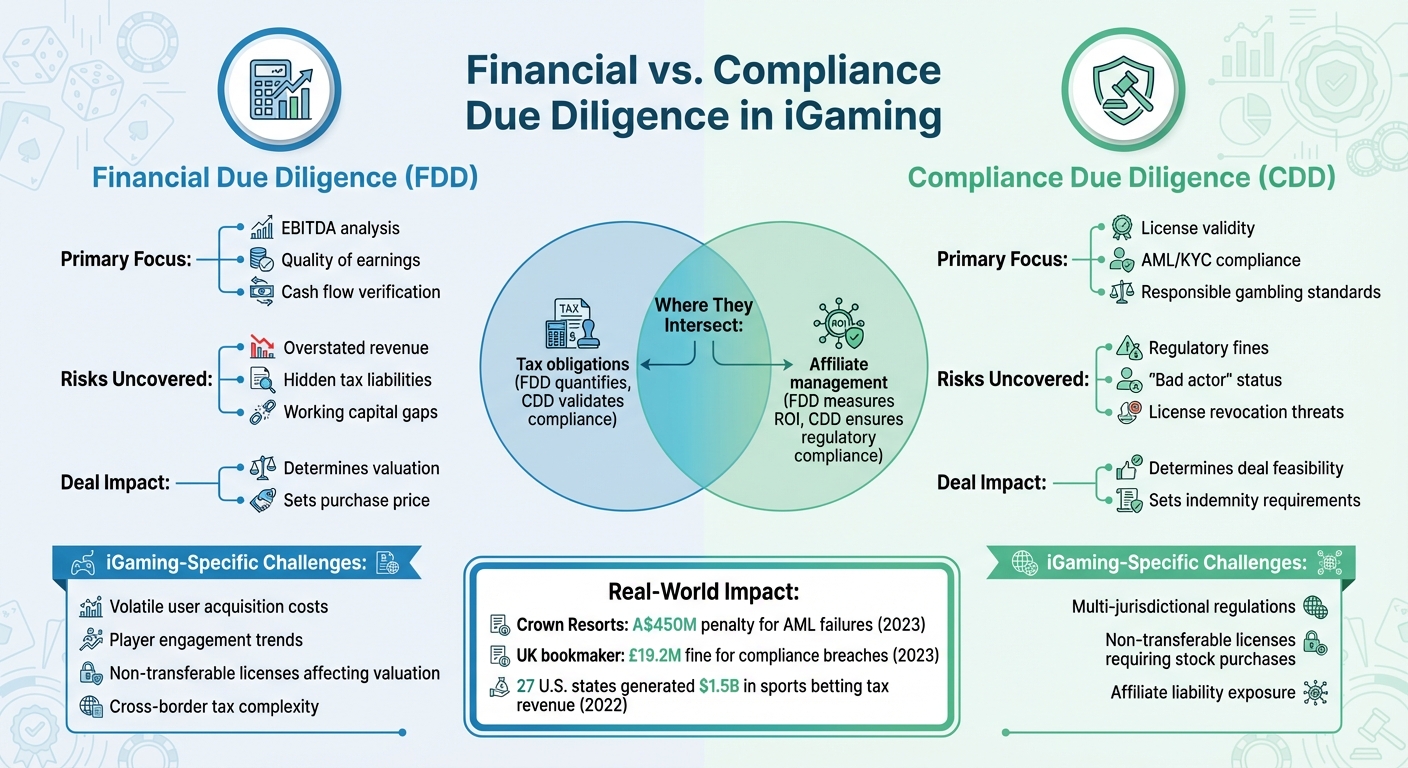
When it comes to due diligence, Financial Due Diligence (FDD) and Compliance Due Diligence (CDD) serve different purposes but often intersect in critical areas. FDD focuses on verifying EBITDA, cash flow, and uncovering hidden tax liabilities. On the other hand, CDD ensures license validity, adherence to AML/KYC protocols, and compliance with responsible gambling standards.
Despite their distinct objectives, both types of reviews overlap in areas like tax obligations and affiliate management. For instance, FDD quantifies the financial impact of tax issues, while CDD ensures these obligations meet regulatory standards. Similarly, affiliate operations are assessed from different angles: FDD evaluates their costs and return on investment, while CDD examines their compliance with regulations. These overlapping considerations play a pivotal role in structuring iGaming M&A deals.
| Feature | Financial Due Diligence (FDD) | Compliance Due Diligence (CDD) |
|---|---|---|
| Primary Focus | EBITDA, quality of earnings, and cash flow [4] | License validity, AML/KYC, and responsible gambling [3] |
| Risk Uncovered | Overstated revenue, hidden tax liabilities, working capital gaps [4] | Regulatory fines, "bad actor" status, license revocation [1][7] |
| Deal Impact | Determines valuation and purchase price [4] | Determines deal feasibility and indemnity requirements [2] |
| iGaming Challenge | Volatile user acquisition costs, player engagement trends [2] | Multi-jurisdictional regulations, non-transferable licenses [7][2] |
Both types of due diligence significantly impact how deals are structured. Stephen Crystal of SCCG Management highlights a key challenge in the gaming industry:
"In the regulated gaming industry, asset deals are often impractical because gaming licenses are frequently non-transferable" [2].
This reality often necessitates stock purchases, where CDD takes center stage. In such cases, buyers inherit all existing liabilities. A prime example is Caesars Entertainment's acquisition of William Hill's U.S. assets. The deal was structured as a stock purchase to ensure licensing continuity across multiple states [2]. This underscores the unique challenges of due diligence in the iGaming sector.
iGaming-Specific Challenges in Each Type
The iGaming industry introduces unique hurdles that further differentiate FDD and CDD. These challenges go beyond the foundational aspects of due diligence and demand specialized attention.
Compliance Due Diligence Challenges:
The multi-jurisdictional nature of gambling regulations is a major obstacle. Laws vary widely across states and countries, requiring expert legal knowledge tailored to each market. A company might be fully compliant in one jurisdiction but face restrictions in newly regulated U.S. states due to past activities in gray markets. Additionally, affiliate liability poses significant risks. Regulators, such as the UK Gambling Commission, hold operators accountable for the actions of their affiliates, adding another layer of complexity [1].
Financial Due Diligence Challenges:
FDD in iGaming is complicated by the non-transferability of licenses. Buyers often need to acquire entire entities to retain licenses, which directly impacts valuation. Revenue volatility is another issue, driven by fluctuating user acquisition costs, regulatory shifts, and changing player engagement patterns [2]. Cross-border operations further complicate matters, particularly in managing tax obligations. Many companies rely on complex holding structures in jurisdictions like Malta or Gibraltar to address double taxation and streamline cash repatriation [2].
The financial risks tied to compliance failures are considerable. In 2023, a major UK bookmaker faced a £19.2 million fine for AML and social responsibility breaches - the largest penalty in British gambling history [7]. That same year, Crown Resorts agreed to pay A$450 million to settle an AUSTRAC case involving "serious and systemic" AML non-compliance [7]. These cases highlight how compliance lapses can have a direct and substantial impact on the financial metrics scrutinized during FDD.
How to Balance Compliance and Financial Due Diligence
Practical Steps for Integrating Both Reviews
Successfully navigating a deal in the iGaming industry requires balancing financial and compliance due diligence from the very start. This means assembling a cross-functional team that includes your CFO, General Counsel, and CISO, along with external advisors who specialize in iGaming regulations [5]. Tackling overlapping risks - like affiliate contracts and tax issues - early on is essential to avoid complications down the line.
A practical way to approach this is by creating a 12-week plan that integrates both financial and compliance reviews. Assign clear responsibilities to team members and centralize all documentation in secure Virtual Data Rooms (VDRs). These VDRs should feature automatic updates, giving both legal and financial teams real-time access to critical documents like disclosure schedules, material contracts, and license renewal logs [5]. This setup minimizes duplicate document requests and helps identify inconsistencies quickly.
Another effective strategy is using earnouts. By tying part of the purchase price to future compliance or performance milestones, you can reduce the risk of overpaying while addressing regulatory uncertainties [2].
Pre-closing regulatory approval clauses are also a must. These clauses ensure that the deal doesn’t close until the necessary authorities approve the change of control, protecting you from inheriting immediate compliance issues [2]. By integrating insights from both compliance and financial reviews into each stage of the transaction, you can better manage risks. With 47% of directors across industries identifying M&A as a strategic priority for 2025 [5], this dual-focus approach is becoming increasingly important.
Using MyReadyMade for Streamlined Due Diligence

MyReadyMade simplifies iGaming mergers and acquisitions by offering verified listings and expert license transfer support across more than 50 jurisdictions. Since gaming licenses are often non-transferable [2], starting with pre-licensed entities that already have the necessary infrastructure - like registered legal entities, corporate bank accounts, and payment provider contracts - can significantly reduce time-to-market.
The platform also provides a unified solution for managing both compliance and financial reviews. With a single point of contact, MyReadyMade ensures a coordinated approach, as highlighted throughout this article. Features like NDA-protected communications, AI-powered valuation tools, and 24/7 deal support allow for an average close time of 30-45 days. This streamlined process is especially useful when evaluating multiple targets, helping you quickly identify opportunities with acceptable risk profiles.
License transfer support is another key advantage. For example, transferring an existing license in jurisdictions like Costa Rica can take as little as two weeks, compared to the 6-12+ months often required for new applications [13]. With MyReadyMade’s verified listings, you can start with businesses that have already passed initial compliance checks. This lets your team focus on more in-depth financial and regulatory reviews instead of spending time on basic validation tasks.
Conclusion
Why Both Types of Due Diligence Matter
In the world of iGaming mergers and acquisitions (M&A), financial and compliance due diligence are not competing priorities - they complement each other. Financial due diligence evaluates a business's current value and future earning potential, while compliance due diligence highlights regulatory risks that could jeopardize that value. As David Schollenberger, Head of Gaming at Healys, aptly states:
"A sensible and fully informed decision to purchase a company can only be made if all the rewards, risks and liabilities are understood before proceeding." [1]
The importance of compliance has been underscored by recent penalties, with multi-million-dollar fines issued for failures in anti-money laundering (AML) practices and social responsibility [7][2]. Since gaming licenses are often non-transferable, most iGaming transactions are structured as stock purchases. This means buyers inherit the entire regulatory history of the target company, including any hidden liabilities that may emerge after the deal closes [2].
By combining financial and compliance reviews, you protect your investment from all angles. Financial due diligence confirms the reliability of revenue streams and profitability, while compliance due diligence ensures you're not stepping into a regulatory minefield. As Greg Brower, Shareholder at Brownstein Hyatt Farber Schreck, explains:
"While it's true that spending more money on compliance never results in more revenue in the conventional sense of the word, not spending enough is almost sure to lead to significant consequences." [8]
This interconnected nature of financial and compliance risks highlights the need for a thorough, well-rounded approach supported by expert guidance.
Getting Expert Help and Using the Right Tools
To navigate these risks effectively, specialized expertise and reliable tools are critical. iGaming M&A transactions require advisors who understand global gaming regulations and technical auditors familiar with gaming software [1][6]. These experts can uncover risks that generalist advisors might overlook, such as "bad actor" clauses that could jeopardize future licenses or affiliate marketing practices that breach license conditions.
Platforms like MyReadyMade simplify the process by offering verified listings, expert M&A advisory, and license transfer support across more than 50 jurisdictions. Starting with pre-vetted opportunities allows you to allocate your resources toward deeper analysis rather than basic validation. This approach not only saves time but also helps you make smarter, safer investment decisions in this complex and highly regulated industry.
Combining expert counsel with integrated platforms is essential for overcoming the unique challenges of iGaming M&A, ensuring your investment is both secure and strategically sound.
FAQs
What’s the difference between compliance and financial due diligence in iGaming M&A deals?
Compliance due diligence is all about making sure the target business plays by the rules. This means checking gaming licenses, ensuring adherence to jurisdiction-specific laws, confirming anti-money-laundering (AML) and know-your-customer (KYC) programs are in place, verifying reporting obligations, and investigating any past or ongoing regulatory issues. Since gaming licenses often can't be transferred and regulators might block ownership changes, unresolved compliance issues can throw a wrench into the deal - or even stop it altogether.
On the financial side, due diligence digs into the target’s overall financial health. This involves analyzing audited financial statements, cash flow patterns, the sustainability of earnings, hidden liabilities, and valuation benchmarks like EBITDA multiples. The aim here is to verify profitability and uncover any financial risks that could impact the business after the acquisition.
Both compliance and financial due diligence are essential in iGaming mergers and acquisitions. Compliance ensures the business operates seamlessly within regulatory frameworks, while financial reviews confirm the investment's economic viability. Platforms like MyReadyMade simplify these often complex processes by providing verified listings and expert advice tailored specifically for regulated industries like iGaming.
How do regulatory challenges affect the valuation of an iGaming business?
Regulatory hurdles play a big role in shaping how an iGaming company is valued. Stricter rules around data security, responsible gambling, and anti-money laundering (AML) drive up compliance costs and increase the risk of hefty fines. Take the UK and Australia, for instance - both have imposed record-breaking penalties in recent years. Meanwhile, U.S. regulators are stepping up enforcement, adding even more pressure. These challenges often make investors cautious, leading them to apply valuation discounts - typically between 10% and 20% - to account for the potential hit to profit margins and operational stability.
The regulatory landscape also affects how deals are structured, which in turn influences valuation. Many iGaming licenses are tied to specific legal entities and can’t be transferred, forcing buyers to opt for stock purchases instead of asset sales to keep licenses intact. Stock deals, however, come with added risks, like hidden liabilities, prompting sellers to negotiate higher prices or include escrow protections to safeguard against unforeseen issues. On the flip side, jurisdictions that allow for more flexible, transferable licenses make asset-based deals possible. These deals are often more attractive, as buyers can sidestep the risk of inheriting regulatory liabilities, leading to higher valuations.
Ultimately, a clear and predictable regulatory framework, coupled with strong compliance practices, can help maintain - or even boost - a company’s market value.
Why is combining compliance and financial due diligence critical in iGaming M&A deals?
Combining compliance and financial due diligence plays a critical role in iGaming M&A because each addresses distinct risks that can significantly impact the transaction. Compliance due diligence focuses on ensuring the target business adheres to regulatory requirements, such as license transferability, anti-money laundering (AML) standards, and jurisdiction-specific gaming laws. Ignoring these aspects can result in fines, legal actions, or even the collapse of the deal.
On the financial side, due diligence assesses the target company’s financial condition. This includes analyzing earnings quality, cash flow consistency, and identifying any hidden liabilities. The goal is to ensure the buyer pays an appropriate price while mitigating potential financial risks. Together, these two processes provide a well-rounded view of the target’s value and any challenges that might arise, boosting the chances of a successful acquisition.
Platforms like MyReadyMade make this process more efficient by offering verified listings, confidential transactions, and expert M&A advisory services. Their integrated approach combines compliance checks - such as license verification and AML frameworks - with in-depth financial analysis, enabling buyers to avoid costly pitfalls and make informed decisions with confidence.
Related Articles

Ultimate Guide to Earnout Negotiations in M&A
Structure and negotiate earnouts in regulated M&A with clear metrics, anti-manipulation covenants, and acceleration or escrow protections.

How to Draft M&A Definitive Agreements
Guide to drafting M&A definitive agreements covering deal structure, reps & warranties, indemnities, payment terms, and regulatory compliance.

How IP Affects Tokenization Valuation
How tokenizing patents, copyrights, and trademarks adds liquidity and market value—plus legal, regulatory, and valuation steps.
Looking to Buy or Sell?
Get in touch with our team for personalized assistance