Confidentiality Tactics for M&A

Confidentiality Tactics for M&A
Confidentiality is critical in mergers and acquisitions (M&A), especially for industries like Fintech, Cryptocurrency, Forex, and iGaming. A single leak can harm valuations, disrupt employee trust, and even trigger legal or regulatory issues. To protect sensitive information, here are six proven tactics:
- Non-Disclosure Agreements (NDAs): Legal contracts that restrict sharing confidential details. They work best when customized and paired with operational safeguards like staged disclosures or watermarked documents.
- Clean Rooms and Clean Teams: Secure environments and designated teams handle sensitive data, ensuring compliance with antitrust laws and preventing "gun-jumping."
- Code Names and Blind Teasers: Conceal identities during early negotiations to reduce the risk of leaks or market speculation.
- Virtual Data Rooms (VDRs): Encrypted platforms with advanced security features like access controls and audit trails for safely sharing documents.
- Encrypted Communication Channels: Protect data during transmission using secure platforms, reducing risks from cyber threats.
- Centralized Access Control: Role-based permissions limit internal access to sensitive information, reducing exposure and potential breaches.
Each method addresses specific risks and can be layered for stronger protection. For regulated industries, these measures are often necessary to ensure compliance with laws like GDPR, CCPA, and antitrust regulations.
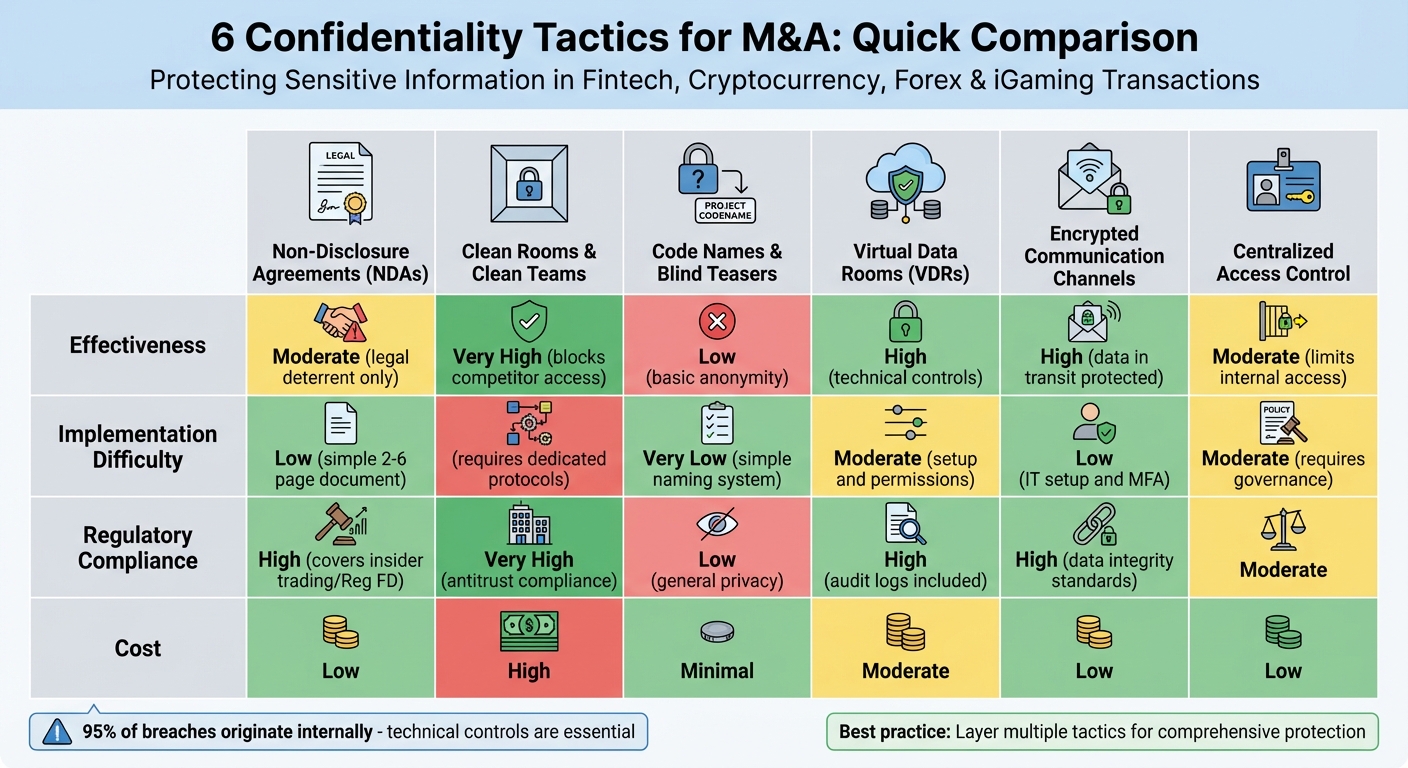
Quick Comparison:
| Tactic | Effectiveness | Implementation Difficulty | Regulatory Compliance | Cost |
|---|---|---|---|---|
| NDAs | Moderate | Low | High | Low |
| Clean Rooms/Teams | Very High | High | Very High | High |
| Code Names/Teasers | Low | Very Low | Low | Minimal |
| VDRs | High | Moderate | High | Moderate |
| Encrypted Channels | High | Low | High | Low |
| Centralized Access | Moderate | Moderate | Moderate | Low |
Using a mix of these tactics ensures confidentiality, protects deal integrity, and aligns with legal requirements.
1. Non-Disclosure Agreements (NDAs)
An NDA serves as the first layer of protection in any M&A deal, legally binding all parties to safeguard sensitive information like financial data, strategies, or customer lists [10][3]. This is especially critical in industries like iGaming, Cryptocurrency, Forex, and Fintech, where licensing and compliance records are key to determining a company’s value. A carefully drafted NDA lays the groundwork for secure and confidential negotiations.
Effectiveness
While NDAs are an important tool, they work best when paired with operational measures like watermarking documents, monitoring virtual data rooms, and releasing information in stages [2][3]. One common issue with NDAs is vague language around what qualifies as confidential, which can complicate enforcement [11][13]. A notable example is the 2012 Delaware Court of Chancery decision in Martin Marietta Materials, Inc. v. Vulcan Materials Co., where the court ruled that using confidential merger details to launch a hostile bid violated NDA terms. This case highlights how strict limits on information use can prevent hostile takeovers [14][15].
When competitors are involved in a deal, standard NDAs are often supplemented with "Clean Team NDAs", which restrict sensitive data from reaching individuals involved in strategic decision-making. This approach helps address antitrust concerns [3]. If a breach occurs, remedies usually come in the form of injunctions rather than financial compensation, as monetary damages often fail to fully address the harm caused by leaked information [13].
Ease of Implementation
NDAs need to be customized for each transaction. Generic templates won’t cut it - courts scrutinize the reasonableness of time limits and the specificity of what’s protected when determining enforceability [11]. Confidentiality obligations in M&A deals typically last one to five years, though trade secret protections can extend indefinitely [10][13]. Non-solicitation and non-hire clauses often span 18 to 24 months [12].
For publicly traded companies, common in sectors like Fintech and iGaming, NDAs must comply with insider trading laws such as Exchange Act Rule 10b-5 and Regulation FD, which prohibit selective disclosure of material non-public information [13][17]. Including a "legally required disclosure" clause ensures that compliance with subpoenas or regulatory requests won’t breach the agreement [13][17]. This tailored approach helps establish the foundation for maintaining confidentiality throughout the deal.
Regulatory Compliance
In tech-driven industries like Fintech and Cryptocurrency, NDAs should also address compliance with export laws, especially when sharing technical information with non-U.S. individuals [13]. For deals between competitors, NDAs must prevent the premature exchange of competitively sensitive information (CSI) - such as pricing or strategic plans - to avoid violating antitrust laws like the Sherman Act or the Hart-Scott-Rodino (HSR) Act [16]. Regulatory bodies like the DOJ and FTC have imposed multi-million-dollar fines for violating these "gun-jumping" restrictions during M&A transactions [16].
"The antitrust laws prohibit two independent companies that are planning to merge from acting as one, and from sharing certain competitively sensitive information with each other, prior to closing their deal." - Mintz [16]
NDAs must also comply with IRS regulations, which prohibit restricting disclosures about tax treatment or structure [17]. Sellers should watch out for "residual" clauses, which allow recipients to use information stored in their employees' "unaided memory" after reviewing confidential materials [13].
Cost
Typically, NDAs are concise documents, running 2 to 6 pages, and should be drafted by experienced attorneys to avoid expensive litigation [17][11][13]. Proving monetary damages for a breach is notoriously difficult, making injunctive relief the most effective - and often costly - remedy [17][13].
To reduce enforcement costs, it’s wise to negotiate clauses for "expense reimbursement" or "attorney fees", requiring the breaching party to cover legal costs [11][17]. Mutual NDAs, where both parties are bound by the same terms, are often quicker and less costly to negotiate since both sides have an incentive to keep the agreement balanced [17].
2. Clean Rooms and Clean Teams
A clean team is a group tasked with reviewing sensitive competitive data - like pricing, customer lists, or production costs - while keeping it confidential from anyone outside the authorized members until legal clearance is granted [18]. A clean room, on the other hand, refers to a secure virtual data room with strict access controls, allowing only authorized individuals to view the data [3].
This method is especially useful in regulated industries such as iGaming, Cryptocurrency, Forex, and Fintech, where licensing and compliance details are critical for valuation. Clean teams also help companies prepare for post-merger actions - like cross-selling strategies or territory planning - while awaiting regulatory approval, reducing the risk of losing value during extended sign-to-close periods [18].
As M&A deals grow longer and more intricate, these tools have become essential.
Effectiveness
Clean teams play a key role in M&A transactions. The average time between signing and closing has stretched to about 6.4 months - a 25% increase over the last two decades - with nearly one in six deals taking over a year to finalize [18]. During these delays, clean teams help ensure "day one" readiness and speed up the realization of synergies.
"A clean team is a neutral body that works under strict confidentiality policies to support companies during various stages of M&A transactions." - Anthony Luu, Partner, McKinsey [18]
Their importance is evident in recent examples. Broadcom's acquisition of VMware in November 2023, for instance, faced an 18-month delay due to regulatory hurdles in China, the EU, and the U.S. In another case, a software company used a clean team for three months after signing to craft a $100 million cross-sell plan, enabling an immediate rollout post-closing [18].
Clean teams also prevent "gun-jumping" violations by keeping sensitive data separate from those involved in pricing or strategic planning [16]. Participants sign a Clean Team NDA, which bans sharing raw data outside the team and requires antitrust counsel to review any summaries before they’re shared with the buyer [3].
Ease of Implementation
Setting up a clean team begins with a formal Clean Team Agreement (CTA) that defines who is authorized, specifies restricted data categories, and outlines how findings will be reported to leadership [16][3]. Challenges include identifying internal staff without competitive decision-making roles and navigating the lengthy legal reviews required for data sanitization [18].
To address this, companies often rely on external advisors, supplemented by select internal experts like FP&A leaders who bring essential knowledge [18]. Only truly sensitive information should be routed through the clean team, while routine administrative data can be handled via standard processes [18].
Clean rooms reinforce security with features like view-only access, disabled downloads, and watermarks [3][18]. If a deal falls through, internal employees who participated in the clean team may face temporary restrictions from working in competitive units to protect the counterparty’s confidential data [3][18].
Regulatory Compliance
Beyond operational benefits, regulatory requirements make clean teams indispensable.
Federal regulations mandate that competitors remain independent until a merger is finalized. Sharing sensitive information prematurely - known as "gun-jumping" - can lead to fines reaching millions of dollars [16][5]. These rules apply even if the transaction doesn’t require a Hart-Scott-Rodino (HSR) filing [16].
"The antitrust agencies... require that competitors engaged in a business combination transaction remain and act as competitors until their merger is consummated." - Mintz [16]
Clean teams must exclude anyone involved in competitive planning, pricing, marketing, or strategy [16][5]. Legal counsel must sanitize and aggregate all findings before sharing them with a joint steering committee. If sharing sensitive data is unavoidable, companies must document the necessity and demonstrate that no less sensitive alternatives exist [16]. In cross-border or heavily regulated deals, clean teams are increasingly tasked with ensuring compliance with data privacy laws like GDPR and other regional standards [18][8].
Cost
Clean teams bring additional costs beyond legal fees. External advisors are essential for maintaining neutrality, adding consulting expenses, while legal reviews for data sanitization further increase costs [18]. However, this investment often proves worthwhile: M&A deals are 2.6 times more likely to succeed when synergy targets are hit within the first two years after closing [18].
"enabling us to quickly exceed our total savings targets." - Integration leader at a global packaging company
Delaying synergy planning until after closing, on the other hand, can lead to substantial value loss.
3. Code Names and Blind Teasers
To safeguard sensitive details during the early stages of mergers and acquisitions (M&A), businesses often turn to strategic naming and confidentiality techniques. One popular approach is using code names (like "Project Falcon") and blind teasers, which help conceal a target's identity before a non-disclosure agreement (NDA) is in place [2][19]. A blind teaser is essentially a one-page summary that outlines high-level information - such as the industry, approximate revenue, and business model - without giving away the company's name or other identifying details [2][19]. Consistency is key: the chosen code name should be used across all communications [1][2].
This method minimizes the risk of competitors, employees, or customers piecing together sensitive information during initial outreach. For instance, in the Verizon/Yahoo! deal, confidentiality breaches resulted in a $350 million reduction in the purchase price [21].
"A teaser includes just enough background on your business to entice buyers, without making it easy for them to reverse-engineer your company's identity." - InvestmentBank.com [19]
Effectiveness
Code names and blind teasers are particularly effective in shielding critical details during the early, highly sensitive phases of a transaction. By keeping the company’s identity under wraps, sellers can gauge buyer interest without sparking market rumors or internal unrest. If too much information leaks, potential buyers might view the company as damaged goods, which could ultimately lower its sale price [19].
This strategy becomes even more crucial for public companies or businesses in regulated sectors like iGaming, Cryptocurrency, Forex, and Fintech. Premature disclosures in these industries can lead to regulatory scrutiny from bodies like the Securities and Exchange Commission or cause stock price volatility [7]. In cross-border deals, where regulatory hurdles are often stricter, code names also help mitigate antitrust risks by avoiding early exposure of sensitive data [6][7].
Ease of Implementation
Implementing this strategy is straightforward: assign a neutral project name and craft a concise blind teaser. Best practices include redacting names and rounding off financial figures to obscure the company’s identity [19]. The code name should be consistently used in all communications - whether in email subject lines, printed documents, or internal discussions - to reduce the chance of accidental disclosures [1][2].
"Use code names or project names for the deal to avoid revealing the actual companies involved." - Welch Capital Partners [1]
A staggered disclosure process is ideal. Start by sharing only the blind teaser, and reveal the company’s identity and financial details only after a qualified buyer signs a legally binding NDA. This layered approach keeps the pool of people with access to sensitive information small, while still enabling serious buyers to assess the opportunity [19][20]. It’s a simple yet effective complement to more complex methods like clean teams and secure data rooms, ensuring confidentiality at every stage of the M&A process.
Cost
The cost of implementing code names and blind teasers is minimal, requiring only administrative effort from internal teams or M&A advisors to prepare sanitized materials and maintain consistent communication practices [1][2]. Unlike more elaborate measures, such as clean teams or virtual data rooms, this tactic doesn’t rely on advanced technology or external consultants. As a result, it’s one of the most budget-friendly ways to protect sensitive information early on. Combined with NDAs and other confidentiality measures, code names and blind teasers form a solid foundation for safeguarding critical details during the M&A process.
4. Virtual Data Rooms (VDRs)
A Virtual Data Room (VDR) is a secure, encrypted online platform designed for sharing sensitive documents. Unlike general cloud storage services, VDRs offer specialized features like granular access controls, user-specific watermarks, and real-time audit trails. These tools allow sellers to control document access, monitor activity, and trace potential leaks effectively [22][23]. VDRs have replaced traditional physical data rooms - secure spaces where paper documents were once reviewed - by providing global accessibility with encryption and multi-factor authentication (MFA) [22][24]. Sellers can also manage information disclosure in stages, holding back the most sensitive details until later in negotiations [2].
"The virtual data room (VDR) may be hosted by the selling company, a third party (such as an investment banker), or by a VDR service provider. Regardless of which hosting option is chosen, the protection of the selling company's trade secrets during the due diligence process requires that the VDR be organized and equipped with appropriate security measures in place." - Tommy Jacks, Of Counsel, Fish & Richardson P.C. [24]
Effectiveness
VDRs are highly effective in reducing confidentiality breaches, particularly since around 95% of such breaches occur internally [19]. By enforcing strict "need-to-know" access, sellers can ensure only key personnel - like top executives, legal teams, and financial advisors - have access to critical data. Regularly monitoring access logs helps detect unusual activity or unauthorized attempts to view restricted files [2]. Many VDR platforms now include AI-driven tools, such as automated redaction, to safeguard sensitive information further. These features are especially valuable in regulated sectors like iGaming, Cryptocurrency, Forex, and Fintech. For transactions involving competitors, "clean rooms" - specialized VDR environments - are used to limit access to a select group of advisors, ensuring that competitively sensitive data remains secure and doesn’t reach a buyer’s operational teams [22][3].
"The use of a clean room allows for compliance with regulatory requirements and ensures that a target's competitively sensitive information is not accessed by individuals who may be involved in competing operational or strategic decision-making activities." - Shaziah Singh, Counsel, Nixon Peabody [3]
These measures not only enhance security but also align with regulatory expectations.
Ease of Implementation
Setting up a VDR is a straightforward process when approached methodically. Most VDRs feature user-friendly interfaces that make organizing files and setting permissions easy. Best practices include disabling downloads for sensitive documents, applying watermarks unique to each user, and using internal code names to prevent accidental disclosure of the target's identity. While monitoring login activity for irregularities is essential, the administrative workload is manageable. For cross-border deals, VDRs eliminate the need for physical travel by providing secure, remote access from anywhere [22].
Regulatory Compliance
VDRs play a crucial role in industries with strict compliance demands by offering enterprise-grade security, detailed permissions, and robust encryption [22]. For companies under SEC oversight, such as those in Fintech or Crypto, VDRs simplify the process of redacting sensitive contract terms that may need to be disclosed publicly [4]. They also help ensure compliance with regulations like GDPR, CCPA/CPRA, and HIPAA [26][27]. To minimize risks, sellers can share template employment agreements early in due diligence instead of full versions [26]. Features like view-only settings and download restrictions, combined with clean room protocols, prevent unauthorized distribution of strategic data. Additionally, VDRs maintain immutable audit trails, which are invaluable for legal and financial audits [22][25].
Cost
While VDRs provide robust security and efficiency, cost is an important consideration. Pricing varies depending on the provider and the complexity of the transaction. Budget-friendly options like SecureDocs start at $250/month with unlimited users, while Box Virtual Data Room offers plans starting at $15/user/month [22]. Mid-range providers, such as Citrix ShareFile ($50/month for 5 users), Digify ($96/month for up to 5 users), and CapLinked ($149/month for up to 5 users), strike a balance between cost and features [22]. For larger, high-stakes transactions, premium providers like iDeals, Intralinks, Datasite, and Ansarada offer custom pricing tailored to the size and security needs of the project. Specialized solutions like DealRoom, which focuses on M&A lifecycle management, start at $1,000/month for basic plans [22].
Though the initial investment may seem high, VDRs reduce operational costs by eliminating physical data rooms and associated travel and storage expenses. They also help prevent costly deal leaks that could harm valuations or derail transactions altogether [19][2]. Flat-rate pricing works well for small and medium-sized businesses, while custom or per-user pricing suits larger, more complex deals [22].
For companies in regulated or high-risk industries - such as those served by MyReadyMade - investing in a VDR is a critical step to protect sensitive information and meet compliance requirements.
5. Encrypted Communication Channels
Encrypted communication channels play a key role in securing communications during mergers and acquisitions (M&A). By safeguarding data both in transit and at rest, these channels offer a layer of protection that standard email simply can't match. Regular email can be intercepted as it moves across public networks, but encrypted platforms rely on protocols like Secure Sockets Layer (SSL), Transport Layer Security (TLS), and Secure File Transfer Protocol (SFTP) to prevent unauthorized access and tampering[29]. Considering that 62% of executives encounter significant cybersecurity threats during M&A transactions[29], encryption is more than just a precaution - it's a necessity.
The risks are undeniable. For instance, 73% of decision-makers say they would walk away from a deal if a data breach were uncovered, and 53% have experienced critical cybersecurity incidents that jeopardized deals[29]. A stark example is Verizon’s acquisition of Yahoo, where breaches affecting over 1.5 billion accounts led to a $350 million price reduction[29].
Effectiveness
Encryption is highly effective when paired with additional security measures. Since 95% of breaches originate internally[19], encryption works best alongside multi-factor authentication (MFA) and strict "need-to-know" access controls. Adding user-specific watermarks to shared documents can also help trace leaks back to their source[2][3]. In highly regulated industries like iGaming, Cryptocurrency, Forex, and Fintech, encryption isn't just a best practice - it’s often a legal requirement. It ensures compliance and minimizes leak risks that could derail valuations or even cause deals to fall apart[28].
Ease of Implementation
Transitioning to encrypted communication tools doesn’t have to be complicated. Many specialized M&A platforms, such as virtual data rooms (VDRs), include encryption, MFA, and granular access controls as part of their package, making the setup process straightforward. That said, governance is key. Companies must enforce strict rules against using unencrypted apps or public file-sharing services. Regular audits of communication activity can also help detect unauthorized access early on[25]. These measures integrate seamlessly with broader confidentiality protocols in M&A.
Regulatory Compliance
Encrypted channels are especially important for deals involving public companies or cross-border transactions. They help businesses comply with laws like GDPR and CCPA/CPRA[8]. In competitive transactions, encrypted platforms provide an added layer of security while ensuring compliance. Additionally, these platforms often generate immutable audit trails, which are invaluable during regulatory reviews[25].
Cost
While encrypted communication channels require an initial investment, the benefits far outweigh the costs. Integrated M&A platforms often bundle encryption with MFA, simplifying the process. Expenses like software subscriptions, staff training, and governance protocols are necessary to protect valuation by preventing leaks[2]. For high-risk industries, this investment is essential to safeguard deal integrity and maintain compliance.
For industries prone to higher risks - such as those supported by MyReadyMade - encrypted communication channels are a non-negotiable tool for protecting both the integrity of the deal and compliance with regulatory standards.
6. Centralized Team Access Control
Centralized access control revolves around assigning role-based permissions to limit access to sensitive data. Instead of granting everyone broad access to confidential documents, this method uses role-based access control (RBAC) to tailor access based on specific job functions. For instance, financial advisors might focus on valuation models, while legal teams review regulatory filings - each group only sees what’s relevant to their role [25]. Like NDAs and secure data rooms, centralized access control helps maintain deal integrity by reducing unnecessary exposure to sensitive information. It works hand-in-hand with other safeguards, such as clean rooms and VDRs, to ensure tight control over access throughout the process.
Effectiveness
Centralized access control is particularly effective in reducing risks tied to human error and social engineering, which account for 68% of data breaches [31]. Industries like iGaming, Cryptocurrency, Forex, and Fintech - where proprietary algorithms and customer data are highly sensitive - rely heavily on this level of control.
In transactions involving competitors, centralized control can also mitigate risks like "gun jumping." By restricting access to a designated clean team, companies can avoid sharing competitively sensitive information prematurely [3][16]. As Mintz explains:
"Failing to maintain competitive independence prior to closing, and failing to wall off certain competitively sensitive information between buyer and seller prior to closing, is called 'gun jumping' and is a very serious violation of the law" [16].
The consequences of such violations are severe, with the Department of Justice imposing fines in the millions.
A case from PCE Companies highlights the risks of lax access control. In one deal, early access given to management employees led to an accidental disclosure of acquisition plans to an external supplier. This forced the seller to speed up the deal timeline and implement a crisis communication strategy to manage the fallout [2].
Another key benefit is real-time monitoring. Automated tools can track access attempts and alert administrators to unauthorized actions, allowing for immediate intervention. These audit capabilities are invaluable for post-transaction compliance, as confidentiality obligations often last three to five years after the deal closes [25].
Ease of Implementation
Implementing centralized access control takes careful planning but integrates well with most M&A systems. Many virtual data rooms (VDRs) already include RBAC features, simplifying the technical setup. The real challenge lies in governance - establishing clear rules about who gets access to what information and when.
One effective approach is to create a "circle of trust", limiting early access to a small group of key executives [2]. As the process advances, access can be gradually expanded. For highly sensitive data, such as customer lists or pricing details, tiered disclosures with redactions, view-only modes, and watermarking can be used [2][3].
Designating supervisory personnel to oversee access management ensures quick resolution of issues. Supervisors should log all access assignments, enabling audits and daily reviews to catch and address potential problems [16][2]. This structured approach naturally aligns with regulatory and audit requirements.
Regulatory Compliance
Centralized access control plays a critical role in adhering to regulatory standards. For example, antitrust and competition laws require competitors in a deal to remain independent until the transaction closes, as outlined under Section 1 of the Sherman Act and Section 5 of the FTC Act [6]. Practical Law emphasizes:
"Competitors involved in a potential deal must remain competitors until the deal closes" [6].
Clean team protocols help ensure compliance with these regulations.
In addition, centralized access control supports data privacy laws by ensuring only necessary personal information is shared [27]. Detailed audit trails further aid compliance verification and incident investigations [25].
Under the SEC’s updated exhibit rules (Regulation S-K), companies can redact commercially sensitive information from public filings only if they "customarily and actually" treat that information as private [4][9]. This makes centralized control essential to prevent accidental disclosures. Similarly, the UK's Data (Use and Access) Act, effective June 19, 2025, demands rigorous due diligence and documentation during M&A processes [30]. Centralized systems provide the tools needed to meet these requirements.
Cost
While centralized access control involves upfront costs - such as VDR subscriptions with RBAC features, staff training, and governance - these expenses pale in comparison to the potential losses from data breaches.
Consider this: 70% of companies experiencing a data breach report major business disruptions, and 29% of breaches stem from third-party vulnerabilities [31]. Leaks can force rushed timelines, lower valuations, and weaken negotiation power [2]. The investment in centralized control pays off by preventing these costly scenarios and safeguarding a company’s competitive edge [8][7].
For industries with stringent regulatory demands, such as iGaming, Cryptocurrency, Forex, and Fintech, centralized access control isn’t just an option - it’s a necessity. Platforms like MyReadyMade offer built-in security protocols tailored to meet these complex requirements, ensuring confidential transactions are handled with care.
Comparison of Tactics
Building on the analysis above, this section breaks down the core strengths and challenges of various confidentiality tactics. Each approach comes with its own set of advantages and limitations. Let’s dive into how these methods stack up.
Non-Disclosure Agreements (NDAs) are a straightforward legal tool that establishes clear boundaries for information use. While they’re cost-effective and easy to implement, NDAs rely on legal enforcement rather than providing any physical or technical barriers to prevent data misuse [17].
On the other hand, Virtual Data Rooms (VDRs) bring technical safeguards to the table. Features like watermarking and access logs offer precise control over who sees what. While setting up and managing permissions requires some effort, VDRs excel at preventing unauthorized sharing of sensitive data [24][3].
For situations involving competitors, clean rooms are indispensable. These environments ensure compliance with antitrust regulations, especially to avoid "gun-jumping" risks - prematurely sharing sensitive competitive information before a deal is finalized. As Mintz points out:
"the Department of Justice has obtained fines reaching several million dollars for parties that violate these antitrust limitations" [16].
Clean rooms demand meticulous protocols, but their role in regulatory compliance makes them essential in high-stakes transactions.
For simpler needs, code names and blind teasers provide anonymity in the early stages of a deal. They’re inexpensive and easy to use but offer limited protection beyond masking identities.
Encrypted communication channels safeguard data during transmission. With proper IT setup and multi-factor authentication, they’re an effective way to maintain the integrity of sensitive exchanges [25].
Lastly, centralized access control helps limit internal exposure to confidential information. However, this method requires strong administrative oversight to ensure proper governance.
Here’s a quick comparison of these tactics across key factors:
| Tactic | Effectiveness | Implementation Difficulty | Regulatory Compliance | Cost |
|---|---|---|---|---|
| NDAs | Moderate (legal deterrent only) | Low (simple 2–6 page document) | High (covers insider trading/Reg FD) | Low |
| VDRs | High (technical controls) | Moderate (setup and permissions) | High (audit logs included) | Moderate |
| Clean Rooms | Very High (blocks competitor access) | High (requires dedicated protocols) | Very High (antitrust compliance) | High |
| Code Names | Low (basic anonymity) | Very Low (simple naming system) | Low (general privacy) | Minimal |
| Encrypted Channels | High (data in transit protected) | Low (IT setup and MFA) | High (data integrity standards) | Low |
| Centralized Access | Moderate (limits internal access) | Moderate (requires governance) | Moderate | Low |
This comparison underscores the importance of layering legal and technical measures to build a strong confidentiality framework. For industries with higher risks - like iGaming, Cryptocurrency, Forex, and Fintech - a multi-tactic approach is essential. Platforms such as MyReadyMade demonstrate how combining these strategies can enhance security during the M&A process. For example, they integrate NDA-protected communications, verified listings for data accuracy, and secure transaction protocols tailored to regulated environments.
This layered approach is particularly critical when dealing with proprietary algorithms, customer databases, and licensing information across 50+ jurisdictions. By blending legal, technical, and access controls, businesses can create a robust defense against both internal and external risks.
Conclusion
Safeguarding confidentiality in M&A goes far beyond just signing an NDA. The findings clearly highlight that a multi-layered strategy - blending legal agreements, technical safeguards, and strict operational protocols - is the most effective way to address both internal and external risks.
Industries managing sensitive assets like proprietary algorithms, customer data, and licensing details cannot afford leaks. As Galvan points out, confidentiality acts as a vital shield, protecting a deal’s valuation, personnel, and strategic opportunities [2]. Interestingly, around 95% of confidentiality breaches are traced back to internal sources [19]. This makes tools like staged disclosure, clean rooms, and virtual data rooms (VDRs) with detailed access controls indispensable.
The optimal approach depends on the specifics of your transaction. For deals involving competitors, clean teams are critical to avoid antitrust concerns. Cross-border transactions require secure platforms with audit trails to meet compliance standards like GDPR and PCI DSS [32]. In early-stage discussions, even basic anonymity measures can play a crucial role in maintaining discretion.
Platforms such as MyReadyMade illustrate how tailored confidentiality measures can secure high-stakes transactions. Their comprehensive solutions ensure that confidentiality protocols align with industry needs and regulatory requirements across more than 50 jurisdictions.
Confidentiality should always remain a strategic priority. Regularly audit vendor security, restrict internal access to a trusted core group, and adopt measures like multi-factor authentication and role-based controls. By combining legal, technical, and operational safeguards, you can protect your deal’s integrity and ensure sensitive information stays secure.
FAQs
What are the advantages of using clean rooms and clean teams in M&A transactions?
Clean rooms and clean teams create a secure space for handling sensitive data during M&A transactions, shielding it from competitors or unauthorized access. By restricting data access to a select group of trusted experts, they help protect trade secrets, prevent leaks, and ensure compliance with privacy laws and competition regulations.
These setups also enable buyers and sellers to share aggregated insights with decision-makers without exposing raw data - a crucial advantage when the parties involved are direct competitors. Beyond that, clean teams can speed up integration planning and synergy assessments before a deal is finalized, cutting down delays and paving the way for smoother transitions. This method keeps the deal on track, minimizes risks, and helps preserve the value of the transaction.
For industries like iGaming, Cryptocurrency, and Fintech - where safeguarding data is paramount - clean rooms and clean teams play a vital role in securely managing sensitive information and ensuring an efficient, trustworthy M&A process.
How do Virtual Data Rooms (VDRs) ensure confidentiality and compliance in M&A transactions?
Virtual Data Rooms (VDRs) play a crucial role in protecting sensitive information during M&A transactions. They provide a secure, cloud-based space where confidential documents are stored and shared. To ensure data safety, files are encrypted both in storage and during transmission. Access is tightly controlled using multi-factor authentication, and deal teams can customize permissions to decide who can view, download, or share specific documents. Plus, real-time activity logs offer a detailed record of user actions, adding an extra layer of oversight.
Beyond security, VDRs help businesses stay compliant with regulations like GDPR and U.S. SEC guidelines. They track who accessed certain files and when, which is vital for regulatory audits. Tools such as dynamic watermarking, redaction capabilities, and instant access revocation reduce the risk of accidental disclosures and help meet legal requirements. Together, these features create a strong system for managing confidentiality and meeting compliance standards during M&A activities.
MyReadyMade incorporates these advanced VDR capabilities to ensure secure and compliant business transactions. Whether in industries like iGaming, cryptocurrency, forex, or fintech, it protects both buyers and sellers throughout the entire process.
Why is encryption important for maintaining confidentiality during M&A transactions, and how does it protect sensitive information?
Encryption plays a crucial role in M&A transactions by transforming sensitive data into unreadable code, accessible only with the appropriate decryption key. This safeguards information from unauthorized access, eavesdropping, and potential data breaches during the exchange of communication.
By securing critical details like financial records, legal documents, and strategic plans, encryption not only protects confidential information but also reinforces trust between involved parties. It ensures adherence to confidentiality agreements and helps preserve the integrity of the deal throughout the process.
Related Articles

Ultimate Guide to Earnout Negotiations in M&A
Structure and negotiate earnouts in regulated M&A with clear metrics, anti-manipulation covenants, and acceleration or escrow protections.
How to Draft M&A Definitive Agreements
Guide to drafting M&A definitive agreements covering deal structure, reps & warranties, indemnities, payment terms, and regulatory compliance.

How IP Affects Tokenization Valuation
How tokenizing patents, copyrights, and trademarks adds liquidity and market value—plus legal, regulatory, and valuation steps.
Looking to Buy or Sell?
Get in touch with our team for personalized assistance