Cross-Border Data Transfers in M&A: Privacy Due Diligence

Cross-Border Data Transfers in M&A: Privacy Due Diligence
In mergers and acquisitions (M&A), privacy risks tied to cross-border data transfers can derail deals, lead to regulatory fines, and damage reputations. Here's what you need to know:
- Privacy Risks: Buyers inherit data liabilities, including past breaches. For instance, Marriott faced regulatory issues years after acquiring Starwood due to a prior data breach.
- Key Regulations: GDPR, CCPA, and laws in China, India, and Russia impose strict rules on data transfers, with fines reaching up to 4% of global revenue.
- Due Diligence Steps:
- Map data flows and assess transfer mechanisms (e.g., SCCs, BCRs, TIAs).
- Review vendor contracts for compliance gaps.
- Use secure data rooms for sensitive information.
- Post-Merger Actions: Isolate systems, align privacy policies, and test incident response plans to ensure compliance.
For industries like Fintech and iGaming, where compliance is critical, expert advisory services can simplify navigating these challenges.
Data Privacy in M&A: Navigating Risks from Diligence to Integration
Privacy Regulations for Cross-Border Data Transfers
Acquiring a business often means navigating a maze of regulatory environments, especially in industries where data plays a central role. When cross-border data transfers are involved, understanding jurisdiction-specific rules becomes critical for successful privacy due diligence.
GDPR Requirements and Global Effects
The General Data Protection Regulation (GDPR) has become a global standard for regulating cross-border data transfers. Chapter V (Articles 44–49) of the GDPR prohibits transferring personal data outside the European Economic Area (EEA) unless the destination country meets certain conditions, such as having an adequacy decision or implementing safeguards like Standard Contractual Clauses (SCCs) or Binding Corporate Rules (BCRs). Since the Schrems II decision, Transfer Impact Assessments (TIAs) are now required to evaluate the legal environment of the destination country.
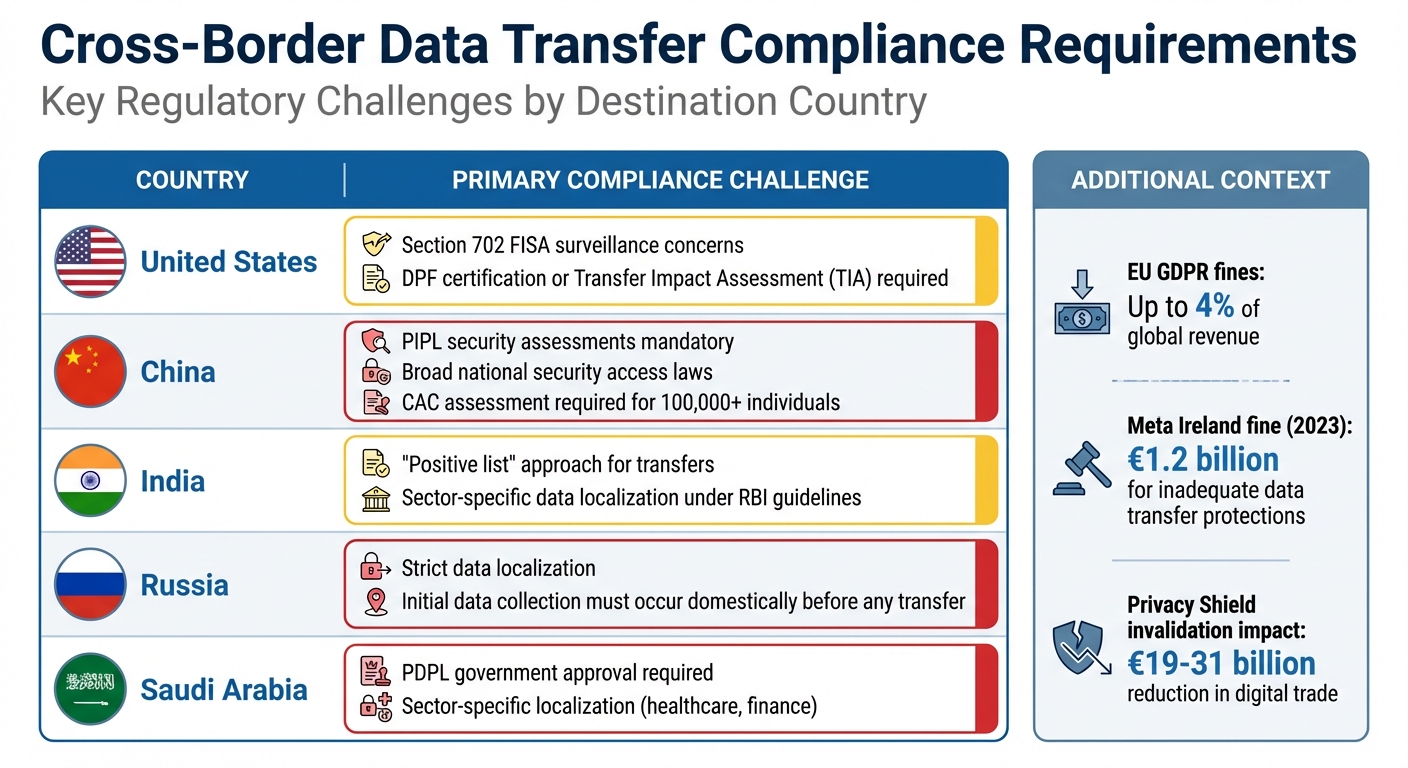
In May 2023, Meta Ireland received a record €1.2 billion fine for transferring EU user data to the U.S. using SCCs that failed to provide sufficient protection for personal data [5].
"Schrems II permanently changed the international transfers landscape: Transfer Impact Assessments are now a standard requirement before using SCCs."
– Sarah Mitchell, Analysis Lead, GDPRScoreCheck [5]
The EU-U.S. Data Privacy Framework (DPF), introduced as a new adequacy mechanism, allows certified U.S. organizations to receive EU data. By early 2026, over 3,000 U.S. companies had self-certified under this framework. However, looming legal challenges - dubbed "Schrems III" - add uncertainty. It’s wise to verify a recipient's certification before relying solely on the framework. For multinational companies, BCRs remain an option, but their lengthy approval process (often taking 2–3 years) can be impractical for fast-moving M&A deals.
CCPA and U.S. Privacy Laws
In the U.S., privacy laws vary widely by state. The California Consumer Privacy Act (CCPA) allows statutory damages of up to $750 per consumer per incident. By April 2026, 14 states had implemented comprehensive privacy laws, focusing on consumer rights such as data access, deletion, and opt-out options. When acquiring a U.S.-based company, it’s crucial to confirm that consent mechanisms are in place, opt-out requests are honored, and vendor agreements comply with state-specific rules.
Global developments in privacy laws add further complexity to cross-border transfers, as outlined below.
New Privacy Regulations
New regional laws are raising the bar for due diligence in cross-border transactions. For example, China’s Personal Information Protection Law (PIPL) enforces strict outbound data transfer rules. Companies classified as Critical Information Infrastructure Operators or those transferring data on 100,000 or more individuals annually must undergo a CAC security assessment, which can delay or block M&A deals involving Chinese data assets.
Other countries have introduced similarly strict measures:
- Saudi Arabia: The PDPL requires government approval for cross-border transfers and enforces data localization in sectors like healthcare and finance.
- India: The DPDP Act uses a “positive list” approach, with strict localization rules under Reserve Bank of India (RBI) guidelines.
- Russia: Data must first be collected domestically before any transfer, per localization laws.
- United States: Section 702 of FISA raises surveillance concerns, requiring DPF certification or a complete TIA for compliance.
| Destination Country | Compliance Challenge |
|---|---|
| United States | Section 702 FISA surveillance; DPF certification or TIA required |
| China | PIPL security assessments; broad national security access |
| India | "Positive list" approach; sector-specific localization |
| Russia | Data localization; initial collection must occur domestically |
| Saudi Arabia | PDPL approval required; sector-specific localization |
The invalidation of past frameworks has significantly impacted digital trade. For instance, the Privacy Shield's invalidation is estimated to have reduced digital trade by €19–31 billion ($22–36 billion). Nearly half (47%) of organizations have expressed doubt about their ability to maintain adequate data protection after Schrems II [4].
"Organizations can no longer treat data transfers as transactional legal matters; they must now conduct ongoing legal and technical scrutiny of every destination jurisdiction."
– Melento [4]
For businesses in regulated sectors like iGaming, Cryptocurrency, Forex, and Fintech, these shifting regulations make compliance a constant challenge. Regular monitoring and flexible strategies are essential to manage the risks tied to cross-border M&A. For tailored guidance in these complex areas, MyReadyMade offers specialized advisory services for high-risk industries.
Privacy Due Diligence on Data Assets
When acquiring a business that manages personal data, evaluating data assets systematically can help uncover compliance issues early.
Data Flow Mapping and Asset Evaluation
Start by documenting the types of personal data and how they move through the organization. This involves identifying categories of data subjects, the kinds of personal information (like names, payment details, or health records), and where this data is stored - whether in cloud servers, physical data centers, or third-party systems [6].
Trace the entire data journey: from collection to processing, storage, and any transfers to external processors. For instance, if the target company uses AWS servers in Ireland but also backs up data in a U.S.-based disaster recovery facility, that cross-border transfer requires its own compliance review.
"Establish the purposes for which the data was originally obtained, your lawful basis for sharing it, and whether these have changed following the merger or acquisition."
– ICO [6]
Ensure the data records are accurate, current, and aligned with retention policies [6]. Assess existing security measures like encryption and pseudonymization. Engaging technical experts to secure database integration is also critical [6].
Once you’ve mapped the data flows, confirm that any international transfers comply with applicable legal standards.
Reviewing Transfer Mechanisms
For international data transfers, identify the mechanisms in place. Are they using the 2021 EU Standard Contractual Clauses (SCCs), Binding Corporate Rules (BCRs), or relying on an adequacy decision? Remember, the deadline for replacing outdated pre-2021 SCCs was December 27, 2022, and failure to comply could lead to enforcement action [3].
If data is being transferred to the U.S., check whether the target company is certified under the Data Privacy Framework (DPF) at dataprivacyframework.gov before relying on adequacy [3]. For UK-related transfers, confirm they’re using the International Data Transfer Agreement (IDTA) or UK Addendum instead of EU SCCs [3]. While some multinational firms like IBM, Marriott, and Johnson & Johnson have EU-approved BCRs, the approval process typically takes 2–3 years, making it unfeasible for most M&A timelines [3].
Transfer Impact Assessments (TIAs)
Building on the transfer mechanism review, TIAs provide a deeper dive into the legal protections in the destination country. EU Data Protection Authorities issued 127 corrective actions for international transfers between 2023 and 2024, with inadequate TIAs being the most common violation [7].
A proper TIA evaluates whether the destination country offers protections equivalent to the EU’s. This includes examining government access laws (like U.S. FISA Section 702), judicial oversight, and whether data subjects have effective legal remedies [3][8]. Companies that combine structured TIA methodologies with customer-managed encryption have reported a 60% reduction in findings during regulatory reviews [7].
"Technical measures provide the strongest protection against government access - contractual measures alone are insufficient."
– Marc ten Eikelder, GDPR Compliance Expert, Kiteworks [7]
Document all legal sources, the rationale for any supplementary measures, and the entire processing chain [3][6]. TIAs aren’t static; they need to be updated when destination country laws change or when transfer volumes significantly increase [3][7]. For businesses in highly regulated industries like iGaming, Cryptocurrency, Forex, and Fintech, specialized advisory services - such as those offered by MyReadyMade - can help navigate these intricate compliance requirements.
This thorough internal data assessment lays the groundwork for evaluating vendor and third-party risks later in the due diligence process, ensuring privacy compliance throughout the M&A journey.
Vendor and Third-Party Risk Assessments
Once you've mapped out internal data flows, it's time to turn your attention outward - evaluating the risks tied to vendors and third-party providers. These external partners often handle sensitive data on behalf of your business, which means their compliance practices can directly impact your own. A thorough due diligence process is essential to address these risks effectively.
Sub-Processor Agreement Review
Start by gathering vendor agreements, data-sharing contracts, and audit records [1]. Pay close attention to whether these documents include cybersecurity clauses like audit rights, data retention and destruction protocols, and security standards. Missing elements in these areas can complicate vendor evaluations.
"Should the target organisation's third-party contracts not contain relevant clauses involving cybersecurity... the acquiring company may not be able to compel the third party to undergo the assessment or divulge important information."
– Erick Gunawan and Jay Gomez, BRG [1]
It’s also critical to verify that vendors hold certifications such as ISO/IEC 27001, ISO/IEC 27701, SOC 2/SOC 3, or PCI-DSS. Review their supporting documentation, including security training records, DSAR forms, and records of processing activities. In cases involving cross-border operations, assess whether local data localization laws could create legal obstacles for system integration or data sharing after the acquisition [1].
Focus your efforts on high-risk assets, particularly in regions with strict data regulations, such as the EU, China, or Canada. This targeted approach helps you manage tight timelines while addressing the most pressing vulnerabilities.
Secure Data Rooms for Due Diligence
In addition to vendor evaluations, ensure secure practices are in place for managing sensitive information during due diligence. Using secure data rooms is key. Before sharing personal data in these spaces, all parties should sign a non-disclosure agreement (NDA) to confirm that the information will be used solely for transaction-related purposes and safeguarded appropriately [2]. It’s best to negotiate the NDA early in the process rather than waiting for the final purchase agreement.
Modern data rooms go beyond simply storing information - they also verify that the data was lawfully collected and shared with proper consent [9]. For example, customer contracts and vendor orders should have personal identifiers, such as names, mobile numbers, and email addresses, redacted unless they’re essential for risk assessments. Avoid relying on generic "compliance with laws" clauses; instead, seek explicit assurances that all data in the room complies with regulations like the GDPR [9].
To mitigate risks from a potentially compromised third-party network, isolate the acquired company’s systems until a thorough risk assessment and penetration testing are completed [2]. Address identified risks through strategies like adjusting the purchase price, setting up indemnity escrows, or including strong representations and warranties related to known or suspected security issues [2].
For industries with heavy compliance demands - such as iGaming, Cryptocurrency, Forex, and Fintech - platforms like MyReadyMade (https://myreadymade.com) can provide expert guidance. They specialize in navigating vendor compliance challenges across over 50 jurisdictions, making them a valuable resource for complex M&A transactions.
Post-Merger Integration and Compliance
Aligning Privacy Policies and Systems
When integrating two companies post-merger, the first step is to isolate the acquired company's systems until a thorough risk assessment is completed. This includes penetration testing to identify vulnerabilities. A cautionary tale is Marriott's acquisition of Starwood in 2016, where legacy system flaws went undetected for years, leading to a breach that exposed around 339 million guest records [2].
"Organizations should ensure appropriate security safeguards, early - ideally before taking control, and certainly before integrating data into existing systems."
– Office of the Privacy Commissioner of Canada (OPC) [2]
To avoid such pitfalls, start by creating unified information security and data privacy policies. This eliminates conflicts between the two organizations' existing frameworks [1]. Consolidating cybersecurity tools is another critical step. Tools that manage consent, Privacy Impact Assessments (PIAs), and Data Subject Access Requests (DSARs) should be merged to improve efficiency and reduce costs [1]. Extend the Security Operations Center (SOC) services to the acquired company, taking advantage of bulk licensing and stronger teams [1].
Before merging databases, seek technical expertise. Mismatched systems can lead to issues like data loss or corruption during the transfer process [6]. Privacy notices and consent mechanisms also need to be updated to align with your compliance standards and cross-border regulations [6]. Data subjects must be informed about changes in data controllers, as they may have legal rights to object under laws like the UK GDPR [6].
Once these unified policies are in place, the focus shifts to implementing clear risk mitigation and remediation strategies.
Risk Mitigation and Remediation Plans
Develop a phased roadmap for compliance, with specific "Day-1" and "Day-100" milestones [10]. Within the first 30 days, secure cyber insurance, update consent frameworks, and provide staff training. By the 100-day mark, consolidate IT security tools, remove redundant data, and establish systems for continuous monitoring [10].
Reducing redundant, obsolete, or trivial (ROT) data is essential. Not only does this lower storage costs, but it also minimizes the risk of breaches. Currently, about 90% of all digital data is unstructured, and it's growing at an annual rate of 55% to 65% [10]. Poor data quality has a massive economic impact, costing the U.S. economy an estimated $3.1 trillion each year [10].
Testing your incident response plan is another key step. Conduct tabletop exercises with the newly combined team to ensure everyone understands their role in case of a breach [2]. Financial safeguards, such as holdbacks, indemnity escrows, or purchase price adjustments, can also help cover unexpected costs like regulatory fines or remediation expenses [2].
The risks are real and significant. For example, Quebec's Law 25 imposes administrative penalties of up to $10 million or 2% of worldwide turnover for non-compliance. Serious violations can result in fines of $25 million or 4% of worldwide turnover [2]. With over 3,000 data breaches reported in 2024 alone [1], proactive risk management is no longer optional.
"In today's environment, privacy is not a box to check - it is a material risk that must be proactively assessed and addressed."
– Jasmine Samra and Sara Josselyn, Gowling WLG [2]
For businesses in heavily regulated industries, expert advisory services can be invaluable in navigating these challenges.
Expert Advisory for Regulated Industries
In regulated sectors, it's critical to map out international data flows and ensure a lawful basis for each transfer post-integration. This could involve using Standard Contractual Clauses or Adequacy Decisions to remain compliant [1].
Platforms like MyReadyMade (https://myreadymade.com) specialize in supporting mergers and acquisitions in regulated industries. They offer expert advisory services for privacy compliance and license transfers across more than 50 jurisdictions. MyReadyMade’s tools help businesses manage complex requirements for cross-border data transfers while maintaining regulatory alignment throughout the integration process.
Additionally, implementing a unified Governance, Risk, and Compliance (GRC) program ensures that third-party vendors and critical supply chains adhere to the same high standards [1].
Conclusion
Privacy due diligence plays a crucial role in cross-border M&A, helping protect deal value, maintain compliance, and ensure smooth business operations. In highly regulated sectors, even minor oversights can lead to hefty penalties - sometimes reaching millions of dollars or a percentage of global revenue.
The Marriott-Starwood acquisition serves as a cautionary tale, highlighting how legacy vulnerabilities can transfer to the purchaser, making them liable for pre-existing privacy issues [2].
To manage these challenges effectively, consider these steps to safeguard your transaction:
- Secure NDAs early and limit information sharing to what’s absolutely necessary [2].
- Evaluate data flows, transfer mechanisms, and third-party contracts to identify any compliance issues before closing.
- Quarantine acquired systems post-merger until thorough security audits and policy alignments are completed [2].
Industries like iGaming, Fintech, and Forex face even more complexity due to strict regulations. Platforms such as MyReadyMade offer specialized M&A advisory services and assistance with license transfers across 50+ jurisdictions. They help businesses navigate intricate cross-border data transfer rules while staying aligned with regulatory demands.
FAQs
What data transfers in an acquisition trigger a TIA?
When sensitive or regulated data crosses borders or surpasses certain volume thresholds during an acquisition, a TIA (Transfer Impact Assessment) is triggered. This process is particularly relevant for data governed by strict privacy and security regulations, like the U.S. Department of Justice's Bulk Transfer Rule or various international privacy laws. Adhering to these regulations is a key part of privacy due diligence during mergers and acquisitions.
How can a buyer verify the target’s SCCs or DPF setup is valid?
Buyers can confirm whether the target's SCCs (Standard Contractual Clauses) or DPF (Data Privacy Framework) setup is valid by performing Transfer Impact Assessments (TIAs). These assessments help ensure that the SCCs align with the latest updates and that the transfer mechanisms meet the legal requirements under current cross-border data transfer regulations.
What should be isolated on Day 1 to avoid inherited breach risk?
On Day 1, focus on isolating the target's data and privacy controls. This step helps minimize the risk of inheriting any security breaches. By doing this, you can clearly identify existing vulnerabilities and prevent potential security issues from being carried over during the transaction.
Related Articles

Ultimate Guide to Earnout Negotiations in M&A
Structure and negotiate earnouts in regulated M&A with clear metrics, anti-manipulation covenants, and acceleration or escrow protections.

How to Draft M&A Definitive Agreements
Guide to drafting M&A definitive agreements covering deal structure, reps & warranties, indemnities, payment terms, and regulatory compliance.

How IP Affects Tokenization Valuation
How tokenizing patents, copyrights, and trademarks adds liquidity and market value—plus legal, regulatory, and valuation steps.
Looking to Buy or Sell?
Get in touch with our team for personalized assistance