Cross-Border License Transfers: Legal Pitfalls
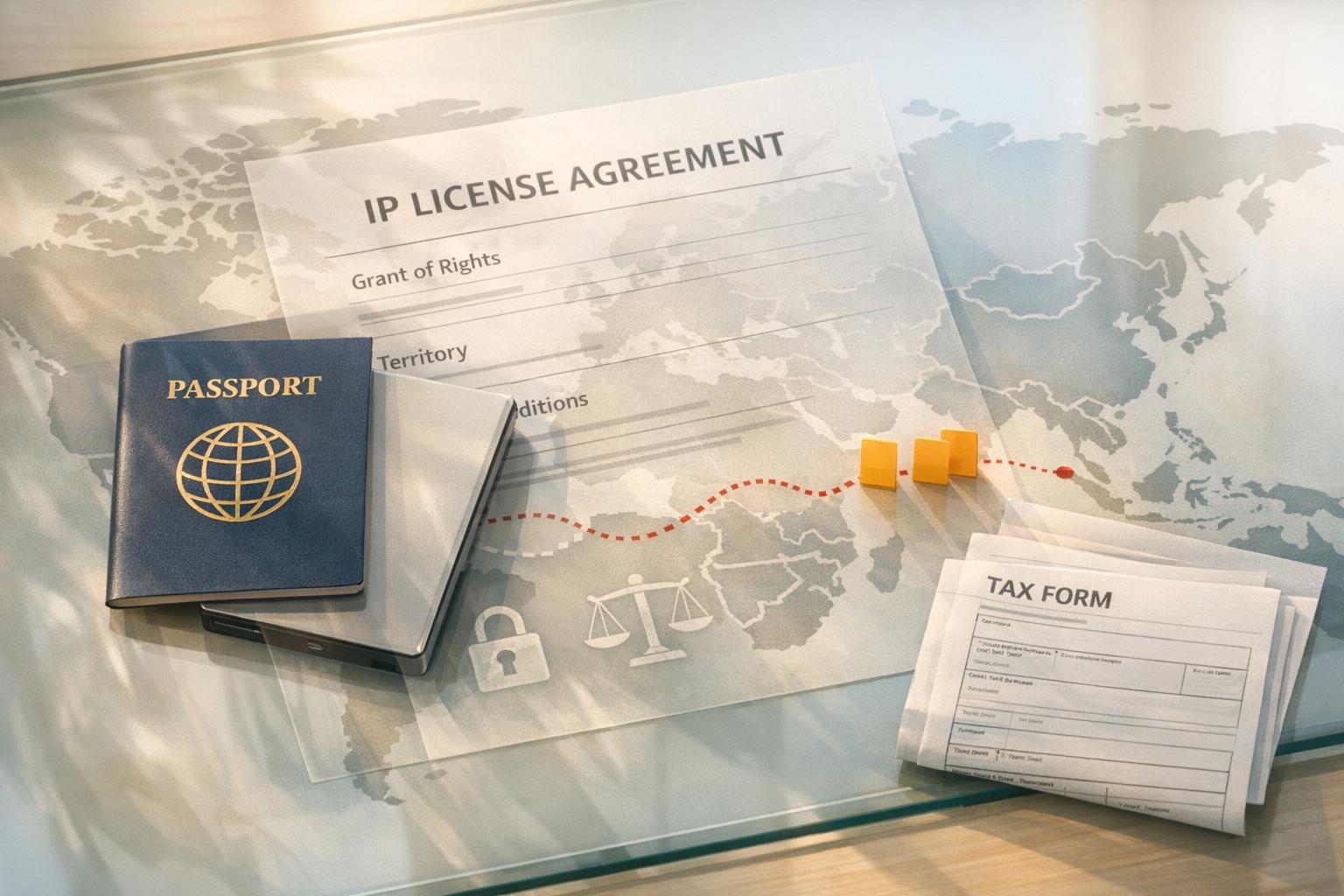
Cross-Border License Transfers: Legal Pitfalls
Cross-border license transfers are complex and can expose businesses to serious legal and financial risks. From jurisdiction-specific rules to tax compliance and data privacy laws, failing to address these challenges can lead to delays, fines, or even failed deals.
Key Challenges:
- Jurisdictional Formalities: Varying registration, language, and legal requirements across countries.
- IP Ownership Issues: Missing documentation or unclear ownership can halt transactions.
- Tax Compliance: Transfer pricing audits, withholding taxes, and double taxation risks.
- Data Privacy Laws: Restrictions like GDPR and data localization rules in regions like the EU, China, and Brazil.
- Software Licensing: Open-source compliance and export control regulations.
Solutions:
- Early Due Diligence: Verify IP ownership and map out regulatory requirements.
- Local Legal Support: Work with experts familiar with jurisdiction-specific laws.
- Tax Planning: Use Double Taxation Agreements and maintain proper documentation.
- Specialized Platforms: Tools like MyReadyMade streamline compliance and speed up deal closures.
Common Legal Pitfalls in Cross-Border License Transfers
Navigating cross-border license transfers can be tricky. Each jurisdiction has its own set of rules, and failing to account for them can lead to delays, fines, or even failed deals. Here's a closer look at some of the common challenges companies face.
Jurisdictional Formalities and Registration Requirements
Many countries require intellectual property (IP) licenses to be registered with their national patent or trademark offices to make them enforceable against third parties[1][2][8]. Without proper registration, licensees might find themselves unable to process royalty payments or protect their rights in court. This is especially true in civil law systems, which cover about 60% of jurisdictions globally and impose stricter compliance rules compared to the more flexible common law systems in places like the U.S., UK, and Australia[3].
Language and drafting requirements can also complicate matters. Some countries demand that agreements be written in the local language and use precise legal terminology to hold up in court. For instance, the U.S. "work-for-hire" doctrine - where IP created by employees automatically belongs to the employer - doesn’t apply in many other countries. This means companies need clear written agreements to secure IP rights from contractors and employees[6][2].
In places like China and India, additional requirements may include using local legal agents or adhering to specific filing formats[2]. Regulated industries face even more hurdles. For example, tech transfer agreements in India often need Reserve Bank approval, while software licenses in some African nations may require telecom regulator reviews[1][2]. On top of this, foreign investment screening mechanisms, like CFIUS in the U.S. or similar EU frameworks, are increasingly monitoring IP transfers involving sensitive technologies such as AI or cybersecurity[2].
Incomplete IP Documentation and Ownership Issues
Ownership clarity is critical, and incomplete documentation can bring transactions to a halt. For example, if a patent was filed under a different entity without a recorded assignment, authorities may refuse to process the transfer, leaving the buyer vulnerable[2]. Some jurisdictions will outright reject applications with gaps in ownership history.
Moral rights can also complicate things. In many countries, creators retain ongoing rights to attribution and integrity, even after selling their economic rights. Without proper waivers or agreements in place, buyers could face unexpected claims or lawsuits.
Tax Implications and Transfer Pricing
Tax compliance is a major concern in cross-border transfers. Tax authorities often view these transactions as high-risk and scrutinize them for transfer pricing violations. For intercompany licenses, prices must align with what unrelated parties would agree to under normal conditions. If companies can’t justify their pricing with solid evidence, they risk audits, penalties, or even double taxation[9][10].
Withholding taxes on royalties can range from 5% to 30%, depending on the country[1]. However, bilateral tax treaties can help reduce these rates - but only if companies maintain proper documentation, like tax residence certificates. Contracts should also specify whether the licensee covers the withholding tax or deducts it from the royalty payment.
A notable case from October 2025 highlights how tax authorities focus on the economic substance of transactions. An Israeli court ruled that a broad license granted to a U.S. parent company effectively transferred economic ownership of IP, even though legal ownership remained with an Israeli subsidiary. This resulted in an exit tax assessment against the U.S. parent[10].
"Tax authorities routinely assert that the IP assigned or licensed in intercompany transactions was under- or over-valued, resulting in costly, high-stakes disputes and potential assessments." - James R. Ferguson and Jason Osborn, Mayer Brown[10]
Authorities use DEMPE factors - Development, Enhancement, Maintenance, Protection, Exploitation - to determine which entity bears the economic risk and should be taxed accordingly. IP holding companies in low-tax jurisdictions must also show they perform real business functions, like R&D or decision-making, to avoid challenges from auditors[9][1].
Data Privacy and Cross-Border Restrictions
Data localization laws are becoming a major obstacle for cross-border technology transfers. Countries like China, Brazil, and those in the EU have strict rules requiring certain types of data to stay within their borders[1][2]. These laws particularly affect software licenses and tech transfers involving user data.
Under GDPR, failing to comply with data transfer rules can lead to fines of up to €20 million or 4% of a company’s global revenue, with total fines exceeding $5.4 billion by early 2025[3][4]. Brazil’s LGPD has similar requirements, mandating the use of Standard Contractual Clauses (SCCs) for cross-border data transfers. Companies must also conduct transfer impact assessments and ensure adequate data protection in receiving countries.
"Data localization requirements can increase…operational risks, hinder risk management and compliance, and inhibit financial regulatory and supervisory access to information." - United States-Singapore Joint Statement on Financial Services Data Connectivity[7]
Software and Open-Source Compliance Challenges
Software licensing, especially when it involves open-source components, presents its own set of challenges. Different countries interpret open-source licenses - like GPL, MIT, or Apache - differently, particularly when it comes to derivative works and distribution obligations. A license structure that works in the U.S. may not comply with local laws elsewhere.
On top of this, software license audits are becoming more frequent and aggressive. Vendors often demand proof of compliance across all international operations. Companies also need to navigate export control regulations, which may restrict certain technologies from being transferred to specific regions or entities.
Understanding and addressing these legal pitfalls is crucial for smooth cross-border license transfers.
sbb-itb-ba142f6
How to Avoid Legal Pitfalls
Early Due Diligence and Local Legal Support
When it comes to cross-border licensing, preparation is key. Start by thoroughly verifying the chain-of-title for your intellectual property (IP). Every assignment must be formally recorded to avoid delays. Missing links in ownership can lead to serious complications, as foreign authorities might reject transfers if the chain isn’t intact [2].
Regulatory mapping is another critical step. If your IP involves sensitive technologies - like artificial intelligence, semiconductors, or defense-related applications - you may run into export controls such as the EAR or ITAR in the U.S. These regulations can even trigger national security reviews, such as CFIUS [2]. Consulting local legal experts early can help you identify and address these risks before they derail your plans.
Tax exposure is another area that requires attention. Withholding taxes on royalties can vary significantly - ranging from 5% to 30%, depending on the country [1]. To minimize tax issues, ensure you have proper documentation for Double Taxation Agreements and confirm that contracts meet local requirements for language, registration, and legal terminology. These steps can save you from enforcement headaches down the line [3][6].
"Good tax planning around IP is not optional in cross-border deals. It is a survival skill." - PatentPC [2]
Also, keep in mind that a U.S.-style license may not translate well internationally. For instance, the "work-for-hire" doctrine, which automatically assigns employee-created IP to employers in the U.S., doesn’t apply in many other countries. In the European Union, creators retain moral rights that cannot be transferred without explicit waivers [6]. Addressing these legal differences upfront can help ensure compliance across jurisdictions. Local legal advisors are invaluable for navigating these complexities.
Using Specialized Marketplaces
After completing due diligence and securing local legal expertise, specialized marketplaces can help simplify the process. Platforms like MyReadyMade connect buyers and sellers with licensed M&A advisors and legal professionals who understand local laws and regulations. Instead of hiring full-time international counsel, you can tap into a network of specialists tailored to your needs - whether it’s a GDPR advisor in Berlin or a tax consultant in Singapore [3].
MyReadyMade also provides verified listings, reducing the risk of issues like incomplete ownership history. The platform supports license transfers in over 50 jurisdictions and offers 24/7 deal support, with most transactions closing in around 30–45 days. This makes it particularly useful in regulated industries like iGaming, Cryptocurrency, Forex, and Fintech, where compliance requirements vary widely by region.
Additionally, the platform includes tools for billing transparency and project management. These features are especially helpful for multi-jurisdictional transfers. By using Standard Contractual Clauses (SCCs) and working with advisors familiar with local data sovereignty laws, you can tackle challenges like data localization and chain-of-title issues. Whether it’s navigating GDPR rules in the EU or meeting data hosting requirements in China, these tools can save you from starting over [3][4].
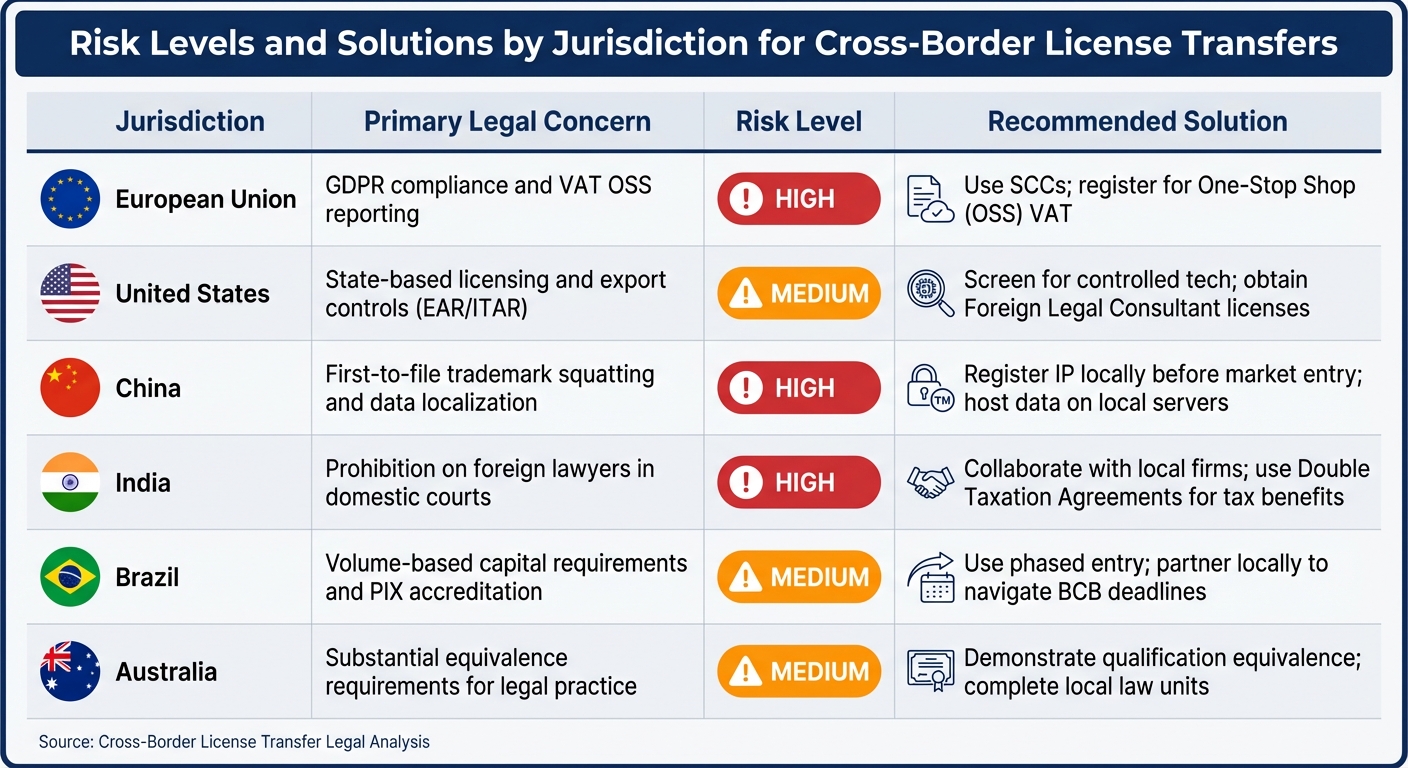
Table: Risk Levels and Solutions by Jurisdiction
| Jurisdiction | Primary Legal Concern | Risk Level | Recommended Solution |
|---|---|---|---|
| European Union | GDPR compliance and VAT OSS reporting | High | Use SCCs; register for One-Stop Shop (OSS) VAT [3] |
| United States | State-based licensing and export controls (EAR/ITAR) | Medium | Screen for controlled tech; obtain Foreign Legal Consultant licenses [2][3] |
| China | First-to-file trademark squatting and data localization | High | Register IP locally before market entry; host data on local servers [2][3] |
| India | Prohibition on foreign lawyers in domestic courts | High | Collaborate with local firms; use Double Taxation Agreements for tax benefits [3] |
| Brazil | Volume-based capital requirements and PIX accreditation | Medium | Use phased entry; partner locally to navigate BCB deadlines [5] |
| Australia | Substantial equivalence requirements for legal practice | Medium | Demonstrate qualification equivalence; complete local law units [3] |
How MyReadyMade Supports Cross-Border License Transfers
Verified Listings and Confidential Transactions
MyReadyMade ensures a seamless chain-of-title through its verified listings. By maintaining a complete ownership history, the platform prevents chain-of-title breaks - issues that arise when there’s missing or unrecorded ownership information. Such gaps can lead to foreign authorities rejecting intellectual property (IP) assignments, causing frustrating delays in approval processes [2].
Confidentiality is another cornerstone of the platform. Trade secrets exposed during transactions can lose their legal protections [2]. To address this, MyReadyMade uses secure, NDA-protected communications from the initial inquiry through to final closing. This is especially critical in regulated industries like iGaming, Cryptocurrency, Forex, and Fintech, where confidentiality isn’t just a preference - it’s a necessity.
"In cross-border deals, protecting trade secrets requires not just contracts, but active operational discipline." – PatentPC [2]
This meticulous approach to documentation aligns perfectly with the platform’s advisory services, ensuring nothing slips through the cracks.
Expert M&A Advisory and Support
Every client benefits from one-on-one guidance provided by a corporate advisor. These experts navigate the complexities of the acquisition process, offering personalized support tailored to your specific goals [11]. Whether it’s regulatory reviews like CFIUS or GDPR or structuring deals to align with your strategy, the advisors are there every step of the way [11].
The support doesn’t end with the transaction. Advisors assist with post-deal essentials such as banking arrangements, licensing, and ongoing compliance [11]. This comprehensive approach proves invaluable, particularly when managing export controls like ITAR or EAR, where missteps can result in multimillion-dollar penalties [2]. Instead of juggling separate legal teams across multiple jurisdictions, you gain access to specialists who are well-versed in local requirements, such as China’s data localization rules, all while streamlining the deal process.
Fast Deal Closures
Time is often a critical factor in cross-border transactions, and MyReadyMade delivers with impressive speed. Most deals are completed within 30–45 days, minimizing operational disruptions [2]. This is especially important in regions like Japan or the EU, where delays in recording assignments can create uncertainty and potentially jeopardize the entire deal [2].
The platform’s 24/7 deal support ensures that transactions progress smoothly, even when multiple time zones are involved. A faster closing timeline also reduces the risk of complications from new regulations. With countries tightening foreign investment rules and data privacy standards, completing a deal quickly can help avoid mid-process challenges [2].
For sellers, MyReadyMade operates on a success-fee basis, meaning you only pay when your business is sold. Buyers, on the other hand, enjoy free access to verified listings and benefit from expert guidance throughout the process. This streamlined, efficient approach makes cross-border transactions less daunting and more achievable.
Conclusion
Cross-border license transfers come with a host of legal and regulatory hurdles that can jeopardize even the most promising deals. These include jurisdictional requirements, incomplete intellectual property (IP) records, tax liabilities, and strict data privacy laws. The financial risks are immense - Meta faced a record-breaking €1.2 billion ($1.3 billion) GDPR fine in May 2023 for unlawful EU-U.S. data transfers, while LinkedIn incurred a €310 million ($337 million) penalty in October 2024 for consent violations [3].
To navigate these challenges, businesses must prioritize early due diligence, enlist local legal expertise, and implement solid data transfer frameworks like Standard Contractual Clauses. Keeping thorough documentation and ensuring tax compliance are equally critical. With civil law systems governing roughly 60% of global jurisdictions and common law systems covering about 30%, understanding these legal frameworks is essential [3]. Additionally, leveraging Double Taxation Agreements can significantly lower withholding tax rates, which often range from 5% to 30%, directly impacting profitability [1].
Specialized platforms can simplify this process by streamlining compliance and reducing delays. MyReadyMade stands out by offering verified listings with complete chain-of-title documentation, eliminating ownership gaps that foreign regulators frequently reject. Its NDA-secured communication tools protect trade secrets, while expert M&A advisors manage critical aspects like CFIUS reviews and GDPR compliance. With deals closing in just 30–45 days across over 50 jurisdictions, the platform ensures smoother cross-border transfers amid increasingly stringent global regulations.
For industries such as iGaming, Cryptocurrency, Forex, and Fintech, where regulations are particularly complex, combining expert guidance with faster timelines can mean the difference between a successful transaction and a costly regulatory setback.
FAQs
What documents prove IP ownership in a cross-border license transfer?
When transferring intellectual property (IP) rights across borders, it's crucial to have documents that clearly establish ownership. This typically includes recorded assignments of rights filed with the appropriate IP office. These assignments can apply to patents, trademarks, copyrights, or designs and serve as proof of ownership, enforceability, and priority.
To avoid potential legal issues, ensure all filings are accurate and meet the specific requirements of the relevant jurisdiction. Small errors or non-compliance can lead to complications down the line.
How can we reduce withholding tax on cross-border royalty payments?
To lower withholding tax on cross-border royalty payments, it’s essential to carefully structure tax clauses in contracts. Incorporate applicable tax treaty provisions, adjust terms to take advantage of reduced treaty rates or exemptions, and revise licensing agreements to align with foreign tax credit rules. Thoughtful planning can reduce tax burdens while staying compliant with international tax regulations.
When do data localization and GDPR rules block a license transfer?
Data localization and GDPR rules can prevent a license transfer when personal data cannot legally leave the EU without proper mechanisms in place. These mechanisms could include an adequacy decision or appropriate safeguards. Additionally, transfers are prohibited if the necessary data protection measures - like ensuring security and accountability - aren’t fulfilled.
Related Articles

KYC vs. AML for Payment Processors: What to Know
KYC confirms identity at onboarding, but only continuous AML monitoring stops payment processors from becoming conduits for financial crime.

Checklist for Secure Player Database Transfers
Step-by-step checklist for secure player database transfers: compliance, encryption, vendor vetting, zero-trust, integrity checks, and audits.
Ultimate Guide to Payment Compliance in iGaming
Roadmap for building compliant iGaming payment systems: AML/KYC, PCI‑DSS, multi‑PSP setup, chargeback controls and jurisdictional risks.
Looking to Buy or Sell?
Get in touch with our team for personalized assistance