Cross-Border M&A: Culture vs. Operations

Cross-Border M&A: Culture vs. Operations
70% of cross-border mergers fail to meet shareholder expectations. Why? Companies often underestimate the challenges of blending people, processes, and compliance across borders. Two key hurdles stand out:
- Culture clashes: Differing values, decision-making styles, and employee engagement approaches can derail integration. For example, nearly 50% of key employees leave after a merger, and misaligned communication styles can increase turnover by 40%.
- Operational obstacles: Regulatory delays, compliance costs, and currency fluctuations are common. In 2025, cross-border deal rejection rates spiked to 8%, and setting up legal entities in foreign markets cost companies around $100,000 per jurisdiction.
To succeed, businesses must address these challenges early. Tools like Employer of Record (EOR) services and platforms such as MyReadyMade simplify compliance and integration, reducing risks and timelines. Balancing people-focused strategies with process-driven planning ensures smoother mergers in regulated industries like iGaming, Fintech, and Cryptocurrency.
1. Cultural Factors in Cross-Border M&A
Integration Challenges
Cultural misalignment is one of the leading reasons cross-border M&A deals fail. The issues often arise in three key areas: differences in organizational purpose, decision-making approaches, and employee engagement styles [5]. For example, when one company values consensus-driven decisions and the other prioritizes rapid actions to tackle financial pressures, the integration process can grind to a halt. Misaligned communication styles can also lead to a 40% increase in key talent turnover [3].
Nearly half of all mergers face cultural conflicts, which can harm both morale and productivity [3]. Employees who feel disconnected from the new culture are 90% less likely to deliver high-quality work and are 11 times more prone to burnout [1]. A striking example of this is the 1998 Daimler-Benz and Chrysler merger. The two companies’ incompatible values ultimately caused a $37 billion loss and led to the deal's failure [3].
To mitigate these risks, companies need to address cultural differences early, ensuring alignment before the integration process is too far along.
Mitigation Strategies
Overcoming cultural friction requires deliberate, early intervention. Yet, only 29% of companies assess cultural factors during due diligence, despite the fact that those who do are more likely to achieve better outcomes. Studies show that businesses successfully managing cultural integration can see returns on investment increase by as much as 30% [3]. One effective approach is perceptions workshops, where teams openly share their views and tackle any misunderstandings head-on [5].
Another strategy involves establishing clear decision-making norms to prevent personal blame for delays. For instance, when Amazon acquired Whole Foods in 2017, it introduced a detailed assimilation plan to merge its tech-driven efficiency with Whole Foods' focus on customer experience [3]. Similarly, Burger King’s merger with Tim Hortons succeeded by relocating its headquarters to Canada, honoring Canadians' deep emotional connection to the Tim Hortons brand [6].
These strategies are especially critical in regulated industries, where unique cultural challenges can amplify integration difficulties.
Industry-Specific Examples
Regulated industries often face distinct cultural hurdles. For example, a fast-moving Silicon Valley firm acquiring a European company may encounter friction due to differing approaches to compliance and operational pace. One U.S. pharmaceutical company merging with a UK biotech startup faced challenges balancing the startup's need for autonomy with the pharma firm's formal hierarchy. The solution? Leadership coaching and cross-functional task forces [6]. Similarly, a Silicon Valley tech company acquiring an Indian software firm tackled cultural clashes - like entrepreneurial speed versus deference to authority - through cross-cultural training and exchange programs [6].
On the other hand, complementary cultures can create immense value. Take Disney’s $7.4 billion acquisition of Pixar as an example. By combining Disney’s expertise in brand management with Pixar’s creative strengths, the partnership more than doubled the company’s market value. Pixar-generated films have since brought in over $20 billion in revenue [3].
Impact on Performance
Successful cultural integration delivers measurable performance improvements. Companies with strong communication strategies are 50% more likely to hit synergy targets within the first year [3]. Actively addressing cultural differences can lead to a 30% boost in employee engagement, and 90% of executives agree that a thriving corporate culture is essential for merger success [3]. Inclusive leadership, in particular, plays a transformative role, multiplying innovation by six times and improving business outcomes eightfold [3].
"Organizations with inclusive leadership are 6 times more likely to be innovative and 8 times more likely to achieve better business outcomes." – Deloitte [3]
Failing to integrate cultures, however, comes at a high cost. Over half of employees would consider leaving if they felt the culture wasn’t a fit post-merger [3]. This risk is even greater in regulated industries, where specialized expertise is both rare and essential. For companies in these sectors - like those highlighted on MyReadyMade - losing key talent can derail the entire integration process. Engaging expert M&A advisors early on can help identify cultural challenges and use the integration phase as a “culture lab” to test and refine strategies before scaling them [5].
2. Operational Factors in Cross-Border M&A
Integration Challenges
When it comes to cross-border M&A, operational hurdles often overshadow other concerns, like cultural alignment. Regulatory approval is one of the biggest obstacles - just one unfavorable ruling can cancel an entire deal [2]. The numbers tell a clear story: in 2025, the rejection rate for cross-border transactions climbed to 8%, a sharp rise from 3% in 2023 [2]. Timelines are another challenge, with cross-border deals typically taking 9 to 18 months to close, compared to just 3 to 4 months for domestic ones [2].
Beyond regulatory delays, setting up operations in a new country is no small feat. Establishing a legal entity in a foreign jurisdiction costs around $100,000 and involves meeting minimum capital requirements, hiring local directors, and navigating complex KYC laws that are constantly evolving [1]. Employee retention also becomes a pressing issue - 47% of key staff typically leave during the initial phase, and within three years, that number rises to 75% [1].
Currency fluctuations add another layer of complexity. Exchange rate shifts can erode deal value, impacting both the purchase price (transaction risk) and financial reporting (translation risk). To combat this, 65% of cross-border deals in 2025 used currency hedging strategies, up from 40% in 2024 [2].
Addressing these operational challenges early is crucial for smooth integration and long-term success.
Mitigation Strategies
The best acquirers tackle operational challenges from the very beginning - starting at the Letter of Intent (LOI) stage. Early engagement with regulators can help avoid last-minute deal collapses. This is especially important as CFIUS reviews surged by 45% in 2025, with 85% of technology-related deals requiring mandatory declarations [2].
Instead of enduring the lengthy six-month process of establishing a legal entity, many companies are turning to Employers of Record (EOR) services. This approach allows businesses to hire and pay employees in new markets immediately while staying compliant, saving over $210,000 per country in setup and maintenance costs [1]. To manage currency risks, forward contracts are used to lock in exchange rates, while collar structures provide downside protection without sacrificing all potential gains [2]. Some companies even build FX adjustment clauses into their purchase agreements, ensuring that prices adjust automatically if currency values shift significantly during extended closing periods [2].
These strategies are especially critical in regulated industries, where operational challenges are amplified.
Industry-Specific Examples
Regulated sectors often face unique hurdles. Technology transactions, in particular, are under intense scrutiny due to concerns around semiconductors, AI, and the handling of sensitive personal data [2]. The European Union's Foreign Subsidies Regulation (FSR), introduced in 2023, has added an extra 3 to 6 months to deal timelines for transactions involving state-backed buyers [2].
Labor laws also vary significantly across borders. For example, the European Commission's Acquired Rights Directive (ARD) prohibits companies from terminating employees during a business transfer, and Collective Bargaining Agreements (CBA) set specific requirements for salaries and benefits [1]. Companies operating across multiple jurisdictions must align employee benefits to avoid attrition and legal risks. Ensuring that acquired employees receive equal or better terms than before is not just a legal necessity but also a key factor in retaining talent [1].
Impact on Performance
Operational execution is what separates successful cross-border deals from failures. Experienced acquirers tend to outperform their less-experienced peers by about 7 percentage points in total shareholder return (TSR) [8]. Intra-regional cross-border deals, where companies acquire targets within their own geographic region, perform even better. These deals deliver an average two-year relative TSR of 1.2%, compared to -0.9% for domestic transactions [8]. The advantage comes from leveraging similar regulatory environments and consumer behaviors while still benefiting from cross-border synergies.
Yet, approximately 60% of M&A deals fail to meet their value expectations due to integration challenges [2]. For businesses in regulated industries, platforms like MyReadyMade can simplify license transfers across 50+ jurisdictions, but expert M&A advisory is often indispensable. Companies that excel in regulatory planning, currency management, compliant hiring, and tech integration are better positioned to achieve the returns that cross-border deals promise. Successfully managing both operational and cultural integration is key to unlocking these benefits.
Global M&A Strategies: Navigating Cross-Border Risks with Euan Rellie & Shawn Whiteside
Pros and Cons
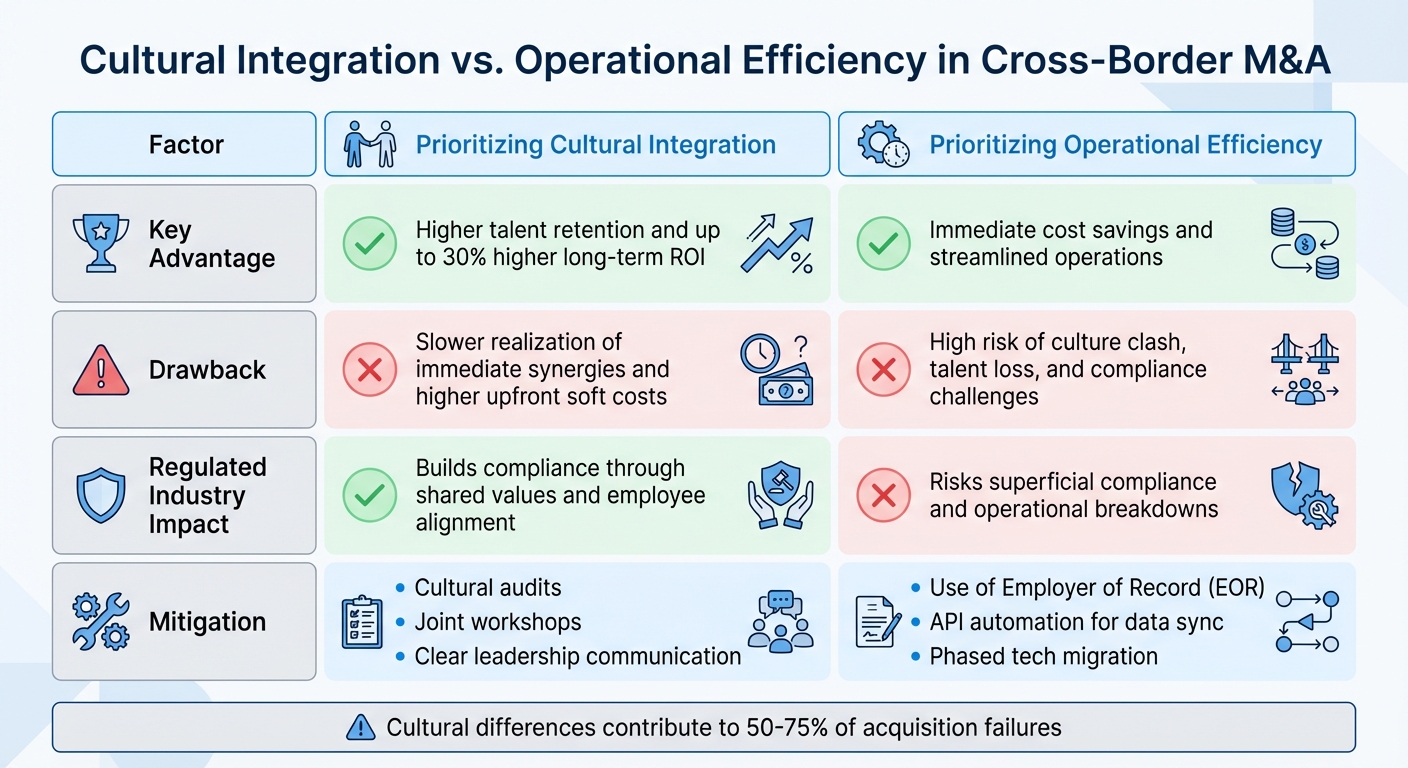
When tackling the challenges of merging businesses, balancing cultural integration with operational efficiency is no small feat. Each approach comes with its own set of trade-offs, and understanding these can help organizations make more informed decisions.
Companies that emphasize cultural integration often see long-term benefits, including up to 30% higher returns on investment compared to those that overlook it[3]. However, this focus requires time and resources. Initiatives like cultural audits, joint workshops, and transparent communication demand significant upfront investment and can delay immediate financial gains[9][4].
On the other hand, prioritizing operational efficiency delivers quick wins, such as cost savings and streamlined processes[9][1]. This is especially crucial in highly regulated sectors like iGaming and Forex, where strict compliance standards must be met. But there’s a catch: moving too fast on operational alignment without addressing cultural differences can lead to clashes, employee turnover, and even compliance pitfalls. As Ian McConnel, Chief Legal Officer at CSC, warns:
"Compliance programs assembled too quickly may look rigorous on paper but struggle in practice."[7]
Here’s a breakdown of the pros and cons of each approach:
| Factor | Prioritizing Cultural Integration | Prioritizing Operational Efficiency |
|---|---|---|
| Key Advantage | Higher talent retention and up to 30% higher long-term ROI[1][3]. | Immediate cost savings and streamlined operations[9][1]. |
| Drawback | Slower realization of immediate synergies and higher upfront soft costs[9][4]. | High risk of culture clash, talent loss, and compliance challenges[9][7]. |
| Regulated Industry Impact | Builds compliance through shared values and employee alignment[7]. | Risks superficial compliance and operational breakdowns[7]. |
| Mitigation | Cultural audits, joint workshops, and clear leadership communication[4][8]. | Use of Employer of Record (EOR), API automation for data sync, and phased tech migration[1][8]. |
These comparisons highlight why an integrated approach is often the best path forward, particularly in regulated industries. For example, Forex companies rely on legal teams to act as cultural interpreters, ensuring cross-border expectations are aligned for effective risk management[7]. Similarly, iGaming firms navigating license transfers across jurisdictions can benefit from platforms like MyReadyMade to simplify operational challenges. However, even with tools like these, fostering trust, alignment, and shared values remains a complex task. It’s worth noting that cultural differences contribute to the failure of 50% to 75% of acquisitions to deliver their promised value[4].
The most successful companies take a balanced approach. They incorporate cultural diagnostics during due diligence, deploy EOR solutions to address compliance and operational gaps, and establish joint leadership early to reduce uncertainty[8][1]. This strategy minimizes the risk of cultural friction derailing projected synergies, ensuring a smoother integration process[9][4].
Conclusion
Cross-border M&A in regulated industries isn’t just about balancing cultural alignment with operational efficiency - it’s about excelling at both. The stakes are high: 70% of cross-border deals fall short of delivering expected value, and 47% of key employees leave after major transactions[1][9]. In industries like iGaming, Forex, and Fintech, where regulatory compliance and institutional expertise are non-negotiable, these failures can have severe consequences.
The companies that succeed approach cultural diagnostics and operational planning as equally critical from the outset. Tools like Employer of Record (EOR) services can shave months off setup timelines and save up to $100,000 per country. At the same time, pulse surveys help gauge employee sentiment, ensuring that operational speed doesn’t create cultural friction - or vice versa, where cultural focus delays essential compliance efforts.
This dual approach is especially valuable when dealing with the intricate demands of multi-jurisdictional compliance. For businesses managing license transfers, navigating complex regulatory frameworks, or addressing cross-border challenges, having specialized support can mean the difference between smooth integration and costly setbacks. MyReadyMade provides verified listings, expert M&A advisory, and license transfer assistance across 50+ jurisdictions. With an average deal close time of 30-45 days, they help regulated industry players handle both the cultural and operational hurdles that often disrupt cross-border transactions.
FAQs
When should cultural due diligence start in a cross-border deal?
Cultural due diligence is best initiated early in the process of a cross-border deal, ideally during the planning and assessment stages. Getting a head start allows you to spot potential cultural challenges and create a solid foundation for smoother integration. Tackling these issues from the outset can help minimize misunderstandings and encourage stronger collaboration between the merging organizations.
How can we keep key employees from leaving after the merger?
Keeping your top talent after a merger requires thoughtful integration strategies that put people first. Start by focusing on cultural alignment and clear communication - two pillars that can make or break employee trust.
Here’s what works:
- Engage employees early. Bring people into the conversation as soon as possible. Address their concerns openly and provide updates to keep them in the loop.
- Clarify career paths. Employees need to know where they stand and what opportunities lie ahead in the merged organization.
- Conduct cultural assessments. During the due diligence phase, assess the compatibility of company cultures. This can help pinpoint potential friction points before they become major issues.
- Invest in onboarding programs. A well-structured onboarding process can smooth the transition, helping employees adapt to new systems, teams, and expectations.
- Proactive HR initiatives. Show employees they are valued by offering support programs, training, or even one-on-one check-ins to address individual needs.
By addressing these areas, you can create a smoother transition and help employees feel supported and valued during what can otherwise be a stressful period.
When is an Employer of Record (EOR) better than setting up a local entity?
An Employer of Record (EOR) is a great solution for companies that need to hire and pay international employees quickly, without the hassle or expense of setting up a legal entity in another country. This approach works particularly well for short-term projects or temporary assignments where creating a local entity isn't practical or worth the investment.
Related Articles

Ultimate Guide to Earnout Negotiations in M&A
Structure and negotiate earnouts in regulated M&A with clear metrics, anti-manipulation covenants, and acceleration or escrow protections.

How to Draft M&A Definitive Agreements
Guide to drafting M&A definitive agreements covering deal structure, reps & warranties, indemnities, payment terms, and regulatory compliance.

How IP Affects Tokenization Valuation
How tokenizing patents, copyrights, and trademarks adds liquidity and market value—plus legal, regulatory, and valuation steps.
Looking to Buy or Sell?
Get in touch with our team for personalized assistance