Crypto License Transfer: Complete Guide for 2025

Crypto License Transfer: Complete Guide for 2025
Transferring crypto licenses in 2025 is a faster alternative to obtaining new licenses, especially for businesses undergoing mergers, acquisitions, or restructuring. With regulatory landscapes evolving, businesses must navigate complex rules for transferring licenses like Money Transmitter Licenses (MTLs), BitLicenses, and custody licenses. Here's what you need to know:
Why Transfer Licenses?
Avoid the time (up to 2 years) and high costs (over $100,000) of obtaining new licenses.Key Changes in 2025:
- U.S. introduced stricter regulations via the SEC and GENIUS Act.
- The UK enforced licensing requirements under its "Draft Order."
- Licensing transfers now require detailed audits and new compliance standards.
Types of Transferable Licenses:
- Money Transmitter Licenses (MTLs): Required for money transmission and wallet services. Costs range from $5,000 to $150,000 per state.
- Crypto Exchange Licenses: Includes New York's BitLicense, which can cost up to $500,000.
- Custody and Broker Licenses: Cover holding assets or acting as brokers. Federal charters now available via the OCC.
Steps to Transfer a License:
- Notify regulators and update compliance frameworks.
- Submit applications through systems like NMLS or FinCEN.
- Provide extensive documentation, including AML/KYC policies, financial records, and personnel vetting.
- Align with state and federal requirements, such as cybersecurity standards (e.g., NIST CSF 2.0).
Post-Transfer Compliance:
Regular audits, transaction monitoring, and filing new IRS forms (e.g., Form 1099-DA) are mandatory to maintain compliance.
Transferring licenses is complex but can save time and resources. Tools like MyReadyMade simplify the process, offering pre-vetted businesses with active licenses and expert advisory support. Whether you’re acquiring a license or managing a transfer, preparation and regulatory alignment are key.
Do you need a Money Transmitter License? | Crypto & Fintech | Adam Tracy
Types of Crypto Licenses You Can Transfer
In the U.S., crypto businesses operate under a two-tier regulatory system. This involves federal registration with FinCEN as a Money Services Business (MSB) and state-level licensing through Money Transmitter Licenses (MTLs) [3]. If you're planning acquisitions or mergers in 2025, it's essential to know which licenses can be transferred.
The three main types of transferable licenses are Money Transmitter Licenses, Crypto Exchange Licenses, and Custody and Broker Licenses. Each comes with specific regulatory requirements, capital thresholds, and approval processes. Here's a closer look at each:
Money Transmitter Licenses (MTL)
MTLs are necessary for businesses involved in money transmission and digital wallet services. These licenses are managed through the Nationwide Multistate Licensing System (NMLS), and transferring them typically requires notifying state regulators about changes in key personnel, such as board members or executives [10].
State capital requirements for MTLs vary widely:
- New York: $500,000
- California: $250,000
- Florida: $100,000
- Texas: $50,000 [9]
Additionally, surety bonds range from $10,000 to $500,000, depending on the state and transaction volume [8]. The overall cost to obtain an MTL can range from $5,000 to $150,000 per state, making multi-state operations a costly endeavor [8].
MTLs are evaluated using the FILMS rating system, which assesses Financial condition, Internal controls, Legal compliance, Management, and Systems. A low rating, such as "4" (Marginal) or "5" (Unsatisfactory), can lead to license suspension or revocation during a transfer or audit [10]. States like Oregon, Vermont, and Connecticut are noted for requiring MTLs for crypto-only businesses to operate legally [12].
Crypto Exchange Licenses
The type of exchange license a business needs depends on whether it deals with securities (regulated by the SEC) or commodities and derivatives (regulated by the CFTC) [3]. One of the most stringent licenses is New York's BitLicense, which covers activities like virtual currency exchange, custody, and token issuance. Obtaining a BitLicense can take anywhere from 6 to 24 months and costs upward of $100,000 in legal and consulting fees [5].
"The fact that a company is registered with FinCEN does not affect whether the company requires a BitLicense."
– New York Department of Financial Services [3]
Transferring a BitLicense requires prior approval from the New York Department of Financial Services (NYDFS) for any major business changes, like ownership transfers [3][5]. The NYDFS also conducts thorough assessments of directors and senior officers during the approval process [3]. Entities with a BitLicense can list certain "Greenlisted" coins (such as BTC, ETH, GUSD, ZUSD, RLUSD) without additional approval, provided they notify the DFS 10 days in advance [3].
Louisiana has also introduced a specialized regulatory framework under the Virtual Currency Business Act (VCBA), adding another layer of licensing requirements for crypto businesses [12]. Interestingly, several major companies, including Bakkt Crypto Solutions and Genesis, voluntarily surrendered their New York licenses between 2024 and 2025 [3].
Custody and Broker Licenses
For businesses offering digital asset custody and brokerage services, additional licenses are required.
Custody licenses allow companies to hold digital assets on behalf of clients. In New York, businesses can choose between a BitLicense and a Limited Purpose Trust Charter. While a BitLicense does not grant fiduciary powers, a Limited Purpose Trust Charter does, and it also exempts entities from needing separate MTLs [3].
Since September 2025, the SEC has recognized state-chartered trust companies as banks for digital asset custody, expanding options for investment advisers [6]. Additionally, in December 2025, the OCC gave conditional approval for national trust bank charters to five entities, including Ripple National Trust Bank and Fidelity Digital Assets. These approvals brought them under a federal regulatory system that oversees more than $85 trillion in assets [7].
The Infrastructure Investment and Jobs Act broadened the definition of "broker" to include DeFi protocol front-ends and NFT marketplaces. These entities now face new reporting requirements, such as filing Form 1099-DA starting in the 2025 tax year [5][11]. Brokers must report gross proceeds from digital asset sales in 2025, with cost-basis reporting becoming mandatory in 2026 [11]. Non-compliance with FinCEN's MSB requirements can result in penalties of up to $5,000 per violation per day [5].
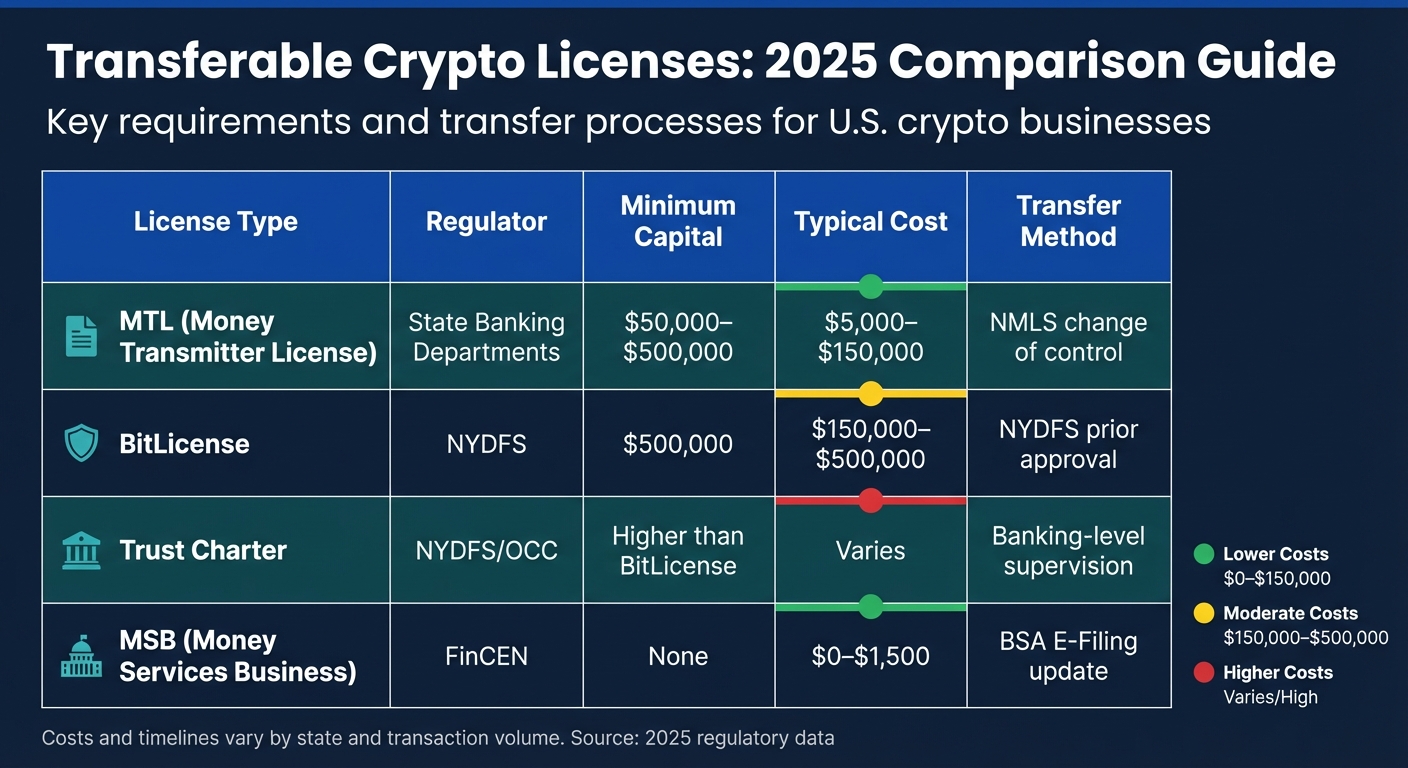
| License Type | Regulator | Minimum Capital | Typical Cost | Transfer Method |
|---|---|---|---|---|
| MTL | State Banking Depts | $50,000–$500,000 | $5,000–$150,000 | NMLS change of control |
| BitLicense | NYDFS | $500,000 | $150,000–$500,000 | NYDFS prior approval |
| Trust Charter | NYDFS/OCC | Higher than BitLicense | Varies | Banking-level supervision |
| MSB | FinCEN | None | $0–$1,500 | BSA E-Filing update |
How to Transfer a Crypto License: Step-by-Step
Transferring a crypto license in the U.S. is a detailed process that requires formal approval from regulators. This is often treated as a "change of control" or a "material change of business." At the federal level, you’ll need to update your FinCEN MSB registration, while state-level Money Transmitter Licenses are managed through the Nationwide Multistate Licensing System (NMLS) [8]. Federal updates typically take 2–4 weeks, while state approvals can range from 6–18 months. For those transferring a New York BitLicense, the New York Department of Financial Services (NYDFS) conducts a rigorous review, including FBI-verified fingerprints and financial background checks for new ownership and management [8].
Due Diligence and Regulatory Notification
Before engaging with regulators, ensure your compliance framework is up to date. This includes reviewing AML/KYC policies to meet 2025 standards and ensuring adherence to the Travel Rule, which mandates collecting and transmitting customer information for transactions exceeding $3,000 [2].
For New York licenses, submit a formal notification to the NYDFS through the NMLS [3]. In California, with the Digital Financial Assets Law (DFAL) set to take effect on July 1, 2026, align your systems with the NIST Cybersecurity Framework (CSF) 2.0 before initiating the transfer [4].
"An application will not be deemed ready for substantive review until the Department has received all required information, documents, and fees... and the required documents appear to be facially adequate."
– New York Department of Financial Services [3]
Once notifications are complete, begin compiling the necessary documentation.
Preparing Documentation
To proceed, gather key corporate documents like Articles of Incorporation, ownership charts, and a list of controlling persons [8]. Compliance documentation should include:
- Written AML/KYC/CTF policies
- A Customer Identification Program (CIP)
- Transaction monitoring procedures
- OFAC/sanctions screening protocols
You’ll also need financial documents such as audited financial statements, proof of minimum capital reserves, and confirmation of your surety bond, which can range from $10,000 to $500,000 depending on the state [8]. Personnel vetting documents, including resumes, background checks, and FBI-verified fingerprints for key roles, are also required. State regulators will assess whether the new leadership meets the "Fit and Proper" standards expected of regulated crypto businesses [8].
Submitting Transfer Applications
File state license transfer applications through the NMLS Company Account Request Form [3]. For federal updates, use FinCEN's BSA E-Filing System to update your MSB registration to reflect the ownership change [8].
Application fees vary significantly. State-level Money Transmitter License transfers can cost between $5,000 and $150,000 per state. For a New York BitLicense, costs - including legal and consulting fees - can range from $150,000 to $500,000 [8].
A notable example is Bullish US Operations LLC, which successfully obtained both Virtual Currency and Money Transmitter Licenses from the NYDFS in September 2025. Their approval highlighted the importance of operational readiness and robust risk management during the license transfer process [3].
Once the application is submitted, focus on aligning your operations with regulatory requirements.
Post-Transfer Compliance
After your license transfer is approved, ongoing compliance is critical. This includes filing Suspicious Activity Reports (SARs) and auditing your AML/KYC systems regularly [8]. Additionally, starting January 1, 2026, brokers must file Form 1099-DA with the IRS to report gross proceeds and cost-basis information for digital asset sales [11].
Train new management on regulatory standards and upgrade your technology to enable real-time monitoring. For those managing a New York license, it’s important to check which digital assets are on the DFS Greenlist - such as BTC, ETH, GUSD, and RLUSD. These assets can be listed without separate approval if you notify the DFS at least 10 days in advance [3].
Staying compliant during and after the transfer ensures a smooth transition and continued regulatory approval.
Jurisdiction Comparison for Crypto License Transfers
Choosing the right jurisdiction can save time and money while avoiding unnecessary regulatory hurdles. In the U.S., licensing requirements vary widely by state, creating a fragmented landscape. For example, Wyoming and Florida waive money transmitter license (MTL) requirements for crypto businesses, making them attractive options. On the other hand, New York's BitLicense is known for being both expensive and slow to process, often taking up to two years and costing hundreds of thousands of dollars [15]. Meanwhile, the European Union provides a streamlined alternative with its MiCA framework, enabling businesses to operate across all 27 member states with a single license.
A significant development occurred in December 2025 when some U.S. entities received conditional approval from the OCC, allowing them to bypass state-by-state licensing and operate under federal oversight [14]. Ripple CEO Brad Garlinghouse commented on this shift:
"To the banking lobbyists – your anti-competitive tactics are transparent... here's the crypto industry – directly under the OCC's supervision and standards – prioritizing compliance, trust and innovation" [14].
The table below highlights key differences across jurisdictions, helping businesses navigate licensing requirements, costs, and timelines.
Comparison Table of Jurisdictions
| Jurisdiction | License Type | Application Timeline | Estimated Costs | Key Requirements | Tax Considerations |
|---|---|---|---|---|---|
| New York | BitLicense | 6–24 months | $150,000–$500,000 | $500,000 minimum surety bond; NMLS filing | 4%–10.9% state income tax |
| California | DFAL License | Deadline: July 1, 2026 | Non-refundable fee | NIST CSF 2.0 alignment; risk-based AML program | 1%–13.3% state income tax |
| Wyoming | Exempt from MTL | N/A | Low | Fintech Sandbox for testing | 0% state income tax |
| Florida | Exempt from MTL | N/A | Low | Pilot program for state fee payments in crypto | 0% state income tax |
| Texas | MTL Required | Varies | $10,000–$150,000 | Custody services via state-chartered banks; tax abatements for miners | 0% state income tax |
| U.S. Federal | OCC National Trust Charter | Conditional approval | High (legal/compliance) | Fiduciary and custodial focus; Federal Reserve access | Federal tax applies |
| European Union | MiCA CASP | 3–5 months | €50,000–€150,000 | Crypto-asset white paper; physical office; passporting across 27 states | Varies by member state |
| Hong Kong | VATP / Stablecoin | 6+ months | High | Retail protection focus; strict token listing criteria | Progressive rates up to 17% |
| Singapore | PSA License | 6+ months | Moderate to high | Operational resilience; custody segregation under Payment Services Act | Varies |
Some states like New Hampshire also provide favorable conditions, exempting crypto businesses from MTL requirements and imposing no capital gains tax. Similarly, Hawaii removed its MTL requirements for exchanges in 2024, although it still enforces state income tax of up to 11% [15]. For those prioritizing tax efficiency, Puerto Rico stands out with 0% capital gains tax on assets acquired while living there, though certain tax decrees come with a $5,000 annual fee [15].
Globally, the cryptocurrency market reached a record valuation of $4 trillion by 2025. Additionally, 85 out of 117 jurisdictions have adopted or are in the process of adopting the FATF Travel Rule for virtual assets [16]. Despite growing global alignment on regulatory standards, the costs and timelines for transferring crypto licenses remain highly dependent on your chosen jurisdiction.
sbb-itb-ba142f6
Legal and Compliance Requirements
Transferring a crypto license in 2025 comes with a host of strict legal obligations. At the heart of every transfer are Anti-Money Laundering (AML) and Counter-Terrorist Financing (CTF) compliance requirements. Regulatory bodies like the NYDFS and California's DFPI mandate that any new owners, directors, or senior officers undergo thorough "character and fitness" evaluations to ensure they meet high standards of integrity [2][19].
The new license holder must provide a detailed, documented AML/CTF framework. This includes a Business-Wide Risk Assessment, Customer Risk Assessment, and the appointment of a qualified Money Laundering Reporting Officer (MLRO) - all tailored to the specific business model [18][13]. These requirements are critical, as demonstrated by the February 2025 case where the operator of the OKX exchange pleaded guilty to running an unlicensed money transmitting business. The company faced $504 million in penalties for failing to comply with AML laws [21].
Another key compliance measure is adhering to the Travel Rule, which requires secure systems for sharing personally identifiable information (PII) on transactions over $3,000 [2][17]. Additionally, in September 2025, the NYDFS issued updated guidance on custodial structures, focusing on client fund segregation to safeguard assets in cases of insolvency. This is a pivotal requirement for entities acquiring a BitLicense [3]. Alongside these measures, technical safeguards play a crucial role in achieving full regulatory compliance.
Cybersecurity is another area where lapses can have severe consequences. Digital assets are prime targets for hackers, and weak security protocols can jeopardize a license transfer. For instance, in February 2025, the FBI reported that North Korean actors stole $1.5 billion in digital assets from the Bybit exchange [21]. To meet California's DFPI standards, applicants must align their cybersecurity and operational security programs with the NIST Cybersecurity Framework (CSF) 2.0 [4]. Conducting an independent AML audit before the transfer can help uncover any compliance gaps that might delay regulatory approval [1].
For stablecoin issuers, maintaining a 1:1 reserve backing in high-quality liquid assets is mandatory under the GENIUS Act of 2025 [20]. Similarly, the EU's MiCA regulations require stablecoin issuers to hold at least 30% of their funds in segregated bank accounts [20]. Failure to verify these reserves through independent audits can not only derail the transfer process but also expose the acquiring entity to potential liabilities for the previous owner's compliance failures.
Using MyReadyMade for Crypto License Transfers
Navigating the complexities of transferring crypto licenses can be a long and daunting journey, often taking anywhere from 6 to 18 months [8]. MyReadyMade simplifies this process by providing a curated selection of verified crypto businesses with active licenses across more than 50 jurisdictions. This approach removes much of the uncertainty and lowers the risk of compliance issues.
To protect sensitive information - such as AML policies, KYC protocols, and audit results - MyReadyMade employs NDA-protected communications [5]. This confidentiality not only safeguards critical data but also helps maintain reputational integrity and secure banking relationships throughout negotiations.
What sets MyReadyMade apart is its efficiency. With 24/7 deal support, the platform significantly shortens the due diligence timeline, completing transactions in an average of 30 to 45 days instead of the typical three to six months [22]. Its AI-powered valuation tool digs deeper than surface-level pricing, aligning with Warren Buffett's wisdom:
"A sales pitch gives you the price, while due diligence gives you the value."
The tool analyzes a range of complex data - financial records, legal status, compliance frameworks, and even factors like cybersecurity readiness and human-AI collaboration. These insights are especially important as such factors increasingly influence market valuations in 2025 [22].
Additionally, MyReadyMade offers expert M&A advisory services to guide clients through regulatory approvals. Since license transfers are often classified as "material changes of business", they require prior approval from authorities like the New York Department of Financial Services (NYDFS) [3]. Having advisors with jurisdiction-specific expertise can be the key to avoiding costly delays and ensuring a seamless transition.
To make the process even more accessible, MyReadyMade uses a transparent fee structure. Sellers pay a success fee upon completing a sale, while buyers can browse verified listings at no cost. This straightforward model keeps the focus on efficiency and trust.
Conclusion
Transferring a crypto license in 2025 isn’t just about ticking boxes - it’s about navigating a maze of regulatory requirements. From meeting FinCEN’s money transmitter rules to satisfying state-specific financial thresholds and securing surety bonds, the process demands precision and preparation[23]. On top of that, regulators will closely scrutinize the "character and fitness" of your officers to ensure they’re financially and operationally capable.
This isn’t a one-and-done task. Maintaining compliance requires ongoing diligence. Appointing a qualified Money Laundering Reporting Officer, conducting independent AML and cybersecurity audits (aligned with frameworks like NIST CSF 2.0), and using blockchain analytics tools to monitor sanctions compliance are critical steps. These efforts not only meet regulatory expectations but also protect your business from potential legal trouble.
Timing plays a crucial role, too. Approval timelines vary widely depending on the jurisdiction - some states offer streamlined processes, while others involve lengthy reviews. This makes finding alternative, efficient solutions even more valuable.
The traditional approach of applying for a license directly is often slow, costly, and complicated. Platforms like MyReadyMade simplify the process by providing access to verified crypto businesses with active licenses in over 50 jurisdictions. They can reduce the timeline from months to just 30–45 days, offering NDA-protected communication, 24/7 deal support, and expert M&A advisory services. They also handle jurisdiction-specific regulatory hurdles that typically slow down transactions.
To ensure success in 2025, proactive planning and strong operational foundations are essential. Strategies like pre-application meetings with case officers, demonstrating economic substance through local offices and resident personnel, and leveraging specialized compliance tools can make the transfer process smoother. Whether you’re managing a merger, acquisition, or operational shift, thorough preparation and the right support can make all the difference in securing your license transfer.
FAQs
What are the main steps to transfer a crypto license in 2025?
Transferring a crypto license in 2025 requires navigating several important steps to meet U.S. regulatory standards. Start by determining the correct jurisdiction for the transfer. Check if federal registration with FinCEN as a Money Services Business (MSB) is necessary, along with any state-specific Money Transmission License (MTL) requirements. Keep in mind that fees for state licenses can vary significantly, ranging anywhere from $0 to $150,000, depending on the state.
Next, perform a detailed due diligence review of the existing license. This should include examining the entity's compliance history, Anti-Money Laundering (AML) and Know Your Customer (KYC) policies, and identifying any unresolved regulatory issues. Once due diligence is complete, gather all required documentation, such as updated corporate charters, shareholder agreements, and officer appointments. Submit the transfer application along with the necessary fees to the appropriate regulatory bodies. Be prepared for regulators to request additional information or impose conditions during the review process.
Once the transfer is approved, the new license holder must implement strong compliance programs to meet ongoing obligations like KYC, AML, and cybersecurity measures. Keeping up with regulatory updates is essential to ensure the license remains valid and in good standing.
How will the updated 2025 regulations affect crypto license transfers?
The 2025 regulatory updates bring some clarity to federal requirements for transferring crypto licenses while tightening state-level and industry-specific rules. On the federal side, the process has become more straightforward, thanks to the SEC providing clearer guidance on how securities laws apply to crypto assets. However, licenses involving security tokens now face stricter standards, requiring updated disclosure and registration compliance before they can be transferred.
State-level compliance, on the other hand, remains a maze of varying regulations. For instance, transferring a license often means updating FinCEN MSB registration, obtaining necessary state money-transmitter licenses, and, for those operating in New York, adhering to the strict NYDFS BitLicense requirements. Beyond these, due diligence is crucial. Buyers must ensure the seller’s KYC/AML programs, broker-dealer registrations, and custody arrangements align with the latest regulations. While federal updates may simplify certain aspects, navigating state-specific and industry-focused compliance remains a critical part of the process.
What costs should I expect when transferring a crypto license?
The cost of transferring a crypto license varies depending on the type of license and the jurisdiction that issued it. For instance, transferring a money transmitter license - often required by exchanges and wallet providers - comes with expenses like filing fees, background checks, and renewal charges, which can add up to several thousand dollars. Similarly, obtaining or transferring New York’s BitLicense involves filing fees and annual charges, making it a considerable financial undertaking. State-specific licenses, such as California’s Digital Financial Assets Law, may also include additional costs like compliance reporting and supervisory fees.
To avoid surprises, it’s important to carefully review the latest fee schedules from the appropriate regulatory authorities. Make sure to include all potential expenses in your planning, such as application fees, legal consultations, compliance audits, and any escrow-related payments, to ensure a thorough and accurate budgeting process.
Related Articles

Ultimate Guide to Earnout Negotiations in M&A
Structure and negotiate earnouts in regulated M&A with clear metrics, anti-manipulation covenants, and acceleration or escrow protections.

How to Draft M&A Definitive Agreements
Guide to drafting M&A definitive agreements covering deal structure, reps & warranties, indemnities, payment terms, and regulatory compliance.

How IP Affects Tokenization Valuation
How tokenizing patents, copyrights, and trademarks adds liquidity and market value—plus legal, regulatory, and valuation steps.
Looking to Buy or Sell?
Get in touch with our team for personalized assistance