Data Security in iGaming: Player Database Migration Guide

Data Security in iGaming: Player Database Migration Guide
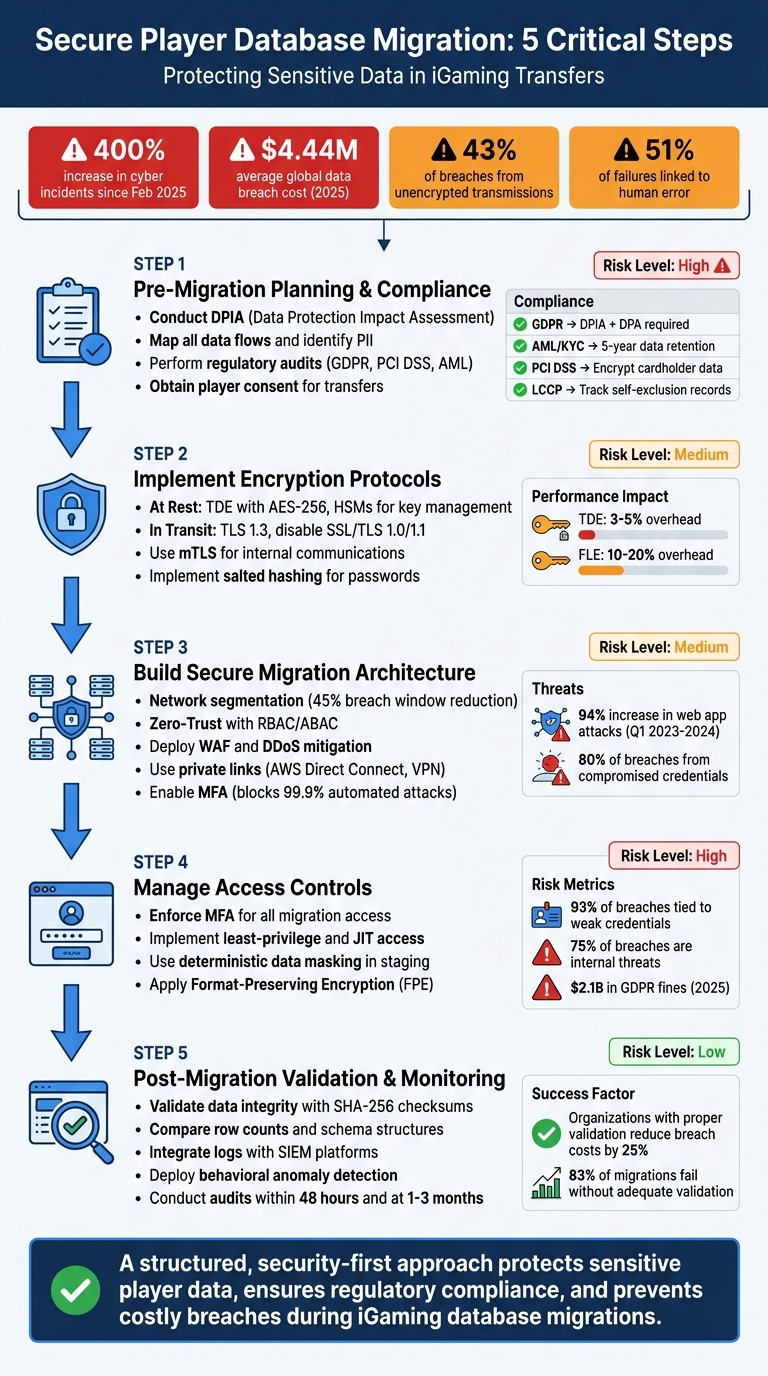
When transferring sensitive player data in the iGaming sector, security and compliance are non-negotiable. Database migrations often occur during acquisitions, upgrades, or provider changes, and mishandling this process can lead to data breaches, regulatory fines, and loss of player trust. Here's what you need to know:
- Key Risks: Cyber incidents have risen 400% since February 2025, with 43% of breaches caused by unencrypted transmissions and 51% linked to human error.
- Compliance Requirements: Regulations like GDPR, PCI DSS, and AML demand encryption, lawful data handling, and proper retention schedules.
- Encryption: Protect data at rest (e.g., TDE, HSMs) and in transit (e.g., TLS 1.3, mTLS). Use strong encryption standards like AES-256.
- Access Controls: Enforce role-based access, multi-factor authentication, and least-privilege principles to reduce breach risks.
- Testing and Validation: Mask sensitive data in staging environments, conduct integrity checks using checksums, and simulate migrations to identify weak points.
- Post-Migration Monitoring: Use tools like SIEM for real-time threat detection and anomaly tracking to ensure ongoing security.
Why It Matters: The average cost of a data breach reached $4.44M globally in 2025, and poor migration planning can lead to service disruptions or compliance failures. By following a structured, secure approach, operators can protect sensitive data and avoid costly mistakes.
Security Risks During Data Migration
sbb-itb-ba142f6
Step 1: Pre-Migration Planning and Compliance Assessment
Before starting a data migration, it's crucial to identify the regulations that apply and understand where your data is currently stored. Operators need to ensure compliance with rules like GDPR, PCI DSS, AML, and gambling regulations specific to their jurisdiction.
Failing to comply with GDPR during high-risk activities, such as data migrations, can result in fines reaching up to 4% of an organization’s annual global revenue [5].
Conducting Regulatory Audits and Mapping Data Flows
Start by performing a Data Protection Impact Assessment (DPIA) to evaluate risks tied to migrating large-scale player databases. Record this activity in your Record of Processing Activities (ROPA) to maintain traceability for regulators [5][6].
Once risks are identified, map all data flows to maintain oversight. Pay special attention to personally identifiable information (PII) in your source database. For example, responsible gambling indicators like addiction flags might fall under GDPR Article 9 as health data, requiring stricter handling [6]. Custodia Privacy emphasizes:
The line between legitimate service personalisation and surveillance‐style profiling that exploits vulnerable players is not just an ethical question - it is a regulatory one [6].
AML regulations require keeping transaction and Know Your Customer (KYC) records for five years after the business relationship ends [6]. To avoid conflicts between GDPR's "storage limitation" principle and AML retention rules, implement a clear retention schedule [5][6].
For cross-border data transfers, use Standard Contractual Clauses (SCCs) or Binding Corporate Rules (BCRs) when moving data from the EU to non-EU countries [7]. Keep in mind that some jurisdictions, like Russia (Law 242-FZ) and India (DPDP Act 2023), require personal data to be stored and initially processed on local servers [7].
| Regulation | Key Migration Requirement | Required Documentation |
|---|---|---|
| GDPR | Only migrate necessary PII (data minimization) | DPIA; Data Processing Agreement (DPA) [5] |
| AML/KYC | Retain data for 5 years post-relationship | Transaction logs; identity verification records [6] |
| PCI DSS | Encrypt cardholder data at rest and in transit | Audit trails; encryption certificates [4] |
| LCCP (UK Gambling Commission) | Track self-exclusion and risk profiles | Behavioral data logs; regulatory access pathways [6] |
| PECR | Maintain marketing consents and suppression lists | Consent records; opt-out documentation [6] |
If using third-party migration tools, ensure they comply with regulations by verifying their documentation through a Data Processing Agreement (DPA) or Business Associate Agreement (BAA) [5].
Obtaining Player Consent for Data Transfers
After completing audits and mapping data, establish a lawful basis for all data transfers. GDPR Articles 5 and 6 require you to document the legal basis for migrating player data and explain the purpose of the migration - why and where the data is being moved [5]. While consent may not always be necessary (e.g., in cases of legitimate interest or contractual obligations), transparency is non-negotiable.
Update players about changes in data residency and processing by revising your privacy policies [4]. Involve your Data Protection Officer (DPO) to ensure all updates are accurate and compliant.
Additionally, honor pre-migration "right to erasure" requests. However, as Custodia Privacy points out:
You cannot fully erase a self‑exclusion record while the exclusion is still in force - and the ICO has confirmed that regulatory compliance can override erasure requests in this context [6].
For marketing communications, PECR requires clear, specific consent. The "soft opt-in" approach is narrowly defined, so ensure marketing consents and suppression lists are correctly transferred to avoid unauthorized solicitations. PECR violations in the gambling sector have resulted in fines totaling hundreds of thousands of pounds [6].
Finally, maintain migration logs, audit trails, and verification records for the required retention period - typically 3 to 5 years under GDPR or up to 6 years for HIPAA-related data [5].
Step 2: Implementing Data Encryption Protocols
Once audits and data mapping are complete, the next step is to secure player data through encryption. This involves safeguarding data in two critical states: when it's stored on servers (at rest) and while it's being transferred between systems (in transit). Both are required under PCI DSS v4.0 and GDPR Article 32 [8][10].
Between Q1 2023 and Q1 2024, web-application attacks saw a staggering 94% increase [15]. For gaming companies, the stakes are high - 70% reported breaches averaging $4.9 million each. Worse, over half of online gamblers say they would abandon a platform after a security breach [15][16].
Encryption at Rest: Full-Disk Encryption and HSMs
To protect player databases, Transparent Data Encryption (TDE) is a reliable choice. TDE works by encrypting data pages before they're written to disk and decrypting them when accessed. This process relies on a three-tier key hierarchy: the Data Encryption Key (DEK) secures the data, the Key Encryption Key (KEK) protects the DEK, and a Key Management System (KMS) or Hardware Security Module (HSM) manages access to the KEK [8][9][12].
For added security, HSMs provide tamper-resistant storage for root keys. A hybrid setup can store root keys in HSMs while managing data encryption keys through the cloud [10][14]. The Cloud Security Alliance highlights that "key management is often more challenging than encryption itself when migrating to public cloud environments" [10]. In fact, 45% of businesses cite managing encryption keys across multiple cloud providers as a major challenge [10].
For highly sensitive data, such as passwords or Social Security numbers, Field-Level Encryption (FLE) offers application-layer protection. However, FLE comes with a trade-off: it typically impacts performance by 10–20%, compared to TDE's lighter 3–5% overhead [8][9][12].
Don’t overlook backups - ensure all migration backups are encrypted. Unencrypted backups can bypass TDE protections entirely [9][13]. To optimize performance, use CPUs equipped with AES-NI to handle AES-256 encryption more efficiently [13].
Next, let’s focus on safeguarding data during transfers.
Encryption in Transit: TLS 1.3 and Data Hashing
TLS 1.3 is the gold standard for securing data in transit. Configure load balancers and database drivers to use TLS 1.3 with strong ciphers like AES-GCM and ECDHE [10]. Outdated protocols, including SSL, TLS 1.0, and TLS 1.1, must be disabled to eliminate vulnerabilities, such as man-in-the-middle attacks [10][12]. PCI DSS v4.0 Requirement 4.2.1 explicitly forbids the use of these older protocols for transmitting cardholder data [9].
In high-security iGaming environments, Mutual TLS (mTLS) adds an extra layer of protection. It ensures both encryption and identity verification between internal service components, such as the application layer and database [16]. For large-scale database transfers, consider supplementing TLS with site-to-site VPNs (IPsec) or private connections like AWS Direct Connect to avoid using the public internet [10].
Sensitive data should not only be encrypted but also hashed where appropriate - for example, passwords. Use salted hashing to prevent rainbow table attacks, adding an extra layer of security [8][9].
During migrations, use markers like prefixes or metadata columns to differentiate between cleartext and encrypted records [11]. Dual-mode application support is crucial during this period, allowing systems to handle both legacy and new encryption formats without service interruptions [11]. Finally, set your KMS to rotate master keys annually - or quarterly for especially sensitive iGaming data - while maintaining access to older keys for legacy records [10].
Step 3: Building a Secure Migration Architecture
Once data encryption ensures security for content both at rest and in transit, the next critical step is creating a secure migration architecture. Without proper planning, migration can leave player data vulnerable to interception, lateral attacks, or unauthorized access - even if encryption is solid. Consider this: 43% of data breaches and 29% of IT outages during transitions are linked to poor architecture [1].
A practical approach involves designing a segmented migration environment. By isolating migration traffic from production systems, the risk of lateral attacks is significantly reduced. Research shows that segmented architectures can reduce breach windows by 45% during large-scale database migrations [1]. This setup builds on the encryption protocols and compliance measures discussed earlier.
In June 2025, Delasport's Platform team, under the leadership of Kiril Dragomirov, Director of Platform Engineering, executed a seamless overnight migration. They moved hundreds of thousands of player accounts in under five hours with zero downtime. Their success relied on a migration-native architecture that used RabbitMQ for asynchronous communication, alongside databases like MongoDB, MSSQL, and MySQL [3]. Dragomirov shared:
Our platform is evolving into a migration-native architecture: modular, replicable, and purpose-built for scaling regulated markets [3].
Using Zero-Trust Networks and Network Segmentation
Network segmentation acts as the first line of defense. By isolating the migration path from production systems through VPN tunnels and private links - such as AWS Direct Connect - you can block lateral movement and prevent attackers from accessing other parts of the infrastructure [1]. Avoid using the public internet for migration traffic; instead, opt for private, secure tunnels.
Pair segmentation with a zero-trust approach, implementing Role-Based Access Control (RBAC) and Attribute-Based Access Control (ABAC) based on factors like location, device type, or time of access. Just-In-Time (JIT) access can grant temporary elevated permissions when needed. These measures are crucial, as over 80% of data breaches stem from compromised credentials or excessive permissions [1].
Strengthen endpoint security by ensuring all devices are patched and deploying Endpoint Detection and Response (EDR) systems. These tools help protect the migration pipeline from breaches caused by connected hardware. Multi-factor authentication (MFA) is non-negotiable for administrative accounts, as it prevents 99.9% of automated login attacks. To stay ahead, schedule quarterly automated reviews to revoke outdated permissions [1].
Protecting the Environment with WAF and DDoS Mitigation
While network segmentation shields internal systems, protecting against external threats is equally important. The gaming industry has seen a 94% increase in web application attacks between Q1 2023 and Q1 2024 [15]. To counter these risks, deploy a Web Application Firewall (WAF) to filter out malicious traffic before it reaches your migration servers. Set load thresholds to prevent system timeouts during bulk data imports [1].
Implement rate limiting and traffic filtering to absorb DDoS attacks while keeping the migration process uninterrupted. Use Mutual TLS (mTLS) to secure internal communications by encrypting data and verifying identities [16]. Additionally, disable outdated ciphers like RC4, DES, and 3DES to prevent downgrade attacks. Use checksums, such as SHA-256, during transfers to detect tampering [1].
Lastly, dry runs are invaluable. Simulate migrations under different loads to uncover and address vulnerabilities before the actual event [3]. These practice runs can make all the difference in ensuring a smooth, secure migration process.
Step 4: Managing Access Controls During Migration
As you build a secure migration framework, tightening access controls is critical. A staggering 93% of breaches are tied to weak credentials or inadequate access protocols [20]. To put this into perspective, the global average cost of a data breach reached $4.44 million in 2025, while U.S. companies faced an even higher average of $10.22 million per incident [4].
Access control failures during migrations can be especially catastrophic. In 2025, 97% of AI-related breaches stemmed from poor access management, such as the absence of multi-factor authentication (MFA) or least-privilege access protocols [4]. Alarmingly, one in six breaches involved AI-enabled deepfake impersonations bypassing traditional security measures [4]. On the brighter side, organizations leveraging AI-driven security tools reduced their breach lifecycle by up to 80 days and saved an average of $1.9 million [4]. These statistics highlight the importance of implementing robust, multi-layered access controls.
Enforcing Multi-Factor Authentication and Least Privilege Access
MFA should be non-negotiable for every user or system accessing the migration environment. To streamline this, integrate access controls with established Identity and Access Management (IAM) solutions like Entra ID or Okta, ensuring centralized authentication and policy enforcement [11].
Pair MFA with a Zero-Trust framework, which continuously verifies user identities. As Nandan Umarji from Mactores advises:
Zero-Trust IAM: Enforce least-privilege access with role-based controls (RBAC), mandatory MFA, and continuous identity verification [4].
Define permissions with precision. For example, assign "encrypt-only" permissions to data ingestion processes, while restricting "decrypt" permissions to a select few with high-level authorization [11]. To further minimize risks, use Just-In-Time (JIT) access, granting elevated permissions only for the exact time required [1].
Data Masking and Secure Testing in Staging Environments
Protecting data during testing is just as important as authentication. Migration testing often requires realistic datasets, but exposing actual user data in staging environments can lead to compliance violations. For instance, in 2025, global GDPR enforcement actions topped $2.1 billion, with 18% of cases linked to data exposure during testing [18]. Internal threats remain a significant concern, accounting for 75% of breaches, with 60% occurring during the software development phase [20].
To avoid these pitfalls, mask sensitive data before it leaves production. Copying unmasked data to staging and masking it afterward creates a compliance gap during transit [18]. Use deterministic masking to ensure referential integrity - this means the same input will always produce the same masked output, keeping relationships between data fields intact [18][19].
For fields like credit card numbers or Social Security numbers, adopt Format-Preserving Encryption (FPE) to maintain the original format and length, ensuring downstream systems function properly during testing [18][20]. To protect personal details like birth dates while maintaining demographic accuracy, shift dates by ±30 days [18]. Additionally, employ pattern-based scanning to identify and mask embedded sensitive information in formats like JSON files, log data, or free-text fields [18].
Before proceeding with the live migration, validate all access control policies and MFA configurations in a staging environment that mirrors production [17]. Enable detailed logging from the outset, ensuring every encryption and decryption action is fully auditable [11]. As Ubiq Security emphasizes:
Sensitive fields become unreadable by default and are only revealed when an authorized identity is validated at runtime [11].
Step 5: Post-Migration Validation and Monitoring
Once the migration process is complete, the focus shifts to ensuring everything is running smoothly and securely. This step is critical - 83% of data migration projects either fail outright or go over budget and timelines due to inadequate planning and validation [25][26][27]. Success often hinges on thorough data integrity checks and proactive threat monitoring.
Validating Data Integrity with Checksums
A robust validation process involves multiple layers:
- Volume Checks: Compare the row counts in source and target databases to confirm all data has been transferred [24].
- Structural Validation: Ensure that schemas, indexes, and foreign key relationships are intact. For example, player transactions should remain linked to their respective accounts [23][26].
- Content Verification: Use checksum algorithms like SHA-256 to create unique fingerprints for entire tables. Any mismatch in hashes signals potential corruption [21][22][24].
- Application-Level Checks: Have business stakeholders run critical reports (like daily revenue or active player counts) on both systems to confirm that the data works as intended [25][27].
For massive datasets, such as multi-terabyte player databases, full checksums may not be practical. In these cases, deterministic sampling - using player IDs to generate hashes for a representative subset - can help [24]. Additionally, manually inspecting edge-case records (e.g., first and last records, or those near year changes) can catch uncommon errors [24]. After confirming data accuracy, reset auto-increment sequences to align with the current maximum ID [24].
Jim Kutz, a data analytics expert, emphasizes the importance of this step:
A single corrupted record can stall a supply chain, trigger GDPR penalties, or erode customer trust [21].
Once integrity is verified, attention turns to ongoing monitoring.
Setting Up SIEM and Anomaly Detection
Real-time monitoring is essential to detect and address issues quickly. Here’s how to stay ahead:
Integrate Database Logs with SIEM: Feeding your logs into a Security Information and Event Management (SIEM) platform helps track activity such as service account usage and admin-level changes. Unusual spikes in login attempts or permission modifications could signal credential misuse or lateral movement by attackers [1].
Behavioral Anomaly Detection: These tools identify suspicious activity by comparing user behavior to established patterns. As Cris Kuehl from Continent 8 Technologies explains:
attackers don't play like the real person [2].
Even valid credentials can trigger alerts if the behavior seems off, reinforcing the encryption and access controls you’ve put in place.
To further secure your system, establish immutable audit trails - potentially leveraging blockchain timestamps - to ensure records can’t be tampered with [1]. Conduct in-depth security audits within 48 hours of the migration and again at one to three months post-migration to catch any configuration drifts [1]. Organizations that follow these practices can reduce breach costs by about 25% [1].
Finally, keep an eye on infrastructure health. Monitor CPU usage, memory, and disk I/O to confirm the new environment can handle live traffic [23]. Regularly test web-based services and APIs, as these are common entry points for unauthorized access to sensitive data [2]. Continuous vigilance ensures your systems remain secure and efficient in the long term.
Tools and Technologies for Secure Database Migrations
Selecting the right tools for securing your iGaming database migration is no small task. It’s a balancing act between meeting regulatory requirements, maintaining performance, and ensuring scalability. A poor choice can lead to vulnerabilities - 64% of breaches involving relational databases are linked to poor key management, not weak encryption algorithms [28]. Additionally, 43% of data compromises stem from unencrypted transmissions [1].
Key Management with Hardware Security Modules (HSMs)
Hardware Security Modules (HSMs) are crucial for safeguarding cryptographic keys. For instance, Fortanix Data Security Manager (DSM), which boasts FIPS 140-2 Level 3 validation and a 4.6/5 rating as of January 2026, offers centralized key lifecycle management across hybrid and multi-cloud setups [29]. Organizations using HSMs see 56% fewer key exposure incidents compared to those relying solely on software-based vaults [34].
For cloud-native environments, major players like AWS KMS, Azure Key Vault, and Google Cloud KMS provide cost-effective, secure options. These services, priced at $1 per customer-managed key per month (AWS), $0.03 per 10,000 transactions (Azure), and ~$0.06 per key/month (Google Cloud) for software-backed keys, all meet FIPS 140-3 Level 3 standards and integrate seamlessly with their respective cloud ecosystems [35].
Encryption Performance Insights
Encryption methods vary widely in their impact on performance. AES-256, when paired with hardware acceleration (AES-NI), has a negligible effect. However, software-based field-level encryption can slow down write-heavy workloads by 50% or more [34][9]. For PostgreSQL users, the pgcrypto extension supports column-level encryption with only a 5% to 10% overhead on read/write operations [28]. Transparent Data Encryption (TDE) solutions, like EDB's TDE, keep latency impacts below 3% [28].
Assaf Fraenkel, a SQL Server expert at Google Cloud, highlights the broader benefits of cloud migrations:
Transitioning database workloads to Google Cloud fundamentally improves an organization's risk management posture and simplifies the audit narrative [30].
DevSecOps and Automation Tools
DevSecOps platforms are indispensable for automating compliance and security during migrations. Tools like Bytebase offer over 100 SQL lint rules, Just-in-Time (JIT) access controls, and dynamic data masking to ensure role-based privacy [32]. A case in point: in October 2023, Gart Solutions completed an AWS migration for a sportsbook platform, leveraging CI/CD automation and Infrastructure as Code (IaC). This approach not only met state-specific U.S. regulations but also boosted system performance by 30% to 40% [31].
For large-scale migrations, tools like JFrog's near Zero Downtime Migration (nZDM) simplify the process. By utilizing the pglogical PostgreSQL extension and an event-driven microservices architecture, JFrog has successfully migrated over 500 databases as of August 2025 [33].
Comparison Table: Encryption Tools and Security Platforms
| Tool/Technology | Primary Use Case | Compliance Alignment | Performance Impact | Pricing/Notes |
|---|---|---|---|---|
| AES-256 | Data-at-rest encryption | PCI DSS, GDPR, HIPAA | Low (hardware-accelerated) | Industry standard |
| TLS 1.3 | Data-in-transit security | PCI DSS 4.0 | 5–15% CPU overhead | Fast handshake, improved security [1] |
| Fortanix DSM | Unified Key Management & HSM | FIPS 140-2 Level 3 | Scalable high-performance | - |
| pgcrypto | Column-level encryption | GDPR (granular control) | 5–10% on read/write | Open-source PostgreSQL extension |
| Google Cloud KMS | Customer-Managed Keys (CMEK) | SOC, ISO, HIPAA | Minimal (integrated with PaaS) | ~$0.06 per key/month [35] |
| AWS KMS | Deep AWS ecosystem integration | FIPS 140-3 Level 3 | Minimal | $1 per key/month [35] |
| Bytebase | DevSecOps & SQL linting | Automated audit trails | N/A (workflow tool) | JIT access, 100+ lint rules [32] |
Practical Considerations
When testing tools, benchmark them with realistic workloads. Performance issues often go unnoticed in small-scale tests but can become significant under production-level traffic [34]. It's also critical to enforce Separation of Duties, ensuring that database administrators cannot access plaintext data, even with full server privileges [30].
How MyReadyMade Supports Secure iGaming Business Transfers
When acquiring an iGaming business, safeguarding the player database is absolutely critical. Even one mistake during the transfer process can compromise sensitive player information. MyReadyMade tackles this challenge head-on by offering verified listings that guarantee acquired assets meet strict security and regulatory standards. This proactive approach helps buyers avoid inheriting "security debt", which could lead to costly vulnerabilities down the line.
MyReadyMade doesn't stop at basic security protocols - it extends its protection into the acquisition process itself. By providing confidential communication channels, the platform ensures sensitive data remains secure during M&A discussions, significantly reducing the risk of insider threats. Given the increasing frequency of cyberattacks, this level of caution is more important than ever. Additionally, MyReadyMade's M&A advisory services guide buyers through the complexities of legacy systems often found in iGaming acquisitions, helping them maintain a clear understanding of potential vulnerabilities throughout the transition.
Beyond secure data migration, MyReadyMade also simplifies license transfers across more than 50 jurisdictions, ensuring compliance with complex regulatory requirements. For instance, the Malta Gaming Authority (MGA) mandates detailed documentation for license transfers, including unrestricted official access, exact server replication details (like rack numbers and IP addresses), and local replication of financial and player activity data [36]. MyReadyMade ensures these requirements are met while also adhering to GDPR's 72-hour breach reporting rule and other location-specific regulations.
To prevent data breaches during migration, MyReadyMade enforces industry-standard protocols. These include multi-factor authentication (MFA) and least-privilege access controls - essential measures for minimizing risks. Considering the global average cost of a data breach is $4.44 million, and a staggering $10.22 million in the U.S. [4], these precautions are not just helpful - they're essential for protecting both finances and reputation.
MyReadyMade also focuses on balancing security with efficiency. With an average close time of 30 to 45 days, the platform ensures that speed never comes at the expense of protection. Its 24/7 support and AI-powered valuation tools enable thorough pre- and post-transfer audits. These audits are conducted at key intervals: two weeks before the transfer, within 48 hours of completion, and again one to three months after migration [1]. This meticulous process addresses a major issue - 51% of data transition failures are caused by human error, such as policy oversights or misconfigurations [1].
Conclusion
Safeguarding player data during database migrations is critical for maintaining trust in the iGaming industry. A well-rounded strategy - encompassing meticulous planning, strong encryption, secure architecture, strict access controls, and continuous monitoring - ensures sensitive data remains protected and regulatory standards are upheld. This approach isn't just recommended; it's an absolute necessity for every migration.
The risks are undeniable. With the average cost of a data breach reaching $4.44 million globally and an even steeper $10.22 million in the U.S., even minor oversights can lead to severe financial repercussions [4]. Furthermore, 51% of data migration failures stem from misconfigurations or neglected policies [1], underscoring the need for a disciplined, security-focused methodology.
"Database migration is no longer just an infrastructure project. It has become a security event where security failures propagate instantly and at scale."
- Nandan Umarji, Mactores [4]
To achieve these standards, many operators rely on trusted industry partners. For example, MyReadyMade upholds rigorous security protocols during mergers and acquisitions. Their verified listings help operators avoid inheriting hidden security risks, while NDA-protected communications reduce insider threats. Additionally, MyReadyMade's M&A advisory services assist buyers in identifying vulnerabilities in legacy systems and facilitate license transfers across more than 50 jurisdictions, ensuring compliance remains seamless throughout the process.
FAQs
What’s the safest way to migrate player PII with minimal downtime?
The safest approach to migrating player PII while keeping downtime to a minimum is adopting a zero-downtime migration strategy. Here’s how to do it effectively:
- Thorough Testing: Test the migration process extensively in a controlled environment to identify and address potential issues before going live.
- Backups and Rollback Plans: Always create full data backups and establish clear rollback procedures in case anything goes wrong.
- Strong Encryption: Use robust encryption methods, such as TLS 1.3 or AES-256, to secure data during the transfer process.
- Incremental Migration: Migrate data in smaller, manageable batches to reduce risks and maintain control over the process.
- Close Monitoring: Keep a close eye on the migration for any anomalies or unexpected behaviors, allowing for quick intervention if needed.
- Low-Traffic Scheduling: Plan the migration during periods of low user activity to minimize disruptions and user impact.
By following these steps, you can ensure a smooth and secure migration process with minimal inconvenience to players.
How do I align GDPR retention rules with AML/KYC record-keeping during migration?
When migrating data, it's crucial to design your database in a way that satisfies both GDPR and AML/KYC requirements. A practical approach is to separate identity data from activity data. This separation allows you to implement clear retention policies for each type of data.
For instance, AML/KYC laws often require you to retain records for a specific period (e.g., 5 years). At the same time, GDPR emphasizes principles like data minimization and the right to erasure. By structuring your database with this in mind, you can meet these legal requirements without conflict.
Consider using schema patterns that allow you to define and manage retention periods effectively. This ensures compliance with both GDPR and AML/KYC regulations while maintaining a well-organized and lawful data management system.
How can I prove the migrated database wasn’t altered or corrupted?
To ensure your migrated database remains intact and unaltered, it's crucial to carry out detailed validation and verification. Start by using specialized tools to check for data consistency and completeness. These tools help identify any discrepancies or missing information in the migrated data.
Additionally, set up strong audit trails with immutable logging. This allows you to monitor and track any unauthorized changes that might occur during the migration process. By combining these measures, you can confirm that your data stays accurate and unmodified throughout the migration.
Related Articles

KYC vs. AML for Payment Processors: What to Know
KYC confirms identity at onboarding, but only continuous AML monitoring stops payment processors from becoming conduits for financial crime.

Checklist for Secure Player Database Transfers
Step-by-step checklist for secure player database transfers: compliance, encryption, vendor vetting, zero-trust, integrity checks, and audits.
Ultimate Guide to Payment Compliance in iGaming
Roadmap for building compliant iGaming payment systems: AML/KYC, PCI‑DSS, multi‑PSP setup, chargeback controls and jurisdictional risks.
Looking to Buy or Sell?
Get in touch with our team for personalized assistance