Ultimate Guide to Debt Financing for Regulated M&A

Ultimate Guide to Debt Financing for Regulated M&A
Debt financing is a powerful tool for acquiring businesses in regulated industries like iGaming, cryptocurrency, Forex, or Fintech. It allows buyers to maintain full ownership by avoiding equity funding, but it also comes with unique challenges due to regulatory delays, compliance requirements, and lender conditions. Here’s what you need to know:
- What it is: Borrowed funds (e.g., senior debt, mezzanine debt) are used to finance acquisitions, often with "Certain Funds" clauses to ensure funding stability during regulatory reviews.
- Challenges: Regulatory delays for license transfers, compliance with anti-money laundering (AML) laws, and mismatched buyer-lender timelines can derail deals.
- Debt Types:
- Senior Debt: Low cost but strict covenants.
- Mezzanine Debt: Flexible but higher interest rates.
- Unitranche: Combines senior and subordinated debt for simplicity.
- Second Lien: Middle ground between senior and mezzanine debt.
- Key Risks: Funding certainty, regulatory compliance, and market volatility can disrupt deals. Addressing change of control clauses and aligning lender terms with regulatory timelines is critical.
- Execution: Success depends on planning the capital stack, negotiating lender terms, and managing regulatory approvals.
To navigate these complexities, align debt structures with cash flow stability and regulatory requirements. Platforms like MyReadyMade can help streamline multi-jurisdictional compliance for faster deal closures.
📢 Acquisition Financing: 3 Key Financing Sources⭐ from Online M&A Courses of "mnainstitute.com"
sbb-itb-ba142f6
Debt Structures for Regulated Acquisitions
Selecting the right debt structure is crucial for the success of regulated M&A deals. The primary options - senior debt, mezzanine debt, unitranche financing, and second lien financing - each come with distinct costs, covenant requirements, and lender profiles. Understanding these structures can help you avoid financing gaps and ensure your capital stack aligns with regulatory approval timelines. Below, we break down the features and limitations of each structure.
Senior Debt and Mezzanine Debt
Senior debt holds the highest priority in the capital stack, giving lenders the first claim on assets and collateral. Traditional banks typically offer this type of financing, which comes with the lowest interest rates but also the strictest covenants and due diligence requirements[3]. In regulated industries, senior debt undergoes even more scrutiny, with lenders often requiring a Debt Service Coverage Ratio (DSCR) of 1.25x and leverage below 4x EBITDA[3]. While senior debt offers lower financing costs, breaching its strict covenants - such as interest coverage or leverage tests - can trigger defaults[3].
Mezzanine debt, on the other hand, is subordinated to senior debt and often includes "equity kickers" like warrants or conversion options. According to analyst Aarjav Vakharia:
"Mezzanine financing entails higher risk for the lender than senior debt and therefore carries a higher interest rate. However, its repayment terms are highly flexible and can be tailored to a company's needs."[5]
This flexibility makes mezzanine debt an attractive option for industries with unpredictable cash flows. However, it comes at a premium, with lenders typically requiring at least 25% equity contribution of the total capitalization. Over time, the traditional debt-to-equity ratio for leveraged acquisitions has shifted from an 80/20 split in the 1980s to a more conservative 60/40 split today[6].
Unitranche and Second Lien Financing
Unitranche financing combines senior and subordinated debt into a single loan facility, usually provided by private credit funds. This approach eliminates the need for separate agreements, speeding up the financing process to as little as 45–90 days[3]. The blended interest rate falls between senior and mezzanine debt, and the structure avoids the complexities of intercreditor agreements[2]. This makes it a streamlined option for borrowers seeking speed and simplicity.
Second lien financing is junior to senior debt but takes precedence over mezzanine and equity by holding a secondary claim on the same collateral as the senior debt[6]. This option, often provided by institutional investors, is more expensive than senior debt but offers more flexibility than traditional bank loans. With fewer restrictive covenants than senior debt, second lien financing can be a middle-ground solution for additional leverage without incurring the higher costs of mezzanine debt[3].
The choice between these options depends heavily on your target company’s cash flow predictability and regulatory timelines. As Rochelle Walk, Partner at AEGIS Law, explains:
"The financing structure of an M&A transaction significantly impacts its feasibility, economics, and risk profile."[1]
For instance, if you’re acquiring a business like an iGaming operator or cryptocurrency exchange with volatile cash flows, the flexibility of unitranche or mezzanine debt may justify their higher costs. On the other hand, for stable companies like Fintech businesses with predictable revenues, the lower interest rates of senior debt might be more suitable - if you can meet the strict covenant requirements during regulatory approval. By carefully tailoring your debt structure to both regulatory and timing challenges, you can better align your strategy with the demands of the acquisition.
Regulatory Compliance and Legal Requirements
When dealing with regulated acquisitions, meeting both lender and agency standards is a must. In the U.S., mergers and acquisitions (M&A) are governed by federal agencies like the SEC (for securities disclosures) and the DOJ/FTC (for antitrust matters), alongside state-level regulations addressing fiduciary duties and specific industry licenses [7]. Industries like iGaming, Fintech, Forex, and cryptocurrency face even more scrutiny, which can extend timelines and increase costs. Below are key areas of compliance critical to these transactions.
Lenders often require "specified representations" to ensure compliance with anti-terrorism laws, anti-money laundering (AML) measures, and national security regulations [2]. To avoid delays, many lenders now use SunGard provisions, which limit the conditions that must be met before funding can proceed. However, aligning the debt commitment letter's "outside date" with regulatory approval timelines is essential. If financing expires before approvals and license transfers are complete, the entire deal could fall apart. Additionally, when assuming the target’s debt, it’s critical to review "change of control" clauses early. Failing to get creditor consent could lead to a default event [4]. Violating federal antitrust rules, like the Hart-Scott-Rodino Act’s notice requirements, can also result in steep penalties - currently $53,088 per day [7].
SEC Disclosure and Investor Screening
The SEC uses three tests - investment, asset, and income - to determine if an acquired business is "significant", which dictates the need for separate audited financial statements [8][9]. If the acquisition's significance level exceeds 20%, the most recent fiscal year's audited financials are required. For levels above 40%, two years of audited financials are necessary [8].
| Significance Level | Required Financial Statements | Pro Forma Requirement |
|---|---|---|
| 20% or Less | None | None |
| > 20% to 40% | Audited (most recent fiscal year) + Unaudited interim | Required (Article 11) |
| > 40% | Audited (two most recent fiscal years) + Unaudited interim | Required (Article 11) |
In addition to SEC disclosures, lenders conduct rigorous investor screenings to ensure compliance with anti-terrorism and AML laws. Transactions involving foreign investors or entities in sensitive sectors like cryptocurrency or Fintech may also face scrutiny from the Committee on Foreign Investment in the United States (CFIUS), which evaluates national security risks [7]. To minimize delays, it’s wise to include "Xerox provisions" in the acquisition agreement. These clauses protect lenders from liability if the deal collapses due to financing or regulatory issues [2]. Together, these requirements lay the groundwork for navigating the complex license transfer process outlined below.
License Transfer and Approval Processes
Licenses cannot be transferred in asset purchases. As Mike Whalen, Partner at Goodwin Law, explains:
"Licenses are not transferable. Licenses can't be transferred. They can't be acquired in an asset purchase. As a result, licensee acquisitions have to be structured as securities/interests deals." [12]
This means acquisitions must be structured as stock sales or reverse triangular mergers to maintain the licensee entity’s existence [11][12]. Efficiently managing license transfers is critical to keeping the deal on track and aligning financing timelines with regulatory approvals.
Regulatory approval is typically required when a new entity gains "control", often defined as owning 10% or more of voting securities. However, thresholds vary by state, ranging from 5% to 25% [12]. In nearly all cases, the target company (the licensee) is responsible for submitting the change of control request, not the buyer [12]. If the buyer is an individual, additional steps like submitting financial details, fingerprints, and undergoing background checks may be necessary [12]. Standard change of control approvals usually take 30 to 60 days, though certain licenses, such as those for mortgage bankers, may take longer. For instance, New York requires a 90-day notice period [12].
For licenses requiring prior approval, structuring the deal with a "sign and delayed close" approach ensures regulatory conditions are met before finalizing the transaction [12]. To streamline multi-jurisdictional transactions, consider negotiating a "critical mass" closing condition, where the deal proceeds once approvals from states representing a significant portion of revenue are obtained [12]. Platforms like MyReadyMade (https://myreadymade.com) can assist with license transfers across more than 50 jurisdictions, helping to reduce compliance risks - a factor in 24% of M&A failures [10].
Risks and How to Manage Them
Debt-financed acquisitions in regulated industries come with a unique set of challenges that can disrupt even the most carefully planned deals. One of the biggest concerns is funding certainty - the possibility that lenders might not provide the loan at closing. If your acquisition agreement doesn't include a "financing-out" clause, you could end up paying a hefty reverse breakup fee or even face legal action if the financing falls through [2]. Delays in regulatory approvals that extend beyond the financing commitment's "outside date" can also void lender obligations [2].
Another critical issue lies in change of control triggers when assuming the target company's existing debt. As Owen D. Kurtin from Kurtin PLLC explains:
"Deals have cratered on failure to obtain creditor consent to assumption of Target debt, as when, for example, the debt instrument makes a 'change of control' without creditor consent an 'event of default'" [4].
Tax laws and market conditions add further complexity. For instance, under the Tax Cuts and Jobs Act, business interest deductions are capped at 30% of EBITDA (or EBIT), making high-leverage financing more expensive than before [4]. Additionally, lenders often include "flex" provisions in financing agreements, allowing them to adjust interest rates, fees, or even the debt structure if they can't syndicate the loan due to market instability. This can significantly increase borrowing costs [2].
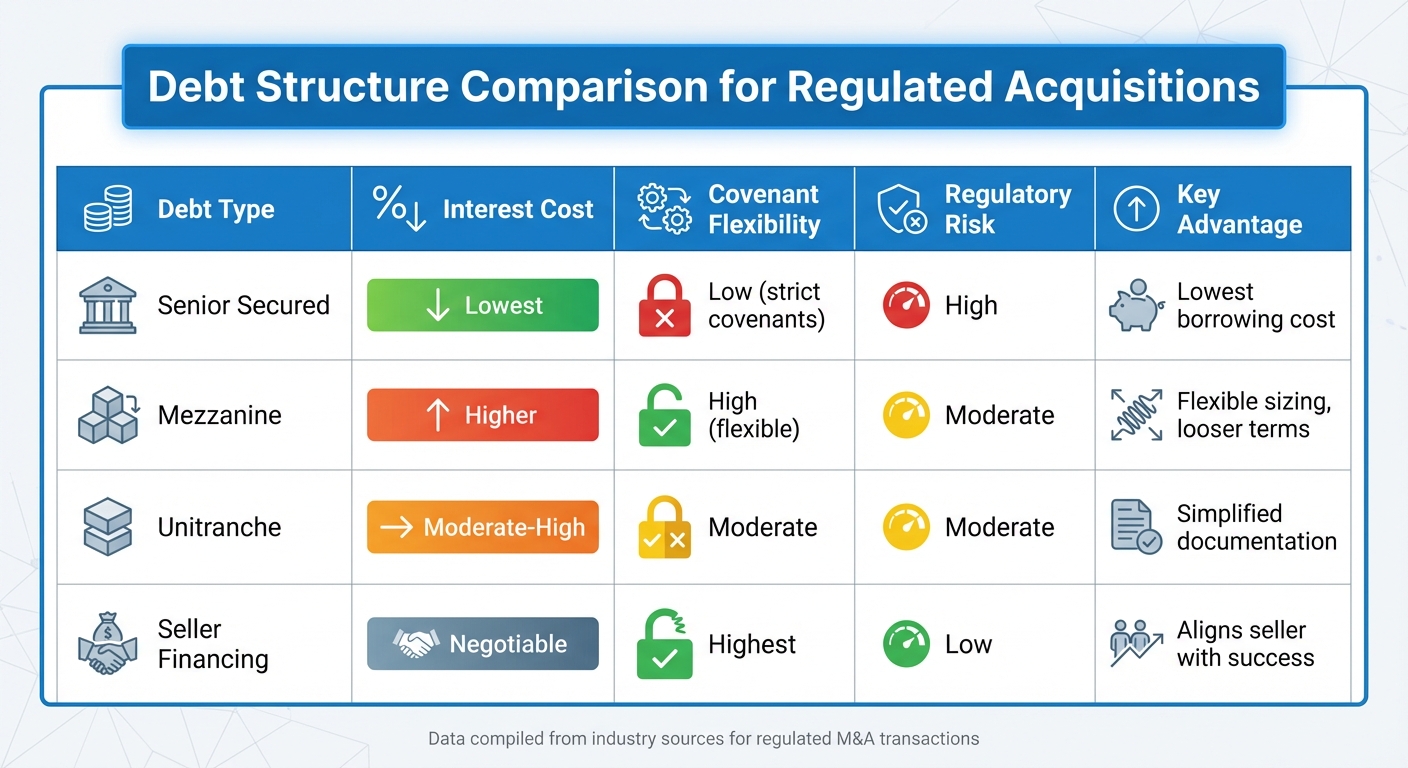
These risks differ depending on the debt structure, as illustrated below.
Debt Structure Comparison
Each type of debt financing comes with its own risks and benefits. Here's a quick breakdown:
| Debt Type | Interest Cost | Covenant Flexibility | Regulatory Risk | Key Advantage |
|---|---|---|---|---|
| Senior Secured | Lowest [3] | Low (strict covenants) [3] | High [2] | Lowest borrowing cost |
| Mezzanine | Higher [3] | High (flexible) [3] | Moderate | Flexible sizing, looser terms |
| Unitranche | Moderate-High | Moderate | Moderate | Simplified documentation |
| Seller Financing | Negotiable [3] | Highest | Low | Aligns seller with success [3] |
Managing Regulatory and Market Risks
Beyond the inherent risks tied to debt structures, external factors like regulatory hurdles and market volatility can heavily impact deal outcomes. To address these, consider the following strategies:
- Negotiate SunGard (Certain Funds) provisions: These limit lender funding conditions to essential compliance factors - such as anti-terrorism and money laundering laws - rather than broad business warranties [2].
- Extend the "outside date" in debt commitment letters: Ensure the timeline accommodates regulatory delays and aligns with the acquisition agreement [2].
- Prepare for ticking fees: These fees compensate lenders for keeping their commitments active during prolonged regulatory reviews [2].
- Review target debt instruments early: Identify and address change of control clauses that require creditor consent [4].
- Consider private credit lenders: Unlike traditional banks, private credit lenders often skip flex provisions since they don't syndicate loans, offering more certainty [2].
- Use price collars for stock components: These set maximum and minimum limits on shares issued, protecting against extreme price fluctuations [4].
- Include Xerox provisions: These clauses protect lenders from direct lawsuits by the seller if the transaction falls through, limiting the seller's remedy to a pre-agreed breakup fee [2].
For multi-jurisdictional deals, platforms like MyReadyMade (https://myreadymade.com) can simplify compliance management across numerous regions, helping you stay ahead of regulatory challenges.
How to Execute a Debt-Financed Acquisition
Executing a debt-financed acquisition in regulated industries takes careful planning and precise timing. Typically, the process spans 45–90 days, starting from initial financing discussions to closing. However, regulatory approvals can stretch this timeline significantly [3]. Success hinges on three key phases: establishing a solid financial foundation, securing favorable lending terms, and navigating the complex closing process. Below, we’ll break down how to put these acquisitions into action.
Step 1: Financial Analysis and Capital Stack Planning
The first step is to lay a strong financial foundation. Begin by calculating the total capital requirement, which often exceeds the purchase price by 15–25% [14]. This additional capital accounts for working capital (10–20% of the purchase price), transaction costs like legal and accounting fees (5–8%), financing costs (2–3%), and a transition reserve covering 3–6 months of debt service [14].
As Alex Lubyansky, Esq., Managing Partner at Acquisition Stars, puts it:
"The purchase price is not your biggest number. The total capital you need... routinely exceeds the purchase price by 15-25%" [14].
Next, independently verify the target’s EBITDA with a Quality of Earnings (QoE) report, and calculate the Debt Service Coverage Ratio (DSCR). Lenders usually require a minimum DSCR of 1.25x, meaning the business should generate $1.25 in net income for every $1.00 in debt payment [14]. Determine how much debt the combined entity can handle; lenders typically finance 3–5x EBITDA, depending on the industry’s risk level and cash flow stability [14].
Structure your capital stack into layers: senior debt (lower risk and cost), subordinated or mezzanine debt (moderate risk and cost), and equity (highest risk and cost) [13]. For example, in February 2026, a first-time buyer acquired a commercial cleaning company for $2.4 million with $620,000 in adjusted EBITDA. The capital stack included:
- $1.68 million SBA 7(a) loan (70%)
- $240,000 seller note (10%) with a 12-month standby
- $180,000 from a ROBS 401(k) rollover (7.5%)
- $300,000 cash equity (12.5%)
This structure achieved a Year 1 DSCR of 2.07x, allowing the buyer to pay off the seller note early by Year 3 [14].
Step 2: Negotiating with Lenders
Negotiating with lenders is critical to avoid unfavorable terms. Start by pre-qualifying lenders before signing a Letter of Intent (LOI) to strengthen your position. Share a standardized information package with multiple banks and credit funds to secure competitive offers [3]. Your data room should include essentials like an "EBITDA bridge", cap table, and collateral schedules to present a clear cash-flow narrative [3].
Focus on avoiding "covenant traps", such as maintenance tests on interest coverage or leverage that could lead to default during market shifts [3]. Owen D. Kurtin from Kurtin PLLC highlights:
"Assumption of Target's debt is a key and frequent part of M&A Acquisition Consideration... it is important for Acquiror to remember... that the M&A transaction thereby becomes a marriage with three or more parties: the Target's creditor or creditors are also in the deal" [4].
Negotiate to remove early principal or balloon payments that could strain cash flow after acquisition [3]. If the deal involves taking on the target's existing debt, push for better terms like reduced interest rates, extended maturity dates, or relaxed collateral requirements [4].
Step 3: Closing the Deal
The final stage involves regulatory checks and coordinating closing logistics. Address any unresolved issues early to avoid last-minute deal-breakers. Confirm the "good standing" of all entities, review UCC-1 filings for existing liens, and ensure compliance with federal, state, and local business licenses [15].
For industries like iGaming, Cryptocurrency, Forex, and Fintech, additional agency-specific approvals may be required for license transfers [7][15]. Conduct Specially Designated Nationals (SDN) and Legal Entity Identifier (LEI) checks to ensure compliance with U.S. sanctions [15]. Non-compliance with Hart-Scott-Rodino (HSR) Act notice requirements can result in a $53,088 daily penalty [7].
When filing statutory transactions like mergers or conversions, use delayed effective dates to avoid filing office backlogs [15]. For complex, multi-jurisdictional deals, platforms like MyReadyMade (https://myreadymade.com) provide expert M&A advisory services. They can assist with license transfers across 50+ jurisdictions, cutting the average closing time to 30–45 days.
Conclusion
When it comes to regulated M&A, achieving successful debt financing hinges on three key practices: choosing the right debt structure, adhering to regulatory requirements, and conducting thorough due diligence. A solid commitment letter is the backbone of your deal, as sellers often require firm funding assurances to mitigate financing-out risks [2]. Whether you opt for senior secured loans, mezzanine debt, or unitranche financing, your decision should reflect the target’s cash flow stability and your desired level of ownership control.
Make sure the "outside date" in your debt commitment letter aligns with regulatory timelines [2]. Falling short on regulatory compliance can lead to hefty penalties. Provisions like SunGard (certain funds) clauses can help by limiting funding conditions to a few critical representations, such as solvency and corporate authority [2].
Private credit lenders, who typically avoid loan syndication, can offer stability by sidestepping flex provisions [2]. This can be particularly beneficial in unpredictable markets, where traditional lenders may adjust rates during syndication.
To streamline the process, run parallel lender negotiations while providing consistent information packages to multiple banks and credit funds [3]. Prepare your data room in advance with key documents like an EBITDA bridge, cap table, and collateral schedules to help meet the standard 45–90 day closing timeline [3]. Also, ensure that the Material Adverse Change (MAC) definitions in your loan agreement are consistent with the acquisition agreement to avoid conflicts that could jeopardize the deal [2].
For industries like iGaming, Cryptocurrency, Forex, and Fintech, navigating regulatory hurdles can be especially tricky. Platforms like MyReadyMade (https://myreadymade.com) specialize in M&A advisory and can assist with license transfers across more than 50 jurisdictions, helping buyers tackle regulatory challenges while securing financing effectively.
FAQs
Which debt type fits my regulated acquisition best?
The best type of debt for a regulated acquisition hinges on several factors, including industry rules, the size of the deal, and the associated risks. Senior secured loans are often a popular choice because they offer favorable terms and tend to align well with regulatory requirements. On the other hand, mezzanine debt might be a better fit for deals with higher risk or for buyers who need more flexibility in their financing structure. To make the right choice, it’s crucial to work with legal and financial advisors who have expertise in your specific industry.
How do I align lender timelines with license approvals?
To keep lender timelines in sync with license approvals, begin by getting a clear picture of how long approvals typically take and plan ahead. Stay in touch with licensing authorities to confirm both timelines and requirements. At the same time, collaborate with lenders to manage expectations effectively.
Make sure to include contingency clauses in your deal documents to account for potential delays. Align regulatory filings with the planned disbursement schedules to avoid mismatches. Bringing in legal and regulatory advisors early in the process can help smooth out potential roadblocks and keep everything on track for timely transaction closures.
What clauses most often kill debt-funded regulated deals?
Clauses tied to financing contingencies and closing conditions, like financial condition requirements at the time of closing, often become major hurdles in debt-funded regulated transactions. These provisions can introduce uncertainty or enforce rigid standards that may be tough to satisfy, potentially causing the deal to fall apart.
Related Articles

Ultimate Guide to Earnout Negotiations in M&A
Structure and negotiate earnouts in regulated M&A with clear metrics, anti-manipulation covenants, and acceleration or escrow protections.

How to Draft M&A Definitive Agreements
Guide to drafting M&A definitive agreements covering deal structure, reps & warranties, indemnities, payment terms, and regulatory compliance.

How IP Affects Tokenization Valuation
How tokenizing patents, copyrights, and trademarks adds liquidity and market value—plus legal, regulatory, and valuation steps.
Looking to Buy or Sell?
Get in touch with our team for personalized assistance