5 Dispute Resolution Clauses for M&A Contracts

5 Dispute Resolution Clauses for M&A Contracts
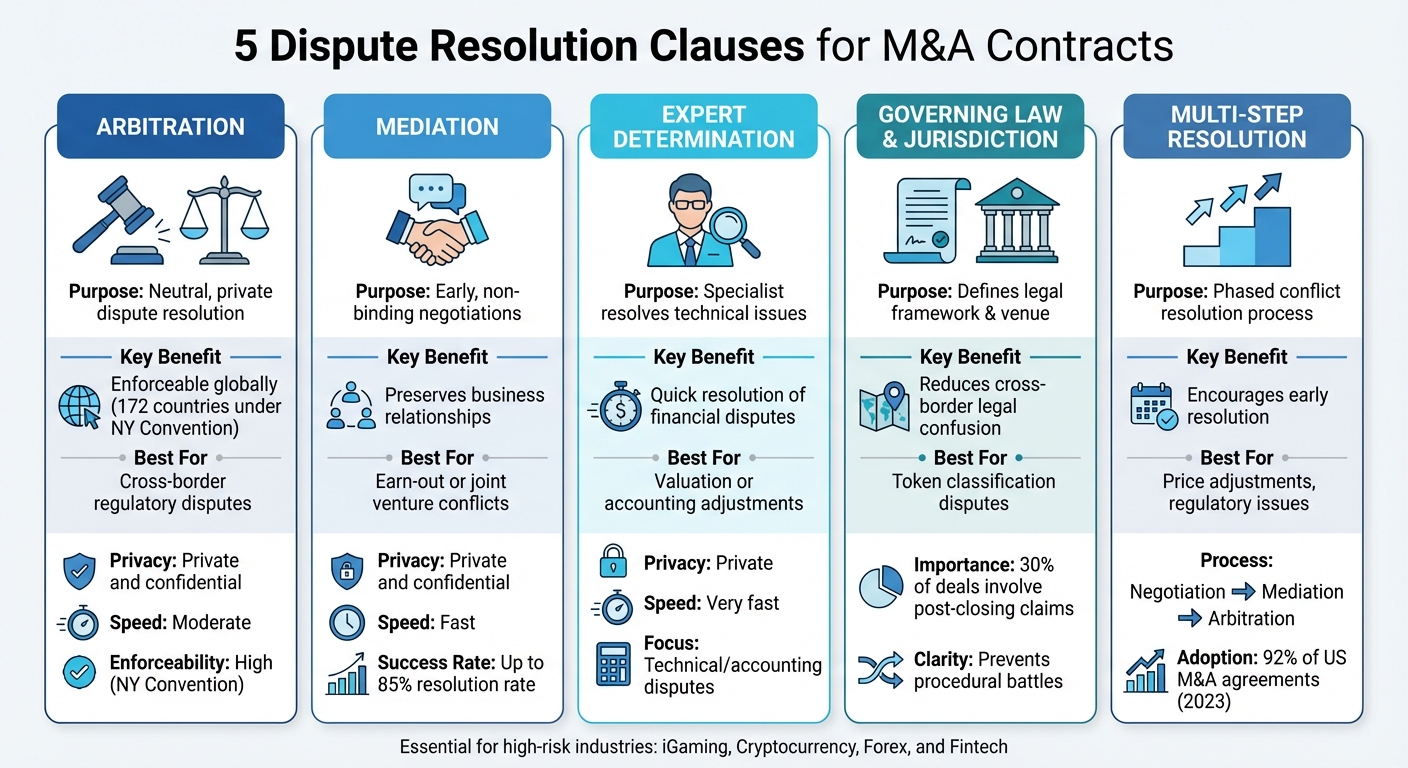
Disputes in M&A deals can derail transactions, especially in high-risk industries like Cryptocurrency, Fintech, and iGaming. Without clear dispute resolution clauses, disagreements often escalate, wasting time and resources. This article outlines five key clauses that help resolve conflicts efficiently while maintaining confidentiality and business relationships:
- Arbitration Clause: Ensures private, neutral resolution of disputes, with global enforceability under the New York Convention.
- Mediation Clause: Encourages early, non-binding negotiations to resolve issues while preserving relationships.
- Expert Determination Clause: Appoints specialists to resolve technical or financial disputes like valuations or earn-out calculations.
- Governing Law and Jurisdiction Clause: Specifies the legal framework and venue for resolving disputes, reducing ambiguity in cross-border deals.
- Multi-Step Dispute Resolution Clause: Structures a phased approach (e.g., negotiation → mediation → arbitration) to resolve conflicts incrementally.
Quick Comparison:
| Clause | Purpose | Key Benefit | Example Use Case |
|---|---|---|---|
| Arbitration | Neutral, private dispute resolution | Enforceable globally | Cross-border regulatory disputes |
| Mediation | Early, non-binding negotiations | Preserves relationships | Earn-out or joint venture conflicts |
| Expert Determination | Specialist resolves technical issues | Quick resolution of financial disputes | Valuation or accounting adjustments |
| Governing Law & Jurisdiction | Defines legal framework & venue | Reduces cross-border legal confusion | Token classification disputes |
| Multi-Step Resolution | Phased conflict resolution process | Encourages early resolution | Price adjustments, regulatory issues |
These clauses, when drafted carefully, save time, reduce costs, and protect sensitive information - key priorities for industries with regulatory and operational complexities.
1. Arbitration Clause
Purpose and relevance in M&A contracts
An arbitration clause provides a neutral and private way to settle disputes that can arise during or after an M&A transaction. These disputes often involve issues like price adjustments, breaches of warranties, or fraud claims. In cross-border deals, arbitration is especially useful because it avoids giving one party an advantage by defaulting to their home country’s legal system [9][11].
A notable example occurred in September 2020 with the Keystone Food Holdings Ltd v. Tyson Foods, Inc. case in the U.S. District Court for the Southern District of New York. Here, a $2 billion disagreement was at stake, and the court directed the parties to arbitration instead of litigation. This case highlighted the strong pro-arbitration stance in U.S. law, showcasing how arbitration can efficiently address high-stakes disputes [8].
Applicability to high-risk industries
In industries like iGaming, Cryptocurrency, Forex, and Fintech, arbitration offers a way to keep sensitive information - such as financial data, trade secrets, or compliance issues - out of the public eye. Because arbitration proceedings are private, they protect proprietary details like algorithms, smart contracts, and licensing challenges across jurisdictions [7][11].
The growing reliance on arbitration is backed by numbers. In 2020, disputes involving shareholders, share purchases, and joint ventures made up 20% of all LCIA cases, compared to 14% in 2019 [10]. Additionally, the ICC saw 27 emergency arbitration requests in 2021, nearly three times the 10 requests filed in 2015 [6]. These emergency proceedings can prevent situations like a seller stripping assets before a deal closes, underscoring arbitration’s timely and protective measures.
For high-risk sectors, platforms like MyReadyMade (https://myreadymade.com) can further streamline M&A transactions by ensuring arbitration clauses are expertly crafted and seamlessly integrated into confidential deals.
Flexibility and enforceability
One of arbitration’s key advantages is its global enforceability. Thanks to the New York Convention, 172 countries are obligated to recognize and enforce arbitral awards [9][11]. This global reach makes arbitration particularly effective for securing assets across borders, which can be a complex task with traditional court judgments.
Another strength is the ability to choose arbitrators with specific expertise. This is especially valuable when disputes involve intricate matters like accounting, digital assets, or financial regulations [7][6]. Arbitration’s flexibility and enforceability make it an ideal tool for resolving complex disputes, while also opening the door to alternative resolution methods.
| Feature | Arbitration | Litigation |
|---|---|---|
| Privacy | Private and confidential [7][11] | Public record [6][11] |
| Enforcement | Recognized in 172 countries under the NY Convention [9][11] | Varies based on treaties [11] |
| Decision Maker | Experts chosen by the parties [7][6] | Randomly assigned judge [11] |
| Appeal Rights | Extremely limited [9][11] | Broad rights to appeal [11] |
To maximize the effectiveness of an arbitration clause, it’s wise to define it broadly (e.g., "all disputes arising out of or in connection with") to cover related claims [7]. Additionally, selecting a seat in arbitration-friendly jurisdictions like London, Singapore, or Paris can further enhance the enforceability of the resolution process [7][9].
2. Mediation Clause
Purpose and relevance in M&A contracts
A mediation clause outlines a non-binding process where a neutral third party helps both parties negotiate a settlement before turning to arbitration or litigation. Unlike litigation, which often escalates conflict, mediation encourages cooperation and helps maintain relationships - especially valuable in situations like earn-out agreements or joint ventures. In fact, up to 85% of disputes can be resolved early through mediation[13].
"By providing for mediation first, the parties have an opportunity to resolve their dispute early... It can therefore eliminate the need for arbitration and/or streamline the remaining unresolved issues." - Leslie Ann Berkoff, Chair of Dispute Resolution Practice Group, Moritt Hock & Hamroff[13]
In M&A transactions, where timing is critical and relationships often continue post-closing, mediation offers a practical way to resolve disputes quickly or narrow down complex issues. This approach is especially beneficial in industries where risks are high.
Applicability to high-risk industries
Confidentiality is a top priority in industries like iGaming, Cryptocurrency, Forex, and Fintech. Mediation provides a private forum to address disputes without exposing sensitive financial data or security protocols.
These high-risk sectors also face unique challenges, such as fluctuating token values, unexpected regulatory penalties, and evolving AML/KYC compliance. Mediation offers the flexibility to address these dynamic issues in ways that traditional litigation might not. For example, platforms such as MyReadyMade (https://myreadymade.com), which handles M&A transactions across more than 50 jurisdictions in regulated industries, rely on well-drafted mediation clauses to help buyers and sellers resolve disputes while keeping deals on track.
Flexibility and enforceability
While mediation offers procedural flexibility, poorly drafted clauses can weaken enforceability. Courts may view vague provisions - such as an "agreement to negotiate in good faith" - as optional rather than binding, which could lead to delays.
To avoid this, mediation clauses should include clear procedural details. For instance, specify time limits (e.g., 30, 60, or 90 days) to prevent stalling, use mandatory language like "shall" instead of "may", and name a reputable ADR institution such as AAA, JAMS, or ICC, along with its mediation rules. For technical M&A deals, it’s also wise to require mediators with relevant financial or industry expertise.
The Singapore Convention on Mediation has further strengthened the enforceability of cross-border mediated settlements, making mediation a more dependable option for international M&A transactions. With careful drafting, mediation can act as a valuable first step in resolving disputes rather than becoming a procedural hurdle. These considerations pave the way for the next steps in dispute resolution.
3. Expert Determination Clause
Purpose and Relevance in M&A Contracts
An expert determination clause is used to appoint a specialist to resolve specific technical or accounting disputes, such as completion accounts, earn-out calculations, or business valuations. These experts are selected for their deep knowledge in handling narrow, factual issues that might stall a transaction or emerge after a deal closes. Unlike arbitration, which deals with broader legal conflicts and often results in compensatory damages, expert determination focuses on precise adjustments - like "dollar-for-dollar" price changes - based on accounting metrics. The process is informal and investigative, with no strict obligation to follow natural justice principles unless explicitly stated in the contract. This approach works well alongside arbitration, offering a quicker way to handle technical financial disputes that could otherwise delay transactions.
Applicability to High-Risk Industries
Expert determination is particularly suited to industries with high levels of risk and volatility, where technical valuation and accounting disputes are common. Sectors like iGaming, Cryptocurrency, Forex, and Fintech are especially vulnerable due to rapid price changes and intricate regulatory requirements.
"Deals involving fintech companies and businesses exposed to the wild fluctuations of energy or cryptocurrency prices have proved especially contentious, not least because of the complex regulatory and fiduciary obligations they involve."
Platforms such as MyReadyMade (https://myreadymade.com), which manage M&A transactions in over 50 jurisdictions across regulated industries, benefit from expert determination clauses. These clauses help resolve valuation disputes efficiently, ensuring that time-sensitive deals remain on track.
Flexibility and Enforceability
Expert determination is valued for its adaptability, allowing parties to design the process to fit their specific needs. Since it operates purely on a contractual basis without a statutory framework, participants can set their own rules, timelines, and standards for evidence. This flexibility makes it ideal for resolving technical issues like EBITDA calculations, working capital adjustments, or token valuations.
The expert's decision is binding - except in cases of fraud or clear, manifest errors, such as obvious arithmetic or clerical mistakes. However, enforcement may require court or arbitration intervention if one party refuses to comply. To minimize disputes, it’s important to precisely define "manifest error", limiting it to unmistakable calculation or clerical mistakes. Establishing a clear accounting hierarchy - such as prioritizing agreed policies, followed by consistency with past practices, and finally adherence to GAAP - can also reduce ambiguity. While expert determinations don’t have the immediate enforceability of arbitral awards under the New York Convention, their speed and cost-effectiveness make them a practical choice for resolving technical disputes in M&A transactions.
4. Governing Law and Jurisdiction Clause
Purpose and Relevance in M&A Contracts
The governing law and jurisdiction clause is a key element in M&A contracts, as it determines which legal system will interpret the agreement and where disputes will be resolved [17][18]. Essentially, the governing law outlines the rights and obligations of the parties, while the jurisdiction clause specifies the forum for resolving conflicts.
For instance, opting for English law and English courts simplifies matters, while combining New York law with arbitration in Singapore can add layers of complexity and increase costs. This clause connects the interpretation of contractual obligations with practical dispute resolution, making it especially critical for high-stakes transactions.
The choice of governing law also impacts practical issues, such as statutes of limitations for indemnity claims. In cross-border deals, failing to identify the applicable law can lead to confusion about whether time limits are considered "substantive" or "procedural", potentially extending liability beyond what was intended [12]. Notably, around 30% of private M&A deals involve post-closing indemnification claims, highlighting the need for precise language in these clauses [15].
Applicability to High-Risk Industries
Certain industries, such as iGaming, Cryptocurrency, Forex, and Fintech, operate under strict regulatory scrutiny across multiple jurisdictions. These sectors often face unique challenges due to their inherently global and unpredictable nature.
"Cybersecurity due diligence is non-negotiable in modern M&A transactions." - Pitcoff Law Group [14]
In cryptocurrency deals, for example, M&A contracts increasingly account for varying global regulations related to token classification, AML/KYC compliance, and cybersecurity requirements [4]. Platforms like MyReadyMade (https://myreadymade.com), which facilitate transactions in regulated industries, benefit from tailored governing law clauses that address the specific regulatory landscape of the target business.
Jurisdiction choices also influence enforceability. Arbitral awards, for example, are more easily enforced internationally under the New York Convention, which covers 48 notified territories, compared to court judgments [1]. This is particularly relevant in Fintech and Cryptocurrency transactions, where assets are often distributed across multiple countries.
Flexibility and Enforceability
Given these regulatory and logistical challenges, a carefully drafted governing law clause can enhance both clarity and enforceability. Such clauses complement dispute resolution provisions, strengthening the overall framework of M&A agreements.
Delaware is a prime example of a jurisdiction that offers certainty through its well-established corporate law framework [18]. In the In re IBP case, the Delaware Court of Chancery compelled Tyson Foods to complete its acquisition of IBP, rejecting claims of a Material Adverse Effect. This case underscores Delaware's role in upholding enforceable agreements [16].
Precision in drafting is crucial to avoid disputes. Conflicting clauses can lead to extended litigation, as demonstrated in Internaves de Mexico S.A. de C.V. v. Andromeda Steamship Corp., where parties spent nearly two years resolving a disagreement over the arbitration venue [3].
"A well-drafted dispute resolution clause prevents unnecessary litigation and ensures business continuity." - Kartikey Mahajan and Bhavya Chengappa, Khaitan & Co [1]
To improve enforceability, contracts should include clear arbitration seats, specified timeframes for claims [12], and non-reliance clauses to prevent fraudulent inducement claims [16]. With cross-border M&A activity valued at approximately $950 billion in 2023, the importance of getting these details right cannot be overstated [6].
5. Multi-Step Dispute Resolution Clause
Purpose and Relevance in M&A Contracts
Multi-step dispute resolution clauses, often referred to as escalation clauses, are designed to address conflicts through a structured, step-by-step process. These clauses combine methods like arbitration, mediation, and expert determination into a phased approach aimed at resolving disputes incrementally before turning to formal litigation or binding arbitration [3].
Typically, the process begins with negotiations at the project level. If unresolved, the issue escalates to senior management for further discussion. From there, it may proceed to mediation or expert determination by a neutral third party, and finally, arbitration or litigation if necessary. In mergers and acquisitions (M&A), these clauses are particularly effective for resolving financial disagreements such as purchase price adjustments, earn-out calculations, and net debt disputes [6]. For example, in 2023, 92% of U.S. M&A agreements included provisions for purchase price adjustments, and 90% of these relied on an independent accountant to resolve disputes [8].
What makes these clauses so useful is their ability to encourage resolution through negotiation, helping to preserve business relationships and avoid the high costs and public exposure tied to litigation.
"An effective, clearly written dispute resolution clause is important to help parties resolve any disputes as efficiently and fairly as possible." - Joel Greer, US Lawyer, ZeLo
However, poorly drafted clauses can lead to delays and prolonged disputes, particularly when the escalation process lacks clarity.
Applicability to High-Risk Industries
Industries like iGaming, Cryptocurrency, Forex, and Fintech benefit significantly from multi-step clauses. These sectors often face challenges such as extreme valuation fluctuations, making mediation and expert determination ideal for resolving issues like price adjustments and earn-outs before resorting to litigation [4][6]. Technical disputes, such as those involving blockchain code, smart contracts, or proprietary algorithms, also benefit from the involvement of independent experts with specialized knowledge [2].
Confidentiality is another major advantage. Mediation and arbitration provide private forums for resolving disputes, shielding sensitive information like trade secrets, user data, and regulatory details from public exposure. In highly regulated industries, a "good faith negotiation" phase can also help address compliance concerns without triggering public court filings, which could attract regulatory scrutiny or harm reputations.
M&A deals in these sectors often include earn-outs or joint ventures where sellers remain involved post-closing. Mediation helps resolve potential conflicts while maintaining the collaborative relationships necessary for achieving performance milestones. Platforms like MyReadyMade (https://myreadymade.com), which focus on transactions in regulated industries, benefit from multi-step clauses that allow for resolving technical and regulatory issues through expert determination before moving to formal proceedings.
Flexibility and Enforceability
Multi-step clauses are highly adaptable to the specific needs of the parties involved. To ensure enforceability, contracts should include clear timelines - such as 30, 60, or 90 days - for each phase of the process [3]. Defining the roles or individuals responsible for each stage is equally important, as is specifying whether earlier steps like mediation must be completed before moving to arbitration [19].
For technical disputes, such as working capital adjustments, appointing an independent auditor ensures that resolutions are accurate and objective [6]. Additionally, these clauses should allow for emergency court intervention during the process. The growing demand for rapid interim relief is evident from the International Chamber of Commerce, which received 27 applications for emergency proceedings in 2021, up from 10 in 2015 [6].
"The parties may choose to spend a certain period (such as 30 days) resolving the issue before seeking the help of a third party to resolve the matter." - Jonathan M. Moses, Global Arbitration Review
Dispute Resolution Options in M&A
Conclusion
Well-crafted dispute resolution clauses are a cornerstone of protecting M&A transactions in regulated industries. They ensure that disputes center on business issues rather than getting bogged down in procedural battles. Take the Internaves de Mexico case as an example - nearly two years were spent arguing over the arbitration venue before the actual breach was even addressed [3].
This is especially critical in regulated sectors, where the stakes are higher due to regulatory complexity, market volatility, and the technical nature of disputes. To put things in perspective, cross-border M&A activity hit around $950 billion in 2023, while nearly 500 controlling-stake deals were terminated globally in 2022 [6]. These figures highlight the importance of contracts that address specific risks, including token classification, AML/KYC compliance, and purchase price adjustments tied to fluctuating valuations.
"The most effective way to handle post-acquisition disputes is to prevent them through precise drafting of aligned expectations within the agreement, and a deal process that integrates legal, accounting, and tax perspectives from the beginning." - Jeffrey Katz, Principal, BDO [5]
To navigate these challenges, dispute resolution mechanisms need to be as precise and adaptable as the industries they serve. Effective clauses provide confidentiality, neutrality, and technical expertise, while establishing clear accounting hierarchies, enforceable deadlines, and neutral forums under agreements like the New York Convention. Whether through arbitration or multi-step processes, these provisions create a solid framework for secure and efficient transactions, especially in volatile markets. For companies in high-risk industries, having these mechanisms in place is crucial for ensuring deal certainty and seamless post-closing integration.
MyReadyMade (https://myreadymade.com) specializes in M&A advisory services for regulated industries, assisting with license transfers across 50+ jurisdictions and guiding clients through robust dispute resolution strategies from signing to post-closing integration.
FAQs
When should an M&A deal use arbitration instead of court litigation?
Arbitration is a popular choice for resolving disputes in cross-border M&A deals, offering reliability, confidentiality, and the benefit of easier enforcement across multiple jurisdictions. By sidestepping the challenges of local court systems and jurisdictional inconsistencies, arbitration provides a streamlined alternative. However, it might not be the best fit when parties need extensive discovery rights or the procedural safeguards typically found in court litigation. Ultimately, the decision to use arbitration hinges on the nature of the dispute, the jurisdictions involved, and what the parties value most.
How do you make a mediation or multi-step clause enforceable?
To make a mediation or multi-step dispute resolution clause enforceable, it’s crucial to draft it with precision and clarity. Lay out each step of the process in detail, including timelines, notice requirements, and the conditions necessary to move from one step to the next. Clearly define the mechanisms involved - whether mediation, arbitration, or litigation - and ensure the language leaves no room for interpretation.
Adding specifics like how mediators or arbitrators will be appointed, the location of proceedings, and the governing rules can further solidify the clause. These details help minimize ambiguity and increase the likelihood that courts or arbitration panels will uphold the clause.
What kinds of disputes should go to expert determination (not arbitration)?
Disputes that are well-suited for expert determination typically revolve around technical or highly specialized issues that demand in-depth expertise. Common examples include purchase price adjustments, financial valuations, representations and warranties, and intricate calculations such as working capital or debt levels. These types of disputes gain from the involvement of a subject matter expert who can provide a precise and efficient evaluation. This approach often proves more effective than arbitration, which is generally better suited for resolving legal or contractual disagreements.
Related Articles

Ultimate Guide to Earnout Negotiations in M&A
Structure and negotiate earnouts in regulated M&A with clear metrics, anti-manipulation covenants, and acceleration or escrow protections.
How to Draft M&A Definitive Agreements
Guide to drafting M&A definitive agreements covering deal structure, reps & warranties, indemnities, payment terms, and regulatory compliance.

How IP Affects Tokenization Valuation
How tokenizing patents, copyrights, and trademarks adds liquidity and market value—plus legal, regulatory, and valuation steps.
Looking to Buy or Sell?
Get in touch with our team for personalized assistance