Due Diligence Checklist for iGaming Acquisitions

Due Diligence Checklist for iGaming Acquisitions
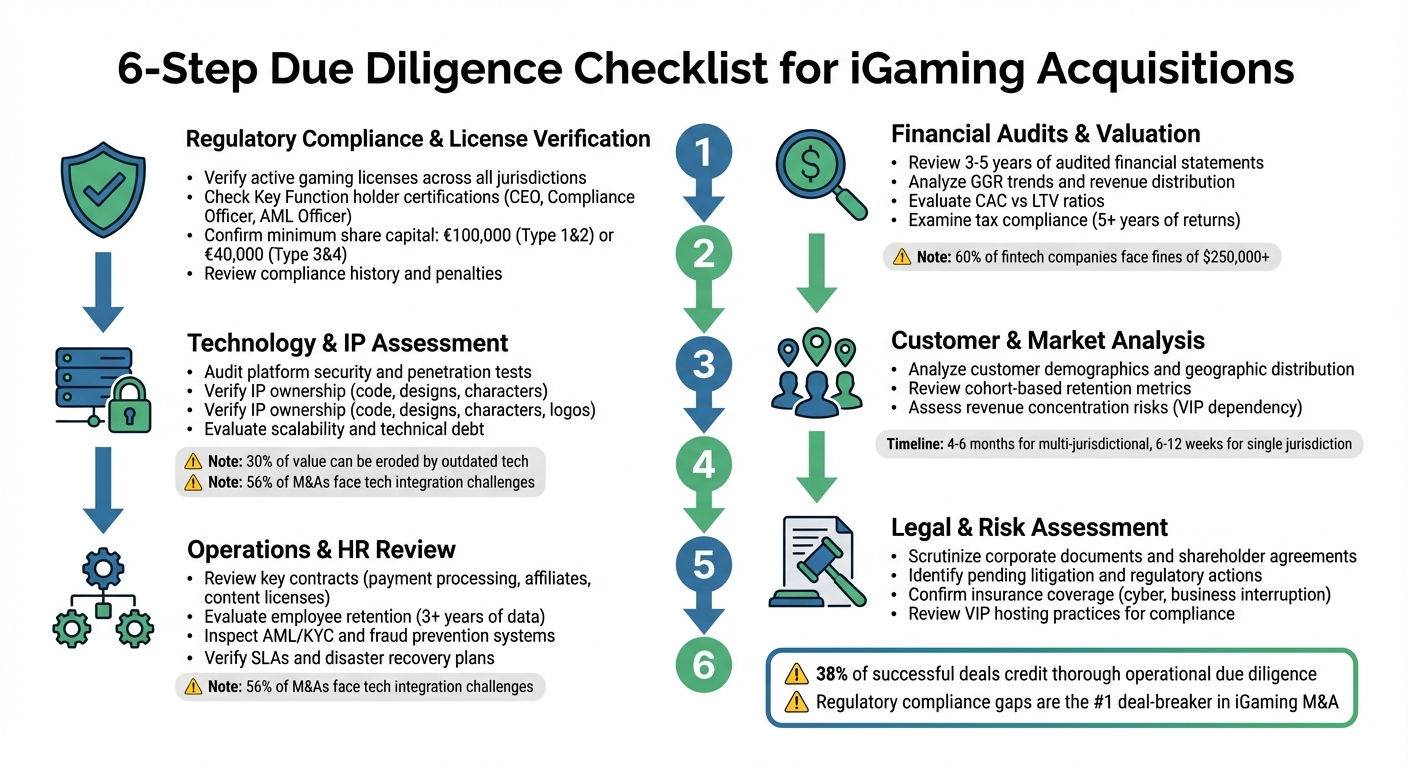
When acquiring an iGaming business, due diligence is critical to avoid regulatory pitfalls, financial risks, and operational challenges. Here's a quick breakdown of what to focus on:
- Regulatory Compliance: Verify active gaming licenses, compliance history, and key personnel certifications. Ensure licenses align with operations and meet jurisdictional requirements.
- Financial Health: Review 3–5 years of financial statements, Gross Gaming Revenue (GGR) trends, tax filings, liabilities, and customer deposit management.
- Technology & IP: Audit platform security, scalability, and intellectual property ownership. Check for outdated systems or unresolved technical issues.
- Customer & Market Analysis: Assess revenue sources, customer demographics, and geographic distribution. Identify risks like over-reliance on VIP players or affiliate networks.
- Operations & HR: Scrutinize contracts, employee retention, and fraud prevention systems. Ensure stability in key roles and vendor agreements.
- Legal Risks: Examine corporate documents, litigation history, and insurance coverage. Look for regulatory red flags or non-transferable licenses.
Key Insight: Regulatory gaps and hidden liabilities are the most common deal-breakers in iGaming acquisitions. A structured approach ensures compliance and protects your investment.
Pro Tip: Tools like MyReadyMade streamline this process by offering verified business listings and expert support across 50+ jurisdictions. They help reduce risks and save time.
This guide ensures you’re prepared to navigate the complexities of iGaming M&A with confidence.
Ep. 164: Life after selling for $160 million w/ Alex Monahan from OddsJam (acquired by Gambling.com)
Regulatory Compliance and License Verification
Regulatory compliance forms the backbone of any iGaming acquisition. Ignoring potential violations can lead to hefty fines, license revocations, or even legal consequences. The first step? Confirm that all gaming licenses are active, appropriately scoped, and in good standing with the relevant authorities.
Verify Active Licenses
Start by checking official regulator websites. For instance, the UK Gambling Commission offers public access to operator details and license statuses [10]. Similarly, Malta's MGA Licensee Portal provides real-time updates [12]. Always cross-check license details directly through these official portals.
It's crucial that the licenses align with the target's actual operations. In Malta, for example, licenses are categorized into four distinct types: Type 1 covers casino games and slots, Type 2 pertains to sports betting, Type 3 includes peer-to-peer games like poker, and Type 4 is for software vendors [12]. Any mismatch between the license type and the business activities is a serious warning sign. Additionally, ensure that required on-site displays, such as the MGA dynamic seal linking to the regulator's database, are present [13].
Don’t overlook the individuals in critical roles. Verify that all "Key Function" holders - such as the CEO, Compliance Officer, and Anti-Money Laundering (AML) Officer - hold valid personal certificates. These roles require "fit and proper" assessments, and any personnel changes must receive regulatory approval [13]. In Malta, these certificates must be renewed every three years [16]. Also, confirm the minimum share capital requirements: €100,000 for Type 1 and Type 2 licenses, and €40,000 for Type 3 and Type 4 licenses [12][13].
Once the licensing is squared away, turn your attention to the company’s compliance history.
Review Compliance History
Examine the target's track record for penalties, failed audits, or license suspensions. For instance, Malta places incomplete license applications in an "incomplete" status for 60 days before rejecting them [12][13]. A history riddled with compliance issues could indicate deeper, systemic problems. Industry data reveals that 60% of fintech companies handling iGaming payments have faced compliance fines of at least $250,000 [15].
Dive into the company’s AML and Know Your Customer (KYC) protocols. Operators licensed in Malta for Type 1, 2, or 3 games must appoint a dedicated AML Officer [13], and all operators are required to maintain written risk assessments for money laundering and terrorist financing [14]. Review the target’s internal compliance plan to identify when the next independent third-party compliance review is due - these reviews are mandatory within the first year of operation and periodically thereafter [13]. Also, confirm that local presence requirements are being met. For example, UK operators must maintain a UK correspondence address [11], while Malta requires a physical presence, a registered office, and a company secretary [13].
For a streamlined approach, platforms like MyReadyMade simplify licensing verification across 50+ jurisdictions, making it easier to address potential compliance concerns efficiently.
Financial Audits and Valuation
Getting a clear picture of a business's financial health is essential to ensure the acquisition price aligns with its actual performance. Financial due diligence helps uncover the true value of a company. Start by reviewing 3–5 years of audited financial statements to evaluate consistent profitability and revenue trends [6][7]. Pay close attention to Gross Gaming Revenue (GGR) patterns and how earnings are distributed across product lines, such as sports betting versus casino games [6][7]. Businesses that show steady GGR growth across multiple verticals are generally more attractive than those reliant on a single revenue source.
Analyze Financial Statements
Dive into monthly, quarterly, and annual financial records to spot any irregularities. Review accounts receivable aging reports to identify potential cash flow challenges, especially if customers are slow to pay [5][7]. Carefully examine how revenue is recognized and whether expenses are matched appropriately - any inconsistencies here could misrepresent the business's true performance. Request a Quality of Earnings (QofE) report to separate sustainable earnings from one-time revenue spikes [6][7][8]. From there, evaluate the key drivers of revenue and the underlying cost structures to confirm long-term profitability.
Assess Revenue and Costs
Use cohort analysis to evaluate Customer Acquisition Cost (CAC) and Lifetime Value (LTV). If CAC is rising faster than LTV, it could signal an unsustainable growth strategy [6]. In the iGaming sector, pay special attention to affiliate commission structures and payment processing costs, as these can vary significantly by region and directly impact profit margins [6]. Watch for patterns of bonus abuse, which can erode profitability without delivering meaningful long-term customer value. Additionally, confirm that player deposit liabilities are properly managed and backed by sufficient cash reserves, as these deposits represent funds owed to customers and can directly affect the business's valuation [6]. Lastly, examine liabilities and tax history to uncover any hidden risks.
Evaluate Liabilities and Tax Compliance
Tax issues are a frequent source of disputes in iGaming mergers and acquisitions [6]. Review at least five years of tax returns and correspondence with tax authorities [3][9]. Create a tax jurisdiction schedule to ensure all point-of-consumption taxes are accounted for and paid correctly [6]. Investigate any pending litigation, settlements, or arbitration cases that could pose future risks [3]. Check for unrecorded liabilities, such as warranties, returns, or unpaid social insurance, which may arise from contractor reclassification [5][4]. Also, confirm whether any key assets or intellectual property have been pledged as loan collateral, as this could limit your rights post-acquisition [4]. A notable example is Verizon’s purchase of Yahoo in 2017, where due diligence uncovered hidden risks, leading to a $350 million price reduction [1].
"A sales pitch gives you the price, while due diligence gives you the value." - DealRoom [8]
For iGaming acquisitions, MyReadyMade offers AI-driven valuation tools and expert M&A advisory services. These resources help buyers navigate the complexities of financial assessments across more than 50 jurisdictions, ensuring you pay a fair price rather than an inflated one.
Technology and IP Assessment
Once you've solidified the financial outlook, the next step is to evaluate the platform's technology and intellectual property (IP). These elements are critical for ensuring sustainable growth post-acquisition. A platform's technology infrastructure can make or break an iGaming acquisition, with up to 30% of its value potentially eroded by outdated software, security gaps, or unresolved technology debt [21]. Start by conducting a thorough review of the technical foundation. This includes both a code audit and a strategic audit to pinpoint inefficiencies and confirm that the platform aligns with your growth objectives. Additionally, gather documentation on disaster recovery plans, safety certifications, and insurance policies that address technology risks to ensure business continuity [18][4].
Audit Platform Security
In the iGaming industry, cybersecurity is paramount. Platforms handle sensitive customer data and financial transactions, making them a prime target for cyber threats. To mitigate risks, review penetration tests and evaluate vulnerabilities in both internal systems and external dependencies, such as open-source components [19][20]. Confirm that the platform's capacity usage levels can handle increased demand after the acquisition [18]. Ensure disaster recovery plans are not only well-documented but also tested regularly for effectiveness [18].
Review Proprietary Technology and IP
Ownership of intellectual property is a critical area that requires careful scrutiny. Disputes over IP can quickly derail an acquisition. Verify that the company has full legal ownership of all IP assets, including software code, graphic designs, game universes, characters, and logos. It's also essential to confirm that any IP created by founders prior to the company's establishment has been formally transferred to the company in writing [4]. In some jurisdictions, like Poland, email agreements or invoices are insufficient for transferring economic copyrights; written agreements specifying the fields of exploitation are mandatory [4].
Conduct searches for Uniform Commercial Code (UCC) filings, tax liens, and judgments to uncover hidden debts or legal claims tied to IP assets [17]. Review contracts with developers, artists, and programmers to ensure they include proper "work-for-hire" or IP assignment clauses. Additionally, examine agreements for any change-of-control clauses that could complicate the acquisition [4].
"Polish law requires an agreement transferring economic copyright to be made in writing and to set forth the fields of exploitation... Transfer of economic copyright in the form of terms agreed through email correspondence, or by issuance of an invoice, will not be effective because the requirement for written form will not be fulfilled." - Wardyński & Partners [4]
Once the IP is secured, the focus can shift to evaluating how well the platform's technology supports scalability and integration with future goals.
Evaluate Scalability and Integrations
Building on the security and IP reviews, it's crucial to assess the platform's ability to scale. Scalability and seamless integration are vital for long-term success. In fact, 56% of mergers and acquisitions encounter post-merger technology integration challenges, often leading to cost overruns and reduced performance [21]. Determine whether the platform's infrastructure can support projected growth by analyzing capacity utilization and identifying potential bottlenecks [17].
Pay special attention to technical debt, as it can consume a significant amount of developer time - up to 33%, according to studies [21]. Review supplier agreements and the overall technology stack to identify critical dependencies that might hinder future growth [20]. Also, consider the impact of intense development periods, often referred to as "crunch" phases, which can lead to the loss of key personnel and destabilize the team over time [4].
Customer and Market Analysis
Once you've assessed the technology, the next step is to dive into user demographics and revenue sources. Understanding customer demographics and geographic distribution helps determine if the acquisition supports your strategic goals and highlights any revenue dependencies [6]. Break down revenue streams by customer segments, geographic regions, and product categories - like sports betting versus casino games - to pinpoint areas reliant on narrow income sources [6]. Additionally, profile customer groups based on age, location, and behavior patterns [5].
Analyze Customer Metrics
Start by using cohort-based analysis to track trends in player acquisition, retention, and reactivation over time [6]. This method helps identify whether growth is sustainable or if it's being propped up by short-term promotions. Evaluate the lifetime value (LTV) of players across different segments to measure long-term profitability [6]. At the same time, assess customer acquisition costs (CAC) to ensure marketing efforts aren't artificially inflating engagement metrics [6].
One major risk in iGaming acquisitions is revenue concentration. Investigate how much of the revenue depends on a small group of VIP players, as losing them could severely impact cash flow [1][3]. Also, assess the performance of marketing channels, especially affiliate networks, to confirm compliance with responsible gambling standards and ensure vulnerable groups are not being targeted [5]. Where possible, conduct direct interviews with customers to gauge satisfaction and anticipate potential behavioral shifts following the acquisition [1].
Now, turn your attention to the target's competitive position and market footprint.
Review Market Position
Using customer data as a foundation, evaluate how the target performs within its competitive landscape. Compare its player engagement metrics and market share to industry benchmarks to gauge its standing [6]. Determine how the company differentiates itself - whether through pricing, quality, technology, or brand reputation [5]. Review the management team's reputation within the industry and assess the effectiveness of promotional strategies to confirm the brand's strength [5].
Pay close attention to geographic revenue distribution, especially given the complex regulatory environments in different regions. For multi-jurisdictional operators, the due diligence process often takes four to six months, compared to six to twelve weeks for single-jurisdiction businesses [6]. Map out the territories where the company has a tax nexus, as point-of-consumption taxation has made traditional tax havens less attractive and created overlapping jurisdictional claims [6]. In the U.S., state-specific regulations add another layer of complexity. For instance, New Jersey has unique legal definitions for "contests of chance", which affect product legality [22].
Additionally, verify whether licenses in key revenue-generating markets are transferable, as non-transferable licenses can significantly impact the deal's feasibility [6]. Review customer and partner agreements for any change-of-control clauses that might allow distributors to terminate contracts upon acquisition [3]. These steps ensure the acquisition aligns with both growth objectives and regulatory compliance.
sbb-itb-ba142f6
Operations and HR Review
After completing your market and technology assessments, it’s time to dive into operations. This means taking a hard look at vendor contracts, employee stability, and fraud prevention systems to prevent disruptions or compliance issues. Strengthening operational integrity requires a thorough review of contracts, management practices, and fraud defenses.
Review Key Contracts
Start by examining all major contracts that keep daily operations running smoothly. Pay close attention to payment processing agreements - look at cost structures, chargeback ratios, reserve requirements, and whether there’s a backup plan in place. Don’t overlook affiliate and marketing contracts; ensure clauses like assignability and change-of-control are clearly defined and won’t cause headaches down the road.
Gaming content and platform licenses are another critical area. Confirm that third-party content licensing for games, platform hosting agreements, and source code escrow arrangements are all in order. Employment agreements for key personnel - like those in technology leadership, compliance, or VIP management - deserve special attention. Check for notice periods, non-compete clauses, and change-of-control bonuses that could lead to unexpected costs.
“A non-transferable license in a key revenue market can fundamentally alter deal structure or viability.”
Also, review Service Level Agreements (SLAs) tied to hosting, data feeds for sportsbooks, and cybersecurity services. Make sure they meet operational needs and include disaster recovery provisions to handle potential disruptions.
Evaluate Management and Employee Retention
Once contracts are sorted, shift your focus to the people behind the operations. Employee turnover can be a serious risk - especially in the iGaming industry, where losing licensed key personnel could jeopardize regulatory compliance. Look at at least three years of historical turnover data to pinpoint any morale issues. Pay special attention to roles that are critical to the business, such as compliance officers, technology leaders, VIP relationship managers, and heads of regulated markets.
Smaller operations often face founder reliance, where the business heavily depends on personal relationships or niche technical knowledge. In these cases, retention plans are crucial. Tailor incentives, offer clear career paths, and consider conducting employee surveys to gauge cultural alignment.
Inspect Fraud Prevention Systems
Fraud prevention is another cornerstone of operational stability. Start by reviewing anti-money laundering (AML) and know-your-customer (KYC) protocols. Bonus abuse detection systems and payment infrastructure metrics - like chargeback ratios and reserve requirements - also need careful evaluation.
Make sure fraud detection systems are equipped to handle affiliate fraud and that marketing partnerships align with responsible gambling practices. For proprietary or licensed platform technology, confirm that source code escrow arrangements and business continuity provisions are in place. Finally, identify any critical dependencies on suppliers or third-party platforms whose loss could disrupt operations. These safeguards are essential for maintaining service continuity and meeting regulatory standards post-acquisition.
Legal and Risk Assessment
Conducting a thorough legal review is a must to uncover any hidden liabilities, ongoing lawsuits, or regulatory issues that could jeopardize an iGaming acquisition. Regulatory compliance gaps are one of the most common deal-breakers in this industry [6].
Scrutinize Corporate Documents
Start by examining essential corporate documents like incorporation records, bylaws, shareholder agreements, and board minutes. Look for clauses or inconsistencies that might complicate the acquisition. For instance, change-of-control provisions may require shareholder approval or create disputes over director authority. It's especially important to focus on shareholder suitability obligations, as gaming regulators often mandate background checks for significant stakeholders.
Ensure all gaming licenses are active, valid in their respective jurisdictions, and include clear transfer provisions. As CBGabriel, Founder of CasinosBroker, explains:
Gaming license verification represents perhaps the single most critical legal workstream. Acquirers must confirm license validity, understand license transferability provisions, identify change-of-control approval requirements, assess license holder suitability obligations, and map license dependency across the operating structure.
For targets operating in multiple markets, break down the legal review by jurisdiction and work with local counsel to verify license status and compliance [6]. Once corporate documents are in order, shift your focus to identifying potential legal and regulatory risks.
Identify Legal and Regulatory Risks
Dive into the company’s litigation history to spot potential red flags. Review any pending lawsuits, regulatory enforcement actions, or consumer protection cases, as these can signal future liabilities. The iGaming sector is under heightened legal scrutiny, particularly concerning addiction-related claims and deceptive marketing practices.
Take, for example, the April 2025 lawsuit filed by the City of Baltimore against FanDuel and DraftKings. The city accused the platforms of using personalized algorithms to target vulnerable users, seeking $1,000 penalties for each violation of its consumer protection ordinance. In January 2025 alone, Baltimore residents wagered $278.5 million on FanDuel [23]. Similarly, Amit Patel, a former Jacksonville Jaguars employee, alleged that FanDuel assigned him a VIP host who contacted him excessively - up to 100 times daily - despite clear signs of gambling addiction. Patel claims the company provided over $1.1 million in gambling credits while he deposited stolen funds in transactions as high as $25,000 each [23].
Carefully review the legal language of promotional offers, especially "risk-free" bet promotions that only refund losses as non-withdrawable bonus credits. Look into VIP hosting practices to ensure hosts aren't pushing users to bet despite signs of addiction or financial hardship. Also, check for any non-public regulatory correspondence or "show cause" notices that could hint at upcoming fines or license reviews [6][23].
Confirm Insurance Coverage
Evaluate insurance policies to ensure adequate coverage for cyber risks, business interruptions, and liabilities. Review the company’s claim history to identify recurring issues or coverage gaps. Confirm that policy limits align with the scale of operations and that coverage extends across all jurisdictions where the company operates. Lastly, verify that policies can be assigned or renewed post-acquisition without significant cost increases or restrictions [6][8].
Closing Checklist
Once due diligence wraps up, it’s time to pull together the findings and figure out the next steps. This phase is where you decide whether to move forward as planned, renegotiate terms, or walk away from the deal entirely.
Compile Key Findings
Start by creating a risk matrix that organizes issues based on their severity and potential impact. Break these down into three categories:
- Deal-breakers: Critical issues like non-transferable licenses in key markets or undisclosed regulatory investigations.
- Valuation adjusters: Problems such as outdated technology that will require significant investment to fix.
- Post-close integration tasks: Operational matters like setting up backup payment processing systems.
Regulatory and licensing issues should be at the top of your priority list. Pay close attention to undisclosed liabilities - things like player deposit obligations, point-of-consumption tax exposures, or pending lawsuits - that could seriously affect the deal’s value [5][6]. Once you’ve outlined the risks, consolidate your findings to guide your integration strategy and final negotiations.
Plan Post-Acquisition Integration
Integration planning should start during due diligence. Use the risks and operational insights you’ve identified to create a detailed roadmap. This roadmap should cover everything from license transfers and regulatory approvals to aligning the operations of both companies. According to research, 38% of corporate dealmakers credit successful deals to thorough operational due diligence [24].
Tools like MyReadyMade’s platform can simplify this process by centralizing document management and tracking critical regulatory milestones, such as change-of-control approvals and suitability checks for licensed personnel [6][8][24]. It’s also crucial to focus on retaining key staff, especially compliance officers and licensed personnel. Losing them could put your regulatory standing in jeopardy across multiple jurisdictions.
Negotiate Final Adjustments
With your integration plan in place, use the risks you’ve identified to negotiate adjustments to the deal terms. Work with legal, financial, and strategic advisors to address deficiencies like cybersecurity risks, tax contingencies, or outdated technology. These issues can justify price reductions or protective measures like escrows and indemnities [5][6][25].
For unresolved tax risks or pending litigation, consider negotiating holdbacks [6]. If non-transferable licenses are a concern, you might need to restructure the deal as an asset purchase instead of a share purchase. Make sure the closing is contingent on resolving critical issues, such as updating anti-money laundering policies or securing missing regulatory permits [2][3]. It’s worth noting that regulatory compliance gaps are the most common material issues that threaten iGaming transactions [6].
Conclusion
Thorough due diligence is an absolute must when purchasing an iGaming business. These transactions come with their own set of challenges - complex regulations, intricate financial structures, and technical hurdles that set them apart from standard corporate acquisitions. As David Schollenberger, Head of Gaming at Healys, aptly states:
A sensible and fully informed decision to purchase a company can only be made if all the rewards, risks and liabilities are understood before proceeding. [2]
Among the most common issues in iGaming transactions are regulatory compliance gaps [6]. Whether it's confirming license transferability, addressing "bad actor" clauses, auditing player deposit liabilities, or scrutinizing affiliate compliance, every single detail matters. A well-structured checklist ensures no stone is left unturned before you finalize your acquisition.
MyReadyMade simplifies this process with verified listings and expert M&A advisory, offering access to pre-vetted opportunities in over 50 jurisdictions. Their team of specialists understands the unique challenges of the iGaming sector, making the process smoother and more efficient.
The final steps in your due diligence will ultimately determine the success of your deal. Timelines for this process can vary - from 6 to 12 weeks for single-jurisdiction deals to 4 to 6 months for operations spanning multiple markets [6]. Be sure to factor these timelines into your strategy, work with experienced iGaming professionals, and base your negotiations on a detailed review of findings. The effort and resources you commit upfront will reward you by securing a compliant, profitable business with strong potential for long-term growth.
FAQs
What are the top regulatory compliance factors to review when acquiring an iGaming business?
When you're looking to acquire an iGaming business, regulatory compliance should be at the top of your checklist. First, confirm that the seller holds valid licenses for all the jurisdictions they operate in. These licenses need to align with your target markets and adhere to rules governing game types, advertising practices, tax obligations, and player protection policies. Overlooking these areas could result in steep fines or even jeopardize the entire deal.
Another crucial step is to examine the company’s anti-money laundering (AML) and know-your-customer (KYC) protocols. These systems must comply with both local regulations and global standards to mitigate legal risks. On top of that, check for strong responsible gambling measures - like deposit limits, self-exclusion options, and real-time monitoring alerts. These features are becoming increasingly essential for license renewals.
You’ll also want to assess compliance with data privacy laws - think GDPR for players in the EU or CCPA for those in California. Pay attention to advertising practices, ensuring they steer clear of misleading claims or targeting underage audiences. Lastly, evaluate the technical standards of the gaming software and payment systems to ensure they meet regulatory requirements. Working with legal experts who specialize in these areas can help you spot potential issues early and pave the way for a smoother acquisition process.
How does financial due diligence help identify hidden risks in an iGaming business?
Financial due diligence is all about diving deep into a company’s financial records to spot risks or liabilities that might not be obvious at first glance. By reviewing documents like audited financial statements, tax filings, cash flow models, and bank reconciliations, buyers can confirm whether the numbers add up and flag any potential concerns.
In the iGaming world, this process often uncovers issues such as overdue licensing fees, unresolved regulatory fines, or unsettled obligations to players. It's also crucial to scrutinize the balance sheet for hidden liabilities - things like software warranties, disputed player refunds, or aging receivables from affiliates. Conducting this kind of detailed review not only provides a clearer picture of the company’s financial health but also helps buyers negotiate smarter and manage risks more effectively during the acquisition.
Why is evaluating technology and intellectual property (IP) crucial in an iGaming acquisition?
Assessing technology and intellectual property (IP) is a critical step in any iGaming acquisition because these assets often drive the company's overall worth. Buyers need to thoroughly examine components like gaming software, databases, patents, trademarks, copyrights, trade secrets, and domain names. This ensures legal ownership, compliance with licensing agreements, and the scalability of the technology. Without this review, buyers risk encountering issues like outdated systems, cybersecurity gaps, or hidden liabilities buried in software licenses.
A comprehensive evaluation not only confirms that the technology is secure and functional but also ensures it’s ready for integration. It also helps identify any regulatory or operational risks tied to these assets. By assessing the value of intangible assets and addressing potential concerns early, this process protects the investment and ensures the acquisition aligns with the buyer's broader strategic objectives.
Related Articles

Ultimate Guide to Earnout Negotiations in M&A
Structure and negotiate earnouts in regulated M&A with clear metrics, anti-manipulation covenants, and acceleration or escrow protections.

How to Draft M&A Definitive Agreements
Guide to drafting M&A definitive agreements covering deal structure, reps & warranties, indemnities, payment terms, and regulatory compliance.

How IP Affects Tokenization Valuation
How tokenizing patents, copyrights, and trademarks adds liquidity and market value—plus legal, regulatory, and valuation steps.
Looking to Buy or Sell?
Get in touch with our team for personalized assistance