Earnout Agreements: Risk Mitigation Strategies

Earnout Agreements: Risk Mitigation Strategies
Earnout agreements can help buyers and sellers bridge valuation gaps in M&A deals by tying part of the purchase price to future performance. However, they often lead to disputes due to unclear terms, accounting manipulation, or shifting priorities post-acquisition. To reduce risks:
- Set clear metrics: Define revenue, EBITDA, or regulatory milestones with precise terms and sample calculations.
- Secure payments: Use tools like escrow accounts, corporate guarantees, or earnout insurance to ensure payouts.
- Prevent manipulation: Negotiate covenants to limit operational changes and safeguard revenue during the earnout period.
- Resolve disputes efficiently: Include audit rights, reporting requirements, and independent expert determination for financial disagreements.
- Balance terms: Keep agreements simple and ensure both parties remain aligned on business goals.
These strategies, combined with expert guidance, can transform earnouts from potential conflict zones into effective deal tools.
Setting Clear Performance Metrics
Choosing Measurable Performance Criteria
Reducing earnout disputes begins with selecting metrics that are clear and easy to measure. For established businesses with steady cash flows, financial metrics like revenue, EBITDA, net income, or gross profit are often the best fit. On the other hand, high-growth platforms might benefit from operational metrics, such as daily active users, sales volume, or market share.
EBITDA, however, isn't defined under GAAP, so it’s critical to spell out exactly what’s included or excluded in its calculation [8]. Be specific about components like interest, taxes, and extraordinary items to avoid any room for manipulation.
In some industries, especially regulated ones, non-financial milestones like FDA approvals, patent issuance, or regulatory licensing take precedence over traditional financial targets. These milestones must be defined with precision to maintain objectivity. This level of clarity lays the groundwork for setting performance periods and calculation methods.
Setting Timeframes and Calculation Methods
Earnout periods typically range from one to three years, giving enough time to evaluate post-closing performance [8]. But defining the timeframe is just the beginning - you also need to decide how targets will be measured. Will they be assessed cumulatively (averaging performance over the entire period) or periodically (evaluating each interval separately)? A cumulative approach can help smooth out fluctuations, reducing the likelihood of disputes over inconsistent performance.
To eliminate confusion, include sample calculations in the contract. Also, specify whether GAAP will be applied consistently with the seller’s pre-closing practices or if any exceptions will apply [8].
For non-financial targets, like regulatory approvals, set specific deadlines and outline the required level of effort, often described as "reasonable efforts." This can prevent situations where a buyer might intentionally delay progress to avoid triggering an earnout payment. Clear timelines and methods are essential to ensure everyone understands the terms.
Removing Ambiguity from Earnout Terms
Ambiguity in earnout agreements can lead to costly disputes. Every term - like "gross profit", "base gross profit", or "compound annual growth rate (CAGR)" - needs a precise definition [6]. For example, in April 2022, the Delaware Superior Court addressed this issue in Schneider Natl. Carriers, Inc. v. Kuntz. The case revolved around whether an earnout provision requiring the purchase of "60 tractors" annually referred to buying 60 new units or simply increasing the fleet by 60 units. This lack of clarity led to a four-day trial and a $40 million payout [5].
To avoid similar pitfalls, contracts should include caps (maximum payout limits) and floors (minimum performance thresholds) to narrow the scope of disputes [8]. They should also address potential problem areas like intercompany transactions, transfer pricing, and shared services, where earnings could be artificially reduced.
Finally, appoint a neutral expert to handle payout disputes [6]. Clearly define whether this individual will act as an "expert", focusing solely on accounting calculations, or as an "arbitrator", with broader legal authority. This distinction can significantly affect how disputes are resolved [5][8].
Preventing Buyer Manipulation
Including Covenants Against Revenue Diversion
After a business changes hands, buyers may attempt to manipulate earnout payments to their advantage. To counter this, anti-diversion covenants act as a critical safeguard. These covenants explicitly prohibit buyers from redirecting customers, leads, or business opportunities to other divisions or affiliated entities. Sellers should also negotiate restrictions to prevent actions that could reduce revenue during the earnout period, such as discontinuing key products, altering pricing strategies, or modifying credit terms. For instance, a buyer might lower prices to shift revenue into a different fiscal year or bundle products with other offerings at reduced margins.
To strengthen protection, contracts can mandate resource commitments. This might include requiring buyers to provide adequate capital, maintain minimum working capital levels, or commit to specific spending on sales and marketing efforts. Revenue-based earnouts are generally less susceptible to manipulation compared to EBITDA-based metrics, as it’s easier for buyers to inflate costs and expenses after the deal closes. If EBITDA is used, sellers should negotiate for standalone accounting practices, ensuring the acquired business operates with its own financial records. This prevents the mingling of revenues and expenses, creating a more transparent system for tracking performance.
Restricting Major Operational Changes
Beyond revenue safeguards, it’s equally important to limit significant operational changes that could impact earnout performance. While buyers often have valid reasons to integrate acquisitions, drastic changes can disrupt business operations and undermine the earnout. Sellers should insist on defined consent rights for any major deviations from an agreed-upon business plan. Instead of vague terms like "commercially reasonable efforts", agreements should include clear, objective criteria.
A relevant example is the December 2018 case Himawan v. Cephalon, Inc., where the Delaware Court of Chancery allowed a lawsuit to proceed because the buyer was required to use commercially reasonable efforts to develop an antibody. The court evaluated the level of resources a comparable company would have committed, demonstrating the importance of well-defined contractual obligations [5].
Establishing Audit Rights and Reporting Requirements
To ensure transparency, earnout agreements should include robust audit rights and clearly defined reporting requirements. These agreements should mandate monthly or quarterly reports that detail metric calculations, provide supporting schedules, and explain any significant variances.
Sellers should also secure the right to inspect the acquired business's financial records, including workpapers, trial balances, general ledgers, and system extracts. A review period of 30 to 60 days should be set for raising audit objections, along with a "loser pays" clause if discrepancies exceed a materiality threshold of 3% to 5%. If disputes remain unresolved, the agreement should allow an independent accountant to make a final, binding determination on the accounting issues.
Additionally, buyers should be required to maintain an archive of ledgers and financial roll-forwards in a virtual data room. This ensures sellers have ongoing access to historical financial data throughout the earnout period. When combined with performance metrics and operational safeguards, strong audit rights create a comprehensive risk management framework.
For sellers in regulated industries, consulting experts like MyReadyMade can provide valuable guidance in crafting effective and secure earnout agreements.
Protective measures to mitigate risk in cross-border M&A: Reps & warranties and earn-out protections
Ensuring Payment Security
Setting Up Escrow Accounts and Corporate Guarantees
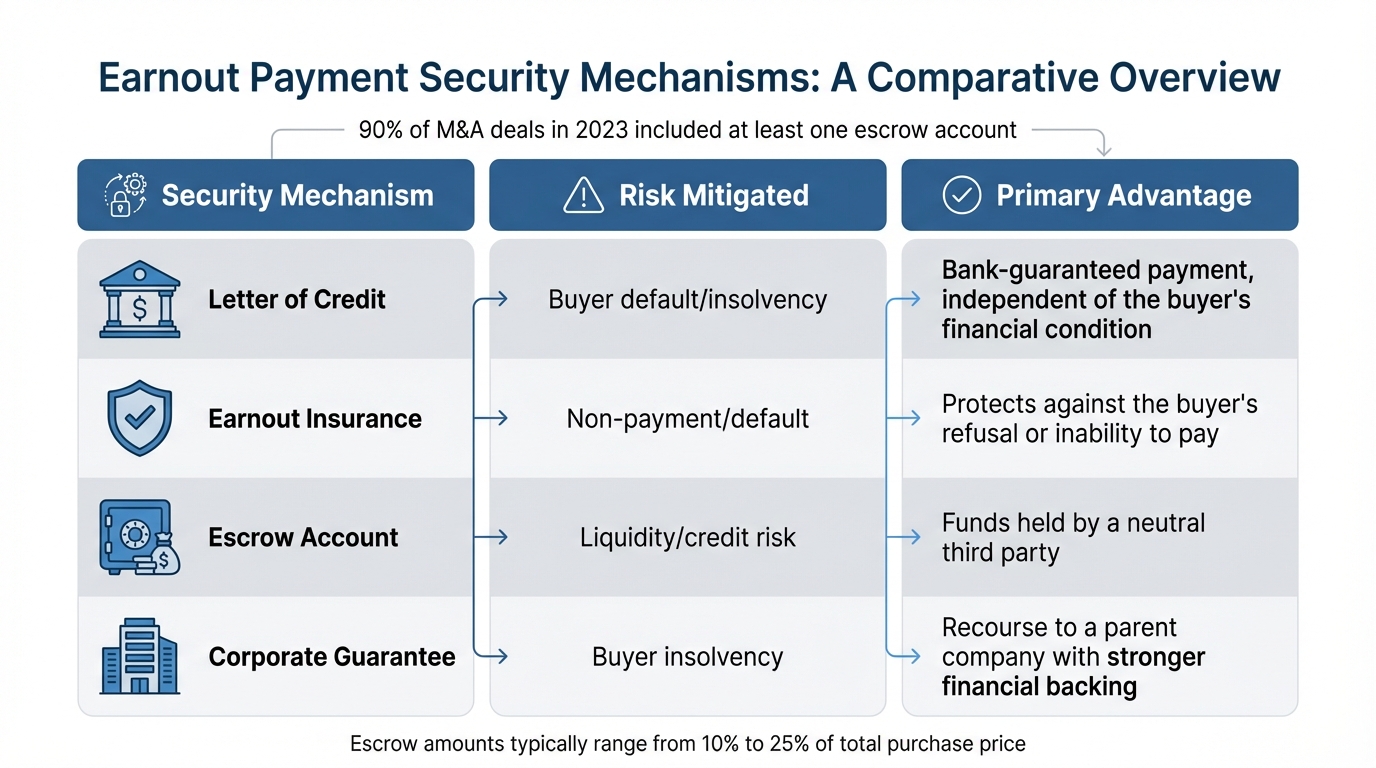
Escrow accounts are a reliable way to secure earnout payments. Instead of depending on the buyer's future financial situation, a portion of the purchase price is held by a neutral third party. In 2023, 90% of M&A deals included at least one escrow account, with more than half using two or more escrows to address various risks [11].
"An escrow often replaces the buyer's rights to claw back payments made to the seller."
- Christopher Letang, Senior Managing Director, M&A, SRS Acquiom [11]
Typically, escrow amounts range from 10% to 25% of the total purchase price [10][13]. In deals without M&A insurance, general indemnification escrows often account for around 10% of the deal value [11]. Sellers generally prefer escrows over holdbacks, where the buyer keeps the funds in their own account.
"The seller favors the escrow option because the funds are readily available and need not be obtained or otherwise sought from the purchaser at a later time, when the purchaser's financial situation may have declined."
- Jarrod Melson, Esq., Harvard Business Services [12]
Corporate guarantees provide another layer of security by making the buyer's parent company financially responsible if the subsidiary cannot pay. This shifts the risk from a potentially underfunded acquisition entity to a larger, more stable company. However, sellers should carefully assess the financial strength of the guarantor before finalizing the deal [14].
Using Letters of Credit and Earnout Insurance
Other tools, such as letters of credit and earnout insurance, can add further security to earnout arrangements.
Letters of credit transfer payment risk from the buyer to a bank, offering a bank-backed guarantee instead of relying on the buyer's financial stability. This is especially useful in industries like life sciences, where earnouts often depend on long-term regulatory milestones, such as FDA approvals, which can take years to achieve [15][5].
Earnout insurance safeguards against both the buyer's inability to pay (due to insolvency) and refusal to pay (wrongful default) [15]. While these policies require premiums and detailed underwriting, they shift the risk to a third-party insurer.
"Specialized insurance policies are available to protect sellers from non-payment risks associated with earnout arrangements."
| Security Mechanism | Risk Mitigated | Primary Advantage |
|---|---|---|
| Letter of Credit | Buyer default/insolvency | Bank-guaranteed payment, independent of the buyer's financial condition [15] |
| Earnout Insurance | Non-payment/default | Protects against the buyer's refusal or inability to pay [15] |
| Escrow Account | Liquidity/credit risk | Funds held by a neutral third party [13] |
| Corporate Guarantee | Buyer insolvency | Recourse to a parent company with stronger financial backing [15] |
These mechanisms create a multi-layered defense against payment risks, which is particularly important in industries with unpredictable regulatory landscapes. Additionally, acceleration clauses can address risks tied to ownership changes.
Adding Acceleration Clauses for Ownership Changes
Acceleration clauses ensure immediate payment of earnouts under specific conditions, such as when the buyer sells the business, declares bankruptcy, or terminates the seller's employment without cause. These clauses are included in nearly 30% of mergers and acquisitions, especially in private deals under $250 million [16][8].
When a buyer resells the acquired business during the earnout period, the new owner might deprioritize the milestones needed for payment. Acceleration clauses address this by requiring an immediate payout based on a pre-agreed formula or amount [14].
Sellers should clearly define the payment formula in the agreement, as disputes over "fair value" can become contentious [14]. For sellers who stay on as part of the management team, linking acceleration to termination without cause can prevent buyers from firing them to avoid making payments [15][14]. Additionally, sellers should watch for subordination risks, where lenders attempt to prioritize senior debt over earnout payments. As Schwabe advises:
"The seller should strenuously object to such limitations."
- Schwabe [14]
Instead, sellers should insist that payments are made unless the buyer is in active default [14].
Handling Disputes and Structuring Payments
Creating Dispute Resolution Processes
When it comes to mergers and acquisitions (M&A), disputes can arise from buyer manipulation or operational changes, making clear dispute resolution mechanisms and well-structured payment processes essential. In fact, post-close disputes occur in about 10% of M&A transactions between buyers and sellers [7]. Having the right dispute resolution system in place can help avoid expensive litigation.
For financial disagreements, independent expert determination is often the go-to solution. For example, when parties clash over earnout calculations, a neutral accounting firm can be appointed to make a binding decision. This method is quicker and more targeted than arbitration, which typically handles broader contract disputes [6][8]. To ensure smooth execution, agreements should outline how the expert is selected, the timeline for decisions, and how costs will be divided [8].
Arbitration, on the other hand, offers a balance of speed, reduced costs, and confidentiality compared to litigation [8]. The choice between arbitration and other methods often depends on whether the parties value privacy and efficiency over a more exhaustive legal process.
In industries heavily influenced by external factors like trade regulations, tiered adjustment mechanisms can help. These mechanisms automatically adjust targets based on predefined scenarios, reducing the likelihood of subjective disputes [6].
"[A]n earn-out…typically reflects [a] disagreement over the value of the business that is bridged when the seller trades the certainty of less cash at closing for the prospect of more cash over time…But since value is frequently debatable and the causes of underperformance equally so, an earn-out often converts today's disagreement over price into tomorrow's litigation over the outcome."
- Vice Chancellor Laster, Delaware Chancery Court [8]
By addressing disputes head-on, these methods lay the groundwork for structuring payments in a way that benefits both parties.
Comparing Lump-Sum vs. Installment Payments
When structuring payments, the choice often comes down to lump-sum payments versus installment payments, each with its own pros and cons.
Lump-sum payments are triggered by hitting a specific milestone, such as FDA approval or securing a patent. While simpler to manage, they can create "cliff" incentives - where narrowly missing a target results in no payout and may discourage further operational effort [8].
Installment payments, in contrast, are spread over several periods (usually 1–3 years) and often include "catch-up" provisions. These allow strong performance in one period to make up for weaker results in another. While this approach promotes sustained effort, it also exposes sellers to the buyer's credit risk over a longer timeframe [8][9].
| Feature | Lump-Sum Payment | Installment Payment |
|---|---|---|
| Complexity | Low; easy to calculate and verify | High; requires tracking over time |
| Seller Risk | Risk of zero payout if narrowly missed | Higher credit risk from extended payments |
| Buyer Risk | Risk of overpaying for a one-time peak | Lower; aligns payments with actual value |
| Incentive Alignment | Risk of "all-or-nothing" demotivation | Encourages ongoing performance |
For installment plans, a cumulative approach - averaging performance over the entire payment period - can be more effective than setting isolated annual targets [8]. Buyers often negotiate setoff rights, allowing them to deduct indemnity claims from future earnout installments [8][9].
Prioritizing Earnout Payments in Capital Structure
Earnout payments are typically subordinated to senior debt, meaning lenders are paid first [1][15]. Sellers should work to establish clear priority terms in the acquisition agreement, ensuring earnouts are appropriately ranked among other obligations.
It’s also important to review the buyer’s debt agreements for any negative covenants that might limit earnout payments [1]. Sellers can safeguard their position by specifying that earnout payments take precedence unless the buyer is actively defaulting on senior debt.
To avoid disputes over accounting practices, agreements should define how items like intercompany overhead, extraordinary gains or losses, and synergies are treated. Relying solely on GAAP can leave room for interpretation, so explicit terms are critical [1][8]. Additionally, buyers often negotiate the right to offset earnout payments against the seller’s indemnification obligations, effectively using these payments as security for post-closing claims [1][8].
Best Practices for Earnout Agreements
Keeping Earnout Structures Simple
When it comes to earnouts, simplicity often leads to better outcomes. Revenue-based earnouts tend to be easier to measure and less prone to manipulation compared to profit-based metrics like EBITDA, which can involve subjective expense allocations [15]. The more complex the calculation, the greater the chance of disputes. To avoid confusion, it’s helpful to include a schedule with sample calculations that clearly shows how metrics will be determined.
Most earnouts are structured to last around 24 months, though some extend up to 36 months [2][3]. However, longer earnout periods come with added risks, such as disputes arising from changing market conditions or evolving business strategies. Keeping the earnout period as short as possible - while still allowing enough time to measure meaningful performance - can help minimize these risks. A straightforward structure also allows experienced M&A advisors to focus their expertise on navigating the finer points of the agreement.
Working with Experienced M&A Advisors
Simplifying the earnout structure is just one part of the equation. Partnering with skilled M&A advisors ensures that the agreement is precise, well-protected, and tax-efficient. These agreements require specialized knowledge to define performance metrics clearly, incorporate protective mechanisms, and achieve favorable tax outcomes [1][8].
For instance, advisors can help include protective measures like acceleration clauses or security arrangements to reduce credit risk [15]. This can be especially important in regulated industries such as iGaming, Cryptocurrency, Forex, and Fintech. Platforms like MyReadyMade offer access to M&A advisors with expertise in these sectors, including the complex task of managing license transfers across more than 50 jurisdictions - an invaluable resource when regulatory milestones are part of the earnout.
Tax treatment is another critical area where expert advice makes a difference. Proper structuring can ensure the earnout is treated as purchase consideration, subject to capital gains tax, rather than as compensation for services, which would face higher ordinary income tax rates [4][8].
Creating Balanced Terms for Both Parties
In addition to simplicity and expert guidance, balanced terms are essential for ensuring both parties remain motivated and protected. Earnouts are most effective when both the buyer and seller have a shared interest in the business’s success. Unbalanced agreements can undermine this cooperation [1].
Clear performance metrics and audit provisions, as mentioned earlier, are key to protecting both parties. Sellers should negotiate "ordinary course of business" covenants to prevent buyers from making strategic changes that could artificially lower earnout targets [2][15]. At the same time, buyers need enough operational flexibility to integrate the acquired business effectively.
Choosing between revenue and EBITDA as performance metrics highlights the importance of balance. Revenue targets are generally harder to manipulate, but they may not fully represent profitability. On the other hand, EBITDA aligns with the bottom line but requires detailed accounting rules to avoid disputes. About 50%–80% of earnouts rely on one of these two metrics [2]. What’s crucial is that both parties understand and accept the trade-offs involved.
"A carefully constructed earnout can be a win for both the buyer and seller." - Fasken [1]
Balanced agreements should also address key concerns like information rights and audit provisions, enabling sellers to verify the buyer’s calculations [1][4]. On the buyer’s side, reasonable set-off rights can provide protection against potential indemnity claims. In fact, over 58% of earnout agreements include such provisions [2], emphasizing the need to align earnout payments with other post-closing obligations.
Conclusion
Earnout agreements can help bridge valuation gaps, but they come with considerable risks, especially in regulated industries like iGaming, Cryptocurrency, Forex, and Fintech. To navigate these complexities, it’s crucial to focus on clear performance metrics, secure payment structures, and expert M&A guidance.
Start by creating strong, measurable performance metrics. Define revenue or EBITDA calculations in precise terms, complete with sample schedules to avoid ambiguity. In regulated industries, it’s wise to include adjustment clauses to address significant regulatory changes during the earnout period [17] [19]. Sellers should also push for covenants that prevent revenue diversion or major operational shifts [15] [17].
Payment security is another cornerstone. Protect against non-payment risks by using tools like escrow accounts, corporate guarantees, letters of credit, or earnout insurance. Include acceleration clauses to ensure immediate payment if there’s a change in control or termination without cause [15] [17].
Dispute resolution is equally important. Establish a clear process, such as arbitration by an independent accountant, to resolve disagreements efficiently and avoid costly litigation [17] [18]. As SRS Acquiom aptly put it:
"Earnouts are often half-jokingly referred to as 'litigation magnets.'" [20]
This highlights the need for careful planning to address potential conflicts upfront.
Collaborating with experienced M&A advisors is essential to create agreements that are technically sound, tax-efficient, and balanced. For businesses in regulated sectors, platforms like MyReadyMade offer access to advisors who specialize in license transfers and regulatory milestones across more than 50 jurisdictions. By integrating these safeguards - clear metrics, secure payment mechanisms, and balanced terms - earnouts can shift from being contentious to becoming strategic tools for mutual success. With proper planning, they can turn potential disputes into opportunities for alignment and growth.
FAQs
What steps can you take to prevent manipulation in earnout agreements?
To minimize the risk of manipulation in earnout agreements, it's essential to set specific and measurable performance metrics right in the contract. For example, you can define clear targets like revenue or EBITDA, while also detailing how these figures will be calculated and which accounting standards will apply. This way, both parties are on the same page about how performance will be assessed.
Adding protections like escrow accounts or security interests can also safeguard funds in case disagreements arise. Including dispute resolution options - such as arbitration or expert determination - offers a neutral path to handle conflicts. Finally, regular reporting, audit rights, and maintaining transparency throughout the earnout period not only reduce the chances of disputes but also help foster trust between everyone involved.
How can I ensure earnout payments are secure?
To ensure earnout payments are received as planned, it's crucial to establish an agreement with well-defined performance metrics. These metrics, which could be financial (like revenue or EBITDA) or non-financial, should be mutually agreed upon to reduce the likelihood of disputes. Additionally, including a detailed payment schedule in the purchase agreement - outlining timing, calculation methods, and required documentation - can prevent misunderstandings.
Legal safeguards, such as escrow accounts, guarantees, or security interests, can provide extra protection if payments are delayed or contested. Regular communication and transparency throughout the earnout period are just as important. Clear dispute resolution procedures should also be included to address any disagreements quickly and effectively. These measures can help ensure payments are made as promised and protect the interests of both parties.
Why are clear performance metrics essential in earnout agreements?
Clear performance metrics play a key role in earnout agreements by offering a transparent and objective framework to determine if the agreed-upon targets have been met. This approach helps minimize misunderstandings or disputes between the parties, ensuring that post-closing payments are calculated fairly and with accuracy.
When specific, measurable criteria are clearly outlined from the start, both buyers and sellers can safeguard their interests and build trust throughout the process. This is particularly important in industries that are highly regulated or involve intricate operations, where precision is crucial.
Related Articles

Ultimate Guide to Earnout Negotiations in M&A
Structure and negotiate earnouts in regulated M&A with clear metrics, anti-manipulation covenants, and acceleration or escrow protections.

How to Draft M&A Definitive Agreements
Guide to drafting M&A definitive agreements covering deal structure, reps & warranties, indemnities, payment terms, and regulatory compliance.

How IP Affects Tokenization Valuation
How tokenizing patents, copyrights, and trademarks adds liquidity and market value—plus legal, regulatory, and valuation steps.
Looking to Buy or Sell?
Get in touch with our team for personalized assistance