Forex Affiliate Transfers: Cross-Border Compliance

Forex Affiliate Transfers: Cross-Border Compliance
Navigating cross-border Forex affiliate transfers is complex. Each jurisdiction has unique regulations for financial promotions, consumer protections, and marketing practices. Missteps can lead to fines or operational shutdowns. For example, in 2024, the UK's FCA amended or withdrew nearly 20,000 financial promotions, emphasizing stricter enforcement globally. Brokers are now held accountable for affiliates' actions, regardless of location.
Key takeaways:
- Regulatory frameworks differ by region: US (CFTC, NFA), UK (FCA), EU (MiFID II), and others.
- Brokers must implement strict AML/KYC protocols, segregate client funds, and document compliance.
- Proper licensing is critical for affiliates and money managers (e.g., MAM/PAMM structures).
- Compliance involves detailed record-keeping, monitoring systems, and navigating regulatory approvals.
This guide outlines how to manage jurisdictional requirements, ensure AML/KYC compliance, and handle fund segregation during transfers. Staying ahead of regulations is essential to protect your brand and operations.
International Forex Regulations Explained
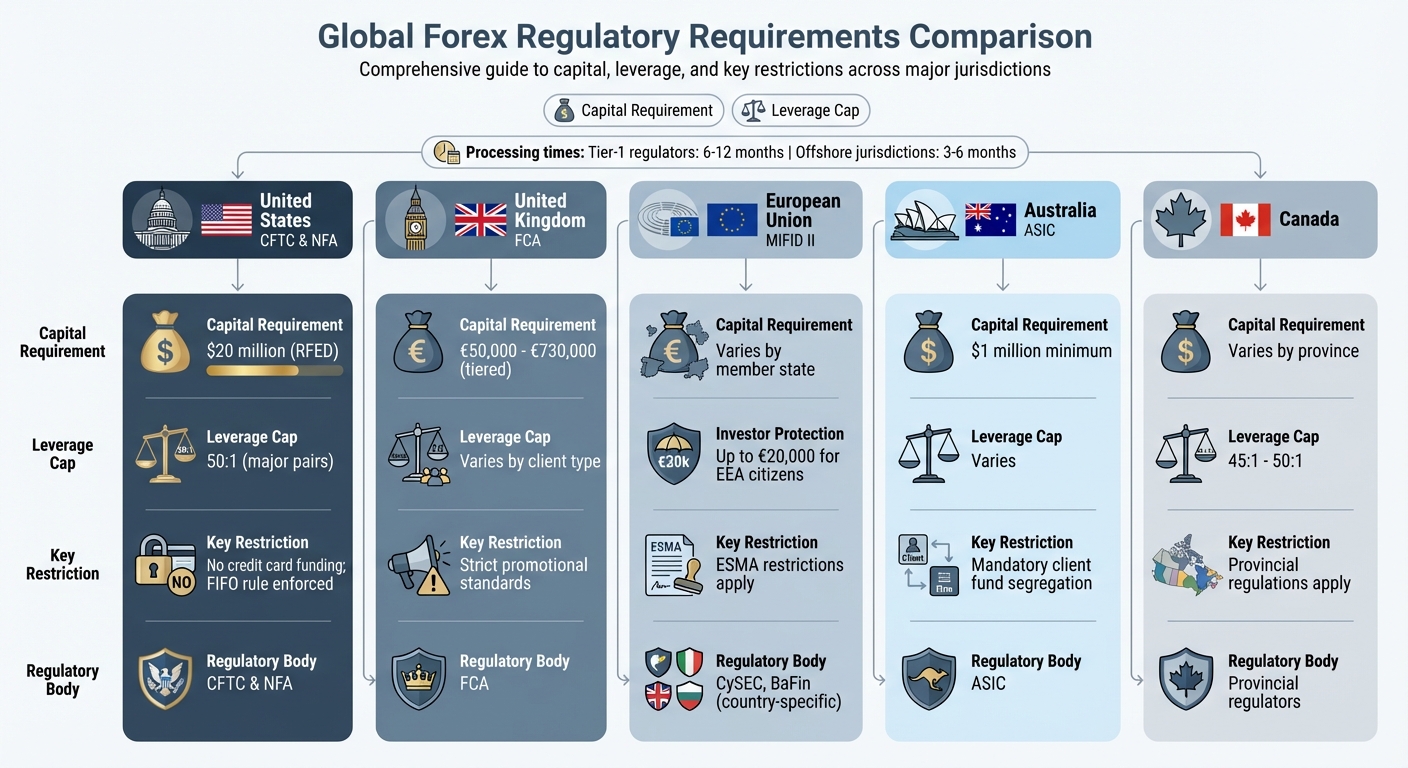
Forex affiliate transfers operate under distinct rules depending on the jurisdiction. Knowing these differences is more than helpful - it's essential to ensure compliance when dealing with cross-border transfers. Each country or region has its own governing bodies, capital requirements, and operational rules that shape how affiliate relationships are managed.
The global regulatory landscape can be broken into key zones. In the United States, the Commodity Futures Trading Commission (CFTC) and the National Futures Association (NFA) enforce some of the strictest rules under the Dodd-Frank Act. These include leverage caps of 50:1 for major currency pairs and a ban on using credit cards to fund Forex accounts [3]. Across the Atlantic, the United Kingdom's Financial Conduct Authority (FCA) operates under the Financial Services and Markets Act 2000, with capital reserve requirements ranging from €50,000 for restricted broker licenses to €730,000 for full market maker licenses [4]. In the European Union, MiFID II sets the standard, but member countries like Cyprus (regulated by CySEC) or Germany (overseen by BaFin) handle direct oversight. EU investors also benefit from protections of up to €20,000 for EEA citizens [4].
Key Regulatory Bodies and Their Jurisdictions
Regulations vary widely across the globe, with each region adopting its own approach. Australia's Securities and Investments Commission (ASIC), for example, requires brokers to maintain a minimum of $1 million in capital and segregate client funds, setting a high bar for compliance outside the US [4]. In the Asia-Pacific region, key players include Singapore's Monetary Authority (MAS), Japan's Financial Services Agency (JFSA), and Hong Kong's Securities and Futures Commission (HKSFC), each with distinct requirements [4].
These differences can create operational challenges. For instance, US regulations enforce the FIFO (First In, First Out) rule, which prohibits hedging, while other regions allow it [5]. In Canada, leverage limits range from 45:1 to 50:1, striking a middle ground between the stricter US caps and the looser rules found in some offshore jurisdictions [4]. This means brokers operating in multiple regions must maintain separate compliance systems - what's legal in one country could be prohibited in another.
Given these complexities, understanding the compliance requirements for various Forex entity types is essential.
Types of Forex Entities and Their Compliance Obligations
Different types of Forex entities face varying levels of compliance requirements. For instance, Retail Foreign Exchange Dealers (RFEDs) in the US must maintain a hefty $20 million in adjusted net capital at all times and are subject to frequent audits [5]. On the other hand, Introducing Brokers (IBs) have lower capital requirements but must register with the NFA and provide written risk disclosures for each dealer they introduce [3]. Additionally, individuals soliciting retail Forex orders must register as Associated Persons (APs) and secure NFA approval [3].
Entity type plays a critical role in compliance during affiliate transfers. An unlicensed affiliate is limited to marketing activities - they cannot handle funds, offer financial advice, or execute trades [1]. In contrast, money managers using MAM (Multi-Account Manager) or PAMM (Percentage Allocation Management Module) structures need specific asset management licenses. They must also use a Limited Power of Attorney (LPOA) to outline their authority without taking control of client funds [1]. Proper classification is crucial, as failing to meet the right obligations can invite regulatory penalties.
| Entity Type | Capital Requirement | Key Restriction |
|---|---|---|
| US RFED | $20 million minimum [5] | Must maintain a physical US office; no credit card funding [3] |
| UK FCA Dealer | €730,000 minimum [4] | Tiered capital based on license type |
| Australia ASIC Broker | $1 million minimum [4] | Mandatory client fund segregation |
| US Introducing Broker | Varies (lower than RFED) | Must register with NFA; provide risk disclosures [3] |
Understanding these regulatory frameworks and entity classifications is the first step in navigating cross-border affiliate transfers. The next step involves thoroughly researching source and destination compliance requirements and documenting them carefully.
How to Identify and Manage Jurisdictional Compliance Requirements
The first step in managing compliance is mapping out the requirements for both the source and destination jurisdictions. Even minor mistakes here can result in fines, delays, or outright rejection of transfers. Before moving forward, it's crucial to fully understand the rules governing both ends of your transaction.
Start by confirming your entity type, as this will dictate your specific compliance responsibilities. Use official regulator portals to check licenses - for instance, the ASIC register for Australia or the FCA register for the UK [1]. Additionally, cross-check against databases like OFAC and SDN to identify any sanctions or restricted entities that could block your transfer. Automated platforms can streamline this process by screening sanctions lists in real time [6].
This initial groundwork sets a solid foundation for further exploration into local regulations and resolving any potential conflicts between jurisdictions.
How to Research Local Regulatory Frameworks
Digging into local regulatory frameworks involves more than just understanding the basics. Begin by identifying broader regional regulations, such as the EU’s PSD2 or APEC’s Cross-Border Privacy Rules (CBPR). Then, narrow your focus to specific national laws like Germany’s BDSG or France’s CNIL requirements [7].
Data sovereignty is another key factor to consider. Certain jurisdictions, such as Singapore (PDPA), Brazil (LGPD), and EU member states (GDPR), require financial or personal data to be stored or processed within their borders [8]. When transferring operations to these regions, carefully document how data flows between systems and ensure you have valid legal mechanisms, such as Standard Contractual Clauses, in place [8].
Foreign exchange (FX) controls in the destination country can also present challenges. Some jurisdictions impose restrictions or additional costs on repatriating affiliate commissions. Conducting thorough research on FX controls early in the process is essential. Working with regulated brokers who provide pre-approved marketing materials and risk disclosure templates can help you establish a strong compliance framework [1].
How to Navigate Overlapping or Conflicting Regulations
After understanding local frameworks, you may encounter situations where regulations overlap or conflict. Even when frameworks seem aligned, national regulators often interpret and enforce rules differently. For instance, while the EU has unified structures like the ECSP and PSD2, individual member states frequently apply local variations, which can create compliance headaches [9].
To address conflicting regulations, you have two main structural options: a subsidiary or a branch structure. A subsidiary requires full local authorization in each jurisdiction, offering better risk isolation but at a higher cost [9]. On the other hand, a branch structure allows you to use "passporting" rights from your home country, reducing overhead while still adhering to local conduct rules and regulatory updates [9].
Many brokers manage these complexities by creating separate affiliate programs tailored to different jurisdictions. This segmentation ensures compliance with specific local rules, such as ESMA restrictions in the EU, without disrupting operations elsewhere [2]. Additionally, your technology systems should be adaptable, capable of handling varying requirements for data collection, retention, and reporting through configurable workflows [9].
To further strengthen compliance, implement multi-layered sanctions screening that checks against both international (EU/UN) and national sanctions lists simultaneously [9]. Use standardized risk warnings across all platforms, making sure they remain visible and aren’t obscured by social media interfaces [2]. Lastly, have clear escalation procedures in place for non-compliant content, including immediate removal and retraining for affiliates.
How to Ensure AML/KYC Compliance During Transfers
Anti-Money Laundering (AML) and Know Your Customer (KYC) protocols are essential for keeping Forex affiliate transfers compliant. Any gaps in these processes can lead to fines or even operational shutdowns. To stay on track, it's crucial to maintain strict oversight, especially when transferring systems and data across borders.
Start by ensuring your transfer plan includes a written AML/KYC policy, appointing a Money Laundering Reporting Officer (MLRO), and conducting a thorough risk assessment that covers both clients and geographic areas [10]. Your policies need to meet the standards of both your licensing jurisdiction - whether it's FSA Seychelles or VFSC Vanuatu - and the requirements of your target markets under FATF frameworks [10]. A one-size-fits-all approach won’t work; policies must be tailored to each jurisdiction.
Assign risk ratings - low, medium, or high - based on factors like client location, payment methods (e.g., crypto vs. bank transfers), and trading behavior [10]. For high-risk clients, verify their Source of Funds (SoF) and Source of Wealth (SoW) before approving account transfers [10]. Use regtech tools for identity verification, such as facial recognition and liveness checks, and implement automated rescreening against sanctions lists (UN, EU, OFAC) and Politically Exposed Persons (PEP) databases whenever there’s unusual activity like large deposits [10].
Record-keeping is another key requirement. You’ll need to retain identity documents, transaction records, and monitoring alerts for 5 to 10 years, depending on jurisdictional rules [10]. During the transfer process, make sure every compliance decision - from onboarding approvals to filing Suspicious Activity Reports (SARs) - is well-documented and easily accessible for audits [10].
This framework ensures a secure foundation for transferring customer verification systems.
How to Transfer Customer Verification Systems
When moving customer verification systems across borders, it’s important to align data collection practices with the regulations of both the source and destination jurisdictions. Use standardized intake forms to collect key data like legal names, dates of birth, residential addresses, nationality, and tax residency [10]. For high-risk clients, include additional financial background details such as Source of Funds and Source of Wealth [10].
Keep centralized audit trails for all verification decisions. Document not just the outcomes (approved or rejected), but also the reasoning, reviewed documents, and the staff involved in the decision-making process [10]. Avoid free-text data collection forms, as they can complicate standardization and migration later.
Use geolocation tools to validate IP and device data, which can help identify fraudulent applications before they enter your system [10]. If your operations are moving to a mobile-first market, such as regions in Africa or Southeast Asia, ensure your KYC portal supports mobile-friendly features like photo uploads for documents. Providing clear visual guides for documents - like utility bills or ID cards - can also improve success rates [11].
Once verification systems are securely migrated, the next step is maintaining robust monitoring to detect suspicious activity.
How to Maintain Suspicious Activity Monitoring
Continuous monitoring is critical to prevent fraud. Implement automated monitoring systems to track all financial activities, including deposits, withdrawals, and internal transfers. Use pattern-based rules to identify red flags such as structuring, rapid "in-and-out" transactions, or payments involving third parties [10].
Set threshold-based alerts for unusual transactions that deviate from a client’s typical behavior. For instance, if a client who usually trades small lots suddenly opens a much larger position, the system should flag this for manual review [10]. Compare trading activity - like lot size and margin usage - with the client’s declared Source of Funds to spot inconsistencies that might require a Suspicious Activity Report (SAR) [10].
AI-driven fraud detection tools can significantly reduce manual workload, identifying complex patterns that might otherwise go unnoticed during high-volume transfer periods [12]. Leading platforms screen against thousands of PEP, sanctions, and media sources, applying hundreds of risk scenarios to flag potential issues [12]. However, human oversight remains essential for interpreting alerts, especially in complex cross-border scenarios [10].
Watch for common red flags during transfers, such as frequent deposits and withdrawals with minimal trading, multiple accounts tied to the same IP address, or funding from high-risk jurisdictions without clear justification [10]. Be mindful of "zombie" leads - users who pass KYC checks but never deposit funds - as they could be testing your system’s vulnerabilities [11]. Establish clear procedures for escalating and filing SARs or Suspicious Transaction Reports (STRs) with authorities within the required timelines [10].
Finally, adjust monitoring thresholds to fit the risk profile of the new jurisdiction. For example, mobile-first trading behaviors in Southeast Asia may require different settings than desktop-heavy markets in the EU [11]. Document every adjustment to ensure readiness for audits and demonstrate compliance to regulators.
How to Manage Financial Controls and Customer Fund Segregation
Once your AML/KYC and verification systems are in place, the next step is ensuring financial controls are solid. Managing customer funds during cross-border transfers requires precision. With the total value of cross-border payments expected to surpass $250 trillion by 2027, even minor missteps in fund management can lead to major issues [7]. Inefficiencies like hidden fees or delays can drain 5% to 7% of your total revenue [13], making it critical to get these controls right from the beginning.
Automated reconciliation systems are a must. These systems track funds in real-time across currencies and banking partners, automatically applying thousands of banking rules to flag potential errors. This can cut payment processing mistakes by up to 66% [6]. They also provide centralized visibility into international subsidiaries, eliminating the need to manually sift through individual bank statements [6].
Another key strategy is optimizing currency management. Using multi-currency accounts allows you to hold and transfer funds in local currencies, avoiding constant conversions through intermediaries. This not only minimizes foreign exchange risks but also lets you time transactions to take advantage of favorable rates [7][8]. For instance, local payment systems like ACH or SEPA cost less than $5 per transaction, compared to $15–$50 for SWIFT transfers [13]. Some fintech platforms even offer exchange spreads as low as 0.5% to 2% [13].
To further tighten controls, implement tiered payment authorizations and automated transaction screening. These measures help prevent financial crimes and reduce manual errors [15]. Systems should also collect necessary tax documentation - like W-9/W-8 forms in the U.S. or SORT codes in the UK - before initiating transfers [6]. Additionally, setting payment thresholds allows smaller transactions to accumulate, cutting down on fixed fees [13].
How to Ensure Compliance with Fund Segregation Rules
Fund segregation rules differ widely across regions, and mixing customer funds with operational capital can result in severe penalties. Clearly define the roles of affiliates versus licensed managers to prevent mishandling during transfers. For example, unlicensed affiliates can only market services, while licensed money managers (like MAM/PAMM operators) need regulatory approval to manage client funds [1].
For managed accounts, the Limited Power of Attorney (LPOA) is a crucial document. It authorizes trading on a client’s behalf without transferring ownership of funds while outlining fee structures and risk limits [1]. This protects both parties by clearly defining legal boundaries for the use of segregated funds.
Adopt SWIFT MT 202 COV messaging standards for cover payment transactions. These standards require detailed originator and beneficiary information, improving transparency and reducing compliance risks with agencies like OFAC [14]. Without these enhanced formats, intermediary banks may lack critical information, creating vulnerabilities [14].
Automate payee screening against SDN/OFAC blacklists to avoid fraud and legal issues [6]. Centralized, secure records for each payee can streamline compliance checks and reduce manual errors. Maintain detailed audit trails to document how customer funds were separated, transferred, and verified at every stage.
How to Secure Customer Accounts During the Transition
Protecting customer accounts is just as important as segregating funds. Use data tokenization and encrypted gateways to safeguard sensitive information during transfers.
Working with multiple local acquirers instead of a single provider can improve bank approval rates by up to 16% and lower interchange costs [7]. This redundancy ensures uninterrupted service even if one payment rail experiences delays or technical issues.
Leverage AI-powered fraud detection to monitor transactions and flag unusual activity in real-time. These systems can detect patterns like frequent withdrawals just below reporting thresholds or access attempts from unexpected locations. However, human oversight is still essential for complex cross-border cases that require nuanced judgment.
Map out all cross-border data flows to ensure compliance with privacy laws like GDPR or PDPA. For data transfers outside the EU/EEA, use Standard Contractual Clauses (SCCs) or Binding Corporate Rules (BCRs) to establish legal grounds. Keep customers informed about transfer timelines, potential service interruptions, and how their funds will remain secure. Transparency not only builds trust but also reduces the volume of support inquiries during transitions.
How to Handle Regulatory Notifications and License Transfers
Once your financial controls and customer protections are in place, the next step is tackling the regulatory paperwork. This stage can often slow down deals, especially when it comes to regulatory notifications and license transfers. For example, tier-1 regulators like the FCA or CySEC typically take 6–12 months to process applications, while offshore jurisdictions such as Seychelles or Mauritius are faster, averaging 3–6 months [19]. Even minor errors, like missing a document or misclassifying your registration category, can lead to manual reviews that stretch the timeline by weeks.
It’s crucial to determine your registration category - whether it’s IB, CTA, or RFED - since each comes with its own notification requirements [3][1]. For money managers handling MAM/PAMM accounts, an asset manager license is necessary, along with a Limited Power of Attorney (LPOA) to outline legal authority and fee structures [1]. Additionally, individuals involved in soliciting or supervising retail forex orders must register as Associated Persons (APs) and secure NFA approval [3].
To avoid compliance risks, verify the registration and disciplinary history of all involved parties using the NFA BASIC system [3]. If you’re expanding into a new jurisdiction, be aware of what constitutes "doing business" there. For instance, in the Philippines, simply running a website that serves local customers could trigger SEC licensing requirements - even without a physical office [16]. Below, we’ll break down how to prepare notification documents and manage potential delays during the license transfer process.
How to Prepare Notification Documents
Accuracy is everything when preparing notification documents. Even small mistakes can delay the process by days or weeks [17]. For example, Forex Dealer Members (FDMs) are required to appoint a Chief Compliance Officer (CCO) to oversee regulatory obligations and submit annual reports to the NFA within 90 days of the fiscal year-end [3]. The CCO must already be a registered principal and approved as a forex AP - this is a non-negotiable requirement [3].
Start early by gathering all necessary personnel filings. Regulators like the FCA, CySEC, and FSCA mandate that the legal entity includes at least two local directors with extensive financial services experience [19]. Securing these personnel ahead of time helps prevent administrative delays. Additionally, you’ll need to provide proof of deposited capital, which varies significantly by jurisdiction - from $50,000 in Seychelles or Mauritius to as much as $730,000 for FCA or CySEC licenses [19].
| Regulator | Jurisdiction | License Cost | Capital Requirement | Processing Time |
|---|---|---|---|---|
| FCA | United Kingdom | $32,500 - $65,000 | $162,500 - $949,000 | 6 - 12 months |
| CySEC | Cyprus | $13,000 - $39,000 | $162,500 - $949,000 | 6 - 12 months |
| FSCA | South Africa | $5,000 - $10,000 | $50,000 | 6 - 12 months |
| MFSC | Mauritius | $15,000 - $20,000 | $50,000 | 3 - 6 months |
| FSA | Seychelles | $1,500 - $3,000 | $50,000 | 3 - 6 months |
In countries like the Philippines, financial institutions must submit quarterly reports on cross-border financial positions, including liabilities to non-residents [16]. Additionally, it’s vital to maintain all records, books, and promotional materials for at least five years to ensure audit compliance [3]. To simplify the process, consider using pre-approved materials from regulated broker partners to meet compliance requirements immediately [1].
For NFA members, establishing a local office in the continental U.S. is mandatory. This office will handle financial records under the supervision of a registered principal [3]. By building on the compliance systems you’ve already established, you can ensure a smooth transition across borders. Once the documentation is complete, the focus shifts to managing any delays in regulatory approvals.
How to Manage Delays in Regulatory Approvals
Delays are common, especially with tier-1 regulators that require extensive audits, compliance interviews, and detailed reporting before granting approval [19]. Without this approval, you won’t be able to operate, open corporate bank accounts, or access tier-1 liquidity providers [19]. These hurdles can create significant operational and financial challenges during the transition.
If speed is a priority, jurisdictions like Seychelles or Mauritius offer faster approval windows of 3–6 months compared to the 6–12 months required by CySEC or the FCA [19]. However, offshore licenses come with limitations - they may lack the credibility and broader operational rights that tier-1 licenses provide. While slower and more expensive, tier-1 licenses offer greater trust and market access.
To minimize delays, ensure your application is pre-submission ready by fully implementing AML/KYC policies, risk management frameworks, and IT infrastructure beforehand [19]. Regulators scrutinize these areas closely, and gaps will result in requests for additional documentation. Establish direct communication channels with the regulatory bodies in each jurisdiction to clarify requirements and foster a cooperative relationship [18].
Transparency with clients during this process is key. As Barbara Corcoran wisely notes:
"Your brand is your reputation. In the world of finance, that's all you have. Are you building a skyscraper on a solid foundation of compliance, or a shack on the sand?" [1]
Being upfront about timelines and potential risks can help build trust and loyalty, even during delays. Use this time to refine your compliance systems and prepare for post-transfer audits, ensuring you’re ready to operate seamlessly once approvals are granted. For those acquiring a Forex business with an existing license, platforms like MyReadyMade (https://myreadymade.com) provide expert advisory services to navigate the complexities of regulatory transfers across 50+ jurisdictions, offering professional support throughout the process.
How to Document Compliance and Maintain Audit Trails
Once you've successfully completed regulatory notifications and license transfers, the next step is just as important: documenting every compliance decision. Without clear records, even a seamless transfer can fall apart during an audit. Regulators expect a detailed trail of compliance decisions, from onboarding customers to ongoing monitoring. If documentation is missing or poorly organized, it could lead to penalties or remediation programs.
Treat documentation as an ongoing process, not a one-off task. Records should be centralized, standardized, and easy to retrieve for audits. Avoid using free-text forms, as they make data comparison more difficult. Instead, use structured formats that allow for efficient analysis across jurisdictions [10]. A clear and accessible audit trail simplifies regulatory reviews and ensures you're prepared for future audits.
How to Organize Compliance Documentation
To stay audit-ready, compile all essential compliance documents related to cross-border transfers. These should include:
- AML/KYC policies approved by senior management.
- Documented risk assessments covering products, clients, and geographies.
- Customer Due Diligence (CDD) and Enhanced Due Diligence (EDD) procedures [10].
For individual customers, keep records like legal names, dates of birth, residential addresses, and tax residency details. For corporate clients, maintain certificates of incorporation, registered addresses, and Ultimate Beneficial Owner (UBO) identifications [10].
Financial and transactional records are equally important. This includes Source of Funds (SoF) and Source of Wealth (SoW) documentation, such as salary slips or tax returns, along with automated transaction logs [10]. For managed accounts (like MAM/PAMM), ensure you have Limited Power of Attorney (LPOA) agreements outlining legal authority, fee structures, and risk parameters [1]. Additionally, retain copies of approved marketing materials and risk disclosure statements to confirm compliance with advertising regulations [1].
Here's a quick reference table to help organize these documents:
| Document Category | Essential Items | Purpose for Audit |
|---|---|---|
| Identity Verification | Government IDs, Proof of Address, Liveness checks | Confirms client identity and location [10] |
| Financial Profile | SoF/SoW evidence, Tax residency data | Justifies transaction volumes vs. income [10] |
| Operational Logs | Transaction monitoring alerts, SAR/STR filings | Shows active risk oversight [10] |
| Legal/Affiliate | LPOA contracts, Approved marketing materials | Defines authority, proves advertising compliance [1] |
| Governance | Staff training logs, MLRO appointment letters | Demonstrates compliance culture [10] |
Using standardized formats for compliance records ensures that auditors or third-party reviewers can easily trace the movement of funds without requiring specialized technical knowledge [20]. Centralizing all documentation into a single system with complete audit trails is essential. For high-risk clients, document the rationale behind onboarding decisions and any Suspicious Activity Reports (SARs) filed. Regulators will closely examine how red flags - like frequent low-value trades or transactions from high-risk jurisdictions - were handled [10].
Retention periods for records vary by jurisdiction, typically ranging from 5 to 10 years after the end of a business relationship [10]. For instance, the IRS requires businesses to keep Form 8300 (for cash payments over $10,000) for five years [21]. Be sure to confirm the specific retention rules for your jurisdiction, as requirements in places like Seychelles or Vanuatu may differ from those in the EU or UK [10].
How to Ensure Post-Transfer Audit Readiness
Once your documentation is organized, the next step is ensuring that it remains accessible and audit-ready. This involves keeping all KYC documents and monitoring logs easily retrievable and ensuring that staff receive updated AML training tailored to the new jurisdiction's regulations [10]. Auditors will expect to see clear, well-documented justifications for every compliance decision [10].
Leverage RegTech solutions to centralize storage and automate audit trails. These tools can help minimize manual errors and ensure you're always prepared for audits [10]. Automated reconciliation systems that sync with your ERP are particularly useful for tracking transactions involving multiple currencies and payment methods. These systems can handle thousands of payment rules to flag errors and ensure compliance in real time [6].
Avoid practices like internal "book transfers", which can obscure audit trails. A notable example is the January 2021 case involving Union de Banques Arabes et Françaises (UBAF). The bank settled for $8,572,500 with the U.S. Department of the Treasury's Office of Foreign Assets Control (OFAC) after using internal book transfers to move USD between a sanctioned Syrian entity and a non-sanctioned client. This practice hid payment details and allowed the sanctioned party to bypass detection [20].
To validate your AML systems, conduct annual independent audits and third-party reviews. Maintain records of all filed Suspicious Transaction Reports (STRs) and Cash Transaction Reports (CTRs), along with detailed logs of real-time sanctions and Politically Exposed Persons (PEP) screenings for all customers and transactions [22].
Finally, track governance and training efforts. Keep logs of annual staff training sessions and board-level oversight meetings to demonstrate a strong compliance culture. As the UK Financial Conduct Authority (FCA) puts it:
"Reliance on third parties is not enough - brokers must actively evaluate and monitor risks themselves." [22]
Conclusion
Cross-border Forex affiliate transfers demand constant vigilance and thorough compliance verification. Regulatory fines globally hit a staggering $19.3 billion in 2024, and failures in compliance can lead to severe consequences, including unlimited fines or up to two years in prison [2]. For example, in March 2024, FINRA imposed an $850,000 fine on M1 Finance for not supervising social media influencers who made misleading claims on its behalf [2].
These penalties highlight the critical need for proactive compliance strategies. Start by implementing pre-approval workflows for affiliate materials and requiring mandatory compliance training during onboarding. Vet influencer partners carefully, checking for any history of regulatory issues [2]. Leverage AI-powered monitoring tools to keep an eye on affiliate channels in real time, ensuring that risk warnings are always visible and not hidden behind features like "read more" buttons [2]. The UK's Financial Conduct Authority (FCA) took action on nearly 20,000 non-compliant financial promotions in 2024 - a massive 33-fold increase compared to 2021 [2].
Follow the "Golden Rules" for affiliate communications: ensure risk warnings are clear, avoid profit guarantees, refrain from offering financial advice, and always maintain honesty [1]. It’s also essential to differentiate between unlicensed affiliates (marketers) and licensed money managers (MAM/PAMM), as the latter require proper regulatory licenses and Limited Power of Attorney (LPOA) documentation [1]. Keep detailed records of affiliate onboarding, training sessions, and content approvals to demonstrate compliance during audits [2].
FAQs
Which country’s rules apply when my affiliates market across borders?
Regulations in the country where your affiliates run marketing campaigns are crucial. For example, regulatory bodies like the FCA (Financial Conduct Authority) in the UK actively oversee and enforce compliance within their jurisdiction. It's essential to ensure that your affiliates follow local laws to avoid any penalties or legal issues.
What can an unlicensed forex affiliate legally do (and not do)?
Affiliates promoting forex services without a license can market these services but must steer clear of offering financial advice, executing trades, or managing client funds. They also cannot claim to be regulated or licensed. It's crucial for affiliates to align their activities with legal requirements to avoid potential legal troubles.
What records should I keep to prove AML/KYC and promotions compliance?
To show compliance with AML/KYC regulations and promotional guidelines, it's crucial to maintain detailed and well-organized records. Key documents to keep include:
- Identity proofs and address verification records.
- Customer due diligence (CDD) documentation.
- Suspicious activity reports (SARs) for any flagged transactions.
- Transaction logs detailing activity histories.
- Compliance-related communications, such as internal memos or external correspondence.
These records help ensure your processes align with global AML standards and meet local regulatory requirements.
Related Articles

KYC vs. AML for Payment Processors: What to Know
KYC confirms identity at onboarding, but only continuous AML monitoring stops payment processors from becoming conduits for financial crime.

Checklist for Secure Player Database Transfers
Step-by-step checklist for secure player database transfers: compliance, encryption, vendor vetting, zero-trust, integrity checks, and audits.
Ultimate Guide to Payment Compliance in iGaming
Roadmap for building compliant iGaming payment systems: AML/KYC, PCI‑DSS, multi‑PSP setup, chargeback controls and jurisdictional risks.
Looking to Buy or Sell?
Get in touch with our team for personalized assistance