How Non-Binding LOIs Impact M&A Negotiations

How Non-Binding LOIs Impact M&A Negotiations
Non-binding Letters of Intent (LOIs) are preliminary documents used in mergers and acquisitions (M&A) to outline potential deal terms without creating legal obligations to finalize the transaction. While they offer flexibility for both buyers and sellers, they also come with risks, especially in regulated industries like Fintech, Cryptocurrency, and iGaming. Here's what you need to know:
- What They Cover: Non-binding LOIs typically outline purchase price, deal structure, and conditions for moving forward. However, clauses like confidentiality and exclusivity are legally binding.
- Key Benefits: They allow parties to test alignment, adjust terms during due diligence, and provide an "exit ramp" if issues arise.
- Risks: Ambiguous language, overly long exclusivity periods, or actions implying commitment can lead to disputes or unintended legal obligations.
- Critical Clauses: Binding sections like confidentiality and exclusivity protect sensitive data and negotiation investments, but breaching them can result in penalties exceeding $200,000.
- Best Practices: Clearly define binding vs. non-binding terms, set realistic timelines, and avoid actions that suggest enforceability before signing a definitive agreement.
Non-binding LOIs are useful tools, but their success depends on precise drafting and clear communication. Missteps can lead to reputational damage, legal disputes, or prolonged negotiations, especially in high-stakes, regulated sectors.
Mastering the Letter of Intent (LOI) in M&A: Best Practices & Common Mistakes
Problems with Non-Binding LOIs in M&A Deals
Non-binding LOIs may provide flexibility, but they also bring notable challenges in regulated M&A transactions. Both buyers and sellers need to navigate these carefully.
Damage to Reputation from Withdrawing
Backing out of a non-binding LOI is legally permissible, but it can tarnish your reputation in the M&A world. In close-knit sectors like iGaming, Fintech, and Cryptocurrency, news of withdrawn deals travels fast. Companies that frequently walk away from agreements might face stricter binding terms or higher break-up fees (commonly 1% to 3% of the deal's total value) in future negotiations [3].
"Even non-binding LOIs can create practical constraints and reputational consequences if you walk away."
– Loraina A. Lopez, LP Legal [1]
Vague language in LOIs can also open the door to legal disputes. Jonathan M. Wagner highlights the risks:
"LOIs that are vague, ambiguous or imprecise present a ripe opportunity for a jilted party to create litigation mischief" [6].
Even if such lawsuits are dismissed, the damage to your credibility can make future negotiations more challenging. For sellers, a failed deal after a lengthy exclusivity period can stigmatize the asset, making it seem like "damaged goods" to other prospective buyers [2].
Beyond reputational concerns, non-binding LOIs can also create inefficiencies in the negotiation process.
Extended Negotiation Timelines
In addition to reputational risks, non-binding LOIs often lead to prolonged negotiations. Since roughly 90% of the terms in a standard LOI are non-binding - covering key aspects like purchase price and deal structure - buyers frequently use due diligence findings to renegotiate these core terms, effectively restarting the clock [3].
The lack of clear milestones makes matters worse. Without firm deadlines for tasks like completing financial reviews or drafting the definitive purchase agreement, negotiations can drag on indefinitely. Roman Mohren from Vista Business Group puts it succinctly:
"Without a defined timeline, deals can drag on indefinitely, causing frustration, resource drain, and potential loss of alternative opportunities" [2].
In regulated industries, broadly worded conditions precedent tied to regulatory approvals can become tools for stalling or easy exit strategies. Ambiguous terms, as previously noted, can create misaligned expectations and force parties back to the negotiating table. Additionally, long exclusivity periods without clear progress can leave sellers stuck, reducing their leverage and causing them to miss out on other opportunities.
These issues underscore the importance of precise and well-structured LOI terms to ensure smoother negotiations and maintain credibility in regulated markets.
How Non-Binding LOIs Provide Flexibility
Non-binding Letters of Intent (LOIs) bring a level of adaptability to mergers and acquisitions (M&A) that can be crucial for navigating the complexities of such transactions. Instead of locking parties into a rigid agreement, these LOIs act as a framework for negotiation, allowing room for adjustments as discussions evolve [3].
Adjusting Terms Based on Due Diligence
One of the key advantages of non-binding LOIs is their "subject to due diligence" clause. This provision gives buyers the ability to adjust critical elements like the purchase price or deal structure based on findings that emerge during due diligence or from new legal or tax insights [8][10]. For example, if due diligence reveals hidden liabilities, financial irregularities, or operational challenges, buyers can request adjustments to the deal - often referred to as "re-trading."
As Alex Lubyansky, M&A Attorney and Managing Partner at Acquisition Stars, explains:
"Just because the LOI says $10M doesn't mean you're getting $10M. Buyers routinely request price reductions during due diligence ('we found X issue, we need a $500K reduction')" [8].
This flexibility isn't limited to buyers. Sellers can also use the non-binding nature of LOIs to renegotiate terms if the buyer's initial offer undervalues the business or if the business's performance changes [3]. Additionally, structural changes - like shifting from a stock sale to an asset sale - can be made during this phase, ensuring neither party is stuck in an unfavorable deal before all the details are clear [3].
Preserving Negotiation Power
Non-binding LOIs also help preserve negotiation leverage for both parties. For buyers, the non-binding terms mean they can walk away without facing legal consequences if key deal terms can't be agreed upon before entering a binding agreement [11]. This is vital in a field where studies show that 70% to 90% of M&A deals fail to create value [8].
Sellers, on the other hand, often hold the most leverage during the LOI stage. Joseph C. Marrow, an attorney at Morse Law, highlights the different priorities:
"A buyer generally favors a more generic LOI with details to follow in a definitive acquisition agreement. A seller often prefers a more detailed LOI addressing material issues that may surface during the transaction process" [12].
Savvy sellers use this window of high leverage to address critical issues - such as indemnity caps, earnout metrics, and baskets - before entering exclusivity, which typically reduces their bargaining power [11][12]. The non-binding nature also allows both sides to test their alignment on key issues like operational control and post-closing employment without the weight of legal commitment. This flexibility often leads to smoother negotiations and more effective M&A outcomes [12].
Binding Clauses in Non-Binding LOIs
While most of a Letter of Intent (LOI) is non-binding, the inclusion of binding provisions is crucial for managing risks during negotiations. These provisions - such as confidentiality, exclusivity, and termination clauses - are enforceable even if the deal doesn't close, carrying potential legal and financial implications [3].
Let’s take a closer look at how confidentiality safeguards sensitive information.
Confidentiality and NDAs
Confidentiality clauses are designed to protect sensitive business data throughout the M&A process. These clauses define what qualifies as confidential - examples include financial statements, customer records, trade secrets, and operational metrics - and restrict the buyer from sharing this data with unauthorized parties or using it for purposes beyond evaluating the deal. If an NDA (Non-Disclosure Agreement) is already in place, the LOI should reference and align with it to avoid inconsistencies.
Roman Mohren of Vista Business Group emphasizes the importance of this provision:
"An LOI without a confidentiality clause could allow the buyer to share sensitive financial data with competitors or use it as leverage in future negotiations" [2].
Confidentiality obligations often extend 2 to 5 years beyond the end of negotiations, regardless of whether the deal is finalized [3]. This extended timeframe protects sellers from potential misuse of proprietary information, reducing risks like competitive harm or internal disruptions caused by leaked discussions.
Exclusivity clauses, on the other hand, focus on protecting the buyer’s investment during the negotiation process.
Exclusivity and No-Shop Clauses
Exclusivity clauses, also known as "no-shop" provisions, prevent the seller from engaging with other prospective buyers for a set period, typically lasting 30 to 90 days [3]. These clauses ensure that the buyer’s time and resources - spent on due diligence, legal reviews, and financial evaluations - aren’t wasted by the seller entertaining competing offers mid-process.
Acquisition Stars highlights the importance of this clause:
"The exclusivity clause is the most commonly litigated LOI provision. Sellers must take it seriously - even discussing a deal with another party can constitute breach" [3].
Violating this clause can lead to significant legal and financial consequences, with damages or litigation costs potentially exceeding $200,000 [3]. To balance the buyer’s need for exclusivity with the seller’s interest in progress, sellers might negotiate milestone-based exclusivity periods. For example, they could require the buyer to provide a draft of the definitive agreement within 45 days, ensuring the buyer is acting in good faith rather than stalling while exploring other options [2].
Termination provisions further clarify how to end negotiations and what obligations remain.
Termination Provisions
Termination clauses define the conditions under which negotiations can end and specify which obligations, like confidentiality and expense allocation, remain enforceable. These provisions create a clear distinction between non-binding deal terms and binding commitments, reducing the risk of disputes. Common triggers for termination include unsatisfactory due diligence results, failure to secure regulatory approval, or breaches of binding terms.
| Provision | Binding Status | Impact of Termination |
|---|---|---|
| Purchase Price | Non-Binding | Exit permitted without penalty |
| Exclusivity | Binding | Breach may lead to damages or injunctive relief |
| Confidentiality | Binding | Survives termination for 2–5 years |
| Expense Allocation | Binding | Ensures costs are paid as agreed |
To avoid confusion, parties should include a "Binding Effect" section that explicitly identifies which parts of the LOI are legally enforceable [15][3]. Courts in certain jurisdictions may interpret silence on termination rights as an implied duty to negotiate in good faith. To preserve the right to walk away without obligations, parties should clearly disclaim any such implied duty [5].
Common Negotiation Mistakes with Non-Binding Terms
Most LOI (Letter of Intent) terms are non-binding, but vague or poorly crafted language can lead to disputes that are both costly and time-consuming. To avoid these pitfalls, it’s essential to understand where negotiations can go wrong. Carl R. Kugler of Reinhart Boerner Van Deuren highlights the risks:
"The legal landscape is littered with deals gone awry, and many of these cautionary tales trace back to a critical mistake made in the LOI." [7]
Let’s break down some common errors that can derail negotiations when LOI terms aren’t clearly defined.
Unclear or Broad Language
Ambiguous language in an LOI often leaves room for misinterpretation. Terms like "reasonable", "industry standard", or "subject to further discussion" can mean very different things to different parties. For example, if an LOI states that the purchase price will follow "industry standard metrics", one party might assume a revenue-based calculation while the other expects an EBITDA-based approach [2].
Another issue arises when non-binding LOIs unintentionally include binding commitments. Even with a non-binding disclaimer, certain phrases or isolated clauses can be interpreted as enforceable. Eileen Duffy Robinett and Jeff Brown of Thompson Coburn LLP explain:
"In a dispute regarding enforceability, courts will not care what you call it... Instead, they will look at the specific language included in the document regarding its expected binding effect." [4]
To avoid confusion, it’s critical to separate binding and non-binding sections with clear headers and qualifying terms like "proposed" or "anticipated." Including a "Binding Effect" clause, as discussed earlier, can further clarify which provisions are legally enforceable [3].
Overly Long Exclusivity Periods
Exclusivity clauses, which prevent sellers from entertaining other offers, can be a double-edged sword. While they provide buyers with security, overly long periods - extending beyond the typical 30 to 90 days - can leave sellers at a disadvantage [3][8]. Alex Lubyansky, an M&A attorney, cautions:
"Signing a 180-day exclusivity period essentially takes your business off the market for 6 months. If that buyer walks away, you've lost irreplaceable time and momentum." [8]
Prolonged exclusivity can result in a "market freeze", where other potential buyers lose interest, and the seller’s leverage diminishes. Worse, some buyers may intentionally delay the process, frustrating sellers or pushing for price reductions (a tactic known as "re-trading") once the seller is locked in [8][13]. Sellers can protect themselves by negotiating milestone-based exclusivity, such as tying a 45-day period to the completion of financial due diligence. Sellers should also include termination rights if the buyer changes deal terms or fails to act in good faith [2][9].
Buyer vs. Seller Pitfalls Compared
Both buyers and sellers face unique risks when negotiating non-binding LOIs. Here’s a side-by-side look at some of the most common vulnerabilities:
| Issue | Buyer Pitfalls | Seller Pitfalls |
|---|---|---|
| Exclusivity | Omitting the clause allows the seller to shop offers to competitors [3]. | Accepting extended periods without milestone-based protections can stall progress [8]. |
| Commitment Language | Committing to "best efforts" makes it harder to walk away after due diligence [7]. | Accepting vague payment terms or undefined earn-out metrics creates uncertainty [2]. |
| Due Diligence Scope | Failing to define access rights can lead to seller resistance or missing key data [3]. | Allowing overly broad investigations can cause delays and frustration [2]. |
| Valuation | Overpaying due to undisclosed liabilities is a major risk [13]. | Treating the LOI price as final may lead to buyers re-trading during due diligence [8]. |
| Non-Competes | Assuming non-competes are standard without checking their scope can backfire [2]. | Agreeing to overly broad non-competes can limit future opportunities, even if the deal falls apart [2]. |
The solution to these challenges lies in careful drafting. Clearly define valuation metrics, set realistic timelines, and ensure all communications go through a single point of contact. This reduces the risk of conflicting statements or misunderstandings that could unintentionally alter the LOI [7].
How to Manage Expectations with Non-Binding LOIs
When it comes to M&A negotiations, the difference between a smooth process and a legal nightmare often hinges on how well you define what’s binding and what isn’t. Without clear boundaries, you risk disputes or unintentionally committing to terms.
Writing Clear "Binding Effect" Sections
A well-drafted "Binding Effect" clause is crucial. This section should spell out which provisions are enforceable - like exclusivity, confidentiality, and expense allocation - while making it clear that all other terms are simply expressions of intent.
Erik Lopez, Partner at Jasso Lopez PLLC, highlights the importance of precision here:
"Clarity about which, if any, terms of an LOI are binding on the parties is of paramount importance. Absent such language, courts may find an LOI to be sufficiently clear as to the parties' intentions to constitute an enforceable agreement." [16]
To avoid misunderstandings, use definitive verbs like "shall" or "will" only in binding sections. For non-binding terms, stick to qualifiers such as "proposed" or "subject to definitive agreement." Structuring the LOI with distinct headings or even separate annexes for binding terms can further emphasize their legal weight.
Another practical tip: tie timelines to specific deliverables. Instead of setting a fixed 30-day due diligence period, start the clock only after receiving a defined list of key diligence materials. This ensures the exclusivity period doesn’t expire while you're still waiting for critical documents. Such clarity ensures a balance between flexibility and enforceability in your agreements.
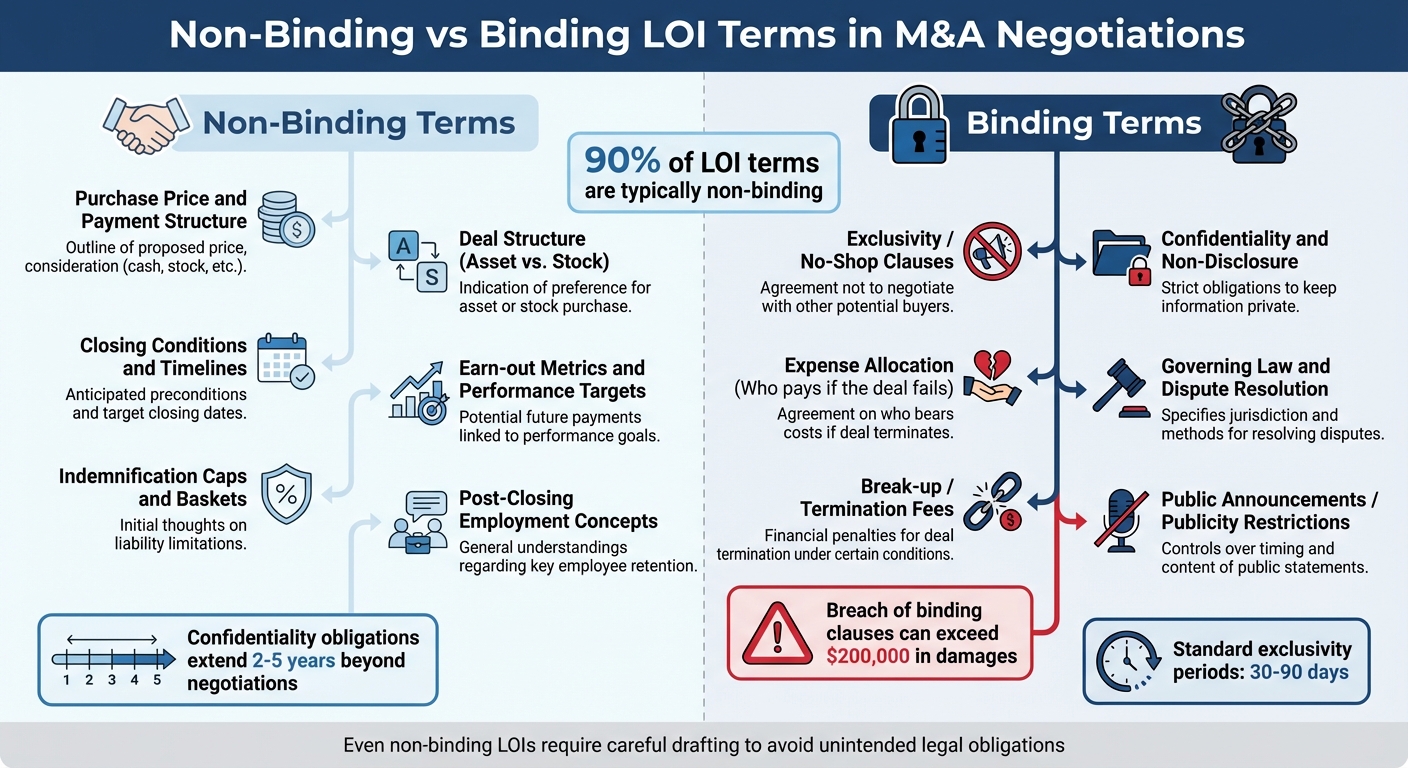
Balancing Non-Binding and Binding Terms
Striking the right balance between non-binding and binding terms is key to protecting all parties during negotiations. Below is a breakdown of typical LOI elements, distinguishing between terms that guide the negotiation framework and those that safeguard the process:
| Non-Binding Terms | Binding Terms |
|---|---|
| Purchase Price and Payment Structure | Exclusivity / No-Shop Clauses |
| Deal Structure (Asset vs. Stock) | Confidentiality and Non-Disclosure |
| Closing Conditions and Timelines | Expense Allocation (Who pays if the deal fails) |
| Earn-out Metrics and Performance Targets | Governing Law and Dispute Resolution |
| Indemnification Caps and Baskets | Break-up / Termination Fees |
| Post-Closing Employment Concepts | Public Announcements / Publicity Restrictions |
Even the best-drafted LOI can be undermined by inconsistent actions. For instance, funding deposits, starting performance, or making public announcements before signing a definitive agreement can inadvertently create enforceable obligations, despite clear non-binding language.
McCarthy Tétrault underscores this point:
"The language of the LOI, however well-drafted, is not alone sufficient to prevent binding obligations from arising... the intention of the parties to enter a binding agreement is to be determined on the entirety of the evidence." [14]
For industries with higher stakes or regulatory complexities - such as iGaming, Cryptocurrency, Forex, and Fintech transactions handled by platforms like MyReadyMade (https://myreadymade.com) - the precision in defining binding and non-binding terms becomes even more critical. In these cases, license transfers and regulatory approvals add layers of complexity. Clearly delineating terms during the interim period not only minimizes legal risks but also creates a smoother path for negotiations in these highly regulated M&A deals.
Conclusion: What to Remember About Non-Binding LOIs
Summary of Advantages and Risks
Non-binding LOIs provide valuable flexibility during M&A negotiations, especially in highly regulated industries where due diligence often reveals unexpected challenges. They allow buyers to adjust terms, such as purchase prices or deal structures, without facing legal obligations. At the same time, sellers retain the freedom to explore better offers. While non-binding LOIs typically outline most deal terms, binding provisions - like exclusivity, confidentiality, and expense allocation - carry real legal and financial implications [3].
However, this flexibility comes with its own set of risks. Binding clauses can lead to legal liabilities exceeding $200,000, along with the possibility of injunctions and reputational harm [3]. Additionally, ambiguous language or inconsistent actions could unintentionally create enforceable obligations, even when the intent was non-binding.
As Thompson Coburn LLP attorneys Eileen Duffy Robinett and Jeff Brown explain:
"LOIs are powerful tools that can assist the parties in efficiently negotiating and drafting definitive agreements, but they require careful handling." [4]
This highlights the importance of precision in drafting LOIs to balance their benefits and risks effectively.
Final Recommendations for M&A Negotiations
To make the most of LOIs while minimizing potential pitfalls, consider these strategies during M&A negotiations. Clear and concise provisions in an LOI not only streamline the process but also help establish trust - essential in regulated industries.
Draft Clear Binding and Non-Binding Sections: Clearly separate binding provisions from non-binding ones. Use terms like "proposed" or "subject to" for non-binding clauses, while reserving definitive language like "shall" for binding commitments.
Set Specific Timelines: Define exclusivity periods with clear milestones rather than vague calendar dates. For example, standard exclusivity durations often range from 30 to 90 days [3].
Account for Industry-Specific Needs: In sectors like iGaming, Cryptocurrency, Forex, and Fintech, regulatory approvals, license transfers, and change-of-control notifications require extra care. Platforms such as MyReadyMade (https://myreadymade.com) offer specialized M&A advisory services across more than 50 jurisdictions, ensuring compliance and clarity in these complex transactions.
Align Actions with Intent: Avoid actions that could imply enforceability, such as operating the business or transferring assets, before a definitive agreement is signed.
FAQs
Can a “non-binding” LOI still be enforced in court?
A "non-binding" LOI might still carry legal weight if it includes binding provisions such as exclusivity or confidentiality clauses. These sections can be enforceable even if the rest of the document isn't. Whether these terms hold up legally often hinges on how the LOI is written and the intentions of the parties at the time of drafting.
How can sellers limit exclusivity so the buyer can’t stall?
Sellers can keep exclusivity in check by clearly outlining a reasonable time frame in the Letter of Intent (LOI), often between 30 and 90 days. Including enforceable terms ensures that progress is made within this period. Additionally, sellers can negotiate clauses that allow them to end exclusivity if the buyer fails to meet specific milestones or deadlines. These measures help sellers avoid unnecessary delays and maintain their bargaining power during negotiations.
What actions can accidentally make an LOI feel binding?
When drafting a Letter of Intent (LOI), it can sometimes feel binding if it includes overly detailed or specific language - like defining key terms or adding binding provisions. To prevent this, make sure to explicitly state that the LOI is non-binding and use language that clearly supports that intention.
Related Articles

Ultimate Guide to Earnout Negotiations in M&A
Structure and negotiate earnouts in regulated M&A with clear metrics, anti-manipulation covenants, and acceleration or escrow protections.

How to Draft M&A Definitive Agreements
Guide to drafting M&A definitive agreements covering deal structure, reps & warranties, indemnities, payment terms, and regulatory compliance.

How IP Affects Tokenization Valuation
How tokenizing patents, copyrights, and trademarks adds liquidity and market value—plus legal, regulatory, and valuation steps.
Looking to Buy or Sell?
Get in touch with our team for personalized assistance