How to Value iGaming Businesses for Sale
How to Value iGaming Businesses for Sale
Valuing an iGaming business requires a deep understanding of its financials, assets, and risks. Here's a quick breakdown:
- Financial Performance: Start with key metrics like Gross Gaming Revenue (GGR), Net Gaming Revenue (NGR), and Seller's Discretionary Earnings (SDE). For larger businesses, EBITDA is the preferred measure.
- Key Assets: Gaming licenses, player databases, and proprietary technology are major drivers of value. Tier 1 licenses (e.g., Malta) add credibility and access to larger markets, while advanced tech reduces costs and boosts scalability.
- Valuation Methods: Use Earnings Multiples, Discounted Cash Flow (DCF), and Comparable Market Analysis to determine value. Multiples vary by business type, with EBITDA multiples ranging from 4x to 20x depending on the sector.
- Adjust for Risks: Regulatory compliance, player retention, and market saturation significantly impact valuation. Strong compliance and diversified revenue streams help mitigate risks.
- Tools and Expertise: Platforms like MyReadyMade offer AI-powered valuations, while M&A advisors ensure accurate financials, regulatory checks, and deal structuring.
iGaming Business 5-Year 3 Statement Financial Projection Model
sbb-itb-ba142f6
Step 1: Analyze Financial Performance
When it comes to valuing an iGaming business, understanding its financial performance is the first and most critical step. This means digging deeper than surface-level profit-and-loss statements to uncover the real earning potential. A thorough financial review lays the groundwork for accurate valuation methods later.
Review Revenue and Profit Trends
Start by examining the financial records from the past three years. Focus on two key metrics: Gross Gaming Revenue (GGR) and Net Gaming Revenue (NGR). These are the cornerstones of iGaming profitability. To recap, GGR is the total amount wagered minus winnings, while NGR accounts for bonuses, fees, and other costs [5][6].
"GGR serves as a foundational element in assessing the financial performance of the online casino and the Sportsbook." - iGpixel [5]
Look closely at the quality of revenue. Revenue from recurring deposits is far more reliable than revenue tied to aggressive, short-term user acquisition strategies. Consistent monthly growth is a better indicator of health than sudden, unsustainable spikes.
Another important metric is the Bets-to-Deposits Ratio, which can highlight potential issues. For example, a high ratio might mean players are burning through bonus funds without contributing to long-term profits [5]. Additionally, analyze Customer Acquisition Cost (CAC) and Lifetime Value (LTV). Ideally, the LTV should be at least three times the CAC for a business to grow sustainably [4]. For gaming startups, a target CAC under $25 is often cited for 2026 [4].
Be wary of declining trends, even if recent numbers look promising. A steady drop in Seller's Discretionary Earnings (SDE) over three years could indicate deferred expenses or revenue pulled forward from future periods [9]. Businesses growing at 20% or more annually tend to attract higher valuation multiples compared to those with stagnant or declining growth [7].
Calculate Seller's Discretionary Earnings (SDE)
Once you have a clear picture of revenue trends, the next step is to normalize earnings to reflect the true financial benefits for an owner. For iGaming businesses valued under $10 million, Seller's Discretionary Earnings (SDE) is the standard metric [8]. SDE captures the total financial benefit for a single owner-operator, including salary, perks, and discretionary expenses. Here's the formula:
SDE = Net Income + Owner's Salary + Owner's Benefits + Interest + Depreciation + Amortization + Discretionary Add-Backs + Non-Recurring Expenses [9].
"SDE answers a fundamental question for buyers: 'If I buy this business and run it myself, how much money will it put in my pocket each year?'" - BuyerEdge [9]
Adjustments are key here. Add back one-time costs and owner-specific expenses like W-2 wages, health insurance, personal vehicle use, family travel, and legal fees. For example, if a business reports $300,000 in net income, with $80,000 in salary, $15,000 in health insurance, and $10,000 in one-time legal fees, the SDE would total $405,000.
Keep detailed records of add-backs - receipts are essential. Be cautious if add-backs exceed 30% of the SDE, as this could raise concerns [9]. If a "one-time" expense appears more than once in five years, treat it as a recurring cost instead of an add-back [9]. Finally, verify reported revenue by comparing it to total bank deposits to avoid discrepancies [9].
For larger iGaming businesses valued over $10 million, EBITDA (Earnings Before Interest, Taxes, Depreciation, and Amortization) is used instead of SDE. EBITDA assumes a professional manager will run the business, so market-rate management salaries remain as expenses [8][9]. Established gaming operations often see EBITDA multiples ranging from 5x to 10x, while highly profitable iGaming operators can fetch multiples as high as 15x to 20x [2]. Mastering these financial principles is essential for applying valuation methods in the next steps.
Step 2: Evaluate Assets
Once financial performance is established, the next step involves assessing non-financial assets to refine a company's valuation. In the iGaming industry, the most valuable assets often aren't physical. Instead, gaming licenses, player databases, and proprietary technology frequently drive a company's worth.
Gaming Licenses and Regulatory Compliance
A gaming license isn't just a legal requirement - it's a gateway to market access, credibility, and protection. Tier 1 licenses, like those from Malta, are costly but open doors to lucrative markets. For instance, applying for Malta's MGA license costs about $27,000, with total first-year expenses typically falling between $163,000 and $272,000 [10][11]. The UK market, on the other hand, offers a quicker return on investment, often within 12 to 18 months [10].
"Malta and Gibraltar are expensive upfront but open doors to markets worth the investment. You're not just buying a license - you're buying regulatory respect." – Tyler Grant, B2B Gaming Compliance Consultant [10]
The published application fee is just the tip of the iceberg - covering only about 40% of the first-year costs [11]. Hidden expenses, such as compliance officer salaries, regular audits, technical certifications, and maintaining capital reserves (e.g., $544,000 in segregated player funds for Malta), can significantly increase the budget. To get a realistic estimate, multiply the published fee by 8 to 12 [11].
Strong compliance systems, including AML/KYC protocols and RNG certifications, not only prevent regulatory setbacks but also enhance platform trust. This trust can lead to a 5% boost in player retention, which, in turn, can increase profits by 25% to 95% [12].
| Jurisdiction | Tier | Market Access | Total Year 1 Cost | Key Benefit |
|---|---|---|---|---|
| Malta (MGA) | Tier 1 | Full EU (Passporting) | $163,000–$272,000 | High credibility; EU-wide reach [10] |
| Curacao | Tier 2 | Global (Non-regulated) | $85,000–$138,000 | Fast approval; no revenue share [10][11] |
Beyond regulatory costs, the quality of a company's player data plays a crucial role in determining its value.
Player Databases and Retention Metrics
The size and quality of a player database are key factors in valuation. A common benchmark values each Monthly Active User (MAU) at $50 to $200 in equity [2]. However, a smaller, highly engaged database often outperforms a larger, low-value one. In many casino operations, the top 10% of players account for 60% to 80% of total revenue [13].
A critical metric to watch is the Lifetime Value (LTV) to Customer Acquisition Cost (CAC) ratio. Ideally, the LTV should be at least 3–4 times the CAC. For example, if acquiring a sports bettor costs $400, their lifetime value should exceed $1,200.
Retention metrics are equally vital. A strong 30-day retention rate (70–80%) and a monthly churn rate under 5% are benchmarks to aim for [12]. With over 50% of iGaming players typically dropping off within the first year, retaining users is essential for boosting valuation. Operators who focus on systematic LTV optimization have seen a 33% increase in LTV and a reduction in churn by up to 40% [13].
Advanced CRM tools, like Optimove or Braze, can unify player data across multiple channels. Predictive analytics further enhance retention by identifying potential churn with up to 86% accuracy, allowing timely interventions to stabilize future revenue streams [12].
With these metrics in place, proprietary technology becomes the next significant factor in determining value.
Software Platforms and Proprietary Technology
Owning proprietary technology can significantly increase a company's valuation. Businesses that develop their own tech stack avoid hefty revenue-share fees - often 10% to 30% for white-label solutions - and gain complete control over the user experience [14]. Proprietary technology can lead to revenue multiples of 6–10x and EBITDA multiples of 15–20x, compared to 1.5x to 3.0x revenue for companies relying on third-party solutions [2].
"Proprietary tech stacks and compliance infrastructure also boost perceived value." – DealStream Guide [2]
Scalability is another critical factor. Platforms designed to add new features without requiring a complete overhaul significantly enhance valuation. On the flip side, businesses burdened by costly "platform migration" challenges may see their valuations drop by 15% to 30% [14][2].
Ownership of the technology is also crucial. Having full rights to source code, proprietary algorithms, and game engines creates intellectual property that can be valued at roughly 1x to 2x the development costs [2].
Advanced platforms that support real-time analytics and AI-driven personalization can further enhance performance. These technologies have been shown to increase retention by 39% and conversion rates by 43% [12]. Additionally, AI-powered virtual croupiers can save operators up to $500,000 annually compared to live dealers, while automated customer support systems can reduce operational costs by around $200,000 per year [12].
| Feature | White Label | Custom Development (Proprietary) |
|---|---|---|
| Ownership | Rented/Licensed | Fully Owned |
| Control | Limited | Total |
| Time to Market | Weeks | 1–2 Years |
| Valuation Impact | Lower (Revenue Share) | Highest (IP Asset) |
| Initial Cost | $20,000–$50,000 | $500,000+ |
Step 3: Apply Valuation Methods
Once financial performance and asset evaluations are complete, the next step is determining the value of an iGaming business. This can be done using three primary methods: the Earnings Multiple Method, Discounted Cash Flow (DCF) Analysis, and Comparable Market Analysis. Each method provides a unique perspective, and savvy buyers often use a combination of all three to arrive at a fair valuation.
Earnings Multiple Method
The Earnings Multiple Method is the most commonly used approach for valuing iGaming businesses. It calculates the Enterprise Value by multiplying the business's earnings by a chosen multiple.
"Pricing a business is based primarily on its profitability. Profit is the number one criteria buyers look for when buying a business and the number one factor that buyers use to value a business." – Jacob Orosz, President, Morgan & Westfield [15]
To implement this method, normalize financials by adding back non-operational expenses like depreciation, interest, and one-time costs to the net profit. For smaller businesses, use Seller’s Discretionary Earnings (SDE), while larger businesses should rely on EBITDA, as outlined in Step 1 [15][16]. Additionally, consider non-financial assets identified in Step 2 when applying multiples.
The choice of multiple depends on factors like the business's sub-sector and maturity. For example:
- Online gaming platforms often see EBITDA multiples in the 12x to 20x range, thanks to scalable infrastructure and recurring revenue [2].
- Established operators in North America or Europe generally achieve multiples of 15x to 20x EBITDA [2].
- Western mobile developers reported lower multiples, around 4.7x EBITDA in 2025, due to their reliance on platforms [1].
- Diversified gaming companies had an average forward EBITDA multiple of 13.8x in mid-2025 [1].
| iGaming Business Type | EBITDA Multiple Range | Revenue Multiple Range |
|---|---|---|
| Online Gaming Platforms | 12x – 20x [2] | 1.5x – 3.0x [2] |
| Established Operators (NA/EU) | 15x – 20x [2] | 6x – 10x [2] |
| Diversified Gaming Companies | 13.8x (Forward) [1] | N/A |
| Western Mobile Developers | 4.7x [1] | N/A |
| Early-Stage iGaming Startups | N/A | 3x – 5x [2] |
Smaller digital businesses tend to have lower multiples, with a median of 1.68x for deals under $100,000, rising to 2.43x for deals over $1 million [17]. To secure higher multiples, reduce owner dependency by documenting Standard Operating Procedures (SOPs) and ensuring the business can operate with minimal owner involvement (less than 15 hours per week) [17]. Diversify revenue sources to avoid platform risk - no single channel should contribute more than 40% of revenue. Additionally, businesses with subscription models or high player Lifetime Value (LTV) can command 30% to 40% higher multiples than transactional models [16].
Discounted Cash Flow (DCF) Analysis
DCF analysis estimates the intrinsic value of a business by projecting future cash flows and discounting them to the present using the Weighted Average Cost of Capital (WACC) [18][19].
"DCF is a financial model that calculates what an investment is worth today by projecting its future cash flows and adjusting them back to present value using a chosen discount rate." – Investopedia [18]
The DCF formula is:
DCF = CF₁/(1+r)¹ + CF₂/(1+r)² + CFₙ/(1+r)ⁿ, where CF represents cash flow and r is the discount rate [18].
For iGaming businesses, cash flow projections should incorporate metrics like Daily Active Users (DAU), Monthly Active Users (MAU), Average Revenue Per User (ARPU), and player retention curves [1]. Free Cash Flow (FCF) is calculated as:
Operating Cash Flow – Capital Expenditures – Change in Working Capital [19].
Given the high-risk nature of the iGaming industry - where 90% of games fail to achieve commercial success - DCF models should include a "Survival Rate" to account for product failure risks [1]. Discount rates should vary by product type; for instance, AAA games generally carry higher risks than diversified live-service platforms [1]. Sensitivity analysis is essential: test scenarios with different churn rates or ARPU to evaluate how these factors affect valuation [19].
The Terminal Value captures the business's worth beyond the forecast period (typically 3–5 years) and is calculated using either the perpetual growth method or an exit multiple [19]. For mobile gaming studios, focus on the "User Acquisition (UA) machine", analyzing how Customer Acquisition Cost (CAC), Lifetime Value (LTV), and payback periods interact [1]. Additionally, consider potential policy changes from major distribution platforms like Apple or Google when setting discount rates or adjusting cash flow assumptions [1].
While DCF provides a detailed view of intrinsic value, Comparable Market Analysis offers benchmarks based on actual transaction data.
Comparable Market Analysis
This method relies on recent sales data to benchmark the valuation of an iGaming business. It’s particularly useful for grounding valuations in practical, real-world numbers.
"A simple rule of thumb is to apply the midpoint of the last five comparable deals, adjusted by ±1x EBITDA or ±0.2x revenue to account for size and growth differentials." – DealStream Guide [2]
Start by identifying transactions with similar characteristics - size, geography, and business model. Resources like MyReadyMade's verified listings offer transparent data on recent iGaming sales across various regions. When referencing public company trading multiples, apply a "private company illiquidity" discount of 15% to 25% to account for differences in liquidity [2].
Ensure comparisons are specific to the business category. For instance, iGaming platforms generally trade at 1.5x to 3.0x revenue, while brick-and-mortar casinos trade at much lower multiples, ranging from 0.3x to 0.7x revenue [2]. For mobile-focused iGaming businesses, focus on metrics like CAC, LTV, and monthly return on capital (typically 2.5% to 5.6%) [1].
The regulatory environment also plays a significant role. Businesses in jurisdictions with favorable regulations may earn a 10% to 20% premium, while those in regions with strict laws or high taxes could face similar discounts [2]. Studios with strong intellectual property (IP), such as established franchises, can command premiums of 2x to 3x over those without recognized brands [1]. Additionally, jurisdictions like Malta, governed by the Malta Gaming Authority (MGA), may require pre-approvals for shareholding changes. This can extend deal timelines and affect the "ready-to-close" valuation [3].
Step 4: Adjust for Risks and Growth Potential
Once you've applied standard valuation methods, it's time to factor in risks and growth potential. These adjustments bridge the gap between theoretical estimates and the realities of operating in a competitive and regulated market. They help ensure the valuation aligns with both challenges and opportunities.
Regulatory Changes and Market Saturation
Regulatory risk is one of the biggest threats to iGaming valuations. Operating without proper licenses or in jurisdictions with changing laws can lead to serious consequences, including fines, license revocation, or even permanent bans. For example, in 2022, 888 UK Limited faced a hefty £9.4 million fine from the UK Gambling Commission due to anti-money laundering and social responsibility breaches. Similarly, Genesis Global was fined £3.8 million and had its license suspended for compliance failures [20][21]. These cases highlight how regulatory missteps can quickly erode a company’s value.
"Compliance management and risk control have become the two pillars of sustainable operations." – RedClaw Content Team [20]
Advertising policies add another layer of complexity. In April 2025, Google reclassified "Sweeps Casinos" (dual-currency systems) as real money gambling, which required stricter certifications. Non-compliant operators faced immediate account suspensions [20]. To stay ahead of regulatory risks, operators must prioritize compliance by appointing a Money Laundering Reporting Officer (MLRO) and integrating automated tools like KYC (Know Your Customer) and GRC (Governance, Risk, and Compliance) systems.
Market saturation also affects growth potential. While the global iGaming market is projected to exceed $100 billion by 2025, the top five operators - Flutter, Entain, DraftKings, MGM, and Caesars - control less than 35% of the market. This leaves 65% of the market open to regional and niche players [22]. Emerging markets, such as Brazil and Peru, present opportunities as regulatory frameworks evolve to allow new operators to enter.
In addition to regulatory and market risks, understanding player acquisition costs and lifetime value is critical for assessing growth potential.
User Acquisition Costs and Lifetime Value (LTV)
Player economics are at the heart of long-term growth. A healthy LTV-to-CAC (Customer Acquisition Cost) ratio should range between 3:1 and 4:1 [12]. Falling below this threshold often results in valuation discounts.
"Player lifetime value stands as the single most critical metric separating thriving iGaming operators from those merely surviving." – Rui Z [13]
Acquisition costs vary depending on the player type. For instance:
- Poker players cost $400–$600 to acquire.
- Sports bettors cost $300–$500.
- Casino players cost $250–$400.
- Slot players cost $100–$200 [12].
However, it's not just about acquiring players cheaply - it’s about acquiring quality players. For example, a Google search campaign might bring in 1,000 players at a €150 CPA (Cost Per Acquisition) with an LTV of €400. Meanwhile, an affiliate partnership might deliver only 200 players at a €300 CPA but with an LTV of €1,200. This demonstrates how higher acquisition costs can be justified by higher player value [13]. Companies that focus on systematic LTV optimization have seen up to 33% higher LTVs and a 40% reduction in churn [13].
Another important factor is mobile optimization. By 2025, mobile users are expected to account for 70% of all iGaming activity [12].
| Financial Metric | Target Benchmark |
|---|---|
| LTV to CAC Ratio | 3x–4x minimum |
| Player Retention (30-day) | 70–80% |
| Monthly Churn | Below 5% |
| Monthly ARPU (Average Revenue Per User) | $100–$200 |
Finally, it's important to assess revenue concentration risk. If more than 40% of total revenue comes from a single acquisition channel, apply a discount of 5% to 10% to account for dependency on that platform.
Step 5: Use Tools and Expert Support
Once you've adjusted for risks and growth opportunities, the next move is to lean on advanced tools and expert guidance. While spreadsheets and multiples are helpful, specialized platforms and experienced advisors can provide a more solid and well-rounded valuation.
Use MyReadyMade for AI-Powered Valuations

MyReadyMade offers AI-driven valuation tools tailored specifically to iGaming businesses. It uses a combination of methods - like the Scorecard Method, Checklist Method, VC Method, and DCF analysis - to account for the unique risk and reward dynamics in gaming operations [1]. Instead of relying on a single metric or formula, this approach cross-checks values across multiple methodologies.
The platform builds on your financial KPIs, automating critical industry-specific analyses such as Average Revenue Per User (ARPU), Lifetime Value (LTV), and player retention patterns [1]. It also factors in risk-adjusted forecasts, taking into account potential challenges like platform concentration, regulatory shifts, and tech obsolescence [1]. Within minutes, MyReadyMade provides a data-driven valuation benchmarked against real-time market data and recent transaction figures [23].
Additionally, the platform identifies what it calls "Evergreen" signals - indicators that traffic and engagement are driven by consistent search intent rather than short-lived trends. These signals can help justify higher multiples by showing sustainable demand [24]. Once you have these insights, they can be further refined with the help of professional M&A advisors.
Work with M&A Advisors
Even with the speed and accuracy of AI tools, human expertise is still crucial for handling the complexities of iGaming transactions. M&A advisors bring three key strengths to the table: financial normalization, regulatory expertise, and deal structuring.
Advisors help normalize your financials by removing one-time expenses to reveal true earnings. This process, known as recasting, can significantly improve your valuation by showcasing the business's actual profitability [8].
"For companies with an estimated value under ~$10M, SDE is used 'almost exclusively'." – Thomas Smale, CEO, FE International [8]
On the regulatory side, advisors review licensing statuses (such as MGA, Curaçao, or Kahnawà:ke) and ensure compliance with "change-of-control" requirements, which often require regulator approval before finalizing a sale [3]. They also prepare data rooms with 12–36 months of iGaming-specific KPIs, including Net Gaming Revenue (NGR) cohorts, KYC/AML compliance metrics, and chargeback ratios [3].
Finally, advisors help bridge valuation gaps by structuring deals with earn-outs or seller financing tied to future performance metrics like NGR or EBITDA. These arrangements can increase the total sale price while reducing risk for buyers [3]. M&A advisory fees typically range from 10% for smaller deals to around 3% for transactions worth billions [26].
"A fair and accurate valuation enhances the credibility of the transaction... assuring both the buyer and the seller that the deal is based on solid financial and market analysis." – ShareVault [25]
Valuation Multiples in iGaming
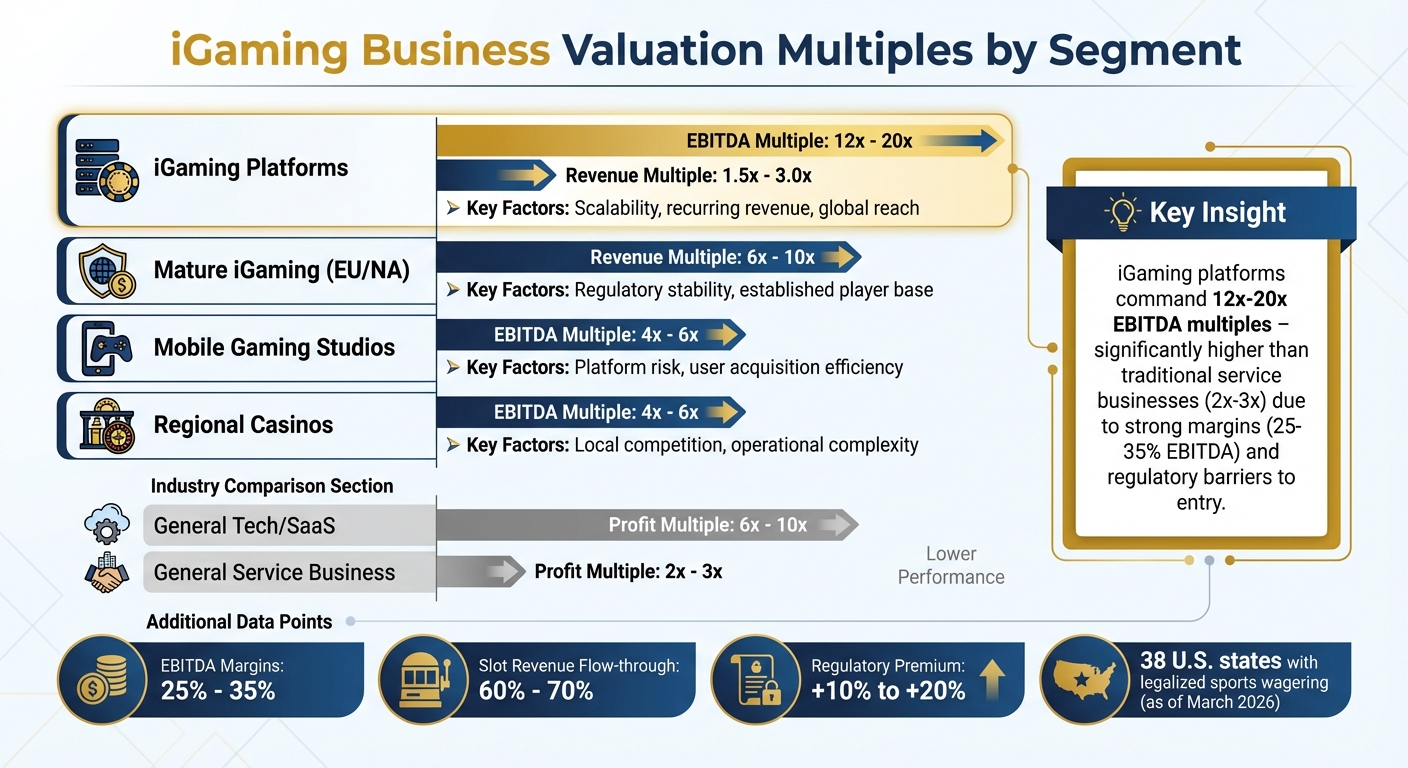
iGaming businesses tend to achieve higher valuation multiples compared to many other industries. This is largely due to their strong profit margins and the regulatory hurdles that act as barriers to entry. Operators in this space often report EBITDA margins between 25% and 35%, with slot revenues sometimes delivering a flow-through of 60% to 70% - a clear sign of strong cash generation and relatively low overhead costs [27].
The valuation multiples can vary significantly depending on the business model and growth stage. Established iGaming platforms in North America or Europe often command EBITDA multiples between 12x and 20x [2], which is notably higher than the 6x to 10x typical for tech companies or the 2x to 3x seen in traditional service businesses [29]. Recent public market data aligns with these benchmarks. For instance, as of mid-2025, DraftKings had an Enterprise Value of $13 billion, with an LTM EBITDA multiple of 18.7x, reflecting its strong growth potential in North America [28]. Similarly, Flutter Entertainment recorded an EV/LTM Revenue multiple of 1.6x and an EBITDA multiple of 9.6x [28]. These examples highlight how factors like market position and growth potential shape what buyers are willing to pay.
"A dollar of revenue from a sustainable live-service game differs fundamentally from revenue generated through unsustainable user acquisition spending." – Daniel Faloppa, Founder, Equidam [1]
Valuation Multiples Comparison Table
The table below provides a snapshot of valuation multiples across different segments in the iGaming and related industries. It also outlines the key factors influencing these valuations.
| Industry Segment | Metric | Low Range | High Range | Influences |
|---|---|---|---|---|
| iGaming Platforms | EBITDA | 12x | 20x | Scalability, recurring revenue, global reach [2] |
| iGaming Platforms | Revenue | 1.5x | 3.0x | Proprietary technology, market share, user retention [2] |
| Mature iGaming (EU/NA) | Revenue | 6x | 10x | Regulatory stability, established player base [2] |
| Mobile Gaming Studios | EBITDA | 4x | 6x | Platform risk, user acquisition efficiency [1][2] |
| Regional Casinos | EBITDA | 4x | 6x | Local competition, operational complexity [2] |
| General Tech/SaaS | Profit | 6x | 10x | Scalability, customer churn rates [29] |
| General Service Business | Profit | 2x | 3x | Owner dependency, limited tangible assets [29] |
Regulatory dynamics play a critical role in shaping these valuations. A strong regulatory position often creates a "moat", which can justify a premium of 10% to 20% [2][27]. With 38 U.S. states having legalized sports wagering as of March 2026 [27], understanding these regulatory factors is essential when applying valuation multiples. These benchmarks offer a useful starting point for refining valuation strategies in this rapidly evolving industry.
Conclusion
Valuing an iGaming business takes more than just crunching numbers. The industry's unpredictable nature - where 90% of games fall short commercially, but a single hit can deliver returns over 1,000% [1] - demands a tailored approach that goes beyond traditional methods. Success lies in blending financial analysis (like normalized EBITDA and revenue trends), asset assessment (including licenses, player databases, and proprietary tech), and risk-adjusted projections that factor in regulatory shifts and platform dependencies.
A thorough valuation process often combines multiple methods. Using DCF analysis adjusted for survival probabilities, market comparables, and asset-based IP evaluations ensures a well-rounded perspective [1]. This approach is especially important in iGaming, where regulatory challenges can lead to valuation discounts of 10% to 20% [2], while strong licensing positions can elevate valuations.
Expert guidance is critical for navigating regulatory filings and contractual intricacies. From managing change-of-control filings with regulators such as the MGA to ensuring provider contracts allow assignment, these details can make or break a deal. Tools like MyReadyMade's AI-powered valuation platform simplify this process by applying industry-specific frameworks that consider platform risks and regulatory complexities. Paired with experienced M&A advisors to manage data rooms and guide the 8- to 20-week sale process [3], these resources help you avoid common deal-breaking issues.
Key metrics, such as CAC-to-LTV ratios and MAU equity benchmarks, often distinguish successful transactions from failed ones. By combining detailed quantitative analyses with expert advice, you can align valuations with the fast-moving dynamics of the iGaming market. With the global video game market projected to grow from $272.67 billion in 2024 to $656.21 billion by 2033 [1], well-calculated transactions hold immense potential for success.
FAQs
Should I value an iGaming business using SDE or EBITDA?
For well-established iGaming businesses, valuations often hinge on EBITDA multiples, which typically fall between 5x and 10x. On the other hand, smaller or owner-operated businesses tend to rely on Seller's Discretionary Earnings (SDE), with multiples usually ranging from 2.0x to 4.5x.
In short, EBITDA is best suited for mature companies, while SDE works better for smaller, owner-led operations to ensure a precise valuation.
How much do gaming licenses and compliance add to valuation?
Gaming licenses and regulatory compliance play a key role in determining the value of iGaming businesses. These expenses go beyond the initial licensing fees, encompassing ongoing compliance efforts, license renewals, legal representation, audits, and other regulatory costs. Depending on the jurisdiction, these additional expenses can significantly exceed the original cost of obtaining the license.
When these costs are high, they can eat into profitability and lower valuation metrics like EBITDA. On the other hand, jurisdictions with lower costs and less complex compliance requirements can boost profitability, which may positively impact the overall valuation of the business.
What due diligence should buyers do before paying a high multiple?
Before committing to a high valuation for an iGaming business, buyers need to dive deep into due diligence. This means taking a close look at financial statements to ensure accuracy, verifying revenue streams for stability, and analyzing user engagement metrics like active users and retention rates to gauge the platform's health.
It's also crucial to evaluate regulatory compliance to avoid legal pitfalls, check operational stability to ensure smooth functioning, and understand market trends and industry dynamics. These steps help confirm whether the valuation aligns with the business's true value while minimizing the risk of unexpected liabilities.
Related Articles

Ultimate Guide to Earnout Negotiations in M&A
Structure and negotiate earnouts in regulated M&A with clear metrics, anti-manipulation covenants, and acceleration or escrow protections.

How to Draft M&A Definitive Agreements
Guide to drafting M&A definitive agreements covering deal structure, reps & warranties, indemnities, payment terms, and regulatory compliance.

How IP Affects Tokenization Valuation
How tokenizing patents, copyrights, and trademarks adds liquidity and market value—plus legal, regulatory, and valuation steps.
Looking to Buy or Sell?
Get in touch with our team for personalized assistance