IP Trends in High-Risk M&A Markets

IP Trends in High-Risk M&A Markets
Intellectual property (IP) is now the backbone of high-risk mergers and acquisitions (M&A) in industries like iGaming, cryptocurrency, forex, and fintech. These sectors prioritize intangible assets - such as proprietary algorithms, software, and brand identity - over physical assets or even current revenue. However, acquiring IP comes with challenges, including legal risks, incomplete ownership documentation, and cross-border regulatory hurdles.
Key takeaways:
- IP drives valuation: Strong IP portfolios often command higher EBITDA multiples (8–12x vs. 5–9x for weaker IP). AI-focused companies can see revenue multiples exceeding 25x.
- Due diligence is critical: Gaps in ownership, expired trademarks, or unresolved infringement claims can lower a target's value or derail deals.
- Emerging risks: AI-generated content and blockchain technologies introduce new complexities, such as copyright issues, data provenance concerns, and smart contract vulnerabilities.
- Regulatory challenges: Cross-border deals face obstacles like local compliance requirements, export controls, and data localization laws.
To mitigate risks, thorough IP audits, secure platforms for transactions, and careful management of licensing transfers are necessary. Buyers and sellers must treat IP as a priority throughout the M&A process to maximize value and avoid liabilities.
IP Due Diligence: The Make-Or-Break Factor In Modern M&A
IP Valuation in Regulated and High-Risk Industries
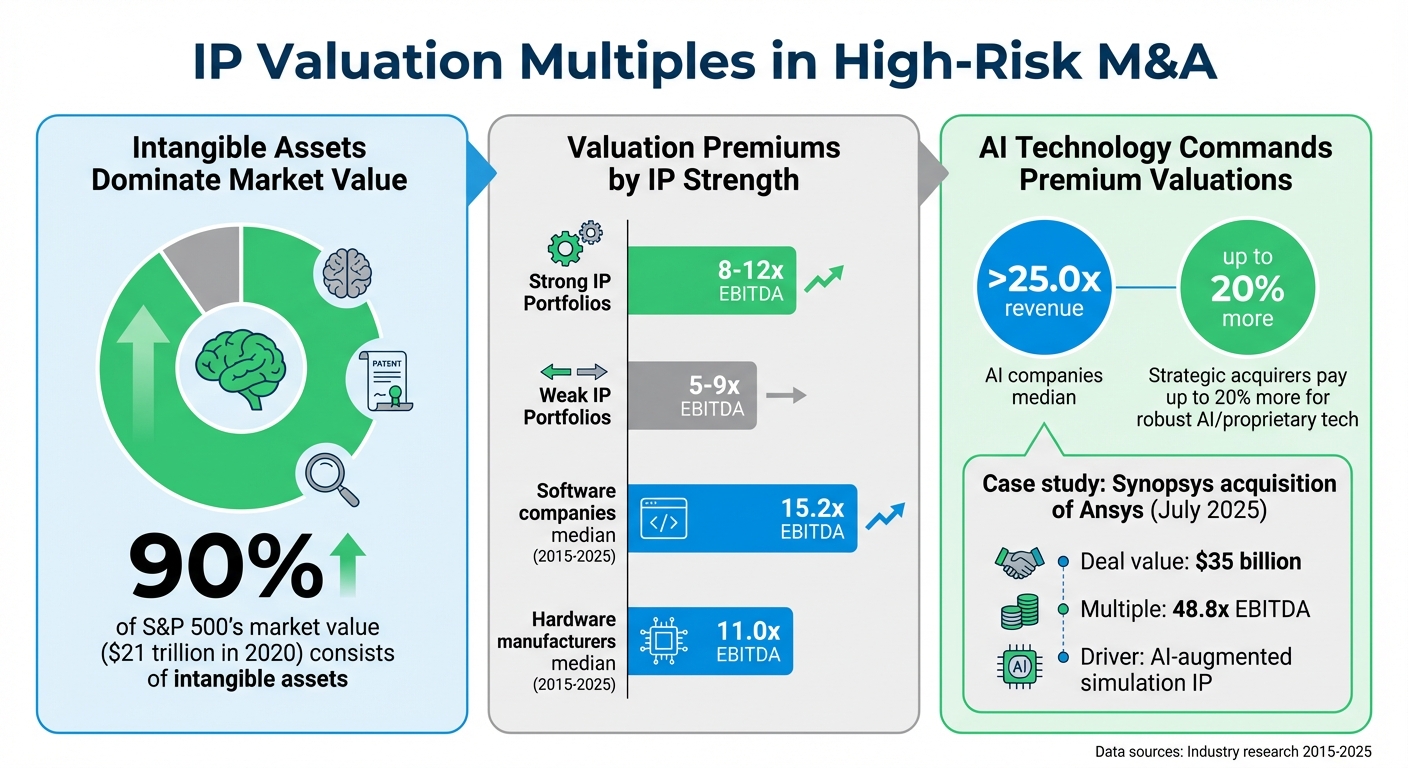
In markets with high-risk M&A activity, intellectual property (IP) has become a cornerstone in determining business value. Intangible assets like patents, algorithms, and brand equity now make up about 90% of the S&P 500's market value, which stood at $21 trillion in 2020 [3]. For industries such as iGaming, crypto, forex, and fintech, proprietary technology often outweighs physical assets or even current revenue in driving valuations. This shift highlights the need for rigorous IP due diligence in these transactions.
Valuation Premiums for Proprietary Technology and Algorithms
Proprietary IP acts as a safeguard for future revenue, offering buyers a layer of security. Companies with strong IP portfolios tend to achieve higher EBITDA multiples, ranging from 8–12x, compared to 5–9x for those with weaker IP positions [3]. Between 2015 and mid-2025, software companies saw median valuations of 15.2x EBITDA, significantly higher than the 11.0x median for hardware manufacturers. For high-growth businesses with proven proprietary technology, valuations often pivot to revenue-based multiples, especially when Annual Recurring Revenue (ARR) is a key metric [3][4].
AI-focused companies command even more impressive premiums. Large-scale deals involving AI businesses often see median multiples exceeding 25.0x revenue [3]. Strategic acquirers are willing to pay up to 20% more for firms with robust AI and proprietary technology [3]. A notable example is Synopsys's $35 billion acquisition of Ansys in July 2025, which represented a 48.8x EBITDA multiple. This deal was largely driven by Ansys's AI-augmented simulation IP, which was seen as a catalyst for future innovation [3].
However, the presence of tech debt can drastically lower valuations or even derail deals during due diligence [4].
Brand Strength in iGaming and Forex Valuations
In regulated industries like iGaming and forex, brand equity plays a critical role. A strong brand acts as a moat, fostering customer trust and providing stability in volatile markets [6]. Trademarks and brand identity are essential for standing out in competitive fintech sectors, where customer recognition directly affects acquisition costs and retention rates [2]. Established brands reduce perceived risks for buyers by showcasing operational maturity and strong market positioning, often leading to higher valuations in M&A scenarios. This makes brand equity a key factor in protecting and enhancing the value of M&A investments.
IP Due Diligence Challenges in High-Risk M&A
In high-risk M&A, where intellectual property (IP) plays a central role, conducting thorough due diligence is critical. But verifying IP ownership isn’t as straightforward as checking a property deed. Gaps in documentation, missing assignments, and jurisdictional issues can turn what looks like a strong IP portfolio into a potential liability. This complexity is even more pronounced in industries like iGaming, crypto, forex, and fintech, where cross-border regulations and strict compliance requirements add layers of difficulty. These challenges often lead to issues like chain-of-title gaps and regulatory obstacles.
Ownership Verification and Chain-of-Title Issues
A chain of title is essentially the ownership history of a piece of IP, tracing its path from the original creator to the current owner. Any gaps in this chain can cause major enforcement problems for buyers. Under U.S. law, for example, a patent or trademark assignment is invalid against a subsequent purchaser unless it’s recorded with the USPTO within three months of the assignment date [7].
"If the chain of title is incomplete at closing, a buyer will encounter issues down the road enforcing IP rights against infringers and filing the forms and fees needed to maintain the IP registrations." - McLane Middleton, Professional Association [7]
One common issue arises from missing founder or employee assignments. Often, IP is developed before a company is formally established or by contractors who never signed invention assignment agreements [8][11]. Joint ownership adds another layer of risk. Under U.S. Patent Law, a joint owner can license the IP to a competitor without needing the other owner’s permission or sharing royalties [10][11].
Take Volkswagen’s acquisition of Rolls-Royce Motor Cars as an example. The deal revealed that the "Rolls-Royce" trademark was owned by another entity, forcing Volkswagen into a licensing deal that cost $78 million [10][11].
Another issue involves unreleased liens on IP. Security interests tied to patents, trademarks, or copyrights need to be checked in both USPTO records and state-level UCC-1 filings [7][11]. For copyrights, federal law requires liens to be recorded with the U.S. Copyright Office - not just through a UCC filing - for the security interest to be valid [11].
But documentation alone isn’t the only hurdle. Regulatory and licensing requirements often complicate matters further.
Regulatory and Licensing Requirements
In some countries, such as China, India, and Brazil, assignments aren’t effective until specific government filings are completed, often requiring local legal agents or notarized translations [9]. In "first-to-file" jurisdictions like China, delays in recording transfers can even allow opportunistic third parties to claim rights [9][11].
Cross-border transactions also face challenges like export controls. For example, ITAR and EAR regulations may require government approval when transferring sensitive fintech or crypto technologies. Additionally, deals involving foreign entities often trigger scrutiny from CFIUS or similar regulatory bodies [9].
"In a cross-border deal, where you have to prove ownership to foreign authorities, [chain-of-title issues] can be fatal." - PatentPC [9]
Data privacy and localization laws further complicate IP transfers. Rules like GDPR in Europe, along with data localization requirements in countries like China, India, and Russia, can restrict the transfer of customer databases or proprietary algorithms across borders [9]. For businesses like iGaming and forex, which rely on customer data to drive valuations, these restrictions can significantly impact the perceived worth of their platforms.
Even after extensive due diligence, regulatory interventions can derail deals. During Mylan’s $7.2 billion acquisition of Meda in 2016, the Federal Trade Commission raised antitrust concerns, forcing Mylan to divest rights and assets for two generic pharmaceutical products before the deal could proceed [5]. This highlights how regulatory challenges can reduce the value of a deal, even after significant time and resources have been spent.
New IP Risks: AI and Crypto Disputes
The rise of AI and blockchain technologies in industries like fintech, crypto, and iGaming is shaking up traditional intellectual property (IP) frameworks. These advancements introduce fresh challenges to due diligence processes, creating gray areas around ownership, data origin, and enforcement across different legal jurisdictions. Just as traditional IP concerns demand careful scrutiny, these emerging risks require a more thorough approach to avoid disputes or penalties after transactions are finalized. For buyers navigating high-risk mergers and acquisitions (M&A), understanding these new complexities is crucial to safeguarding against future legal and regulatory pitfalls.
AI-Generated IP and Data Rights Issues
One of the biggest questions in AI-related M&A is whether AI-generated content qualifies for copyright protection. In places like Australia, copyright laws demand a human author and some level of "originality", meaning independent intellectual effort. This means that AI-created assets - like source code, logos, or marketing materials - produced with minimal human involvement may not qualify for protection, leaving them open to replication by competitors [12].
"It is unlikely that copyright will subsist in works created by AI with little or no human input other than basic prompting." - Landers & Rogers [12]
Data provenance is another pressing issue. If the data used to train AI models is unlicensed or sourced unlawfully, the resulting models could face legal challenges. Courts may order deletions or require expensive fixes after a deal has closed [13]. This risk is particularly concerning in sectors like fintech and crypto, where proprietary algorithms and customer data are often key drivers of a company’s valuation.
"If training data is later found to be tainted, models and their derivatives could face deletion, injunction, or costly remediation after the deal has been finalized." - Reed Smith LLP [13]
Confidentiality is also at stake. Using public AI tools to create assets can unintentionally expose a company’s proprietary information to the AI provider’s training data or even to the public domain [12]. Additionally, AI-generated code might include open-source components that trigger "copyleft" obligations or depend on third-party APIs and model weights that cannot be transferred during a merger [13]. Regulatory compliance adds yet another layer of complexity. Under CFIUS regulations, violations involving "critical technology" like AI and machine learning can lead to fines of up to $250,000 per violation [13].
While AI poses its own set of challenges, blockchain technology brings a different set of IP concerns to the table.
Blockchain and Smart Contract IP Challenges
Blockchain technology, particularly smart contracts, introduces unique hurdles. These self-executing contracts are governed by code, but flaws in the programming can lead to major issues, such as unauthorized fund transfers or unexpected legal disputes. A notable example is the 2016 DAO hack, where a coding vulnerability in a smart contract on Ethereum led to the theft of $50 million worth of ether [16]. Another instance occurred in 2020 when MakerDAO’s smart contracts failed to handle a market crash, resulting in unexpected losses for users [16].
"As the adoption of smart contracts grows, so does the sophistication of attacks targeting them." - World Economic Forum [16]
Enforcing rights under traditional contract laws becomes tricky when automated code doesn’t perform as intended [16]. Adding to the complexity, the pseudonymity of blockchain users makes it difficult to pinpoint who is responsible for copyright or trademark violations [15]. Jurisdictional issues also arise, as blockchain transactions operate in a decentralized, borderless environment [14].
A newer challenge is the rise of generative identity assets. For instance, in February 2026, social media creator Khaby Lame entered a $975 million deal to commercialize an AI-powered "digital twin." This allowed for the creation of new AI-generated performances using Lame’s voice and behavioral data for e-commerce livestreams. The transaction highlighted the lack of standalone legal protections for identity as an asset in UK/EU law [17].
"The asset being licensed, and the core source of value, is not simply likeness or voice, but the ability for 'Lame' to perform continuously in a commercial environment." - Jessica Welborn, Herbert Smith Freehills Kramer LLP [17]
Without standalone "identity rights", detailed contracts are essential to define what AI-generated behaviors are allowed and who bears liability for potential issues [17]. Buyers must also confirm that all training data and datasets used are legally sourced. Otherwise, they risk acquiring "tainted" AI models that could be subject to court-ordered deletion after the deal is complete [13].
How to Reduce IP Risks in High-Risk M&A
Managing intellectual property (IP) risks in high-stakes mergers and acquisitions (M&A) requires a careful and structured approach. By addressing potential challenges early, companies can avoid costly disputes and ensure smoother transactions. Here’s how to approach this.
Conducting Thorough IP Audits
One of the first steps in mitigating IP risks is performing a detailed IP audit. This process should begin as soon as deal discussions start - waiting until final negotiations can lead to missed issues. Start by creating a complete inventory of all IP assets, including patents, trademarks, copyrights, trade secrets, domain names, software code, algorithms, and proprietary databases. This is particularly critical in industries like iGaming and fintech, where proprietary algorithms are central to a company’s valuation [1] [18] [19].
Next, verify ownership of each asset. Check that all IP is legally owned by the company through properly executed assignment agreements from employees, contractors, and founders. Missing or incomplete documentation can lead to ownership gaps, which can derail the deal [1] [18] [19].
It’s also important to review licensing agreements for clauses like "change-of-control" or anti-assignment provisions that could block IP transfers. For software-heavy businesses, an audit of open-source components is essential to avoid potential restrictions from certain licenses [10] [19] [20]. Additionally, check for any ongoing or past litigation involving the IP, as unresolved disputes can limit its future use [10] [18] [19].
Using Verified Platforms for Confidential Transactions
Verified platforms can significantly reduce risks during high-risk M&A processes, particularly in cross-border and licensing scenarios. Platforms like MyReadyMade provide secure environments for transactions, offering verified business listings and NDA-protected communications. This is especially critical in industries such as crypto and forex, where protecting sensitive competitive information is a top priority.
These platforms also offer centralized access to accurate IP data, reducing clerical errors during title transfers and ensuring consistency across global portfolios [21]. AI-powered tools on these platforms allow for quick risk assessments without compromising on detail. For instance, during SoftBank’s acquisition of ARM, advanced AI-driven IP analytics tools were used to complete due diligence in just a few days by scanning the global technology landscape [5].
"Rapidly gaining a clean chain of title is the new competitive advantage." – Gilles Hubschwerlin, Director of Title Updates, Anaqua [21]
MyReadyMade also provides expert M&A advisory services to guide buyers and sellers through complex IP transfers in regulated industries. With an average deal closing time of 30–45 days and 24/7 support, this platform helps streamline transactions while maintaining confidentiality and security.
Managing License Transfers Across Jurisdictions
Transferring licenses across jurisdictions adds another layer of complexity to high-risk M&A. Unlike a single closing event, cross-border IP transfers involve multiple steps, such as recording assignments with local trademark and patent offices, complying with foreign investment laws, and coordinating with tax authorities [9]. Each jurisdiction has unique requirements, which may include specific formats, local legal agents, translations, or government filings. For example, recording patent or trademark assignments in Japan, South Korea, or the EU can take weeks or even months [9].
A notable example is Mylan’s proposed $7.2 billion acquisition of Meda in 2016, which faced a challenge from the U.S. Federal Trade Commission. To resolve antitrust concerns, Mylan had to divest rights and assets related to two generic pharmaceutical products [5].
MyReadyMade supports license transfers in over 50 jurisdictions, helping buyers and sellers navigate these regulatory hurdles and avoid delays. Early risk mapping is crucial - determine whether the target operates in regulated sectors like defense, AI, or semiconductors before finalizing letters of intent [9]. Draft precise assignment language in employment and contractor agreements, using terms like "hereby assigns" to ensure automatic transfer of rights [22] [23]. After closing, track maintenance fees and renewal deadlines across all jurisdictions to prevent IP rights from lapsing during the transition [8] [9].
Conclusion
In high-risk M&A deals, intellectual property (IP) plays a central role. Industries like iGaming, crypto, forex, and fintech rely heavily on intangible assets, which often make up the majority of a company's market value. This makes IP a key factor in acquisition decisions [2]. However, these assets come with their own set of challenges, including verifying ownership, navigating complex international regulations, and addressing risks tied to AI-generated content and blockchain technologies.
Post-closing, IP-related liabilities - such as missing assignments, expired registrations, or restrictive licenses - can surface, leading to costly legal disputes and reducing the overall value of the transaction [1][20]. Yotam Werzansky-Orland, Head of Innovation and Intellectual Property at CIM-Cyprus Business School, emphasizes this point:
"In the fast-paced world of fintech, where innovation is currency and intellectual property is a valuable asset, thorough IP due diligence in M&A deals is not just important - it's essential" [2].
To mitigate these risks, proactive measures are critical. This begins with detailed IP audits that confirm ownership, licensing agreements, and litigation histories. Legal teams increasingly view well-maintained IP documentation as a sign of business maturity and as a tool for driving rapid market expansion [1].
Platforms like MyReadyMade help streamline this process by offering support across more than 50 jurisdictions, NDA-secured communications, and access to expert advisory services. With AI-powered tools and centralized documentation, these platforms reduce errors and speed up deal timelines - an essential advantage in industries where technology evolves rapidly, sometimes even during the transaction process [24].
Success in high-risk M&A requires treating IP as a strategic focus throughout every stage of the deal, from initial evaluation to post-closing integration [20]. By prioritizing thorough IP preparation and leveraging tools like MyReadyMade, buyers and sellers can ensure they maximize the value of their transactions.
FAQs
What IP red flags can kill a deal in iGaming, crypto, forex, or fintech?
In industries like iGaming, crypto, forex, or fintech, intellectual property (IP) concerns can pose serious challenges. Two major red flags to watch for are:
- Suspicious corporate structures: This includes setups like shell companies or overly intricate arrangements that can obscure ownership or accountability.
- Unresolved IP disputes: Ongoing conflicts over intellectual property rights can create uncertainty and potentially stall operations.
These issues can significantly delay or even derail mergers and acquisitions (M&A). Addressing such risks early in the process is essential to avoid complications down the line.
How do AI training data and AI-generated assets impact IP due diligence?
AI training data and AI-generated assets are changing how intellectual property (IP) due diligence is handled in mergers and acquisitions (M&A). One key factor is the legal standing of the training data itself. If the data used to train AI models was obtained improperly, it could expose companies to serious legal risks.
This means due diligence efforts now go beyond standard checks. They must include verifying where the data comes from and closely examining how the AI was developed. These steps help identify potential issues, such as licensing conflicts or disputes over ownership rights. Staying compliant is critical to minimizing legal risks during these transactions.
What steps are needed to transfer IP and licenses across multiple countries?
Transferring intellectual property (IP) and licenses across borders involves tackling a maze of legal and regulatory hurdles. To make the process smoother, it’s important to start with a detailed pre-closing assessment. This helps uncover potential tax issues and IP-related risks that could cause problems later.
Ensuring that IP rights are enforceable in the destination country is another critical step. Without this, your rights may not hold up under local laws. Additionally, licensing agreements need to be carefully reviewed and adjusted to meet the specific requirements of local regulations.
Lastly, thorough documentation and legal due diligence are non-negotiable. These steps are vital for staying compliant and ensuring that the transfer process goes as smoothly as possible, no matter the jurisdiction.
Related Articles

Ultimate Guide to Earnout Negotiations in M&A
Structure and negotiate earnouts in regulated M&A with clear metrics, anti-manipulation covenants, and acceleration or escrow protections.

How to Draft M&A Definitive Agreements
Guide to drafting M&A definitive agreements covering deal structure, reps & warranties, indemnities, payment terms, and regulatory compliance.

How IP Affects Tokenization Valuation
How tokenizing patents, copyrights, and trademarks adds liquidity and market value—plus legal, regulatory, and valuation steps.
Looking to Buy or Sell?
Get in touch with our team for personalized assistance