License Compatibility in iGaming M&A

License Compatibility in iGaming M&A
When iGaming companies merge or acquire others, transferring licenses is rarely straightforward. Licenses are tied to specific entities and jurisdictions, making compatibility assessments critical. Without the right licenses, operators risk losing access to banking, payment processors, and key partnerships. Ownership changes often require regulatory approval, which involves background checks, financial reviews, and meeting jurisdiction-specific requirements.
Key challenges include:
- Non-transferable licenses: Most jurisdictions prohibit direct license transfers, requiring deals to maintain the original licensee's legal structure.
- Jurisdictional differences: Approval timelines, tax rates, and financial thresholds vary widely (e.g., Malta requires $84,000–$105,000 in capital, Estonia over $1 million for games of chance).
- Compliance risks: Anti-money laundering (AML) violations, data privacy issues (e.g., GDPR fines), and unresolved regulatory problems from past operations can derail deals.
- Ownership scrutiny: Background checks on shareholders and executives, plus varying thresholds for "significant interest" (e.g., 10% in some regions, 25% in others), complicate transactions.
To navigate these hurdles, companies must conduct detailed due diligence, work with regulatory experts, and plan for jurisdiction-specific approval timelines. Solutions like structuring acquisitions as share sales and using specialized platforms can help streamline the process and avoid delays.
Duane Morris' Gaming M&A report
Common Challenges in License Compatibility Assessments
License compatibility can be a tricky road to navigate, especially in the fragmented world of iGaming regulation where every jurisdiction plays by its own rulebook.
Jurisdictional Mismatches
One of the biggest hurdles in license compatibility assessments is that gaming licenses are typically non-transferable. In most cases, these licenses are tied to specific companies and cannot be sold or passed to new owners.
"Many jurisdictions have strict legal or regulatory prohibitions against the sale or transfer of a gaming license." - Phil Savage, Head of European Affairs, IMGL [2]
This means acquirers often have to structure deals in ways that keep the licensed entity intact instead of folding it into a new corporate framework. On top of that, technical requirements add another layer of complexity. For instance, Malta's MGA mandates primary servers to be located in Malta or another EU-compliant jurisdiction, while Curaçao requires a regional presence. Approval timelines also vary widely, often delaying deals since no transaction can close until all jurisdictions involved give the green light [1][2][3].
Tax structures further complicate matters. Consider this: Spain imposes a 20% gross gaming revenue (GGR) tax, while Malta’s rate starts at just 5% [5]. These differences not only affect the financial viability of deals but also influence how transactions are structured and how long they take to finalize.
Ownership and Shareholder Rules
Ownership changes bring their own set of challenges. Some jurisdictions demand pre-approval before a transaction can close, while others only require notification after the fact. Regulators often conduct detailed background checks on Ultimate Beneficial Owners (UBOs), key executives, and principals, scrutinizing their identity, financial standing, integrity, competence, and criminal records [2][4].
The definition of what constitutes a "significant interest" also varies. In some regions, any stake of 10% triggers regulatory scrutiny, while others set the threshold at 25% or higher [2][6].
Financial requirements are another critical piece of the puzzle. For example, Estonia requires $1,000,000 in capital for games of chance licenses but only $25,000 for games of skill. Meanwhile, Greece demands $200,000 in paid-up capital plus a $500,000 guarantee [1]. If an acquirer doesn't meet these thresholds in all relevant jurisdictions, the deal could grind to a halt.
Adding to the complexity, the UK Gambling Commission requires license holders to maintain a UK address for service of documents throughout the license’s lifetime, regardless of where the parent company is based [4].
Cross-Border Compliance Gaps
Even after tackling jurisdictional and ownership challenges, cross-border compliance can throw additional curveballs. Software platforms optimized for one market may fail to meet the data security or player protection standards of another, directly impacting license compatibility [2][7].
Data privacy laws add another layer of difficulty. The EU’s GDPR, for instance, allows fines of up to $20 million or 4% of annual global turnover for violations, while U.S. regulations like the California Consumer Privacy Act (CCPA) operate under different frameworks [2]. Marketing compliance also becomes a concern - under the UK’s License Conditions and Codes of Practice (LCCP), operators are held accountable for the regulatory missteps of their marketing affiliates. This means acquirers must carefully review affiliate contracts to avoid inheriting unexpected compliance risks [7].
Finally, "bad actor" provisions can complicate matters even further. Companies that previously operated in unregulated or "grey" markets may find themselves blocked from obtaining new licenses or facing diminished suitability ratings during due diligence. This is especially relevant in regions like Brazil and the Netherlands, which are transitioning from grey to fully regulated markets [7].
Key Factors Affecting License Transferability in iGaming
When it comes to transferring a license during mergers and acquisitions in the iGaming industry, the process is far from straightforward. Beyond the jurisdictional and ownership hurdles, there are three critical areas that regulators examine closely. Any missteps in these areas can completely derail a deal, making them essential considerations for both buyers and sellers.
Capitalization and Financial Stability
Regulators place immense importance on financial transparency and stability. This means proving not only the origins of your capital but also your ability to sustain operations under challenging conditions. To eliminate any links to criminal activity, authorities require verification of both "source of wealth" and "source of funds" [9].
"The Commission will not grant an operating licence until it is fully satisfied that the operation will not be financed by the proceeds of crime and that profits from the operation will not be used to finance criminal activity." - Gambling Commission [9]
Capital requirements differ significantly across jurisdictions. For example, Malta's MGA mandates between $85,000 and $107,000 depending on the license type, while Estonia requires $1,070,000 for games of chance but only $26,750 for games of skill [1]. Brazil's newly regulated market sets an even higher threshold at approximately $5,250,000 (BRL 30 million) [5].
In addition to meeting these financial benchmarks, acquiring entities must also comply with shareholder disclosure rules. For instance, the UKGC requires detailed suitability checks for shareholders holding more than 10% of the company and mandates disclosure for anyone with a 3% stake [9]. If these financial and ownership criteria aren’t met, the transfer process can grind to a halt.
AML/CTF and Compliance Standards
Anti-money laundering (AML) and counter-terrorism financing (CTF) measures are non-negotiable for regulatory compliance. Regulators have adopted a zero-tolerance approach, and penalties for failures in this area can be astronomical. In 2023, the UKGC fined a major bookmaker $24,000,000 for widespread AML shortcomings [10], while Binance.com faced a historic $3.4 billion penalty from FinCEN for failing to maintain an effective AML program [12].
The compliance history of the target company also plays a pivotal role. In Australia, Crown Resorts was hit with a record A$450 million penalty in 2023 for systemic AML violations, which led to the company being deemed unsuitable to hold licenses in Melbourne and Perth until significant reforms were implemented [10]. Similarly, Star Entertainment faced A$100 million fines in both New South Wales and Queensland after investigations uncovered over A$900 million laundered through junket operations [10].
"For operators, AML gambling compliance has shifted from being a legal obligation to a core survival mechanism." - Manimama Legal Advisor [11]
Acquirers must carefully review the target’s AML framework. This includes auditing the Money Laundering Reporting Officer (MLRO) structure, examining Suspicious Activity Reports (SARs) and Currency Transaction Reports (CTRs), and ensuring that Customer Due Diligence (CDD) procedures align with current standards [10][11]. Regulatory changes, such as the UK’s elimination of the 72-hour grace period for identity verification in 2025, add further complexity to integrating acquired platforms [11].
Player Protection and Operational Regulations
Operational and technical compliance is another key area that can make or break a license transfer. Platforms designed for one market often fail to meet the player protection and data security standards required in another, jeopardizing the validity of the license [2].
Data privacy laws, particularly under GDPR, introduce additional risks. Acquirers can inherit liabilities for data breaches that occurred before the acquisition, with fines reaching up to $21,400,000 or 4% of annual global turnover [2]. Ensuring compliance with these regulations is critical for maintaining a license post-acquisition.
Regulators also assess whether operators use financial terminology like "stock", "investment", or "index" in their offerings, as this can influence the regulatory classification of their products [9]. These seemingly small details can have a significant impact on whether a license remains valid after the transfer.
Solutions for Streamlining License Compatibility Checks
Getting expert help and identifying regulatory challenges early can make navigating license compatibility during mergers and acquisitions (M&A) much smoother. Below are strategies to tackle regulatory hurdles effectively.
Conducting Thorough Due Diligence
A detailed due diligence process helps uncover potential issues before they create problems. It should focus on seven key areas: verifying identities and beneficial ownership, auditing financial records, evaluating the qualifications of key personnel, performing independent technical reviews of gaming software, assessing anti-money laundering (AML) and counter-terrorism financing (CTF) procedures, ensuring hosting locations meet jurisdictional requirements, and checking for litigation or liability risks [4][13][14].
"Due diligence is completed before a deal closes to provide the buyer with an assurance of what they're getting." - CFI Team [13]
Technical compliance deserves extra attention. Independent audits of gaming software are often mandatory to verify fairness and security standards [5]. Financial assessments should go beyond just reviewing balance sheets, taking a closer look at historical data and future projections to ensure compliance. If the target company operates from an overseas head office but is applying for a UK license, it must maintain a physical UK correspondence address - not just a P.O. box - throughout the license's duration [4].
Working with Regulatory Experts
In addition to thorough due diligence, working with regulatory specialists can make a big difference. Transferring licenses isn’t always straightforward, as many jurisdictions don’t allow direct sales or transfers of gaming licenses. In such cases, deals often need to be structured to preserve the legal existence of the licensee [2].
Regulatory advisors can help navigate "change of control" requirements, which often involve getting pre-approval or notifying regulators [2][6]. They can also perform jurisdictional gap analyses to pinpoint differences in data protection standards. To avoid delays, experts often recommend structuring acquisitions as share sales rather than asset sales, as this approach helps maintain the target company’s regulatory standing [6].
Approval timelines also vary greatly depending on the jurisdiction. For instance, a UK Gambling Commission license application typically takes 3–6 months, while Estonia processes applications within 2–3 months [1]. Expert guidance can help you plan around these timelines and avoid costly delays.
Using Specialized Platforms for M&A Support
Platforms like MyReadyMade simplify the M&A process by offering verified listings and pre-acquisition due diligence for over 50 jurisdictions [1]. Their advisory team helps buyers choose the best jurisdiction to meet their market goals - whether pursuing high-reputation regions like the UK and Malta or faster options like Estonia (2–3 months) and Anjouan (3–4 weeks) [1].
Additionally, MyReadyMade connects operators with essential services, such as payment processors, corporate banking, and game aggregators, which are critical for maintaining compliance after the acquisition [1]. For deals spanning multiple jurisdictions, the platform is especially useful in managing varying approval timelines and the complexities of holding licenses across different regions [2]. By offering streamlined support, MyReadyMade helps speed up market entry while ensuring regulatory compliance from the outset.
Post-Acquisition License Integration Methods
After completing due diligence, the next critical step is ensuring that all licenses remain compliant across jurisdictions during the integration process. This phase requires aligning technical systems, maintaining continuous compliance, and adhering to strict timelines.
Consolidating Licenses Across Jurisdictions
In most gaming jurisdictions, licenses cannot simply be transferred. To address this, deals are typically structured to preserve the original licensee's legal standing. For example, in July 2024, Everi Holdings Inc. merged with International Game Technology PLC in a $6.3 billion transaction. To ensure operational continuity, Everi was structured to operate as a wholly owned subsidiary. Key transaction documents, such as Tax and Employee Matters Agreements, played a vital role in facilitating integration across jurisdictions [2][8].
Technical harmonization is another essential aspect. Platforms designed for different markets often vary in how they handle data and security. This means integrating licenses requires ensuring that technology complies with jurisdiction-specific mandates [2]. Consolidating hosting infrastructure is also important - it reduces latency and eliminates potential legal inconsistencies [3].
Adopting ISO 27001 standards offers documented proof to regulators that the consolidated entity meets high standards for information security and risk management [3]. This is particularly critical under EU GDPR regulations, where violations can result in fines of up to €20 million or 4% of annual global revenue [2].
Once technical and legal elements are aligned, the focus shifts to maintaining compliance and operational oversight.
Maintaining Compliance After Acquisition
Compliance doesn’t end with securing initial approvals. Ongoing efforts, such as regular audits, are necessary to ensure continued adherence to licensing requirements. These audits should include evaluations of Random Number Generators (RNGs), payout verifications, and security inspections conducted by independent agencies [5]. Such measures help confirm that gaming software continues to meet the technical standards of various licensing bodies.
Regulators often require pre-approval or immediate notification for any ownership changes [2].
"A requirement to obtain regulatory approval is the norm where there is a change of ownership, in the financial or equity interest, or in the persons with control or significant influence over the licensee" - Phil Savage, Head of European Affairs, IMGL [2]
Another factor to consider is physical presence requirements. For instance, the UK Gambling Commission mandates a non–PO Box correspondence address within the UK for the duration of the license. This address must have staff or an official representative, such as a solicitor or auditor, available to receive legal documents. Failure to maintain this presence could jeopardize the license [4].
Maintaining this level of oversight is especially important when dealing with the varied timelines for regulatory approvals.
Planning for Jurisdiction-Specific Approval Timelines
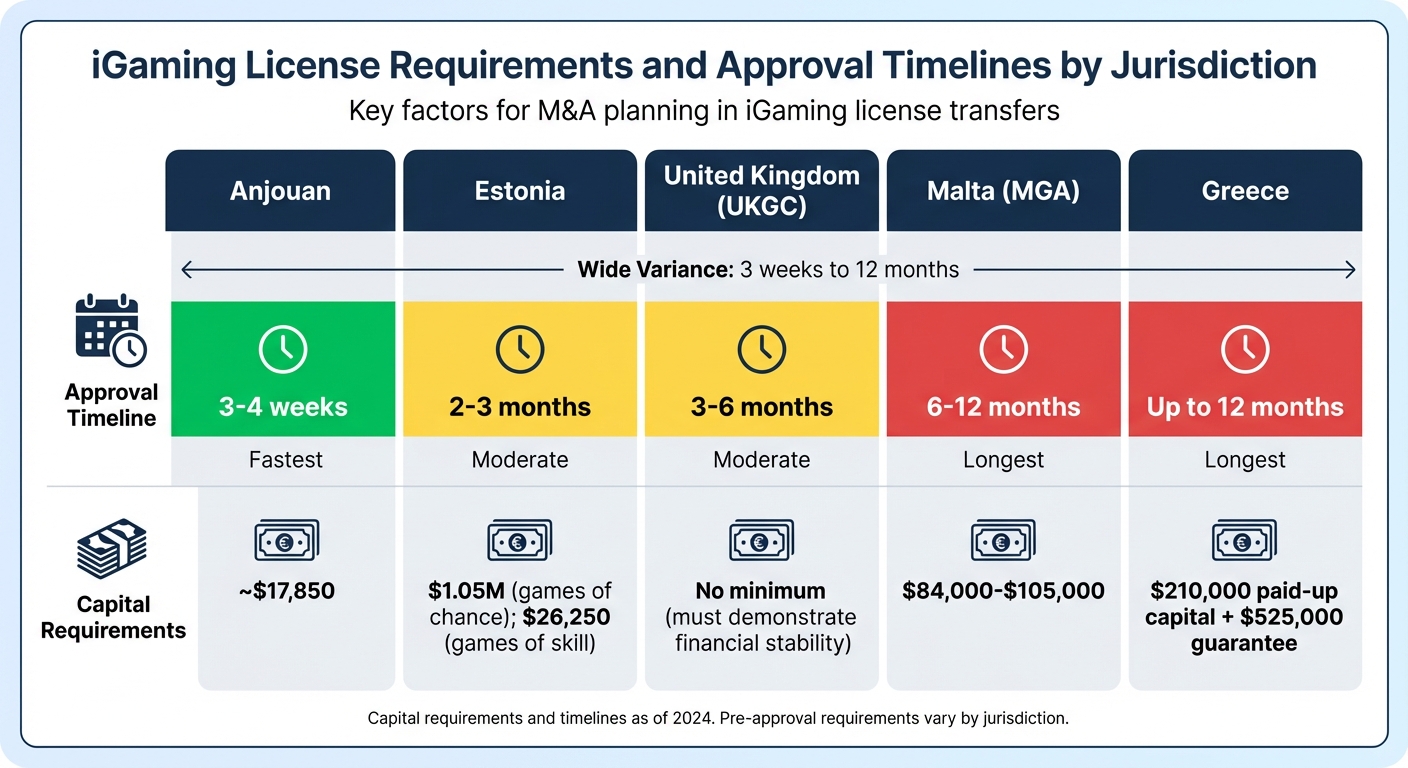
When a company holds licenses in multiple jurisdictions, the approval process can become complex, with timelines varying significantly. These differences need to be mapped out well in advance to avoid delays [2]. Below is a breakdown of approval timelines and capital requirements for several jurisdictions:
| Jurisdiction | Approval Timeline | Capital Requirements |
|---|---|---|
| Anjouan | 3 to 4 weeks | ~$17,850 |
| Estonia | 2 to 3 months | $1.05M (chance); $26,250 (skill) |
| United Kingdom (UKGC) | 3 to 6 months | No minimum (must show stability) |
| Malta (MGA) | 6 to 12 months | $84,000 – $105,000 |
| Greece | Up to 12 months | $210,000 capital; $525,000 guarantee |
For example, acquiring a company with licenses in both the UK (3–6 months) and Malta (6–12 months) requires careful coordination of both approval processes. Some regulators demand pre-approval before the transaction closes, while others allow post-completion notification [2]. Understanding these differences early on helps structure the deal timeline effectively and ensures smooth operations without interruptions.
Conclusion
Navigating license compatibility in iGaming mergers and acquisitions demands careful planning and expert oversight. High-profile cases have shown that unresolved regulatory issues from the past can continue to haunt acquiring companies long after the ink has dried on the deal [2].
Adding to the complexity, operating across multiple jurisdictions today comes with its own set of hurdles. Approval timelines vary widely - from as short as 3 to 4 weeks in Anjouan to as long as 12 months in Greece or Malta. Each regulator enforces unique requirements, including capital thresholds, physical presence mandates, and technical infrastructure standards [1]. To complicate matters further, many jurisdictions don’t allow direct license transfers, requiring deal structures that maintain the original licensee's legal standing [2].
To mitigate these challenges, it’s crucial to pre-screen buyers, conduct thorough technical audits, and ensure hosting infrastructures align with regional regulations. For instance, the Malta Gaming Authority mandates notification of shareholding changes within 3 days of a transaction - failure to comply could lead to license cancellation [15]. These proactive steps help ensure regulatory compliance and keep operations running smoothly.
FAQs
What challenges arise when transferring iGaming licenses during mergers and acquisitions?
Transferring an iGaming license during mergers and acquisitions can be a tricky process, mainly due to the strict regulatory requirements involved. Each jurisdiction treats license transfers as a unique regulatory procedure, meaning approval from local gaming authorities is mandatory. Take the U.S., for example - many states require explicit consent from the gaming commission before any changes in ownership or control can take place. This approval process often includes detailed background checks, financial assessments, and extensive paperwork, which can lead to delays and additional costs.
Cross-border transactions only make things more complicated. Licenses issued in one country might not align with the regulations of another. For instance, a license from Malta would likely not be recognized in the U.S., forcing buyers to either partner with a local operator or go through the time-consuming process of applying for a new license. This patchwork of regulations creates both uncertainty and compliance challenges.
To navigate these hurdles, many businesses rely on platforms like MyReadyMade. These platforms offer expert guidance and support, helping companies manage license transfers across various jurisdictions more efficiently and with fewer delays.
How do differences in licensing regulations affect iGaming mergers and acquisitions?
Jurisdictional differences in licensing rules can make iGaming mergers and acquisitions a tricky business. Each region has its own set of requirements for licensing, compliance, and financial obligations, all of which need careful attention during the deal-making process. Take Malta’s MGA, for example - it enforces rigorous anti-money laundering (AML) measures and requires a minimum capital reserve of €1.25 million. On the other hand, the UK Gambling Commission prioritizes player protection and often conducts additional checks on key personnel. These differing standards can stretch timelines and drive up costs as due diligence teams work to align the target company’s licenses with the buyer’s compliance framework.
Cross-border transactions bring even more hurdles. U.S. state licenses are particularly attractive to European operators, but any merger must prove that the combined entity adheres to both U.S. and EU regulations. In some cases, discrepancies in licensing can delay or even derail a deal unless new licenses are obtained or existing ones are transferred. This process typically demands local legal expertise and regulatory approval, adding another layer of complexity.
To make navigating this maze easier, many dealmakers turn to platforms like MyReadyMade. These platforms offer verified business listings, expert advisory services, and assistance with license transfers across more than 50 jurisdictions. By using such tools, companies can streamline transactions, reduce regulatory risks, and set the stage for smooth operations after the merger.
How can iGaming companies ensure compliance with AML and data privacy regulations during M&A deals?
To navigate anti-money-laundering (AML) and data privacy regulations during mergers and acquisitions, iGaming companies need a clear plan to reduce risks and stay compliant.
Start with a detailed AML risk assessment. This includes reviewing ownership structures, analyzing jurisdictions, and verifying sources of funds. Establish customer due diligence (CDD) as your foundation and step it up for higher-risk cases. Keep your AML policies updated, use automated tools for monitoring, and document everything thoroughly to satisfy regulatory checks.
For data privacy, map out how personal data flows within the merged organization and ensure compliance with privacy laws tied to gaming licenses. Apply privacy-by-design principles, encrypt sensitive data, and restrict access to only those who need it. Assign a Data Protection Officer and regularly perform privacy impact assessments to identify and address any risks.
Additionally, invest in ongoing employee training, keep a detailed compliance log, and work with specialized M&A advisors like MyReadyMade to simplify license transfers and regulatory approvals. Taking these steps not only protects your business but also ensures a seamless transition during the merger or acquisition process.
Related Articles

Ultimate Guide to Earnout Negotiations in M&A
Structure and negotiate earnouts in regulated M&A with clear metrics, anti-manipulation covenants, and acceleration or escrow protections.

How to Draft M&A Definitive Agreements
Guide to drafting M&A definitive agreements covering deal structure, reps & warranties, indemnities, payment terms, and regulatory compliance.

How IP Affects Tokenization Valuation
How tokenizing patents, copyrights, and trademarks adds liquidity and market value—plus legal, regulatory, and valuation steps.
Looking to Buy or Sell?
Get in touch with our team for personalized assistance