License Transfer Clauses vs. Change of Control

License Transfer Clauses vs. Change of Control
When buying or selling businesses in regulated industries like iGaming, Cryptocurrency, Forex, or Fintech, license transfer clauses and change of control provisions are critical for compliance and deal success. These clauses determine how licenses are handled during ownership changes and can significantly impact transaction timelines and risks. Here's the key difference:
- License Transfer Clauses: Triggered when licenses are reassigned to a new legal entity, often requiring regulatory approval (e.g., asset sales or mergers).
- Change of Control Provisions: Activated when ownership or control of the existing entity changes, even if the legal entity holding the license remains the same (e.g., stock purchases).
Both clauses involve regulatory scrutiny, which can delay deals or lead to penalties if mishandled. Proper planning, due diligence, and aligning deal structures with these requirements are essential to avoid complications.
Benzinga Cannabis Capital Conference 2025: Cannabis M&A Licensing Pitfalls with Charles Alovisetti
Key Differences Between License Transfer Clauses and Change of Control Provisions
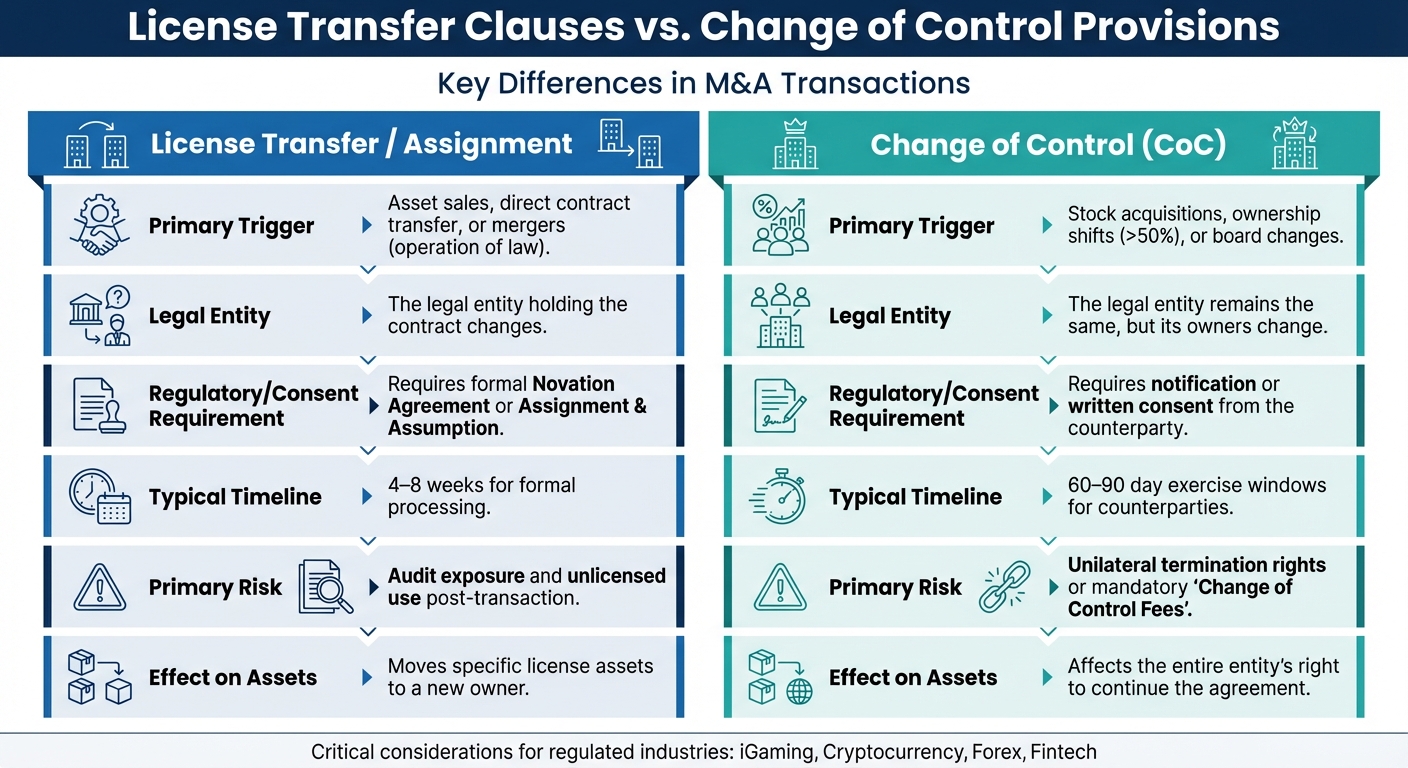
Triggers and Requirements Compared
The key distinction between license transfer clauses and change of control provisions lies in what activates them. License transfer clauses are triggered when a contract or asset is moved to a different legal entity. This typically happens during asset sales, divestitures, or mergers where the original entity ceases to exist [11][8]. On the other hand, change of control provisions come into play when the legal entity remains intact, but its ownership changes - such as when a buyer acquires more than 50% of a company’s stock [7][11].
Here’s an important detail: a simple "no assignment" clause won’t protect against a stock purchase. Why? Because the legal entity holding the license doesn’t change. This makes understanding the difference between these provisions essential for structuring transactions effectively.
Approval processes also vary significantly. License transfers often require formal documentation, such as a Novation Agreement, which must be signed by the transferor, transferee, and licensor [8]. For major licensors like Microsoft, this process can take anywhere from 4 to 8 weeks [8]. Change of control provisions, however, range from simple notification requirements to scenarios where counterparties have "sole discretion" to approve or deny, giving them substantial control [10].
These differences in triggers and approval requirements have a direct impact on transaction timelines and strategies.
Effects on M&A Transactions
License transfer clauses and change of control provisions can significantly influence deal timelines and valuations. In regulated industries like Fintech, change of control requirements tied to licenses often become the "long pole" - the factor that dictates when a deal can close [4]. Discovering "sole discretion" clauses late in the diligence process can lead to major changes in deal pricing [10].
Laurent Campo, a partner at Potomac Law Group, highlights the importance of these provisions:
Change of control provisions in the target's third-party contracts are not a diligence item. They are a deal term. Treating them otherwise is how transactions get repriced, restructured, or killed. [10]
Counterparties often use consent requests as leverage to renegotiate pricing or demand longer commitments [10]. Buyers must decide early whether to make third-party consent a condition for closing. While this protects buyers, it also gives counterparties control over the timeline and allows sellers an escape route if consent is denied [10].
Consider a real-world example: In early 2026, a private equity portfolio company faced a major issue during a divestiture. Its parent Enterprise Agreement lacked a novation clause, leaving the acquirer - a European software group - with no active license coverage for 2,400 users for 90 days. Redress Compliance had to step in, negotiating an emergency interim bridge and structuring a full novation to resolve the compliance risk [8].
Comparison Table: License Transfer Clauses vs. Change of Control
The table below highlights the core differences between these two provisions:
| Feature | License Transfer / Assignment | Change of Control (CoC) |
|---|---|---|
| Primary Trigger | Asset sales, direct contract transfer, or mergers (operation of law) [1][8] | Stock acquisitions, ownership shifts (>50%), or board changes [6][7] |
| Legal Entity | The legal entity holding the contract changes [8] | The legal entity remains the same, but its owners change [1] |
| Regulatory/Consent Requirement | Requires formal Novation Agreement or Assignment & Assumption [8] | Requires notification or written consent from the counterparty [7] |
| Typical Timeline | 4–8 weeks for formal processing [8] | 60–90 day exercise windows for counterparties [10] |
| Primary Risk | Audit exposure and unlicensed use post-transaction [8] | Unilateral termination rights or mandatory "Change of Control Fees" [1][7] |
| Effect on Assets | Moves specific license assets to a new owner [8] | Affects the entire entity's right to continue the agreement [6] |
When License Transfer Clauses Apply
In transactions involving license transfer clauses, the specifics of the assets and regulatory requirements often shape the process.
Asset Sales in Regulated Industries
License transfer clauses are especially important when a buyer acquires specific assets rather than purchasing the entire company through a stock sale. In an Asset Purchase Agreement (APA), the buyer selects particular assets - such as licenses, permits, intellectual property, or customer lists - while avoiding unwanted liabilities [12][13]. However, many licenses and permits cannot be transferred directly, requiring buyers to reapply when the legal entity changes [13].
This creates a significant challenge. As noted by the Law Office, SRP Lawyer:
In an asset sale, the buyer is not buying the company. The buyer is buying specific things the company owns... Anything not listed stays behind [13].
Regulated industries further complicate this scenario. Licenses often cannot be transferred at closing, as buyers must fulfill jurisdictional requirements as new applicants. This can extend transaction timelines considerably.
Cross-border transactions introduce even more complexity. For example, transferring intellectual property internationally may prompt export control reviews under ITAR or EAR in the U.S., or require national security clearances in countries like China [9]. Even after the deal closes, some nations - such as Japan and South Korea - do not recognize the transfer until it is officially recorded with their patent or trademark offices [9]. PatentPC highlights this issue:
In some places, assignments do not take effect until they are officially recorded with the country's patent or trademark office [9].
These challenges can lead to operational disruptions, where buyers may be unable to enforce IP rights or collect licensing revenue legally.
Another potential roadblock is chain-of-title issues. If the target company’s ownership history for a license or patent is incomplete - perhaps due to missing assignments from original inventors - it can prevent a legal transfer in jurisdictions that require official recordation [9]. To avoid such pitfalls, buyers should verify the complete ownership chain during due diligence.
These asset-specific hurdles highlight the need for thorough regulatory approvals to ensure a smooth transfer.
Regulatory Approval and Compliance Requirements
Securing approval involves filing detailed applications, financial disclosures, and undergoing background checks to verify the licensing of key personnel [5][14]. For instance, broker-dealer asset transfers must adhere to specific regulatory filing requirements, such as those outlined in FINRA Rule 1017 [5].
Regulatory review timelines can vary widely. For cross-border asset transfers, these reviews may take anywhere from 30 days to six months or longer, depending on the sector and complexity [9]. To accommodate this, parties should plan for a 6–8 week buffer in their deal calendar to address regulatory review and comment periods [13][14]. Non-compliance with pre-merger notification requirements under the Hart-Scott-Rodino (HSR) Act can result in steep fines of up to $53,088 per day [12][14].
For larger transactions involving the sale of "all or substantially all" assets outside normal business operations, statutory approval requirements often demand both board and shareholder votes [13][14]. For instance, California Corporate Code § 1001 mandates dual approval for California corporations [13]. Additionally, FINRA advises firms to consult with their FINRA coordinator early in the process to address potential operational challenges [5]. Structuring regulatory approval as a condition precedent to closing helps protect buyers from being obligated to finalize a transaction when critical licenses cannot be transferred [9].
For businesses navigating regulated asset transactions, expert advisory services - like those provided by MyReadyMade - can simplify the complex process of license transfers and regulatory compliance.
When Change of Control Provisions Apply
Change of control provisions come into play when there’s a shift in a company’s ownership structure, such as through share purchases or mergers, rather than through the sale of specific assets. These provisions differ from license transfer clauses, as they focus on ownership stakes rather than individual assets. They are triggered when one party acquires or increases its ownership in a company beyond certain thresholds.
Ownership Changes in Regulated M&A
In sectors like Fintech and financial services, change of control provisions are activated once specific ownership thresholds are crossed. These thresholds depend on the jurisdiction and type of firm involved. For example, under the UK FSMA regime, thresholds for regulated entities like insurers and credit institutions are set at 10%, 20%, 30%, and 50%. For FCA-registered cryptoasset firms, the threshold is 25% or more [3].
Interestingly, the trigger isn’t tied to the transaction's closing but rather to the decision to acquire. Regulatory oversight begins as soon as the parties agree on a deal that meets these thresholds. Regulators also examine whether parties are "acting in concert", aggregating holdings of coordinated buyers to determine if a threshold is reached [3].
In Fintech mergers and acquisitions, these provisions are often seen as a "long pole" - a crucial yet time-intensive aspect that can significantly extend deal timelines [4]. Identifying these requirements early is critical to avoid unnecessary delays. Once thresholds are recognized, securing the necessary regulatory consents becomes a priority.
Consent and Notification Requirements
When ownership thresholds are met, strict notification and consent protocols are triggered. Regulatory approval must be obtained before completing the transaction. Proceeding without approval can lead to severe consequences under UK FSMA, including unlimited fines or imprisonment for up to two years [3]. Omar Salem, a Partner at Fox Williams, highlights:
Regulatory approval must precede completion of the transaction [3].
To secure approval, companies need to submit detailed documentation, such as management CVs, three-year financial forecasts, and evidence of funding like loan agreements and bank statements. Regulators assess the buyer’s suitability, financial standing, and the transaction’s impact on the company’s ability to meet prudential requirements [3]. The FCA has stated:
Our assessment focuses on the controller's suitability, financial strength and the ongoing ability of the firm to satisfy threshold conditions [3].
Managing timelines is essential. Under UK guidelines, the statutory review period is 60 working days once a notification is deemed "complete." However, regulators can pause the clock for up to 30 working days to request more information [3]. For Q1 2025/26, FCA approvals took a median of 40 days, with the longest cases taking up to 70 days [3]. Fox Williams advises:
The quality and completeness of the application can significantly influence the speed of the decision [3].
Post-transaction, authorized firms must notify regulators of the completed change in control within 14 days [3]. For complex deals, starting pre-notification discussions with regulators can help clarify information requirements and avoid delays [3]. Additionally, Sale and Purchase Agreements should include regulatory approval as a condition precedent to closing, ensuring enough time is built into the transaction timeline for the full assessment process [3].
How to Navigate License Transfer Clauses and Change of Control Provisions
Planning ahead is key when dealing with license transfers and change of control provisions in mergers and acquisitions (M&A). Without proper due diligence and attention to compliance, transactions can face significant delays or even collapse. By treating licensing as a central compliance priority from the beginning, you can avoid many common pitfalls.
Conducting Due Diligence
Start by creating a thorough inventory of licenses for every jurisdiction where the target company operates. This inventory should include essential details like license numbers, expiration dates, current status, the issuing authorities, and the exact legal entity listed on each license [2]. With over 75,000 federal, state, and local jurisdictions in the United States, each with its own set of complex rules, this step is absolutely critical [2].
Pay close attention to the language in agreements, particularly regarding "assignment" versus "change of control." Often, these provisions are buried in boilerplate sections under headings like "Severability" or "Entire Agreement." For deals involving intellectual property or international operations, ensure the chain-of-title is complete. Missing assignments - especially from founders or contractors - can lead to complications when recording rights in foreign jurisdictions [9].
Thorough due diligence lays the groundwork for smoother approvals and better deal structuring.
Securing Approvals and Structuring Deals
Once due diligence is complete, align the deal structure with regulatory requirements as soon as possible. Involve legal and compliance teams early to ensure licensing considerations are integrated into the deal timeline [2]. Regulatory deadlines should be factored into the schedule to allow enough time for processing amendments or transfers before closing [2]. Include conditions precedent in your Sale and Purchase Agreement to ensure all necessary approvals and third-party consents are secured before finalizing the deal [17].
Explore deal structures that help minimize disruption. A reverse triangular merger, for example, allows the target company to retain its legal identity, which is especially useful when licenses or contracts cannot be assigned. Sandra Feldman, Publications Attorney at Wolters Kluwer, explains:
The reverse triangular merger is useful where the loss of identity of a constituent would cause problems - such as where the target... possesses rights, licenses, or contracts that do not permit assignment [16].
For deals involving multiple jurisdictions, specialized support can simplify the process. MyReadyMade, for instance, assists with license transfers in over 50 jurisdictions, helping buyers and sellers in regulated industries manage the complexities of cross-border compliance.
Reducing Transaction Delays and Risks
To prevent delays, address licensor concerns early in the process. Design the deal to address these concerns upfront. If a licensor is worried about a large acquirer increasing production, consider agreeing to volume-based limits that restrict usage to the licensee’s pre-acquisition levels, with a small allowance for organic growth [1]. Alternatively, you might structure the deal so the licensee operates as a separate subsidiary or business unit, which can help maintain the license’s validity while limiting immediate expansion [1].
Establishing a pre-negotiated "Change of Control Fee" can help avoid disputes during the transaction [1]. You might also consider creating blacklists or whitelists to specify competitors who cannot receive the license or to identify pre-approved entities. However, be cautious with such measures and consult antitrust counsel, especially when dealing with international transactions [1].
Relying on clauses that state consent "cannot be unreasonably withheld" is rarely effective in M&A. Larry Schroepfer highlights the risk:
If the licensor withholds consent and takes the position that its refusal is reasonable, the licensee's only recourse is to sue... but there is no acquirer in the world that is going to wait around until this dispute slowly grinds through the legal process [1].
Finally, treat post-closing updates as a structured project with clear milestones for verification. Many jurisdictions, such as the California State License Board, require written notification of ownership or name changes within strict deadlines (e.g., 90 days) to avoid penalties or license revocation [2]. Similarly, failing to submit an asset purchase statement (Form 8594) to the IRS on time can result in fines of up to $3 million [15]. Tools like Virtual Data Rooms with features like automated indexing and built-in redaction can make managing large volumes of compliance documents much more efficient [15].
Conclusion
Understanding the nuances between license transfer clauses and change of control provisions is essential in regulated mergers and acquisitions (M&A). As David Tollen, Founder of Tech Contracts Academy, puts it:
Change of control and assignment terms actually address opposite ownership changes. If an assignment clause addresses change of control, it says what happens if a party goes through an M&A deal and no longer exists... A change of control clause, on the other hand, matters when the party subject to M&A does still exist [11].
This distinction plays a critical role in deal structuring, especially since many licenses are treated as securities or interest transactions rather than simple asset transfers [18]. It’s a factor that should guide both strategic planning and thorough due diligence.
Given their impact on M&A timelines, license transfer and change of control provisions require careful attention from the start. Regulatory approvals tied to change of control often slow down transactions. Mike Whalen, Partner at Goodwin Procter LLP, highlights the importance of planning for these delays:
Because deals can't close over change of control approvals pending with regulators, transactions involving targets with licenses in the prior approval bucket must be structured as a sign and delayed close [18].
To avoid setbacks, early planning and due diligence are non-negotiable. For cross-border transactions, navigating compliance across multiple jurisdictions can be particularly challenging. Companies like MyReadyMade offer support for license transfers in over 50 jurisdictions, helping streamline the process for buyers and sellers in regulated industries.
The stakes couldn’t be higher. According to Harvard Business Review, 70% to 90% of acquisitions fail, often due to poor planning and integration [19]. By prioritizing licensing and change of control provisions as core compliance issues, you can better position your transaction for success and sidestep costly errors.
FAQs
How do I tell if my deal triggers a license transfer or a change of control?
When dealing with licensing agreements, pay close attention to the license transfer clause. This section typically spells out the conditions under which a license can be transferred. For instance, it might require prior consent from the licensor or allow transfers only under specific circumstances, such as a sale or corporate reorganization.
Another crucial factor is a change of control, which happens when a new party takes over control of a company. This often occurs during mergers, acquisitions, or significant shifts in ownership. Such changes can trigger specific provisions in your agreements, depending on the terms outlined.
To avoid surprises, carefully review the terms and thresholds stated in your agreements. And if you're unsure about the implications for your deal, it's wise to consult legal counsel for clarity.
Can a “no assignment” clause block a stock purchase?
A “no assignment” clause is designed to stop the transfer of contractual rights or obligations without prior consent. When it comes to stock purchases, the effect of this clause hinges on how it’s written. If the clause specifically limits ownership or stock transfers, it could either prevent or complicate the deal. Whether the clause applies ultimately depends on whether the transaction is considered an assignment or a change of control as defined by the contract.
What should I do if regulatory approval won’t be ready by closing?
If regulatory approval isn't expected to be ready by the closing date, it's wise to negotiate a closing condition that allows for an extension or sets up escrow arrangements until the approval is secured. Another option is to delay the closing altogether. This approach can help sidestep risks tied to license transfers and changes in control, ensuring compliance and minimizing potential issues.
Related Articles

Ultimate Guide to Earnout Negotiations in M&A
Structure and negotiate earnouts in regulated M&A with clear metrics, anti-manipulation covenants, and acceleration or escrow protections.

How to Draft M&A Definitive Agreements
Guide to drafting M&A definitive agreements covering deal structure, reps & warranties, indemnities, payment terms, and regulatory compliance.

How IP Affects Tokenization Valuation
How tokenizing patents, copyrights, and trademarks adds liquidity and market value—plus legal, regulatory, and valuation steps.
Looking to Buy or Sell?
Get in touch with our team for personalized assistance