License Transfer Milestones in Fintech

License Transfer Milestones in Fintech
Fintech license transfers are a complex but vital part of mergers and acquisitions. Here’s what you need to know:
- Licenses can't be sold or transferred directly. Transfers require ownership changes of the licensed entity and regulatory approval.
- Approval timelines vary: U.S. state licenses often take 30–60 days, while stricter regions like the EU or UK can take up to 24 months.
- Preparation is key: Due diligence, compliance audits, and finalized documentation are essential to avoid delays.
- Post-transfer updates: Ownership records, compliance systems, and financial reporting must be updated promptly.
Acquiring a licensed fintech entity is often faster than applying for new licenses, saving months or even years. However, the process demands thorough planning and expert guidance to navigate regulatory requirements efficiently.
Pre-Transfer Preparation Steps
Before submitting regulatory documents, it's essential to complete key steps to ensure a smooth transfer process.
Due Diligence and Compliance Audits
Start by creating a comprehensive inventory of all licenses. This includes listing every state money transmitter license, federal MSB registration, and any pending applications. Some firms also document workaround arrangements or FBO (For Benefit Of) account setups that may need review for future applicability [1].
Next, identify all post-transfer controllers. Keep in mind that control thresholds vary - commonly 10%, but sometimes 5% or 25% [1]. Regulators also assess whether individuals are "acting in concert", meaning family members or related entities whose holdings are combined to determine if the threshold is met [4].
Ensure criminal background checks for all controllers and beneficial owners are current - these must be no older than 6 months when submitted [5][6]. Financial reviews are also critical, as they confirm funding sources and ensure capital adequacy after the transfer [4][5][1].
A compliance audit should evaluate anti-money laundering (AML) procedures, financial crime controls, and any potential conflicts of interest [5]. It's also necessary to address any unpaid arbitration awards or settlements, as unresolved issues can delay approval [3].
These due diligence efforts guide the structuring decisions outlined in the next step.
Ownership Change and Business Model Review
Since licenses are non-transferable, transactions must be structured as securities or interest deals. Mike Whalen, Partner at Goodwin Law, explains:
"Licenses can't be transferred. They can't be acquired in an asset purchase. As a result, licensee acquisitions have to be structured as securities/interests deals" [1].
The responsibility for filing the change of control request lies with the existing licensee, not the new owner [1]. For example, FINRA requires members to file a Change in Membership Application (CMA) at least 30 days before any ownership change [3].
Regulators expect thorough and finalized documentation, along with proactive compliance from the outset [6]. A detailed business plan is essential, covering future strategy, projected financials, governance structures, staff qualifications, and risk management systems [5]. The FCA emphasizes this point:
"We expect all documents to be final versions that have been reviewed thoroughly and appropriately signed off before you submit them. We won't review draft documents" [6].
New Applications vs. Transfers: Timeline Comparison
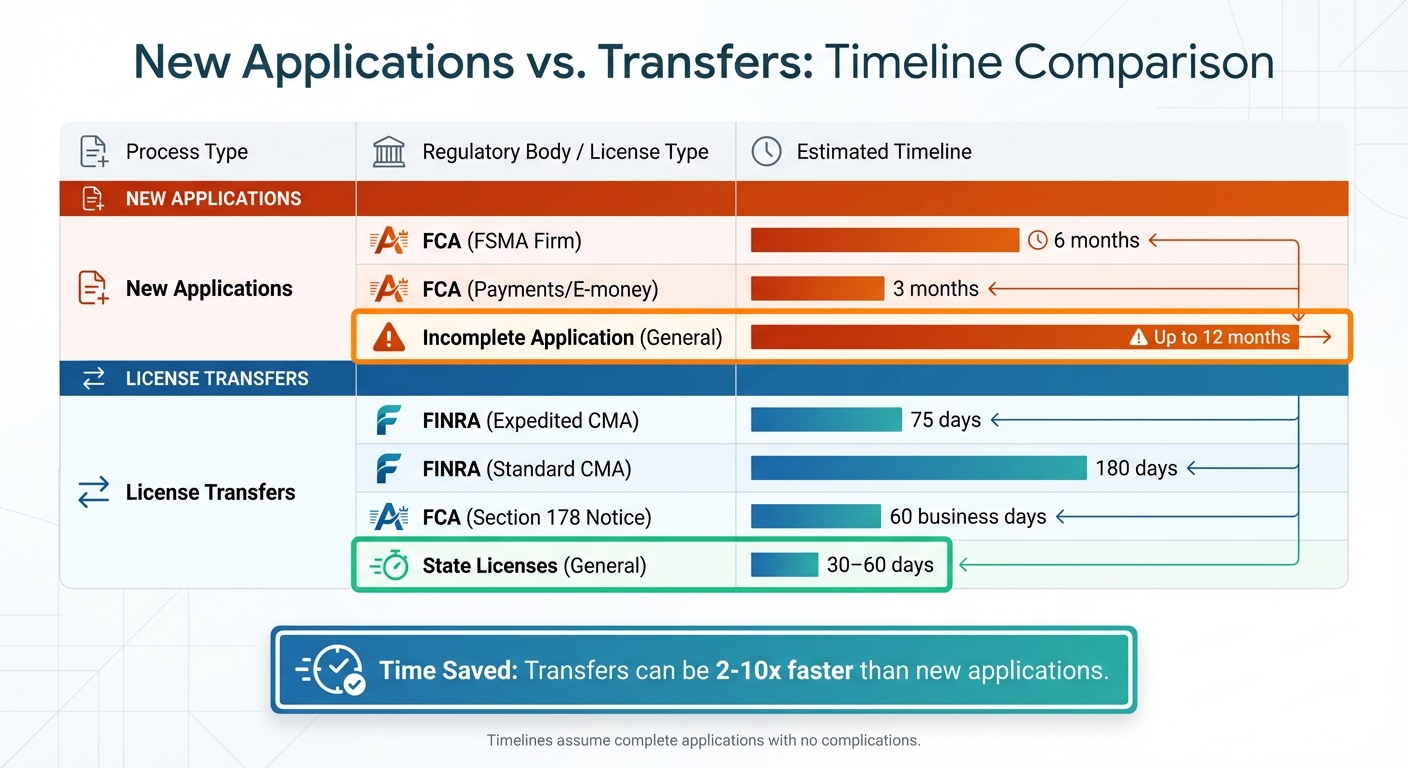
The time saved by transferring an existing license compared to applying for a new one can be considerable. Here's a breakdown of estimated timelines:
| Process Type | Regulatory Body / License Type | Estimated Timeline |
|---|---|---|
| New Application | FCA (FSMA Firm) | 6 months [6] |
| New Application | FCA (Payments/E-money) | 3 months [6] |
| New Application | Incomplete Application (General) | Up to 12 months [6] |
| License Transfer | FINRA (Expedited CMA) | 75 days [3] |
| License Transfer | FINRA (Standard CMA) | 180 days [3] |
| Change of Control | FCA (Section 178 Notice) | 60 business days [4] |
| Change of Control | State Licenses (General) | 30–60 days [1] |
New applications require building compliance infrastructure from scratch. This includes registering with FinCEN, creating AML programs, securing surety bonds (ranging from $50,000 to $500,000, or $500,000 in New York), and providing audited financials [7]. In contrast, transfers emphasize reviewing existing compliance records and conducting background checks for new owners [1].
Given the need for regulatory approval before closing, most transactions follow a "sign and delayed close" structure. This makes regulatory approval a condition for closing [1]. Buyers often aim to close once a "critical mass" of approvals - representing states with the highest revenue share - is achieved, rather than waiting for all jurisdictions [1].
sbb-itb-ba142f6
Regulatory Submission and Review Process
Once all preparations are finalized, the formal submission process begins. Building on the groundwork laid during pre-transfer stages, you’ll need to compile and organize all necessary documents for submission to the relevant authorities.
Pre-Submission Document Preparation
Before filing, ensure you’ve gathered all required materials. Corporate documents should include the purchase agreement, a comprehensive transaction description, and updated organizational charts that clearly outline the new ownership structure [1][3]. Financial records must demonstrate sufficient capital. For instance, a Lithuanian Electronic Money Institution (EMI) requires at least EUR 350,000 in minimum capital [9][10].
Your submission must also include complete compliance manuals. These should cover your Anti-Money Laundering and Counter-Terrorism Financing (AML/CTF) program, customer due diligence (KYC) procedures, and data protection policies [10]. For personnel documentation, regulators typically require personal financial details, fingerprints, and background checks for all new directors, officers, and major shareholders [10][1].
Operational plans should detail your business model, revenue forecasts, risk mitigation strategies, cybersecurity protocols, and any partnerships or outsourcing agreements [9][10]. Additionally, specific regulatory forms may be required, such as FinCEN Form 107 for U.S. Money Services Businesses (MSBs), updated NMLS forms, or FINRA Form CMA [8][1][3]. Surety bonds are another critical component, providing customer protection in case the business fails [10].
For U.S. regulators like FINRA, all foreign-language documents must be certified and translated into English, and currency amounts should be converted to U.S. dollars [3]. If your transaction involves account transfers, include drafts of negative consent letters (NCLs) during your initial application to avoid unnecessary delays [3].
Submitting the Full Application
Once all documentation is ready, the next step is submitting a complete application to the appropriate regulatory body. Regulators will only begin their review after receiving all required materials and fees [12]. For example, the New York Department of Financial Services (DFS) insists on complete submissions, stating:
"An application will not be deemed ready for substantive review until the Department has received all required information, documents, and fees... and the required documents appear to be facially adequate" [12].
If you’re handling a U.S. MSB, re-registration is mandatory when there’s a transfer of more than 10% of voting power or equity interest. FinCEN underscores this responsibility:
"Registration of an MSB is the responsibility of the owner or controlling person of the MSB and must be filed by the registration deadline" [8].
To avoid delays, confirm the correct forms and processes with the relevant regulatory bureau before filing [11]. Missing or incomplete items are a frequent cause of application delays [12].
Regulatory Review and Information Requests
After submission, regulators will begin their assessment. For change of control approvals, many fintech licenses are reviewed within 30 to 60 days, provided there are no complications [1]. Mike Whalen, Partner at Goodwin Law, explains:
"The timing of approvals is another matter. Assuming filings have no issues, many change of control approvals should come in within 30 to 60 days, but some could take much longer" [1].
In the UK, the FCA has 60 working days to evaluate a change in control notification once the application is deemed complete [4][5]. If additional information is requested in writing, the assessment period can be paused for up to 30 business days [5]. For FINRA, review times range from 75 days for expedited applications to 180 days for standard ones [3].
Regulators often conduct suitability checks on new controllers, which may include criminal background checks, fingerprinting, and reviews of personal financial histories [5][1]. They’ll also examine financial soundness, requiring proof of secured funding and financial projections that demonstrate compliance with minimum capital requirements [5]. Be prepared to answer detailed questions about your operational strategy, including governance structures, board composition, outsourcing arrangements, and risk management systems [4][5]. Compliance frameworks will receive close scrutiny, particularly AML procedures, financial crime controls, and conflict of interest management [5].
To stay organized, maintain an updated tracking chart for filing dates and key contacts [1]. In distressed sales, regulators may apply heightened scrutiny to net worth, surety bonds, and the retention of critical personnel [1]. These steps ensure that regulatory expectations are met and pave the way for smooth post-transfer compliance.
Post-Transfer Compliance Requirements
Once regulatory approval is in place, the focus shifts to ensuring all records are updated and compliance standards are maintained. This phase is critical for smooth operations under the new ownership structure.
Updating Records and Notifying Regulators
The first step after a transfer is to file a Form BD Amendment to update ownership details. Additionally, representatives must be registered using Form U4 filings, and the FINRA Contact System (FCS) information must be updated within 30 days. FINRA emphasizes:
"FINRA Member firms are required to update contact information via the FINRA Contact System (FCS) within 30 days following any changes and to review required contact information annually." [3]
For cases involving the transfer of 50 or more representatives, the FINRA Mass Transfer Program can simplify the process by automating terminations with the predecessor firm and re-registering representatives. Each representative should receive an updated Form U4 to confirm the accuracy of their disclosure record.[3]
Operational systems also require updates. For instance, systems like TRACE (for fixed income reporting) and OATS (for reporting relationships) need to reflect the changes. The Super Account Administrator plays a key role here, ensuring former employees’ system entitlements are removed and new accounts are created for incoming personnel. Failure to secure these processes can lead to vulnerabilities. Take the 2022 Revolut breach, where over 50,000 customer records were compromised, as a cautionary example of what can happen when access controls are overlooked.[17]
Some jurisdictions also require post-closing notices, even after approvals are obtained. While many states impose a 30-day notice period, specific licenses - like New York's mortgage banker license - require a 90-day advance notice.[1]
Maintaining Compliance Obligations
Regulatory compliance doesn’t stop at updating records. Firms must maintain financial and compliance reports and retain transaction records for up to five years to meet audit requirements.[13]
The compliance workload can be daunting. A recent survey revealed that 93% of fintech companies find compliance at least "somewhat challenging", and 47% see regulatory hurdles as a key barrier to growth.[17] Adding to the pressure, the global average cost of a data breach hit $4.88 million in 2024, marking a 10% rise from the previous year.[16]
Recent enforcement actions, such as penalties for GDPR violations and unregistered crypto lending, highlight the risks of non-compliance.[15] To mitigate these risks, firms should conduct annual reviews to ensure regulatory contact information is accurate. Automated RegTech solutions can help by tracking real-time regulatory updates, reducing errors, and easing the administrative load.[13][14]
For businesses navigating these challenges, expert assistance can make a significant difference.
Using MyReadyMade for Post-Transfer Support

Managing compliance across multiple jurisdictions is no small task. MyReadyMade offers tailored support for fintech companies handling licensing and compliance after a transfer. With expertise in over 50 jurisdictions, the platform assists with ongoing reporting, regulatory updates, and operational transitions.
Their services include round-the-clock support and expert guidance on filing deadlines, personnel registration, and maintaining financial and regulatory standards. MyReadyMade ensures your operations stay compliant and your licenses remain secure, so you can focus on growing your business.
Conclusion
Main Milestones Summary
The process of transferring licenses involves several key steps, starting with due diligence, moving through regulatory review, and ending with post-transfer compliance. During due diligence, licenses are verified, and it's determined whether a "change of control" is triggered - often defined as a 10% ownership change[1]. For fintech licenses that cannot be transferred directly, structuring the transaction as a transfer of securities or interests becomes necessary[1].
Regulatory review is often the most time-consuming phase, sometimes extending beyond 60 days[1]. Regulators typically follow one of five approval paths, ranging from requiring prior approval to allowing post-closing notifications. Importantly, the review process only begins once all application materials are deemed complete, adding another layer of complexity.
Given these challenges, having experienced guidance can help minimize delays and ensure smooth progress.
The Value of Expert Support
Tackling these steps without professional assistance can lead to significant costs, both in terms of time and resources. For instance, obtaining a new license independently can take anywhere from 12 to 24 months, a delay that often outweighs the acquisition premium paid for a licensed business[2]. MyReadyMade offers specialized support for fintech companies, managing the entire transfer process across more than 50 jurisdictions and achieving an average transaction close time of just 30–45 days.
Their services include M&A advisory, management of confidential documentation, and ensuring that regulatory submissions are thorough and complete from the outset. As Finnovation.UK aptly puts it:
"You only get one chance to make a first impression."[18]
With 24/7 support and deep expertise in license transfers, MyReadyMade helps businesses avoid the regulatory and compliance hurdles that can disrupt acquisitions.
FAQs
What is considered a “change of control” for a fintech license?
A "change of control" for a fintech license happens when there's a major shift in ownership or management. This could include events like mergers, acquisitions, or transferring control that significantly alters the structure of the license holder. In most cases, these changes must be reported to regulators and approved to ensure all legal requirements are met.
What can I do to avoid regulatory delays in a license transfer?
To avoid regulatory delays, ensure your application is complete and meticulously prepared to meet all outlined requirements. Start by conducting expert gap analyses to identify and address any potential weaknesses. Additionally, schedule pre-application meetings with regulators to clarify expectations and align on key details early in the process.
A well-organized submission that highlights strong governance, operational resilience, and financial stability can significantly reduce follow-up questions, helping to streamline the review process. Prioritizing thorough planning and maintaining proactive communication with regulators are crucial steps to keep the process moving efficiently.
What needs to be updated immediately after the transfer closes?
When there's a change in control or ownership, it's crucial to update the license immediately. This step helps you stay in line with regulatory requirements and steers clear of any potential legal troubles.
Related Articles

KYC vs. AML for Payment Processors: What to Know
KYC confirms identity at onboarding, but only continuous AML monitoring stops payment processors from becoming conduits for financial crime.

Checklist for Secure Player Database Transfers
Step-by-step checklist for secure player database transfers: compliance, encryption, vendor vetting, zero-trust, integrity checks, and audits.
Ultimate Guide to Payment Compliance in iGaming
Roadmap for building compliant iGaming payment systems: AML/KYC, PCI‑DSS, multi‑PSP setup, chargeback controls and jurisdictional risks.
Looking to Buy or Sell?
Get in touch with our team for personalized assistance