License Transfers in M&A: What to Know

License Transfers in M&A: What to Know
When buying or merging with a company in regulated industries like iGaming, Crypto, Forex, or Fintech, ensuring proper license transfers is critical. Licenses are tied to legal entities, and failing to transfer them correctly can lead to operational shutdowns, fines, or even forfeited revenue. Here's a quick breakdown:
- Non-Transferable Licenses: Some licenses, like software agreements, don’t automatically transfer and may require explicit approval or new applications.
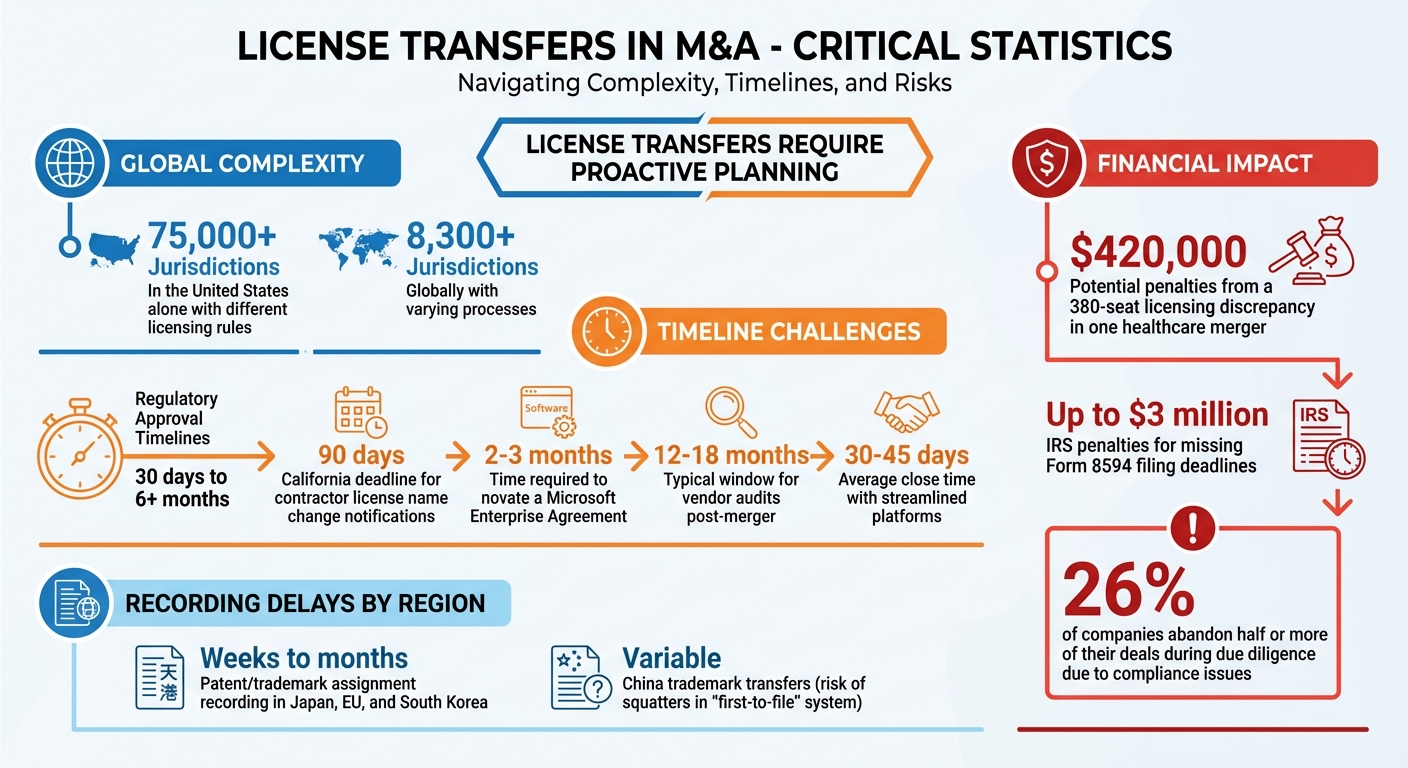
- Jurisdictional Complexities: Rules differ across 8,300+ jurisdictions globally, with strict deadlines and varying processes.
- Regulatory Delays: Approval timelines can range from 30 days to over six months, especially for sensitive industries.
To navigate this, build a detailed license inventory, engage experts, and communicate early with regulators. Platforms like MyReadyMade can streamline compliance for faster, smoother transactions.
Common Challenges in License Transfers During M&A
Non-Transferable Licenses
One of the biggest hurdles in mergers and acquisitions (M&A) is dealing with licenses that can't be transferred. For example, software licenses, trademark agreements, or operating permits often remain tied to the original company name. This means they don’t automatically move with the business during a merger or reorganization.
The case of Cincom Systems Inc. v. Novelis Corp. is a perfect example of how this can go wrong. When Alcan Ohio reorganized into Novelis through a series of mergers, they kept using Cincom's software on the same systems and in the same location. However, because the legal entity changed and the license agreement prohibited transfers, the U.S. Court of Appeals for the Sixth Circuit ruled that Novelis had committed copyright infringement. The software itself didn’t move - just the company name changed - but that was enough to invalidate the license [7].
This assumption of non-transferability creates immediate operational risks. Even in cases where the reorganization happens between affiliated companies, changing the legal entity on the license can lead to claims of unauthorized transfer. To resolve this, you’ll need explicit approval from the licensor or, in some cases, a new application entirely. Either approach can delay the deal and introduce uncertainty, especially when factoring in the different requirements across jurisdictions.
Different Rules Across Jurisdictions
Navigating license transfers becomes even trickier when dealing with multiple jurisdictions. In the United States alone, there are over 75,000 federal, state, and local jurisdictions, each with its own rules for updating, transferring, or reapplying for licenses [2]. A process that’s straightforward in one state may be completely different - or even problematic - in another.
For instance, California has strict deadlines. Licensed contractors who change their company name must notify the state registrar in writing using a specific form within 90 days. Missing this deadline could result in disciplinary action against the license [2]. Other states have their own timelines and requirements, which can quickly complicate things.
Cross-border transactions add yet another layer of complexity. For example, recording patent or trademark assignments in countries like Japan, the European Union, or South Korea can take weeks or even months [3]. During this waiting period, buyers are unable to enforce rights or collect revenue tied to those assets. In China, where trademarks operate under a "first-to-file" system, any delay in transferring a trademark could allow squatters to claim it during the transition [3]. To avoid these pitfalls, planning ahead for jurisdiction-specific rules is absolutely critical.
Regulatory Approval Delays
Regulatory approvals can also throw a wrench into even the most carefully planned deals. Many licenses include "change of control" clauses requiring prior approval from regulatory bodies before a transaction can close.
Deals involving sensitive technologies often face additional scrutiny. For example, transfers may trigger reviews by the Committee on Foreign Investment in the United States (CFIUS) or require export licenses under regulations like the International Traffic in Arms Regulations (ITAR) or Export Administration Regulations (EAR) [3]. These investigations can extend timelines significantly - sometimes from 30 days to over six months.
Another common issue is chain-of-title problems. If a founder personally owns a trademark or if software was developed by a contractor without a formal assignment, proving ownership to foreign regulatory agencies can become a nightmare. Without perfect documentation, some countries outright refuse to record transfers [3].
James Harris, Principal of Corporate Development Integration at Google, explains this challenge well:
"If everybody is thinking about the checklist, then nobody is thinking about what is not on the checklist" [8].
This complexity is one reason why 26% of companies abandon half or more of their potential deals during due diligence due to compliance issues [6]. These delays aren’t just bureaucratic - they can make or break a deal. Anticipating regulatory challenges early on is key to keeping the process on track.
sbb-itb-ba142f6
How to Manage License Transfers Effectively
Create a Complete License Inventory
Before anything else, make sure to build a detailed inventory of all licenses and accounts involved in the transaction. This includes business licenses, tax accounts, patents, trademarks, software licenses (including open-source), and trade secrets. For each item, document the type, official number, expiration date, current status, and the relevant filing authority or jurisdiction. Make sure this list reflects any jurisdiction-specific rules or requirements that could impact the transfer process [4][2].
Accuracy is key. The legal entity name on each license must match the acquiring or current entity exactly. Even minor discrepancies - like "Inc." versus "Incorporated" - can lead to delays or rejections. Additionally, verify the chain-of-title for intellectual property. For example, if a patent is still registered to a dissolved entity or an individual founder, that’s an issue that needs to be addressed early [4][2][3].
Keep all relevant documents - such as assignment agreements, signature pages, and translated copies for international filings - in a single secure and accessible location. The fast pace of mergers and acquisitions (M&A) leaves no room for wasting time hunting through emails or spreadsheets. Also, closely monitor expiration dates and maintenance fees during the transition to avoid losing rights unintentionally [4][3].
Work with Licensing Experts
Once your inventory is complete, it’s time to bring in professionals. Managing compliance across tens of thousands of jurisdictions is a complex task prone to costly errors [2]. Experts with a deep understanding of jurisdiction-specific rules can help you avoid pitfalls. For instance, certain professional service firms may require specific entity structures, like a PC (Professional Corporation) or PLLC (Professional Limited Liability Company), to maintain their licenses in some states. Karen J. Poist, CPA at Stambaugh Ness, highlights the risks:
"A single misstep can ruin the deal... changing ownership and entity structures through the M&A process can unintentionally void a firm's professional licenses if you are not careful" [5].
For international transactions, experts can handle country-specific requirements like translations, notarizations, and engaging local legal agents for foreign patent or trademark filings [3][4]. They can also help navigate Foreign Direct Investment (FDI) screening protocols, which vary widely by country and can block deals in sensitive industries like defense or telecommunications [9][3]. To ensure enough time for this critical research, involve these advisors as soon as you sign a Letter of Intent [6].
Communicate Early with Regulatory Authorities
In addition to internal preparation and expert advice, proactive communication with regulatory authorities is essential. Reach out early to coordinate your transaction timeline with regulatory deadlines and processing times, which can vary from 30 days to over six months [2][3]. Some licenses and intellectual property cannot legally transfer without prior government approval, so early outreach helps identify and address these obstacles before they disrupt the deal [3].
Timing is critical. In many jurisdictions, rights tied to licenses or intellectual property only become enforceable once updates are officially recorded with the relevant authority. As PowerPatent explains:
"The timing matters because the rights you expect to have only truly begin once the update is filed. By moving fast, you turn contractual rights into enforceable rights without leaving open space for risk" [4].
Make regulatory clearance a precondition for closing the transaction [3]. Assign a dedicated team to manage post-closing updates and verify that all filings are completed and accepted [2]. Early communication also gives you the chance to propose solutions - like compliance audits or firewalls - that might address regulatory concerns and prevent the deal from being blocked [3].
Best Practices for License Transfers in Regulated Industries
Match Your Approach to the Transaction Type
The type of transaction - whether it’s an asset sale, stock sale, or merger - sets the tone for your licensing requirements. For asset purchases, licenses don’t usually transfer automatically. You’ll likely need to file new applications or formal assignments with the relevant regulatory bodies. Additionally, the IRS mandates both parties to submit Form 8594 (Asset Purchase Statement). Missing this filing deadline can result in penalties of up to $3 million [6].
In stock sales, even though the legal entity remains the same, many licenses include change of control clauses that require prior approval before ownership can shift [6]. For example, broker-dealers must submit a Continuing Membership Application (CMA) under FINRA Rule 1017 when there’s a material change in ownership [10].
When it comes to intellectual property, asset sales require formal ownership assignments to be recorded, while stock sales typically only need an update to the ownership record [4]. Misaligning your strategy with the transaction type can lead to compliance issues [6].
Once your deal structure is clear, focus on managing post-closing license updates effectively.
Plan for Post-Close License Amendments
Closing the deal is just the start - you’ll need to handle a series of administrative updates afterward. Notify licensing boards and state authorities about changes in leadership, stock structures, or entity details promptly. Don’t forget to complete final tax returns and close accounts for any merged or dissolved entities [5].
Treat these updates as a formal project. Assign a dedicated team, establish clear checkpoints, and verify that all filings are completed on time [2]. Regulators monitor public records closely, so even minor delays in renewals could lead to enforcement actions or license revocations [2]. Karen J. Poist, CPA at Stambaugh Ness, emphasizes the importance of compliance:
"Whether you are merging, acquiring, selling, or planning for internal succession, compliance must be front and center, not something you check off after closing" [5].
For intellectual property, recording assignments with the appropriate patent or trademark office is essential. Without proper recordation, you won’t have the legal standing to enforce your rights - even if you technically own the asset by contract [4][3]. Additionally, align your timeline with regulatory deadlines. For instance, contractor license holders in California must notify the State License Board of name changes within 90 days to avoid disciplinary action [2].
To make these processes smoother, consider using a specialized platform for managing complex license transfers.
Use MyReadyMade for Streamlined Transactions

MyReadyMade offers tools and expertise to simplify license transfers, especially in regulated and high-risk industries like iGaming, Cryptocurrency, Forex, and Fintech. These sectors often involve intricate licensing requirements that can make or break a deal.
The platform provides features like verified listings, NDA-protected communications, and 24/7 deal support, ensuring confidentiality and efficiency. With an average close time of 30 to 45 days, MyReadyMade helps keep transactions on track. Buyers can access verified listings for free, while sellers pay a success fee only after their business sells. By centralizing due diligence materials and working with regulatory authorities early, MyReadyMade minimizes compliance risks - an issue that causes 26% of companies to abandon half or more of their deals [6].
Conclusion
Key Takeaways
License transfers don’t just happen - they require intentional planning, accurate documentation, and regulatory approval. With over 75,000 jurisdictions to navigate [2], ownership changes demand strict compliance. Failing to formally update or transfer licenses can lead to losing enforcement rights, audit penalties, or even operational shutdowns due to violations.
Consider this: during one healthcare merger, a 380-seat licensing discrepancy could have resulted in $420,000 in penalties if it hadn’t been identified during proactive due diligence [1]. This example highlights how critical it is to treat licensing as a core compliance priority before and after corporate changes. The risks are too high to ignore.
To avoid these pitfalls, start early. Compile a thorough license inventory during due diligence, consult with legal experts familiar with your industry’s specific requirements, and notify regulatory bodies as soon as the deal is announced. Processes like novating a Microsoft Enterprise Agreement can take 2–3 months, while vendor audits often occur within 12–18 months [1]. Waiting until the deal closes can leave you exposed to compliance gaps, fines, or enforcement actions.
For companies in regulated industries like iGaming, Cryptocurrency, Forex, and Fintech, platforms like MyReadyMade can simplify this process. They offer verified listings, secure NDA-protected communications, and expert guidance for license transfers across 50+ jurisdictions. This can help you close deals in as little as 30 to 45 days while ensuring compliance remains intact.
Treat license transfers as a cornerstone of your M&A strategy. By taking these proactive steps, you can ensure a smooth transition and maintain compliance throughout the process.
Assuring Compliance During Merger Or Aquisition
FAQs
Which licenses usually can’t be transferred in an acquisition?
Licenses tied to intellectual property often come with non-transferable clauses, making them tricky during acquisitions. These clauses mean the license rights don't automatically transfer to a new owner. Instead, they require explicit consent or amendments to move forward. It's crucial to carefully review licensing agreements for these restrictions to avoid unexpected roadblocks.
When should we contact regulators about a change of control?
You should inform regulators about a change of control as soon as you can, preferably during the due diligence stage and well before the deal is finalized. Reaching out early helps secure necessary approvals on time and avoids potential delays in closing.
What deal terms protect us if license approvals take too long?
To tackle delays in license approvals, it's a smart move to include deal terms that factor in closing conditions tied to regulatory approval. These conditions give the buyer the option to delay or even back out of the deal if approvals aren't obtained within a specific timeframe. This approach minimizes risks associated with drawn-out approval processes, offering both parties some much-needed flexibility and protection during the transaction.
Related Articles

Ultimate Guide to Earnout Negotiations in M&A
Structure and negotiate earnouts in regulated M&A with clear metrics, anti-manipulation covenants, and acceleration or escrow protections.

How to Draft M&A Definitive Agreements
Guide to drafting M&A definitive agreements covering deal structure, reps & warranties, indemnities, payment terms, and regulatory compliance.

How IP Affects Tokenization Valuation
How tokenizing patents, copyrights, and trademarks adds liquidity and market value—plus legal, regulatory, and valuation steps.
Looking to Buy or Sell?
Get in touch with our team for personalized assistance