License Transfers and Valuations in Fintech M&A

License Transfers and Valuations in Fintech M&A
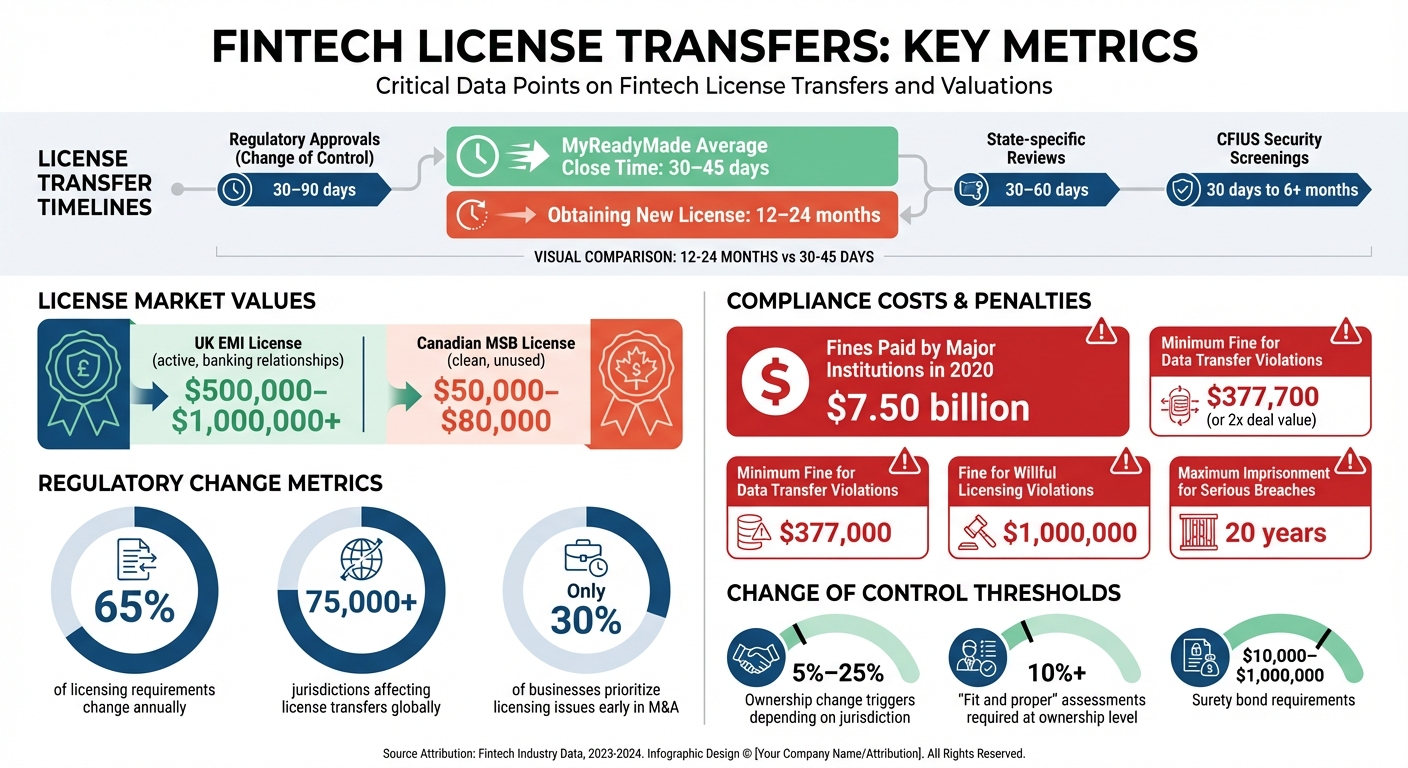
When fintech companies are acquired, licenses don’t automatically transfer to the buyer. This creates challenges, including regulatory delays, compliance risks, and valuation impacts. Regulatory approvals for license transfers can take 30–90 days or longer, depending on the jurisdiction. In some cases, obtaining a new license can take 12–24 months, making acquiring licensed entities a faster option despite higher costs.
Key points:
- License Value: Regulatory licenses can be worth more than technology or customer relationships. For example, a UK EMI license can sell for $500,000–$1 million, while a Canadian MSB license fetches $50,000–$80,000.
- Regulatory Delays: Change of Control (CoC) approvals and cross-border licensing complexities can delay deals by months.
- Compliance Risks: Gaps in documentation or losing key personnel can void licenses or disrupt operations.
- Valuation Impact: Clean compliance records and stable banking relationships increase valuations, while licensing uncertainty lowers them.
Solutions include starting regulatory due diligence early, structuring deals to manage risks (e.g., phased acquisitions), and leveraging platforms like MyReadyMade to streamline transfers and protect valuations.
Fintech Talk: Mergers & Acquisitions with Nicole Pienkos (FIS) & Alex Johnson (Fintech Takes)
sbb-itb-ba142f6
Common Challenges in Fintech License Transfers
Navigating licensing challenges is a critical step in fintech mergers and acquisitions (M&A). These obstacles can directly impact business valuations by delaying timelines, increasing costs, and introducing risks. For buyers and sellers, understanding these hurdles early on helps in structuring deals for smoother closings, while also highlighting how each issue affects valuation and deal structures.
Regulatory Approval Delays
One of the most common challenges involves regulatory approvals, particularly Change of Control (CoC) requirements, which are mandatory in most jurisdictions before a transaction can close. Depending on the region, CoC review thresholds can range from 5% to 25% ownership [1] [7]. Regulators also conduct "fit and proper" assessments for new directors and significant shareholders (usually those acquiring more than 10%). These assessments often require personal financial disclosures, fingerprint submissions, and criminal background checks. Under MiCAR, for instance, anyone acquiring over 10% of a Crypto-Asset Service Provider must pass this assessment [1] [7].
State-specific license reviews can take anywhere from 30 to 60 days, though certain sectors, like mortgage lending, may require even longer timelines. To minimize delays, some buyers opt for "critical mass" closings. This approach allows the deal to proceed once approvals are secured from jurisdictions that account for a significant portion of revenue, instead of waiting for every jurisdiction to sign off.
Cross-Border Licensing Complications
Cross-border transactions add another layer of complexity, often affecting valuations. Even within unified regulatory frameworks like MiCAR in the EU, national variations in implementation and oversight create challenges. Renate Prinz, Partner at McDermott Will & Schulte, highlights this issue:
"While MiCAR is directly applicable EU-wide, its national implementation and supervisory practices vary significantly. Member states still vary greatly in their approach to regulation" [7].
Data localization laws further complicate cross-border deals. Countries like China, India, and those under the EU's GDPR restrict the transfer of financial and personal data across borders, potentially hindering post-acquisition integration. Violations of these laws can lead to fines of at least $377,700 or even double the deal value [3].
National security screenings also come into play. For example, in the US, transactions involving sensitive technologies often trigger reviews by entities like CFIUS, with timelines ranging from 30 days to over six months [6]. Unlike the EU’s passporting system, which allows a single license to cover all member states, US fintech firms face a state-by-state licensing process. Globally, there are over 75,000 jurisdictions affecting license transfers, and around 65% of licensing requirements change annually [3], making compliance a moving target.
Compliance Gaps and Operational Disruptions
Internal compliance issues can further complicate license transfers. Gaps such as outdated documentation or structural changes can stall deals or even void licenses. Missing or incomplete documents - like AML/KYC manuals, shareholder registers, or regulatory correspondence logs - can disrupt operations and lower valuations.
Structural changes pose additional risks. Licenses are often tied to specific legal entities, so converting a sole proprietorship into a corporation or changing a corporate registration number can invalidate existing licenses, requiring a completely new application [3]. Similarly, the loss of key licensed personnel during a transition can result in suspended or canceled operational permits.
Financial stability is another major concern, particularly in distressed sales. Targets must meet regulatory requirements like net worth thresholds, surety bond obligations (ranging from $10,000 to $1 million), and capital reserve minimums. Failing to meet these can lead to extended approval timelines [1].
Maintaining banking relationships during ownership changes is equally crucial. Banks may close accounts during transitions, halting transaction processing. As David Brillant from Brillant Law Firm advises:
"The best time to call a business transfer attorney is before you think you need one. By the time most owners reach out, they're already facing tight deadlines or unexpected complications" [3].
Non-compliance can result in severe penalties. In 2020 alone, major institutions faced $7.50 billion in fines for various violations. More serious breaches, such as willful violations of licensing or export rules, can lead to fines of up to $1,000,000 and even imprisonment for up to 20 years [3].
How License Transfers Affect Business Valuations
The challenges tied to license transfers have a profound impact on business valuations, especially in fintech mergers and acquisitions (M&A). Often, the regulatory license itself holds more value than the technology or customer relationships. Unlike traditional industries where pricing revolves around products or customer bases, the regulatory standing of a fintech business becomes its most critical asset. When the ability to transfer a license is uncertain, valuations can plummet, and in some cases, deals may fall apart entirely [4].
Securing a new fintech license can take anywhere from 12 to 24 months in key markets like the EU, UK, or UAE [2]. This lengthy process can cost buyers not just time but also lost revenue, missed opportunities for growth, and delayed partnerships. PaymentGenes Capital highlights the financial toll of this waiting period:
"The opportunity cost of waiting - lost revenue, delayed expansion, missed partnerships - is often far greater than the acquisition premium paid for a licensed business" [2].
This explains why buyers are often willing to pay a premium for licensed entities, despite the complexities of license transfers. The cost of acquiring a licensed business is typically much lower than the expense and time required to build regulatory infrastructure from scratch.
Valuation Reductions from Transfer Uncertainty
When license transfers are uncertain, valuations take an immediate hit. Most deals cannot legally close until regulatory approval is granted, leaving buyers exposed to extended periods of risk and capital commitment without operational control. This uncertainty often leads to deal structures designed to protect buyers, such as "sign and delayed close" arrangements that hinge on regulatory conditions being met. However, these delays weaken sellers' negotiating power, forcing valuation discounts to account for the increased risk.
Banking continuity is another critical factor influencing valuations. Businesses with stable banking and Payment Service Provider (PSP) accounts are more attractive to buyers and often command higher prices [4]. If banks close accounts during ownership transitions, it can disrupt operations, leading to lower valuations as buyers factor in the risks of integration and potential revenue losses.
Compliance issues uncovered during due diligence can result in even steeper valuation cuts. Hidden fines, regulatory warnings, or incomplete documentation often surface during audits triggered by M&A activity [8]. Rimsha Jalil, a Fintech and Compliance Writer at 7BaaS, captures this dynamic succinctly:
"Clean compliance = premium valuation. Any investigations = discount" [4].
How Regulatory History Influences Valuation Premiums
A company’s regulatory history is another key driver of valuation. Businesses with spotless compliance records can command premium pricing, as they reduce buyer risks and streamline regulatory approvals [4]. For example, a clean, unused Canadian Money Services Business (MSB) license typically sells for $50,000 to $80,000, while an active UK Electronic Money Institution (EMI) license with established banking relationships can fetch between $500,000 and over $1,000,000 [4]. This pricing disparity underscores the value of a strong regulatory track record and trusted relationships.
Sellers are increasingly treating their compliance infrastructure as a strategic asset rather than a mere administrative necessity [2]. Features like automated AML/KYC systems, well-maintained regulatory correspondence logs, and audit-ready documentation signal reliability to buyers. These elements demonstrate a company’s ability to handle regulatory scrutiny both during and after a license transfer.
The growing preference for acquiring licensed firms over building regulatory frameworks from scratch reflects this shift. Many global fintech companies, particularly those from the US, Asia, and the UAE, are using M&A to enter the UK and EU markets [2]. These transactions are about more than just acquiring licenses - they are about securing established regulatory relationships, documented compliance histories, and operational credibility that would otherwise take years to develop.
For sellers, the takeaway is clear: maintaining spotless compliance records, ensuring stable banking relationships, and prioritizing regulatory standing are essential for maximizing valuation in future transactions. For buyers, regulatory licenses should be a primary consideration from the outset, not just a box to check during due diligence [2]. By understanding these dynamics, both parties can better structure deals that balance regulatory challenges with financial goals.
Solutions for Efficient License Transfers
Navigating license transfers can be tricky, but using the right strategies can help buyers and sellers clear regulatory hurdles, preserve deal value, and keep things moving smoothly. Below are some practical steps to streamline the process.
Early Regulatory Due Diligence
The earlier you start the regulatory review process, the better. Experts Will Atherton, Jennifer W. Cheng, Matt San Roman, and Tyler J. Thompson from Reed Smith highlight the importance of timing:
"Start Diligence Early: Launch regulatory, privacy, and cybersecurity workstreams at the NDA stage to identify gating issues and avoid surprises before exclusivity" [5].
Kick things off by compiling a detailed license inventory. This should include the type, number, expiration dates, status, issuing authority, and legal entity for each license. Map out the change-of-control requirements for every jurisdiction involved to avoid delays. With ever-changing regulations across multiple jurisdictions [3], this inventory becomes the backbone of your transfer strategy.
Be aware that regulatory approval thresholds vary by state - some trigger at 10% ownership changes, while others may set the bar at 5% or 25% [1]. Understanding these thresholds early can save you from last-minute surprises that might delay closing by 30 to 90 days or more. Staying organized with a weekly tracking chart that includes filing dates, regulator contact summaries, and projected approval timelines can help keep everything on track [1].
Using MyReadyMade for License Transfer Support
MyReadyMade offers a specialized platform for managing license transfers across more than 50 jurisdictions. Its verified listings and confidential deal management tools pre-screen buyers to ensure they meet regulatory requirements, reducing the risk of change-of-control rejections. This upfront vetting saves months of effort that might otherwise be wasted on deals that don’t meet compliance standards [4][3].
The platform also protects both parties during the sensitive pre-approval phase through confidential deal management. NDA-protected communications and carefully managed negotiations prevent premature public exposure, which could lead to regulatory scrutiny or even license revocation [4]. This is especially critical in industries like fintech, where ownership changes are closely monitored, and any instability can spark investigations.
Additionally, MyReadyMade’s M&A advisory team ensures that transactions are structured correctly from the beginning. Since licenses are typically non-transferable and must stay with the original legal entity, deals are often structured as securities or interest transfers rather than asset purchases [1]. The platform’s advisors also coordinate with banks and Payment Service Providers (PSPs) to prevent account closures, a common risk during ownership transitions [4]. This collaboration helps ensure smooth operations throughout the process.
Phased Acquisitions to Manage Transfer Risks
Another way to reduce risks is by structuring acquisitions in phases. This approach ties the transaction to key licensing milestones, protecting buyers from overpaying for licenses that might later be restricted or revoked. A popular model is the "sign and delayed close" structure, where the purchase agreement is signed, but the deal doesn’t officially close until regulators approve the change of control [1].
To avoid being held up by a single jurisdiction, buyers can negotiate a "critical mass" condition. This allows the deal to close once approvals from states representing a significant portion of revenue are secured, even if some low-revenue jurisdictions remain unapproved [1]. While this may leave the buyer temporarily unlicensed in certain areas, it prevents smaller regulators from stalling the entire transaction.
Partial acquisitions are another option. Buyers can take a minority stake and use the seller’s license during the transition to full ownership [9][4]. These deals often include Transition Services Agreements (TSA), where sellers stay involved for 6 to 12 months post-acquisition to act as the "qualifying party" for licenses [9]. By tying payments to licensing milestones, phased acquisitions protect the buyer’s investment while ensuring a smooth transition [9][4].
Protecting Valuations After License Transfer
Once license transfers are streamlined, the next step is preserving valuations. This involves creating adaptable compliance systems, structuring deals thoughtfully, and offering ongoing transaction support.
Building Adaptable Compliance Systems
Regulations are in constant flux - around 65% of license registration requirements change every year [3]. Automated tools for AML/KYC processes and transaction monitoring can help maintain resale value while reducing the risk of human error.
Businesses with advanced, automated compliance systems often achieve higher valuations. These systems ensure uninterrupted operations, avoiding the lengthy 12- to 24-month delays typically needed to secure new licenses [2]. A spotless regulatory history, backed by well-organized documentation, can position your compliance team as a key asset. This approach ties back to earlier discussions on reducing valuation risks during license transfers.
For context, in 2020, regulatory noncompliance cost major players like Goldman Sachs, Wells Fargo, and JP Morgan Chase a combined $7.50 billion in fines [3]. Penalties for breaches in data transfer rules can be steep - up to $377,700 or twice the transaction value for civil violations, and as much as $1,000,000 for willful offenses [3]. To avoid such financial hits, businesses should build systems ready to address emerging challenges like AI governance, fair lending standards, GDPR, and CCPA. These measures can shield your company from valuation drops after a transfer.
Structuring Deals to Align with Regulations
The way a deal is structured can significantly influence buyer confidence and valuation. Tools like earnouts, escrows, and special indemnities help bridge valuation gaps and reassure buyers about potential regulatory issues that might arise post-transfer.
Maintaining banking continuity is another critical factor. Stable relationships with banks and Payment Service Providers (PSPs) are key drivers of value. Ensuring a smooth transition of these accounts post-sale can prevent sudden closures, which could disrupt operations and reduce valuations [4]. Buyers are more likely to favor companies with existing banking partnerships, as rebuilding these relationships from scratch can be time-consuming and costly.
Intellectual property (IP) also plays a crucial role. All technology, including legacy code developed by contractors, must have formal assignment agreements in place. Without these, foreign authorities might reject license ownership claims, leading to legal complications [6]. Proper IP documentation eliminates uncertainties, supporting stronger valuations.
These deal structures lay the groundwork for effective post-transfer support, ensuring regulatory compliance remains intact.
Post-Transfer Support Through MyReadyMade
The M&A advisory team at MyReadyMade provides critical post-transfer support, managing regulatory filings and working with authorities in over 50 jurisdictions to keep deals on track. This phase is crucial, as operational handovers and compliance continuity can determine a deal's success.
"Without professional support, transfers can fail. Regulators may revoke licenses if documentation is incomplete or if the buyer doesn't meet 'fit and proper' tests." – 7BaaS [4]
MyReadyMade also offers post-sale training and consulting to help buyers operate automated AML/KYC systems, maintain banking relationships, and stay on top of compliance requirements. With AI-powered tools to assess fair market value and an average close time of 30 to 45 days, MyReadyMade minimizes delays and prevents compliance issues, helping to protect valuations.
Conclusion
License transfers in fintech M&A go far beyond just ticking regulatory boxes - they directly influence deal timelines and valuations. The difference between a seamless transaction and a deal falling apart often hinges on addressing regulatory challenges early. Surprisingly, only 30% of businesses prioritize licensing issues at the beginning of the M&A process [8].
A clean compliance record can boost valuations, while delays or gaps in licensing can lead to significant discounts. With 65% of license registration requirements changing every year [3], staying ahead of these shifts is critical for safeguarding your business's value.
"The opportunity cost of waiting - lost revenue, delayed expansion, missed partnerships - is often far greater than the acquisition premium paid for a licensed business." – David Nuñez, Consultant, PaymentGenes [2]
These hurdles call for proactive approaches. The key lies in early due diligence, structured deal planning, and the right expertise. MyReadyMade simplifies the process by handling regulatory filings across 50+ jurisdictions, managing banking transitions, and ensuring compliance post-transfer. Their expertise reduces typical license delays of 12 to 24 months to an average close time of just 30 to 45 days [2].
Ultimately, whether you're buying or selling, treating licenses as a central asset rather than an afterthought can make or break your deal. In the fast-moving fintech world, success favors those who plan ahead and collaborate with experts who know the regulatory landscape inside and out.
FAQs
What’s the fastest way to confirm which licenses need regulator approval after an acquisition?
To streamline the process, start by conducting thorough licensing due diligence as early as possible. Carefully review existing licenses, understand the specific requirements for each jurisdiction, and consult with legal professionals or relevant authorities. This will help you identify any licenses that can’t be transferred and outline the steps needed for approvals. Taking this proactive route reduces potential delays and ensures everything stays compliant throughout the acquisition.
How can a buyer reduce deal risk while waiting for change-of-control approvals?
To lower the chances of complications during change-of-control approvals, buyers should focus on early due diligence, carefully examine licensing requirements, and structure deal terms with regulatory considerations in mind. Taking the extra step to secure required consents ahead of time can streamline compliance and help prevent delays in the process.
What compliance issues most often lead to valuation discounts in fintech M&A?
Valuation discounts in fintech mergers and acquisitions often stem from compliance hurdles. Issues like licensing challenges, a company's regulatory compliance history, and the complexities involved in transferring licenses can all play a role. Factors such as change of control requirements and delays in securing license approvals can extend deal timelines and, ultimately, affect the perceived value of the business.
Related Articles

Ultimate Guide to Earnout Negotiations in M&A
Structure and negotiate earnouts in regulated M&A with clear metrics, anti-manipulation covenants, and acceleration or escrow protections.

How to Draft M&A Definitive Agreements
Guide to drafting M&A definitive agreements covering deal structure, reps & warranties, indemnities, payment terms, and regulatory compliance.

How IP Affects Tokenization Valuation
How tokenizing patents, copyrights, and trademarks adds liquidity and market value—plus legal, regulatory, and valuation steps.
Looking to Buy or Sell?
Get in touch with our team for personalized assistance