Top 5 M&A Risks In Regulated Industries

Top 5 M&A Risks In Regulated Industries
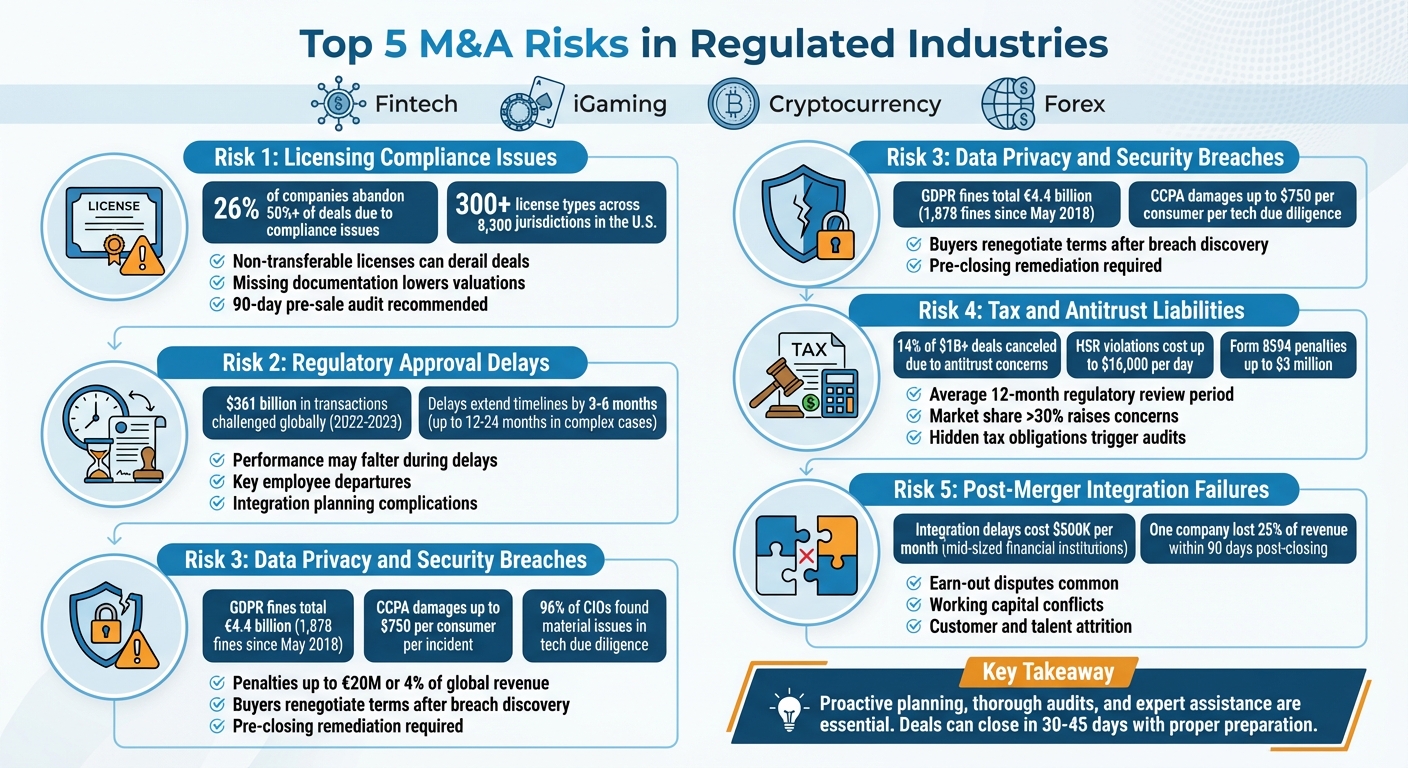
Selling a business in regulated industries like iGaming, cryptocurrency, forex, or fintech is challenging due to strict compliance requirements and potential deal-breakers. Here's a quick rundown of the five main risks to address before selling:
- Licensing Compliance Issues: Ensure all licenses are active, transferable, and in good standing. Missing or non-transferable licenses can delay or derail deals.
- Regulatory Approval Delays: Approval processes can extend timelines by months or years, increasing costs and risks for sellers.
- Data Privacy and Security Breaches: Unresolved breaches or weak privacy practices can lead to fines, reduced valuations, or deal cancellations.
- Tax and Antitrust Liabilities: Hidden tax obligations or antitrust concerns can result in penalties, lengthy investigations, or failed deals.
- Post-Merger Integration Failures: Poor integration planning can cause financial losses, disputes, and compliance risks post-closing.
Key Takeaway: Proactive planning, thorough audits, and expert assistance are essential to mitigate these risks. Addressing compliance issues early can protect your business's value and improve deal success rates.
Tips for Managing M&A Risk: Legal Strategies for Buyers and Sellers | Tina Kassangana
1. Licensing Compliance Issues
Tackling licensing compliance issues is a critical part of any pre-sale risk management strategy. Sellers who address these challenges head-on can present their businesses as trustworthy, low-risk opportunities to potential buyers.
Impact on Deal Timelines and Closures
Licensing hurdles, particularly change-of-control provisions, can throw a wrench into deal timelines. Licenses don’t always transfer automatically, and discovering this late in the process can derail months of effort. Lucialpiazzale puts it bluntly:
"The fastest way to ruin a closing date is to learn a week before funding that a core license is not transferable" [3].
Adding to the complexity, regulatory approvals - like state banking permissions or NMLS certifications for lenders - can take weeks or even months. These delays push closing dates further out, creating uncertainty that makes buyers hesitant. With up to 90% of M&A deals failing overall, compliance issues during due diligence are often a significant factor. In fact, 26% of companies abandon half or more of their deals due to compliance problems uncovered during this phase [2]. These delays and risks add layers of difficulty to an already complex process.
Regulatory and Legal Compliance Challenges
The U.S. regulatory environment is notoriously complex, with over 300 license types spanning 8,300 jurisdictions and more than 100 industries [2]. Compliance in one state doesn’t guarantee compliance in another. Take the gaming industry, for example: licenses may apply to facilities, equipment, and even individual employees - each requiring separate background checks and approvals. If tribal gaming is involved, tribal compacts add another layer of complexity.
Missing or disorganized documentation is another common issue. Sellers often struggle to produce complete records of operating permits, professional licenses for employees, or local tax permits. High turnover in compliance roles or unfiled reports can raise red flags, potentially lowering valuations or jeopardizing deals [1]. These challenges demand a focused and proactive approach to ensure compliance.
Effectiveness of Mitigation Strategies
To avoid these pitfalls, sellers should conduct a licensing audit at least 90 days before listing their business. This involves identifying all active licenses, verifying their transferability, and ensuring they’re in good standing. Creating a regulatory charter - a simple, easy-to-follow guide outlining the relevant laws, agencies, and licenses across all operating jurisdictions - can also help clarify compliance requirements [3].
Using a Virtual Data Room to centralize compliance documentation is another effective step. This not only streamlines due diligence but also signals to buyers that the business is well-organized and prepared. For industries like iGaming, cryptocurrency, forex, or fintech, platforms such as MyReadyMade offer specialized tools for managing license transfers across more than 50 jurisdictions, helping sellers navigate tricky approval processes. Additionally, bringing in third-party compliance experts early in the process can help identify and resolve potential issues before they become deal-breakers. This proactive approach can save time, reduce stress, and keep negotiations on track.
2. Regulatory Approval Delays
Regulatory approval delays are a major obstacle that can disrupt M&A transactions, particularly in industries with heavy oversight.
Impact on Deal Timelines and Closures
Delays in regulatory approvals can stretch what might have been a straightforward deal into a drawn-out process. While many M&A transactions wrap up within three months, regulatory reviews can push timelines out by an additional three to six months - or even longer. In more complex or contested cases, this period can extend to a staggering 12 to 24 months. Between 2022 and 2023, regulators globally challenged transactions worth at least $361 billion [4].
These delays create what Bain & Company calls a "critical period", during which businesses face significant risks. Performance may falter, key employees might leave, and leadership must juggle integration planning alongside daily operations. A striking example is Adobe's canceled $20 billion acquisition of Figma in 2023, which fell apart after regulators raised concerns about the deal's potential effects on the design software market [4]. Such delays not only prolong the transaction but also amplify operational and financial risks.
Cost Implications for Sellers
For sellers, prolonged approval timelines can have serious financial consequences. Leadership teams often find themselves stretched thin, trying to balance integration efforts with maintaining everyday business operations. This divided focus can lead to talent loss and the suspension of long-term investments. Companies may also face tough choices to meet earnings targets while managing integration costs. If the deal ultimately collapses, sellers may lose out on growth opportunities and face delays in executing strategic plans [4].
Regulatory and Legal Compliance Challenges
Regulatory bodies, particularly in the U.S., have become more assertive, targeting sectors like technology and healthcare. Agencies like the Department of Justice and the Federal Trade Commission (FTC) are increasingly pursuing legal remedies to block or modify deals. For instance, the FTC challenged Amgen's $27.8 billion acquisition of Horizon Therapeutics until a consent order was reached. Similarly, Microsoft had to restructure its $69 billion acquisition of Activision Blizzard in 2023 to address concerns from the European Commission and the UK's Competition and Markets Authority [4].
Effectiveness of Mitigation Strategies
Sellers can take steps to reduce the impact of regulatory delays. One approach is to prepare for worst-case scenarios, such as a 24-month delay coupled with high employee turnover. Protective covenants, like cancellation fees or purchase price adjustments tied to revenue or profit changes, can also provide a safety net. Starting integration planning early - focusing on the operating model and technology systems - helps maintain momentum during delays.
For highly regulated industries such as iGaming, cryptocurrency, forex, and fintech, platforms like MyReadyMade offer specialized M&A advisory services. They assist with navigating regulatory approvals across more than 50 jurisdictions, ensuring compliance issues are addressed before they jeopardize a deal. Additionally, investing in retention packages can help keep critical talent on board during extended review periods. Tackling these challenges head-on helps preserve the deal's value and reassures buyers [4].
3. Data Privacy and Security Breaches
Data privacy issues bring serious challenges to regulated industries, often causing financial and operational disruptions. For sellers, these risks can’t be ignored, especially when navigating complex transactions.
Impact on Deal Timelines and Closures
Discovering a breach during due diligence can throw a wrench into deal timelines. Buyers may delay closing to allow sellers time to manage the breach, implement an incident response plan, and secure their systems. If vulnerabilities are widespread, buyers often renegotiate terms. This could mean lowering the purchase price to cover costs like remediation, regulatory fines, or even customer losses. Buyers might also insist on structural safeguards, such as holdbacks, indemnity escrows, or specific indemnities, to address these risks after closing [6].
The Marriott International case highlights these challenges. In November 2018, Marriott revealed a breach affecting 339 million records in the Starwood Hotels database, which it had acquired in 2016. The breach, undetected for four years, had originated in 2014 - two years before Marriott’s acquisition. The Office of the Privacy Commissioner of Canada held Marriott accountable for the pre-existing vulnerabilities in Starwood’s network [6].
Cost Implications for Sellers
Beyond delays, data breaches can lead to hefty financial penalties. Under the California Consumer Privacy Act (CCPA), damages can reach $750 per consumer per incident, with penalties for intentional violations climbing as high as $7,500 per violation [7]. Similarly, GDPR enforcement has resulted in over 1,878 fines since May 2018, totaling more than EUR 4.4 billion. Non-compliance can lead to penalties of up to 20 million Euros or 4% of global annual revenue, whichever is greater [7]. Quebec’s Law 25 imposes fines of up to $10 million or 2% of global turnover, with severe violations reaching $25 million or 4% of global turnover [6].
Third-party vendor vulnerabilities can also inflate costs. Many breaches stem from reliance on providers with weak security practices. Common issues include storing sensitive data without proper encryption or failing to comply with laws like HIPAA (healthcare), GLBA (finance), or COPPA (children’s data) [5][7].
Regulatory and Legal Compliance Challenges
Regulators now expect buyers to evaluate the privacy practices of target companies before finalizing deals. Sellers who fail to demonstrate compliance risk losing deals altogether. GDPR-like regulations, which impose extra-territorial measures and revenue-based fines, are gaining traction in regions such as Canada, the Middle East, and Asia-Pacific countries like Australia, New Zealand, and Singapore [7].
"In today's environment, privacy is not a box to check - it is a material risk that must be proactively assessed and addressed." - Jasmine Samra, Counsel, Gowling WLG [6]
Litigation risks are also increasing as more states grant residents the right to sue for breaches. Privacy litigation often targets inadequate cookie consent mechanisms, adding another layer of liability in transactions. The growing use of AI tools complicates matters further, particularly when these tools process or store sensitive data without proper authorization [7].
Effectiveness of Mitigation Strategies
For sellers in industries like iGaming, cryptocurrency, forex, and fintech, early privacy diligence is key. Reviewing publicly disclosed breaches, lawsuits, and privacy policies before opening the data room can help identify potential issues. A 2022 survey revealed that 96% of CIOs reported uncovering material issues or opportunities during technology due diligence in M&A deals [7].
Post-closing, isolating systems is critical. Delaying integration of the acquired company’s systems until after a thorough risk assessment and penetration testing can prevent cross-contamination of security vulnerabilities [6]. Additionally, NDAs with explicit privacy safeguards ensure compliance with laws like PIPEDA before sharing sensitive information during deal evaluations [6]. Platforms like MyReadyMade offer expert advisory services to address privacy concerns in over 50 jurisdictions for regulated industries.
Negotiating protective measures - such as purchase price adjustments, indemnity escrows, or pre-closing remediation requirements - can help manage risks while keeping deals on track [6].
"74% of CEOs view technology integration in M&A as 'a source of competitive advantage or growth enabler, rather than the cost of doing business.'" - Saee Muzumdar, Partner, Gibson Dunn [7]
4. Tax and Antitrust Liabilities
Tax and antitrust issues can pose serious challenges for sellers in regulated industries, often leading to delays, increased costs, or even deal cancellations.
Impact on Deal Timelines and Closures
Antitrust scrutiny can significantly prolong deal timelines. While typical transactions may close in about three months, regulatory investigations often extend this to an average of 12 months, with complex deals sometimes taking up to two years [4]. In the U.S., mergers valued at $119.5 million or more must file premerger notifications with the DOJ and FTC, triggering a mandatory waiting period [2]. If regulators issue a "second request" for additional information, this can lead to months - or even years - of delays [9].
The data highlights the scale of the issue: in 2022 and 2023, over $361 billion in announced deals faced regulatory challenges globally [4]. Antitrust concerns are the second most common reason for deal cancellations, impacting roughly 14% of transactions valued at over $1 billion annually [2]. For instance, the FTC's challenge to Amgen's $27.8 billion acquisition of Horizon Therapeutics in 2023 caused months of delays before a consent order was reached, restricting Amgen from bundling its products with Horizon's orphan drugs [4]. Of the $255 billion in challenged deals that eventually closed, nearly all required some form of remedy [4]. These extended timelines expose sellers to greater financial and legal risks.
Cost Implications for Sellers
Non-compliance with regulatory requirements can result in hefty financial penalties. For example, failing to adhere to Hart-Scott-Rodino (HSR) reporting can lead to fines of up to $16,000 per day [8]. In one notable case, Berkshire Hathaway paid $896,000 in civil penalties in 2014 for failing to report an acquisition of voting shares in USG Corporation as required under the HSR Act [9].
Tax liabilities can be just as burdensome. Sellers who neglect to file Form 8594 (Asset Purchase Statement) on time may face penalties of up to $3 million [2]. Hidden tax obligations can also result in multi-million dollar settlements and invite additional IRS audits [2]. Even smaller deals are not exempt - George's Foods, LLC acquired a chicken processing plant from Tyson Foods for $3 million in 2011, only to face a DOJ lawsuit post-closing, leading to a settlement addressing anticompetitive effects on local farmers [9].
Regulatory and Legal Compliance Challenges
These financial risks are exacerbated by increasingly stringent regulatory scrutiny, especially in industries like technology and healthcare. U.S. regulators now lean toward litigation over settlements, often seeking court-ordered remedies instead of negotiated consent decrees [4]. The FTC has shifted its focus from analyzing individual product competition to examining the broader portfolios of buyers and sellers [4].
Certain factors raise antitrust concerns, such as a market share exceeding 30% or a Herfindahl-Hirschman Index (HHI) increase of over 100 in concentrated markets [2]. "Gun-jumping" violations are another risk, occurring when parties take ownership or coordinate activities before the statutory waiting period ends. Procedural gun-jumping involves premature ownership transfers, while substantive gun-jumping includes competitor coordination prior to closing [8]. As Jon B. Dubrow, Partner at McDermott Will & Schulte LLP, cautions:
"Careless document creation can make an easy deal hard by raising questions where there otherwise would not be any" [8].
Effectiveness of Mitigation Strategies
Proactive planning is key to navigating these challenges. Engaging antitrust and tax experts early in the process can help identify potential issues before negotiations begin [8][10]. Using third-party "clean teams" to handle sensitive data during due diligence can also prevent gun-jumping claims [8].
Managing internal communications is equally important. Sellers should avoid using terms like "dominant position", "pricing power", or "foreclose competition" in deal-related documents, as these phrases can attract regulatory scrutiny [8]. Negotiating deal covenants, such as reverse break-up fees and purchase price adjustments, can help mitigate financial risks during lengthy pre-close periods [4].
For sellers in industries like iGaming, cryptocurrency, forex, and fintech, platforms like MyReadyMade provide specialized M&A advisory services across over 50 jurisdictions, helping navigate tax and antitrust challenges. In highly concentrated markets, preemptive asset divestitures can also ease regulatory approvals for larger transactions [4]. Addressing these tax and antitrust liabilities effectively is essential for preserving deal value and ensuring smooth post-merger integration.
5. Post-Merger Integration Failures
Closing a merger deal is just the beginning. The real challenge lies in post-merger integration, where the success of the entire transaction is often determined. When integration falters, it can lead to costly consequences for sellers, especially in regulated industries. Even after a deal is finalized, poor integration can eat away at the expected payout and spark disputes that drag on for months - or even years.
Cost Implications for Sellers
When integration fails, sellers often bear the brunt of the financial fallout. Earn-out disputes are a common issue, especially when buyers change accounting practices, leading to disagreements over critical payout metrics [12]. Sellers also remain vulnerable to indemnification claims for issues like tax liabilities, data privacy breaches, or other unresolved matters. These gaps in integration can force sellers to return portions of the purchase price [12].
Another frequent problem involves working capital disputes. Poorly integrated financial systems can lead to conflicts over inventory valuation or accounts receivable [12]. Beyond these direct financial issues, integration missteps can also result in customer attrition and talent loss. For example, one company lost a customer responsible for 25% of its revenue within 90 days of closing due to integration challenges [12]. Similarly, uncertainty over job security and cultural clashes can drive away critical talent, undermining the entire deal's value while increasing recruitment costs [12]. These disruptions don’t just hurt financially - they often invite further regulatory scrutiny.
Regulatory and Legal Compliance Challenges
In heavily regulated industries like iGaming, cryptocurrency, forex, and fintech, integration failures can lead to significant compliance risks [11]. Merging entities often operate under different regulatory frameworks, and failing to align them can result in overlooked requirements. For instance, ignoring internal governance rules under DORA can create vulnerabilities [11]. Misaligned security protocols also increase the risk of data breaches, which can lead to hefty fines under regulations like GDPR, NIS2, or SOC 2 [11].
Delays in integration can also amplify regulatory scrutiny, leading to additional penalties beyond initial non-compliance issues. For mid-sized financial institutions, such delays can double integration timelines from three months to six, costing an estimated $500,000 in extra compliance expenses per month [11]. As John Levitske from HKA Global, LLC explains:
"Early planning ensures that integration aligns with the value the buyer expected when pricing the deal" [12].
Separate compliance processes post-merger often create silos that are both costly and risky. A cohesive integration strategy is critical to avoid these pitfalls.
Effectiveness of Mitigation Strategies
Sellers can reduce risks by adopting several effective strategies. A thorough gap analysis during due diligence is a good starting point, as it helps identify differences in compliance frameworks and pinpoints areas that need attention before the deal closes [11]. Using a risk matrix to map out both entities' risk profiles allows resources to be allocated efficiently. High-priority areas like data protection and financial reporting should be addressed first, with less critical workflows handled later [11].
To avoid earn-out disputes, sellers should draft clear provisions that detail accounting methods, audit rights, and include neutral third-party experts for quick dispute resolution [12]. Transition Services Agreements (TSAs) can also help maintain operational continuity while systems are being integrated [12].
For regulated industries, tools like MyReadyMade can simplify compliance and integration processes across 50+ jurisdictions, offering valuable support for sectors like iGaming, cryptocurrency, forex, and fintech. Finally, establishing a centralized compliance monitoring function ensures that policies are updated across the entire organization, setting the stage for long-term success [11].
Conclusion
Selling a regulated business comes with its own set of challenges, and compliance risks often take center stage. From licensing issues and regulatory delays to data breaches, tax complications, and integration missteps, these risks can either derail a deal or significantly reduce its value. The good news? Most of these pitfalls are easier - and cheaper - to address with proper planning than to fix after they surface.
Preparation is everything. Sellers need to ensure their licenses are in order, check regulatory databases for any past sanctions, and evaluate their overall compliance practices before entering negotiations. This kind of groundwork not only builds trust with potential buyers but also helps avoid unpleasant surprises. Bringing in third-party compliance experts can be a game-changer. These specialists can uncover hidden risks, like unresolved enforcement actions or past data breaches, that might otherwise slip through the cracks [1]. They can also create a regulatory charter - a detailed guide to the laws that apply to your business and your current compliance status - which can keep negotiations on track [3]. For industries like iGaming, cryptocurrency, forex, and fintech, platforms such as MyReadyMade offer tailored solutions, including verified business listings, expert advisory services, and help with license transfers across more than 50 jurisdictions.
Cutting corners on due diligence can come at a high cost. Missed details might lead to retroactive fines, contract limitations, or even license suspensions that weren’t disclosed upfront. In the worst cases, regulatory roadblocks can jeopardize financing or cause the entire deal to collapse [1]. On the flip side, sellers who plan ahead, work with experts, and resolve licensing issues early can protect the value of their deal and often close transactions within 30–45 days with the right support.
As Lucialpiazzale wisely noted:
"In regulated industries, compliance is both a cost center and a moat. The same rulebook that burdens you may keep competitors out" [3].
FAQs
What should I verify about my licenses before listing my business for sale?
Ensure that all your licenses are current, transferable, and meet the necessary regulatory requirements. This not only helps you avoid potential legal hurdles but also simplifies the transaction process. Taking the time to prepare thoroughly can minimize delays and reduce risks when finalizing the sale.
How can I keep an M&A deal moving during long regulatory reviews?
To keep things moving during extended regulatory reviews, prioritize open and transparent communication with regulators. Ensure your documentation is thorough and well-organized, making it easier to address any questions or concerns. Stay ahead by actively managing compliance and preparing for post-approval integration. It's also smart to adjust your timelines to account for potential delays. By including contingency plans and maintaining flexible schedules, you can adapt to changing requirements and keep the process on course.
What cybersecurity proof do buyers expect during due diligence?
Buyers often look for clear proof of strong cybersecurity practices during the due diligence process. They want to see documented policies, effective controls, and established procedures that protect sensitive information and minimize the risk of breaches. Showing that these safeguards are in place can help alleviate concerns about potential financial, legal, or reputational risks.
Related Articles

Ultimate Guide to Earnout Negotiations in M&A
Structure and negotiate earnouts in regulated M&A with clear metrics, anti-manipulation covenants, and acceleration or escrow protections.

How to Draft M&A Definitive Agreements
Guide to drafting M&A definitive agreements covering deal structure, reps & warranties, indemnities, payment terms, and regulatory compliance.

How IP Affects Tokenization Valuation
How tokenizing patents, copyrights, and trademarks adds liquidity and market value—plus legal, regulatory, and valuation steps.
Looking to Buy or Sell?
Get in touch with our team for personalized assistance