How M&A Advisory Simplifies License Transfers

How M&A Advisory Simplifies License Transfers
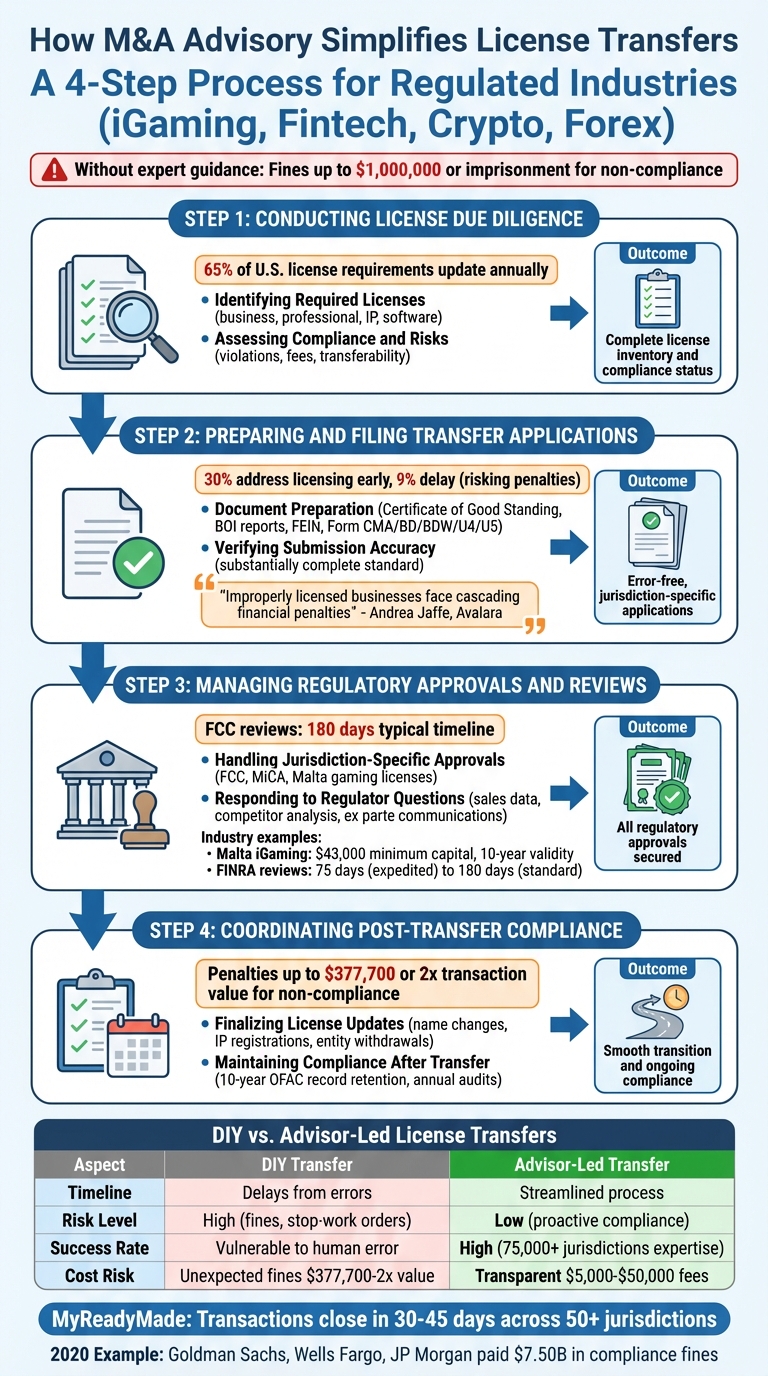
Navigating license transfers during mergers and acquisitions (M&A) can be complex, especially in regulated industries like iGaming, cryptocurrency, fintech, and forex. Licenses are often tied to specific business entities and are non-transferable, making their management critical to avoid shutdowns, legal penalties, or financial losses. Here's how M&A advisors help streamline the process:
- Due Diligence: Identifying and cataloging all licenses, including federal, state, and local permits, intellectual property, and software agreements.
- Compliance Checks: Ensuring licenses are valid, in compliance, and transferable while addressing potential violations or risks.
- Filing Applications: Preparing accurate, jurisdiction-specific documentation to avoid delays or rejections.
- Regulatory Approvals: Managing pre-closing reviews, responding to regulator inquiries, and adhering to timelines.
- Post-Transfer Compliance: Updating records, filing required documents, and monitoring ongoing obligations to maintain good standing.
Without expert guidance, businesses risk fines up to $1,000,000 or even imprisonment for non-compliance. M&A advisors reduce these risks by handling the intricate details, ensuring smooth transitions, and maintaining regulatory requirements.
Benzinga Cannabis Capital Conference 2025: Cannabis M&A Licensing Pitfalls with Charles Alovisetti
sbb-itb-ba142f6
Step 1: Conducting License Due Diligence
Before closing an M&A deal, it's essential to map out all the target business's licenses. This means documenting every federal, state, and local license. With U.S. jurisdictions updating about 65% of license requirements annually, this step is crucial [2]. Laying this groundwork ensures a smoother process for the steps that follow.
Identifying Required Licenses
The first step is to inventory all active licenses and authorizations. This includes gathering certificates, renewal notices, and regulatory communications [2][5]. The aim is to organize licenses by type and jurisdiction. These can range from general business licenses and professional certifications to more specialized permits like liquor, health, or environmental authorizations [2][9].
Beyond traditional licenses, advisors also review intellectual property and software assets. This includes third-party software licenses, patents, trademarks, domain names, and even social media accounts. For software, it's critical to determine if the deal structure activates "anti-assignment" clauses or qualifies as an "assignment by operation of law" [7][9]. Using a tracking system, like a spreadsheet, can help monitor the status of each license - whether it's completed, pending, or in progress - and keep tabs on expiration dates and renewal requirements [2].
After cataloging the licenses, the next step is to confirm their compliance status.
Assessing Compliance and Risks
Advisors must evaluate whether each license is in compliance. This involves checking for any violations, unpaid fees, or upcoming expirations that could complicate the deal [2][5]. Software audits are especially important. Many major licensors now run formal audit programs, and non-compliance issues uncovered during these audits can lead to massive fee demands - sometimes reaching nine figures and even surpassing the value of the transaction itself [7].
Another key task is determining whether each license can be transferred. Some licenses are tied to a specific business, location, or individual, making them non-transferable. For instance, professional licenses held by medical or legal practitioners typically cannot be transferred [2][5]. Advisors also need to confirm that employees and contractors have signed "present-tense" assignment agreements. This ensures the target company legitimately owns all the intellectual property it claims [4][9]. To avoid delays, it's a good idea to contact relevant authorities early to confirm required procedures, documentation, and timelines [2].
Step 2: Preparing and Filing Transfer Applications
Once the due diligence phase wraps up, advisors move on to assembling and submitting transfer applications. A recent survey highlights that while 30% of businesses address licensing requirements early, 9% delay this step, potentially exposing themselves to penalties[10]. Errors in these filings can lead to rejections or fines, making precise documentation essential for smooth coordination between regulatory bodies and internal teams.
Document Preparation and Coordination
Advisors compile detailed document packages tailored to meet the specific requirements of each jurisdiction. Key corporate documents often include a Certificate of Good Standing from the state of formation and updated Beneficial Ownership Information (BOI) reports. Tax and identity-related filings may require a new or updated Federal Employer Identification Number (FEIN) and current business address records[10][12]. When intellectual property is involved, legal assignments are prepared, and any third-party licensing agreements requiring renegotiation are reviewed[11].
In industries with heavy regulation, like finance, the documentation process becomes even more intricate. For broker-dealers, essential filings include:
- Form CMA: Used for Continuing Membership Applications.
- Form BD Amendments: To update ownership or control changes.
- Form BDW: For withdrawing predecessor firms[13].
Personnel records also play a critical role, requiring Form U4 for representative registrations, Form U5 for terminations, and fingerprint cards. For acquisitions involving 50 or more individuals in the securities industry, advisors can streamline the process by using mass transfer programs, which eliminate the need for individual Form U4 filings[13].
"Improperly licensed businesses can find themselves in a cascading series of financial penalties."
– Andrea Jaffe, Senior Director of Professional Services, Avalara[10]
Coordination among departments is crucial. Tax, legal, and licensing teams must communicate continuously, as the type of transaction - such as a merger or stock purchase - determines the specific filing requirements[10]. Advisors also liaise with regulatory authorities ahead of submission to clarify how investigations will be handled and to ensure the correct "master file" is utilized[14][15]. Regulatory review timelines vary, with FINRA offering expedited reviews in about 75 days and standard reviews taking up to 180 days. Applications for ownership or control changes must be submitted at least 30 days before the proposed transaction date[13].
Once all documents are prepared, advisors meticulously check for compliance with regulatory standards.
Verifying Submission Accuracy
Before submission, advisors rigorously verify that applications meet the "substantially complete" standard to avoid rejections. FINRA explicitly warns that incomplete applications will be rejected, and applicants risk forfeiting part of their application fee[13]. This step involves ensuring full disclosure of stock and membership interests, even for shareholders owning less than 10%. Vague statements, such as "five stockholders holding less than 10%", are not acceptable and will result in rejection[15].
For international transactions, additional steps include certifying, translating, and converting documents to align with U.S. standards[13]. Advisors must also ensure that no documents are redacted, as regulators like FINRA guarantee confidentiality but will not accept redacted submissions[13]. To prevent delays, advisors often submit drafts of critical documents, such as Negative Consent Letters (NCLs) for account transfers, alongside the main application. Tools like Web CRD are used to confirm that all registrations have transferred successfully and to identify any blocks imposed by specific state jurisdictions[13].
Step 3: Managing Regulatory Approvals and Reviews
Once submissions are made, advisors take charge of navigating regulatory reviews. For instance, the FCC typically aims to complete license transfers within 180 days, though this timeline can stretch if additional information or security concerns come into play [16]. To stay ahead, advisors closely monitor these review periods and set up data rooms by Day 90. This ensures they can quickly address regulator inquiries and prevent unnecessary delays [16]. Since timelines and requirements differ across industries, advisors must adapt their approach to align with specific regulatory frameworks.
Handling Jurisdiction-Specific Approvals
Each industry comes with its own set of regulatory hurdles. In telecommunications, advisors often hold pre-filing consultations with FCC staff to confirm the correct forms and identify potential issues before a formal submission [16]. For crypto and fintech transactions, the Markets in Crypto-Assets (MiCA) Regulation - adopted as the EU standard in 2025 - requires technical audits by certified cybersecurity experts and "fit and proper" checks for all shareholders [6].
The iGaming sector poses unique challenges, particularly because its licenses are typically non-transferable and tied to specific corporate entities.
"In the regulated gaming industry, asset deals are often impractical because gaming licenses are frequently non-transferable."
– Stephen Crystal, SCCG Management [1]
In this sector, advisors arrange technical audits to ensure systems meet security standards. For example, Malta gambling licenses require a minimum capital of $43,000 and are valid for 10 years before renewal [17]. Additionally, Malta’s corporate tax rate of 35% can be reduced to as low as 5% for online gambling businesses, making the jurisdiction an appealing choice for operations spanning multiple regions [17].
Responding to Regulator Questions
After addressing jurisdiction-specific approvals, advisors must handle regulator questions promptly. During the review period, regulators often request details such as sales data, competitor analyses, and other supporting documents. Advisors work quickly to provide these responses, ensuring that the "transaction clock" continues to move forward [18]. If regulators flag potential issues, advisors propose tailored remedies or conditions to resolve concerns and keep the deal on track [18].
In some cases, advisors engage in ex parte communications - meetings with regulatory staff to discuss complex legal or policy concerns. These meetings must be documented, with summaries and accompanying materials filed within two business days to maintain transparency [18]. For crypto transactions, firms like LegalBison have supported clients like BoomFi in securing Polish VASP (Virtual Asset Service Provider) authorizations. This involves creating Risk Matrices and preparing clients for mandatory "fit and proper" assessments required by regulators [6].
"Transactions can be approved with conditions that allow the transaction to proceed but eliminate or mitigate the potential harms the Commission has found are likely to occur."
– Federal Communications Commission [18]
Advisors also ensure that M&A agreements include pre-closing regulatory approval clauses, which prevent deals from moving forward until all necessary jurisdictions have granted their consent [1]. This safeguards both parties from finalizing a transaction that could later face legal obstacles due to licensing restrictions.
Step 4: Coordinating Post-Transfer Compliance
Once regulatory approvals are in place, the focus shifts to ensuring a smooth transition and ongoing compliance. This stage involves tying up loose ends like updating public records, registering ownership changes, and setting up systems to manage future obligations. Overlooking these steps can lead to costly penalties, such as fees, loss of good standing, or fines reaching $377,700 or even twice the transaction value [2].
Finalizing License Updates and Registrations
Creating a detailed post-closing checklist is key. Assign responsibilities between outside counsel and the acquirer's legal team to ensure nothing falls through the cracks [19]. For example, the surviving company’s name needs to be updated in its home state and any other jurisdiction where it operates. This often involves filing documents like a "Certificate Re Merger" [19].
It’s equally important to withdraw any merged entities to avoid unnecessary costs. In California, for instance, failing to do so could trigger the $800 minimum franchise tax [19]. Intellectual property (IP) updates are another critical step. Notify trademark and patent registries with updated notification letters, assignment agreements, and notary seals [20][21]. For international IP transfers, additional steps like document translations and legalization through local consulates may be required [20]. These diligent updates help minimize risks and keep operations running smoothly.
Maintaining Compliance After Transfer
Post-transfer compliance doesn’t stop with initial updates - it’s an ongoing process. Advisors play a crucial role in helping businesses track recurring obligations, which can vary significantly by jurisdiction. With approximately 65% of license requirements changing annually [2], staying on top of these updates is essential. Tools like online compliance calendars can help monitor deadlines for annual reports, franchise taxes, and license renewals [19].
As of March 2025, the U.S. Department of the Treasury's Office of Foreign Assets Control (OFAC) requires businesses to retain transaction records for 10 years, doubling the previous five-year requirement [19].
"Any delay in license verification, even if due to human error or outdated processes, will affect everything from staffing efficiency to regulatory adherence."
– Ethico [2]
Conducting audits across all jurisdictions after the transfer is another must. This ensures that name changes and qualifications are correctly handled, avoiding complications in future transactions and maintaining good standing wherever the business operates [19].
Benefits of M&A Advisory in License Transfers
Trying to manage license transfers on your own can open the door to serious risks. Just consider this: in 2020, major financial players like Goldman Sachs, Wells Fargo, and JP Morgan Chase collectively paid a staggering $7.50 billion in fines for regulatory noncompliance [2]. That kind of financial hit highlights how critical proper oversight is when dealing with transactions in heavily regulated industries. Experienced advisors bring the expertise needed to navigate fast-changing regulations, ensuring compliance is met on time. This not only speeds up approvals but also reduces costly errors and makes transitions much smoother. It’s a clear case for why professional guidance can make all the difference.
DIY vs. Advisor-Led License Transfers
The gap between managing license transfers on your own and leveraging the expertise of seasoned advisors becomes obvious when you compare the outcomes:
| Feature | DIY License Transfer | Advisor-Led Transfer |
|---|---|---|
| Timeline | Delays from paperwork errors or missed deadlines [2] | Streamlined with established regulatory connections and detailed checklists [8] |
| Risk Level | High risk of fines, stop-work orders, or license loss [2] | Lower risk through proactive compliance checks and audits [8] |
| Success Rate | Vulnerable to human error [2] | Higher success due to expertise in over 75,000 jurisdictions [2] |
| Cost Predictability | Unexpected fines ranging from $377,700 to twice the transaction value [2] | Transparent fees with upfront cost planning [2] |
This comparison makes one thing crystal clear: having expert support is essential, especially in high-stakes M&A transactions.
"The best time to call a business transfer attorney is before you think you need one. By the time most owners reach out, they're already facing tight deadlines or unexpected complications."
– David Brillant, Brillant Law Firm [2]
Advisors play a key role in identifying licenses that can’t be transferred, giving businesses enough time to apply for new ones. They also handle the preparation of critical documents like business plans, financial forecasts, and ownership disclosures [8]. While professional fees typically range from $5,000 to $50,000 [2], this upfront investment can prevent penalties that could reach up to $1,000,000 - or even result in imprisonment for up to 20 years [2].
How MyReadyMade Simplifies License Transfers

Specialized platforms like MyReadyMade take the process even further by simplifying it. Their M&A advisory services cover license transfers across more than 50 jurisdictions. MyReadyMade connects buyers and sellers with advisors who manage jurisdiction-specific challenges, such as setting up Anti-Money Laundering (AML) and Know Your Customer (KYC) frameworks for industries like Fintech and iGaming [8]. They also work closely with regulators to ensure approvals are handled efficiently.
The time it takes to secure a license varies depending on the location. For instance, obtaining an iGaming license in Anjouan might take 4–8 weeks, while in the UK, the process could stretch to 6–9 months [8]. With MyReadyMade, transactions can close in as little as 30–45 days, cutting down what could otherwise be a months-long process filled with potential errors.
Conclusion
Navigating license transfers in regulated industries doesn’t have to be a daunting task. With the guidance of experienced M&A advisors, businesses can manage the complexities of over 75,000 federal, state, and local jurisdictions without falling into costly compliance pitfalls [2]. These experts identify licenses that can’t be transferred early in the process, coordinate regulatory approvals across multiple agencies, and structure deals to ensure smooth operations during the transition. This process underscores the importance of minimizing risks while maintaining business continuity.
The financial stakes are high: penalties for non-compliance can climb to $377,700 or twice the transaction value, while willful violations may lead to fines of up to $1,000,000 - and even imprisonment [2]. M&A advisors offer more than regulatory expertise; they synchronize timelines, use tools like indemnity agreements to manage risks, and provide cross-border insights to avoid complications that could derail deals. Their role extends from due diligence to post-transfer compliance, ensuring every step of the process is aligned with closing dates to prevent disruptions to customer contracts or revenue streams [2][3].
A practical example of this expertise can be seen in platforms like MyReadyMade. Their M&A advisory services manage license transfers across more than 50 jurisdictions, connecting buyers and sellers with specialists who tackle jurisdiction-specific challenges. This approach mirrors the streamlined process discussed in this article, transforming what could be a lengthy ordeal into a smooth and efficient transition.
Working with qualified advisors not only safeguards deal value but also ensures compliance and keeps your business running seamlessly.
FAQs
What risks do businesses face when handling license transfers without an M&A advisor?
Handling license transfers without the help of an experienced M&A advisor can put businesses in a tricky spot. Navigating the maze of licensing requirements, which often vary widely between jurisdictions, can be overwhelming. This complexity increases the likelihood of compliance issues, delays, and even legal penalties - especially in tightly regulated sectors like iGaming, cryptocurrency, and fintech.
Beyond compliance, there’s the risk of operational hiccups. An incomplete or poorly managed license transfer can disrupt daily operations, threaten business continuity, and leave companies exposed to regulatory violations. On top of that, disputes over ownership or transfer rights can escalate into costly legal battles - or worse, result in losing the licenses altogether.
By working with a seasoned M&A advisor, businesses can ensure thorough due diligence, reduce risks, and streamline the entire license transfer process, keeping everything on track and above board.
How do M&A advisors help ensure compliance with changing licensing regulations?
M&A advisors play an essential role in navigating the complexities of licensing requirements, which can shift with regulatory changes. By conducting thorough due diligence, they assess the specific licensing needs of a business, considering factors like jurisdictional regulations, whether licenses can be transferred, and if new licenses are required due to changes in ownership or structure.
To protect the transaction, advisors often include regulatory approval clauses in agreements. These clauses ensure that deals only move forward once all licenses are verified and meet compliance standards. Additionally, they use tools such as indemnities, warranties, and escrow arrangements to address risks related to non-compliance or potential regulatory updates. This careful planning not only ensures smooth license transfers but also safeguards the transaction’s legality and operational continuity.
How do M&A advisors help ensure compliance after a license transfer?
M&A advisors play a critical role in navigating the intricate legal and regulatory landscape that comes with transferring licenses. They ensure the process aligns with jurisdictional rules, verifying that all transfers are handled properly. This includes managing essential filings and securing approvals for changes in ownership or control - steps that are vital to avoid legal complications or interruptions in operations.
Beyond the transfer itself, these advisors help businesses remain compliant by establishing systems for license renewals and ensuring all licenses stay valid. They also guide companies in adhering to industry-specific regulations, reducing the risk of lapses or violations. Their expertise not only protects the business’s operations but also helps preserve its reputation throughout and after the transition.
Related Articles

Ultimate Guide to Earnout Negotiations in M&A
Structure and negotiate earnouts in regulated M&A with clear metrics, anti-manipulation covenants, and acceleration or escrow protections.

How to Draft M&A Definitive Agreements
Guide to drafting M&A definitive agreements covering deal structure, reps & warranties, indemnities, payment terms, and regulatory compliance.

How IP Affects Tokenization Valuation
How tokenizing patents, copyrights, and trademarks adds liquidity and market value—plus legal, regulatory, and valuation steps.
Looking to Buy or Sell?
Get in touch with our team for personalized assistance