NDA Challenges in Multi-Jurisdictional M&A
NDA Challenges in Multi-Jurisdictional M&A
When companies negotiate cross-border mergers and acquisitions (M&A), non-disclosure agreements (NDAs) become essential to protect sensitive information like financial data, trade secrets, and even the existence of negotiations. However, international M&A deals introduce complex legal challenges due to conflicting laws, varying confidentiality standards, and enforcement issues.
Key points to know:
- Conflicting Laws: Different jurisdictions may have clashing rules on governing law, dispute resolution, and NDA enforceability.
- Confidentiality Variations: Definitions of "confidential information" differ globally, with some countries requiring explicit labeling and others offering automatic protection.
- Enforceability Issues: Indefinite NDA durations or overly broad terms can be invalidated in some regions.
- Dispute Resolution: Arbitration is often preferred for cross-border disputes, but careful drafting of multi-tier clauses is critical.
- Non-Solicitation Clauses: These must align with local employment laws to avoid being deemed unreasonable.
- Regulated Industries: Sectors like fintech and cryptocurrency face stricter compliance requirements, including AML and KYC checks.
To address these challenges, NDAs should be tailored for each jurisdiction, with clear definitions, enforceable terms, and strong dispute resolution mechanisms. Leveraging tools like Virtual Data Rooms and expert legal advice can streamline the process and ensure compliance.
Platforms like MyReadyMade offer secure solutions for managing sensitive transactions, providing verified business listings, license transfer support, and expert guidance across 50+ jurisdictions. These tools simplify the complexities of multi-jurisdictional M&A while ensuring confidentiality and regulatory adherence.
The New Reality of Cross-Border M&A | SS&C Intralinks #mergersandacquisitions #dealmaking
sbb-itb-ba142f6
Common Challenges in Cross-Border NDAs
When it comes to cross-border mergers and acquisitions (M&A), NDAs play a key role in safeguarding sensitive information. However, navigating the complexities of international legal systems can present several challenges.
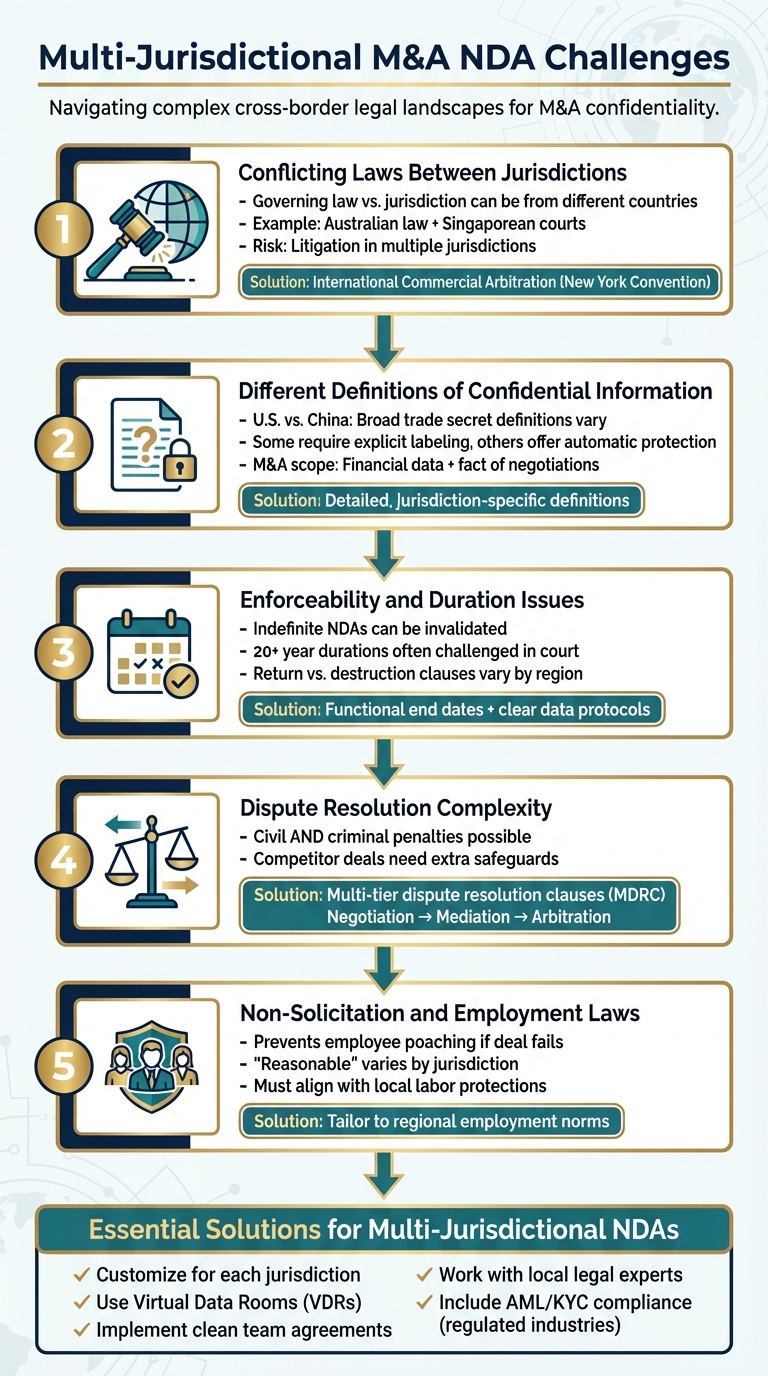
Conflicting Laws Between Jurisdictions
One of the biggest hurdles stems from differences in governing laws and jurisdictions. Governing law outlines which country’s legislation applies to the contract, while jurisdiction determines where disputes are resolved. As lawyer Ilyas Omari explains, "The governing law and jurisdiction can be from different countries" [3]. For instance, an NDA might be governed by Australian law, but disputes are handled in Singaporean courts. This setup can lead to complications, especially when breaches occur across borders, potentially requiring litigation in multiple jurisdictions [3].
Another issue is the variation in what’s deemed "reasonable." For example, some countries may allow indefinite NDA durations, while others might find such terms unfair or unenforceable [4]. Courts frequently challenge NDAs with excessive durations (e.g., 20+ years), which could render the entire agreement void [4]. To address these challenges, many turn to International Commercial Arbitration. Awards granted under the New York Convention are enforceable in numerous countries, offering a practical way to resolve disputes [3].
Different Definitions of Confidential Information
The definition of "confidential information" isn’t universal and varies widely between countries. Gary Sangha, Founder & CEO of LexCheck, points out, "Compared to the U.S., China has a fairly broad definition of 'trade secrets.' Any information with commercial value unknown to the public can become a confidentiality breach" [5].
In M&A, the definition often becomes even broader. Attorneys Bill Rosin and David Craan highlight that "confidential information" can include everything from the seller’s business details to the mere fact that negotiations are taking place [2]. Adding to the complexity, some jurisdictions require information to be explicitly marked as confidential, while others offer automatic protection during due diligence.
Variations in Enforceability and Duration Terms
What’s enforceable in one country may not hold up in another. For example, an NDA with an indefinite duration could be invalidated in some jurisdictions. As Crowley Law LLC notes, "An NDA that lasts forever can be challenged and invalidated in court" [4]. Striking the right balance between protection and enforceability is crucial, especially when dealing with multiple legal systems.
Return and destruction clauses also pose challenges. Recipients of confidential information may push for the right to destroy digital data rather than return physical files. Meanwhile, sellers might require formal certification of destruction to meet different document retention laws [2]. These variations make cross-border enforcement even more complicated.
Dispute Resolution and Jurisdiction Issues
Choosing between arbitration and litigation is another critical decision in cross-border NDAs. International transactions often involve strict regulations, and improper disclosures can lead to both civil and criminal penalties [2]. Standard NDAs may not suffice, particularly when competitors are involved. Bill Rosin and David Craan caution that "prospective buyers and sellers that occupy the same or similar competitive space... need to carefully review the transaction with experienced legal counsel" to avoid liability from wrongful disclosures [2]. In some cases, clean team agreements are used to add safeguards, especially when Hart-Scott-Rodino filing thresholds aren’t met [2].
Non-Solicitation Clauses and Employee Poaching
Non-solicitation clauses are often included in NDAs to prevent the poaching of key employees if a deal doesn’t go through. However, what’s considered reasonable varies greatly across jurisdictions. In some countries, broad restrictions on employee contact are acceptable, while in others, such clauses may be seen as limiting trade. These provisions must be carefully tailored to align with local employment laws, labor protections, and norms around employee mobility [2].
How to Structure Effective Multi-Jurisdictional NDAs
Drafting an NDA that works across multiple jurisdictions is no small feat. It requires thoughtful planning and careful attention to regional legal nuances. Here's how to craft agreements that safeguard your interests and stand up in different legal systems.
Customizing NDAs for Each Jurisdiction
A single, generic NDA won’t cut it in cross-border M&A. Legal standards for enforceability vary greatly between jurisdictions, influenced by factors like antitrust rules and data privacy laws. To ensure compliance, work with local legal experts in each jurisdiction. They can help you navigate regional legislation and identify potential risks before finalizing your agreement. This step is especially important in heavily regulated sectors like energy or finance, where industry-specific rules can render poorly worded clauses invalid.
Localization is key. Some jurisdictions mandate that legal documents be filed in the local language to be valid. Beyond translation, ensure your documents also comply with regional data residency and privacy laws, such as the CCPA or FISMA, which dictate how and where data can be stored and transferred. As CapLinked emphasizes:
Moving data across borders may require additional safeguards. Standard contractual clauses, approved certifications, or specialized frameworks might be necessary to prove you're handling information in line with privacy guidelines [6].
For deals involving competitors, clean team agreements are essential. These agreements manage competitively sensitive information while steering clear of antitrust violations.
When defining "Representatives", be precise about who can access confidential information. Specify which third parties - like attorneys, advisors, or institutional investors - are permitted access, and ensure they’re bound by confidentiality agreements. This prevents leaks to unintended parties or competitors. Given the rise of AI tools, address their use explicitly. Decide whether to allow or restrict AI tools for due diligence and prioritize secure, enterprise-grade tools over open-source options that could compromise trade secrets. This is especially critical in light of earlier challenges with AI potentially exposing confidential data [1].
Once jurisdiction-specific adjustments are in place, focus on clearly defining confidential information.
Writing Clear Confidential Information Clauses
Vague language can undermine an NDA’s enforceability. Avoid broad terms like "proprietary information" and instead use detailed definitions that hold up under legal scrutiny. In M&A scenarios, this might include derivatives of the information, the fact that negotiations are taking place, and the identities of the parties involved [1].
To avoid your NDA being invalidated as a "de facto noncompete", exclude certain categories of information. Specifically, carve out public knowledge, information known prior to the agreement, and a worker's "general knowledge, skill, and experience" [7][8]. This is particularly important in jurisdictions like California, where overly broad terms are more likely to be struck down.
Rather than opting for indefinite timeframes, use functional end dates - for example, when the information is no longer secret or has been disclosed through lawful means [8]. Also, include clear protocols for returning or destroying sensitive data, with required certification. For digital data, recipients may prefer destruction over returning physical files, so specify the process and allow limited retention if needed for legal or evidentiary purposes [1].
Once your information clauses are solid, the next step is to establish a fair and enforceable dispute resolution mechanism.
Choosing Fair Dispute Resolution Methods
Incorporate multi-tier dispute resolution clauses (MDRCs) that require negotiation, mediation, and then arbitration or litigation [9]. Arbitration is often the preferred option because its awards are enforceable under the New York Convention in many countries, unlike court judgments that may face jurisdictional barriers [9].
To strengthen these clauses, reference well-established institutional rules, such as those from the ICC or CEDR. This provides the procedural clarity courts require for enforceability [9]. Use mandatory language like "shall" or "must" to make pre-arbitration steps a "condition precedent" [9][10]. Include specific timeframes, such as a 30 to 90-day cooling-off period before escalating the dispute [9].
For example, in Republic of Sierra Leone v. SL Mining Limited (March 2021), the English High Court ruled that missing a mandatory three-month cooling-off period was an issue of "admissibility", not "jurisdiction." This allowed arbitration to proceed despite the procedural lapse [9]. This trend limits judicial interference, leaving tribunals to decide whether procedural steps were followed.
Add urgent relief carve-outs so parties can seek interim measures, like injunctions, without waiting for the full dispute resolution process to play out [9]. Also, include a "pre-estimate of loss" in the agreement to simplify damage claims in case of an NDA breach [5]. Finally, implement a Virtual Data Room (VDR) to provide global teams with consistent access while maintaining audit trails for accountability and dispute resolution [1].
NDA Considerations for Regulated Industries
Meeting Industry-Specific Compliance Requirements
Regulated industries, like iGaming, Cryptocurrency, Forex, and Fintech, operate under intense scrutiny, especially during cross-border M&A transactions. NDAs in these fields must address strict requirements for AML (Anti-Money Laundering), KYC (Know Your Customer), and data residency to ensure compliance with international regulations.
Before sharing any sensitive details, parties must verify their counterparts to comply with AML and KYC laws. Failure to meet these standards during due diligence can lead to major legal headaches, including hefty fines from regulatory agencies for violating data protection or privacy laws in cross-border deals [6].
NDAs should also clearly define how personal or financial data is stored and transferred, aligning with frameworks like FISMA, SOC 2, and CCPA [6]. As CapLinked explains:
Having a clear plan for meeting compliance standards reduces stress and keeps both parties working toward a common goal [6].
For industries like fintech or forex, where competitors may engage in M&A, clean team agreements become critical. Bill Rosin and David Craan from Dickinson Wright PLLC highlight this need:
Prospective buyers and sellers that occupy the same or similar competitive space... need to carefully review the transaction with experienced legal counsel to understand whether or not additional compliance safeguards need to be put in place before the sharing of any competitively sensitive information [2].
NDAs should also include permitted disclosure clauses, allowing confidential information to be shared when required by government or regulatory bodies. Additionally, it’s important to restrict the use of AI tools to enterprise-grade solutions that don’t retain input data [2].
Navigating these challenges requires a platform capable of managing both confidentiality and regulatory compliance seamlessly.
Using MyReadyMade for Confidential Transactions

MyReadyMade provides a secure solution tailored for high-risk industries, ensuring NDA-protected communications from the very first inquiry. This safeguards sensitive business information throughout the transaction process.
The platform's verified business listings minimize the risk of dealing with unvetted entities - a crucial step given the stringent KYC and AML requirements in regulated sectors. With support for license transfers across more than 50 jurisdictions, MyReadyMade simplifies one of the most complex aspects of cross-border M&A, particularly in industries like iGaming and Cryptocurrency, where licensing rules vary widely by region.
MyReadyMade's expert M&A advisory team is well-versed in the compliance challenges unique to regulated industries. They help structure transactions to meet both confidentiality standards and regulatory requirements, streamlining what would otherwise involve multiple advisors across different regions. Plus, with 24/7 support, the platform ensures time-sensitive compliance issues are resolved quickly, even when coordinating across international time zones - a major advantage for transactions involving U.S. and global regulatory frameworks.
Conclusion and Key Takeaways
Handling multi-jurisdictional M&A deals demands NDAs that go beyond standard confidentiality clauses. Companies face challenges like conflicting legal frameworks, differing definitions of confidentiality, and varying enforceability across borders. As CapLinked highlights, "When your M&A deal spans multiple jurisdictions, you must juggle various legal standards, cultural nuances, and data security mandates - all while working under strict timelines" [6].
The stakes are even higher in regulated sectors such as iGaming, Cryptocurrency, Forex, and Fintech. NDAs in these industries must address anti-money laundering (AML) and know your customer (KYC) compliance, data residency rules, and region-specific regulations. When competitors are involved, clean team agreements become critical to avoid breaching antitrust laws.
To navigate these complexities, NDAs must be tailored to specific jurisdictions, with clear definitions of confidential information and strong dispute resolution clauses. Companies should work with local legal experts, rely on secure Virtual Data Rooms, and implement strict data handling procedures. This approach ensures both confidentiality and compliance with regulatory requirements.
Platforms like MyReadyMade simplify the process by offering verified listings, NDA-protected communications from the start, and support for license transfers across more than 50 jurisdictions. Their 24/7 expert assistance helps resolve time-sensitive regulatory challenges within both U.S. and global frameworks. These strategies not only safeguard sensitive information but also streamline cross-border M&A operations.
FAQs
Which country’s law should govern a cross-border M&A NDA?
The governing law for a cross-border M&A NDA is usually tied to the country where the agreement is signed or where the main transaction takes place. When U.S. parties or assets are involved, U.S. law is often chosen because of its well-known and established legal framework.
How do I define “confidential information” so it’s enforceable abroad?
To make "confidential information" enforceable internationally, it’s crucial to clearly define its scope in the NDA. Outline exactly what is covered - such as technical data, financial details, or other sensitive information - and ensure all forms of disclosure are included, whether written, oral, or electronic. The definitions should align with international standards and comply with local laws. Also, explicitly state that confidentiality obligations will continue even after the agreement ends. This level of precision and jurisdictional awareness enhances enforceability in cross-border M&A transactions.
When should an M&A NDA use arbitration instead of court litigation?
Arbitration works well for an M&A NDA when the goal is a quicker, enforceable, and impartial resolution process. This becomes particularly valuable in cross-border transactions since arbitration awards are recognized in more than 170 jurisdictions under the New York Convention. It’s also an effective way to handle intricate disputes without the hurdles that often come with enforcing court decisions across various countries.
Related Articles

Ultimate Guide to Earnout Negotiations in M&A
Structure and negotiate earnouts in regulated M&A with clear metrics, anti-manipulation covenants, and acceleration or escrow protections.

How to Draft M&A Definitive Agreements
Guide to drafting M&A definitive agreements covering deal structure, reps & warranties, indemnities, payment terms, and regulatory compliance.

How IP Affects Tokenization Valuation
How tokenizing patents, copyrights, and trademarks adds liquidity and market value—plus legal, regulatory, and valuation steps.
Looking to Buy or Sell?
Get in touch with our team for personalized assistance