Representations in Crypto M&A: What Buyers Must Know
Representations in Crypto M&A: What Buyers Must Know
Buying a cryptocurrency business? Here's what you need to know upfront:
Crypto M&A deals come with unique risks that traditional industries don’t face. From verifying digital asset ownership to navigating regulatory compliance, buyers must address these critical areas to avoid financial and legal pitfalls. Key focus points include:
- Ownership Verification: Ensure sellers can prove control of assets through private keys or signed transactions.
- Regulatory Compliance: Confirm adherence to AML/KYC requirements and licensing to avoid fines or revoked operations.
- Smart Contract Risks: Audit smart contracts for vulnerabilities, licensing conflicts, and regulatory issues.
- Risk Management: Use indemnification clauses, escrow accounts, and price adjustments to protect against unforeseen liabilities.
Crypto’s complexity and volatility demand thorough due diligence and strong contractual protections to safeguard your investment. Dive into the details to avoid costly surprises.
Due diligence on crypto firms: What red flags to look for?
Digital Asset Ownership Representations
In the world of crypto M&A, proving ownership hinges on control of private keys. Buyers must ensure the seller can demonstrate clear ownership and the ability to transfer assets at closing. Without this verification, there's a serious risk of paying substantial sums for tokens that may be inaccessible or not genuinely under the seller's control.
Ownership and Private Key Security
The cornerstone of ownership representation is proof of control. Wallet screenshots are unreliable and can be easily manipulated. Instead, sellers should demonstrate control by either signing a transaction or sending a verification message directly from each wallet.
For multi-signature wallets, identifying all key holders is essential. A case in 2024 underscored the risks when undocumented seed phrases compromised an asset transfer [4]. Buyers should require assurances that cold storage devices are operational, backup seed phrases are securely stored, and recovery protocols are both documented and tested. When third-party custodians are involved, additional representations should cover the security of their storage and access controls.
Custody and Storage Arrangements
Beyond asset control, clear custody arrangements help reduce risks. If a target relies on third-party custodians, buyers should ensure these custodians meet FinCEN and state licensing requirements, utilize hardware security modules (HSMs), and have adequate insurance coverage. A 2024 case illustrated how compliance issues flagged by third-party custodians at the eleventh hour could derail a deal [4].
Representations should also outline access to cold storage and detail security measures. Whether a hardware wallet is stored in a secure bank vault with dual-control protocols or kept in an executive's home, buyers need transparency about access procedures. This becomes especially critical if a key custodian is unavailable at closing. Additionally, buyers should confirm that both cyber insurance and errors-and-omissions policies explicitly cover failures related to digital-asset custody, as many standard policies exclude crypto-related incidents.
"For corporate counsel, the binary nature of blockchain control (either you have the keys or you don't) turns a technical issue into an operational one." - ACC Corporate Counsel Now [4]
Buyers should conduct forensic verification before finalizing any deal. Preserving system logs, device serial numbers, and wallet addresses can create a valuable digital evidence trail. This documentation is crucial for supporting insurance claims or legal recovery efforts if assets are lost after the transaction closes.
Regulatory Compliance Representations
Regulatory compliance issues can completely derail a crypto M&A deal. Skipping a thorough review of a target company's compliance status is a risky move - it could saddle buyers with massive fines, revoked licenses, and reputational hits that might undermine the entire acquisition. Unlike traditional industries with well-established rules, the crypto space operates in a maze of evolving state and federal regulations.
Consider this: Between March 2014 and December 2017, Bittrex, Inc. processed over 116,000 transactions totaling $263.5 million in violation of OFAC regulations. Their mistake? Failing to screen IP addresses for customers in sanctioned jurisdictions like Iran. Operating without a compliance program for two years, Bittrex ended up with a civil penalty exceeding $24 million [12]. Similarly, Kraken faced penalties for processing transactions for users in Iran from October 2015 to June 2019. By November 2022, they settled with OFAC and committed to implementing geolocation screening and investing in blockchain analytics tools [12].
"A lax AML program can expose you to fines and reputational damage."
- John Montague, Attorney, Montague Law [8]
These examples highlight the importance of treating regulatory compliance representations as non-negotiable. A lack of proper compliance infrastructure not only creates legal and financial exposure but also signals deeper operational issues. Below, we break down key areas like AML/KYC processes and the importance of a clean regulatory record.
AML/KYC and Licensing Compliance
First, confirm that the target holds all required licenses. For example, New York-based businesses must have a BitLicense, which comes with a $5,000 application fee and strict ongoing requirements [9]. In California, the Digital Financial Assets Law (DFAL), effective July 1, 2025, imposes fines of up to $100,000 per day for unlicensed activity, with even higher penalties for material violations [10]. Multi-state operators face even more complexity, as each state may impose its own money transmitter license requirements.
Beyond licensing, buyers need to evaluate the target’s AML (Anti-Money Laundering) and KYC (Know Your Customer) systems. Representations should confirm that the business has:
- Qualified individuals overseeing compliance.
- Board-approved written policies.
- Annual independent testing of its AML program.
For New York BitLicense holders, policies must be reviewed annually, and all transaction records must be kept for at least seven years [9].
Additionally, buyers should demand evidence of comprehensive sanctions screening against the OFAC Specially Designated Nationals (SDN) list. This includes continuous IP-based sanctions screening and the use of multiple blockchain analytics tools to flag high-risk activities [11].
"Screening customers who may be subject to U.S. sanctions laws is not a one-time at onboarding or periodic responsibility."
- Sarah Jane Hughes, University Scholar and Fellow in Commercial Law, Indiana University Maurer School of Law [11]
For stablecoin issuers, representations should confirm that reserves equal to the amount of outstanding stablecoins are maintained. California’s DFAL further requires stablecoin issuers to either hold a license or operate as a bank [10].
No History of Regulatory Violations
A spotless regulatory record is just as important as robust compliance systems. Buyers should confirm that the target has no history of regulatory penalties or ongoing investigations, as they could inherit these liabilities post-closing. Successor liability means buyers can be held responsible for pre-existing violations [7][12]. Past issues can also lead to license suspensions or revocations, which could paralyze the business.
Request all correspondence with regulators such as the SEC, CFTC, FCA, and NYDFS. Pay close attention to any voluntary disclosures of potential violations, as these could signal deeper problems, even if they result in reduced penalties [12][13]. For companies with a BitLicense, review investigative reports on principal officers and stockholders. NYDFS requires BitLicensees to undergo examinations at least every two years, and these reports can provide valuable insights into the company’s compliance health [9].
To dig deeper, consider hiring specialized third-party providers for historical blockchain analysis. These experts can uncover past links to sanctioned addresses that standard due diligence might miss [7][12]. Since Representations and Warranties (R&W) insurance is often unavailable for digital asset transactions due to their high-risk nature, buyers should rely on precise representations and solid indemnification clauses for protection [7][1].
Finally, structure the purchase agreement to include broad indemnification for regulatory fines. It’s also wise to place a portion of the purchase price in escrow to cover any compliance issues that surface post-closing. In fact, 85% of U.S. M&A deals in 2023 included post-closing price adjustments to manage financial risks, reinforcing the importance of these safeguards [7].
These regulatory representations are just as critical as confirming digital asset ownership when it comes to protecting your acquisition from hidden liabilities.
Intellectual Property and Smart Contract Representations
Intellectual property (IP) disputes can throw a wrench into any crypto acquisition. If the company you're acquiring doesn’t legally own the technology you’re paying for, you could be walking into a legal minefield. In the world of blockchain mergers and acquisitions, IP often involves proprietary consensus algorithms, token designs, smart contract code, and wallet interfaces. Unlike traditional software deals, crypto transactions frequently include open-source elements, AI-generated code, and immutable smart contracts. These IP checks go hand-in-hand with earlier evaluations of digital asset control and regulatory compliance.
Blockchain IP Ownership
The first step is ensuring the target company has full ownership of its technology. Scrutinize Proprietary Information and Invention Assignment Agreements (PIIAs) for all current and former employees, founders, and consultants. These agreements need to use present-tense phrases like "hereby assigns" instead of future promises like "will assign", which may not hold up in some legal jurisdictions.
"One of the easiest ways to derail a startup deal is discovering the company doesn't actually own its own technology."
- Montague Law [14]
Open-source components also require careful review. Watch out for license conflicts, especially with viral licenses like GPL, which might force you to release proprietary code. Use third-party code scans to uncover hidden dependencies or license terms that could inadvertently expose your patent portfolio to licensors after the acquisition.
"An acquiror generally would not expect to grant a patent license to third parties as a result of the consummation of an acquisition - in particular if such entity has a valuable patent monetization program."
- Ed Batts, Partner, Gibson Dunn [15]
Pay attention to source code escrow agreements. These often include clauses that trigger code release upon a change in control, potentially giving competitors access to your proprietary technology once the deal closes.
AI-generated code presents another challenge. Current U.S. law doesn’t recognize AI as an "author" or "inventor", which means code created solely by AI might not qualify for copyright protection. This could leave such code open for anyone to legally copy.
Smart Contract Integrity and Compliance
Ownership is just one piece of the puzzle. Verifying the reliability and security of smart contracts is equally important. Smart contracts are a mix of legal agreements and executable code, and once deployed on a blockchain, they’re usually immutable. Unlike traditional software, you can’t patch bugs or vulnerabilities after the fact. Buyers should require assurances that all smart contracts have been professionally audited, are free of exploits, and meet regulatory standards.
"Smart contracts feature a unique blend of legal agreement and technical code."
- Bryce S. Robins, Scarinci Hollenbeck LLC [16]
Request up-to-date, third-party audit reports and make the deal contingent on a fresh audit. Cybersecurity threats evolve quickly, and older assessments may no longer be relevant. These audits should flag software bugs, coding errors, or vulnerabilities that could lead to asset loss or exploitation.
Check for backdoors or kill switches in the code, as these could allow insiders to manipulate the contract or drain funds. Ensure the target company owns all smart contract code, including any open-source libraries used. Confirm that their use complies with licenses like Apache or MIT to avoid future legal headaches.
Smart contracts can also bring compliance challenges. Depending on their functionality, they might fall under securities laws, tax reporting rules, or anti-money laundering (AML) and know-your-customer (KYC) regulations. The target company should provide assurances that these regulatory factors have been evaluated and addressed. If penetration testing results are outdated or unavailable, commission new tests to identify cybersecurity risks before closing the deal.
To manage risks, structure the purchase agreement with strong indemnification clauses that cover IP disputes and smart contract issues. Set aside a portion of the purchase price in escrow to handle unforeseen liabilities, such as exploits or IP conflicts uncovered after the deal is finalized.
During the transition period, enforce strict access controls and non-disclosure agreements (NDAs) to protect trade secrets, including proprietary algorithms and consensus mechanisms. Establishing a clear chain of title for intellectual property is essential to avoid disputes later. Addressing these complexities early through detailed representations can make the difference between a smooth acquisition and a legal nightmare.
Risk Allocation in Crypto M&A Deals
In crypto M&A transactions, managing risk is all about ensuring liabilities are properly assigned - usually to the seller - after the deal closes. This involves confirming the integrity of intellectual property, smart contracts, and regulatory compliance before shifting potential risks such as regulatory fines, security breaches, or even token price volatility back to the seller. These risks can emerge long after the deal is finalized, making contractual protections critical. With the blockchain M&A market reaching approximately $5 billion in transaction value by mid-2020 and around 400 deals completed globally since 2013, the industry has developed strategies to handle these challenges effectively [17].
Indemnification and Limitations
Indemnification clauses are the cornerstone of risk management in crypto M&A deals. These provisions ensure that the seller compensates the buyer for breaches of representations or warranties - like failing to disclose an ongoing SEC investigation or misrepresenting token ownership. In many cases, indemnification is the buyer's exclusive remedy for such breaches, which makes negotiating these clauses a top priority [5].
"Indemnification provisions often serve as the exclusive remedy for breaches in M&A agreements, underscoring their critical role in risk management."
Buyers often request special indemnities for high-risk issues identified during due diligence. For instance, if the target company has a history of anti-money laundering (AML) violations or is under investigation by agencies like FinCEN, a special indemnity ensures the buyer is protected - even if the seller claims the breach was minor. A notable example occurred in July 2017 when FinCEN imposed a $110 million penalty on BTC-e for willful AML violations, along with a $12 million penalty on its owner, Alexander Vinnik [17].
To further safeguard against losses, buyers often negotiate liability caps and baskets, which set limits and thresholds for claims. However, materiality scrapes can be added to remove materiality qualifiers from representations, ensuring that even small but numerous errors - when combined - can exceed the basket threshold and trigger indemnification.
The duration of indemnification is another critical factor. While general representations might last 6–24 months, fundamental representations like token ownership or regulatory compliance often have indefinite survival periods. For tax or regulatory breaches, indemnification should align with the statute of limitations, as these issues can take years to arise.
These indemnification strategies lay the groundwork for additional financial protections.
Escrow and Holdbacks for Crypto Liabilities
Indemnification provisions are often paired with escrow and holdback mechanisms to ensure funds are available for future claims. Without these, even the best indemnification clause is useless if the seller becomes insolvent or otherwise unable to pay.
- Escrow Accounts: Funds are held by a neutral third party until specific conditions, like regulatory approvals or security audits, are met. Sellers often prefer this method due to its neutrality and security.
- Holdbacks: The buyer retains a portion of the purchase price, offering greater control over the funds. While this provides leverage for the buyer, it may offer less assurance to the seller.
In the crypto space, smart contract escrows are becoming popular. These blockchain-based agreements automate fund releases when predefined conditions - such as verified private key transfers or regulatory milestones - are satisfied [5]. While they can streamline the process, it's essential to include a fail-safe or "kill switch" to regain control in case of technical issues [3][6].
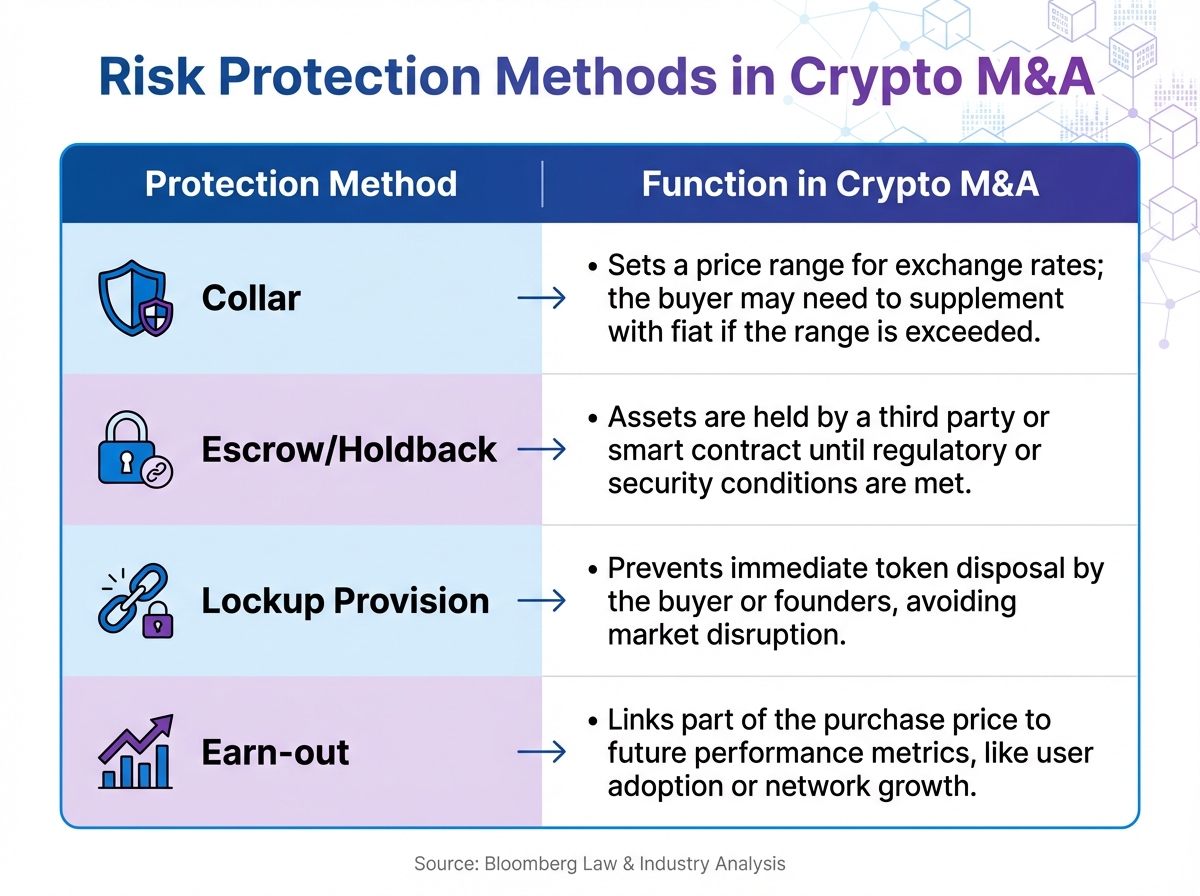
| Protection Method | Function in Crypto M&A |
|---|---|
| Collar | Sets a price range for exchange rates; the buyer may need to supplement with fiat if the range is exceeded [3]. |
| Escrow/Holdback | Assets are held by a third party or smart contract until regulatory or security conditions are met [5]. |
| Lockup Provision | Prevents immediate token disposal by the buyer or founders, avoiding market disruption [3]. |
| Earn-out | Links part of the purchase price to future performance metrics, like user adoption or network growth [1][3]. |
To address price volatility, consider using price collars to adjust for major shifts in cryptocurrency-to-fiat exchange rates before closing. Alternatively, stablecoins can be used for payments and escrow to maintain price stability [3].
When releasing escrowed funds, make third-party audits of smart contracts and custody solutions a requirement. Certificates signed by executive officers should verify the accuracy of wallet addresses before funds are placed in escrow [3]. Additionally, structuring earn-outs around regulatory achievements - such as obtaining a BitLicense or clearing SEC scrutiny - can help balance valuation differences and align incentives [3].
Key Takeaways for Buyers in Crypto M&A
Buying a cryptocurrency business comes with its own set of challenges that go beyond the typical M&A agreements. As highlighted earlier, buyers must focus on four critical areas: regulatory compliance, digital asset ownership, intellectual property (IP) integrity, and accurate tax reporting. These factors are essential to navigating the complexities of crypto transactions.
Jeannie Shin, Partner at Orrick, emphasizes the evolving nature of these deals:
"Crypto provisions in M&A agreements highlight areas of concern for businesses today – and provide clues to how the crypto M&A landscape will change."
- Jeannie Shin, Partner, Orrick[2]
Between 2020 and 2022, the number of M&A deals funded with cryptocurrency more than doubled[3]. To address the unique risks in such transactions, buyers should consider strategies like price collars, escrow funds, and thorough technical due diligence. On top of that, U.S. regulations require businesses to report any cryptocurrency transactions exceeding $10,000 to the IRS[3].
For specialized support, platforms like MyReadyMade can be invaluable. They offer verified business listings, expert advisory services, and assistance with license transfers across more than 50 jurisdictions. This is particularly important for meeting regulatory requirements like money transmitter licenses or BitLicense.
Montague Law underscores the importance of legal precision in these deals:
"A well-crafted M&A agreement is the backbone of any transaction."
- Montague Law[1]
To protect your investment, verify wallet addresses using signed certificates and conduct test transactions before finalizing the deal. Also, ensure your Stock Purchase Agreement defines "knowledge" to include not just what the seller knew, but also what they should have reasonably discovered. These steps can safeguard against regulatory penalties, security breaches, and hidden liabilities.
FAQs
How can I prove the seller really controls the wallets?
To confirm that the seller has control over the wallets, review blockchain transaction records to verify ownership. Make sure the wallets are clearly linked to the seller. Additionally, perform thorough technical and security audits of both the wallets and any related smart contracts. Taking these precautions can help establish ownership and minimize risks during the transaction.
What compliance red flags can create buyer liability after closing?
Several compliance issues can surface after a transaction closes, potentially exposing buyers to liability. These include:
- Unresolved regulatory violations: Past breaches or unresolved issues with regulators can resurface and lead to penalties.
- AML/KYC concerns: Gaps in anti-money laundering (AML) or know-your-customer (KYC) protocols can create legal and financial risks.
- Non-compliance with token issuance rules: If token offerings failed to meet regulatory standards, buyers may face scrutiny.
- Security breaches: Previous data breaches or inadequate cybersecurity measures could result in liability or reputational damage.
- Connections to criminal activities: Any ties to illicit activities, whether intentional or not, can lead to serious consequences.
To reduce these risks, it's essential to conduct thorough due diligence before closing and establish ongoing compliance monitoring afterward. This proactive approach can help identify and address potential problems early.
What smart contract issues should trigger escrow or special indemnities?
Smart contract challenges that may call for escrow or special indemnities often stem from custody-related risks. These include situations like frozen wallets, lost private keys, or errors by custodians. Such issues can completely block transactions, and unlike traditional systems, recovering assets is typically not an option.
To reduce these risks, it's essential to implement strict policies, use multi-signature arrangements, and establish verified access procedures. These measures help safeguard against preventable failures and ensure smoother operations.
Related Articles

Ultimate Guide to Earnout Negotiations in M&A
Structure and negotiate earnouts in regulated M&A with clear metrics, anti-manipulation covenants, and acceleration or escrow protections.

How to Draft M&A Definitive Agreements
Guide to drafting M&A definitive agreements covering deal structure, reps & warranties, indemnities, payment terms, and regulatory compliance.

How IP Affects Tokenization Valuation
How tokenizing patents, copyrights, and trademarks adds liquidity and market value—plus legal, regulatory, and valuation steps.
Looking to Buy or Sell?
Get in touch with our team for personalized assistance