Top Risk Mitigation Strategies for Crypto M&A

Top Risk Mitigation Strategies for Crypto M&A
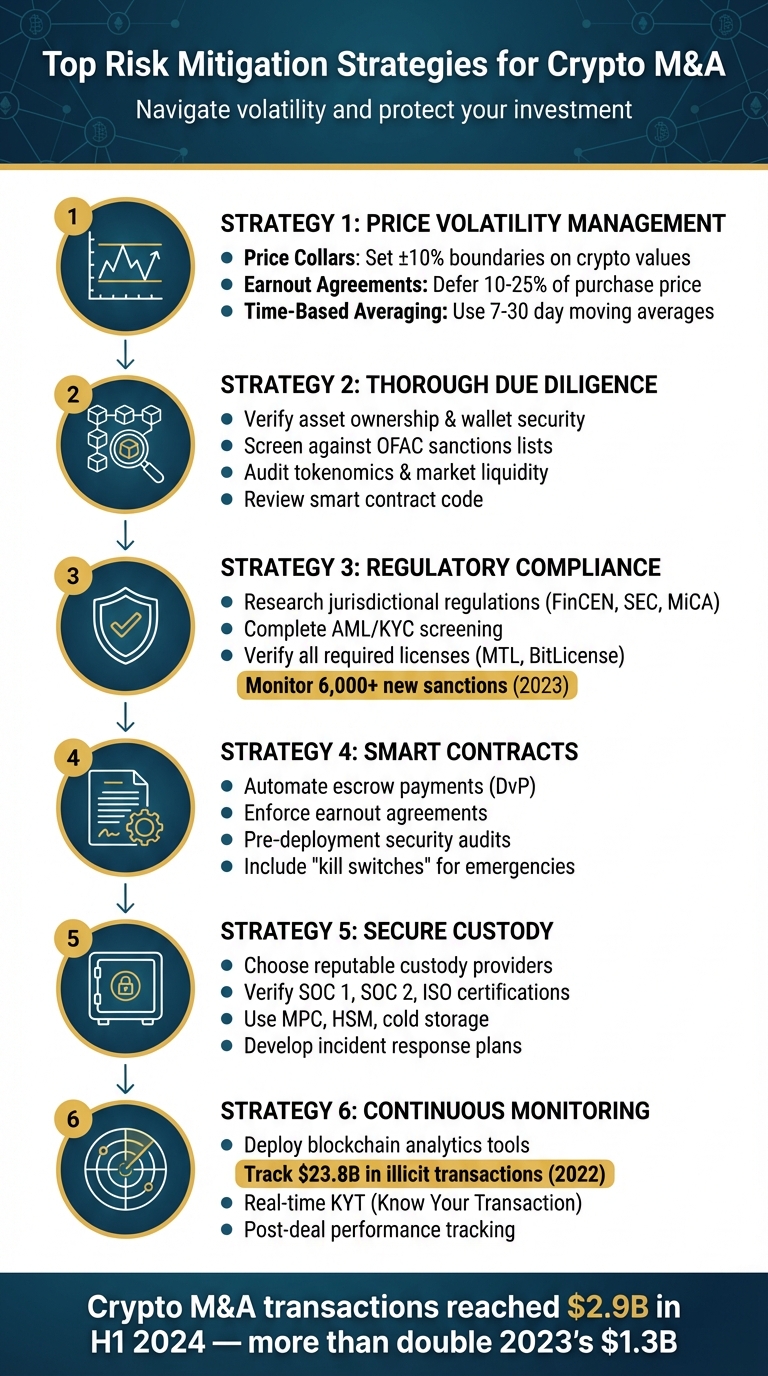
Cryptocurrency mergers and acquisitions (M&A) are fraught with unique risks: extreme price volatility, complex regulations, cybersecurity threats, and technical challenges in due diligence. These risks require tailored strategies to protect investments. Here's a quick overview of effective mitigation tactics:
- Price Volatility: Use price collars and earnout agreements to stabilize valuations during negotiations.
- Thorough Due Diligence: Verify crypto asset ownership, wallet security, tokenomics, and market liquidity.
- Regulatory Compliance: Research jurisdictional laws and ensure AML/KYC standards are met to avoid legal liabilities.
- Smart Contracts: Automate escrow payments and enforce post-deal obligations with pre-audited smart contracts.
- Secure Custody: Choose reputable custody providers and implement incident response plans to safeguard digital assets.
- Continuous Monitoring: Use blockchain analytics to track transactions, flag risks, and ensure post-deal compliance.
These strategies address the challenges of crypto M&A, helping buyers and sellers navigate this volatile and fast-moving market.
Jan-Philip Grabs, Karl-Martin Ahrend - Market Insights and Particularities of Crypto M&A
1. Structure Pricing to Account for Market Volatility
Cryptocurrency prices are infamous for their dramatic fluctuations, often making it tricky to determine a fair value between the time a deal is signed and when it closes. To tackle this challenge, two common strategies come into play: price collars and earnout agreements. Price collars establish boundaries for exchange rate movements, while earnouts tie parts of the purchase price to future performance. Together, these tools help mitigate the risks that market volatility could turn an otherwise solid deal into a regrettable one. Let’s dive into how each approach works.
1.1 Set Price Collars
Price collars act as a financial safety net by setting upper and lower limits on a cryptocurrency’s value, with any excess difference settled in fiat currency [1]. This ensures buyers aren’t forced to overpay if prices spike and protects sellers from losing out in the event of a sudden crash.
Here’s an example: Imagine agreeing to pay $10 million for a crypto business with a price collar set at ±10%. If Bitcoin’s value drops 20% before the deal closes, the buyer would cover the shortfall in U.S. dollars, sidestepping the need for a full renegotiation [1].
To make this strategy even more reliable, time-based averaging can be applied. Instead of relying on a single-day spot price, a 7-day or 30-day moving average is used to account for short-term price swings [2]. This method smooths out volatility and prevents extreme market events from unfairly skewing the final deal price. When using locked-box structures, where the price is fixed at a pre-signing date, collars become even more crucial. Without them, the buyer could be left bearing all the risk of price drops between the locked-box date and the closing [9].
As Osborne Clarke highlights:
If the exchange rate is fixed in advance of completion, either party may make a bad bargain as the actual rate is very likely to have changed by completion, potentially significantly [1].
1.2 Structure Earnout Agreements
Earnout agreements defer part of the purchase price, tying it to the future performance of the acquired assets or business. This approach reduces the buyer’s upfront risk while rewarding the seller if agreed-upon milestones are achieved [2][5]. In middle-market transactions, it’s common to see 10% to 25% of the purchase price structured as an earnout [11].
Earnouts are particularly useful when the future value of tokens or the growth of the business is uncertain. These agreements typically cover one to three years, though some can stretch up to five years [11].
However, as Thomas H. Wagner of Polsinelli PC points out:
Given the volatility of digital assets, there is a higher than typical likelihood that the value of the earn-out or purchase price adjustment will also fluctuate substantially [5].
To minimize risks, it’s essential to define performance metrics clearly. Use straightforward targets like gross revenue, which are harder to manipulate than metrics such as EBITDA [11]. If earnout payments involve tokens, specify whether targets are measured by fiat value or token quantity. Using methods like time-weighted average prices (TWAP) or volume-weighted average prices (VWAP) can also help smooth out volatility [2]. Additionally, including a dispute resolution mechanism - such as independent accounting arbitration - can prevent disagreements from escalating into lengthy legal battles [10][11].
2. Perform Thorough Crypto Asset Due Diligence
Before finalizing any M&A deal involving crypto assets, it's crucial to dig deep into the target's holdings. Skipping this step can leave you exposed to risks like weak security, illiquid tokens, or even assets tied to sanctions - any of which could drain the deal's value or invite regulatory trouble.
As EY notes:
Digital assets are a unique asset class that introduce novel risks to an organization that traditional due diligence may not identify [4].
The stakes are high. In one case, hackers breached an exchange's hot wallets and made off with over $150 million in digital assets [5]. Such incidents not only erase value but also erode trust and can lead to regulatory scrutiny. To mitigate these risks, focus on two key areas: verifying asset ownership and wallet security, and analyzing tokenomics and market liquidity.
2.1 Verify Asset Ownership and Wallet Security
Start by determining whether the target uses self-custody or relies on third-party providers. Self-custody offers direct control but demands stringent security protocols. Third-party custody, on the other hand, requires you to vet the provider's reputation and ensure they comply with regulations.
It's also essential to confirm that client funds are segregated from the company's own assets. This reduces liability risks in case of financial trouble. Dive into private key management by reviewing access controls, multisignature wallet setups, and cold storage practices. Robust asset recovery options, like backup keys, are another must-have [8].
Blockchain analytics can be a powerful tool here. They provide a complete picture of asset flows - where funds originate and where they go. Use these tools to screen wallet addresses against global sanctions lists, such as those maintained by OFAC, the UN, and the EU. These steps lay the groundwork for a detailed asset review.
As TRM Labs explains:
Conducting comprehensive entity due diligence checks on crypto exchanges, custody providers, and other VASPs - prior to onboarding them as customers or partners - is one of the most critical steps any financial institution will take as part of its crypto compliance program [12].
To further ensure asset legitimacy, request independent third-party audits of the target's crypto holdings, financial records, and compliance measures.
2.2 Evaluate Tokenomics and Market Liquidity
The value of a token is shaped by its tokenomics - how it's supplied, distributed, and incentivized. During due diligence, identify whether the target holds utility tokens (used for accessing services) or value storage tokens (designed to retain or grow in value). Each type requires a tailored valuation strategy [5].
Pay close attention to token supply mechanisms. Fixed-supply tokens can create scarcity, driving up value, while mintable tokens risk inflation, which erodes value. Also, check for ownership concentration. If a small number of wallets control a large share of the supply, they could manipulate the market or trigger a sell-off [4].
Liquidity is another critical factor. If the target holds tokens that are thinly traded or illiquid, they could face solvency issues during market downturns. TRM Labs highlights this risk:
A VASP with large holdings in speculative or illiquid tokens may face solvency risks during market downturns, potentially jeopardizing its counterparties and customers [12].
Ensure the tokens are listed on major exchanges with strong trading volumes to minimize liquidity risks.
Finally, review the smart contracts behind the tokens. Many tokens rely on automated protocols for managing supply, staking rewards, or governance. Vulnerabilities in these contracts - such as loopholes that allow unauthorized minting or fund siphoning - can pose significant risks. Request a formal audit of these contracts from a trusted firm [8]. As Mayer Brown warns:
A target company's vulnerabilities will become the acquirer's vulnerabilities [8].
3. Maintain Regulatory Compliance and AML/KYC Standards
After addressing market volatility and ensuring asset security, the next critical step is to navigate the regulatory landscape. Compliance with evolving regulations, particularly those related to Anti-Money Laundering (AML) and Know Your Customer (KYC) standards, is essential to safeguard your investments and ensure a smooth transaction process.
Regulatory compliance plays a central role in crypto mergers and acquisitions (M&A). It's the backbone of successful deals, as failure to meet legal requirements can lead to hefty fines, revoked licenses, or even criminal charges. The crypto industry in the United States, for instance, operates under a maze of federal and state regulations, making it imperative to tread carefully.
Recent high-profile cases highlight the risks of non-compliance. Companies like Robinhood Crypto LLC and individuals such as Roman Storm have faced multimillion-dollar fines and criminal charges for failing to meet AML standards [16][14]. These examples serve as stark reminders that compliance lapses can lead to significant liabilities for acquiring firms.
The regulatory environment saw a notable shift in January 2025 with the executive order "Strengthening American Leadership in Digital Financial Technology", which signaled a more business-friendly approach [16][17]. However, enforcement remains stringent. In 2023 alone, over 6,000 new sanctions were imposed, and regulators continue to keep a close watch on crypto firms for AML and KYC violations [20].
3.1 Research Jurisdictional Regulations
The first step is understanding the regulatory requirements in the jurisdictions where the target entity operates. In the United States, cryptocurrency exchanges and money services businesses (MSBs) must register with FinCEN and adhere to the Bank Secrecy Act (BSA). Additionally, many states require Money Transmitter Licenses (MTL), and New York mandates a "BitLicense" for virtual currency activities [13][15][16]. If the target operates in multiple states, ensure all licenses are valid and up to date.
The Securities and Exchange Commission (SEC) applies the "Howey Test" to determine whether a crypto asset qualifies as a security, which would require registration under the Securities Act of 1933 unless an exemption applies [16]. As the SEC emphasizes:
New technologies do not remove conduct from the purview of U.S. federal securities laws [16].
For stablecoins, the GENIUS Act establishes federal requirements for reserves, audits, and financial integrity, with final regulations expected by July 2026 [17]. Notably, in 2025, QCAD announced plans to meet Canada's Staff Notice 21-333 requirements, aiming to become the first regulated Canadian stablecoin, following Circle's USDC compliance earlier that year [21].
Cross-border deals introduce additional complexities. In the European Union, the Markets in Crypto-Assets Regulation (MiCA) allows a single license to cover multiple member states through "passporting" [21]. Brazil, on the other hand, introduced a Virtual Asset Service Provider (VASP) regime in November 2025, which includes minimum capital requirements of up to $6.9 million [21]. Carefully research the licensing and regulatory obligations in every jurisdiction where the target operates.
Understanding these frameworks is a crucial step before diving into AML/KYC screening.
3.2 Complete AML/KYC Screening
Comprehensive AML and KYC screening is essential to avoid inheriting liabilities related to money laundering, terrorism financing, or sanctions violations. For example, in November 2023, Binance faced a record-breaking fine of $4.3 billion from U.S. authorities for inadequate AML and KYC controls [20]. Similarly, Poloniex was fined $7.6 million in May 2023 for allowing transactions from sanctioned regions like Crimea, Iran, and Syria [20].
Start by screening all transaction parties against the OFAC Specially Designated Nationals (SDN) List. Under OFAC's "50 Percent Rule", entities owned 50% or more by blocked individuals or entities are also considered blocked [14]. OFAC enforces sanctions under strict liability, meaning violations can occur even without intent or knowledge [14].
Use blockchain analytics, geolocation tools, and real-time monitoring to trace the origin of assets, block access from high-risk areas, and detect suspicious transaction patterns [18][13][14]. MSBs are required to report suspicious transactions (SARs) involving amounts of $2,000 or more [13].
For high-risk profiles - such as Politically Exposed Persons (PEPs) or customers from jurisdictions with weak AML controls - conduct Enhanced Due Diligence (EDD) [18][19]. This includes screening global media and regulatory publications for adverse mentions or pending investigations tied to the target [20].
As stated in the Bank Secrecy Act regulations:
An effective anti-money laundering program is one that is reasonably designed to prevent the money services business from being used to facilitate money laundering and the financing of terrorist activities [13].
AML/KYC efforts should be ongoing rather than a one-time exercise. Consider independent third-party audits of the target's AML programs to ensure they align with the business's size and risk profile [13]. Continuous monitoring is key to staying compliant and mitigating risks.
4. Use Smart Contracts for Automated Safeguards
Smart contracts bring a new level of efficiency and security to M&A processes by automating and enforcing deal terms. These are essentially pieces of software that execute actions automatically when pre-set conditions are met. By using smart contracts, you can reduce execution risks and streamline operations significantly [22][23].
Think of them as automated escrow agents - they hold funds or tokens and release them only when specific milestones are verified on the blockchain [1][23]. This eliminates the delays often caused by traditional intermediaries. By embedding deal terms directly into the code, smart contracts also reduce counterparty risk and increase transparency.
But smart contracts aren’t just about payments. They can handle complex post-deal obligations, like performance-based earnouts or token vesting schedules [1][6]. As Osborne Clarke points out:
Smart contracts... have been mooted as suitable for use for earn-outs, loan note instruments, escrow arrangements, and some transaction closings [1].
However, the immutability of blockchain means that once a smart contract is deployed, it’s tough to modify or reverse. That’s why pre-deployment audits and the inclusion of "kill switches" - mechanisms for manual intervention in emergencies - are critical [1]. Another key consideration is the "oracle problem", which requires you to define trusted data sources that will trigger the contract’s actions [23].
The following sections explore how smart contracts enhance payment security and enforce post-deal commitments.
4.1 Automate Escrow Payments
Smart contracts excel at managing escrow payments by locking assets until all contractual terms are met [1][6]. This process relies on "atomic operations", which ensure that linked actions either fully succeed or fail. This is especially useful for scenarios like delivery-versus-payment (DvP) [22].
For instance, in a DvP transaction, the smart contract ensures that both parties fulfill their obligations before executing the exchange. This eliminates the risk of one party receiving payment without delivering the agreed asset. Research from Onyx by J.P. Morgan and MIT highlights the importance of atomic operations:
Atomic operations - those program operations that run completely independently of any other processes - ensure that linked instructions either completely succeed or fail, which is crucial for transactions like delivery-versus-payment (DvP) or payment-versus-payment (PvP) [22].
When off-chain events are involved, smart contracts rely on "oracles" - trusted third-party data feeds - to retrieve the necessary information and trigger payments [23]. Oracles can also integrate with dispute resolution systems, enabling arbitrators to direct escrowed funds based on their decisions [23].
Before deploying smart contracts, it’s crucial to commission an independent code audit to ensure the logic aligns with your legal and commercial terms [23]. Also, define oracle sources early in the negotiation process to prevent disputes over which data feeds control payment releases [23]. Keep in mind that not every M&A term can be automated - use smart contracts for straightforward tasks like payments, while handling subjective terms like representations and warranties through traditional legal documentation [23].
4.2 Enforce Post-Deal Obligations
Smart contracts don’t stop at escrow - they can also automate ongoing post-deal commitments, such as earnouts and performance-based payments. When benchmarks or financial metrics are met, the contract automatically releases funds or tokens, eliminating the need for manual verification [1][6]. This reduces the administrative workload and avoids disputes that often arise with traditional earnout agreements.
For management incentives, smart contracts can enforce time-based or performance-based vesting schedules, ensuring that tokens are distributed only when earned [6][24]. This not only increases transparency - since all parties can verify the blockchain record - but also minimizes the risk of payments being unfairly withheld [5][6].
Montague Law explains:
Smart contracts can automate the release of funds upon the fulfillment of predefined conditions, enhancing efficiency and reducing reliance on intermediaries [6].
The cost savings here are significant. By automating processes, you reduce the need for third-party intermediaries like escrow agents or legal auditors [1][6]. However, it’s important to account for gas fees, which are the transaction costs for executing smart contracts on the blockchain. These fees can vary depending on market conditions [1].
Before using smart contracts for post-deal obligations, conduct thorough security audits to identify potential vulnerabilities or flaws in the logic [8][9]. As mentioned earlier, including "kill switches" in the contract design allows for intervention if something goes wrong or circumstances change [1]. Additionally, your overarching M&A agreement should outline what happens if the smart contract fails to execute as intended [1]. Since recovering stolen assets from decentralized networks is extremely challenging, establish clear indemnification terms to address cybersecurity risks [6].
5. Implement Secure Custody and Operational Protocols
When it comes to crypto M&A, securing custody is absolutely essential. Unlike traditional assets, cryptocurrencies can be transferred globally and irreversibly in mere seconds. This makes them a prime target for cybercriminals, and the risks are significant [8].
The consequences go beyond financial losses. As Mayer Brown highlights:
A target company's vulnerabilities will become the acquirer's vulnerabilities. We are aware of instances where an acquirer also "acquired" an intrusion because the threat actors were inside the target's systems at the time of the acquisition and then spread into the network of the acquirer [8].
Without strong custody measures and operational safeguards, your organization could be exposed to serious cyber threats. Here's how to mitigate these risks.
5.1 Select Reputable Custody Services
The first step is choosing a custody provider that prioritizes securing private keys - often the single point of failure in crypto security [25]. Look for providers that utilize advanced tools like Multi-party Computation (MPC), Hardware Security Modules (HSM), and cold (air-gapped) storage to minimize the chances of theft or loss [25].
Before making a decision, thoroughly vet the provider. Check for third-party attestations such as SOC 1, SOC 2, or ISO certifications, and review their insurance policies to understand what’s covered in case of a loss. Additionally, assess their compliance with regulatory requirements and the legal framework for asset custody [25]. During due diligence, focus on their governance structure and access controls. This includes identifying who manages multisignature wallets and cold storage, as well as evaluating their cybersecurity team and overall financial stability [8] [25].
5.2 Develop Incident Response Plans
Securing custody is only part of the equation. A robust incident response plan is equally critical, especially since threat actors could already be lurking in the target company's systems at the time of acquisition.
Start by documenting all digital assets and identifying key access points. Conduct thorough penetration tests and vulnerability assessments on the target’s cybersecurity infrastructure before integration. If the target relies on smart contracts, ensure they’ve been rigorously audited and that any open-source components are fully understood [8].
Your incident response plan should include scenario-planning exercises to prepare for various types of cyber threats. Assign an Incident Response Team (IRT) to handle and classify incidents, distinguishing between minor vulnerabilities and more serious, reportable events. For public companies, compliance with SEC cybersecurity disclosure rules is vital. The SEC mandates that material cybersecurity incidents be reported within four business days of determining their materiality [26]. This makes it essential to establish protocols for rapid evaluation and reporting, even during off-hours [26].
As Mayer Brown points out:
The potential negative impact of reputational damage from a cyberattack on a digital assets business - and its owners, investors and vendors - cannot be overstated. In highly competitive markets, reputational damage can sometimes be impossible to overcome [8].
6. Deploy Continuous Transaction Monitoring Tools
Closing a deal is just the beginning when it comes to managing risk. While earlier compliance and due diligence efforts lay the groundwork, continuous transaction monitoring is essential for staying ahead of evolving threats. In 2022, illicit cryptocurrency addresses moved around $23.8 billion, marking a 68% increase from the previous year [3]. Without advanced monitoring systems, crypto businesses risk missing critical red flags tied to illegal transactions.
As TRM Labs aptly points out:
The biggest risk isn't exposure to crypto - it's not knowing you're exposed at all [27].
To combat this, advanced monitoring tools are indispensable. These systems provide a clear view of every transaction within your operations, ensuring no suspicious activity slips through the cracks. Here's how to implement them effectively.
6.1 Apply Blockchain Analytics
In traditional finance, anti-money laundering (AML) checks often occur during onboarding, but in the crypto world, that's far from sufficient. Continuous Know Your Transaction (KYT) monitoring is a must. These tools analyze blockchain transactions in real time, flagging interactions with sanctioned wallets or known bad actors and issuing immediate alerts for suspicious activity [3].
With the help of Blockchain Intelligence (BI) tools, which leverage machine learning, businesses can detect advanced laundering tactics like layering and splintering - methods where large transactions are broken into smaller ones across multiple channels [27]. This level of transparency is critical. For instance, in 2022, hackers stole approximately $3.8 billion from digital-currency businesses, much of it targeting DeFi protocols [3].
To strengthen your defenses, look for platforms offering entity screening capabilities. These tools compare transactions against extensive databases of Virtual Asset Service Providers (VASPs) and high-risk entities. For example, inflows to Garantex, a Russia-based exchange, made up 82% of the total crypto volume tied to sanctioned entities worldwide [27]. Without proper screening, your business could unintentionally facilitate transactions with these entities.
Failing to monitor transactions adequately can result in hefty penalties. In October 2022, Bittrex, Inc. settled with OFAC and FinCEN for $100 million after failing to screen customer information against sanctions [28]. Beyond catching illicit activity, continuous monitoring ensures that on-chain operations align with your business objectives.
6.2 Track Post-Deal Performance
Real-time alerts are just one piece of the puzzle. Tracking post-deal performance is equally important to ensure compliance and operational efficiency. Analytics dashboards that integrate KYC and KYT data can help you assess counterparties and pinpoint those that pose high financial or reputational risks [3].
Automated controls, such as stop-loss triggers or hedging mechanisms, can act on real-time risk data to prevent potential losses. Regular audits of smart contracts can also help identify and address unintended transactions before they escalate [3]. These tools don’t just flag risks - they provide actionable insights to refine strategies after an acquisition.
Proactivity is key for compliance teams. As Samidh Guha, Founding Partner at Guha PLLC, notes:
Compliance officers cannot wait for clear regulations to be issued and must be proactive in crafting best-in-class compliance programs to satisfy a spectrum of regulators [28].
This involves maintaining meticulous records of trading data, source code updates, and token release schedules. Regulators are increasingly wary of communication platforms like Telegram and Signal, especially those with auto-delete features. To stay compliant, ensure your communication policies allow for a defensible audit trail [28]. By consolidating AML and KYC systems into a unified compliance structure immediately after closing a deal, you can protect your operations and avoid the costly penalties that have plagued other firms.
Conclusion
Managing risks in crypto M&A demands a well-rounded strategy that addresses financial, legal, and operational challenges. This approach stems from earlier discussions about price protection, regulatory compliance, and operational security. Tools like price collars and earnout structures help stabilize financial risks, while legal safeguards such as AML/KYC screening ensure compliance. On the operational side, measures like smart contract audits and secure custody are critical to counter cyber threats and market volatility, as demonstrated by the turbulence in May 2022 [1][3].
As Mayer Brown aptly notes:
A target company's vulnerabilities will become the acquirer's vulnerabilities [8].
This highlights how interconnected risks can amplify, with even minor technical flaws potentially causing significant financial and regulatory fallout. To address these challenges, assembling multidisciplinary teams is key. Combining M&A professionals, blockchain specialists, and forensic accountants ensures a thorough understanding of digital asset-specific risks. Additionally, using specialized platforms can simplify these complex transactions.
For instance, MyReadyMade (https://myreadymade.com) offers a secure marketplace tailored for high-risk industries like cryptocurrency. It provides features such as verified listings, confidential NDA-protected communications, and expert advisory services. The platform also facilitates license transfers in over 50 jurisdictions and boasts deal closures within 30–45 days.
Maintaining vigilance throughout the M&A process - from initial audits to ongoing post-closing monitoring - is essential. The crypto M&A market is evolving quickly; aggregate transactions soared to $2.9 billion in the first half of 2024, more than doubling the $1.3 billion recorded in 2023 [7]. Success in this dynamic landscape hinges on ensuring that every layer of risk management works cohesively to protect your investment.
FAQs
What are price collars, and how do they reduce risks in cryptocurrency M&A deals?
Price collars are agreements used in mergers and acquisitions (M&A) to handle valuation risks that arise from price swings. They are especially useful in cryptocurrency M&A, where asset values can change dramatically in a short time. These mechanisms define a minimum and maximum range for the transaction value, creating boundaries for the deal price.
By putting these limits in place, price collars protect both buyers and sellers from drastic market changes. This approach helps create a more stable and predictable negotiation process, reducing uncertainty and making crypto M&A deals easier to navigate for both parties.
How do smart contracts enhance security and streamline crypto M&A transactions?
Smart contracts, those self-executing agreements stored on a blockchain, bring a new level of security and efficiency to cryptocurrency M&A deals by automating critical processes. These digital contracts handle tasks like determining purchase prices, releasing escrow funds, and transferring tokens - but only when specific conditions, such as regulatory approvals or audit completion, are met. This automation eliminates the need for manual oversight, cutting down on human errors and reducing the potential for fraud.
One of their biggest advantages is the ability to speed up settlement times. While traditional M&A closings can drag on for weeks, smart contracts can finalize transactions within minutes. This not only saves time but also reduces costs and allows capital to be put to use more quickly. Their transparent and tamper-resistant design ensures that all parties can clearly see and trust the contract's terms, which is particularly valuable for cross-border or high-stakes deals. Platforms like MyReadyMade integrate these contracts into their workflows, providing a secure and streamlined solution for buyers and sellers navigating the cryptocurrency space.
What are the key steps to ensure compliance when buying or merging cryptocurrency businesses?
To navigate compliance in cryptocurrency mergers and acquisitions (M&A), start with thorough due diligence. Identify the relevant federal and state regulatory bodies, such as the SEC, CFTC, DOJ, FinCEN, and state money-transmitter regulators. Carefully review the target company’s licensing, registration, and reporting obligations, particularly for activities like token offerings, custodial services, and exchanges. Assess whether any digital assets are classified as securities under SEC regulations and determine if registration or exemption requirements apply.
It’s crucial to implement robust anti-money laundering (AML) and know-your-customer (KYC) programs that align with U.S. FinCEN rules and international frameworks like the FATF Travel Rule. Leverage blockchain analysis tools to monitor transactions, flag suspicious activities, and maintain accurate records. Additionally, confirm that any required state licenses, such as money-service business (MSB) or money-transmitter licenses, are in place before finalizing the deal.
Post-transaction compliance is equally important. Establish strong governance measures, including regular compliance monitoring, periodic audits, and clear protocols for responding to regulatory inquiries. Platforms like MyReadyMade can streamline this process by providing expert M&A advisory, verified business listings, and assistance with license transfers across more than 50 jurisdictions, ensuring compliance is embedded from the outset.
Related Articles

Ultimate Guide to Earnout Negotiations in M&A
Structure and negotiate earnouts in regulated M&A with clear metrics, anti-manipulation covenants, and acceleration or escrow protections.

How to Draft M&A Definitive Agreements
Guide to drafting M&A definitive agreements covering deal structure, reps & warranties, indemnities, payment terms, and regulatory compliance.

How IP Affects Tokenization Valuation
How tokenizing patents, copyrights, and trademarks adds liquidity and market value—plus legal, regulatory, and valuation steps.
Looking to Buy or Sell?
Get in touch with our team for personalized assistance