10 Risks in iGaming M&A Exit Planning

10 Risks in iGaming M&A Exit Planning
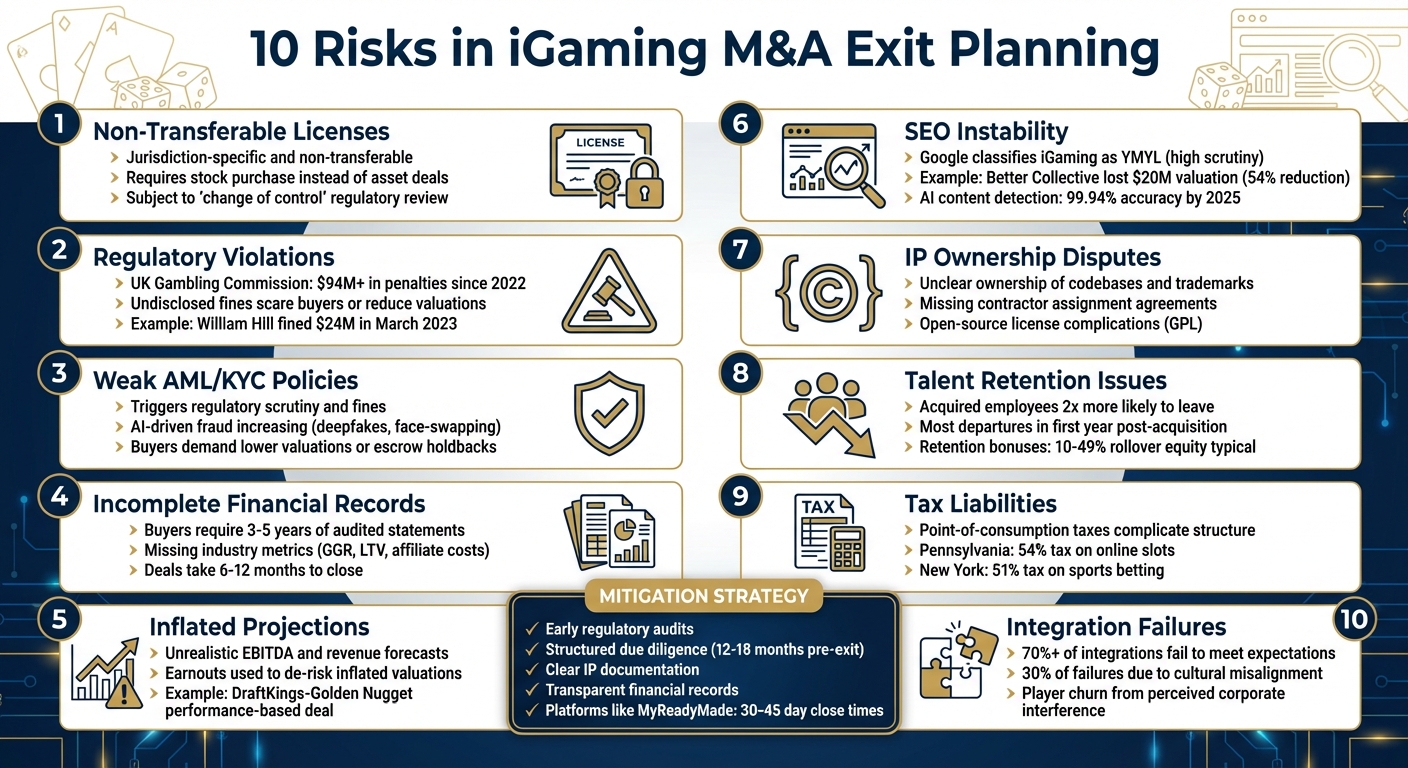
Selling an iGaming business comes with unique challenges that can derail deals if not addressed early. From complex regulations to tax liabilities, these risks can significantly impact valuations and timelines. Here's a quick look at the top risks:
- Licenses: Non-transferable and jurisdiction-specific, requiring careful structuring of deals.
- Regulatory Violations: Undisclosed fines or compliance gaps can scare off buyers or reduce valuations.
- Weak AML/KYC Policies: Poor anti-money laundering frameworks can trigger regulatory scrutiny and fines.
- Financial Records: Incomplete audits or inflated projections can erode buyer trust.
- SEO Instability: Traffic volatility or penalties can lower valuations.
- IP Ownership: Disputes over codebases or trademarks can delay deals.
- Talent Retention: Losing key personnel during transitions can disrupt operations.
- Tax Liabilities: Poor tax planning or cross-border issues can create post-sale disputes.
- Integration Failures: Poor post-deal planning can lead to operational chaos.
- Gray Markets: Operating in unregulated areas can activate "bad actor" clauses, limiting buyer opportunities.
To mitigate these risks, early audits, structured due diligence, and clear communication are critical. Platforms like MyReadyMade can streamline the process by offering regulatory audits, data rooms, and pre-screened buyers. Planning ahead can save time, reduce complications, and maximize exit value.
Russell Mifsud: ESG, Investments, macro climate and the future of the igaming industry
1. Non-Transferable or Invalid Licenses
iGaming licenses come with a unique challenge - they are non-transferable and issued solely to corporate entities. Take the UK, for instance, where operating licenses are explicitly non-transferable [9]. This creates a significant hurdle if you're looking to sell your iGaming business through a traditional asset deal. In such deals, buyers typically pick and choose specific assets, leaving the licensed entity behind. However, this approach can create major complications.
"In the regulated gaming industry, asset deals are often impractical because gaming licenses are frequently non-transferable." - Stephen A. Crystal, Founder and CEO, SCCG Management [1]
To navigate this issue, many opt for a stock purchase instead. Here, rather than selling individual assets, you sell the entire subsidiary that holds the license. This ensures the license remains intact. A great example of this strategy is Caesars Entertainment's acquisition of William Hill's U.S. assets in April 2021. By purchasing the U.S. subsidiary outright, Caesars maintained licensing continuity across multiple states [1].
Still, a stock purchase doesn't mean regulators won't take a closer look. A "change of control" review is typically required, where regulators scrutinize the buyer's identity, corporate structure, and financial stability [8][10]. If the buyer fails to meet these strict standards - or if the business has a history of operating in gray markets - regulators may enforce "bad actor" provisions, potentially blocking the deal [2].
To mitigate these risks, it's crucial to conduct a thorough regulatory audit before listing your business for sale. This includes documenting all licenses, ensuring compliance across jurisdictions, and verifying technical requirements [2]. Additionally, include M&A clauses that make the deal contingent on securing all necessary regulatory approvals [1]. These steps can help smooth the path for a successful transaction.
2. Undisclosed Regulatory Violations and Fines
Hidden compliance violations can derail acquisitions, as undisclosed fines or breaches often lead potential buyers to either walk away or demand sharp valuation reductions. A striking example of this is the UK Gambling Commission, which has issued over $94 million (£75 million) in penalties for anti-money laundering (AML) and related compliance failures since 2022 [12].
In March 2023, William Hill Group was hit with a $24 million (£19.2 million) fine due to "widespread and alarming" failures in AML measures and safer gambling practices. Investigators discovered that the company allowed a new customer to spend $28,750 (£23,000) without verifying the source of funds. This penalty came shortly after 888 Holdings acquired the brand, forcing the new ownership to roll out a detailed remediation plan and undergo independent audits [12]. This case highlights how undisclosed compliance issues can significantly impact deal terms and post-acquisition strategies.
Another example is Crown Resorts, which agreed to a settlement of $281 million (AUD 450 million) in May 2023. The settlement addressed serious and systemic AML violations, including partnerships with junket operators tied to organized crime [12][6].
"What will be revealed in due diligence is an important consideration for a company wishing to be purchased, to ensure it is marketable and achieves the maximum price."
– David Schollenberger, Head of Gaming, Healys [2]
Beyond these headline-grabbing fines, undisclosed violations often include weak customer due diligence (CDD), failure to verify sources of funds (SOF), poor transaction monitoring that overlooks "smurfing" activities, and operating in restricted markets without proper geo-blocking [12][14]. Regulators also hold operators accountable for the actions of their affiliates, meaning non-compliance by marketing partners can result in significant liabilities [2].
To avoid these pitfalls, conduct a comprehensive due diligence audit of all regulatory communications, infringement notices, and penalties before entering negotiations. If violations are identified, disclose them early and take corrective action - this could involve upgrading risk assessment tools or closing high-risk accounts [12]. Failing to address hidden liabilities can not only slash valuations but also activate "bad actor" provisions, which may prevent buyers from obtaining future licenses in regulated markets. These hurdles can create challenges far beyond the typical complexities of transferring licenses [2].
3. Weak AML, KYC, and Compliance Policies
Flimsy AML (Anti-Money Laundering) and KYC (Know Your Customer) policies can derail an M&A deal faster than you might think. When a buyer acquires a company, they also take on its compliance liabilities. If your AML framework has gaps, expect potential buyers to push for lower valuations, demand strict indemnity clauses, or require hefty escrow holdbacks to shield themselves from future regulatory headaches.
The financial stakes are enormous. In the iGaming sector alone, regulatory penalties for AML violations have soared into the hundreds of millions of dollars. These fines often stem from failures in areas like customer due diligence, verifying the source of funds, and monitoring transactions. This underscores just how critical it is to have strong AML and KYC measures in place.
Adding to the complexity, AI-driven fraud is opening new doors for criminals. The UK's National Crime Agency has flagged rising misuse of deepfake technology and face-swapping tools to bypass KYC checks. These methods are being used to create "mule" accounts, which facilitate money laundering and even terrorist financing [13]. Regulators are also tightening their grip on "open-loop" payment systems - those that allow withdrawals through different methods than deposits - because they make it easier to obscure illicit fund flows [13].
"The key to any risk assessment is that it adopts an approach that attempts to distinguish the extent of different risks to assist with prioritising mitigation efforts, rather than being a generic box-ticking exercise."
– Gambling Commission [15]
To avoid these pitfalls, consider commissioning an independent AML audit to uncover any compliance gaps. Pay close attention to high-risk areas: verify the sources of funds for customers making large deposits (think five or six figures), implement automated screening tools to check global sanctions and PEP (Politically Exposed Persons) lists, and ensure your systems can flag suspicious activities like rapid account changes or "chip dumping" in poker games [6]. Buyers will dig deep into your compliance history, and any red flags could either scuttle the deal or significantly reduce your payout.
4. Incomplete Financial Audits and Records
When it comes to selling your iGaming business, having accurate financial audits isn't just a formality - it's essential. Sloppy or incomplete financial records can derail your exit before negotiations even get off the ground. Buyers in the iGaming industry expect three to five years of audited financial statements, including profit and loss statements, balance sheets, and cash flow reports [17][3]. If your records aren’t clean and well-organized, buyers may either walk away or significantly lower your valuation to account for the risks.
But it doesn’t stop at standard accounting. The iGaming sector comes with its own set of financial documentation requirements that go beyond what traditional businesses face. Buyers need to see industry-specific metrics like Gross Gaming Revenue (GGR) trends by region, player deposit liabilities, lifetime value (LTV) analyses based on player cohorts, affiliate commission structures, and regional payment processing costs [17]. Missing any of these critical details can immediately raise red flags for potential buyers.
"Financial due diligence examines 3-year historical performance, including revenue trends, profitability, debt obligations, liquidity, and cash flow stability."
– CasinosBroker [17]
Even if you think your documentation is thorough, undisclosed liabilities can still sink a deal. During due diligence, buyers often uncover hidden issues like tax obligations, overdue accounts receivable, unrecorded warranties, or undervalued inventory [16]. Tax liabilities, in particular, are a common source of post-close disputes in iGaming M&A transactions [17]. For instance, when DraftKings acquired Golden Nugget Online Gaming in August 2021, they structured the deal with earnouts tied to future revenue - a way to hedge against overpaying based on unverified financial projections [1].
Preparing your financial records isn’t something you can do at the last minute. Start organizing months in advance of your planned exit. Set up a centralized data room with all the necessary documents, including bank statements, tax filing histories (covering VAT/GST and gaming-specific duties), credit facility agreements, and records of chargeback ratios and merchant account reserves [17][3]. Map out your tax obligations across all jurisdictions where you operate to avoid surprises. Additionally, conduct cohort-based LTV analyses to demonstrate that your revenue streams are stable and not just temporary spikes [17].
Timing is everything. iGaming M&A deals typically take six to twelve months to close, though experienced advisors may shorten this to five months [17][3]. Disorganized financial records can delay the process, giving buyers more leverage to negotiate or opening the door for competitors to present better offers.
5. Inflated Revenue Projections and EBITDA Metrics
When it comes to financial audits, nothing shakes buyer confidence faster than inflated revenue projections or overly optimistic EBITDA metrics. In the iGaming industry, buyers are becoming increasingly cautious about rosy forecasts that aren’t grounded in normalized earnings or realistic assumptions. A common pitfall? Sellers often base their growth predictions on past marketing performance without factoring in the growing competition or the skyrocketing advertising budgets needed to maintain market share [1][11]. Take the regulated U.S. sportsbook market as an example - FanDuel, DraftKings, BetMGM, and Caesars collectively dominate 90% of the market. This makes buyers skeptical of bold projections from smaller operators trying to carve out a piece of the pie.
Temporary revenue boosts from unsustainable bonus models or overestimated synergies can also mislead buyers. These practices mask the true picture of player retention and long-term EBITDA potential [5]. To get a clearer view, buyers scrutinize metrics like player retention rates and lifetime value (LTV) analysis. These numbers reveal whether revenue is genuinely organic or artificially inflated. Interestingly, around 95% of executives point to cultural fit as a critical factor for successful integration, yet cultural mismatches often derail synergy targets [7].
"Earnouts allow buyers to de-risk paying inflated upfront valuations based on seller projections that may not materialize."
– Stephen Crystal, Founder and CEO, SCCG Management [1]
To counter these risks, earnout structures are becoming a popular solution. These agreements tie part of the purchase price to future performance milestones, such as revenue growth or player retention [1][3]. For instance, DraftKings’ acquisition of Golden Nugget Online Gaming included performance-based payments linked to future revenue, while Bally’s acquisition of Gamesys involved deferred payments tied to specific expansion and margin goals [1].
To ensure transparency and build trust, it’s crucial to normalize earnings by removing one-time gains and future capital expenditures. This helps present a clearer picture of sustainable performance [2][4]. Additionally, using clear, auditable definitions of revenue and user growth can make your financials more transparent [1]. A well-rounded valuation approach - combining EBITDA multiples, revenue multiples, and discounted cash flow (DCF) - can provide a more accurate snapshot of your company’s true worth [3]. In the competitive world of iGaming, this level of clarity can make all the difference when navigating the exit process.
6. SEO and Traffic Instability
In the world of mergers and acquisitions (M&A), just as financial and regulatory factors can sway outcomes, unstable SEO and traffic patterns can significantly impact a business's valuation. For the iGaming sector, where organic traffic often drives worth, fluctuating search rankings can scare off potential buyers. During due diligence, acquirers carefully evaluate SEO performance, watching for warning signs like unnatural backlink profiles, penalties tied to AI-generated content, or ranking volatility caused by Google algorithm updates [3]. These issues can complicate pricing negotiations and make businesses less appealing, often leading to "investors sitting back or making very low offers" [20].
The stakes are even higher now that Google classifies iGaming as a "Your Money or Your Life" (YMYL) niche, applying rigorous scrutiny similar to that used for financial or medical content [19]. A clear example of this occurred in August 2024 when Better Collective faced challenges from Google’s policy updates. The company reported a $20 million impairment on its acquisition of Playmaker HQ, slashing the deal’s valuation from $54 million to $25 million - a 54% reduction driven by content monetization concerns [22]. SEO issues like these directly influence deal valuations, echoing the broader risks seen in regulatory and financial assessments.
"Unstable traffic has meant investors are 'sitting back or making very low offers.' He described the market as feeling 'stuck.'"
– Andrew Perlman, CEO, Recurrent Ventures [20]
AI-generated content adds another layer of complexity. With Google expected to invest an additional $75 billion in AI detection technology by 2025, tools like Originality.ai, boasting a 99.94% detection rate for AI-generated articles, are becoming more sophisticated [18]. SEO expert Matthew Woodward warns, "Using AI generated content is an uncontrolled risk because you never know how Google are going to change the algorithm" [18]. Overreliance on AI-generated material can put a company’s valuation at risk.
To address these challenges, businesses should prioritize a thorough SEO audit. This includes analyzing backlink quality, organic traffic trends, and any history of Google penalties [3]. Buyers also pay close attention to metrics like returning visitor rates and conversion rates to assess the sustainability of SEO efforts. Diversifying traffic sources - through social media channels and first-party data - can enhance a business's appeal and reduce its reliance on fluctuating organic traffic [20].
7. IP Ownership Disputes Over Codebases and Trademarks
When preparing for a successful exit, protecting your intellectual property (IP) is just as important as managing regulatory, financial, and operational concerns. Ensuring clear legal ownership of your software code and trademarks is crucial to instilling confidence in potential buyers. As David Schollenberger, Head of Gaming at Healys, explains:
"Intellectual property rights due diligence is critical to re-evaluating the value and level of risk of an igaming company." [2]
One common pitfall arises when early-stage companies fail to secure proper assignment agreements with contractors. This can leave your legal claim to essential components of your business in question. Buyers will want to see an unbroken chain of title from every developer to your company. If there are gaps, you'll need to address them with confirmatory assignments before finalizing the deal.
Trademark protection is another critical area. If your brands aren't registered in every jurisdiction where you operate, you leave yourself open to third-party claims that can diminish the value of your business. This is especially problematic in the iGaming industry, where brand recognition plays a key role in attracting and retaining players. Unregistered trademarks can send up red flags for buyers.
Additionally, the use of open-source components under copyleft licenses, such as GPL, could require you to disclose proprietary code. This not only complicates matters but can also reduce the overall value of your platform.
Resolving IP concerns promptly is just as important as addressing regulatory and financial risks. Any significant IP issues uncovered during due diligence can significantly delay the typical 6–12 month M&A process. Louisa Chambers, Head of Technology & Commercial Transactions at Travers Smith, underscores this point:
"It is essential that any major issue raised in the IP due diligence process is remedied before or on completion (e.g. via confirmatory assignments) to allow a buyer to operate the business effectively." [23]
Taking a proactive approach to IP issues strengthens buyer confidence and helps prevent last-minute complications. Start by conducting a thorough internal IP audit as part of your broader due diligence efforts. Secure present-tense assignment agreements from all employees and contractors - using language like "hereby assigns" rather than "will assign." Make sure your trademarks are registered in all relevant jurisdictions, and leverage automated tools to create a Software Bill of Materials (SBOM) that lists all open-source components. By addressing these matters early, you can avoid potential price reductions or even the collapse of the deal.
8. Key Personnel and Talent Retention Problems
When it comes to iGaming M&A deals, the challenges aren't just about finances or navigating regulations - keeping the right people on board can be just as critical. Human capital risks can make or break the success of an acquisition.
The reality is, losing key team members during an M&A deal can throw operations into chaos. Statistics show that employees from acquired companies are twice as likely to leave, with most departures happening in the first year [24]. In the iGaming world, where roles like compliance officers, platform developers, and player retention managers are highly specialized, replacing these individuals isn’t just difficult - it’s often a major setback. These departures can disrupt operations and undermine the value buyers are banking on.
When key personnel leave, it’s not just about losing a warm body in a seat. It means a loss of institutional knowledge, strained customer relationships, and a ripple effect that can lead to even more departures. As Monica Kwok from Goodwin points out, these losses can destabilize the entire operation [24]. For sellers, this creates a serious problem, especially if the deal includes earnouts tied to performance metrics - like maintaining 80% active player retention over two years. Without the right people, hitting those targets can quickly become impossible [1].
To tackle this, companies need to take action early. Retention bonuses tied to milestones and performance can help keep key players engaged. Offering rollover equity - typically between 10% and 49% - to founders and senior management is another way to ensure stability [25].
Clear communication is also essential. A joint communication plan should highlight what’s staying the same - like leadership or core processes - and provide designated points of contact for employee concerns. In asset deals, waiving waiting periods for benefits and honoring existing perks can go a long way toward maintaining morale.
Additionally, conducting workforce due diligence is crucial. This means identifying employees with contract protections, negotiating retention packages, and mapping out roles for the post-deal structure. In iGaming, where regulatory delays can stretch timelines, early planning becomes even more important. Addressing these personnel risks is just as critical as managing financial and regulatory hurdles to ensure a smooth and successful exit.
9. Unresolved Tax Liabilities and Poor Legal Structures
Tax problems and inefficient legal setups can throw a wrench into an iGaming exit. Buyers dive deep into tax filings, corporate structures, and cross-border payment practices, and any red flags in these areas can significantly lower valuations.
The iGaming industry comes with its own set of tax complications, which sellers often underestimate. For instance, point-of-consumption (PoC) taxes are based on where the player is located, not where the company operates. This makes traditional low-tax hubs like the Isle of Man or Alderney less attractive [2]. In the U.S., the tax burden can be especially heavy. Pennsylvania taxes online slots at a steep 54% of gross gaming revenue, while New York takes 51% of sports-betting revenue [21]. Adding to the complexity, the Wayfair decision means companies may owe sales and use taxes in states where they meet economic thresholds, even if they don’t have a physical presence there [27].
Beyond taxes, the way a company is structured can also affect its appeal to buyers. Poorly planned legal frameworks can force buyers into stock deals because non-transferable gaming licenses require the sale of the entire entity [1]. Ben Robinson, Managing Partner at Corfai, highlights another critical aspect:
"Payments and AML posture determine bankability – weak rails mean a governance discount" [21].
Operating in unregulated or illegal markets adds another layer of risk. Such activities can activate "bad actor" clauses, making it harder for buyers to secure licenses in regulated markets, which significantly reduces a company’s appeal to institutional buyers [2].
To avoid these pitfalls, early planning is key. Companies like Flutter Entertainment use layered holding companies across different jurisdictions to reduce tax burdens and simplify regulatory filings [1]. Establishing holding companies in M&A-friendly locations like Malta or Cyprus can also help. For example, Cyprus offers a competitive corporate tax rate of 12.5%, which can secure better tax treatment and make license transfers smoother [1][28].
Engaging tax and legal advisors 12–18 months before an exit is a smart move. These experts can help identify outstanding liabilities, restructure your organization, and ensure compliance with OECD transfer pricing guidelines when managing intellectual property across subsidiaries [1]. Deloitte's 2025 M&A Trends Survey emphasizes this point:
"Addressing taxes early in the transaction process may allow for strategic and administrative advantages that can help enhance after-tax cash proceeds, mitigate tax risks, and reduce disruptions" [29].
A well-organized structure not only boosts valuation but also simplifies post-sale integration. For example, B2B software providers with streamlined setups often achieve EBITDA multiples of 6×–12×, while operators in emerging markets with messy tax profiles typically see only 2×–4× [28]. Proactive restructuring doesn’t just increase value; it lays the groundwork for a smoother transition after the deal closes.
10. Post-Closing Integration and Transition Failures
Even after closing a deal, integration challenges can derail success. Over 70% of post-merger integrations fail to realize the expected benefits [30]. In the iGaming sector, these risks are amplified by regulatory hurdles and the sensitivity of player communities. Poorly planned transitions can lead to lost value, internal disputes, and damage to brand reputation.
One major stumbling block is cultural misalignment. Nearly 30% of failed mergers stem from cultural differences [31]. In the iGaming world, this often plays out as tension between data-driven operators and instinctive, "gut feel" entrepreneurs. A good example of overcoming this challenge is Microsoft’s acquisition of Mojang (Minecraft) for $2.5 billion in September 2014. Microsoft allowed Mojang to retain its creative independence while helping the studio branch into education markets. By 2021, Minecraft had sold over 176 million copies [32]. In contrast, Embracer Group’s aggressive acquisition spree - over 100 studios between 2017 and 2024 - used a "light touch" integration approach that resulted in operational chaos. This led to thousands of layoffs, studio closures, and game cancellations [33]. These examples highlight the importance of addressing cultural and operational mismatches early on.
Operational integration is another minefield. Merging player databases, aligning software systems, and ensuring platform stability during the transition require precise planning. Activision Blizzard’s $5.9 billion acquisition of King Digital Entertainment in February 2016 faced strategic challenges because of King’s heavy reliance on the "Candy Crush" franchise [32]. To avoid such pitfalls, companies should immediately establish an Integration Management Office (IMO) and implement a 100-Day Plan to achieve short-term synergies.
Retaining talent is equally crucial. Losing key personnel - whether they’re founders, lead developers, or customer support specialists - can derail the integration process. One way to address this is through earnouts tied to measurable goals, like maintaining an 80% player retention rate over 24 months or securing licenses in new U.S. states [1]. As Pierric Blanchet, Founder of The Gambling Cockpit, puts it:
"PMI [Post-Merger Integration] is as critical as finding the right opportunity in M&A, since a bad integration will only lead to extra costs, tech issues and legal difficulties" [3].
Lastly, player sentiment cannot be ignored. Gamers and bettors are highly attuned to corporate changes, and any perceived interference can lead to backlash or player churn. Open communication with both employees and the player community is essential to reducing risks and maintaining trust. A well-executed transition plan doesn’t just preserve value - it helps unlock the synergies that made the acquisition worthwhile in the first place.
How MyReadyMade Can Help Reduce M&A Risks
MyReadyMade offers a specialized marketplace tailored for regulated, high-risk industries like iGaming, helping to address challenges such as non-transferable licenses and regulatory scrutiny. The platform ensures thorough verification through state-by-state regulatory audits, technical system evaluations, and financial reviews, including 3–5 years of audited profit and loss statements, balance sheets, and cash flows. This process validates recurring revenue streams and ensures SEO performance remains intact [2][3].
License transfer support is a key feature, particularly in the gaming industry, where licenses are often non-transferable and tied to specific corporate entities. MyReadyMade provides guidance on whether a stock purchase is necessary to maintain these licenses. This is especially crucial in places like Malta, where the Malta Gaming Authority operates under an "ex-post" model. In this system, regulators are informed after a transaction occurs, and if new shareholders fail "fit and proper" or "source of funds" checks, the entire transaction may be reversed [1][26].
The platform also prioritizes a confidential deal process, employing anonymous teasers and strict NDAs before sharing detailed Confidential Information Memorandums. This approach safeguards proprietary technology and reduces risks tied to player sentiment. By securing intellectual property during due diligence, MyReadyMade ensures sensitive business details remain protected throughout the transaction [3][33].
Additionally, MyReadyMade’s M&A advisory services offer sellers centralized data rooms and structured earnout strategies tied to revenue or regulatory milestones, such as entering a new U.S. state. The platform rigorously pre-screens buyers, verifying their credentials and funding sources to align with regulatory requirements. With transaction close times averaging 30–45 days and round-the-clock support, MyReadyMade simplifies the complexities of iGaming M&A deals [1][26].
Conclusion
Planning an exit in the iGaming industry is not something you can afford to rush. The 10 risks discussed - from licenses that can't be transferred to integration issues after closing - have the potential to severely impact your deal's value or even cause it to fall apart. As David Schollenberger, Head of Gaming at Healys, emphasizes:
"What will be revealed in due diligence is an important consideration for a company wishing to be purchased, to ensure it is marketable and achieves the maximum price" [2].
Today, the stakes are higher than ever. With investment capital becoming more expensive and buyers scrutinizing deals with increased caution, securing fast and reliable returns is a top priority. Taking steps like conducting early audits, ensuring clear ownership of intellectual property, and establishing strong compliance frameworks can help you avoid costly surprises as the deal progresses.
Adopting a proactive strategy is critical. Platforms like MyReadyMade offer tools to simplify the process, boasting an average transaction close time of just 30–45 days. By focusing on regulatory audits, maintaining confidentiality, and facilitating access to verified buyers, MyReadyMade tackles common challenges in the iGaming sector. Its structured due diligence process and expertise in navigating regulations across 50+ jurisdictions can significantly streamline what is often a 6–12 month ordeal.
FAQs
What are the biggest challenges in transferring iGaming licenses during an M&A deal?
Transferring an iGaming license during an M&A deal is no small feat. These licenses are usually non-transferable and specifically tied to the entity that holds them, making the process tricky. Regulatory authorities in each jurisdiction require prior notification and formal approval for any ownership changes. And here's the kicker: they can deny the transfer if the new owner doesn't meet their strict suitability standards. For instance, in the U.S., state gaming commissions like those in Nevada and Massachusetts explicitly prohibit license transfers without prior regulatory approval.
To work around this, many buyers opt for a stock purchase of the entity holding the license rather than going for an asset purchase. This strategy helps maintain license continuity but introduces its own set of legal challenges. It demands thorough due diligence to verify the license's current status, compliance history, and any specific requirements tied to the jurisdiction. On top of that, buyers and sellers often negotiate safeguards like indemnity clauses, escrow holdbacks, and representations and warranties insurance to protect against unexpected liabilities or regulatory hiccups.
Considering the regulatory maze across more than 50 jurisdictions, having expert M&A advisory services, like those provided by MyReadyMade, can significantly simplify the process and help avoid unnecessary delays.
What impact can undisclosed regulatory violations have on the valuation of an iGaming business?
Regulatory violations that go under the radar can severely impact the valuation of an iGaming business. These hidden problems can lead to fines, license suspensions or revocations, and costly remediation efforts. For potential buyers, such risks are red flags, often resulting in lower offers, demands for escrow holdbacks, or stricter indemnity clauses.
To steer clear of these challenges, it's essential to carry out comprehensive compliance reviews and address any potential violations before putting your business on the market. Taking proactive steps to resolve regulatory issues not only safeguards your valuation but also makes the transaction process much smoother.
Why is retaining top talent important during an iGaming M&A process?
Retaining top talent is a key priority during an iGaming M&A because much of the company’s value is tied to the expertise of its workforce. Employees handle vital areas like platform operations, regulatory compliance, and player engagement - areas that directly influence the business's performance. However, M&A deals often trigger higher employee turnover, especially within the first year. This can lead to operational disruptions, licensing challenges, and a drop in the overall value of the acquisition.
To address these challenges, implementing talent-retention strategies is essential. Options like retention bonuses, earn-outs, and clearly defined post-deal roles can help keep critical team members onboard. Tools like MyReadyMade offer entrepreneurs practical solutions to structure deals in a way that prioritizes retaining key employees, ensuring smooth operations and long-term stability.
Related Articles

Ultimate Guide to Earnout Negotiations in M&A
Structure and negotiate earnouts in regulated M&A with clear metrics, anti-manipulation covenants, and acceleration or escrow protections.

How to Draft M&A Definitive Agreements
Guide to drafting M&A definitive agreements covering deal structure, reps & warranties, indemnities, payment terms, and regulatory compliance.

How IP Affects Tokenization Valuation
How tokenizing patents, copyrights, and trademarks adds liquidity and market value—plus legal, regulatory, and valuation steps.
Looking to Buy or Sell?
Get in touch with our team for personalized assistance