How to Sell Your Crypto Exchange in 90 Days
How to Sell Your Crypto Exchange in 90 Days
Selling a crypto exchange in just 90 days is challenging but achievable with proper planning and execution. Here's how you can streamline the process:
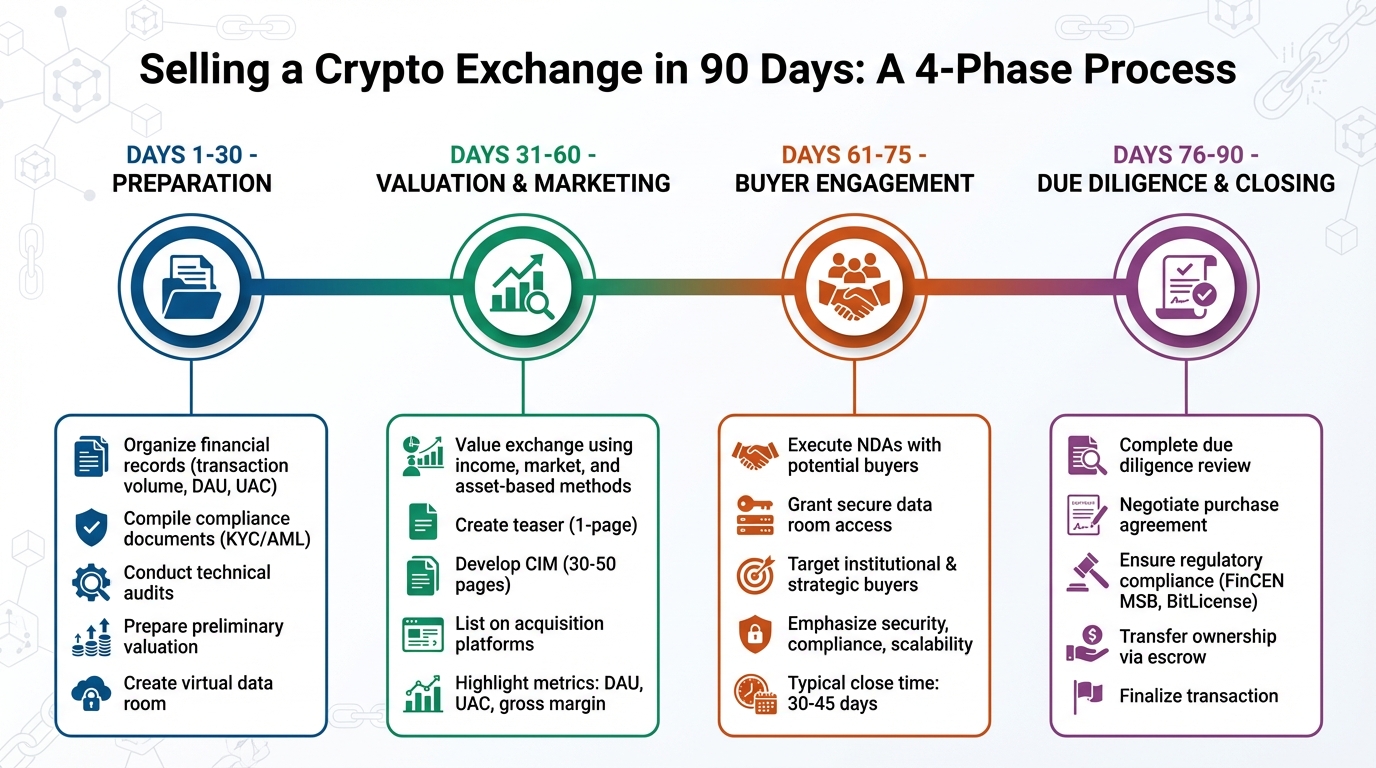
- Phase 1 (Days 1–30): Organize financial records, compliance documents (KYC/AML), and technical audits. Prepare a preliminary valuation using metrics like transaction volume, DAU, and User Acquisition Cost (UAC).
- Phase 2 (Days 31–60): Value your exchange using income, market, or asset-based methods. Create professional marketing materials, including a teaser and Confidential Information Memorandum (CIM). List on platforms like MyReadyMade to attract serious buyers.
- Phase 3 (Days 61–75): Engage potential buyers through NDAs and secure data rooms. Target both institutional and strategic buyers while emphasizing metrics like security, compliance, and scalability.
- Phase 4 (Days 76–90): Finalize due diligence, negotiate the purchase agreement, and close the deal. Ensure compliance with federal and state regulations, including FinCEN MSB registration and, if applicable, a BitLicense.
Days 1-30: Preparing Your Exchange for Sale
The first month is all about laying the groundwork for a smooth and successful sale. Buyers will dig deep into every aspect of your exchange, so being prepared now can help you avoid delays and secure a better deal. This phase focuses on organizing records, mitigating operational risks, and setting a realistic price range. Getting these basics right is crucial before moving on to valuation and buyer outreach.
Organizing Financial Records and Documents
Start by pulling together all the key financial and operational data buyers will want to see. This includes transaction volumes, Daily Active Users (DAU), User Acquisition Cost (UAC), gross margins, three years of tax filings, and a current capitalization table. Break down every revenue stream - trading fees, withdrawal fees, and any interest income from lending activities.
You’ll also need to gather corporate governance documents, such as state formation paperwork, board meeting minutes, service contracts, employment agreements, and intellectual property (IP) assignments. To make the process easier, create a virtual data room with neatly organized folders for quick access during due diligence.
Compliance is critical. Collect all KYC (Know Your Customer) and AML (Anti-Money Laundering) records to demonstrate your regulatory adherence. Prepare legal opinion letters that clarify whether your listed tokens are classified as securities or commodities, and ensure you have copies of all relevant state or national licenses. As Exit Advisor points out, "Regulatory compliance, including adherence to KYC and AML regulations, can serve as a competitive advantage" [1].
From a technical perspective, buyers will expect to see smart contract audit reports from reliable firms like CertiK or PeckShield. Include penetration test results, whitepapers, and access to your GitHub repositories or source code. Addressing these technical and regulatory requirements early can prevent surprises that might derail the sale later.
Finally, require potential buyers to sign a solid Non-Disclosure Agreement (NDA) before sharing any sensitive information. This protects your business data and user information throughout the process.
Improving Operations to Increase Value
This is the time to strengthen your operations and address any weaknesses that could hurt your valuation. One key area to focus on is leadership. If your exchange depends too much on you as the founder, buyers may see this as a risk. Diversify leadership roles, document succession plans, and ensure your team can run the business independently [3].
Another area to optimize is your matching engine. Faster execution speeds and lower slippage can attract high-volume traders, boosting revenue. Upgrading your security infrastructure with multi-signature wallets and cold storage solutions not only meets operational standards but also makes your exchange more appealing to buyers.
Switching to GAAP-based accrual accounting is another smart move if you haven’t done so already. According to BDO, "Accrual basis financial statements consistent with GAAP are table stakes in today's M&A processes and ensure both the buyer and your own advisors are all operating off reliable financial information" [3]. A Quality of Earnings (QoE) report can also validate your financials and build buyer confidence.
Track and document the metrics institutional buyers care about, like DAU, UAC, gross margin, and sales efficiency. Additionally, formalize partnerships with wallet providers and payment processors. These relationships signal broader market connections and reduce integration risks for potential buyers.
Once you've addressed these areas, you’ll be ready to secure a data-backed valuation.
Getting a Preliminary Valuation with MyReadyMade
With your records in order, use MyReadyMade's AI-powered valuation tool to get an initial price range. This tool analyzes metrics like transaction volume growth, daily active users, user acquisition cost, and gross margins to produce a data-driven estimate, giving you a solid starting point for negotiations.
You’ll also need to identify "add-backs" - one-time expenses that temporarily reduce your EBITDA. These might include relocation costs, excess owner compensation, or unusual disruptions. Adjusting for these helps reflect your exchange’s true earning potential. Wendy G. Marcari of Epstein Becker & Green explains, "A valuation will typically be based on a multiple of the last 12 months' earnings before interest, taxes, depreciation, and amortization (EBITDA)" [6]. Normalizing these figures ensures buyers see the full picture of your profitability.
MyReadyMade’s tool uses multiple valuation methods, including the Income Approach (Discounted Cash Flow), the Market Approach (comparing to similar recent sales), and the Assets Approach (assets minus liabilities). For crypto exchanges, it also factors in intangibles like brand presence, proprietary technology, and matching engine performance.
Days 31-60: Valuing and Listing Your Exchange
With your financials in order and operations running smoothly, the next step is to ensure your exchange is accurately valued and your listing grabs attention. This phase is all about striking the right balance - using realistic valuation techniques while crafting professional marketing materials. The goal? Attract serious buyers while safeguarding sensitive information until an NDA is signed.
How to Value a Crypto Exchange
Valuing a crypto exchange involves equity-focused models that consider cash flow, revenue, and industry benchmarks. The three primary approaches are:
- Income Approach: Discounted Cash Flow (DCF) analysis.
- Market Approach: Comparing recent sales of similar businesses.
- Assets Approach: Subtracting liabilities from assets.
As Ankura Consulting Group puts it:
The standard valuation toolkit remains foundational to a rigorous valuation analysis, whether valuing blockchain and crypto companies or otherwise [7].
Adjust EBITDA to account for non-recurring expenses, like one-time legal fees or excess owner compensation. A Quality of Earnings (QoE) report, typically costing $5,000 to $10,000, can validate these adjustments and address potential buyer concerns during due diligence [9].
Key factors influencing valuation include transaction volume growth, Daily Active Users (DAU), regulatory compliance (e.g., KYC/AML protocols), and strong security measures like cold storage and multi-signature wallets. Institutional buyers pay close attention to metrics like Lifetime Value (LTV), Customer Acquisition Cost (CAC), and churn rate. For high-growth startups, a 10x revenue multiple is often used - assuming cash flow is sustainable [8].
| Valuation Driver | Metrics to Monitor | Impact on Value |
|---|---|---|
| Financial Health | Gross Margin, EBITDA | High: Establishes profitability. |
| User Engagement | Daily Active Users, Churn Rate | High: Shows platform loyalty. |
| Security | Audit History, Cold Storage % | Critical: Lowers operational risk. |
| Compliance | KYC/AML Adherence, Licenses | Critical: Appeals to cautious buyers. |
| Growth | Transaction Volume, UAC | Medium: Signals future potential. |
Hiring an M&A advisor can also boost your sale price by 6% to 25%, though success fees typically range from 2% to 5% of the final sale price [9].
Creating Your Listing on MyReadyMade
Once your valuation is set, it’s time to highlight your exchange to serious buyers. Platforms like MyReadyMade offer NDA-protected communication and access to verified buyers across 50+ jurisdictions, ensuring confidentiality until you’re ready to disclose details.
Your listing should focus on metrics that matter most to institutional buyers: transaction volume growth, DAU, User Acquisition Cost (UAC), and gross margin. Security is another major selling point - if over 90% of user assets are stored in cold storage or if multi-signature wallets are implemented, make this a standout feature [10]. As Exit Advisor explains:
Scalability and operational efficiency are not just buzzwords but critical components of their value proposition [1].
Highlight your exchange’s matching engine performance, including execution speed and minimal slippage - key factors for high-volume traders. Also, emphasize regulatory compliance by detailing your KYC/AML processes, licenses, and any legal opinions on token classifications. Exchanges adhering to frameworks like the EU’s Markets in Crypto-Assets (MiCA) report churn rates up to 40% lower than non-compliant platforms [13].
Prepare for due diligence by organizing a virtual data room with clearly labeled folders for Financials, Legal, HR, and Operations. MyReadyMade’s platform simplifies this process, with transactions typically closing in 30–45 days.
Writing a Teaser and Confidential Information Memorandum
With your exchange listed, the next step is to create marketing materials that attract buyers without revealing sensitive details. Start with a one-page teaser designed to spark interest. This document should include:
- Your market position (niche and competitive strengths).
- High-level financial highlights (revenue and EBITDA ranges).
- Growth potential.
- A transaction overview (e.g., full exit or strategic partnership) [5].
Once an NDA is signed, provide a more detailed Confidential Information Memorandum (CIM). This 30–50 page document should tell your exchange’s full story, covering:
- Executive Summary: History, ownership structure, and reasons for sale [5].
- Market & Regulatory Analysis: Industry trends, competition, and KYC/AML adherence [1] [5].
- Financial Performance: Historical data and projections, focusing on transaction volume growth, UAC, and gross margin [1] [5].
- Operations & Technology: Performance of your matching engine, blockchain scalability, and security measures like cold storage percentages and multi-signature wallets.
- Growth Opportunities: Plans for entering new markets or adding revenue streams like lending or staking [1] [5].
When presenting financial forecasts, stick to conservative estimates based on past performance. Include base, upside, and downside scenarios to show that you’ve considered risks like market volatility or regulatory shifts [5]. As BDO warns:
Tax and accounting deficiencies can derail an otherwise successful transaction [3].
Finally, emphasize your security track record. Highlight cryptographic techniques, third-party smart contract audits, and compatibility with major blockchain formats (ERC-20, BEP-20, SPL). Providing this level of detail reassures buyers that your infrastructure is ready to scale and integrate seamlessly with their operations [12].
Days 61-75: Finding and Engaging Buyers
With your listing live and marketing materials ready, it’s time to focus on connecting with qualified buyers. This stage is all about targeting the right prospects, leveraging professional networks, and securely sharing sensitive information. The digital asset M&A market is thriving, with serious buyers actively seeking opportunities like yours [2]. This phase builds on the groundwork you’ve laid, ensuring your sale progresses smoothly within the 90-day timeline.
Identifying Strategic and Institutional Buyers
Buyers come in different shapes and sizes, and understanding their motivations is key. Strategic buyers - such as larger exchanges, fintech companies, payment processors, and wallet providers - are often drawn to the immediate value your user base and infrastructure can offer. They’re looking for connections that help them expand market share or add new revenue streams without starting from scratch [1][15]. For example, a payment processor might buy your exchange to integrate crypto services into their offerings, while a larger exchange might see your platform as a gateway to a new geographic region.
On the other hand, institutional buyers - like private equity firms, venture capital funds, and family offices - use specialized tools to scout for acquisition targets. They focus on scalability, compliance, and financial health. These buyers are particularly interested in features like strong KYC/AML protocols, a high-performance matching engine, and a clear path to profitability [14][16]. It’s also worth noting that traditional financial institutions and tech companies are increasingly entering the digital asset space, acquiring exchanges to leverage existing infrastructure [2].
A growing trend to watch is infrastructure repurposing. For instance, some buyers in the mining sector are acquiring crypto businesses to use low-cost power contracts for AI applications [2]. If your exchange has standout technical assets - like a top-tier matching engine - highlight these as potential synergies. This diverse range of buyer profiles opens up significant opportunities for strategic outreach.
Using MyReadyMade's Buyer Network
Platforms like MyReadyMade can help streamline the process by connecting you with pre-qualified buyers in over 50 jurisdictions. This can shave weeks off the typical 6–12 month sale timeline [17]. Their network includes institutional investors and M&A professionals actively seeking acquisitions. By browsing Buyer Mandates, which detail what buyers are looking for, you can tailor your pitch to align with their needs.
Confidentiality is a priority. MyReadyMade uses NDA-protected communication to safeguard sensitive discussions. Once a buyer shows interest, their M&A advisory team verifies the buyer’s liquidity and readiness to proceed. This tiered system ensures that only serious buyers with verified funds gain access to your data room. With this approach, transactions often close within 30–45 days.
When engaging buyers, focus on metrics that matter: transaction volume growth, Daily Active Users (DAU), User Acquisition Cost (UAC), and gross margin [1]. Once initial interest is confirmed, secure confidentiality with NDAs before sharing detailed information.
Setting Up NDAs and Data Room Access
Before sharing any sensitive information, have every potential buyer sign a Non-Disclosure Agreement (NDA). A solicitor should draft this document to protect your trade secrets, intellectual property, and competitive advantages [17]. As Team Acquira emphasizes:
Confidentiality is of utmost importance to avoid damaging the business' reputation or causing anxiety among employees, customers, and suppliers. [17]
Once the NDA is in place, grant buyers access to a virtual data room. Organize your documents into clearly labeled folders, such as:
- Financials: Transaction volume, DAU, UAC, gross margin
- Security: Multi-signature protocols, cold storage details, cryptographic audit reports
- Compliance: KYC/AML manuals, FinCEN/MSB registrations, jurisdictional risk assessments
- Operations: Matching engine specs, scalability benchmarks
- Legal: Equity structure, counterparty consent lists, regulatory correspondence
Use a staggered approach to sharing information. Start with high-level summaries and only provide detailed documents once a buyer shows serious intent [11]. MyReadyMade’s platform tracks document access, giving you insight into which buyers are most engaged. This helps you prioritize negotiations and stay on track to close the sale within 90 days.
sbb-itb-ba142f6
Days 76-90: Due Diligence and Closing
The final stretch of selling your business requires precision and speed. At this stage, buyers will dive deep into your operations, so having your documents in order and your legal team on standby is non-negotiable. The groundwork laid in earlier phases ensures you're ready for a smooth conclusion.
Organizing Due Diligence Documents
A well-structured Virtual Data Room (VDR) is your best ally here. It should include critical documentation across several categories:
- Legal: Articles of incorporation, bylaws, and cap table.
- Compliance: AML/CFT policies, KYC procedures, SAR/STR logs, and FinCEN/MSB registration.
- Financial: Three years of audited financial statements, tax returns, and debt agreements.
- Technical: Cybersecurity audits, IT infrastructure details, and key security protocols.
- Operational: Token policies, custodial agreements, and whitepapers.
Institutional buyers typically expect at least three years of historical data before committing to a deal [20]. Make sure your records meet this standard and address any compliance gaps through independent reviews if needed. Additionally, prepare a detailed list of jurisdictions where your exchange operates to confirm compliance with local licensing and "Travel Rule" requirements [18]. Regulatory timelines vary widely - for instance, obtaining a Canada MSB registration might take one to three months, while securing an EU MiCA-compliant CASP license could extend to nine months or more [19].
As TRM Labs highlights:
Conducting comprehensive entity due diligence checks on crypto exchanges... is one of the most critical steps any financial institution will take as part of its crypto compliance program. [18]
Once your due diligence materials are ready, you can shift your focus to finalizing the deal terms.
Negotiating the Purchase Agreement
After the buyer completes their review, negotiations will move into high gear. Start with a detailed Letter of Intent (LOI) to set clear expectations and minimize disagreements during the final agreement phase [21]. The LOI should lay the groundwork for key terms like representations, warranties, and indemnification, with a focus on crypto-specific risks such as digital asset ownership, secure key management, and regulatory compliance [22].
Keep communication open with the buyer by providing regular updates. As Morgan & Westfield advises:
For buyers, no news can be bad news, so keep them up-to-date and excited about the sale. [21]
To avoid surprises, conduct a "dry run" of the closing process with your M&A advisor. This practice run helps identify and fix minor issues before the official closing. Aim to minimize the time between signing the agreement and closing the deal [21].
Completing the Transaction
The final step is executing the purchase agreement and transferring ownership. Using an escrow service can simplify this process by securely handling fund and document transfers [21]. Nowadays, many M&A closings happen virtually, with electronic document signing and escrow-based fund releases.
Before transferring digital assets, take these precautions:
- Include pre-closing test transactions to confirm wallet addresses and verify key management systems [22].
- Ensure the buyer has established their legal entity and obtained an Employer Identification Number (EIN) [21].
- If dissolving your original entity, file the necessary paperwork with the Secretary of State to avoid ongoing tax and filing responsibilities.
It's essential to comply with federal laws, such as registering with FinCEN as a Money Services Business (MSB) for any crypto exchange operating in the U.S. The buyer must also implement an AML program that includes written policies, a designated compliance officer, regular employee training, independent testing, and solid Customer Due Diligence (CDD) measures [23][24].
A cautionary tale: In February 2025, Aux Cayes Fintech Co. Ltd. (OKX) admitted to operating an unlicensed money transmitting business. They paid $84.4 million in fines and $420.3 million in criminal forfeiture after it was revealed they allowed U.S. users to bypass restrictions with VPNs and delayed implementing effective KYC/AML programs until early 2024 [23].
Payment transfers are typically made in USD via wire transfer or ACH, with funds held in escrow until all conditions are met. Retain tax and employment records for three to seven years post-sale, and ensure compliance with the Worker Adjustment and Retraining Notification (WARN) Act for employee notifications and payments during the transition. With thorough preparation, you can close the deal within the 90-day timeline and confidently move forward to your next opportunity.
US Regulatory Requirements for Crypto Exchange Sales
Selling a crypto exchange in the U.S. involves navigating a maze of regulations from agencies like FinCEN, the SEC, the CFTC, and various state-level authorities. Tackling these requirements early can help establish trust with potential buyers. Below is a breakdown of key federal and state mandates, as well as specific reviews like SEC compliance and BitLicense requirements.
Federal and State Compliance Requirements
If you're running a crypto exchange in the U.S., registering with FinCEN as a Money Services Business (MSB) is non-negotiable. This registration must be completed within 180 days of starting operations and renewed every two years via FinCEN Form 107 [25][27]. Additionally, you’re required to implement a written Anti-Money Laundering (AML) program. This program should include:
- A designated compliance officer
- Internal controls
- Employee training
- Regular independent audits [27]
On top of that, you must file Currency Transaction Reports (CTRs) for cash transactions over $10,000 and Suspicious Activity Reports (SARs) for transactions exceeding $2,000 [27][28]. As Joseph B. Evans from McDermott Will & Emery warns:
Operating a money transmitting business without an MSB or the appropriate state MTL is a federal felony. [28]
Beyond federal requirements, exchanges also need state Money Transmitter Licenses (MTLs) for every state in which they operate. Application fees vary widely, ranging from $0 to $5,000 per state, while licensing fees can cost between $0 and $3,750 [27]. Surety bond requirements range from $1,000 to $5,000,000, and net worth requirements can go from $5,000 to over $2,000,000 [27].
Before listing your exchange for sale, audit your compliance records. Make sure all FinCEN filings are current and that your state MTLs are active. The National Multistate Licensing System (NMLS) can help you verify this [27]. Some states, like Illinois, Georgia, Massachusetts, Kansas, Texas, Tennessee, and Washington, offer streamlined processes to make ownership transfers smoother [27].
Preparing for SEC and BitLicense Review
If your exchange deals in digital assets classified as securities, you'll need to register as a Broker-Dealer or an Alternative Trading System (ATS) with the SEC [26]. Exchanges offering crypto derivatives or swaps must also comply with CFTC regulations by registering as an FCM, IB, or SEF [26].
Buyers will scrutinize your SEC compliance closely. The SEC Division of Corporation Finance emphasizes:
Disclosure should be tailored to the issuer's business and presented in clear, concise, and understandable language, without overly relying on technical terminology or jargon. [32]
To prepare, compile a detailed disclosure package that includes:
- A description of your business operations
- Revenue models
- Security characteristics of listed tokens
- Management structure
- Audited financial statements [32]
If your exchange employs smart contracts, you may need to file the contract code as part of your disclosures [32]. Conduct a thorough audit to ensure your white papers and marketing materials align with these disclosures, and have third-party security audits performed on any proprietary code [32].
For exchanges serving New York residents, obtaining a BitLicense under 23 NYCRR Part 200 is mandatory [29][30]. The application fee is $5,000, and the process typically takes 12 to 18 months [27]. New York also requires a minimum surety bond or a funded account of $500,000 to protect customers [29].
The New York Department of Financial Services highlights:
Failure to submit all of these items, as described, is the most common reason for delays in the application process. [29]
If you're planning a sale within the next 90 days, prioritize the BitLicense application or transfer process. Use your NMLS Identification Number as a universal reference across jurisdictions to ensure consistency [29]. Additionally, confirm that your supported assets are listed on the NYDFS "Greenlist" to simplify compliance for potential buyers [29][31]. Alternatively, consider applying for a New York State limited purpose trust company charter, which allows money transmission without a separate MTL and provides fiduciary powers [29][27].
| Regulatory Authority | Requirement/License | Required For |
|---|---|---|
| FinCEN | MSB Registration | Money transmission, exchanges, custodial services |
| SEC | Broker-Dealer / ATS | Platforms trading security tokens |
| CFTC | FCM / IB / SEF | Crypto derivatives and swaps trading |
| State Regulators | Money Transmitter License (MTL) | Businesses holding or transmitting customer funds |
| NYDFS | BitLicense | Crypto businesses serving New York residents |
Having a solid compliance program isn't just about avoiding legal trouble - it also builds trust with buyers. As Carlton Fields explains:
A strong compliance program safeguards against legal risks and enhances trust with customers, partners, and investors. [26]
Conclusion: Completing Your Sale in 90 Days
Wrapping up, early preparation, accurate valuation, and strict compliance are the cornerstones of successfully selling your crypto exchange within 90 days.
Selling a crypto exchange in such a short timeframe is no small feat, especially when the typical sale process for a tech company can stretch over 4 to 6 months or more [3]. However, by organizing financial records, consolidating intellectual property, and assembling your deal team early, you can significantly speed up the process.
A strong valuation is non-negotiable. It serves as the backbone of your deal. Whether you use income-based, market-based, or asset-based methods, focus on metrics like transaction volume, daily active users (DAU), and user acquisition costs (UAC) to establish a price that’s both realistic and defensible. As Crowell points out:
The business valuation lays the foundation for the transaction and helps to structure the terms of the deal [4].
Compliance is another critical factor. Demonstrating adherence to KYC and AML regulations reassures buyers and reduces risks, making your exchange more attractive - especially to institutional investors. With the CFTC hinting that a simplified regulatory framework for digital assets might emerge within 12 to 18 months [33], exchanges with strong compliance practices are in higher demand.
Platforms like MyReadyMade can simplify the process. With tools like AI-powered business valuation, a network of verified buyers, and support for license transfers in over 50 jurisdictions, they enable faster transactions. Their average close time of 30 to 45 days proves that, with the right tools and preparation, even highly regulated markets are navigable.
Key Points for Crypto Exchange Sellers
To finalize your sale strategy, focus on these essential steps:
Organize your records: Create a secure digital data room for all key documents. As Matthew Moisan and Ryan Flynn highlight:
Having an organized data site is not only an efficient way to share information, but also demonstrates to the potential buyer that you are a serious company [4].
Centralize intellectual property: Ensure all employee and contractor IP assignments are signed, and confirm that regulatory filings and licensing documents are up to date.
Build a professional deal team: Include M&A attorneys and CPAs experienced in preparing GAAP-compliant financials. BDO warns:
Tax and accounting deficiencies can derail an otherwise successful transaction [3].
Track buyer-relevant KPIs: Metrics like transaction volume, gross margin, and DAU are crucial. Document EBITDA adjustments to highlight your exchange’s value.
Enforce NDAs and maintain competition: Require strict NDAs before granting access to your data room. Use MyReadyMade’s buyer network to maintain a competitive bidding process, minimizing the risk of last-minute renegotiations.
Address "key man risk": Spread critical responsibilities across your management team to reduce reliance on any single individual, including yourself as the founder [3].
Prepare for due diligence: Ensure all material contracts, regulatory filings, and licenses are readily accessible in your virtual data room. Advanced security measures like multi-signature wallets and cold storage can also serve as key selling points, especially for institutional buyers [1].
FAQs
What factors determine the value of a crypto exchange?
The worth of a crypto exchange hinges on several critical elements. These include its financial performance - factors like revenue, EBITDA, and growth trends play a major role. The trading volume on the platform and the size of its user base are also key indicators of its market strength. Another vital aspect is the depth of liquidity the exchange offers, which directly impacts trading efficiency and user experience.
Equally important are security protocols and regulatory compliance. These create a foundation of trust, reassuring both users and potential investors. Beyond these, the scalability of the platform's technology, its operational efficiency, and how it stacks up against competitors in the market further shape its valuation. A strong mix of these factors not only boosts the exchange's market value but also makes it more appealing to prospective buyers.
What steps should I take to comply with U.S. federal and state regulations when selling my crypto exchange?
To stay compliant, begin by establishing a strong KYC/AML program to verify users and prevent any unlawful activities. Make sure to register your business with federal agencies like FinCEN and obtain any required state money transmitter licenses. If your exchange handles tokens or assets that might fall under the category of securities, it's crucial to meet SEC disclosure requirements and adhere to all applicable regulations.
Partnering with knowledgeable legal counsel is essential for navigating these rules, keeping detailed records of your compliance measures, and addressing any state-specific obligations. Taking these steps early on can simplify the sale process and ensure you're fully aligned with regulatory expectations.
What are the best ways to attract buyers while keeping the sale of my crypto exchange confidential?
To attract serious buyers while safeguarding confidentiality, it’s essential to work with a reliable M&A advisor or broker. They can help screen potential buyers and promote your business discreetly. Always require interested parties to sign a non-disclosure agreement (NDA) before sharing any sensitive details. Additionally, use a secure virtual data room with restricted access, watermarked files, and activity tracking to maintain control over who accesses your information.
When sharing details, take a phased approach. Start with a high-level overview and only provide more in-depth materials, like a confidential information memorandum (CIM), to buyers who meet your qualifications. Centralize all communication through your advisor to maintain consistency and minimize the risk of information leaks. These steps not only help you engage serious buyers but also ensure your business’s sensitive details remain protected throughout the sale process.
Related Articles

Ultimate Guide to Earnout Negotiations in M&A
Structure and negotiate earnouts in regulated M&A with clear metrics, anti-manipulation covenants, and acceleration or escrow protections.
How to Draft M&A Definitive Agreements
Guide to drafting M&A definitive agreements covering deal structure, reps & warranties, indemnities, payment terms, and regulatory compliance.
How IP Affects Tokenization Valuation
How tokenizing patents, copyrights, and trademarks adds liquidity and market value—plus legal, regulatory, and valuation steps.
Looking to Buy or Sell?
Get in touch with our team for personalized assistance