Top Clauses in M&A Agreements

Top Clauses in M&A Agreements
In mergers and acquisitions (M&A), especially in regulated industries like iGaming, Cryptocurrency, Forex, and Fintech, certain contract clauses can make or break a deal. These agreements are not just about price - they’re about managing risks, navigating regulations, and ensuring both parties are protected. Here’s what you need to know:
- Purchase Price Adjustments: Ensures the final price matches the company’s actual financial state at closing. Common methods include Net Working Capital (NWC) adjustments.
- Representations and Warranties: Sellers disclose key details about compliance, taxes, and liabilities, while buyers use this to mitigate risks.
- Indemnification Provisions: Clarifies who pays for breaches or undisclosed liabilities post-closing. Caps, baskets, and survival periods are key here.
- Conditions Precedent: Regulatory approvals, license transfers, and other conditions must be met before closing.
- Efforts Clauses: Defines the level of action required to secure regulatory approvals, ranging from “reasonable efforts” to “hell-or-high-water” obligations.
- Post-Closing Covenants: Includes non-compete agreements, license transfers, and financial reconciliations to ensure smooth transitions.
- Regulatory and Tax Compliance Clauses: Addresses compliance with industry-specific regulations and tax liabilities to avoid penalties.
- Confidentiality and Non-Solicitation: Protects sensitive information and prevents poaching of employees or clients.
- Dispute Resolution Mechanisms: Arbitration and expert determination are often preferred for faster, private resolutions.
- Governing Law and Jurisdiction: Specifies which legal system governs the agreement and where disputes will be resolved.
Failing to address these clauses properly can result in costly penalties, regulatory hurdles, or unexpected liabilities. Platforms like MyReadyMade offer tailored M&A advisory services to streamline these processes and mitigate risks.
Indemnification in Mergers & Acquisitions Explained
1. Purchase Price Adjustments and Mechanisms
In most M&A deals, the purchase price agreed upon during negotiations often doesn't match the target company's actual financial condition at the time of closing. Changes in cash flow, inventory levels, and receivables between these two points can significantly impact the deal. That's where purchase price adjustment clauses come into play. These clauses act as a "true-up" mechanism, ensuring that the final payment aligns with the business's actual state when ownership is transferred [4][6]. Interestingly, about 80% of M&A deals now include these adjustment mechanisms - an increase from roughly 50% a decade ago [6].
One common method is Net Working Capital (NWC) adjustments. These are calculated as the difference between current assets and current liabilities, ensuring the business has enough liquidity to operate. Here’s how it works: the buyer and seller agree on a "target amount", typically based on the company's trailing 12-month average working capital. If, at closing, the actual working capital is below this target, the purchase price is reduced dollar-for-dollar. Conversely, if it exceeds the target, the price increases. For instance, in the Mehiel v. Solo Cup Company case, a $5.6 million facility was classified as a long-term asset, leading to a $5.6 million price reduction [4].
The adjustment process generally unfolds in three steps:
- First, the seller provides an estimated adjustment at closing.
- Next, the buyer submits a final calculation, typically within 60–90 days.
- Finally, any disputes are resolved by an independent accounting firm, following GAAP standards [3].
Interestingly, data shows that buyers benefit from closing adjustments 48% of the time, while sellers only come out ahead in 17% of cases [5].
"The rationale for a Net Working Capital Adjustment is that the target business needs a minimum amount of net working capital in order for its operations to be continued by the buyer in the ordinary course after the closing." – Ballard Spahr LLP [3]
To avoid confusion, it's a good practice to attach a detailed schedule showing which line items are included in the working capital calculation [3]. This can prevent disputes like the one in Brim Holding Company, Inc. v. Province Healthcare Company. In that case, a $50,000 litigation reserve reduced working capital and also triggered a double recovery through a separate indemnity provision. To avoid such scenarios, agreements should clearly state that the same item cannot be adjusted through both a purchase price adjustment and an indemnification claim [4].
2. Representations and Warranties
After purchase price adjustments, sellers are also required to provide clear representations and warranties. These are essentially the seller's formal assurances about the business's key aspects, such as ownership and compliance with regulations. They serve several purposes: ensuring full disclosure, giving buyers the option to back out if any statements are proven false before closing, transferring financial risks to the seller, and encouraging accurate disclosures [10].
In most middle-market transactions, sellers typically provide between 25 and 40 representations, while buyers only offer around 5 [8]. These representations fall into two main categories:
- Fundamental issues: These cover critical areas like corporate authority, ownership, title, and broker's fees. These warranties often last for 3 to 6 years or, in some cases, indefinitely.
- General matters: These address topics like financial statements, legal compliance, material contracts, intellectual property, and undisclosed liabilities. These warranties usually expire within 12 to 18 months [7][8].
To ensure clarity, disclosure schedules are used to list any exceptions to the seller's representations. For instance, if a company is involved in litigation, this would be detailed in a schedule (e.g., "the company is not in litigation, except as listed in Schedule X"). Courts and insurers rely on these schedules rather than informal due diligence notes [11]. Notably, 98% of M&A deals include a "no undisclosed liabilities" clause, and 93% address legal compliance [11].
"Reps and warranties are not only about what is and is not. They reflect the parties' understanding of which party will bear the burden of losses that arise from certain events or circumstances." – Erik Lopez, Partner, Jasso Lopez PLLC [10]
Sellers often use knowledge qualifiers - phrases like "to the seller's knowledge" - to limit their responsibility to what key executives (like the CEO or CFO) are actually aware of. On the other hand, buyers may push for a broader standard, such as "constructive knowledge", which includes what the seller should reasonably know after proper investigation [7][9].
In transactions without Representations and Warranties Insurance, financial protections like indemnity caps are typically set between 8% and 12% of the purchase price. Additionally, the median "basket" (the deductible amount before claims can be made) is about 0.5% of the purchase price [7][8].
3. Indemnification Provisions
Once representations and warranties set the stage for baseline disclosures, indemnification provisions step in to clarify who bears the responsibility for breaches. These provisions are essentially a safety net, requiring the seller to compensate the buyer for losses tied to breaches of representations, warranties, or covenants.
"Indemnification is a contractual remedy and risk allocation mechanism that the parties to an M&A transaction negotiate to address certain post-closing issues and losses." – Danielle Rosato and Tracy Belton, Arnold & Porter [15]
Indemnification typically revolves around three main components: caps, baskets, and survival periods. Caps limit the seller’s liability, often to 50% of the purchase price for general breaches and up to 100% for more critical issues like fundamental representations [13]. Baskets, on the other hand, set thresholds for losses - tipping baskets impose full liability once the threshold is reached, while deductible baskets only cover losses exceeding that threshold [14]. Survival periods determine how long indemnification obligations remain active, usually lasting 12–18 months for general matters, but sometimes indefinitely for fundamental issues [13].
In regulated industries, buyers often negotiate indemnities to address specific risks identified during due diligence. To ensure funds are available, 10–20% of the purchase price is commonly held in escrow [16].
Most agreements also include key provisions like fraud carve-outs, anti-sandbagging clauses, and stipulate that indemnification serves as the sole post-closing remedy - fraud being the notable exception [12].
4. Conditions Precedent and Termination Rights
Before finalizing an M&A deal, both parties must satisfy specific conditions precedent - essentially, the final hurdles before closing. In heavily regulated industries like iGaming, Fintech, Crypto, and Forex, these conditions are especially strict. They often involve regulatory approvals and license transfers, which can significantly impact whether a deal moves forward. These requirements act as safeguards, ensuring both parties are protected in such high-stakes transactions.
The most critical of these conditions in regulated sectors is regulatory approval. Authorities such as gaming commissions, financial regulators, and central banks must sign off on the transaction before it can close [17][20]. Another key factor is meeting licensing requirements, which ensures the buyer can either obtain or transfer the necessary operational licenses [2]. Additional conditions often include confirming the accuracy of warranties at closing (known as the "bring-down" of representations), obtaining third-party consents from crucial partners like vendors or payment processors, and ensuring no legal barriers, such as injunctions, interfere with the deal [17][19][20].
"The primary purpose of closing conditions is to protect the parties against unforeseen contingencies that may arise between the signing of the acquisition agreement and the closing of the deal." – Guiding Legal Counsel [17]
Once these conditions are met, the focus shifts to termination rights, which outline when either party can back out of the deal. These rights are critical for protecting both sides if unforeseen issues arise. For example, the "drop-dead" date allows either party to terminate if the required conditions aren't met by a specific deadline [19][20]. Other triggers include material breaches of promises or obligations (often after a chance to fix the issue), a Material Adverse Change (MAC) that significantly reduces the target's value, or the failure to secure necessary financing [19][20][21]. A Delaware Court ruling clarified that a "knowing and intentional" breach doesn’t require malicious intent but does involve deliberate non-compliance [21].
To minimize disputes, it's crucial to clearly define terms like "commercially reasonable" versus "best efforts" when pursuing regulatory approvals. Additionally, aligning drop-dead dates with financing expiration dates can help avoid complications [18][22]. Sellers, in particular, should negotiate firm outside dates to reduce exposure to market fluctuations, while buyers should push for updated disclosure schedules at closing to account for any changes during the process [17][20].
For businesses navigating these complexities in regulated M&A deals, platforms like MyReadyMade provide tailored support to address these critical aspects effectively.
5. Efforts Clauses
Efforts clauses play a crucial role in ensuring that regulatory approvals are obtained between the signing and closing of a deal. These provisions outline the level of commitment each party must uphold to overcome potential hurdles - whether it’s securing a gaming license, obtaining antitrust clearance, or addressing foreign investment regulations. In industries like iGaming, Fintech, Cryptocurrency, and Forex, regulatory approvals are often the linchpin for deal completion. Efforts clauses help assign the risks tied to delays or outright denials of these approvals.
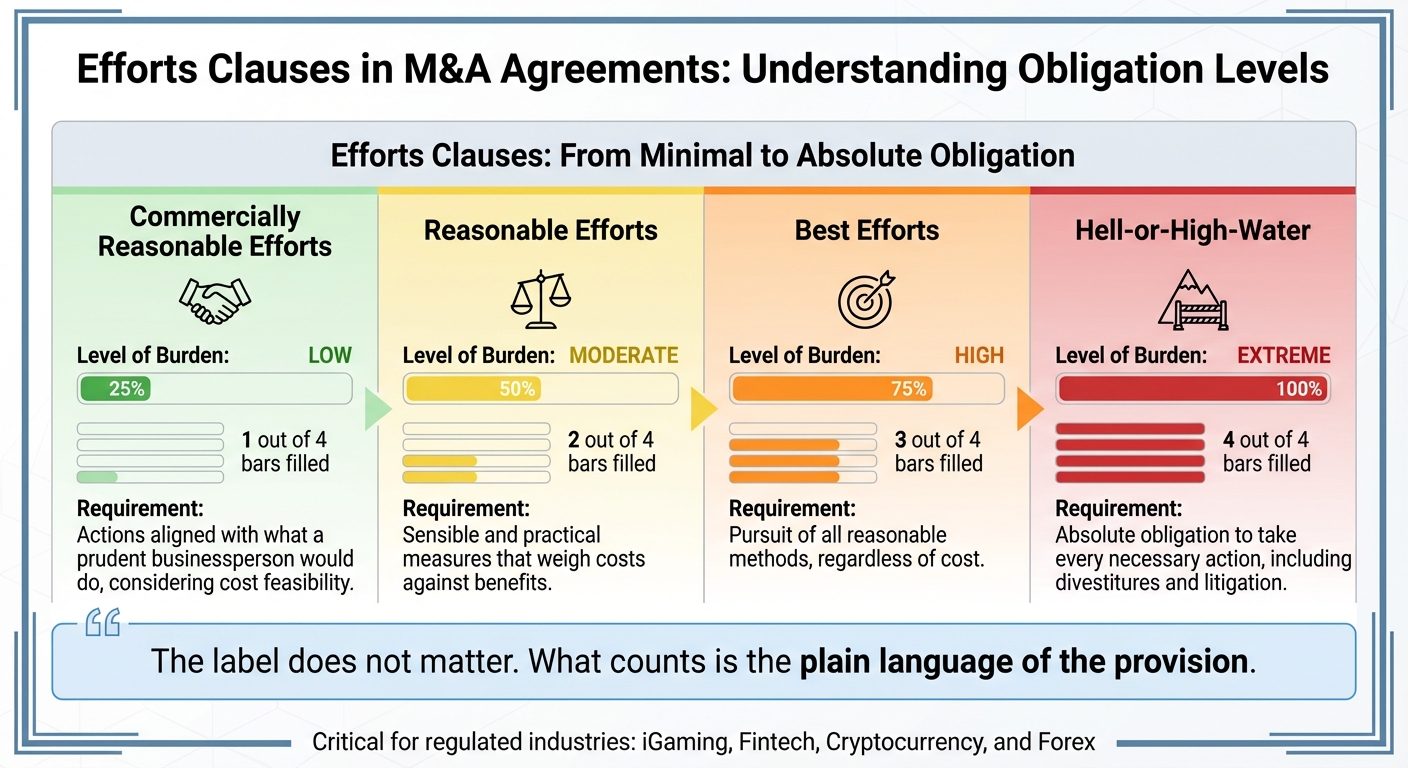
The wording of these clauses is critical, as terms like "best efforts" and "reasonable efforts" are interpreted with precision. As one expert put it, "The label does not matter. What counts is the plain language of the provision." To better understand the nuances, here’s a breakdown of common effort standards and their implications:
| Effort Standard | Level of Burden | Requirement |
|---|---|---|
| Commercially Reasonable | Low | Actions aligned with what a prudent businessperson would do, considering cost feasibility. |
| Reasonable | Moderate | Sensible and practical measures that weigh costs against benefits. |
| Best | High | Pursuit of all reasonable methods, regardless of cost. |
| Hell-or-High-Water | Extreme | An absolute obligation to take every necessary action, including divestitures and litigation. |
Real-world cases illustrate the risks of poorly defined efforts clauses. Take the failed $54 billion Anthem-Cigna merger, for example. In August 2020, the Delaware Court of Chancery found that Cigna violated its "hell-or-high-water" clause by undermining Anthem’s efforts to defend against a Department of Justice antitrust challenge. As Quinn Emanuel explained:
"Effort does not guarantee a desired outcome - either regulatory approval or a closing."
Another example is the December 2018 deal between Rent-A-Center and Vintage Capital. Vintage failed to provide written notice to extend the drop-dead date of December 17, 2018, even though negotiations with the FTC were ongoing. This oversight allowed Rent-A-Center to terminate the deal on December 18 and secure a $126.5 million breakup fee.
These examples underscore the importance of clearly defining both required and excluded obligations in efforts clauses. Avoid vague language and instead specify actions in detail. For instance, clarify whether a party must appeal a regulatory denial or defend a permit in court. To manage risks, set financial caps and objective criteria like filing deadlines. Also, make it clear what actions are not required, particularly those that could threaten a party’s financial stability or strategic goals.
For regulated industries, well-constructed efforts clauses are essential. Platforms like MyReadyMade offer expert M&A advisory services to help structure these provisions effectively, ensuring clarity and minimizing risks.
6. Post-Closing Covenants and Obligations
After carefully navigating pre-closing and closing processes, post-closing covenants play a crucial role in ensuring the smooth operation of a business after a transaction. These agreements hold both parties accountable and protect the buyer's interests, especially in regulated industries like iGaming, Fintech, Cryptocurrency, and Forex. They cover everything from license transfers to retaining critical knowledge.
Non-compete and non-solicitation agreements are key components of these covenants. These agreements typically prevent sellers from starting competing businesses or soliciting customers and employees for a period of two to five years [23]. As Robert Connolly, Partner at Levenfeld Pearlstein, puts it:
"Covenants operate as formal agreements critical to maintaining the value of a target company" [23].
Such restrictions are essential for maintaining operational continuity, particularly in heavily regulated sectors. But restrictive covenants are just one piece of the puzzle - transitional arrangements are equally important.
Transition Services Agreements (TSAs) act as a bridge, ensuring the business remains functional while the buyer sets up independent systems. These agreements often cover critical functions such as IT support, payroll, finance, and administrative tasks. For instance, IT services might require up to 12 months to transition, while simpler functions like payroll could be completed in just three months [26]. In industries like Fintech and Cryptocurrency, TSAs may also address platform uptime, shared software licenses, and data security measures to avoid service interruptions.
Regulatory compliance obligations are another non-negotiable aspect. Post-closing covenants must outline the seller’s role in transferring business licenses, notifying government agencies of ownership changes, and updating intellectual property assignments [24]. Sellers are also expected to provide access to key technical staff to ensure a smooth transfer of knowledge. These steps are critical to maintaining compliance and setting the stage for final financial adjustments.
Financial adjustments round out the post-closing process. Net Working Capital (NWC) reconciliations typically occur 30 to 90 days after closing [25], ensuring the buyer receives the agreed-upon cash, user balances, and working capital. In fast-paced sectors like Fintech and Crypto, earnouts are often used to address valuation gaps, with future performance metrics serving as benchmarks. Clearly defining the methods and timelines for these calculations helps avoid disputes. For expert advice on structuring these provisions, platforms like MyReadyMade offer M&A advisory services tailored to regulated industries.
7. Regulatory and Tax Compliance Clauses
In industries like iGaming, Fintech, Cryptocurrency, and Forex, regulatory and tax compliance clauses play a crucial role in shielding both parties from unexpected liabilities and regulatory hurdles. While representations and indemnification clauses establish a framework for risk allocation, compliance clauses go a step further by addressing potential operational and financial risks after the transaction closes.
Regulatory compliance clauses focus on meeting industry-specific standards. As highlighted in ICLG's Mergers & Acquisitions guide:
"Certain industries, such as public utilities, insurance, gaming, banking, media, transportation and mining, are highly regulated, and therefore subject to industry-specific rules that regulate the ability of any acquirer, whether U.S. or foreign, to engage in business combinations" [1].
For foreign buyers, the Committee on Foreign Investment in the U.S. (CFIUS) evaluates transactions to address national security concerns, especially in areas like data privacy, IT, and telecommunications - key elements in many Fintech and Crypto transactions [1]. Additionally, the Hart-Scott-Rodino (HSR) Act mandates notification and waiting periods for larger deals, with penalties for non-compliance reaching $53,088 per day [1]. Securing the necessary licenses is often a critical step before the deal can close [2].
Tax compliance clauses serve two main purposes: ensuring sellers disclose historical tax liabilities and establishing a foundation for indemnification claims. These clauses require sellers to provide detailed information about their tax filings, payment histories, audit records, and any ongoing examinations across all jurisdictions where they operate [27]. Such clauses typically remain active for the duration of the statute of limitations, plus an additional 60 days [27].
To avoid potential tax issues after closing, pre-closing tax covenants are often included. These covenants restrict sellers from actions like altering accounting methods, filing amended returns, or settling tax audits in ways that could increase the buyer's tax burden [27]. Buyers may also include withholding rights, allowing them to deduct applicable taxes - such as those required under FIRPTA - from the purchase price [27]. In many M&A transactions, 10% to 20% of the purchase price is held in escrow to address post-closing indemnification needs, including those related to tax and regulatory breaches [2].
Given the complexity of these requirements, expert guidance is essential. For businesses operating in regulated sectors, MyReadyMade (https://myreadymade.com) offers specialized M&A advisory services, including support for license transfers across more than 50 jurisdictions. Their expertise ensures that compliance clauses are structured and executed effectively, helping businesses navigate regulatory and tax challenges with confidence.
8. Confidentiality and Non-Solicitation
In M&A deals, safeguarding proprietary information and personnel is just as crucial as addressing financial and regulatory concerns. Confidentiality and non-solicitation clauses are essential tools for protecting these assets from the very beginning. As Jacob Orosz, President of Morgan & Westfield, wisely points out:
"The non-disclosure agreement (NDA) is the first document to be signed in a transaction and establishes the negotiation framework" [29].
This initial step sets the stage for clear and enforceable non-solicitation terms.
Confidentiality clauses should be comprehensive, covering all information exchanged during the transaction. The definition of "shared information" must be broad enough to include all forms of data, ensuring it is used exclusively for evaluating the potential deal [28]. A landmark case in May 2012, Martin Marietta Materials Inc. v. Vulcan Materials Co., highlighted the importance of these clauses. The Delaware Court of Chancery ruled that Martin Marietta violated confidentiality agreements by leveraging merger discussions to attempt a hostile takeover. The result? A four-month injunction that reinforced the importance of "permitted use" restrictions [30].
Non-solicitation clauses are equally critical. These provisions prevent buyers from soliciting the seller's employees, customers, or suppliers. A stricter variation, the "no-hire" clause, goes a step further by prohibiting employment offers altogether. These clauses typically include language that restricts the buyer from "directly or indirectly" influencing any party to change their business relationship with the seller [28] [32]. While durations vary, one year is the most common, though some agreements extend up to 18 to 24 months.
When sensitive information is involved - especially in deals with direct competitors or within high-tech industries - a phased disclosure strategy is highly recommended. This approach delays the sharing of critical data until a Letter of Intent is signed [32]. For particularly sensitive cases, a "clean team" approach may be employed. Under this model, only individuals who are removed from the buyer's daily competitive operations review the confidential data. To further safeguard information, avoid clauses that allow employees to rely on details stored in their "unaided memory" [31].
Given the challenges of proving monetary damages in cases of confidentiality breaches, agreements should explicitly allow for injunctive or equitable relief. As Destiny Aigbe, a Securities Attorney, explains:
"Monetary damages are often extremely difficult for a plaintiff to prove as a result of a breach of a confidentiality agreement. Consequently, a discloser's best opportunity for recourse may be to seek injunctive or equitable relief" [28].
Finally, it’s critical that the agreement extends its reach to all representatives of the buyer - including consultants and financing sources. This can be achieved by requiring these parties to either adhere to the NDA or sign separate joinders, ensuring full accountability across the board [32].
9. Dispute Resolution Mechanisms
When M&A deals hit a roadblock, drawn-out litigation can be a costly and risky path. It not only consumes resources but also risks exposing sensitive proprietary information. Instead, arbitration and mediation offer faster, more private ways to address disputes, preserving the confidentiality critical to regulated transactions.
Arbitration has become the preferred choice for resolving cross-border M&A disputes. In fact, cross-border M&A activity has grown significantly, with deal volume rising from about $395 billion in 1997 to $950 billion in 2023 [33]. Jonathan M. Moses, a Partner at Wachtell, Lipton, Rosen & Katz, highlights the key reasons behind this trend:
"The reasons for choosing arbitration in a cross-border context may include the perception that an arbitral tribunal will be more neutral than a national court, the confidentiality of arbitration, the greater ease of enforcing an arbitral award in the relevant jurisdictions, the ability to select arbitrators with the relevant technical or financial expertise and the greater control that the parties will have over procedural matters" [33].
For industries like iGaming and Fintech, where confidentiality is paramount, arbitration ensures that sensitive business models and financial data stay out of public court records. Parties can choose arbitrators with expertise in specific areas - such as cryptocurrency regulations or gaming licenses - while also benefiting from the international enforceability of arbitral awards under the New York Convention. The growing demand for quick resolutions is evident, with emergency arbitration applications at the International Chamber of Commerce (ICC) increasing from 10 in 2015 to 27 in 2021 [33].
For disputes involving technical matters, such as working capital adjustments or earn-out calculations, expert determination is a practical option. This process relies on an independent auditor or industry specialist to resolve factual accounting issues efficiently, without the procedural complexities of formal arbitration [33][35]. It’s essential, however, to specify in the agreement that the expert is "acting purely as an expert, not as an arbitrator" to limit judicial review [33].
For companies incorporated in Delaware seeking expedited resolutions, the Delaware Rapid Arbitration Act (DRAA) offers a unique solution. It requires arbitrators to issue a decision within 180 days, ensuring both confidentiality and speed - critical for time-sensitive approvals [34].
10. Governing Law, Jurisdiction, and Miscellaneous Provisions
Governing law and jurisdiction clauses are essential to ensuring the enforceability of contracts, particularly in highly regulated markets. While dispute resolution provisions focus on resolving conflicts, these clauses establish the legal framework under which disputes will be interpreted and resolved. This becomes especially important in cross-border M&A agreements within industries like iGaming, Cryptocurrency, and Fintech, where regulatory oversight is often complex.
Why Governing Law Matters
Selecting a governing law provides clarity and predictability in how a contract will be interpreted. Many sophisticated M&A agreements rely on well-established legal systems such as New York or English law. However, regulated industries face a unique hurdle: the split application of laws. For instance, the purchase agreement might be governed by New York law, but internal corporate matters - like shareholder rights or fiduciary duties - are typically subject to the laws of the company’s jurisdiction of incorporation. A notable example is Immunocore Ltd’s 2021 Deposit Agreement, which was governed by New York law, while the company’s shareholder rights and obligations adhered to the laws of England and Wales [37].
Precision in Jurisdiction Clauses
For cross-border deals, it’s critical to specify jurisdiction with precision. Vague terms can lead to forum shopping, so agreements should explicitly name the courts. For example, the "United States District Court for the Southern District of New York" is a common choice in M&A agreements. In 2018, Mereo Biopharma Group plc adopted this approach, using New York as the governing law and including a clause where all parties waived objections to venue in the Southern District of New York [37]. Additionally, when parties are based abroad, appointing a local process agent ensures smooth handling of legal documents [36].
Regulatory Considerations
All agreements must comply with mandatory federal statutes, regardless of the chosen governing law. For example, the Hart-Scott-Rodino Act requires antitrust filings for transactions exceeding $126.4 million as of 2025, with penalties reaching $53,088 per day for non-compliance [1][38]. Similarly, CFIUS filing fees for national security reviews are tiered, with the highest fee at $300,000 for deals valued at $750 million or more [38]. In sectors like Fintech and Cryptocurrency, agreements should explicitly state that performance is subject to local laws and regulations where assets are held [36].
Key Drafting Tips
- Exclude conflict of laws principles: Include language stating that the governing law applies "without regard to principles of conflicts of laws" to avoid courts applying another jurisdiction’s laws [36][37].
- Exclude the CISG: Opt out of the United Nations Convention on Contracts for the International Sale of Goods (CISG) to ensure only the chosen domestic law applies [37].
- Address sovereign immunity: For deals involving state-owned entities, include waivers of sovereign immunity to ensure the agreement is enforceable [36].
These drafting strategies align the contract with the overarching dispute resolution framework and help ensure that the agreement is both enforceable and compliant with applicable regulations. By addressing these nuances, parties can minimize legal risks and streamline the final stages of deal execution.
Conclusion
In regulated industries, M&A agreements are not just legal formalities - they're vital tools for managing risks and safeguarding both parties involved. The key clauses in these agreements each serve a distinct purpose. Conditions precedent ensure all necessary regulatory approvals are secured before closing. Representations and warranties provide transparency about compliance and financial stability. Indemnification provisions clarify who bears responsibility for any liabilities discovered after the deal closes. And covenants help maintain business value during the interim period.
Failing to address regulatory compliance can be costly. For instance, violations of the Hart-Scott-Rodino Act can result in penalties as steep as $53,088 per day [1]. Poorly drafted indemnification clauses may leave buyers stuck with unexpected liabilities, such as undisclosed tax debts or regulatory breaches uncovered post-closing. A notable example is the failed $54 billion Anthem-Cigna merger. The Delaware Court of Chancery ruled that Cigna violated its "hell or high water" clause, but no damages were awarded because regulators would have blocked the deal regardless [18]. This highlights the importance of precise drafting and expert legal guidance.
Crafting these agreements often requires specialized knowledge. Even defining which representations are "fundamental" - like tax compliance or ownership status - can significantly affect how long they remain enforceable.
For industries with heightened regulatory risks, platforms like MyReadyMade provide essential support. They offer verified listings, expert advisory services, and assistance with license transfers across more than 50 jurisdictions, simplifying complex processes and addressing regulatory challenges effectively.
FAQs
What is the difference between 'best efforts' and 'reasonable efforts' in M&A agreements?
The terms "best efforts" and "reasonable efforts" in M&A agreements outline different levels of commitment when working toward a goal. "Best efforts" demand the highest level of obligation, requiring a party to take every possible action to achieve the objective - even if it involves substantial costs or difficulties. On the other hand, "reasonable efforts" establish a less stringent standard, requiring a party to act diligently and in good faith, but only as far as a reasonable person would under similar circumstances.
This distinction is crucial because "best efforts" can result in stricter compliance requirements and potentially greater liability, while "reasonable efforts" provide more flexibility. To minimize misunderstandings, it’s essential to clearly define these terms in the agreement, ensuring both parties are aligned on their responsibilities and the expected level of effort.
What are indemnification provisions, and how do they protect buyers in M&A deals?
Indemnification provisions play a key role in M&A agreements, acting as a safety net for buyers against unforeseen liabilities that may arise after the deal closes. These clauses obligate the seller to cover losses stemming from breaches of representations, warranties, or other contractual commitments.
By specifying the types of claims or losses covered, setting financial caps, and defining enforcement timeframes, these provisions help protect the buyer’s investment. This becomes particularly critical in industries with higher risks or strict regulations, where hidden liabilities or inaccurately represented assets could heavily affect the acquired business's value.
Why are compliance clauses essential in M&A deals for Fintech and Cryptocurrency industries?
Compliance clauses play a key role in M&A deals within the Fintech and Cryptocurrency sectors because these industries operate under strict regulations that are constantly changing. These clauses are designed to ensure both parties comply with critical rules, including anti-money laundering (AML), know-your-customer (KYC), and securities laws, helping to avoid legal penalties and operational hiccups.
In the Cryptocurrency space, where regulatory oversight from agencies like the SEC and CFTC is becoming more intense, compliance clauses take on even greater importance. They outline responsibilities, clarify liabilities, and ensure the target company adheres to regulatory standards throughout the transaction process. By doing so, these clauses not only protect both parties involved but also encourage transparency and streamline due diligence. This makes them indispensable for managing risks in these highly regulated and high-stakes industries.
Related Articles

Ultimate Guide to Earnout Negotiations in M&A
Structure and negotiate earnouts in regulated M&A with clear metrics, anti-manipulation covenants, and acceleration or escrow protections.

How to Draft M&A Definitive Agreements
Guide to drafting M&A definitive agreements covering deal structure, reps & warranties, indemnities, payment terms, and regulatory compliance.

How IP Affects Tokenization Valuation
How tokenizing patents, copyrights, and trademarks adds liquidity and market value—plus legal, regulatory, and valuation steps.
Looking to Buy or Sell?
Get in touch with our team for personalized assistance