5 Turnaround Steps for Distressed iGaming Businesses

5 Turnaround Steps for Distressed iGaming Businesses
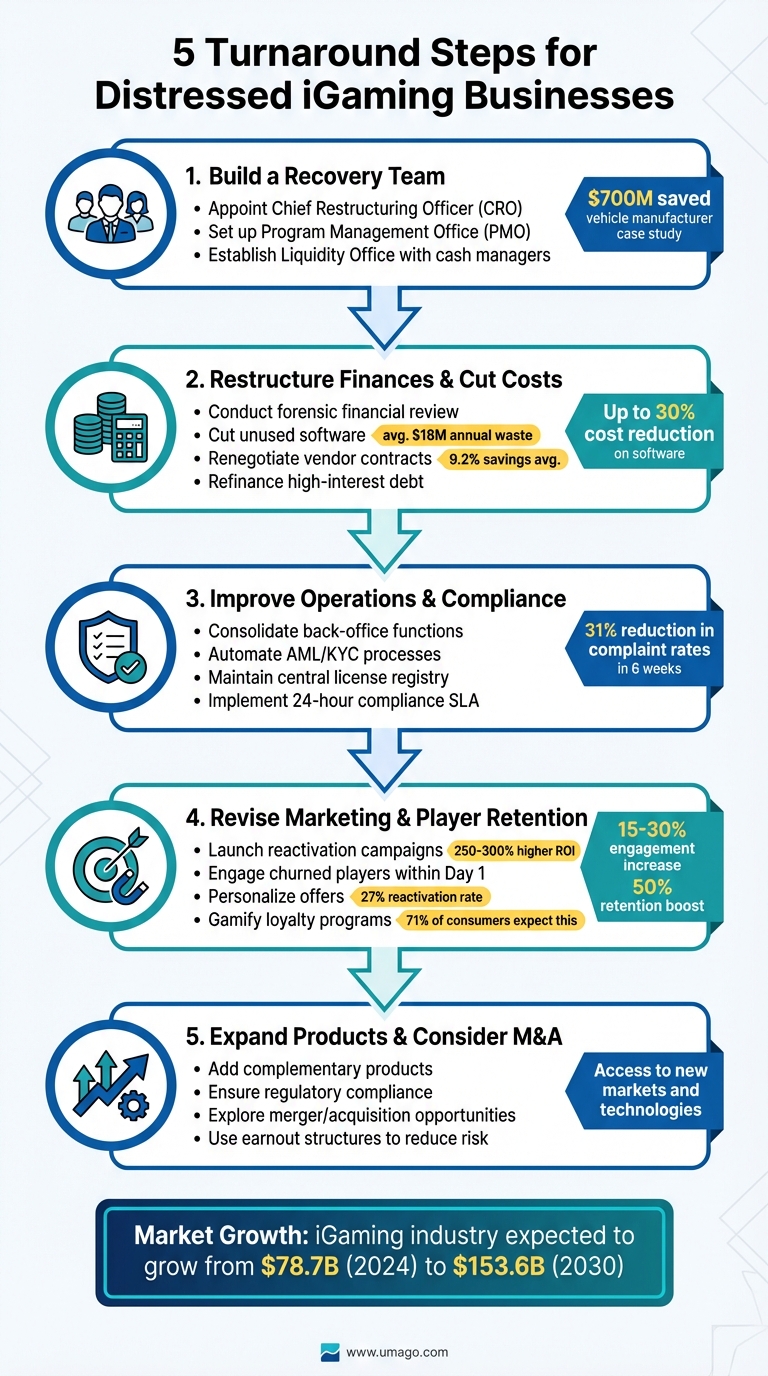
When your iGaming business is struggling, quick action can make the difference between recovery and failure. Here's a simple plan to stabilize operations, improve profitability, and set the stage for growth:
- Assemble a Recovery Team: Bring in external experts like a Chief Restructuring Officer (CRO) and set up a Program Management Office (PMO) to oversee recovery efforts and cash flow.
- Fix Finances: Audit expenses, cut unnecessary costs (like unused software), renegotiate contracts, and restructure debt for better terms.
- Streamline Operations & Compliance: Simplify workflows, automate KYC/AML processes, and stay ahead of regulatory requirements to avoid fines.
- Boost Marketing & Retention: Focus on reactivating players with personalized campaigns, improve user experience, and refine loyalty programs.
- Diversify & Explore M&A: Add complementary products and consider mergers or acquisitions to access new markets or technologies.
Key Insight: Acting early is critical. Address financial leaks, fix compliance gaps, and focus on customer retention to regain stability. If recovery isn't viable, mergers or strategic exits might be the best path forward.
DraftKings' Playbook: Profit Turnaround, Live Betting, Media Deals ft. CEO Jason Robins
1. Build a Recovery Team
When your iGaming business hits a crisis, the first step is to gather the right people to tackle the problem. In these moments, it’s crucial to lean on specialists rather than relying solely on your current management team. Think of it like bringing in trauma surgeons to handle a critical injury. Start by enlisting external experts who can lead the recovery process with a fresh perspective.
Begin by appointing a Chief Restructuring Officer (CRO) or hiring an external turnaround management specialist. These professionals focus on implementing recovery strategies while your internal team continues managing day-to-day operations [8]. Having an outsider take charge can be transformative - companies often bring in new CEOs from outside the organization to introduce fresh ideas and break away from old patterns [7]. This move sends a strong message to stakeholders that meaningful change is underway.
Next, set up a Program Management Office (PMO) to oversee the recovery process. This team is responsible for coordinating initiatives across the business, tracking progress, and holding everyone accountable [9]. Alongside the PMO, establish a Liquidity Office staffed with cash managers who can provide clear, short-term cash flow forecasts to the C-suite [9]. In times of crisis, knowing exactly where every dollar is going is non-negotiable.
From the start, assign clear roles to avoid confusion. A finance specialist should focus on liquidity forecasting and restructuring debt. An operations expert should pinpoint inefficiencies - like issues with payment gateways or compliance hurdles - that could be eating into revenue. Meanwhile, an advisory board can offer strategic guidance and ensure the recovery plan stays on course [8]. Without clearly defined responsibilities, internal delays can derail progress.
This structured approach has proven successful. For instance, one vehicle manufacturer saved $700 million in just one year by implementing a similar recovery strategy [9]. Acting early and assembling the right team significantly improves your chances of turning things around. Once your recovery team is in place, the next step is to focus on refining your financial structure.
2. Restructure Finances and Cut Costs
With your recovery team in place, it's time to focus on tightening up your financial operations. Start by conducting a forensic review of your income statement and working-capital cycle. This deep dive will help you pinpoint areas where money is consistently being lost or where cash is tied up unnecessarily [12].
The iGaming industry is particularly prone to hidden software expenses, often due to unused subscriptions that quietly drain resources. On average, businesses lose $18 million annually on unused SaaS licenses, and optimizing software usage can reduce costs by up to 30% [11]. Audit every subscription - game providers, payment processors, analytics tools, customer support platforms - and cut anything that's redundant or underutilized. For instance, Teddy Collins, Vice President of Finance at SeatGeek, highlighted the impact of this approach:
With completely integrated spend management and travel, we were able to cut T&E costs by 50% with only a 15% reduction in travel [11].
Beyond software, make it a priority to renegotiate vendor contracts regularly. Effective negotiation can save companies an average of 9.2% on total contract value [11]. Reach out to payment gateway providers, affiliate networks, and hosting services to negotiate better terms, such as extended payment schedules or volume discounts. If cash flow becomes a concern, alert your lenders early and use a 13-week cash flow forecast to identify critical periods when delaying payments might be necessary [2][4].
When it comes to debt, consider refinancing high-interest, short-term loans into longer-term, lower-cost options [13]. In the iGaming sector, stock purchases are often preferred over asset deals since gaming licenses are tied to specific corporate entities and can't be easily transferred [3]. If you're exploring outside investments or mergers, earnout structures can help mitigate risk by linking payments to future performance metrics like revenue growth or player retention [3].
Labor costs are another area to approach strategically. While it's important to trim expenses, prioritize retaining key talent critical to your long-term recovery [2]. Transitioning to remote or hybrid work models can reduce overhead while boosting productivity [11]. Additionally, automating administrative tasks - such as accounting - can deliver a significant return, with some companies seeing an ROI of up to 200% in the first year [11]. The ultimate goal is not just to survive but to build a leaner, more agile operation that can adapt as market conditions evolve.
3. Improve Operations and Meet Compliance Requirements
Once your finances are on solid ground, the next step is to streamline operations and ensure compliance - a critical phase for distressed iGaming businesses. Regulatory penalties and inefficient workflows can make or break your recovery efforts. Start by consolidating back-office functions like HR, IT, and treasury into a shared services model. This approach helps standardize processes and cut down on administrative costs [2]. Simplifying your IT infrastructure is another key move - it reduces technical debt and speeds up updates [2][4].
Compliance, however, isn't just a box to check off. As Caesar Fikson, iGaming Data Analyst at NOWG, explains:
Compliance isn't a tax on growth; it's an accelerator when you operationalize it. Revenue didn't grow because we 'added compliance' - it grew because we removed friction and risk that were slowing everything else down [5].
To make compliance work for you, implement automated systems for AML monitoring and KYC/IDV processes. Include features like biometric liveness checks and sanctions screening [5][15]. This approach has proven results, with some businesses reducing complaint rates by 31% in just six weeks [5]. Use CMS tools equipped with GEO-toggles and automated affiliate monitoring to remove non-compliant offers instantly. Setting a 24-hour SLA for these takedowns can help you avoid hefty regulatory fines [5].
Another essential step is maintaining a central registry for all license numbers, renewal dates, and responsible managers. Missing a renewal is an entirely preventable mistake that can shut down operations overnight [5]. Assign a senior manager or board member as your official compliance officer, and notify regulators of their appointment within 14 days [18]. Regular AML/KYC audits are also critical - they help identify risks before regulators step in [15][17]. In some regions, such as the UK, you might have access to "special measures", a supervised pilot program that allows you to address compliance issues before facing formal regulatory action [16].
Plan for the compliance standards you'll need six months from now, not the ones you needed last quarter. This forward-looking strategy prevents constant retrofitting and keeps you ahead of evolving regulations [5]. If you're aiming to reduce launch delays, consider turnkey or white label solutions. These packages combine software, payment systems, and support into a ready-to-deploy setup [14][15]. The goal is to build an operation that's lean, compliant, and scalable. With this foundation in place, you can shift your focus to refining marketing strategies and boosting player retention - key steps in driving your recovery forward.
4. Revise Marketing and Player Retention
Once your operations are stable, it’s time to tackle marketing and player retention head-on. The goal? Reverse player churn and re-engage your audience with smart, data-driven strategies. For businesses in distress, reactivation campaigns deliver 250-300% higher ROI compared to acquiring new players [19]. Why? It’s far more cost-effective to reconnect with someone familiar with your platform than to convince a newcomer to join. Optimove’s research highlights this: 27% of inactive players can be reactivated on Day 1, but if you wait three months, that drops dramatically to just 2% [21]. As Optimove puts it:
The sooner you engage churned players, the higher their reactivation rate. Those who do return later are typically worth far less [21].
To maximize impact, focus on deposit-driven reactivation rather than flat bonuses. Players who make deposits bring in 44% more long-term value than those lured back with generic bonuses [21]. Instead of offering one-size-fits-all incentives, consider mission-based rewards tied to real engagement. This not only protects your margins but also keeps players actively involved [20]. Personalization is key - 71% of consumers expect tailored experiences, and 76% get frustrated when it’s missing [19]. Use your CRM to segment players by behavior and deliver offers through the right channels: SMS for urgent deals (with a 98% open rate), email for detailed promotions, and push notifications for live-event engagement [19].
To ensure long-term growth, rethink your loyalty program. Gamified features like badges and leaderboards can increase engagement by 15-30% and boost retention by up to 50% [19]. Maria Sandell, CRM Director at Betsson Group, underscores the importance of personalization in this space:
Personalization in iGaming promotions is no longer a luxury – it's a necessity. Players expect tailored experiences, and those operators who can deliver will see significant improvements in retention and player value [19].
Lastly, eliminate any technical hurdles that might drive players away. Poor customer support and clunky interfaces can kill retention efforts. Test your registration and deposit processes across all devices - something as simple as a broken button can block deposits [1]. Additionally, ensure your onboarding experience aligns with your ads. For example, if you promise "fast cashouts", make sure that’s reflected in the user journey. These tweaks can significantly improve Day 7 retention rates [20].
5. Expand Product Lines and Consider M&A Options
Once you've stabilized your marketing efforts and improved customer retention, it's time to think about diversifying your revenue streams. Relying on a single product can leave your business exposed to shifting customer preferences or tighter regulations. The solution? Introduce complementary products that align with your expertise. For instance, if you operate a pre-match sportsbook, adding live betting could be a natural next step. However, venturing too far outside your core focus might dilute your brand and stretch your resources too thin [22].
When adding new products, regulatory compliance must be a top priority. Each offering comes with its own set of challenges, from KYC (Know Your Customer) standards to responsible gaming protocols and tax requirements, which vary depending on the jurisdiction [22]. Your technology stack also plays a crucial role - new products need to integrate seamlessly with your existing systems and APIs. Sticking to your core strengths ensures a more cohesive recovery strategy. Gabriel Sita, Founder of CasinosBroker, cautions against mismatched product strategies, noting:
A target successful in Northern Europe might have little traction in emerging Latin American markets due to mismatched player expectations [22].
Mergers and acquisitions (M&A) can also be a powerful tool for recovery, offering access to new markets, technologies, or customer bases. Take Caesars Entertainment, for example. In April 2021, they acquired William Hill's U.S. assets through a stock purchase to maintain licensing continuity [3]. Similarly, DraftKings' acquisition of Golden Nugget Online Gaming in May 2022 used earnout structures to avoid overpaying for unproven revenue projections [3].
Earnouts are especially beneficial for distressed sellers, as they reduce the buyer's risk while giving sellers a chance to demonstrate their business's potential. For instance, an earnout might require maintaining 80% active player retention over 24 months or achieving $100M in annual revenue to trigger a $20M payout [3]. Stephen Crystal, Founder and CEO of SCCG Management, explains:
Earnouts allow buyers to de-risk paying inflated upfront valuations based on seller projections that may not materialize [3].
Conclusion
Turning around a struggling iGaming business calls for a clear, well-structured plan that tackles the root issues head-on. First, financial restructuring is crucial - it stabilizes the company and prevents insolvency [2][6]. Next, operational improvements help streamline processes, reduce waste, and free up resources to reinvest in growth [2][10]. Finally, market repositioning ensures the business focuses on its most profitable customer segments, creating a foundation for long-term sustainability [7][23]. When these three elements align, they create a positive cycle: financial stability enables operational upgrades, which then fuel strategic growth initiatives [2].
As the iGaming landscape evolves, precision and adaptability are becoming more important than sheer scale. Ivan Montik, Founder of SOFTSWISS, captures this sentiment perfectly:
What now matters is foresight: the ability to balance innovation with stability and turn change into long-term value [26].
The numbers tell an optimistic story for the industry. The global iGaming market is expected to nearly double, growing from $78.7 billion in 2024 to $153.6 billion by 2030 [25]. Operators that combine regulatory compliance with targeted marketing and personalized loyalty programs are positioned to thrive in this expanding market [24]. Acting early in the recovery process and sticking closely to a well-thought-out plan significantly increases the chances of success. Waiting for a full-blown crisis only limits your options [6].
If recovery efforts fall short, exploring mergers, acquisitions, or even a strategic exit might be necessary. As KPMG advises:
The sooner you identify issues and formulate a plan, the greater your options - and the higher your odds of success in getting value creation back on track [2].
For those considering M&A or a strategic exit, platforms like MyReadyMade provide tailored support. They offer services such as verified listings, expert advisory, and license transfer assistance across more than 50 regulated jurisdictions, simplifying complex transactions in the iGaming sector.
Beyond financial and operational strategies, engaging stakeholders remains a cornerstone of recovery. Early communication with lenders, vendors, and customers helps maintain trust and secures the flexibility needed to navigate challenges [2][23]. Addressing difficult conversations upfront - whether to negotiate debt extensions or restructure obligations - can provide the breathing room necessary for a successful turnaround. With disciplined financial management, operational efficiency, and a sharp strategic focus, even the most troubled iGaming businesses can find their way back to profitability.
FAQs
What does a Chief Restructuring Officer (CRO) do during an iGaming business turnaround?
A Chief Restructuring Officer (CRO) plays a key role in turning around a struggling iGaming business. Their job is to pinpoint the core issues dragging the company down and craft a recovery plan that works. This often means tightening up operations, cutting unnecessary expenses, renegotiating debt, and ensuring the business stays compliant with licensing rules - all while navigating the fast-moving and highly regulated iGaming landscape.
A CRO doesn’t work in isolation. They collaborate with stakeholders like investors, regulators, and employees to build trust and agreement on the path forward. Armed with the authority to act quickly, they might make bold moves, such as selling off non-essential assets or refining the product lineup, to stabilize cash flow and safeguard the company’s licenses. For iGaming professionals who need expert support or are exploring acquisition opportunities, MyReadyMade connects buyers with experienced CROs and advisors who specialize in regulated industries, offering a discreet and efficient way to guide the business back on track.
What are the benefits of conducting a software audit for iGaming businesses looking to reduce costs?
A software audit is an essential step for iGaming businesses aiming to pinpoint inefficiencies in their operations. This process involves a detailed review of all technology components, such as gaming engines, payment gateways, third-party licenses, and back-office tools. By compiling an inventory and examining actual usage, operators can uncover issues like duplicated features, unused licenses, or outdated systems - factors that can drive up hosting and maintenance expenses.
Tackling these inefficiencies opens the door to renegotiating contracts, removing unnecessary services, or consolidating systems onto a more scalable platform. Many operators discover that transitioning from custom-built solutions to ready-made white-label platforms can dramatically cut development costs. For those looking for a smoother transition, MyReadyMade offers a specialized marketplace where businesses can buy or sell verified iGaming platforms. This ensures compliance with over 50 jurisdictions while helping operators reduce costs and improve overall efficiency.
Why is it more cost-effective to reactivate existing players than to acquire new ones?
Reengaging players who have already interacted with your brand can be a smarter and more cost-efficient strategy than chasing new ones. These players are already acquainted with what you offer, which makes them more likely to return and participate again. In fact, reactivated players often match - or even surpass - new players in terms of lifetime value because they've already demonstrated interest in your services.
Focusing on reactivation isn’t just easier on the budget; it also delivers a faster return on investment. You sidestep the hefty costs tied to introducing your brand to fresh audiences and instead tap into an audience that already knows and trusts you. This strategy helps you make the most of your existing player base while avoiding the challenges of building credibility from the ground up.
Related Articles

KYC vs. AML for Payment Processors: What to Know
KYC confirms identity at onboarding, but only continuous AML monitoring stops payment processors from becoming conduits for financial crime.

Checklist for Secure Player Database Transfers
Step-by-step checklist for secure player database transfers: compliance, encryption, vendor vetting, zero-trust, integrity checks, and audits.
Ultimate Guide to Payment Compliance in iGaming
Roadmap for building compliant iGaming payment systems: AML/KYC, PCI‑DSS, multi‑PSP setup, chargeback controls and jurisdictional risks.
Looking to Buy or Sell?
Get in touch with our team for personalized assistance