UI/UX Due Diligence for iGaming M&A

UI/UX Due Diligence for iGaming M&A
When evaluating an iGaming platform for mergers or acquisitions, UI/UX is a game-changer. Poor design can lead to user churn, compliance issues, and financial setbacks. Meanwhile, well-executed UI/UX can boost retention, revenue, and platform valuation. Here’s why it matters:
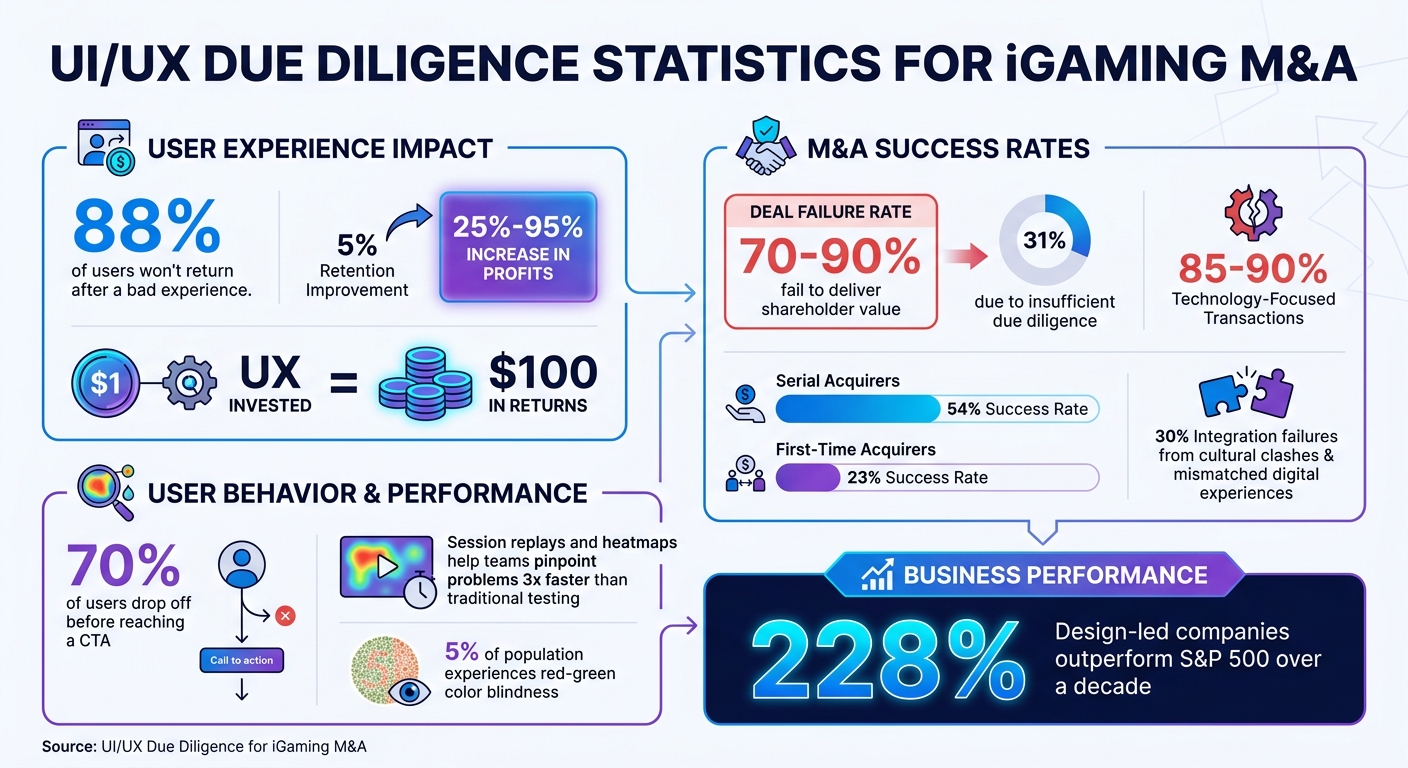
- 88% of users won’t return after a bad experience.
- A 5% retention improvement can increase profits by 25%–95%.
- Every $1 invested in UX can yield up to $100 in returns.
Key areas to focus on during due diligence include usability, design consistency, and performance. Platforms must meet accessibility standards, ensure fast load times, and comply with evolving regulations like the European Accessibility Act (2025) and UK gaming rules (2026). Tools like heatmaps, session replays, and performance metrics help identify friction points.
UI/UX is no longer optional in iGaming - it’s a core factor in user trust, regulatory compliance, and long-term growth. Neglecting it risks integration failures, while prioritizing it can unlock significant value in M&A deals.
🚨 The Future of Sports Betting: UX, Prediction Markets & U.S. Expansion | Double Down with Breslo
sbb-itb-ba142f6
Key Areas to Evaluate in UI/UX Due Diligence
When conducting UI/UX due diligence, focus on three main areas: usability and accessibility, design consistency, and performance. Weaknesses in any of these areas can indicate technical debt and lead to costly fixes after acquisition [5]. Together, these factors provide insight into potential risks and opportunities, laying the groundwork for a thorough evaluation.
Usability and Accessibility
A user-friendly interface needs to meet accessibility standards, such as ensuring keyboard navigation follows a logical left-to-right, top-to-bottom flow without "traps." This is crucial for compliance with WCAG guidelines, particularly for motor-impaired users [6]. High color contrast for text and UI controls is equally important, as approximately 5% of the population experiences red-green color blindness [6]. Avoid relying solely on color or sensory cues to convey critical information.
For iGaming platforms, transparency by design is non-negotiable. Information like Return to Player (RTP), odds, and volatility should be easy to find and explained in straightforward language. As InPlaySoft puts it:
"If players need three clicks, a glossary, and a law degree to find the RTP, the UX is sending the wrong message" [2].
Platforms should move away from "account value" models and focus on "entertainment" models. This involves emphasizing session time and net results (spending versus wins) while offering accessible tools for setting limits [2]. This approach not only aligns with emerging regulations in markets like Brazil, the UK, and the EU but also builds player trust, which boosts platform valuation [2].
Design Quality and Consistency
Inconsistent branding or designs that imitate investment apps can mislead users about the nature of gambling, creating trust issues and increasing the likelihood of disputes or chargebacks [2]. A due diligence review should examine the target's UI/UX methodologies, frameworks, and prototyping processes. These elements should support scalability, which is essential for building a reliable and expandable iGaming brand [5].
Also, check whether the platform uses semantic heading structures (h-tags) correctly. This ensures compatibility with screen readers, rather than using headings purely for visual styling [6]. Platforms with consistent design across all user touchpoints are more likely to attract buyers, as they reduce perceived risks and boost trust [5].
Performance and Responsiveness
Fast load times are critical to both attracting and retaining users [2]. Studies show that 88% of users won't return after a poor experience, making performance a key factor in avoiding churn [2]. Due diligence should also evaluate the platform's technological infrastructure to ensure it can handle high traffic during peak betting periods without compromising the user experience [7].
The platform must perform seamlessly across mobile, desktop, and other devices. Real-time features, like personalized "reality checks" or reminders based on player behavior, should function smoothly [2]. Together, consistent design and strong technical performance create a cohesive user experience that drives retention and revenue.
To gauge market health, compare metrics like Monthly Active Users (MAUs), Average Revenue Per User (ARPU), and churn rates against industry benchmarks [4]. Even a small improvement in retention - just 5% - can increase profits by 25% to 95% [2], underscoring the importance of optimizing performance as a core value driver.
UI/UX Metrics and Tools for Assessment
Key Metrics for Evaluating UI/UX
To truly understand how effective your UI/UX design is, you need to focus on measurable data. Metrics like engagement, retention, monetization, and technical performance provide a clear picture of user interaction and overall platform success.
Start with engagement metrics such as Daily Active Users (DAU) and Monthly Active Users (MAU). These numbers help you calculate the Sticky Factor (DAU/MAU), which shows how often users transition from occasional to daily activity [9]. Metrics like average session length and session frequency can also indicate how compelling your platform is - are users coming back regularly?
Retention metrics are another cornerstone. Analyzing Day 1, Day 7, and Day 30 retention rates helps you gauge whether users stick around long enough to develop loyalty [8][9]. On the flip side, the churn rate (the percentage of users who stop using the platform) highlights where your design might fall short in keeping their interest. Pay special attention to the so-called "Golden Cohort", the first group of users, as their behavior often sets the tone for long-term financial success [9].
When it comes to monetization, focus on metrics like conversion rate (the percentage of players who spend money), Average Revenue Per User (ARPU), Average Revenue Per Paying User (ARPPU), and Average Revenue Per Daily Active User (ARPDAU) [8][9]. ARPPU, which looks only at paying users, offers insights into how much your core audience is willing to spend. Together, these numbers reveal how well your platform drives revenue and its overall financial performance.
Finally, in industries like iGaming, Responsible Gaming (RG) metrics are crucial. Tracking visible net results, how often players use limit-setting tools, and the frequency of "reality checks" ensures compliance with regulations while building trust with users [2].
These metrics don’t just provide numbers - they highlight areas for improvement and naturally guide the choice of tools for deeper analysis.
Tools and Techniques for UI/UX Analysis
To identify and fix pain points in your user experience, behavioral analytics tools are indispensable. Platforms like Mouseflow offer heatmaps, session replays, and journey mapping to uncover where users hesitate, loop back, or abandon key processes like registration or placing bets. For example, journey analytics often reveal that up to 70% of users drop off before reaching a call to action (CTA) [10]. Using session replays and heatmaps can help UX teams pinpoint problems three times faster than traditional usability testing [10].
For a broader evaluation, heuristic analysis can be a game-changer. Tools like Heurix leverage frameworks such as Nielsen Norman Group’s heuristics to assess areas like aesthetic design, error prevention, and system status visibility. This ensures users always have a clear understanding of their current balance or bet status, reducing confusion.
Technical performance also plays a major role. Google’s Core Web Vitals - including Largest Contentful Paint (LCP), First Input Delay (FID), and Cumulative Layout Shift (CLS) - measure loading speed, interactivity, and visual stability. These metrics are critical for platforms like iGaming, where 88% of users are unlikely to return after a frustrating experience [10]. Monitoring JavaScript error rates is equally important, as unnoticed technical issues can quietly drive users away.
When conducting audits for iGaming platforms, focus on key areas like registration, onboarding, game discovery, and transaction processes. For example, ensure the search bar provides accurate suggestions even with single-word queries, and that bonuses are prominently displayed above the fold. Mobile design should prioritize one-handed navigation, with buttons placed within thumb reach. Finally, compare Net Promoter Scores (NPS) and churn rates against industry benchmarks to evaluate how well your design keeps users engaged [4].
Regulatory and Market Considerations for UI/UX in iGaming
Compliance with iGaming Regulations
When assessing an iGaming platform during M&A, compliance goes beyond just having the correct documentation - it’s about whether the platform’s interface visibly reflects regulatory adherence. By 2026, regulators are increasingly expecting compliance to be evident within the platform itself, rather than hidden in policy documents or backend systems [12]. This means features like deposit limits, KYC (Know Your Customer) processes, and audit trails must be both accessible and verifiable directly through the user interface.
Starting June 30, 2026, new UK regulations will require platforms to present deposit limit functions clearly. Similarly, the European Accessibility Act, effective June 28, 2025, mandates that registration, transactions, and navigation be designed to accommodate users with disabilities [12]. A practical way to evaluate compliance is by using the "Five-Click Rule." This approach tests whether evidence for regulatory controls - such as deposit limit logic or audit trails - can be accessed in five clicks or fewer. As Gamingtec highlights:
"If an operator, auditor, or regulator asks to see the evidence behind a control, can the business produce it in a few steps... If not, the problem is rarely documentation alone. It usually points to a deeper issue in governance" [12].
Responsible Gaming (RG) features should be seamlessly integrated into the core user experience, not buried in obscure account settings. Key information, like deposit limits or responsible gaming disclosures, should naturally appear within user journeys [2][13]. Platforms that frequently require manual updates to meet jurisdictional rules not only increase compliance risks but may also have lower valuations compared to systems that inherently manage regulatory complexity [12]. This visibility into compliance directly influences both market readiness and player trust, areas that are further shaped by evolving market demands.
Adapting to Market Trends and Player Preferences
While regulations set the minimum requirements, market trends and player preferences drive the ongoing evolution of UI/UX design. In 2025 and 2026, players are prioritizing speed, smooth gameplay, and intelligent personalization over traditional incentives like bonus size [3]. Mobile-first design has become non-negotiable, as the majority of bets now originate from mobile devices [14][11]. Nikolaj Plugatar, Business Development Manager at Slotegrator, underscores this shift:
"The creation of a casino interface design that is initially oriented to mobile devices is necessary... mobile-first design is no longer a recommendation but rather a mandatory standard" [11].
Modern UI/UX has moved away from purely profit-driven layouts to an "entertainment-first" focus. For example, displaying session summaries like "You played for 38 minutes and spent US$ 24" can significantly enhance player awareness compared to multiple responsible gaming pop-ups [2].
Platforms should also incorporate AI-powered personalization to deliver tailored game suggestions and adjust the interface dynamically based on user behavior [14][3]. Additionally, ensure that key buttons on mobile interfaces are positioned within thumb reach for one-handed use. Friction during registration, such as excessive data requests, should be minimized to prevent user drop-off [11].
Localization plays a crucial role in appealing to diverse markets. For instance, Western markets often prefer calm, understated color schemes, while Japanese players might expect vibrant, high-energy designs reminiscent of arcade games [11]. A platform’s CMS should allow for quick adjustments to elements like colors, fonts, and content to suit different regions, without requiring developer involvement [11]. These capabilities make the platform more adaptable and appealing across various player demographics.
Using Expert Advisory for UI/UX Due Diligence
By combining detailed UI/UX evaluations with compliance checks, expert advisory services provide essential insights that connect technical assessments with strategic decision-making.
How MyReadyMade Supports UI/UX Evaluation

Effective UI/UX due diligence in the iGaming M&A space demands a nuanced understanding of both design principles and regulatory requirements. MyReadyMade steps in by offering verified business listings alongside specialized M&A advisory services, helping buyers perform comprehensive evaluations. Their advisors analyze key metrics like Monthly Active Users, retention rates, and churn, while also cross-referencing these numbers with real user feedback from platforms such as Reddit, Discord, and Twitch [4].
Additionally, MyReadyMade employs AI-driven tools to review corporate records and open-source intelligence. They also simplify the process of license transfers across more than 50 jurisdictions, ensuring that UI/UX compliance - including accessibility standards and responsible gaming features - meets specific market regulations [7]. This expert-led approach enables a more thorough understanding of both technical and strategic risks, laying the foundation for smarter decision-making.
The Value of Industry Experts in UI/UX Assessment
Studies reveal that 70–90% of M&A deals fail to deliver shareholder value, with insufficient due diligence contributing to roughly 31% of these failures. For technology-focused transactions, the failure rate climbs even higher - up to 85–90% [16]. A major reason for this is the lack of proper evaluation of digital assets like UI/UX design. As UX researcher Anupam Sarkar puts it:
"A design-informed M&A strategy ensures continuity, enhances customer trust, and accelerates adoption" [1].
Industry experts complement the quantitative and regulatory checks by transforming raw data into actionable strategies. They dive into game mechanics, user flows, and performance metrics, pinpointing areas for improvement [15]. Their work often includes technical audits of UI/UX frameworks, prototyping standards, and code quality to ensure scalability and stability - critical factors for supporting growth post-acquisition. This process also uncovers hidden risks that could otherwise lead to user churn [5] [1].
David Kaye, CEO of Snapshot Games, highlights the importance of expert analysis:
"I am consistently impressed with the quality of the analysis in Naavik's blockchain gaming breakdowns" [15].
Expert advisors also bridge communication gaps when target companies present unclear or incomplete data [7]. They assist in creating detailed 100-day integration plans and strategies to align digital ecosystems before the deal closes [16] [1]. This is especially crucial since around 30% of integration failures arise from cultural clashes and mismatched digital experiences [16] [1]. Notably, serial acquirers who rely on proven playbooks and expert guidance see a 54% success rate, compared to just 23% for first-time acquirers [16]. These numbers underscore the critical role professional advisors play in ensuring successful UI/UX due diligence.
Conclusion
UI/UX due diligence isn’t just a box to check - it’s a critical factor in player retention, regulatory adherence, and long-term business value. With up to 90% of mergers falling short of shareholder expectations and 88% of users unlikely to return after a poor experience [1][2], neglecting digital assets can lead to costly consequences. Data confirms that investing strategically in UI/UX delivers measurable ROI and boosts conversions [2]. These results underscore its importance in meeting today’s demanding industry standards.
The iGaming industry is shifting toward safer-by-design principles, emphasizing transparency, responsible gaming features, and compliance-ready experiences. In regulated markets like the UK, the EU, and Brazil, platforms that display net results alongside balances, make RTP (Return to Player) information readily available, and provide personalized nudges foster trust while reducing churn. As InPlaySoft highlights:
"When the platform teaches the right mindset, everybody wins: players stay safer, operators build trust, and long-term value replaces short-term spikes" [2].
This evolution highlights the need for expert guidance in navigating both technical and regulatory challenges. MyReadyMade’s approach combines verified listings, AI-powered analysis, and license transfer support across 50+ jurisdictions, ensuring UI/UX aligns with both player expectations and regulatory requirements.
Effective UI/UX due diligence can turn potential risks into opportunities by pinpointing friction points, confirming scalability, and ensuring smooth post-merger integration. This prevents operational hiccups and delays. With design-led companies outperforming the S&P 500 by 228% over a decade [2], prioritizing UI/UX is not optional - it’s a necessity for achieving sustainable growth in iGaming M&A. Addressing these UI/UX priorities equips buyers to secure seamless integration and long-term market success.
FAQs
What UI/UX red flags can signal hidden post-acquisition costs?
Some design choices in apps and platforms may quietly encourage spending beyond what users initially expect. These UI/UX red flags include:
- Dark Patterns: These are deceptive design techniques that manipulate user behavior. For example, they might trick users into making purchases they didn’t intend.
- Manipulative Monetization Tactics: Features designed to nudge users toward spending, often without clearly explaining the costs involved.
- Misleading Urgency Cues: Phrases like "Only 2 left!" or countdown timers can create unnecessary pressure, making users feel they must act quickly and spend money.
- Unclear Currency Bundles: Virtual currency systems that don’t clearly show their real-world value can make it hard for users to track how much they’re spending.
- Overly Frictionless Payment Flows: While convenience is great, payment processes that are too seamless can lead users to spend without fully realizing it.
These practices can lead to hidden costs, catching users off guard with unexpected expenses after their initial purchase.
Which UI/UX metrics best predict retention and revenue in iGaming?
When it comes to predicting player retention and revenue in iGaming, a few key metrics stand out: session duration, play frequency, and user satisfaction. These metrics are closely tied to how long players stay engaged and their overall lifetime value.
But it’s not just about keeping players hooked - responsible UI/UX design plays a huge role. By encouraging healthy gaming habits, platforms can build trust with their audience. This trust fosters long-term engagement, which, in turn, contributes to steady revenue growth.
How can we quickly verify UI/UX compliance for UK and EU accessibility rules?
To ensure your UI/UX aligns with UK and EU accessibility regulations, refer to the EU Accessibility Act (Directive (EU) 2019/882). This directive outlines specific standards for digital services, including online gambling platforms. Conduct thorough technical assessments to confirm compliance with the relevant accessibility guidelines for each jurisdiction. Doing so helps ensure your platform is both user-friendly and inclusive for all.
Related Articles

Ultimate Guide to Earnout Negotiations in M&A
Structure and negotiate earnouts in regulated M&A with clear metrics, anti-manipulation covenants, and acceleration or escrow protections.

How to Draft M&A Definitive Agreements
Guide to drafting M&A definitive agreements covering deal structure, reps & warranties, indemnities, payment terms, and regulatory compliance.

How IP Affects Tokenization Valuation
How tokenizing patents, copyrights, and trademarks adds liquidity and market value—plus legal, regulatory, and valuation steps.
Looking to Buy or Sell?
Get in touch with our team for personalized assistance