Ultimate Guide to Buyer Qualification in Regulated M&A

Ultimate Guide to Buyer Qualification in Regulated M&A
Buying a business in regulated industries like iGaming, Crypto, Forex, or Fintech is far from straightforward. Unlike traditional deals, these transactions require regulatory approval, which can make or break your acquisition. Here's what you need to know:
- Regulated M&A involves strict government oversight. Ownership changes trigger a "Change of Control" process requiring 3–6 months of regulatory review.
- Key Buyer Requirements: Financial strength, compliance readiness, and operational capability are mandatory. Regulators scrutinize financial records, compliance systems, and business plans.
- Challenges: Failing to meet these standards can derail deals. For example, unqualified buyers risk legal fees, delays, and even deal cancellations.
- Industry-Specific Hurdles: iGaming buyers must comply with anti-money laundering laws, while Fintech and Crypto buyers face capital adequacy and licensing challenges.
- Due Diligence: Both buyers and sellers conduct thorough checks to ensure financial stability, regulatory compliance, and operational readiness.
Bottom line: Preparation is everything. Understand regulatory requirements, address compliance gaps, and ensure financial transparency to avoid costly mistakes. For smoother transactions, platforms like MyReadyMade offer tailored solutions for regulated M&A deals.
Buy-Side M&A Masterclass, Pt. 1 | Before You Buy: Strategy, Criteria & Sourcing
sbb-itb-ba142f6
Buyer Qualification Requirements in Regulated Industries
Once you understand the regulatory environment, the next step is meeting the qualification standards. Regulators typically focus on three main areas: financial strength, compliance readiness, and operational capability. These factors are crucial in determining whether your acquisition gets the green light.
Financial Requirements
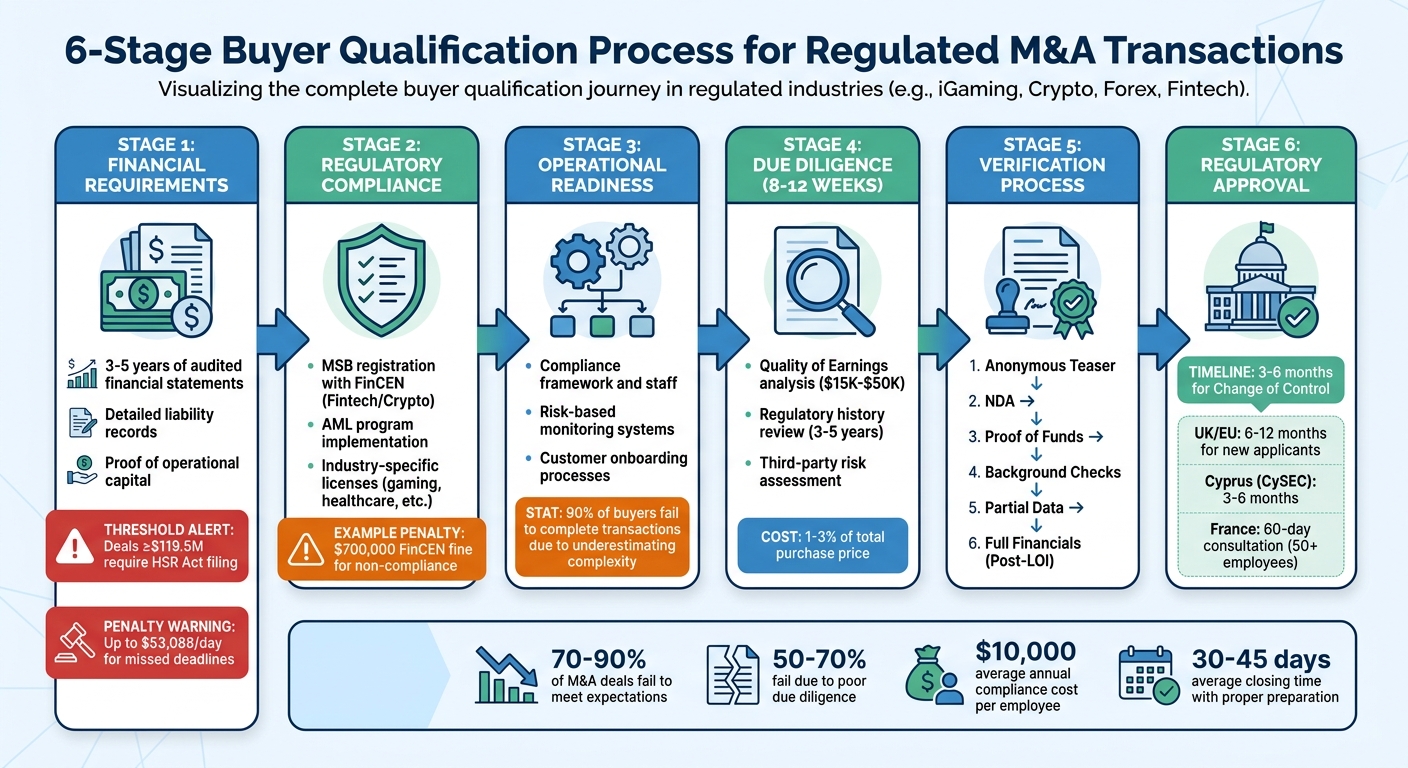
Regulators want assurance that you can not only afford the acquisition but also sustain operations afterward. In financial services, organizations like the Office of the Comptroller of the Currency (OCC) in the U.S. and the Office of the Superintendent of Financial Institutions (OSFI) in Canada enforce strict standards for capital adequacy and solvency. Buyers must provide 3 to 5 years of audited financial statements, detailed liability records, and evidence of sufficient operational capital to support the transition [6].
For deals worth $119.5 million or more, the Hart-Scott-Rodino (HSR) Act requires pre-merger notifications to the FTC and DOJ. These filings include detailed financial disclosures, and missing deadlines can result in hefty penalties - up to $53,088 per day [7]. Additionally, the IRS requires buyers to file Form 8594 for asset purchases, with non-compliance penalties reaching as high as $3 million [6].
Financial missteps can derail deals, even massive ones. For example, Bayer's $63 billion acquisition of Monsanto in 2018 suffered due to inadequate due diligence on Roundup litigation risks. This oversight wiped out over $50 billion in shareholder value and led to legal provisions exceeding $10 billion [5]. Research shows that 70% to 90% of M&A deals fail to meet expectations, often due to financial miscalculations [5][6].
For operational brokerages, verifying segregated client funds is critical. For instance, in early 2026, Cyprus Investment Firms holding approximately $16 million in segregated client funds were seen as high-value targets because they offered immediate revenue potential rather than being dormant shells [3].
Once financial stability is established, the focus shifts to regulatory compliance.
Regulatory Compliance Standards
Regardless of the industry, buyers must adhere to regulatory requirements from day one. In Fintech and Crypto, for example, buyers must register as Money Services Businesses (MSBs) with FinCEN and implement risk-based Anti-Money Laundering (AML) programs [8]. Similarly, gaming acquisitions treat casinos as financial institutions for AML purposes, requiring suspicious activity reports to be filed [2]. Healthcare deals demand compliance with HIPAA, proper Medicare/Medicaid enrollment, and adherence to Stark and Anti-Kickback statutes [9].
In 2015, FinCEN imposed a $700,000 penalty on a company and its subsidiary for failing to meet MSB registration requirements [8]. Beyond federal rules, buyers must also address state-specific regulations. These can range from obtaining gaming licenses issued by state commissions to meeting EPA and OSHA standards for construction or ensuring compliance with safety case regimes required by FERC or the FAA in energy and transportation sectors [2][9].
One critical step is verifying the transferability of licenses. Many licenses include "change-of-control" clauses, which can invalidate existing permissions when ownership shifts. This often requires fresh inspections or pre-clearance to avoid operational delays [9][4]. Ignoring this detail could lead to business suspensions while waiting for new approvals.
With financial and compliance requirements in place, operational readiness becomes the final hurdle.
Operational and Business Alignment
Financial strength and regulatory compliance alone won’t cut it. Regulators and sellers also assess whether you have the expertise, strategic vision, and operational infrastructure to ensure seamless business continuity after the acquisition [1]. Todd Torquato from REAG highlights this point:
A well qualified buyer is not just someone with financial capabilities, but an entity or individual with the expertise and strategic vision to execute a successful acquisition. [1]
Operational due diligence focuses on whether the business can thrive without the current owner. Factors like key person dependency and revenue concentration above 20–25% can introduce risks that may require earnout structures to mitigate [4].
In regulated industries, buyers must show they can establish or maintain a strong compliance framework. This often involves hiring specialized compliance staff and implementing risk-based monitoring systems. Evaluating customer onboarding and complaint resolution processes is another way to demonstrate operational competence [9]. Studies reveal that 90% of buyers entering regulated markets fail to complete transactions, often underestimating the complexities of running such businesses [10].
Due Diligence in Buyer Qualification
In regulated M&A, due diligence is a two-way process. While buyers meticulously examine the target business, sellers and regulators are equally focused on assessing the buyer. They look at the buyer’s financial health, compliance history, and operational capabilities to ensure the transaction can be completed smoothly. Skipping this step can lead to expensive post-closing disputes or regulatory hurdles. M&A attorney Alex Lubyansky emphasizes this point:
"Due diligence is the single most expensive failure mode in M&A. Every major post-closing dispute... traces back to something that was missed or underweighted before signing." [11]
Although professional due diligence can cost between 1% and 3% of the total purchase price [13], it’s a worthwhile investment compared to the potential fallout from unresolved issues discovered after closing. Typically, this process spans 8 to 12 weeks during the exclusivity period after signing a Letter of Intent (LOI) [11]. Once the groundwork is laid, the buyer can dive into a detailed evaluation of the target business.
Evaluating the Target Business
Buyers must first create a regulatory roadmap. This involves identifying the laws, oversight agencies, and compliance requirements tied to the target’s products and operations. A critical step is determining which licenses are necessary and whether a change of control could invalidate them, require pre-approval, or trigger inspections [9].
On the financial front, a Quality of Earnings (QoE) analysis is usually the starting point. This analysis, costing between $15,000 and $50,000 depending on the deal’s complexity [13], helps uncover one-time expenses or accounting irregularities. It’s common for due diligence to reveal EBITDA adjustments that range from 10% to 15% compared to the seller’s initial claims [13].
Regulatory history is another key area to scrutinize. Buyers should review three to five years of correspondence, exam reports, deficiency letters, and any ongoing investigations. Federal and state databases can also reveal undisclosed enforcement actions involving the target or its owners [2]. To gain deeper insight, interviewing the target’s compliance officer can clarify how compliance is managed [9].
Third-party risk is equally important, as regulators often hold businesses accountable for their vendors. Buyers should examine SOC 2 reports, HIPAA Business Associate Agreements, and data processing agreements [9]. If the deal involves real estate, a Phase I Environmental Site Assessment - costing $3,000 to $5,000 and taking two to four weeks - is typically required [11].
While buyers are busy analyzing the target, sellers and regulators are simultaneously vetting the buyer’s qualifications.
How Sellers and Regulators Verify Buyers
To protect sensitive information, sellers use a staged disclosure approach. This usually follows this sequence: Anonymous Teaser → NDA → Proof of Funds → Background Checks → Partial Data → Full Financials (Post-LOI) [14]. Christopher Quick, the author of The Digital Merchant, offers this caution:
"Resistance to proof of funds is itself a serious screening signal." [14]
Verifying financial capacity involves reviewing bank statements, lender pre-qualification letters, or evidence of private equity commitments [14]. Background checks are also conducted to uncover potential conflicts of interest and to collect references from past sellers [14].
Regulators take their own steps to evaluate buyers. They conduct sanctions and anti-money laundering (AML) screenings to ensure the buyer and its executives meet required standards [2]. For larger transactions - those exceeding roughly $119.5 million in 2026 - the Hart-Scott-Rodino Act requires antitrust filings with the DOJ and FTC [11].
In tightly regulated industries, a change of control often triggers additional requirements, such as inspections or formal pre-approval, before the deal can proceed [9].
Jurisdiction-Specific Buyer Qualification Requirements
Navigating buyer qualification standards can be tricky, especially when regional and industry-specific regulations come into play. These differences can lead to delays or even failed deals if not addressed early on.
Regional Regulatory Differences
In the United States, the dual federal-state system creates a maze of regulatory requirements. Federal agencies like the SEC, DOJ, and FTC manage securities and antitrust issues, while state authorities oversee corporate governance and industry-specific licensing. For instance, the gaming and betting industries require state-specific licenses for facilities, equipment, and even staff [2]. Foreign buyers face additional hurdles, such as CFIUS reviews for national security concerns, though exemptions exist for buyers from Australia, Canada, New Zealand, and the UK [7].
In the United Kingdom and European Union, regulators conduct detailed evaluations to ensure buyers meet ownership thresholds. This process often takes 6 to 12 months for new applicants. Additionally, KYC (Know Your Customer) and AML (Anti-Money Laundering) requirements are stricter than in the U.S. Agencies like the UK's FCA and PRA, as well as Germany's BaFin, are known for their thorough assessments. American buyers targeting European companies should prepare extensive KYC documentation in advance to avoid delays.
Canada adds its own layer of complexity with a decentralized regulatory system. While federal banking and insurance matters fall under the OSFI, securities are handled at the provincial level by entities like the Ontario Securities Commission [2]. However, compliance in one province, such as Ontario, doesn't automatically apply to others like Quebec or Alberta, making it essential to verify requirements for each province.
For Cyprus-licensed firms, particularly in the Forex and CFD sectors, CySEC's change of control process takes 3 to 6 months. This review assesses new shareholders, management qualifications, and updated business plans [3]. In France, companies with 50 or more employees face a mandatory 60-day consultation period before signing a Sale and Purchase Agreement. Non-compliance can lead to criminal penalties and fines of up to 2% of the purchase price [16].
These regional variations are just the beginning - industry-specific regulations add even more layers of complexity.
Industry-Specific Regulations
Different industries come with their own unique regulatory challenges. For example, in iGaming, U.S. buyers must navigate state-by-state licensing requirements. Casinos are also classified as financial institutions under the Bank Secrecy Act, requiring stringent AML reporting [2]. Before closing a deal, buyers should review the target's AML procedures and customer due diligence policies to ensure compliance with these high standards.
In the Fintech and Forex sectors, buyers often prioritize operational businesses with live banking connectivity, such as SEPA or Faster Payments, and established safeguarding accounts. Due diligence should include verifying infrastructure components like BIN sponsorship agreements, correspondent banking relationships, and safeguarding account setups, which can take years and significant investment to establish independently [3]. In South Africa, ensure the target has a "Key Individual" and a functioning compliance program, as required by the FSCA [3].
In the APAC region, especially in Labuan, Malaysia, there's growing interest in money broking companies that combine traditional FX/CFD infrastructures with permissions for spot and CFD crypto trading [3]. These hybrid licenses offer flexibility but demand buyers to demonstrate expertise across multiple regulatory frameworks.
Starting your regulatory analysis early is crucial. Identify the laws, oversight agencies, and compliance requirements tied to your target's jurisdiction and industry. Be sure to account for approval timelines, which can range from three months to over a year, when structuring your deal [17][16]. Tools like MyReadyMade can help simplify this process by providing expert advice and facilitating confidential, efficient transactions across various jurisdictions.
How MyReadyMade Simplifies Buyer Qualification
MyReadyMade takes the hassle out of navigating regulated M&A qualification by connecting you with verified business listings and delivering specialized M&A advisory services tailored to industries like iGaming, Cryptocurrency, Forex, and Fintech. By tackling financial, compliance, and operational challenges head-on, the platform ensures buyer qualification aligns with your growth objectives. Operating in over 50 jurisdictions, MyReadyMade offers access to opportunities that meet strict compliance standards right from the start.
MyReadyMade's Buyer Support Services
The advisory team at MyReadyMade is there to guide you through the maze of regulatory requirements. Instead of spending months deciphering which licenses need pre-clearance or additional inspections, you benefit from license transfer management that identifies potential "change-of-control traps" before they can derail your transaction [18]. This is especially crucial in regions like Canada or the EU, where regulatory requirements can differ significantly [2].
Through its regulatory mapping service, MyReadyMade provides a clear breakdown of the compliance requirements specific to your target's jurisdiction and industry. Whether you're working with Cyprus-based Forex firms under CySEC regulation or navigating the patchwork of state-specific iGaming rules in the U.S., you'll know exactly what documentation and approvals are needed. This clarity helps you plan realistic timelines - essential when approval processes can take anywhere from three months to over a year.
In addition to expert advisory services, MyReadyMade's structured disclosure process helps keep deals on track and accelerates closure.
Confidential and Efficient Transactions
MyReadyMade goes beyond advisory support by ensuring your transactions are both secure and efficient. Using a well-established six-stage disclosure protocol (Anonymous Teaser → NDA → Proof of Funds → Background Checks → Partial Data → Full Financials), the platform protects your identity while maintaining rigorous qualification standards [14].
Thorough background checks examine litigation history, acquisition results, and corporate affiliations to flag potential conflicts before you gain access to sensitive business data [14]. This benefits both parties: sellers can trust they’re dealing with serious buyers, and you avoid wasting time on deals that could hit regulatory roadblocks. With an average closing time of 30 to 45 days, this structured process minimizes common delays in regulated M&A transactions.
Conclusion
Buyer qualification forms the backbone of any successful regulated M&A deal. Falling short in this area can lead to costs nearly three times higher than compliance, along with risks like federal investigations, licensing delays, and long-term damage to your reputation [12][2]. As Nichole Brazelton from DealStream highlights:
Understanding the regulatory framework of the business you're buying is more than a legal necessity - it's an operational and reputational one [2].
This underscores the importance of thorough buyer qualification throughout the M&A process.
Research shows that 50% to 70% of M&A deals fail, often due to poor due diligence [1][4][15]. For regulated industries, the stakes are even higher. Large companies already spend an average of $10,000 per employee annually on compliance [12]. Entering an acquisition without proper preparation can turn a promising opportunity into a costly compliance nightmare.
The qualification process does more than just protect against legal risks - it builds trust with sellers while shielding you from potential liabilities like retroactive fines or license suspensions [2]. To navigate this effectively, ensure licenses are active and transferable, audit compliance teams for stability, and verify past sanctions through federal and state databases.
Specialized expertise, such as that offered by MyReadyMade, can simplify this complex process. With tools like regulatory mapping across 50+ jurisdictions and structured disclosure protocols, you'll have a clear understanding of the documentation and approvals required before committing resources. In regulated M&A, the difference between a smooth closing and a drawn-out regulatory review often boils down to preparation. By investing in expert guidance and thorough planning, you set the stage for a successful transaction.
FAQs
What documents do regulators usually require from a buyer?
Regulators typically ask for several critical documents during the due diligence phase. These include financial statements, corporate records, legal agreements, and proof of compliance with applicable laws and licenses. These documents are essential for verifying that the buyer adheres to regulatory requirements and is set up for a seamless transaction.
How can I tell if the target’s licenses will transfer after a change of control?
To figure out whether the target's licenses will transfer after a change of control, you need to dig into the specific licensing laws and regulations tied to the industry. It's a good idea to consult with regulators or legal advisors during the due diligence process. They can help clarify the steps for transferring licenses and any required approvals. This way, you can ensure everything stays compliant and avoid running into problems with regulatory authorities.
What are the quickest ways to reduce regulatory delays before signing an LOI?
To avoid regulatory delays before signing a Letter of Intent (LOI), prioritize careful pre-market preparation. This means gathering all compliance-related documents and ensuring they are accurate and complete. Partnering with seasoned M&A advisors can also make a big difference - they can help spot and address potential regulatory challenges ahead of time. Taking these proactive steps can simplify due diligence and speed up the approval process.
Related Articles

Ultimate Guide to Earnout Negotiations in M&A
Structure and negotiate earnouts in regulated M&A with clear metrics, anti-manipulation covenants, and acceleration or escrow protections.

How to Draft M&A Definitive Agreements
Guide to drafting M&A definitive agreements covering deal structure, reps & warranties, indemnities, payment terms, and regulatory compliance.

How IP Affects Tokenization Valuation
How tokenizing patents, copyrights, and trademarks adds liquidity and market value—plus legal, regulatory, and valuation steps.
Looking to Buy or Sell?
Get in touch with our team for personalized assistance