Ultimate Guide to Distressed M&A in Regulated Sectors
Ultimate Guide to Distressed M&A in Regulated Sectors
Distressed M&A involves acquiring businesses or assets under financial strain, often requiring fast decisions to prevent value loss. In regulated sectors like fintech, iGaming, and crypto, these deals face added challenges due to licensing, compliance, and regulatory approvals. Here's what you need to know:
- Key Structures: Out-of-court sales (fast but riskier), Section 363 asset sales (court-protected), and Chapter 11 plans (ideal for equity acquisitions and preserving tax benefits).
- Regulatory Hurdles: Licensing requirements, antitrust reviews, and foreign investment screenings can delay deals.
- Due Diligence: Focus on fraudulent transfer risks, asset valuation, and compliance gaps to avoid liabilities.
- Risk Management: Tools like stalking horse bids, DIP financing, and credit bidding help secure assets.
- Post-Acquisition: License transfers, transition services, and regulatory filings are critical for seamless integration.
Platforms like MyReadyMade simplify these processes by offering M&A advisory and support for license transfers across 50+ jurisdictions. Whether navigating bankruptcy sales or regulatory complexities, preparation and expert guidance are essential for success.
Opportunity Amidst Crisis Buying Distressed Assets Claims, and Securities for Fun and Profit
Transaction Structures for Distressed Deals
Out-of-Court Sales
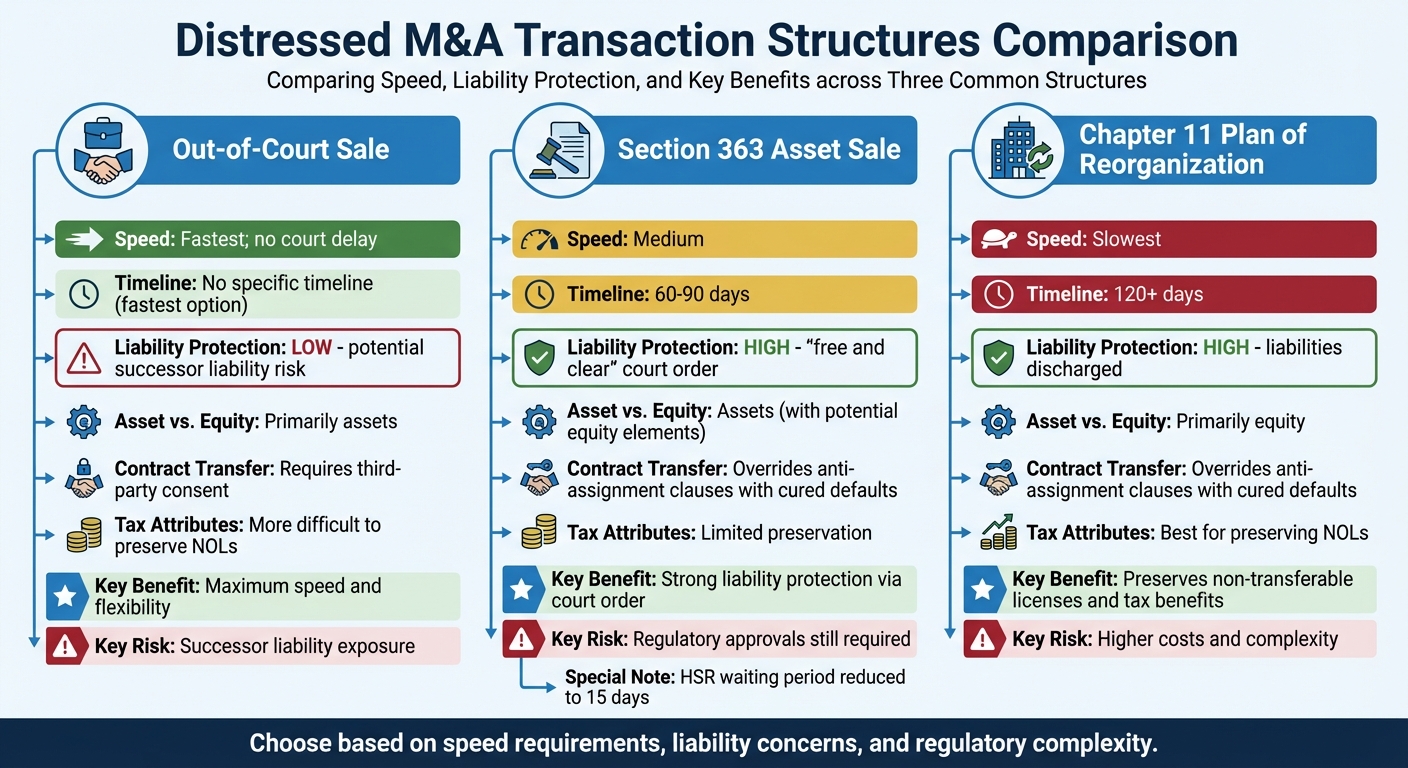
Out-of-court sales are known for their flexibility and speed, as they bypass the lengthy process of bankruptcy proceedings. However, they come with their own challenges. Securing assets free of liens can be tricky, and there's a real risk of successor liability under state laws. Courts may apply doctrines like "mere continuation" or "de facto merger", potentially leaving buyers responsible for the seller's obligations. To reduce the risk of a fraudulent transfer claim, it's wise to get an independent third-party valuation to confirm that a fair value was paid for the assets [5][9].
On the other hand, Section 363 asset sales provide a layer of judicial protection, which can reduce liability concerns even further.
Section 363 Asset Sales
Section 363 sales, conducted under the U.S. Bankruptcy Code, allow buyers to acquire assets with a court order that ensures the transfer is "free and clear" of liens and claims [6]. As Ice Miller LLP highlights:
"One of the greatest benefits to a buyer who acquires assets through a 363 sale is the conveyance of the assets by court order that conveys title 'free and clear' - that is, the buyer takes the assets 'free and clear' of all liens, claims, interests, and encumbrances." [9]
The process typically spans 60 to 90 days, starting with the selection of a stalking horse bidder and ending with the sale's completion [5]. For transactions that require reporting, the waiting period under the HSR Act is reduced to just 15 days [2].
Section 363 sales offer several advantages. Buyers can pick specific assets and contracts they want while leaving behind unfavorable ones. Even contracts with anti-assignment clauses can be assumed, provided any defaults are addressed. Stalking horse bidders often negotiate protections like break-up fees and expense reimbursements, while competing bidders are required to make good faith deposits. Additionally, Section 363(m) protects buyers from negative outcomes if an appeal arises, as long as the court determines the buyer acted in good faith.
However, regulatory approvals are still necessary. Buyers must obtain clearance from antitrust authorities, CFIUS, and other relevant regulators. In industries with heavy oversight, a Transition Services Agreement (TSA) can ensure operations continue under the seller's existing licenses while waiting for regulatory green lights [6][10].
Chapter 11 Plans of Reorganization
Chapter 11 plans are typically more time-intensive, taking over 120 days due to the need for creditor voting and extensive disclosures [2]. This structure is ideal for buyers looking to acquire a debtor's equity rather than just its assets. It’s particularly valuable for preserving non-transferable licenses, permits, or tax benefits like net operating losses (NOLs) [5]. Paul H. Zumbro, a partner at Cravath, Swaine & Moore LLP, explains:
"By acquiring a business through a plan, an acquiror can use the Chapter 11 process to shape the business and liabilities of the target whose equity it is acquiring by, among other things, rejecting unfavourable executory contracts and discharging liabilities." [5]
Chapter 11 is often necessary in industries like iGaming or forex, where licenses are tied to the entity and cannot be transferred separately. This approach allows buyers to restructure liabilities while maintaining compliance, but it does come with higher costs and added complexity compared to Section 363 sales [5][7]. Choosing the right structure depends on balancing speed, liability concerns, and regulatory requirements.
| Feature | Out-of-Court Sale | Section 363 Asset Sale | Chapter 11 Plan |
|---|---|---|---|
| Speed | Fastest; no court delay [5] | 60–90 days [5] | 120+ days [2] |
| Liability Protection | Low; potential successor liability risk | High; "free and clear" order [6] | High; liabilities discharged [5] |
| Asset vs. Equity | Primarily assets [5] | Assets (with potential equity elements) [6] | Primarily equity [5] |
| Contract Transfer | Requires third-party consent [5] | Overrides anti-assignment clauses with cured defaults [6][8] | Overrides anti-assignment clauses with cured defaults [8] |
| Tax Attributes | More difficult to preserve NOLs [5] | Limited preservation [5] | Best for preserving NOLs [5] |
Understanding these options helps buyers align their approach with their risk tolerance and strategic goals. For those navigating complex deals, expert guidance can make a big difference. Platforms like MyReadyMade (https://myreadymade.com) offer verified listings, M&A advisory, and support for license transfers in areas like iGaming, cryptocurrency, forex, and fintech - making the process smoother and more efficient.
Regulatory Challenges in Distressed M&A
Antitrust Review and Failing Firm Defenses
Even in times of economic uncertainty, distressed companies must contend with strict antitrust scrutiny. Both the U.S. Department of Justice (DOJ) and the Federal Trade Commission (FTC) enforce rigorous standards, emphasizing that:
"Setting aside competition law during times of crisis has proven unwise. Indeed, doing so is likely contrary to the public interest" [11].
For deals that might otherwise face antitrust barriers, the failing firm defense offers a potential route forward. However, this defense comes with a high burden of proof. Buyers must demonstrate that the target company cannot meet its financial obligations, lacks viable reorganization options under Chapter 11, and that the seller made genuine efforts to find alternative buyers [11][12]. As the U.S. Court of Appeals for the Sixth Circuit aptly described it:
"a last-resort strategy for mergers facing significant hurdles" [12].
Real-world cases highlight the complexities of this process. In May 2020, the DOJ intervened to block Dean Foods' asset sale to Dairy Farmers of America, citing antitrust concerns, despite Dean Foods being in Chapter 11 bankruptcy. The dispute was resolved when the parties agreed to divest milk processing plants in Massachusetts and Wisconsin to alleviate competition issues [12]. Similarly, CoStar Group's $588 million acquisition of RentPath in June 2020 required navigating an FTC "Second Request" review, which had been issued earlier that year to assess competitive implications [12].
Section 363 sales, often used in bankruptcy proceedings, come with a shortened 15-day Hart-Scott-Rodino (HSR) waiting period [12]. However, buyers must proactively address antitrust concerns during the bidding process, as unresolved regulatory issues can disqualify them from being considered the "highest and best" bidder. Anticipating these challenges is essential for structuring successful distressed M&A deals.
For cross-border transactions, the hurdles multiply.
Foreign Investment Screening
When foreign buyers are involved in distressed deals, an additional layer of regulatory scrutiny comes into play. The Committee on Foreign Investment in the United States (CFIUS) evaluates such transactions to ensure they do not pose risks to national security. This is especially true for deals involving sensitive technology or critical infrastructure [1][2]. Financial distress does not exempt a transaction from CFIUS review; the committee applies the same rigorous standards, regardless of the target's financial condition.
For buyers from countries under heightened scrutiny, the CFIUS review process can introduce significant delays and uncertainty [1][2]. Sectors like fintech and cryptocurrency, where companies handle sensitive data or operate critical payment systems, are particularly prone to such reviews. Buyers must account for potential CFIUS filing requirements when planning their bids and negotiating timelines, as even expedited approvals can take months.
Beyond antitrust and foreign investment hurdles, sector-specific licensing requirements add further complexity.
Licensing and Compliance Requirements by Sector
Bankruptcy proceedings do not eliminate the need for regulatory licensing approvals. While Section 363 sales allow for the transfer of many contracts, buyers are still required to secure regulatory clearance for license transfers [2]. This can be particularly challenging in industries such as iGaming, forex, and fintech, where licenses are often tied to specific entities and jurisdictions.
In the U.S., a bankruptcy court order can transfer assets "free and clear" of most liens and successor liabilities. However, certain obligations, like environmental liabilities, may still follow the assets [2]. Buyers must conduct thorough due diligence to identify potential "cure costs" tied to executory contracts and leases, as these costs are often necessary to maintain critical operational agreements [2].
To bridge the gap during regulatory approval processes, Transition Services Agreements (TSAs) can allow continued operations under existing licenses [6][10]. In Canada, courts impose additional conditions, such as ensuring employee and pension obligations are addressed before sale approval, adding another layer of complexity to cross-border distressed transactions [2].
Platforms like MyReadyMade (https://myreadymade.com) provide specialized M&A advisory services to navigate these regulatory challenges. With expertise in license transfers across over 50 jurisdictions and industries like iGaming, cryptocurrency, forex, and fintech, they help buyers manage the complexities of regulated distressed deals while avoiding common pitfalls.
Due Diligence for High-Risk Assets
Distressed deals in regulated sectors require a level of scrutiny far beyond typical M&A due diligence. Tight timelines and financial pressures can lead to overlooked liabilities, overestimated asset values, or operational flaws that erode the value of the deal. Buyers who skip critical steps or rely solely on what the seller provides risk facing clawback claims, successor liabilities, or realizing that the assets they purchased are worth far less than expected.
Fraudulent Conveyances and Clawbacks
In distressed transactions, courts differentiate between two types of fraud: actual fraud, where a seller intentionally transfers assets to avoid creditors, and constructive fraud, where a seller receives less than "reasonably equivalent value" while insolvent or becomes insolvent because of the sale [9][13]. Due diligence must evaluate whether the transaction leaves the seller with inadequate capital or unable to meet its debts [9][13]. As an expert from Ice Miller LLP warns:
"A buyer should not assume that he or she will be able to recover any losses from the seller through breach or representation or warranty claims... since the seller may have limited, if any, business operations or liquidity after the sale." [9]
To minimize these risks, buyers should obtain both a fairness opinion and a solvency opinion. These independent evaluations use verifiable data to confirm that the price paid is fair and the seller was not insolvent at the time of the transaction [9][16]. In jurisdictions like the United Kingdom, sales made at undervalued prices within two years of insolvency can face legal challenges [15][17]. Other safeguards include purchase price holdbacks or escrows to cover liabilities after closing, and Section 363 sales, which provide added protection through a bankruptcy court's declaration that the price is "fair and adequate" [9]. These measures are critical for protecting buyers in high-risk, regulated environments.
Once fraudulent transfer risks are addressed, the next priority is ensuring accurate valuation of the assets.
Valuing IP and Assets in Regulated Markets
Valuing assets in distressed situations requires a mix of technical expertise and practical judgment. As Mike Fussman, Partner at CohnReznick, puts it:
"Distressed valuation is where the science of valuation truly meets the art of the specialty." [14]
The first step is deciding between liquidation value, which assumes a piecemeal sale, or going-concern value, which reflects ongoing operations [14]. Three main valuation approaches are typically used:
- Income approach: Uses discounted cash flow to estimate value based on expected future cash flows.
- Market approach: Compares multiples from similar companies or transactions.
- Cost approach: Estimates replacement cost when future economic benefits are uncertain [14][16].
T. J. Hope, Managing Director at Stout, emphasizes the importance of evaluating value from a creditor's perspective:
"The courts have made it clear that the fair market value of the assets or business transferred should be analyzed from the creditor's point of view." [16]
Beyond financial models, buyers must thoroughly audit intellectual property (IP) to confirm ownership of trademarks, patents, and other assets. Independent litigation checks on key client or supplier contracts are also crucial to uncover disputes or operational entanglements that could impact asset value [15]. Accurate valuation ensures buyers avoid overpaying for distressed assets in these highly regulated markets.
After valuation, buyers must tackle operational risks that could undermine the benefits of the acquisition.
Operational Risks in Fintech and Other Sectors
Some industries - like fintech, cryptocurrency, iGaming, and forex - come with their own set of operational challenges. Technology dependencies, such as data center security, payment systems, and proprietary platforms, demand detailed technical due diligence to ensure smooth operations post-acquisition [15]. Losing access to critical technologies or expertise can severely impact the acquired business [15].
Compliance issues add another layer of complexity. Fintech and cryptocurrency transactions, for example, face intense scrutiny under Anti-Money Laundering (AML) and Know Your Customer (KYC) regulations, including verifying clients' Source of Wealth (SoW) [15][17]. Buyers also risk inheriting liabilities for regulatory violations committed by the seller. Forensic accounting and Politically Exposed Persons (PEP) screenings are essential steps to identify these risks early.
Contracts can also pose risks. Key client and supplier agreements may be voided due to insolvency clauses, nonperformance, or breaches of operating terms. Independent litigation checks are necessary to confirm enforceability. Additionally, during the period between signing and closing, buyers must manage "gun-jumping" risks - where sharing sensitive information prematurely could lead to regulatory fines. Outside counsel or clean teams can help navigate this process [4]. Each of these due diligence steps is critical to reducing post-acquisition liabilities.
| Risk Category | Specific Operational Risk | Mitigation Strategy |
|---|---|---|
| Technology | Data center security & tech reliance | Technical due diligence and Transition Service Agreements (TSAs) |
| Compliance | AML and SoW gaps | Forensic accounting and PEP screenings |
| Contractual | Voided client/supplier contracts | Independent litigation checks and nonperformance audits |
| Regulatory | Successor liability for violations | Indemnities, escrows, or "fix-it-first" divestitures |
| Valuation | Fraudulent conveyance/clawback risk | Independent third-party valuations and solvency opinions |
For buyers navigating these intricate due diligence processes across multiple jurisdictions, platforms like MyReadyMade (https://myreadymade.com) offer specialized M&A advisory services. Their expertise in areas like iGaming, cryptocurrency, forex, and fintech helps identify potential risks and compliance gaps that could derail deals. They also assist with license transfers across over 50 jurisdictions, ensuring regulatory continuity post-acquisition.
Risk Management Strategies in Distressed M&A
When it comes to distressed mergers and acquisitions (M&A), acting quickly and strategically is key to avoiding unforeseen losses. Tools like stalking horse agreements, debtor-in-possession (DIP) financing, and carefully chosen transaction structures can make all the difference. For buyers in industries such as iGaming, cryptocurrency, forex, and fintech, these strategies are particularly important due to the intense licensing and compliance requirements. Building on the due diligence and regulatory insights discussed earlier, these approaches add an essential layer of protection in the complex world of distressed M&A.
Stalking Horse Agreements and Auction Processes
A stalking horse agreement sets the stage for competitive bidding by establishing a minimum price through a binding asset purchase agreement (APA). This initial bid acts as a benchmark, ensuring that other offers match or exceed its terms. As Debra A. Dandeneau, Chair of Global Restructuring at Baker McKenzie, explains:
"A stalking horse bidder is more often than not the successful bidder at the end of the section 363 sale process." [2]
To protect their investment, stalking horse bidders often negotiate break-up fees and expense reimbursements. These measures compensate them if another party wins the bid. Court approval ensures that assets are sold "free and clear" of liens and successor liabilities, providing buyers with a clean slate. Additionally, securing a "good faith purchaser" ruling under Section 363(m) safeguards the transaction from being overturned on appeal [2].
DIP Financing and Credit Bidding
DIP financing provides critical liquidity to businesses during bankruptcy, giving DIP lenders super-priority status and control through strict covenants. On the other hand, credit bidding allows secured creditors to use their debt as currency to bid on assets, effectively setting a price floor. Michael H. Goldstein, Partner at Goodwin, notes:
"The right to credit bid can be 'chilling' to the process because bidders do not believe that the assets are worth more than the debt, and as a result, the lender's right to credit bid its full debt is viewed as providing the bid floor." [6]
By combining stalking horse bids to establish a baseline price with financing mechanisms to maintain operational stability, buyers can position themselves strongly - especially in highly regulated industries where uninterrupted operations are critical.
Section 363 Sales vs. Chapter 11 Plans
The choice between a Section 363 sale and a Chapter 11 plan often hinges on factors like speed, tax implications, and liability concerns. Section 363 sales allow assets to be transferred "free and clear" of legacy liabilities, offering buyers strong protections [2]. However, these sales typically result in the loss of tax benefits such as net operating losses (NOLs). In contrast, Chapter 11 plans preserve these tax attributes and allow for equity-based restructuring, but they come with longer timelines and the need for creditor approval. Both options can face regulatory hurdles, particularly in industries requiring strict licensing, necessitating careful coordination with licensing authorities [10].
| Feature | Section 363 Asset Sale | Chapter 11 Plan of Reorganization |
|---|---|---|
| Liability Protection | Strong "free and clear" protections | Successor liability risks depend on plan terms |
| Tax Attributes | Typically loses NOLs and tax benefits | Can retain NOLs and other tax advantages |
| Regulatory Risk | Faster process but potential licensing delays | Longer process allows for regulatory coordination |
For buyers navigating these intricate processes in regulated sectors such as iGaming, cryptocurrency, forex, and fintech, platforms like MyReadyMade (https://myreadymade.com) provide expert advisory services. Their support spans over 50 jurisdictions, ensuring smooth license transfers and regulatory compliance, whether opting for a swift Section 363 sale or a more gradual Chapter 11 plan.
Post-Acquisition Integration in Regulated Sectors
Successfully integrating acquisitions in regulated sectors demands thorough planning to ensure compliance with regulatory rules while maintaining seamless operations. This involves coordinating license transfers, managing transition services, and handling intricate compliance filings across various jurisdictions - all without disrupting day-to-day business activities.
License Transfers Across Jurisdictions
Transferring licenses during an acquisition is not as straightforward as it might seem. According to Mike Whalen, Partner at Goodwin:
"Licenses can't be transferred. They can't be acquired in an asset purchase. As a result, licensee acquisitions have to be structured as securities/interests deals" [19].
This means acquisitions must be structured as equity or securities transactions to retain licenses within the original legal entity.
Regulations vary widely by jurisdiction, with "change of control" thresholds ranging from as low as 5% to as high as 25% [19]. Regulatory bodies typically fall into one of five categories: requiring prior approval, advance notice only, advance notice with discretionary approval, post-closing notice, or post-closing notice with discretionary approval [19]. For example, New York mandates at least 90 days' prior notice for changes to mortgage banker licenses, while most other states process approvals within 30 to 60 days [19].
Given that deals cannot close while regulatory filings are pending, a "sign and delayed close" structure is often used, contingent on receiving necessary approvals [19]. To prevent delays caused by small jurisdictions, buyers can negotiate "critical mass" closing conditions, allowing the transaction to proceed once approvals are secured from states representing a significant portion of the target’s revenue [19]. Tracking tools, like weekly charts, can help monitor filing dates, regulator contacts, and expected approval timelines [19].
Distressed acquisitions often face additional hurdles, such as financial shortfalls in meeting net worth or surety bond requirements. Whalen highlights:
"The timing of receiving change of control approvals from regulators is usually longer in a distressed sale" [19].
Buyers must address these gaps promptly to avoid prolonged delays. Additionally, new directors and owners should prepare personal disclosures early, as the submission of fingerprints, financial records, and background checks often becomes a bottleneck in the process [19].
For businesses operating in multiple states, platforms like MyReadyMade (https://myreadymade.com) offer tailored M&A support, simplifying license transfers and guiding buyers through the regulatory maze efficiently.
Beyond license transfers, ensuring smooth operations post-closing requires careful management of transition services and regulatory filings.
Managing Transition Services and Regulatory Filings
Securing critical contracts and services immediately after closing is essential for uninterrupted operations. In Section 363 sales, buyers can usually assume executory contracts and unexpired leases, even if anti-assignment clauses exist, provided any defaults are resolved [2]. Negotiating who covers these "cure costs" - the buyer or the debtor - is a key step in maintaining operational continuity [2].
Ongoing regulatory obligations also demand attention. If the target is under enforcement actions, these compliance requirements remain in effect post-closing. Complex corporate structures, such as a bank owning a broker-dealer, may require additional approvals from bodies like FINRA for ownership changes. Regulators typically expect buyers to have experienced personnel and strong risk management systems in place [3].
To avoid revenue disruptions, buyers must file regulatory paperwork promptly and secure early client consent for asset management subsidiaries. For Section 363 bankruptcy sales, the HSR Act waiting period is reduced to 15 days, compared to the standard 30 days [2]. However, state-level approvals often take longer, making early preparation crucial for a smooth transition.
Conclusion and Key Takeaways
Distressed M&A in regulated sectors presents a unique set of challenges, combining financial distress with stringent regulatory oversight. Success in this environment requires a strategic approach, meticulous planning, and active collaboration with regulators. Here are the core strategies that emerged from the discussion:
1. Structure deals to limit liability risks.
Section 363 sales under the Bankruptcy Code provide a critical advantage by enabling buyers to acquire assets "free and clear" of liens and claims [9][18]. This structure helps minimize exposure to legacy liabilities, making it a favored option in distressed transactions.
2. Move fast, but with a solid plan.
Distressed deals often operate on accelerated timelines. For example, Section 363 sales can close in as little as 60 days [2]. Buyers must have committed capital ready to avoid financing contingencies, which can derail deals. Additionally, the Hart-Scott-Rodino Act shortens the waiting period for bankruptcy sales to just 15 days, compared to the usual 30 days [18][2]. Early and proactive engagement with regulators is critical to avoid delays.
3. Be prepared for regulatory scrutiny.
Regulatory intervention is an ever-present risk in these transactions. A recent example is Polaris Operating LLC, which faced significant hurdles when the Railroad Commission of Texas nearly revoked its operating authority due to non-compliance with inactive well regulations. The company managed to complete its asset sale just in time [10]. As Douglas Brickley and Joel E. Cohen of Stout highlight:
"the process is not immune to regulatory inquiry and intervention" [10].
For industries like iGaming, Cryptocurrency, Forex, and Fintech, where regulatory complexities are particularly high, platforms like MyReadyMade offer tailored M&A advisory services. They assist with license transfers across over 50 jurisdictions, helping buyers navigate regulatory approvals and mitigate risks during deal execution.
These strategies emphasize the importance of careful planning, regulatory awareness, and the right partnerships to successfully manage distressed M&A in regulated sectors. Platforms like MyReadyMade play a crucial role in simplifying these intricate processes and ensuring smoother transactions.
FAQs
Which distressed deal structure should I choose (out-of-court, 363, or Chapter 11)?
The right structure depends on what matters most to you. Out-of-court deals provide flexibility, though they might not guarantee lien-free assets. Section 363 sales are faster and come with court-approved protections, letting buyers acquire assets free of liens. Chapter 11, while more intricate, allows for a thorough restructuring process, making it a strong choice for keeping a business intact. Weigh factors like speed, control, and legal certainty carefully when making your decision.
What approvals can delay a distressed acquisition in regulated sectors?
Delays in acquiring distressed assets frequently arise from regulatory reviews designed to ensure compliance with industry regulations and safeguard public interests. Agencies such as the Office of the Comptroller of the Currency (OCC), Federal Trade Commission (FTC), and Department of Justice (DOJ) may need to provide approvals for matters like compliance checks, antitrust evaluations, or licensing requirements. These processes often involve thorough due diligence and mandatory waiting periods, which can stretch timelines significantly. In highly regulated industries like banking or financial services, where multiple layers of approval are typically necessary, these delays can extend to months or even years.
How can I reduce clawback, successor liability, and compliance risks?
To navigate the challenges of clawback, successor liability, and compliance risks in distressed M&A deals, strategic due diligence and thoughtful transaction structuring are essential. Here are some key approaches to consider:
- Gain a clear understanding of state-specific laws and bankruptcy protections, such as Section 363 sales, which can offer certain safeguards.
- Opt for deal structures like asset purchases or transactions through bankruptcy proceedings to help limit exposure to liabilities.
- Perform in-depth due diligence to identify any hidden risks, whether they are legal, financial, or related to environmental concerns.
By taking these steps, buyers can better manage and reduce potential post-acquisition obligations.
Related Articles

Ultimate Guide to Earnout Negotiations in M&A
Structure and negotiate earnouts in regulated M&A with clear metrics, anti-manipulation covenants, and acceleration or escrow protections.

How to Draft M&A Definitive Agreements
Guide to drafting M&A definitive agreements covering deal structure, reps & warranties, indemnities, payment terms, and regulatory compliance.

How IP Affects Tokenization Valuation
How tokenizing patents, copyrights, and trademarks adds liquidity and market value—plus legal, regulatory, and valuation steps.
Looking to Buy or Sell?
Get in touch with our team for personalized assistance