Ultimate Guide To Exit Planning For Regulated Businesses

Ultimate Guide To Exit Planning For Regulated Businesses
Exiting a regulated business like iGaming, Cryptocurrency, Forex, or Fintech is more complex than a standard business sale. Here’s what you need to know:
- Licenses Are Key Assets: They’re critical for your business’s value and marketability. Transferring them can take weeks to months depending on the jurisdiction.
- Compliance Matters: Buyers will scrutinize your AML records, audits, and regulatory history. Clean compliance boosts your valuation.
- Valuation Metrics: EBITDA multiples are common, but revenue multiples or DCF analysis may apply to high-growth industries like Fintech.
- Exit Goals: Define your financial needs, legacy plans, and involvement post-sale. Timing your exit 12–24 months in advance is ideal.
- Risk Reduction: Address owner dependence, renew licenses, and improve financial transparency to attract buyers.
- Exit Strategies: Options include strategic sales, IPOs, ESOPs, or asset liquidation, each with varying timelines, tax impacts, and valuations.
- Regulatory Approvals: Start early. License transfers and compliance reviews can delay deals, especially in regulated sectors.
- Professional Help: M&A advisors can increase sale prices by 6%-25%. Assemble a team 18 months before your exit.
Selling a regulated business takes preparation. Start 3–5 years early to maximize your value and ensure a smooth process.
Blick Rothenberg - Entrepreneurs - Planning for a Successful Business Exit

Step 1: Determine Your Business Value
Before planning your exit, it’s essential to figure out what your business is worth. For regulated businesses, this goes beyond simply checking your bank balance. Factors like licenses, compliance history, and operational systems often carry more weight than revenue. These elements shape the foundation of your valuation and help align your exit strategy with market expectations.
Valuation Metrics for Regulated Businesses
For regulated industries, valuations typically rely on EBITDA multiples - multipliers applied to Earnings Before Interest, Taxes, Depreciation, and Amortization [8][3]. In the financial services sector, the average multiple is 2.22x, but this varies widely by niche. For example, medical billing companies average 2.97x, insurance agencies get 2.68x, while banking and loan businesses average just 1.05x [9].
Smaller businesses - those earning under $1 million in owner earnings - use a different metric called Seller’s Discretionary Earnings (SDE). This measure adds back non-recurring expenses and owner perks to show the true cash flow available to a new owner [9][10]. Across all industries in 2024, businesses sold for an average of 2.57x their annual earnings [10]. High-performing companies, particularly those with revenue growth and EBITDA margins over 10%, earned a 28% higher EBITDA multiple compared to average performers in 2023 [8].
For high-growth areas like Fintech or Crypto, buyers often turn to revenue multiples or Discounted Cash Flow (DCF) analysis. The latter projects future cash flows and adjusts them to their present value [8][3]. In financial services, the average revenue multiple is 0.94x, but it can climb significantly if your business demonstrates strong growth potential [9].
"The notion of 'value' is fluid in nature and demands an understanding of what the business is worth to a potential acquirer as opposed to what it is worth to the owner." – Alberto Sinesi, Director at PKF Investment Banking [8]
These valuation metrics highlight the importance of compliance and licensing, which can significantly influence your business’s value.
How Compliance and Licensing Affect Valuation
Licenses can serve as a protective "moat", making your business more attractive to buyers and often commanding higher valuation multiples [8]. Investors and large operators value licensed entities because acquiring them provides quicker market entry compared to the lengthy process of securing new licenses [1].
The jurisdiction and quality of your license play a huge role in marketability. For instance, a Malta Gaming Authority (MGA) license, which requires $80,000 to $100,000 in capital and takes 6 to 12 months to obtain, is far more desirable than a license from a jurisdiction with lower barriers [1]. Additionally, your compliance history is equally critical. Clean regulatory records and well-organized documentation can reduce "uncertainty discounts" that buyers might apply if they suspect hidden compliance risks [11]. Conversely, issues like pending litigation, audits, or regulatory investigations can deter buyers or significantly lower your valuation [11].
Another key factor is operational independence. If your business relies heavily on you - the founder - for maintaining relationships with payment providers, regulators, or clients, buyers may see this as a "key man risk" and offer less [10]. The more your business can run smoothly without your direct involvement, the better your valuation. In 2024, financial service businesses spent a median of 169 days on the market [9], and those with well-documented operations sold faster and at higher prices.
Step 2: Set Your Exit Goals
Now that you've established the value of your business, it's time to map out your exit goals. This step involves aligning your personal aspirations, financial targets, and long-term plans for the legacy of your business.
Personal and Financial Objectives
Start by separating your personal goals from your financial ones. Are you planning to retire, start a new venture, or ensure the business stays in the family? Or maybe you're considering a sale to a strategic buyer who can take your business to the next level? These decisions will shape your exit strategy.
Think about your involvement after the exit. Will you stay on as a consultant or board member, or are you looking for a complete break? As Amy Wirtz from The Family Business Consulting Group explains:
"If it sells, will it … support the … people who own it? After you pay all the fees and taxes, does that give you enough money to live off of?"
It's also essential to figure out your target net proceeds - the amount of cash you'll have left after taxes, fees, and debts. For example, if you need $3 million to comfortably retire and your business is valued at $4 million, you'll want to ensure the sale covers that need.
Another key financial consideration is wealth diversification. Many business owners have most of their net worth tied up in their company, which is a highly illiquid asset. Selling your business can free up capital, allowing you to create a diversified investment portfolio that spreads risk. Tools like Qualified Small Business Stock (QSBS) could even exempt up to $10–15 million in capital gains from federal taxes [12].
By setting clear objectives, you'll be better positioned to determine the right time and approach for your exit.
When to Exit Your Business
Timing is everything when it comes to exiting your business. Ideally, you should plan your exit 12–24 months in advance [6]. This gives you time to fine-tune operations, strengthen leadership, and ensure all compliance documentation is in order.
Market and regulatory conditions should also influence your timing. Shifts in licensing rules or industry trends can significantly impact your business's valuation. For instance, new regulations like MiCA in the EU or changes from bodies like the UK Gambling Commission can create opportunities - or challenges - for achieving a premium sale. If your business deals with government contracts, selling during a period of strong backlog visibility can also boost value by reducing perceived risks.
Forced exits, whether due to cash flow problems or unexpected crises, often lead to lower valuations and, in some cases, asset sales instead of strategic deals. In fact, over 70% of businesses fail to sell because of poorly planned exits [13]. Conducting an early valuation - ideally 3–5 years before your intended exit - can reveal any gaps between your business's current value and your financial goals. This gives you the time you need to bridge that gap and maximize your outcome.
Step 3: Increase Business Value Before Exit
Before listing your business for sale, take steps to address operational weaknesses and compliance gaps. Buyers often apply discounts when they spot uncertainties in these areas [11]. Tackling these issues early can help bridge the gap between your current valuation and your financial goals.
How to Reduce Business Risks
Buyers see risk as a direct threat to their potential return on investment. The more risks they uncover, the less they're willing to pay - or they may even walk away entirely. For businesses in regulated industries, managing risk is especially important. Compliance failures can result in fines, license revocations, or even shutdowns.
Start with a pre-sale audit to uncover regulatory and operational vulnerabilities. Confirm that your business complies with all relevant state and federal laws, including tax regulations, wage and hour requirements, and corporate agreements [15]. If any licenses are nearing expiration, renew them well in advance to avoid creating uncertainty for potential buyers.
Another major concern for buyers is owner dependence. As Judy Brown, Principal at SC&H Wealth, explains:
"Potential buyers see owner dependence as a risk, so creating a capable, experienced management team makes your business more attractive." [17]
Address this by documenting your Standard Operating Procedures (SOPs) and building a strong management team that can handle day-to-day operations without your involvement. This demonstrates that the business can operate independently, making it a more appealing, transferable asset [3][17].
Also, review key contracts for "change of control" or "anti-assignment" clauses that could complicate a sale. If such clauses exist, start renegotiating them early - this process can take months [3][11]. To retain key employees during the transition, consider implementing Stay Bonus Plans. Research shows that businesses with effective succession planning enjoy higher employee retention rates, which buyers often reward [17].
For industries like iGaming, Cryptocurrency, Forex, and Fintech, cybersecurity is another critical area. Data breaches not only damage customer trust but can also lead to regulatory penalties [16]. Strengthen your cybersecurity measures by adopting encryption, firewalls, and regular security audits to reassure buyers that your business is well-protected.
| Risk Category | Impact on Valuation | Mitigation Strategy |
|---|---|---|
| Regulatory/Compliance | High: Can lead to fines or license loss. | Conduct regular audits; ensure compliance with industry-specific laws [15][17]. |
| Human Capital | Medium-High: Loss of key talent disrupts operations. | Implement Stay Bonus Plans and leadership development programs [15][17]. |
| Cybersecurity | High: Data breaches erode customer trust and trigger penalties. | Implement ISMS (Information Security Management Systems) and conduct regular audits [16]. |
| Financial Integrity | High: Inaccurate records can lead to deal collapse. | Maintain at least three years of audited or reviewed financial statements [3]. |
| Owner Dependence | Medium-High: The business may suffer post-exit. | Document SOPs and empower a second-tier management team [3]. |
Once you've reduced these risks, shift your focus to improving operational efficiency and financial transparency.
Improve Operations and Financial Performance
With risks under control, enhancing your financial performance becomes the next priority. Business valuations often hinge on a multiple of earnings - usually EBITDA, EBIT, or revenue [19][4]. To maximize your sale price, normalize your EBITDA by removing non-recurring expenses and aligning owner compensation with market standards [19][4]. For example, if personal expenses like car leases or travel have been charged to the business, separate those now [18][4].
Buyers are particularly drawn to businesses with recurring revenue and low customer churn [20][4]. If your revenue depends heavily on a small number of clients, this could be a red flag. Ideally, no single client should represent more than 10% of your total sales [20].
Financial transparency is equally vital. Maintain at least three years of audited financials and consider conducting a Quality of Earnings report to identify and resolve discrepancies early [3][4]. Wendy G. Marcari of Epstein Becker & Green, P.C. advises:
"If recordkeeping has been inconsistent, prioritize remedying this deficiency now. Engage professionals to organize financial and operational data so it can be presented clearly and credibly." [11]
Bringing in experts to streamline your financial and operational data ensures clarity and credibility, reducing the likelihood of last-minute price reductions or deal disruptions.
As Commons Capital puts it:
"A business built to sell is, by definition, a business built to last. It is operationally efficient, financially transparent, and strategically positioned for future growth." [3]
Start these improvements 3 to 5 years before your planned exit [3][4]. This gives you enough time to refine your operations, strengthen your team, and establish consistent performance - all of which contribute to a higher valuation and a smoother sale process.
sbb-itb-ba142f6
Step 4: Choose Your Exit Strategy
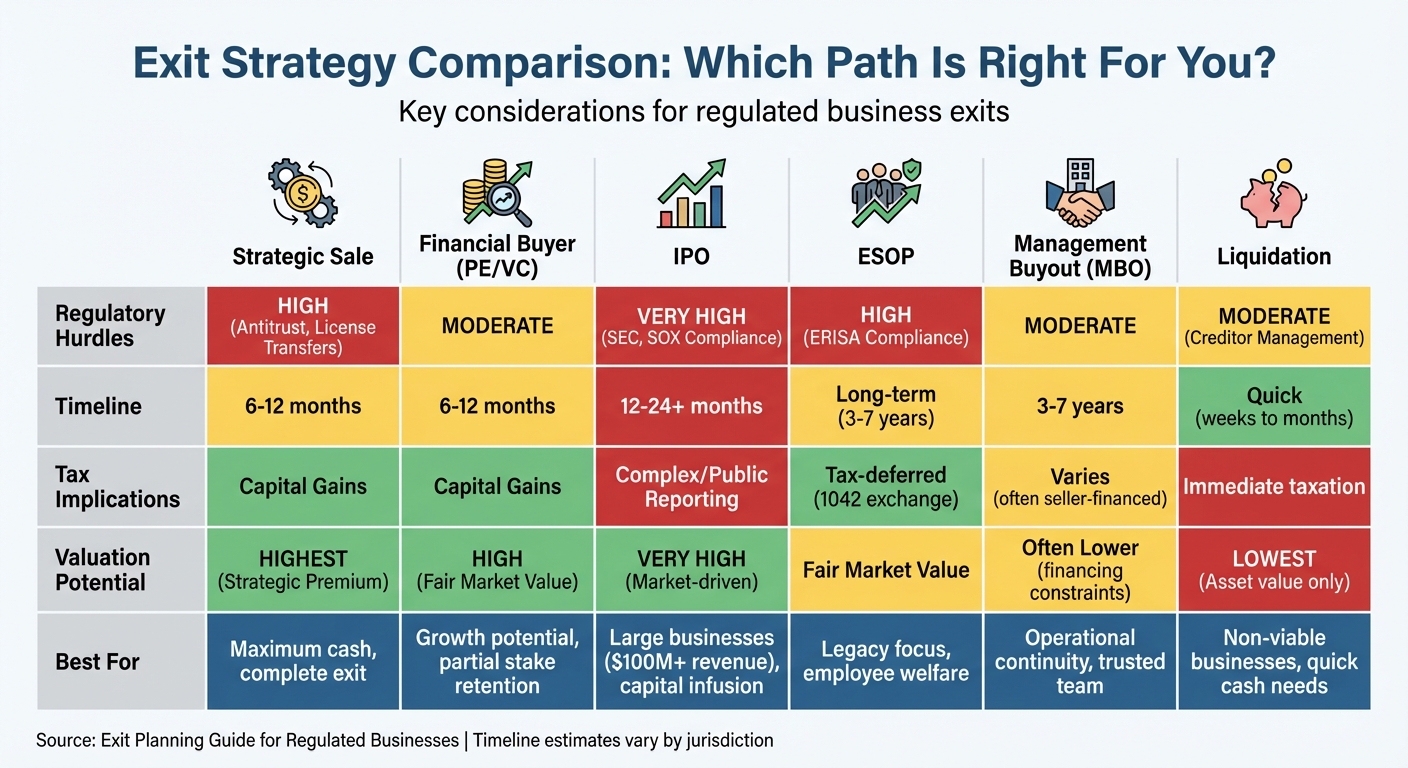
After strengthening your business operations and reducing risks, the next step is deciding how you want to exit. Your decision will hinge on what matters most to you - whether it’s maximizing cash, preserving your legacy, staying involved, or minimizing tax liability. Each exit option comes with its own regulatory requirements, timelines, and effects on valuation, especially in sectors like iGaming, Cryptocurrency, Forex, and Fintech.
Many business owners are not fully aware of the range of exit strategies available to them[7]. Understanding these options and their trade-offs is key to aligning your exit plan with your personal and financial goals. Below, we’ll explore some of the most common strategies and their unique considerations.
Family Succession and Employee Buyouts
Passing ownership to family members or employees focuses on maintaining continuity and legacy rather than securing immediate cash. These internal transitions keep institutional knowledge within the business but often come with lower valuations and may require you to finance the sale yourself[4].
Family succession allows you to hand the business down to the next generation. However, this path is fraught with challenges - only 30% of family businesses successfully transition to the second generation, and just 13% make it to the third[4]. One significant issue is determining fair market value. Selling at a discounted price to assist a family member could trigger gift tax implications if the IRS views the discount as a "gift." Additionally, you’ll need to resolve potential conflicts among heirs and ensure the next generation is prepared to manage a regulated business.
Management Buyouts (MBOs) involve selling the business to your current leadership team, ensuring operational continuity. This is particularly important in regulated industries where specialized knowledge is critical. However, managers often lack the capital to buy you out, which may require seller financing or additional company debt[4].
Employee Stock Ownership Plans (ESOPs) transfer ownership to a trust for employees, offering tax advantages like the 1042 exchange, which can defer capital gains taxes indefinitely[23]. As Brian Roth of Bank of America explains:
"The transition to an ESOP-owned company essentially puts the value and wealth of a company into the hands of the employees over time." [23]
Setting up an ESOP is complex and costly, as it falls under ERISA regulations and requires strict fiduciary oversight[22]. This makes it a viable option for owners who prioritize employee welfare and long-term legacy over immediate liquidity.
Acquisitions and IPOs
If your goal is to achieve maximum valuation and liquidity, consider a third-party sale or an IPO. These external exits often yield the highest sale prices but come with regulatory challenges and a loss of control.
A strategic acquisition occurs when a competitor or a related business buys your company. These buyers often pay a "strategic premium" above market value to acquire your licenses, customer base, technology, or market share[23]. As Brian Roth notes:
"If you want maximum valuation, and thus maximum liquidity, [a strategic buyer] is likely the way to go." [23]
However, strategic buyers typically demand full ownership and may implement staff reductions to eliminate redundancies. In regulated industries, these transactions can take 6 to 12 months due to license transfer requirements and potential antitrust reviews[24]. For sectors like iGaming and Forex, license transfers are often the main bottleneck, requiring pre-approval from regulators before the deal can close[21].
Financial buyers, such as private equity firms or venture capital funds, focus on businesses with high growth potential. They usually pay fair market value and may allow you to retain a minority stake, particularly in industries like Crypto and Fintech where founder expertise is crucial. This "second bite at the apple" strategy lets you sell a majority stake now while potentially benefiting from a larger exit later[7]. However, private equity firms will push for aggressive scaling to prepare for their own eventual exit.
Initial Public Offerings (IPOs) are often seen as the pinnacle for large-scale regulated businesses, offering high valuations and significant capital infusion[23]. However, they are only feasible for companies with at least $100 million in annual revenue. The process is lengthy - usually 12 to 24+ months - and involves stringent regulatory compliance, including SOX requirements and ongoing SEC reporting[23]. Additionally, you’ll face public scrutiny of your financial data and "lockup periods" that restrict you from selling shares immediately after the IPO[25]. Market conditions also play a critical role; in 2022, the U.S. saw 78% fewer IPOs compared to the previous year, underscoring how external factors can impact this option[23].
Liquidation and Asset Sales
Liquidation is an option when the value of your assets exceeds the value of the business as a going concern[4]. While this approach provides quick cash, it typically yields the lowest valuation since buyers only pay for tangible assets, with no premium for goodwill, customer relationships, or intellectual property.
For regulated businesses, liquidation requires moderate regulatory oversight to ensure creditors and liabilities are properly handled[4]. Although the process can be completed relatively quickly, it’s usually a last resort for businesses that are no longer viable or unable to find buyers willing to take on regulatory responsibilities.
Asset sales involve selling specific parts of the business, such as technology, customer lists, or licenses, while retaining or closing the rest. This can be a practical choice if certain assets hold more value individually than the business does as a whole. However, this approach generally results in lower total proceeds compared to selling the business as an ongoing entity.
Comparing Exit Strategies
Here’s a quick comparison of the key trade-offs for each exit strategy:
| Exit Strategy | Regulatory Hurdles | Timeline | Tax Implications | Valuation Potential |
|---|---|---|---|---|
| Strategic Sale | High (Antitrust, Licenses) | 6–12 months | Capital Gains | Highest (Strategic Premium) |
| Financial Buyer | Moderate | 6–12 months | Capital Gains | High (Market Value) |
| IPO | Very High (SEC, SOX) | 12–24+ months | Complex/Public | Very High (Market Driven) |
| ESOP | High (ERISA Compliance) | Long-term | Tax-deferred | Fair Market Value |
| MBO | Moderate | 3–7 years | Varies | Often Lower |
| Liquidation | Moderate (Creditors) | Quick | Immediate | Lowest (Asset Value) |
Selecting the right exit strategy isn’t about finding the "best" option - it’s about choosing the one that fits your goals, financial needs, and the unique challenges of your regulated business. As Scott Snider, President of The Exit Planning Institute, puts it:
"A well-prepared business owner and company has multiple exit options. That's the beauty of exit planning." [26]
For businesses in regulated industries like iGaming, Cryptocurrency, Forex, and Fintech, platforms such as MyReadyMade (https://myreadymade.com) can help streamline these complex transactions. With expertise in license transfers across over 50 jurisdictions and M&A advisory services, they can guide you through the regulatory hurdles that often complicate these exits.
Step 5: Handle Legal, Tax, and Licensing Requirements
When selling a business, addressing legal, tax, and licensing requirements is crucial. Overlooking these areas can lead to delays, reduced sale prices, or even failed deals. Ideally, tax planning should start three to five years before the sale to ensure a smooth process.
Wendy G. Marcari, Attorney at Epstein Becker & Green, P.C., underscores the need for early preparation:
"If your business operates pursuant to licenses, permits, or contracts with governmental authorities, map out the regulatory approvals that would be needed to consummate a change of control, and the estimated time to obtain those approvals." [11]
This section will guide you through essential tax strategies and the steps to secure regulatory approvals.
Tax Planning for Business Exits
Effective tax planning is not something to leave until the negotiation phase. The structure of your sale, your business entity type, and the timing all significantly impact your after-tax proceeds.
For example, stock sales are often favored because they qualify for long-term capital gains treatment. In 2025, federal capital gains tax rates are 0%, 15%, or 20%, depending on your taxable income [28]. There’s also a 3.8% Net Investment Income Tax (NIIT), though active S-corp owners are often exempt [27][28]. On the other hand, asset sales can be less favorable for sellers, as they may trigger ordinary income tax rates (up to 37%) on depreciation recapture [28].
Your business entity also plays a key role. C-corporations face double taxation on asset sales, while S-corporations and LLCs, as pass-through entities, are taxed only once at the individual level.
Here are some strategies to consider for reducing or deferring taxes:
- Installment Sales: Spread payments over several years to defer taxable gains and potentially stay in a lower tax bracket.
- Qualified Small Business Stock (QSBS): If you’ve held eligible C-corporation stock for over five years, you may exclude up to 100% of capital gains under Section 1202.
- Employee Stock Ownership Plans (ESOPs): These allow you to defer capital gains by reinvesting proceeds into qualified U.S. stocks or bonds.
- Opportunity Zones: Reinvest gains into Qualified Opportunity Funds (QOFs) to defer taxes until December 31, 2026, and potentially eliminate tax on future appreciation.
- Charitable Remainder Trusts (CRT): Transferring your business to a CRT before the sale can eliminate immediate capital gains taxes while providing an income stream for a set term.
Teri M. Kaye, CPA and Partner at CohnReznick, advises:
"Don't sign an LOI without language stating that it must be structured as a 'tax-efficient transaction' for the seller, unless the buyer is providing consideration for the tax consequences to the seller." [29]
For asset sales, negotiating the purchase price allocation (IRS Form 8594) is critical. Allocating more of the price to goodwill, which qualifies for capital gains treatment, can benefit the seller. Barbara Weltman, SBA Blog Contributor, explains:
"The reason the seller wants to allocate as much as possible to capital gain assets such as goodwill, the buyer wants a good allocation for assets, such as equipment and realty, that can be depreciated going forward." [27]
Here’s a quick comparison of tax strategies:
| Strategy | Best For | Tax Impact |
|---|---|---|
| Stock Sale | Sellers of C-corps or S-corps | Generally 100% capital gains; avoids double taxation |
| Asset Sale | Buyers seeking depreciation | Seller may face ordinary income tax on depreciation recapture |
| Installment Sale | Sellers without urgent liquidity needs | Defers tax liability over the payment term |
| QSBS (Sec 1202) | Early-stage C-corp founders | Potential 100% federal tax exclusion on gains |
| ESOP Sale | Owners focused on legacy | Deferral of gains if proceeds are reinvested in U.S. stocks or bonds |
Don’t forget to account for state and local taxes. For instance, in California, capital gains may be taxed at ordinary income rates as high as 13.3% [28]. Additionally, the 2025 annual gift tax exclusion is $19,000 per person, while the lifetime gift tax exemption is $13.99 million [28].
Once your tax strategies are in place, focus on securing the licenses and permits needed for regulatory compliance.
License Transfer and Regulatory Approvals
For businesses in regulated industries, transferring licenses can be one of the most time-consuming steps in the sale process. Unlike non-regulated businesses, these require prior approval from government agencies before ownership can change hands.
Start by auditing all licenses, permits, and government contracts that will require a change of control approval. This audit should be completed at least a year before your planned exit [11]. Include the necessary regulatory approvals in your sale process and closing timeline [11].
Approval timelines vary widely depending on the jurisdiction. Here are some examples:
- Malta Gaming Authority (MGA): Typically takes 6 to 12 months, with capital requirements of €80,000–€100,000 [1].
- UK Gambling Commission (UKGC): Usually requires 3 to 6 months.
- Estonia Tax and Customs Board: Takes 2 to 3 months, with capital requirements of €1 million for games of chance and €25,000 for games of skill [1].
- Anjouan Gaming License: Processes in about 3 to 4 weeks with capital needs around €17,000 [1].
- Hellenic Gaming Commission (Greece): May take up to 12 months, with €200,000 in paid-up capital and a €500,000 guarantee [1].
These timelines highlight the importance of strong compliance practices established early in the process.
It’s also essential to vet potential buyers. A buyer who already holds the necessary licenses can speed up the transfer process [11]. During negotiations, review commercial contracts for "change of control" or "anti-assignment" clauses that might restrict asset or equity transfers [11].
Prepare a digital data room to streamline due diligence. Include at least three years of audited financial statements, compliance records, corporate formation documents, and current licenses and permits. Regulators often request these materials during their review.
Finally, remember that the sale structure affects licensing. Stock sales usually require a "change of control" filing, while asset sales may require the buyer to obtain new licenses, potentially delaying the transaction. If you’re closing the business instead of selling it, formally cancel all licenses and permits to protect your financial reputation and avoid future liabilities [5][6].
Step 6: Assemble Your Exit Planning Team
Once your legal, tax, and licensing matters are squared away, it’s time to focus on building a strong exit planning team.
Exiting a regulated business is no small feat. It involves navigating license transfers, tax strategies, and deal structuring. Yet, surprisingly, 80% of business owners planning an exit don’t have a formal transition team in place [32]. This often results in missed opportunities and lower sale prices.
Your team should include a Certified Exit Planning Advisor (CEPA) to align your business, personal, and financial goals into a clear roadmap [30]. You’ll also need an M&A advisor to identify qualified buyers and structure the deal, a transactional attorney to handle legal agreements and compliance, and a CPA to ensure your financials meet GAAP standards and are tax-efficient [31].
The right advisors can make a huge difference. For instance, Axial shared a case study where an M&A advisor helped a family business achieve a sale multiple far beyond their expectations - jumping from an anticipated 5× profit to a final 9× profit [33].
Start assembling your team 18 months before your exit date [2]. Look for advisors with expertise in your industry, and interview several candidates to find the right match. Andrew Van Alstyne, Financial Planner at Fiduciary Financial Advisors, emphasizes:
"The best way to work through this is by having a plan in place years before you are looking to sell." [6]
Working with M&A Advisors and Transaction Platforms
An experienced M&A advisor does much more than just find buyers. They manage the entire transaction process, freeing you to focus on running your business. On average, working with an advisor can save you over 30 hours of work per week and increase your sale price by 6% to 25% [2].
For regulated industries like iGaming, Cryptocurrency, Forex, and Fintech, specialized transaction platforms can provide additional support. MyReadyMade, for example, offers verified business listings, secure communications, and expert advisory services tailored to regulated sectors. They handle license transfers across 50+ jurisdictions and provide 24/7 deal support, with an average closing time of 30 to 45 days.
When choosing an M&A advisor or platform, prioritize those with proven expertise in your industry’s regulatory timelines. They should also have strong relationships with corporate banking partners and payment service providers, which are often challenging to secure in regulated sectors [1]. During the engagement, set clear milestones and request regular updates in your agreement [2]. A skilled advisor will create competitive tension among buyers to drive up your sale price and secure better terms [33]. They’ll also manage the digital data room, oversee due diligence, and handle buyer communications - all while maintaining confidentiality and ensuring compliance with industry regulations.
Create Your Exit Timeline
With your team in place, the next step is to establish a clear timeline to guide your exit process.
A well-thought-out timeline is critical for success. Experts recommend starting the exit planning process 3 to 5 years [34] - or even 5 to 8 years [35] - before your target departure date. This allows ample time to boost your business’s value, clean up financial records, and address regulatory hurdles.
Work backward from your ideal exit date to set milestones. Here’s a typical timeline for a well-prepared exit:
| Phase | Timing (Before Exit) | Key Activities |
|---|---|---|
| Initial Planning | 3–5+ Years | Conduct valuation, identify asset gaps, and build value [34] |
| Team Assembly | 18 Months | Select M&A advisors and legal/tax experts [2] |
| Advisor Hiring | 15 Months | Interview advisors, negotiate terms, and set milestones [2] |
| M&A Launch | 12 Months | Finalize valuation, prepare marketing materials, and identify buyers [2] |
| Due Diligence | 3–6 Months | Open data room, manage buyer inquiries, and negotiate LOIs [2] |
| Closing | 0 Months | Finalize purchase agreement and facilitate leadership handover [2] |
For regulated businesses, account for license transfer windows and regulatory approval timelines. SBA lenders often require three years of clean financial records [14], so if your books aren’t in order, you’ll need time to transition from cash-basis to accrual accounting. Market conditions also play a role; high interest rates or a sluggish market may require extending your timeline [14].
Setting a firm exit date creates a clear deadline to keep your plans on track. As Axial advises:
"A great way to solidify your commitment is by deciding when you want your business sold and setting a firm exit date... having a clear deadline is highly effective in building the focus and momentum needed to successfully sell your business." [2]
It’s worth noting that only 20% to 30% of businesses listed for sale end up selling [30], and 75% of business owners regret selling due to lack of preparation [30]. A structured timeline, paired with the right team, can dramatically improve your chances of a successful and satisfying exit.
Conclusion
Exiting a regulated business is a complex process that goes far beyond just having solid financials. In these industries, compliance, licensing, and regulatory approvals play a pivotal role in determining the success of your sale and the final valuation.
Consider this: only 30% of family-owned businesses successfully transition to the second generation[4]. This highlights the importance of starting early. Preparing 3 to 7 years ahead of your planned exit allows you to address critical areas like closing asset gaps, normalizing financials, and ensuring operational independence[4]. This proactive approach lays the groundwork for a structured strategy that tackles both regulatory and operational hurdles.
In regulated industries, valid licenses are more than just paperwork - they’re strategic assets. They ensure compliance, simplify market entry for buyers, and can significantly boost your business’s valuation[1].
Given the intricacies involved, having the right team is non-negotiable. Bringing together M&A advisors, specialized attorneys, and CPAs ensures you’re equipped to handle the challenges. Platforms like MyReadyMade can further simplify the process by offering verified listings, expert advisory services, and support for license transfers across over 50 jurisdictions. These resources, combined with thorough planning, can make your exit both profitable and fully compliant.
As Commons Capital aptly put it:
"A business built to sell is, by definition, a business built to last. It is operationally efficient, financially transparent, and strategically positioned for future growth."[3]
FAQs
What key factors should you consider when valuing a regulated business for sale?
Valuing a regulated business requires a mix of standard financial metrics and a careful look at factors unique to the regulatory environment. To begin, use common valuation methods like net tangible assets, price-to-earnings (P/E) ratio, or discounted cash flow (DCF) analysis to assess the business's financial worth. In the U.S., these values are generally presented in dollars (e.g., $3.2 million), with commas separating thousands and a period for decimals.
For regulated businesses, the regulatory environment has a major impact on valuation. Key elements include the value and transferability of operating licenses, the business's compliance history, and the extent of regulatory oversight (e.g., AML/KYC requirements for fintech or crypto companies). A clean, transferable license in a high-demand market can drive up the value significantly. On the other hand, compliance issues, non-transferable licenses, or potential liabilities like pending investigations or fines can lower the valuation. Buyers will also factor in the ongoing costs of maintaining compliance when deciding on their offer.
What steps can I take to ensure a smooth license transfer when selling my regulated business?
A smooth license transfer is essential when selling a regulated business since much of the company's value hinges on keeping its regulatory approvals intact. Start by reviewing your licenses early, making sure all compliance obligations - like filings, reporting, and capital requirements - are up to date. Resolve any outstanding issues that might cause delays, and document critical details such as renewal dates, attached conditions, and licensing terms. Regulators often require a formal written request and may impose a review period before approving ownership changes, so being well-prepared and maintaining clear communication is key.
To make the process more efficient, collaborate with experienced legal counsel or an M&A advisor who can manage regulatory communications and draft the necessary agreements. Submit the buyer’s information and transaction summaries to the regulator well ahead of time. You might also consider using escrow arrangements to address any compliance requirements that arise after the deal closes. Additionally, platforms like MyReadyMade can provide expert support for license transfers, helping ensure a smooth handoff for both the buyer and seller.
What tax considerations should regulated businesses keep in mind when planning an exit?
The tax consequences of an exit strategy for regulated businesses largely hinge on how the deal is structured. For an asset sale, taxes can vary depending on the type of asset. Most assets are subject to capital gains tax, but items like inventory or certain types of goodwill may be taxed as ordinary income. How the purchase price is allocated across these assets can have a big impact on the seller's tax liability.
In a stock sale, sellers often enjoy capital gains tax treatment on the entire equity stake. However, buyers typically lose the chance to adjust the tax basis of the business's underlying assets, which can affect future tax benefits.
When it comes to mergers or tax-free reorganizations, gains might be deferred if the transaction meets specific IRS requirements. On the other hand, an IPO can trigger ordinary income taxes on compensation tied to the offering and may also bring alternative minimum tax (AMT) into play. For businesses that are liquidated, the tax treatment of distributed assets depends on their type - some may be taxed as capital gains, while others are treated as ordinary income.
Regulated businesses also need to factor in payroll taxes, like Social Security and Medicare, regardless of the chosen exit route.
Strategic planning and professional guidance are essential to optimize after-tax proceeds while staying compliant with both federal and state tax regulations.
Related Articles

Ultimate Guide to Earnout Negotiations in M&A
Structure and negotiate earnouts in regulated M&A with clear metrics, anti-manipulation covenants, and acceleration or escrow protections.

How to Draft M&A Definitive Agreements
Guide to drafting M&A definitive agreements covering deal structure, reps & warranties, indemnities, payment terms, and regulatory compliance.

How IP Affects Tokenization Valuation
How tokenizing patents, copyrights, and trademarks adds liquidity and market value—plus legal, regulatory, and valuation steps.
Looking to Buy or Sell?
Get in touch with our team for personalized assistance