Ultimate Guide to LOI Confidentiality Clauses
Ultimate Guide to LOI Confidentiality Clauses
When negotiating a business deal, a Letter of Intent (LOI) often includes confidentiality clauses to protect sensitive information. While most LOI terms are non-binding, confidentiality provisions are enforceable and critical for safeguarding trade secrets, financial data, and other proprietary details. These clauses prevent misuse of information, protect against employee poaching, and ensure compliance with legal and regulatory requirements.
Key takeaways:
- Purpose: Confidentiality clauses restrict how shared information can be used during negotiations.
- Scope: Covers trade secrets, financials, business plans, and even the fact that discussions are happening.
- Enforcement: Breaches can lead to legal remedies like injunctions, monetary damages, or specific performance.
- Industry Focus: High-risk sectors (e.g., iGaming, Cryptocurrency, Fintech) require stricter protections due to competition and regulatory scrutiny.
- Drafting Tips: Define confidential information clearly, include exclusions (e.g., public knowledge), and outline procedures for returning or destroying data.
To strengthen protections, phased disclosure, “clean teams,” and standstill provisions can help manage risks, especially in regulated industries. Platforms like MyReadyMade offer tools for secure transactions, ensuring sensitive details stay protected throughout the negotiation process.
Key Components of Effective Confidentiality Clauses
Core Elements to Include
Confidentiality clauses in Letters of Intent (LOIs) must be explicitly binding. While most LOI terms are non-binding, certain sections - like those covering Confidentiality, Expenses, or Exclusivity - should be clearly designated as legally enforceable [3]. The definition of confidential information should be broad, covering everything from business plans and trade secrets to financial data and even the fact that negotiations are underway. At the same time, the clause should restrict the use of this information strictly to evaluating the transaction.
Make sure to identify who is authorized to receive the information - such as employees, legal counsel, or financial advisors - and require them to protect the information with the same care they apply to their own sensitive data. Standard exclusions should be included for information that is public, previously known, obtained from third parties, or independently developed. Additionally, include provisions for situations where disclosure is compelled by law, along with requirements for the return or destruction of confidential materials. The return or destruction clause should mandate that all confidential documents be either returned or destroyed, with written confirmation provided once completed. It’s also critical to include language granting the right to seek injunctive relief or specific performance to protect sensitive information. For trade secrets, consider an indefinite duration to ensure ongoing protection under state laws [1]. These detailed measures are especially important in high-stakes industries like mergers and acquisitions.
By addressing these core elements, confidentiality clauses can provide strong protections while still accommodating the practical needs of the deal.
Balancing Protection and Practicality
While robust confidentiality clauses are essential, overly restrictive terms can hinder the deal-making process. One way to strike a balance is through phased disclosure - gradually releasing sensitive information as the transaction progresses [6].
For deals involving direct competitors, such as those in sectors like iGaming or Fintech, a "clean team" approach can be invaluable. As Morgan Lewis suggests, "a 'clean team' approach with much more specific provisions and controls regarding the disclosure of such information" can help avoid disputes over misappropriation if the deal falls through [2].
Additionally, confidentiality clauses should address practical concerns like archival and regulatory exceptions. For instance, archival copies of confidential information may need to be retained for compliance purposes, such as automated email backups or cloud storage. Carve-outs for compelled disclosure should also be included, allowing parties to comply with legal or regulatory orders while providing the disclosing party an opportunity to seek protective measures. Be cautious with residual rights clauses - if any confidential information lingers in a recipient’s unaided memory, ensure that such retention is limited to unintentional recollection to prevent misuse.
Striking the right balance between robust protection and practical considerations is critical, especially when drafting clauses for highly regulated industries. This ensures confidentiality while allowing negotiations to move forward effectively.
Drafting Confidentiality Clauses for Regulated Industries
Addressing Regulatory and Licensing Requirements
When creating confidentiality clauses for industries like iGaming, Crypto, Forex, and Fintech, it’s important to account for legal and regulatory obligations. Include carve-outs for disclosures required by law, court orders, or regulatory authorities. For instance, regulators often need access to transaction details, making these carve-outs essential.
Another key element is requiring immediate notification and a coordinated response. If disclosure to a regulator is unavoidable, the recipient should notify the disclosing party immediately. Both parties should then work together to secure a protective order or ensure the information receives other confidential treatment. In transactions involving public companies - common in Fintech and Crypto - addressing Regulation FD under the Securities Exchange Act of 1934 is crucial. This ensures all parties are clear on their obligations under federal securities laws.
To protect sensitive data, implement controlled disclosure measures. For example, limit access to proprietary algorithms or licensing details to a small group of advisors. This reduces risks like antitrust issues or claims of misappropriation.
For deals involving public companies, consider standstill provisions. These clauses prevent unsolicited bids or hostile actions during negotiations, usually restricting buyers from making unsolicited offers or acquiring stock for 6 to 18 months. A notable case highlighting the importance of such measures is the Delaware Court of Chancery's 2012 ruling in Martin Marietta Materials Inc. v. Vulcan Materials Co.. Here, a "permitted use" clause - limiting the use of information to a "negotiated transaction" - effectively acted as a standstill provision, blocking a hostile takeover attempt even in the absence of an explicit clause [7].
These regulatory considerations lay the groundwork for aligning confidentiality clauses with effective M&A practices.
Aligning with M&A Best Practices
Building on regulatory requirements, there are additional strategies to strengthen confidentiality provisions in Letters of Intent (LOIs). One critical step is to specify that closing the transaction hinges on securing all necessary regulatory and licensing approvals. Additionally, define "permitted use" narrowly to ensure that confidential information is used exclusively for evaluating the transaction - not for competitive purposes or hostile bids.
To maintain consistency, reference any previously signed Non-Disclosure Agreements (NDAs). This avoids conflicting terms and ensures ongoing protection. In industries where data retention is legally required, include terms allowing recipients to retain necessary copies of confidential information for archival or evidentiary purposes in compliance with laws or professional standards. Explicitly addressing insider trading restrictions is also essential to meet federal securities law requirements.
As noted by Morgan Lewis:
"Protection of trade secrets under state law can be lost (deemed waived) if they are disclosed without a written agreement."
Letters of Intent (LOIs), What is Letter of Intent? Explained in detail #letterofintent #LOI #LWMRM
sbb-itb-ba142f6
Enforcing LOI Confidentiality Clauses
Legal Remedies for Breaches
The ultimate protection for confidentiality clauses lies in enforcement. When a breach occurs, one of the most effective remedies is injunctive relief. As Erik Lopez, Partner at Jasso Lopez PLLC, points out:
"Monetary damages are often extremely difficult for a plaintiff to prove as a result of a breach of a confidentiality agreement. Consequently, a discloser's best opportunity for recourse may be to seek injunctive or equitable relief (a court-ordered act or prohibition against an act) to stop any further disclosures." [9]
To strengthen your position, include an "inadequacy of damages" clause and waive bond requirements, enabling quicker access to injunctive relief [9].
Other potential remedies include specific performance or monetary damages. Financial compensation can cover out-of-pocket costs, lost benefits, or reliance damages [10][4]. In cases involving fraud, punitive damages might also come into play [10]. Some LOIs go further by including breakup fees or liquidated damages, which outline clear penalties for breaches. These terms should be mutual to ensure fairness [5].
For trade secrets, protection should last indefinitely - or at least until the information becomes public [9]. With these safeguards in place, it's also vital to establish a robust dispute resolution process to handle any conflicts that arise.
Resolving Confidentiality Disputes in High-Risk Deals
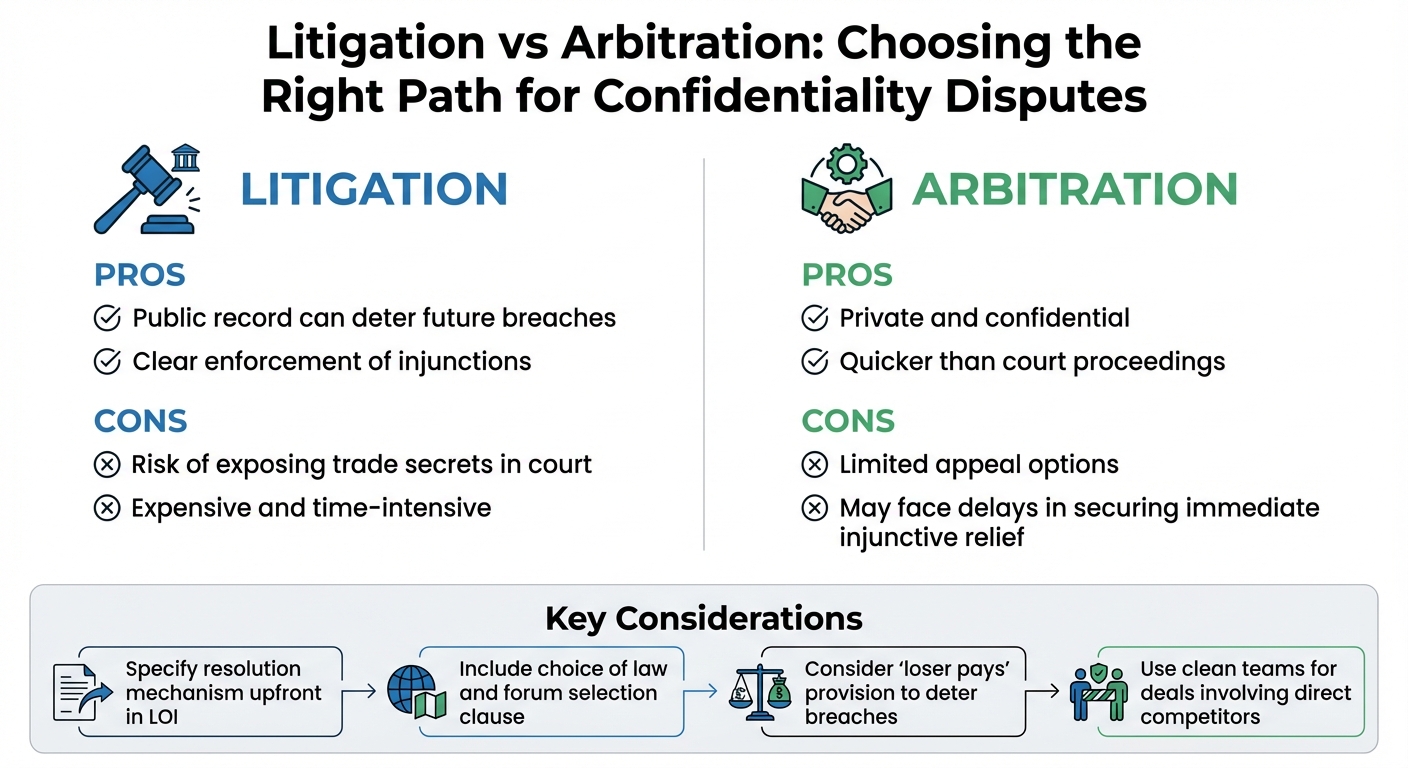
Handling disputes, especially in high-stakes industries like iGaming, Crypto, or Fintech, requires a carefully considered approach. Litigation is often chosen for its ability to enforce injunctions and create a public record, which can discourage future breaches. However, it carries risks, such as exposing trade secrets in open court, and can be both costly and time-consuming [6][9]. On the other hand, arbitration offers privacy and is generally faster, though obtaining immediate injunctive relief may still require court involvement [4][9].
| Dispute Resolution Mechanism | Pros | Cons |
|---|---|---|
| Litigation | Public record can deter future breaches; clear enforcement of injunctions | Risk of exposing trade secrets in court; expensive and time-intensive [6][9] |
| Arbitration | Private and confidential; quicker than court proceedings | Limited appeal options; may face delays in securing immediate injunctive relief [4] |
This comparison highlights the importance of tailoring dispute resolution clauses in your LOI. To avoid jurisdictional conflicts, specify the resolution mechanism upfront. Include a choice of law and forum selection clause, particularly for cross-border transactions [1][4]. A "loser pays" provision, where the losing party covers all legal fees, can also be a powerful deterrent against breaches [1][9].
For deals involving direct competitors, using clean teams can help manage disputes in sensitive transactions [1][2]. In public company deals, standstill provisions are particularly useful. They make it easier to prove breaches, such as unauthorized bids, compared to demonstrating misuse of confidential information [8][9].
Ultimately, the burden of proving a breach rests on the disclosing party - a challenging task in complex transactions [1][2]. To protect your interests, draft LOIs with narrow "permitted use" definitions and clear enforcement provisions, especially in regulated industries where stakes are high.
Best Practices for LOI Confidentiality
Mutual Confidentiality: Protecting Both Parties
Mutual confidentiality ensures that both parties' sensitive information is safeguarded right from the start. Unlike agreements that only protect the seller, mutual non-disclosure agreements (NDAs) create a balanced approach, often leading to quicker sign-offs. This is particularly important in high-risk industries like iGaming, Cryptocurrency, Forex, and Fintech, where buyers may need to share proprietary technology or compliance information during evaluations [1][2].
To protect sensitive details, sign the NDA before any information exchange begins [1][2][6]. If an NDA was already signed during initial discussions, reference it in your Letter of Intent (LOI) to ensure continuity [1][2]. Additionally, make sure confidentiality provisions in the LOI are clearly marked as binding, as most LOI terms are non-binding unless explicitly stated otherwise [1][3][13].
For transactions involving direct competitors, consider implementing clean teams to reduce risks [1][2]. As Jacob Orosz, President of Morgan & Westfield, emphasizes:
"A properly prepared agreement signals to buyers that you're well-represented, and buyers will be less likely to use negotiating tactics they'd try with unsophisticated, poorly represented sellers" [6].
Be specific about what information is protected. Avoid vague terms like "all business information" and instead list concrete categories such as source code, financial forecasts, and regulatory licensing data [11][5]. Recipients should be required to protect this information as diligently as they protect their own [11][12]. Also, include protocols for returning or destroying materials if negotiations fall through, along with written confirmation of compliance [1][11][12].
For an extra layer of security, platforms like MyReadyMade can provide specialized tools to safeguard confidential transactions.
Using MyReadyMade for Confidential Transactions

MyReadyMade complements strong confidentiality practices with advanced tools that simplify M&A transactions while maintaining security. The platform vets potential buyers thoroughly before disclosing your company’s identity, ensuring only serious parties with verified financial capacity gain access to sensitive information [14]. NDA-protected communications keep discussions secure throughout the process.
To attract qualified buyers while minimizing exposure, MyReadyMade uses anonymous one-page teasers [14][6]. The platform also offers expert M&A advisory services and supports license transfers across more than 50 jurisdictions, addressing the complex compliance needs typical in iGaming, Cryptocurrency, Forex, and Fintech deals. Transactions on MyReadyMade are efficient, with most deals closing in 30–45 days. Sellers benefit from this professional confidentiality management without any upfront costs, paying only a success fee when the deal is finalized.
Conclusion
Confidentiality clauses in Letters of Intent play a critical role in safeguarding sensitive information and ensuring the success of business deals. For industries like iGaming, Cryptocurrency, Forex, and Fintech - where trade secrets and market stability are paramount - these clauses act as a protective shield. Without a formal agreement, state laws may not protect your trade secrets, potentially leaving your most valuable assets vulnerable [2].
Getting the details right from the start is key. Your confidentiality clause should be explicitly marked as binding, clearly outline what qualifies as protected information, and hold recipients accountable for breaches caused by their representatives. As Jacob Orosz, President of Morgan & Westfield, aptly puts it:
"A properly drafted confidentiality agreement (CA) sets expectations and signals to buyers that you're well-represented" [6].
This level of professionalism not only discourages aggressive negotiation tactics but also fosters mutual respect, aligning with the strategies discussed earlier.
Once confidential information is leaked, the legal options are often limited to monetary damages. This underscores the importance of preventive measures and swift enforcement. To further protect your interests, consider adding non-solicitation clauses to safeguard key employees for at least one year. Require written certification of material destruction if the deal falls through, and adopt a phased disclosure approach - releasing the most sensitive data only as buyer commitment increases.
Platforms like MyReadyMade offer valuable tools to enhance security during high-risk transactions. With features such as pre-qualified buyers, secure NDA communications, and anonymous teasers, MyReadyMade adds an extra layer of protection throughout the typical 30–45 day transaction cycle. When combined with the drafting practices outlined earlier, these tools help ensure your sensitive data remains secure.
Effective confidentiality practices do more than protect your business during negotiations - they showcase professionalism, support regulatory compliance, and help preserve your business's value throughout the transaction and beyond.
FAQs
What ensures that confidentiality clauses in LOIs are legally enforceable?
Confidentiality clauses in Letters of Intent (LOIs) hold legal weight when they clearly outline what qualifies as confidential information, detail the responsibilities of the receiving party, and comply with state trade-secret laws. These components provide a strong legal basis for courts to enforce the agreement.
For the clause to stand up in court, it’s essential to use precise wording, eliminate any ambiguity, and customize it to fit the unique aspects of the transaction. When drafted correctly, confidentiality clauses safeguard sensitive information and offer legal options if a breach occurs.
What is phased disclosure, and how does it balance confidentiality with practicality in LOIs?
Phased disclosure is a method where information is shared gradually as a transaction moves forward. This approach helps both parties maintain confidentiality while still enabling practical decision-making. At the outset, sellers might share broad overviews or key financial figures. This way, they protect sensitive data and trade secrets but still provide buyers with enough insight to assess the opportunity.
As the due diligence process advances and specific milestones are reached, the confidentiality agreement can be updated to allow for more detailed disclosures. This step-by-step process ensures buyers get the details they need to make informed decisions, while sellers minimize risks and avoid exposing sensitive information too early.
What is the role of clean teams in M&A deals between direct competitors?
Clean teams are indispensable in mergers and acquisitions between direct competitors, ensuring that sensitive information is shared securely without risking competitive misuse. While confidentiality clauses in Letters of Intent (LOIs) provide baseline protection, clean teams add an extra layer of security by tightly controlling access to proprietary data. Only a select group of pre-approved individuals, bound by stringent agreements, are permitted to review critical information. This process helps safeguard trade secrets and prevents any unfair competitive advantage.
By protecting details like customer lists, pricing strategies, and business models, clean teams not only shield valuable information but also reduce potential misunderstandings during due diligence. In high-stakes industries such as technology or heavily regulated sectors, clean teams play a vital role in maintaining trust and safeguarding competitive intelligence throughout the transaction.
Related Articles

Ultimate Guide to Earnout Negotiations in M&A
Structure and negotiate earnouts in regulated M&A with clear metrics, anti-manipulation covenants, and acceleration or escrow protections.

How to Draft M&A Definitive Agreements
Guide to drafting M&A definitive agreements covering deal structure, reps & warranties, indemnities, payment terms, and regulatory compliance.

How IP Affects Tokenization Valuation
How tokenizing patents, copyrights, and trademarks adds liquidity and market value—plus legal, regulatory, and valuation steps.
Looking to Buy or Sell?
Get in touch with our team for personalized assistance