Ultimate Guide to RPA in Regulated Industries

Ultimate Guide to RPA in Regulated Industries
Regulated industries like finance, cryptocurrency, and gaming face constant pressure to meet strict compliance standards while managing large volumes of data. Robotic Process Automation (RPA) offers a reliable solution by automating repetitive tasks, reducing errors, and ensuring audit readiness.
Key Takeaways:
- What is RPA? Software bots that mimic human actions to handle rule-based tasks like data entry and reporting.
- Why RPA Matters: Cuts compliance errors by up to 90%, reduces operational costs by up to 30%, and ensures 24/7 monitoring.
- Applications: Streamlines KYC/AML processes, automates regulatory reporting, and improves transaction monitoring.
- Implementation Steps: Identify tasks for automation, establish a governance framework, and test thoroughly before deployment.
- Challenges: Addressing security, meeting compliance standards, and scaling effectively with clear strategies.
RPA is reshaping operations in regulated sectors, offering precision and efficiency while helping businesses stay compliant with evolving rules.
A step-by-step guide to successful RPA implementation | Episode 1
How RPA Works in Back-Office Operations
Back-office operations handle enormous amounts of data, from transaction logs to customer verifications. Robotic Process Automation (RPA) steps in to automate these repetitive, rule-based tasks, saving time and cutting down on errors that could otherwise be costly.
Compliance and Reporting Automation
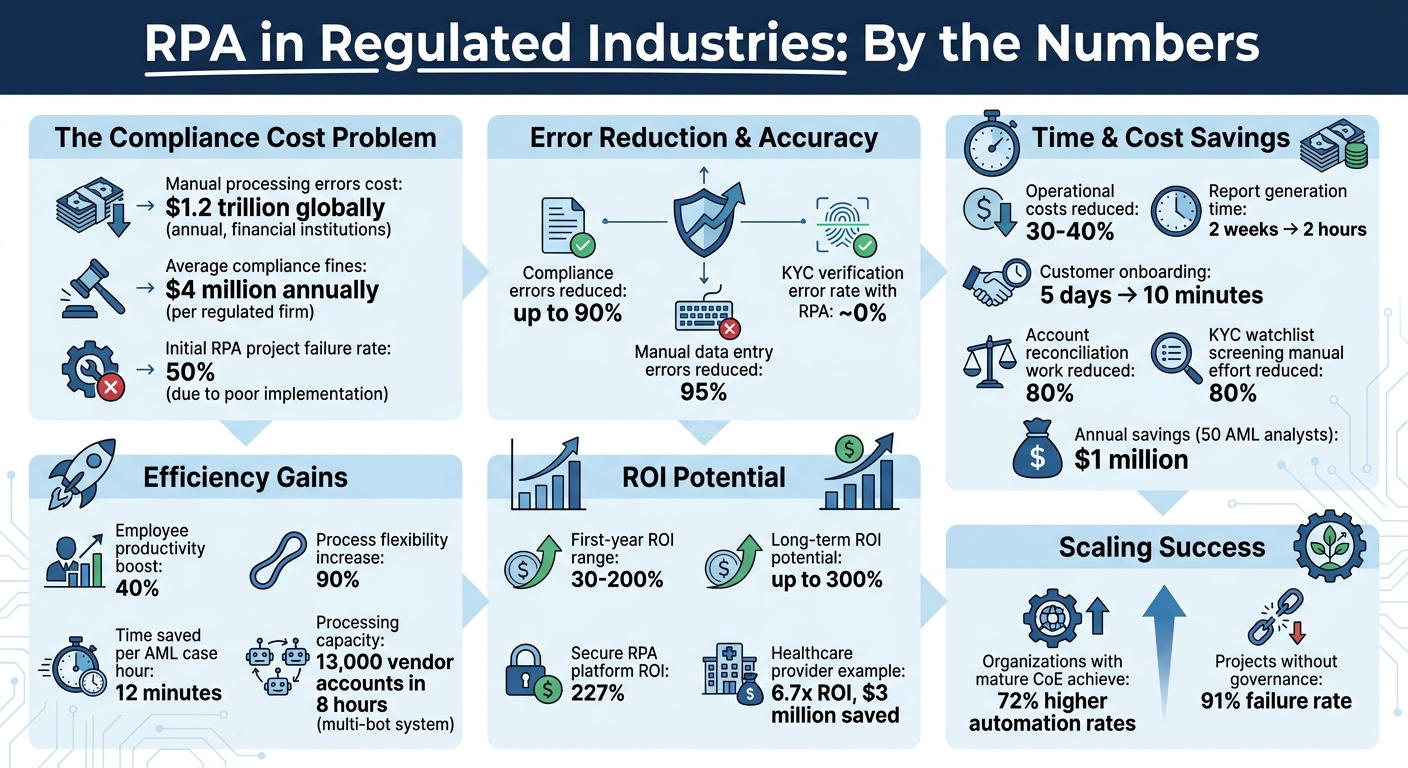
Regulatory reporting is often a tedious and error-prone manual process. Compliance teams typically spend weeks gathering data from various systems, cross-checking numbers, and formatting reports to meet specific standards. RPA changes the game by reducing this process from weeks to just hours - report generation times can drop from 2 weeks to as little as 2 hours [6].
RPA bots consolidate data from multiple systems to create standardized reports automatically [6]. Every action they perform is logged with precise timestamps, creating an audit trail that regulators can easily review. This level of transparency is crucial, especially since manual processing errors and inefficiencies cost financial institutions around $1.2 trillion globally each year [6]. Additionally, regulated firms face an average of $4 million annually in compliance-related fines [6].
"RPA enhances compliance by enforcing process consistency and providing audit trails and transparency." - UiPath [5]
When regulations inevitably change, RPA bots can be swiftly updated to align with new requirements [3]. This flexibility eliminates the delays that come with retraining staff or overhauling manual workflows. Beyond compliance, RPA also excels in areas like customer verification and fraud detection.
KYC and AML Processes
Know Your Customer (KYC) and Anti-Money Laundering (AML) processes are notoriously time-consuming in regulated industries. RPA automates tasks like gathering customer documents and verifying them against internal and external databases [7][8]. This automation significantly reduces both time and costs, cutting customer onboarding times from 5 days to just 10 minutes in some cases [6].
In practical terms, RPA can reduce manual effort in KYC watchlist screening by over 80% [8]. For example, a team of 50 AML analysts could save up to $1 million annually by automating repetitive KYC tasks [7]. The accuracy of these automated solutions is impressive, with error rates close to 0% [7].
"The accuracy of RPA solutions for KYC verification process is perfect, with almost 0% error rate." - Daniel Madajewski, Business Development Manager, Comarch Finance [7]
For AML compliance, RPA bots monitor transactions in real-time, flagging suspicious activities based on predefined rules and notifying compliance teams instantly [7][2]. They can automatically close low-risk alerts while routing high-priority cases to the appropriate investigators [8]. Additionally, RPA simplifies the filing of Suspicious Activity Reports (SARs) to regulators like FINCEN, ensuring timely and accurate submissions [8][2]. These efficiencies allow an AML analyst to save approximately 12 minutes for every hour spent on a case [7].
RPA's impact extends beyond compliance, offering powerful tools for data reconciliation and transaction monitoring.
Data Reconciliation and Transaction Monitoring
Data reconciliation is an area where RPA truly excels. For instance, a multi-bot RPA system can process nearly 13,000 vendor accounts in just 8 hours [2]. These bots validate data across different systems, ensuring records are accurate, complete, and up-to-date - essential for industries like finance and cryptocurrency, where precision is critical.
By automating account reconciliation, RPA can reduce manual intervention by up to 80% [6]. It performs rule-based tasks with a high degree of accuracy, cutting manual processing errors by up to 90% and reducing errors from manual data entry by 95% [6].
In transaction monitoring, RPA bots scan thousands of transactions at lightning speed, identifying suspicious activities far more effectively than manual reviews [3]. They flag anomalies immediately, enabling compliance teams to act quickly and prevent small issues from escalating into major compliance breaches. Additionally, the audit trails generated by RPA provide regulators with clear, time-stamped records, simplifying the process of proving compliance.
Benefits of RPA for Regulated Businesses
Switching from manual to automated processes offers clear advantages, directly affecting profitability and improving compliance. RPA reshapes back-office operations by cutting inefficiencies and reducing risks tied to human-driven workflows.
Efficiency and Cost Savings
RPA significantly lowers labor costs by taking over repetitive tasks 24/7 [9], increasing throughput while allowing employees to focus on more strategic responsibilities. Companies using RPA have reported a 40% boost in employee productivity [10]. Additionally, scaling operations becomes easier - handling larger data volumes or adapting to new regulations can be achieved by deploying more bots, rather than hiring additional staff. This shift can enhance process flexibility by as much as 90% [10]. These efficiency improvements work hand in hand with strengthened compliance efforts.
Better Compliance and Risk Management
Beyond operational improvements, RPA enhances compliance and reduces risks. Automated systems create precise, time-stamped audit trails [1][2], streamlining audits compared to the time-consuming process of reconstructing logs manually.
With real-time monitoring, RPA can continuously scan for irregularities, flagging suspicious transactions immediately [1][2]. Data accuracy also benefits, as bots validate and reconcile records to ensure regulatory submissions are dependable [9].
"In sensitive industries, regulatory compliance is not just a legal requirement; it's a business imperative." - Umair Shahab, Head of Business Development, BlocBelt [1]
RPA frameworks also incorporate security measures like encryption, role-based access, and centralized oversight [9]. Bots are programmed to access only the systems necessary for their tasks, reducing the risk of exposing sensitive information like personal data or payment details. When regulations change, updating bot workflows is quicker and more dependable than retraining an entire workforce [2].
How to Implement RPA in Regulated Industries
Implementing RPA in regulated industries requires a careful balance between speed and control. Studies indicate that 91% of projects lacking proper governance fail, while organizations with a mature Center of Excellence (CoE) achieve automation rates up to 72% higher [11][12][13]. To harness the benefits of RPA while ensuring compliance, follow these structured steps.
Identifying Processes for Automation
Start by using process mining tools to analyze transaction volumes and workflow patterns. This data-driven approach, combined with workshops involving process owners, helps identify repetitive, high-volume tasks and locate bottlenecks [12]. Set up an intake system to capture baseline metrics like transaction volume, task complexity, benefit potential, and risk profile. In regulated industries, processes must also be evaluated for their impact on data privacy, auditability, and reporting requirements [11][12]. By involving risk, audit, and compliance teams early, you can ensure that automated workflows meet strict IT controls and regulatory standards.
"RPA assists with the stringent and complex compliance regulations which dominate the industry, and it allows for easier compliance processes and audits with 100% accuracy." - WeAreBrain [11]
Focus on rule-based processes with minimal exceptions. In banking, for example, this could include tasks like Know Your Customer (KYC) checks, Anti-Money Laundering (AML) processes, and data migration from legacy systems. First-year ROI for RPA implementations often ranges from 30% to 200%, with long-term returns potentially reaching 300% [12]. A U.S. healthcare provider demonstrated this potential by achieving a 6.7x ROI and saving $3 million through centralized RPA governance [12].
Building an RPA Center of Excellence (CoE)
A strong CoE is essential for selecting processes, enforcing standards, and maintaining executive support [12][14]. The structure of your CoE should match your organization's size and maturity. Centralized models work well for beginners, while federated models are better suited for large, decentralized organizations looking to scale quickly [13][15].
Gaining executive sponsorship is critical. Leaders like the CFO, COO, or CIO can allocate budgets and enforce standards across departments [12][14]. Assemble a cross-functional team that includes solution architects, RPA developers, business analysts, and change managers. Establish a steering committee with representatives from IT, HR, Finance, and Risk to ensure automation efforts align with broader business goals [14][15]. For example, DHL Global Forwarding created a virtual delivery center, reassigning about 50% of its staff to higher-value tasks during a pilot phase. They achieved full ROI within a month and then scaled globally [12]. Use tools like a RACI matrix (Responsible, Accountable, Consulted, Informed) to define roles clearly and avoid conflicts throughout the automation lifecycle [12]. A well-organized CoE ensures scalability, security, and compliance.
Testing and Deployment
Begin with a controlled pilot deployment. With governance in place, focus on thorough testing and phased rollouts. Ensure your testing environment closely mirrors production, as differences in factors like screen resolution or network latency can cause issues [16].
"Deploying RPA without a rigorous testing framework is like launching a ship without a rudder." - Ragini Kumari, QA Expert, Testriq [16]
Develop reusable test components to streamline maintenance and maintain consistency. Test bots with unstructured data, such as null values or unfamiliar date formats, to ensure they handle exceptions effectively. Perform load testing to simulate peak usage scenarios before full deployment [16][17]. Adhere to the principle of least privilege by restricting bots' system access to only what is necessary for their tasks. Use secure credential vaults instead of hardcoding passwords [17]. Finally, implement centralized logging and real-time monitoring to maintain detailed audit trails. Apply version control to all RPA scripts to track changes and enable quick rollbacks if needed [17].
Common Challenges and How to Solve Them
Implementing RPA in regulated industries often comes with its share of challenges. Surprisingly, about 50% of initial projects fail - not because of the technology itself, but due to the way it's implemented [21]. By recognizing these hurdles and applying proven strategies, you can sidestep costly missteps and potentially achieve a 227% return on investment with a secure RPA platform [18]. Key challenges typically arise in areas like security, regulatory compliance, and scaling, each requiring specific solutions.
Security and Data Privacy Concerns
When bots handle sensitive information, security risks become a major concern. Misconfigured bots can accidentally expose personal data or financial records to the wrong parties. If bots lack unique identities, unauthorized users could disguise themselves as legitimate bots, making it hard to trace breaches. Additionally, storing bot credentials in plain text or relying on weak encryption makes them easy targets for cyberattacks.
To address these issues, assign every bot a unique identifier with clearly defined access privileges. Use an encrypted password management system with multi-factor authentication (MFA) to store credentials securely. Enforce a least-privilege access policy, allowing bots to access only the specific data they need - such as limited patient information for HIPAA compliance. Encrypt RPA logs and implement strict access controls to ensure their integrity for audits. Monitoring tools can also play a vital role by flagging any unusual bot behavior or unauthorized system access.
While securing data is critical, successfully navigating complex regulatory frameworks is just as important.
Meeting Regulatory and Compliance Requirements
Beyond technical safeguards, regulated industries must adhere to a maze of compliance standards. These range from GDPR’s rules on data accuracy and retention to HIPAA’s requirements for safeguarding patient health information, and AML/KYC protocols for financial monitoring. For instance, financial firms operating in the EU will need to comply with the Digital Operational Resilience Act (DORA) starting January 17, 2025 [19]. RPA bots can help reduce compliance risks by executing tasks with precision, minimizing the potential for human error in areas like data entry and reconciliation [1].
"Automation serves as the bridge between the different departments and stakeholders involved in compliance processes, streamlining workflows, and ensuring consistent, rapid responses to ICT-related incidents."
– Sam Bauman, Industry Marketing Manager, FINS, UiPath [19]
To further ensure compliance, use automated test suites to simulate failure scenarios and stress-test your ICT infrastructure. This helps validate that systems remain compliant even during disruptions. Centralize vendor tracking to monitor the compliance of third-party ICT service providers, which is increasingly crucial under modern financial regulations.
Managing Change and Scaling RPA
Even after addressing security and compliance, managing change and scaling RPA present their own challenges. Resistance to change ranks as the third most common obstacle for companies adopting robotic automation [21]. Around 45% of businesses using AI and robotics report struggles with deployment or integration [21]. With the Intelligent Process Automation Market projected to hit $51.35 billion by 2032 [4], it’s clear that scaling requires more than just investing in technology.
Transparent communication can help ease concerns about job displacement. Early on, explain how RPA supports employees by freeing them from repetitive work, and invest in training programs to help them transition to more meaningful roles. Starting with low-to-medium complexity processes can demonstrate quick wins, building confidence before moving to more intricate workflows.
"The key here is communication. Involve your employees early in the process, explain how automation will enhance their roles by offloading repetitive tasks, and ensure there are new opportunities for skill development."
– Vikrant Tomar, Certified RPA Developer [22]
To scale effectively, establish an automation operating model involving key stakeholders, including business units, a Center of Excellence (CoE), IT teams, internal auditors, and global risk/control teams [20]. Appoint an RPA owner to oversee bot performance, manage updates, and handle issues caused by system changes. Develop a controls framework that aligns regulatory requirements, like GDPR or PCI-DSS, with automated processes. Finally, sustained C-suite support is critical - ensure executives back the vision at every stage [20].
Conclusion
RPA is reshaping back-office operations by cutting up to 90% of errors - errors that collectively cost banks a staggering $1.2 trillion worldwide [6]. By delivering accuracy and agility, RPA directly tackles the operational challenges we’ve discussed. For industries like iGaming, Cryptocurrency, Forex, and Fintech - where compliance is non-negotiable and profit margins are slim - RPA transforms error-prone manual tasks into efficient, scalable automated workflows.
But it’s not just about saving money. RPA allows businesses to reallocate skilled employees to more strategic roles. With software robots handling repetitive tasks 24/7, teams can focus on solving complex problems rather than spending time on routine data entry. Financial organizations adopting RPA have reported impressive results: operational costs reduced by 40–60%, regulatory reporting times slashed from two weeks to just two hours, and manual intervention in account reconciliation decreased by up to 80% [6].
"Robotic Process Automation represents more than just a technological upgrade - it's a strategic revolution in banking operations."
– AutomationEdge [6]
As regulations grow stricter and data volumes continue to expand, delaying the adoption of RPA could mean higher costs, unhappy customers, and falling behind more agile competitors. The next step? Integrating generative AI and machine learning into RPA systems to handle even more complex workflows. Organizations embracing this shift will not only enhance compliance but also gain a sharper competitive edge.
If you’re in regulated sectors like iGaming, Cryptocurrency, Forex, or Fintech, check out MyReadyMade (https://myreadymade.com) for verified business listings that prioritize automation and compliance frameworks.
FAQs
How do I pick the best first RPA processes to automate?
When deciding where to begin, focus on processes that are rule-based, repetitive, and high-volume. These tasks often involve digital inputs and follow clear, well-defined steps. Targeting such processes ensures a quicker return on investment while keeping complexity under control.
For industries with strict regulations, it's smart to prioritize processes that already align with compliance requirements. This approach not only maximizes benefits but also helps minimize potential risks.
How can RPA be audited and proven compliant?
RPA helps maintain compliance by automating tasks with precision and generating comprehensive audit trails. It allows auditors to review complete datasets, spot irregularities, and apply policies uniformly - critical in sensitive fields like anti-money laundering (AML) and banking. With transparent, repeatable, and verifiable processes, RPA not only streamlines audits but also supports regulatory adherence while boosting efficiency and improving risk management.
What security controls should RPA bots have for sensitive data?
When RPA bots deal with sensitive information, robust security measures are a must to safeguard confidentiality, maintain data integrity, and meet regulatory standards. Here are the key practices to ensure a secure environment:
- Encryption: Use strong encryption methods like AES-256 to protect data both at rest and during transmission.
- Access Controls: Enforce strict access policies, including the use of complex passwords, to limit data access to authorized personnel only.
- Audit Logs: Maintain tamper-proof audit logs to track activities and ensure accountability.
Additionally, conducting regular security assessments - such as vulnerability scans and penetration tests - helps uncover and address risks before they become serious issues. These steps are critical for building a secure and compliant RPA framework.
Related Articles

KYC vs. AML for Payment Processors: What to Know
KYC confirms identity at onboarding, but only continuous AML monitoring stops payment processors from becoming conduits for financial crime.

Checklist for Secure Player Database Transfers
Step-by-step checklist for secure player database transfers: compliance, encryption, vendor vetting, zero-trust, integrity checks, and audits.
Ultimate Guide to Payment Compliance in iGaming
Roadmap for building compliant iGaming payment systems: AML/KYC, PCI‑DSS, multi‑PSP setup, chargeback controls and jurisdictional risks.
Looking to Buy or Sell?
Get in touch with our team for personalized assistance