Valuation Disputes in Regulated Industries: Key Insights

Valuation Disputes in Regulated Industries: Key Insights
Valuation disputes often arise in regulated industries like iGaming, Fintech, Cryptocurrency, and Forex due to rapid regulatory changes, market volatility, and the challenges of assessing intangible assets like licenses and technology. These disagreements typically stem from:
- Regulatory Complexity: Shifting rules (e.g., LIBOR cessation, SEC rulings) impact asset valuations and compliance costs.
- Market Volatility: Unstable markets, as seen during events like the Terra/Luna collapse, complicate valuation timing and methods.
- Clashing Valuation Methods: Disputes occur over whether to prioritize historical earnings, cash flow forecasts, or asset values.
Key Valuation Approaches:
- Income Approach: Focuses on future cash flows but requires adjustments for binary regulatory risks.
- Market Approach: Benchmarks against peers but must account for regulatory landscapes.
- Asset-Based Approach: Useful for distressed entities, highlighting the value of licenses and other intangibles.
Resolving Disputes:
- Use independent experts for unbiased valuations.
- Mediation and arbitration help settle disagreements efficiently.
- Clearly define valuation standards in contracts to avoid ambiguity.
Regulated industries rely heavily on licenses, which can represent a significant portion of a business's worth. Understanding their value, compliance costs, and transferability is critical for accurate valuations and smoother transactions.
Why Valuation Disputes Happen in Regulated Industries
Regulatory and Compliance Challenges
Regulatory shifts often complicate the valuation process. A prime example is the cessation of LIBOR, which required companies to transition to alternative rates. This change introduced operational and legal risks, making valuation more complex. As Randall Quarles, Former Vice Chair for Supervision at the Federal Reserve Board, noted:
"Cessation of LIBOR use…will be one of the highest priorities of…bank supervisors" [3].
This transition sparked disagreements over how to value both existing contracts and future cash flows.
Another challenge lies in the classification of digital assets. In the SEC v. Ripple Labs case (2020–2024), Judge Analisa Torres ruled that Ripple's institutional sales of XRP, totaling $728 million, were unregistered securities, while public sales were not [1]. This distinction forced analysts to reconsider how token sales and their utility influence business value, as different sales channels carry varying regulatory costs.
Further complicating matters are heightened antitrust scrutiny on serial mergers and the subjective nature of the Current Expected Credit Losses (CECL) methodology, which estimates lifetime losses. These factors often lead to valuation disagreements, especially during periods of market instability [3].
Market Volatility and Uncertainty
In volatile markets, even small shifts in valuation dates can result in significant discrepancies. This often leads to disputes over timing and methodology, as parties try to reconcile these differences.
The Terra/Luna collapse in June 2024, highlighted in SEC v. Terraform Labs, underscored the dangers of circular valuation models that ignored economic fundamentals. When the $40 billion ecosystem collapsed in May 2022, it exposed deep flaws in models reliant on consistent demand for the TerraUSD (UST) stablecoin [1]. Similarly, during the Celsius Network bankruptcy (Case No. 22-10964) in July 2025, the court found that CEL tokens were marketed as investments, even though users had no enforceable claims to underlying assets, leading to significant value loss [1].
Earnout provisions, often used to bridge valuation gaps, can also become contentious during market shifts. As Vice Chancellor Laster of the Delaware Court of Chancery aptly put it:
"Earnouts convert today's disagreement over price into tomorrow's litigation over the outcome" [4].
When market conditions change rapidly, the methods used to calculate earnout payments can become a fresh source of dispute, further intensifying disagreements over valuation methodologies.
Differences in Valuation Methods
Valuation experts often clash over whether to prioritize historical earnings or future cash flows. The Discounted Cash Flow (DCF) method, which relies on subjective discount rates and forecasts, is particularly debated in regulated industries, where sudden regulatory changes can upend business models [2].
Other approaches also have their limitations. Net income reflects profitability but can be skewed by extraordinary costs. Gross revenue might overstate value without proper adjustments. Meanwhile, Net Book Value provides stability but often overlooks market appreciations and intangible assets like intellectual property and goodwill [2].
The IRS adds its own layer of scrutiny through Revenue Ruling 59-60 and 83-120, evaluating whether buy-sell valuations are "fair and reasonable." The agency examines factors like earnings, dividends, and book value to ensure valuations aren't being used for tax avoidance or disguised gifts [2]. If a method fails to meet the standard of a "bona fide arm's-length transaction", regulators may reject it outright, forcing parties to renegotiate [2].
sbb-itb-ba142f6
Selling Your Business - A Primer for Highly Regulated Entities: Town Hall Webinar
Valuation Methods for Regulated Businesses
Income Approach for High-Risk Businesses
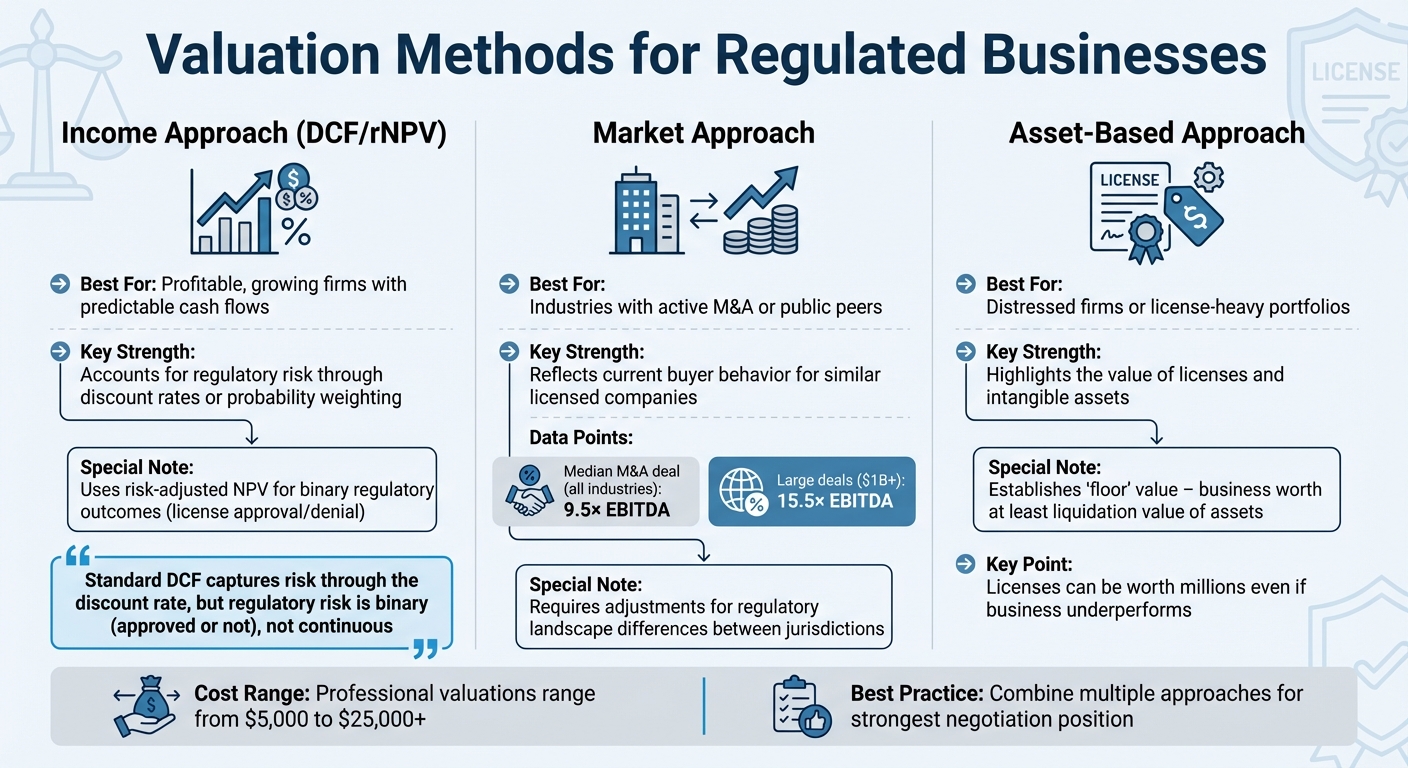
The income approach focuses on valuing a business based on its ability to generate future cash flows. It's widely used for profitable companies in regulated industries, but for high-risk sectors like iGaming and Fintech, it requires some fine-tuning. Traditional discounted cash flow (DCF) models struggle to address the binary nature of regulatory risks - where outcomes are often an all-or-nothing scenario, such as license approval or denial.
To tackle this, risk-adjusted net present value (rNPV) introduces a more nuanced way to account for success probabilities and the time value of money. As the Healthcare Investment Banking Guide explains:
"Standard DCF captures risk through the discount rate, but regulatory risk... is binary (approved or not), not continuous" [8].
One way to handle this uncertainty is through contingent payments tied to regulatory milestones. These allow buyers to manage the risks of businesses awaiting licenses or entering new markets. By linking payments to specific regulatory outcomes, acquirers can reduce valuation uncertainty while ensuring fair compensation for sellers.
The next step involves using the market approach to gain additional perspective by comparing similar businesses in regulated sectors.
Market Approach Adjusted for Regulatory Risks
The market approach offers a way to benchmark a company’s value against recent transactions or the valuation of public peers. As business valuation analyst Gino Pisano notes:
"The market approach method is especially useful when there's robust market data and when the subject company operates in an industry with active mergers and acquisitions" [5].
However, in regulated industries, raw multiples often need adjustments to account for the regulatory landscape. For example, a Fintech company with a full UK banking license will likely command a higher multiple than one operating in a jurisdiction with unclear regulations. In the first half of 2024, the median M&A deal across all industries was approximately 9.5× EBITDA, but for large deals exceeding $1 billion, the median rose to 15.5× [9]. These differences reflect not only company performance but also the regulatory stability and maturity of their operating regions.
Strategic buyers often pay premiums when specific licenses or synergies are involved. For instance, when Publicis Groupe acquired Influential for $500 million, the valuation was driven by the strategic opportunities the firm brought - not just its earnings [9]. Similarly, in regulated industries, transferable licenses in attractive jurisdictions can justify higher valuations.
Asset-Based Approach and License Valuation
The asset-based approach calculates a company’s value by subtracting liabilities from the total value of its tangible and intangible assets. While often used for distressed companies or holding entities, it provides a baseline valuation in regulated sectors. M&A attorney Alex Lubyansky explains:
"For operating businesses, the asset approach typically establishes a 'floor' value. Your business should be worth at least the liquidation value of its assets" [7].
In regulated industries, licenses frequently hold more value than physical assets. These intangible assets, such as gaming licenses in Malta or money transmitter licenses covering multiple U.S. states, can be worth millions - even if the business itself is underperforming. This makes the asset-based approach particularly important for distressed sales or non-operating entities, where the licenses might be the most valuable part of the business.
| Valuation Approach | Best For | Key Strength for Licensed Businesses |
|---|---|---|
| Income (DCF/rNPV) | Profitable, growing firms with predictable cash flows | Accounts for regulatory risk through discount rates or probability weighting |
| Market | Industries with active M&A or public peers | Reflects current buyer behavior for similar licensed companies |
| Asset-Based | Distressed firms or license-heavy portfolios | Highlights the value of licenses and intangible assets |
Professional business valuations typically range from $5,000 to $25,000 or more, depending on the complexity [7]. Before applying any method, it’s crucial to normalize financials by adjusting for one-time expenses like legal settlements, personal costs, or overly high owner salaries [7]. Combining multiple approaches - such as using the market approach to validate a DCF analysis - can provide a solid foundation for negotiations [5][6].
These methods establish a framework for navigating valuation challenges in regulated industries, offering a blend of analytical rigor and practical negotiation strategies.
How to Resolve Valuation Disputes
Independent Expert Valuations
When parties can't agree on a business's value, bringing in a neutral third-party expert can often resolve the impasse. Mohamed A. Abdelhaleem from Andersen in Egypt highlights the importance of this approach:
"In arbitration, disputes often hinge on the fair determination of financial worth, making valuation a cornerstone of the process" [10].
Independent experts are especially useful in regulated industries where disputes arise over technical matters like EBITDA adjustments or deferred income [11]. A notable example is the January 2024 ruling by the Delaware Court of Chancery in Paul v. Rockpoint Group LLC. This case involved a valuation dispute after a co-founder left the company. The court clarified that the appointed appraiser’s role was to act as an expert - not an arbitrator - limiting their ability to interpret contract terms solely to complete the valuation. The court then required the defendant to submit a redacted valuation report, removing any improper legal arguments [12].
To minimize disputes, contracts should clearly define the valuation standard. Specify whether Fair Market Value or another basis applies and include an accounting hierarchy in your Share Purchase Agreement. For example, prioritize specific policies first, followed by consistency with prior statements, and finally GAAP [11]. This structure reduces ambiguity and provides the expert with clear guidelines. Such clarity also sets the stage for alternative dispute resolution methods discussed next.
Mediation and Arbitration
Mediation and arbitration offer two distinct paths for resolving valuation disputes. Mediation involves a neutral facilitator helping parties reach a voluntary, non-binding settlement. Arbitration, on the other hand, provides a faster, confidential process that results in a binding decision [13].
Mediation is particularly effective in regulated industries where preserving business relationships or finding creative solutions beyond contractual terms is important. Arbitration works better when a final and enforceable decision is needed without the publicity of litigation.
A 2024 case study of Sesar Inc., a tech startup founded in 2019, underscores the value of mediation. Two co-founders disagreed on the company’s valuation - one argued for $50 million using a forward-looking DCF model with 20% growth projections, while the other supported $40 million based on a conservative comparable company analysis. A neutral valuation expert helped mediate the dispute by analyzing multiple methodologies, leading to a $45 million settlement. This resolution not only allowed the company to move forward with strategic decisions but also improved the co-founders’ working relationship [13].
For disputes centered on technical metrics like EBITDA adjustments, expert determination is a practical option. This method involves appointing a subject-matter expert, often an accountant, to make a binding decision on specific financial issues rather than broader legal ones [11][14]. Between 2022 and 2023, 90% of U.S. M&A agreements with Purchase Price Adjustment provisions named an independent accountant as the expert for resolving disputes [14]. These approaches help resolve valuation disagreements efficiently and effectively.
Using MyReadyMade for Accurate Valuations

MyReadyMade offers AI-powered tools designed for data-driven valuations, particularly in regulated industries. Their M&A advisory team specializes in handling the complexities of valuing businesses in sectors like iGaming, Fintech, and Forex. From factoring in license premiums to addressing regulatory risks, MyReadyMade provides tailored solutions. With support for license transfers in over 50 jurisdictions and an average transaction close time of 30-45 days, the platform streamlines the valuation and transaction process.
Licenses and Compliance in Valuation Disputes
How Licenses Drive Business Value
In regulated industries, licenses are often the backbone of business value. They provide exclusive or limited rights to operate in specific regions, making their terms - like exclusivity and transferability - key factors in valuation disputes. When contracts are breached, these operating rights often become the center of heated disagreements [15].
The financial stakes are high. For example, Pennsylvania charges $10 million per vertical (like casino or sports betting) for an iGaming license. However, the state's hefty 54% tax rate on slot revenue significantly impacts profitability [16]. Compare this to New Jersey, where the gaming market generates more than $1.5 billion annually. There, operators face application fees ranging from $200,000 to $400,000 and a more manageable 15% flat tax rate [16]. In Michigan, operators saw $1.4 billion in gross gaming revenue in 2023, but compliance requires a $300,000+ investment in local server infrastructure to meet physical location mandates [16]. These high costs often lead to disputes during mergers or acquisitions, especially when parties debate how licenses should be valued.
Another sticking point is transferability, which becomes crucial in acquisitions. Securing an independent license can take 9–18 months in most jurisdictions, so many businesses rely on partnerships with existing license holders. These partnerships, often structured as white-label or revenue-share deals, typically cost 15–30% of gross gaming revenue on an ongoing basis [16]. For smaller markets like West Virginia, which generates about $50 million annually, operators need to spread platform costs across multiple states to remain viable [16]. When assessing value, disagreements often arise over whether partnerships or independent licenses offer better long-term benefits.
Operating across multiple regions adds another layer of complexity, especially when it comes to compliance.
Managing Multi-Jurisdiction Compliance
Navigating compliance across multiple jurisdictions significantly increases costs and fuels valuation disputes. In the U.S., there’s no federal gambling license, meaning operators must adhere to 50 different state regulations, each with its own geolocation and server requirements [16]. On top of that, ongoing compliance tasks like payment processing and mandatory reporting can consume 15–25% of gross revenue [16]. These challenges often spark disagreements about the strategic value of licenses in certain areas.
The regulatory landscape varies widely across jurisdictions. For example, Malta’s Gaming Authority requires €80,000–€100,000 in capital and takes 6–12 months to approve applications. In contrast, Anjouan’s process costs about €17,000 and takes only 3–4 weeks. Estonia, meanwhile, demands €1 million in paid-up capital for games of chance but just €25,000 for games of skill [17].
Ownership changes can also complicate things. In places like the UK, Malta, and Nevada, any corporate restructuring requires regulatory approval or notification [18]. Trust plays a big role too - over 70% of players say they only trust online casinos licensed by well-known authorities, making the reputation of a license a critical factor in valuation [19]. Regulatory scrutiny is intense: in 2022, more than 15% of online casino license applications were rejected due to incomplete due diligence [19]. If new owners fail to meet these standards, the license - and the business value tied to it - could be jeopardized [18].
Conclusion
Valuation disputes in regulated industries often emerge when conflicting valuation methods and fast-changing regulatory environments clash with speculative metrics that overshadow core business fundamentals. This is especially evident in sectors like iGaming and Fintech, where the value of licenses plays a pivotal financial role.
To address these challenges, effective resolution strategies typically involve neutral expert assessments and clear, pre-determined valuation formulas. As Weil Law explains:
"Agreed value provides immediate clarity on how a business or asset will be valued... This certainty allows the parties to plan accordingly and reduces the likelihood of disputes" [2].
Blending different approaches - such as a 60% income-based and 40% asset-based valuation - offers a way to balance differing perspectives. This method captures both tangible assets and the potential for future earnings [2].
Sensitivity analyses are another valuable tool. By testing how valuation outcomes shift with changes in discount rates or revenue projections (e.g., a 10%–20% variance), businesses can identify risk-adjusted values under various regulatory scenarios [1]. Additionally, updating agreed valuations regularly, ideally every year, ensures they remain fair and reflective of evolving market conditions [2].
Platforms like MyReadyMade are designed to navigate the complexities of regulated industries, including iGaming, Fintech, and Cryptocurrency. Offering AI-powered business valuations and expert M&A advisory, the platform provides verified listings in over 50 jurisdictions and boasts an average transaction close time of just 30–45 days. This combination of technology and expertise helps buyers and sellers address unique valuation challenges while preserving confidentiality.
Understanding how license value, compliance costs, and market volatility interact is essential. Recognizing that licenses often represent the largest portion of a business's value - and considering how multi-jurisdiction compliance impacts operational expenses - can lead to fair and defensible valuations.
FAQs
How do you value a license-heavy regulated business?
Valuing businesses in regulated industries like iGaming or Fintech involves a careful look at revenue or EBITDA multiples, with adjustments based on several key factors:
- Regulatory environment: The complexity and stability of regulations in the region can significantly impact valuation.
- Market position: A strong foothold in the market often commands higher multiples.
- Revenue stability: Consistent and predictable revenue streams are highly attractive to investors.
Licenses are often a cornerstone of these valuations. Their worth depends on factors like market demand, transferability, and the challenges posed by regulations. By blending these considerations with industry benchmarks and insights into regulatory frameworks, a fair and accurate valuation can be established for such businesses.
How should regulatory risk be modeled in a DCF?
Regulatory risk in a discounted cash flow (DCF) analysis is typically addressed by adjusting the discount rate to include a risk premium. This adjustment accounts for the potential impact of regulatory outcomes on future cash flows. One widely used method involves applying probability-weighted scenarios, especially for binary outcomes, to reflect the uncertainty tied to regulatory decisions. This approach helps capture how such risks might influence the financial projections.
What should a contract include to prevent valuation disputes?
A contract needs a well-defined valuation clause that outlines how an asset or business will be valued. This might involve using a specific formula or a set process to reduce subjective disputes. By doing so, it creates a clear and predictable method for determining value when certain conditions arise.
Related Articles

KYC vs. AML for Payment Processors: What to Know
KYC confirms identity at onboarding, but only continuous AML monitoring stops payment processors from becoming conduits for financial crime.

Checklist for Secure Player Database Transfers
Step-by-step checklist for secure player database transfers: compliance, encryption, vendor vetting, zero-trust, integrity checks, and audits.

Ultimate Guide to Payment Compliance in iGaming
Roadmap for building compliant iGaming payment systems: AML/KYC, PCI‑DSS, multi‑PSP setup, chargeback controls and jurisdictional risks.
Looking to Buy or Sell?
Get in touch with our team for personalized assistance