Vendor Compliance Checklist for M&A Deals
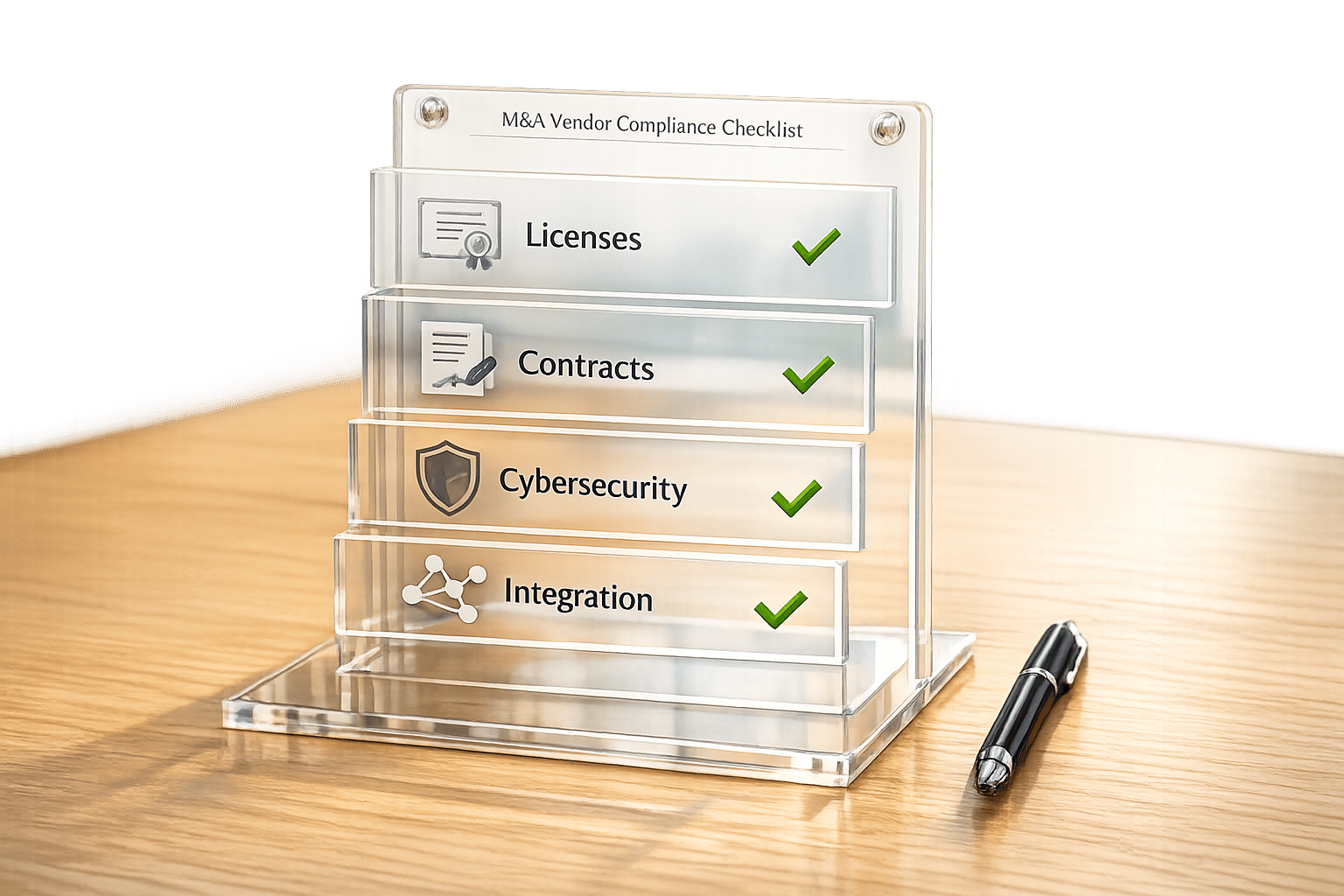
Vendor Compliance Checklist for M&A Deals
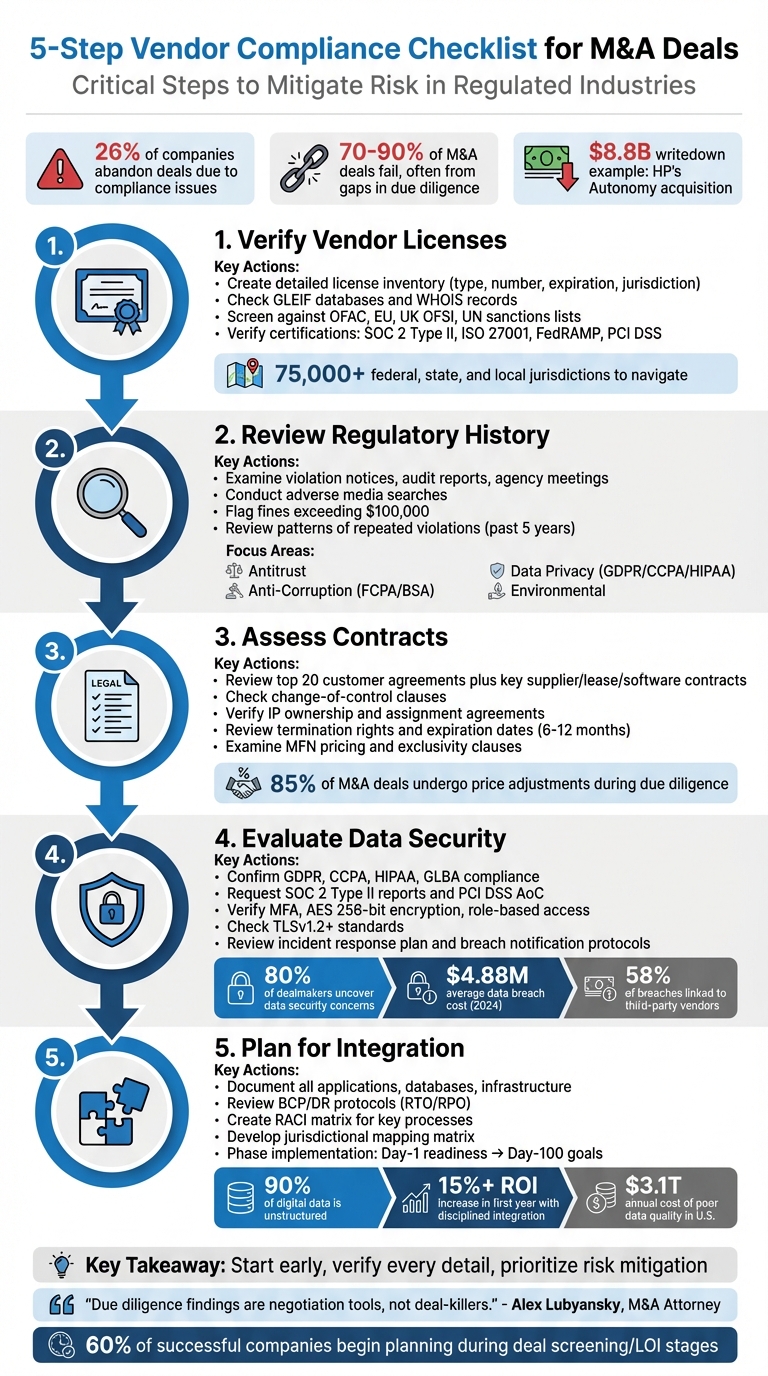
When companies in regulated industries like Fintech, Cryptocurrency, or iGaming pursue mergers and acquisitions (M&A), vendor compliance is a critical step that can determine the success or failure of the deal. Skipping proper compliance checks can cost millions, with examples like Hewlett-Packard's $8.8 billion writedown after acquiring Autonomy due to missed compliance issues. Here's what you need to know:
- Why It Matters: 26% of companies abandon deals due to compliance issues, and 70–90% of M&A deals fail, often because of gaps in due diligence.
- Key Risks: Licensing, regulatory violations, weak contracts, and cybersecurity vulnerabilities can lead to fines, lawsuits, or operational shutdowns.
- Core Steps:
- Verify Vendor Licenses: Ensure licenses are valid, up-to-date, and compliant with jurisdictional requirements.
- Review Regulatory History: Look for fines, violations, or patterns of non-compliance.
- Assess Contracts: Check for change-of-control clauses, IP ownership issues, and termination risks.
- Evaluate Data Security: Confirm adherence to GDPR, CCPA, and other data protection laws.
- Plan for Integration: Ensure systems, contracts, and compliance frameworks align post-deal.
Key Takeaway: A detailed compliance checklist helps mitigate risks, avoid costly surprises, and improve negotiation leverage during M&A transactions. Start early, verify every detail, and prioritize risk mitigation strategies for a smoother process.
Licensing and Regulatory Compliance Review
Verifying Vendor Licenses
Start by creating a detailed license inventory. Include essential details like the type of license, its number, expiration date, current status, issuing authority, jurisdiction, and the legal entity's name [7]. This step is especially important when navigating the complexities of over 75,000 federal, state, and local jurisdictions, each with its own compliance standards [7].
To confirm vendor legitimacy, use resources like the GLEIF databases [4] and check WHOIS records to spot red flags, such as recently registered domains for vendors that should be well-established [4]. Go a step further by screening the vendor, its officers, and parent companies against key sanctions lists: OFAC (U.S.), EU Consolidated Sanctions, UK OFSI, and UN Security Council lists [2][4].
For added assurance, supplement vendor-provided documents with independent verifications. Look into SEC EDGAR and FDIC BankFind for any enforcement actions [4]. Verify certifications, such as SOC 2 Type II, ISO 27001, and FedRAMP (for cloud vendors). If the vendor handles cardholder data, ensure they provide a PCI DSS Attestation of Compliance (AoC) [4].
"Licensing is not an administrative afterthought; it is a core compliance obligation that must be addressed before and immediately after any corporate change." - Wolters Kluwer [7]
Reviewing Regulatory History
Once licenses are verified, delve into the vendor's regulatory history. Examine all interactions with regulators, including violation notices, audit reports, and transcripts of agency meetings. Conduct adverse media searches to uncover potential compliance failures, lawsuits, or breaches [4][8]. Pay close attention to regulatory fines exceeding $100,000 or patterns of repeated violations over the past five years, as these are major warning signs that require further investigation [2].
Additionally, review any past, ongoing, or pending audits - both internal and external - as well as court orders or settlement payments. These can reveal enforcement actions or regulatory issues that might not yet be officially documented [4]. Keep in mind that some jurisdictions impose strict notice periods for regulatory updates, such as requiring name-change notifications within 90 days to avoid penalties [7].
| Regulatory Area | Key Act/Regulator | Review Focus |
|---|---|---|
| Antitrust | Sherman/Clayton Acts | Market share, case history, and collusion risks [5] |
| Anti-Corruption | FCPA / BSA | Anti-bribery policies, suspicious activity reporting, and AML programs [5] |
| Data Privacy | GDPR / CCPA / HIPAA | Data breach response protocols and PHI privacy policies [5] |
| Environmental | Clean Air/Water Acts | Emission permits and pollutant discharge compliance [5] |
Contract Review and Risk Assessment
Reviewing Key Contract Terms
Once you've verified licenses and regulatory history, it’s time to dive into vendor contracts. Start by examining the top 20 customer agreements along with key supplier, lease, and software license contracts [6]. These documents can often contain hidden risks that might impact the value of the deal.
Pay close attention to change-of-control provisions - these clauses allow vendors to terminate or renegotiate terms if ownership changes [10][6]. For instance, suppliers have been known to cancel agreements shortly after a deal closes, which can significantly affect revenue [6].
Non-assignment clauses in software licenses and leases are another area to scrutinize. These clauses often require written third-party consent at least 30 days before closing. Without this consent, you risk sudden contract terminations or increased costs [6][9].
Another critical area is intellectual property ownership. If employees or contractors developed core technology without proper IP assignment agreements, the company might not legally own its key assets [6][9]. In such cases, securing executed IP assignments should be a mandatory condition for closing. Additionally, review termination rights, particularly "at-will" clauses or contracts set to expire within 6–12 months, as these could lead to unexpected losses in revenue or supply [2][11].
Don’t overlook most-favored-nation (MFN) pricing and exclusivity clauses. These can restrict your ability to integrate the acquired company into your supply chains or negotiate better pricing after the acquisition [6]. Lastly, ensure that data processing agreements comply with regulations like GDPR, HIPAA, or CCPA. These agreements should also include clear breach notification timelines and audit rights [2][1].
Once you’ve identified these vulnerabilities, the next step is to implement deal protections to address them.
Risk Mitigation Strategies
After pinpointing contract risks, the focus shifts to mitigating them. One of the most common strategies is a purchase price reduction to account for the financial impact of the issues - 85% of M&A deals undergo price adjustments during due diligence [6]. For liabilities that are harder to quantify, such as pending lawsuits or missing IP assignments, consider setting aside an escrow holdback (usually 5–10% of the purchase price) to cover potential losses [6].
"The issues that kill deals or cost buyers hundreds of thousands of dollars post-closing are almost always legal - a contract that terminates on change of control, IP that was never properly assigned..." - Alex Lubyansky, M&A Attorney [6]
Make sure to secure written third-party consent and formalize any verbal commitments as part of the closing conditions [6][9]. If one customer accounts for more than 20% of total revenue, consider tying 20–40% of the purchase price to an earnout based on customer retention [6].
For companies operating in multiple states, conducting a sales tax nexus study can help identify uncollected tax liabilities that could become your responsibility [9]. To protect against compliance failures, regulatory fines, or data breaches that occurred before closing, include specific indemnification provisions that shift liability to the seller [2][6].
Here’s a quick summary of key contract types, their risks, and how to mitigate them:
Contract Comparison Table
| Contract Type | Key Risks | Mitigation Steps | Sector Relevance |
|---|---|---|---|
| Customer Contracts | Change-of-control termination; revenue loss | Obtain pre-closing consent; escrow holdbacks | All (especially SaaS/Service) |
| Supplier Agreements | Supply chain disruption; exclusivity limits | Negotiate assignment rights; identify backups | Manufacturing, Retail |
| Employment Agreements | Key talent flight; severance triggers | Retention bonuses; new non-compete signings | Tech, Healthcare |
| IP Licenses | Ownership defects; termination on sale | IP assignment cleanup; warranty of title | Tech, Pharma |
| Facility Leases | Landlord refusal to assign; rent hikes | Early landlord engagement; estoppel certificates | Retail, Industrial |
| Data Processing | Regulatory fines (GDPR/HIPAA); breaches | Compliance warranties; audit rights | Healthcare, Finance |
Data Security and Cybersecurity Protocols
Checking Vendor Data Protection Policies
After addressing regulatory and contractual compliance, the next step is to ensure data security and implement strong cybersecurity protocols. Start by examining how vendors handle sensitive information, ensuring they comply with relevant data privacy laws. Depending on the transaction's scope, this could include GDPR for European operations, CCPA for California-based customers, HIPAA for healthcare data, or GLBA for financial services [1][12]. Interestingly, about 80% of global dealmakers uncover data security concerns during due diligence [12].
Don't just take vendors at their word - request formal compliance documentation. Key documents to ask for include the Attestation of Compliance (AoC) for PCI DSS and SOC 2 Type II reports, which confirm the vendor's security controls over time [4][12]. Avoid relying on verbal assurances or marketing claims; instead, insist on reviewing the actual compliance records.
It's also critical to confirm that vendors have secure data retention and deletion procedures in place. Past breaches, such as those affecting Verizon's acquisition, highlight the financial risks tied to weak data protection. Additionally, review the vendor's subprocessor list, as these "fourth parties" can introduce hidden vulnerabilities into your supply chain. Research has shown that even well-known platforms like Stripe and QuickBooks sometimes lack publicly accessible subprocessor pages [4]. For cross-border transactions, ensure the vendor provides data residency documentation to comply with data sovereignty requirements under laws like GDPR and CCPA [4].
Once these data protection policies are verified, the next focus should be on assessing the vendor's operational security measures.
Evaluating Cybersecurity Readiness
Documentation alone isn't enough - it's equally important to assess the vendor's operational cybersecurity defenses. Start by categorizing vendors based on their potential impact: high for those handling sensitive or critical data (e.g., payment processors), medium for essential service providers, and low for those with minimal exposure [12].
For high-impact vendors, confirm the use of multi-factor authentication (MFA), AES 256-bit encryption, and role-based access controls [12][4]. Check that their SSL/TLS configurations meet at least TLSv1.2 standards, with TLSv1.3 preferred for higher-risk transactions [4]. Automated tools can help identify open ports, exposed services, and known vulnerabilities, providing deeper insights into their security posture.
"Integration periods are when risk peaks. When tenants, networks, and identities connect, gaps that were tolerable in isolation can become material." - Abnormal AI [14]
Operational maturity is another important factor. Assess how quickly the vendor patches vulnerabilities and how prepared they are to respond to incidents. Post-acquisition reviews often uncover vulnerabilities that can lead to operational disruptions, emphasizing the importance of rigorous cybersecurity evaluations.
Request evidence of recent penetration testing and vulnerability scans (conducted within the past 12 months). Review their incident response plan, including breach notification protocols and business continuity measures [12][13]. With the average data breach projected to cost $4.88 million in 2024 - a 10% increase from the previous year - and 58% of breaches linked to third-party vendors [12], conducting thorough cybersecurity evaluations is essential to reducing post-acquisition risks.
Integration Readiness and Post-Close Compliance Planning
Evaluating Vendor Integration Capabilities
After verifying cybersecurity protocols, the next step is to evaluate how well the vendor’s systems can integrate with yours. Start by documenting every application, database, and infrastructure component to pinpoint critical dependencies and potential redundancies [16]. Since roughly 90% of digital data is unstructured, this step can be particularly challenging during M&A integration [3].
Pay close attention to the vendor's business continuity plans (BCP) and disaster recovery (DR) protocols. Specifically, review their recovery time objectives (RTO) and recovery point objectives (RPO) to understand how quickly operations can be restored after disruptions [15]. For financial systems, ensure the vendor’s chart of accounts can be standardized and their reporting calendars aligned with yours. If these elements don’t match up, consolidating financial data from day one will be nearly impossible [16].
To streamline the transition, use a RACI matrix (Responsible, Accountable, Consulted, Informed) to define roles for key processes. This approach eliminates confusion about responsibilities and avoids the "turf wars" that can derail integration efforts [16]. Instead of a hard cutover, consider running both legacy and new systems simultaneously. This allows you to validate data and provide user training without disrupting operations [16].
"The real war isn't closing the deal; it's winning the integration." - Usypchuk [16]
Creating a Compliance Roadmap
Once integration capabilities are assessed, shift focus to regulatory alignment and internal controls for post-close compliance. Start by developing a jurisdictional mapping matrix to align the new entity’s regulatory requirements with identified integration risks. This includes compliance with data privacy laws like GDPR and CCPA, as well as any industry-specific permits [16]. Instead of merging two existing compliance policies, design a unified program tailored to the combined company’s actual risk profile [16].
Break the compliance roadmap into phases. Day-1 readiness should prioritize mission-critical systems like ERP and CRM, ensuring they function immediately. Day-100 goals can focus on broader integration tasks [3][16]. Assign a single accountable owner to oversee compliance integration, supported by a cross-functional team - often called a "war room" - led by the CFO. This team should map out processes and decide which systems to keep [16].
Before integration, identify and delete redundant or obsolete data. Poor data quality costs the U.S. economy an estimated $3.1 trillion annually, so cleaning up data not only reduces liability but also shrinks your attack surface [3]. Develop a transition plan for continuous monitoring to maintain compliance as regulations evolve. A disciplined integration process that meets key functional milestones can increase ROI by over 15% in the first year [16].
Conclusion
Vendor Compliance Checklist Summary
A vendor compliance checklist is your safeguard against the risks that often lead to M&A failures. Key elements such as licensing verification, contract review, data security assessment, and integration readiness help turn potential risks into measurable factors for negotiation. For example, identifying critical change-of-control clauses can transform compliance challenges into actionable opportunities during deal discussions.
Statistics highlight the importance of this process: about 85% of M&A deals experience purchase price adjustments due to due diligence, and 50% of technology-related deals fall apart entirely during this phase[6]. Thoroughly verifying licenses across hundreds of categories and jurisdictions[1], screening vendors against OFAC and EU sanctions lists[4], and confirming certifications like SOC 2 Type II or ISO 27001[1][4] can prevent costly liabilities. Consider this: the average data breach costs $4.45 million, while supply-chain breaches average $4.91 million and can take up to 267 days to detect[15].
"Due diligence findings are negotiation tools, not deal-killers." - Alex Lubyansky, M&A Attorney, Acquisition Stars[6]
The timing of your compliance efforts matters. Studies show that 60% of successful companies begin planning their operating models during the deal screening and LOI stages[1]. Using tools like virtual data rooms to centralize documentation, implementing a tiered risk model for vendors, and verifying audit reports (not just self-attestations) are practical steps to ensure compliance[4][15]. By addressing these checklist items, you can mitigate risks from pre-deal negotiations through post-close integration.
How MyReadyMade Supports M&A Transactions
MyReadyMade simplifies vendor compliance for M&A deals, especially in heavily regulated industries. The platform uses verified business listings backed by GLEIF and WHOIS data to confirm vendor legitimacy[4]. Its expert advisory services guide you through complex licensing requirements across more than 50 jurisdictions, ensuring no critical permits or regulatory gaps jeopardize your transaction.
For international deals, MyReadyMade automates sanctions screening against major regulatory lists, cutting the traditional 4–6 week manual process down to under 90 seconds for up to 22 vendor checks[4][15]. This efficiency is particularly valuable in industries like iGaming, Cryptocurrency, Forex, and Fintech, where compliance risks are high. With 26% of companies abandoning half or more of their deals due to these challenges[1], MyReadyMade provides the tools and expertise needed to navigate the complexities of M&A transactions with confidence.
Vendor Due Diligence in Mergers and Acquisitions
FAQs
Which vendors should I review first during M&A due diligence?
Start by focusing on vendors that carry the greatest risks. This includes those managing sensitive data, offering financial services, or operating internationally where sanctions could be a concern. Pay close attention to vendors involved in cybersecurity, compliance, and regulatory matters, as well as those with intricate structures or operations spanning multiple jurisdictions. It's also wise to prioritize reviewing vendors with a history of enforcement actions, litigation, or sanctions issues to address potential problems early on.
What compliance documents should I request from critical vendors?
When conducting due diligence for mergers and acquisitions, it's crucial to request specific compliance documents from key vendors. These documents provide insight into potential risks and ensure the vendor operates within legal and regulatory frameworks. Here's what you should ask for:
- Business registration and legal entity verification: This confirms the vendor's legitimacy and verifies their legal standing.
- Sanctions screening reports: These reports help ensure the vendor isn’t subject to any sanctions that could pose compliance risks.
- Regulatory enforcement filings and litigation disclosures: Reviewing these documents allows you to evaluate legal risks tied to the vendor, such as past or ongoing regulatory actions or lawsuits.
- Governance and compliance documentation: This includes policies, procedures, and risk assessments that demonstrate the vendor’s commitment to compliance and sound governance practices.
By gathering these documents, you can better assess compliance and address potential risks during the M&A process.
What deal protections should I use if vendor compliance issues are found?
If vendor compliance issues come up during an M&A deal, deal protection mechanisms can help manage the risks. Tools like match rights and target termination fees are often used. Match rights allow the buyer to match any competing offers, while termination fees compensate the buyer if the deal falls through. These measures can help keep the deal on track and safeguard your position when compliance challenges arise.
Related Articles

Ultimate Guide to Earnout Negotiations in M&A
Structure and negotiate earnouts in regulated M&A with clear metrics, anti-manipulation covenants, and acceleration or escrow protections.

How to Draft M&A Definitive Agreements
Guide to drafting M&A definitive agreements covering deal structure, reps & warranties, indemnities, payment terms, and regulatory compliance.

How IP Affects Tokenization Valuation
How tokenizing patents, copyrights, and trademarks adds liquidity and market value—plus legal, regulatory, and valuation steps.
Looking to Buy or Sell?
Get in touch with our team for personalized assistance