Why Vendor Relationships Matter in M&A

Why Vendor Relationships Matter in M&A
In mergers and acquisitions (M&A), vendor relationships often determine whether a deal succeeds or fails. Neglecting these relationships can lead to disrupted operations, increased costs, and weakened partnerships. Here’s what you need to know:
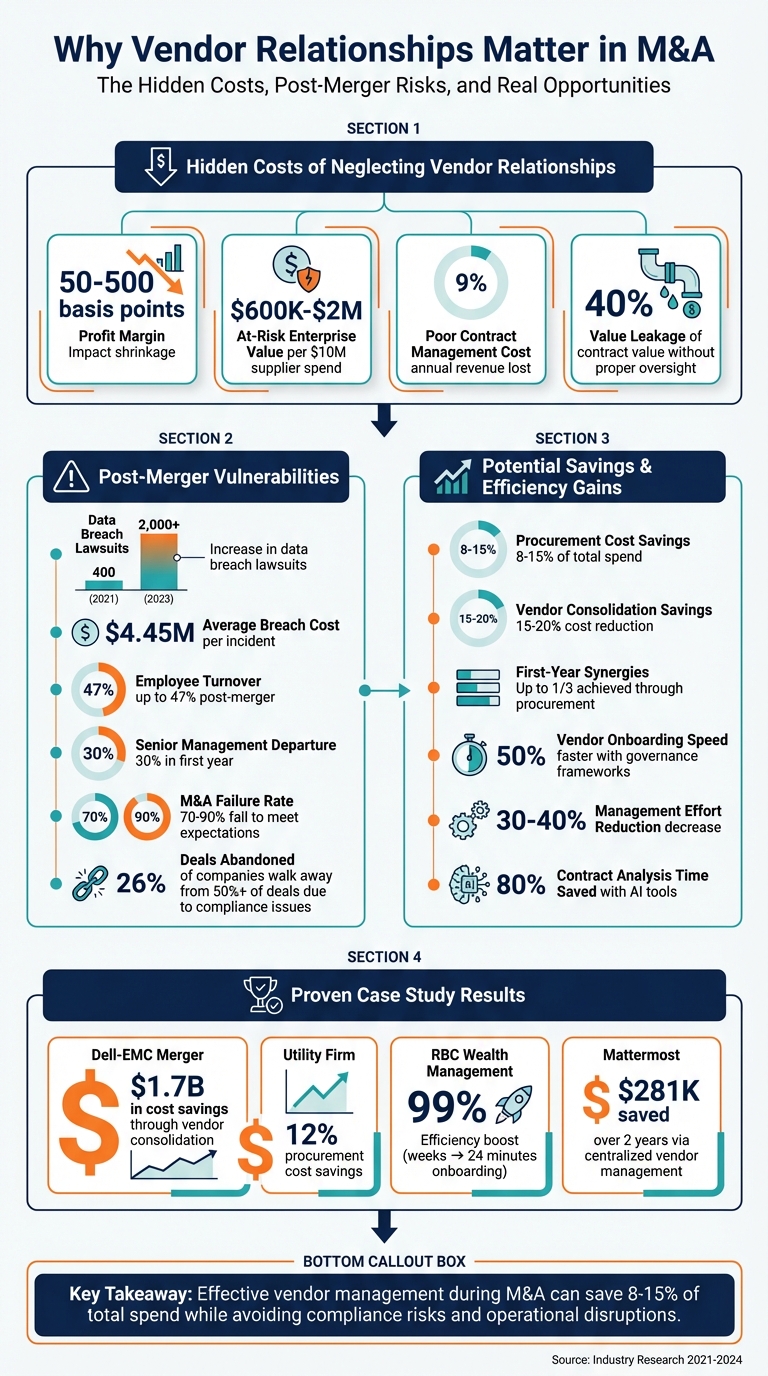
- Hidden Costs: Informal perks like priority shipping and flexible payment terms often disappear post-merger, causing profit margins to shrink by 50–500 basis points.
- Cybersecurity Risks: Data breach lawsuits surged from 400 in 2021 to over 2,000 in 2023, highlighting vulnerabilities in inherited vendor ecosystems.
- Contract Challenges: Issues like change-of-control clauses and early termination penalties can halt critical services and disrupt business continuity.
- Employee Turnover: Up to 47% of employees leave post-merger, often taking key vendor knowledge with them.
Key Takeaway: Managing vendor relationships effectively during M&A transitions can lead to cost savings (8–15% of total spend), smoother integration, and long-term financial gains. Ignoring this can result in compliance issues, operational inefficiencies, and lost deal value.
How Vendor Relationships Work in M&A
Vendors as Business Assets
Vendor relationships play a key role in shaping the success of mergers, acting as strategic assets that influence both operational stability and financial performance. These partnerships bring three major benefits: reliability during transitional periods, early access to new features that drive innovation, and preferential pricing terms that may not always be explicitly outlined in contracts [5]. Vendors also provide critical updates, such as alerts on price changes, product discontinuations, or supply chain issues, enabling companies to adapt operations proactively [1].
When managed effectively, vendor relationships can lead to significant cost savings - up to 20% - and improved operational efficiency. For example, a $10 million supplier spend could put $600,000 to $2 million of enterprise value at risk during a merger transition if vendor relationships are neglected [1] [5]. Recognizing this, CFOs are increasingly stepping into a pivotal role as "architects of third-party synergy", elevating vendor management from a routine task to a strategic focus [3].
But while the benefits are clear, mergers often introduce challenges that complicate vendor management.
Common Vendor Management Problems After Mergers
Despite the advantages vendors bring, mergers can create significant hurdles in managing these relationships. One major issue is misalignment in financial systems, such as accounts payable and receivable. This misalignment can lead to invoicing errors, which strain vendor relationships [3]. In fact, 50% of suppliers cite onboarding to new payment portals as one of the most frustrating aspects of business transitions [3]. Additionally, delays in consolidating systems - known as integration debt - result in redundant licenses, manual processes, and reduced productivity [4].
Contractual challenges also complicate vendor management. Change of control clauses, restrictions on contract assignments, and early termination penalties can prevent the seamless transfer of essential services [2]. Without categorizing vendors into groups like Critical (essential to retain), Tactical (offering scaling opportunities), and Operational (standard goods), integration teams often struggle to allocate resources efficiently [2].
Adding to these difficulties is employee turnover. Post-merger, up to 47% of employees leave, with 30% of senior management departing within the first year. This loss of personnel often erodes institutional knowledge about vendor relationships, further complicating the integration process [4].
Research Findings: Vendor Consolidation and Optimization
How to Consolidate Vendors
Procurement often drives a significant portion of M&A synergies, with up to one-third achieved within the first year [11]. To streamline vendor management, it's helpful to divide suppliers into three groups:
- "C-suite" suppliers: Strategic partners essential to operations.
- "Mid-tier" suppliers: Vendors that can generate early savings through volume bundling.
- "Tail-end" suppliers: Low-impact vendors that are ideal for quick consolidation.
This categorization allows for tailored approaches. For instance, strategic suppliers require roadmap alignment, while tail-end vendors can be consolidated efficiently through methods like e-auctions or catalog harmonization.
AI-powered contract analysis tools are transforming how companies approach consolidation. By using natural language processing, these tools can scan legacy contracts and flag potential obstacles like change-of-control clauses, assignment restrictions, or early termination fees. This technology can cut negotiation preparation time by as much as 80% [11]. These efficiencies open the door to quick wins, such as aligning rebates, optimizing freight terms, and bundling volumes.
"In a world where 60-80% of deals fail to deliver expected value during PMI, procurement is much more than just a lever."
- Michael Jonas, Partner, Roland Berger [11]
Beyond initial consolidation, merged companies can use their combined buying power to unlock even more value.
Using Increased Buying Power After Mergers
The combined purchasing power of merged entities creates opportunities to renegotiate contracts and standardize pricing. A notable example is Dell's $67 billion acquisition of EMC in 2016. Vendor consolidation was central to Dell's integration strategy, targeting $1.7 billion in cost savings through supply chain improvements [10]. This case highlights how effective vendor management can directly contribute to achieving M&A goals.
Procurement savings post-merger typically range from 8% to 15% of total spend [11]. Companies can maximize this value by presenting a unified front to suppliers. A centralized approach prevents vendors from exploiting internal inefficiencies. For example, Mattermost implemented a centralized vendor management system under IT Manager Daniel Sischy, consolidating its SaaS vendors. This effort led to over $281,000 in savings over two years [9].
"When you have 50 managers, it's really difficult to ensure that each person is properly negotiating on behalf of the company."
- Daniel Sischy, IT Manager, Mattermost [9]
Centralized vendor management also simplifies contract harmonization. Often, legacy entities pay different rates for the same services. Aligning payment terms, pricing, and liability caps across the organization eliminates these discrepancies. This not only reduces costs but also improves operational efficiency and eases the administrative burden of managing duplicate agreements.
Vendor Due Diligence in Mergers and Acquisitions
Compliance and Risk Management with Vendors
Compliance challenges can derail mergers and acquisitions (M&A) faster than almost anything else. In fact, 70% to 90% of M&A deals fail to meet expectations, with compliance issues being a major culprit [12]. Even more alarming, 26% of companies walk away from half or more of their deals after uncovering compliance problems during due diligence [12]. The financial fallout can be staggering - a single data breach costs companies an average of $4.45 million [12]. And let’s not forget the potential penalties for tax missteps; failing to file IRS forms like Form 8594 can result in fines reaching $3 million [12].
Finding Compliance Problems
Spotting compliance risks among vendors requires a thorough and systematic approach. Some of the biggest red flags include regulatory violations (like antitrust or tax issues), data security breaches (think GDPR, CCPA, or HIPAA non-compliance), intellectual property disputes, and violations of international sanctions [12][13].
Financial health is often the first indicator of trouble. Vendors with a current ratio below 1.0 or a debt-to-equity ratio above 1.0 signal potential instability [13]. Revenue dependency is another concern - if more than 30% of a vendor’s revenue comes from a single client, that could spell trouble for the stability of your partnership [13].
AI-powered tools can make this process faster and more precise. For instance, contract analysis software can scan thousands of documents to flag clauses that might lead to compliance issues. Security audits, including SOC 2 Type II reports and ISO 27001 certifications, ensure vendors meet necessary data protection standards [13]. In highly regulated industries, automated systems that screen vendor executives against sanctions lists from OFAC, the EU, and the UN help companies avoid costly violations [13].
| Vendor Financial Red Flags | Threshold for Concern |
|---|---|
| Current Ratio | Below 1.0 |
| Debt-to-Equity | Above 1.0 |
| Operating Margin | Below 3% |
| Revenue Concentration | Single client > 30% of total revenue |
By identifying these risks early, companies can address them proactively, ensuring that vendor relationships contribute positively to the success of the M&A deal.
Updating Vendor Contracts for the New Company
Once compliance risks are identified, updating vendor contracts becomes a critical next step. This starts with creating a comprehensive inventory of all active agreements, noting each vendor’s annual spend and total contract value [2]. Using contract management tools, companies can consolidate vendor data from both merging entities, setting the stage for strategic renegotiations that align with the new organization’s goals [3].
Revised contracts should include key provisions like indemnification clauses, compliance warranties, audit rights, and clear termination triggers for compliance or security failures [13]. Payment systems are another area to address - vendors often face challenges adapting to new payment platforms, so aligning systems early can prevent unnecessary disruptions [3]. Establishing clear communication channels and escalation paths ensures that any issues are resolved quickly [6].
For industries like iGaming and Fintech, contracts must also address sector-specific requirements, such as business licensing, data privacy (GDPR, CCPA), and anti-money laundering protocols [12][14]. By combining risk identification with targeted contract updates, companies can protect deal value while keeping vendor relationships on track during the transition.
Case Studies and Measured Results
Cost Reductions and Better Service
The financial benefits of effective vendor relationship management during mergers and acquisitions (M&A) are far from hypothetical - real-world examples show tangible results. For instance, a major utility firm managed to achieve 12% savings in procurement costs by leveraging post-merger synergies. This wasn't just about slashing expenses; it involved smarter vendor consolidation and streamlining procurement processes across the newly unified organization [15].
Take RBC Wealth Management as another example. In early 2026, after an acquisition, they uncovered 26 overlapping systems in their technology stack. By consolidating these vendors and systems, they slashed client onboarding time from weeks to just 24 minutes - a staggering 99% boost in operational efficiency [16]. This highlights how vendor consolidation can drive efficiency and deliver value far beyond just cutting costs.
On a broader scale, businesses that excel in vendor management often see 15-20% cost reductions through consolidation and process optimization [16]. However, the risks of poor governance are significant - 40% of a contract's value can slip away without proper oversight, and ineffective contract management costs enterprises an average of 9% of their annual revenue [16]. While the immediate savings are impressive, the long-term operational advantages are just as critical for maintaining competitiveness post-merger.
Ongoing Benefits After the Merger
The benefits of vendor optimization don’t end once the merger is complete. Research spanning 11 industries from 2009 to 2018 reveals that in the financial sector, M&A activity often leads to stronger financial performance, with results becoming evident after about two years. This underscores how the value of vendor optimization continues to grow well beyond the initial integration phase [8].
Doug Roginson, Head of Supplier Relationship Management at JPMorganChase, highlights the evolving role of vendor management:
"The goal is to get beyond negotiating rates, service levels and delivery schedules and work toward market-making, brand-differentiating joint value creation" [7].
Companies that adopt robust governance frameworks enjoy 50% faster vendor onboarding and a 30-40% reduction in management effort [16]. These efficiencies transform vendor management from a behind-the-scenes function into a strategic tool for growth and differentiation, delivering long-term competitive advantages.
Conclusion
Vendor relationships are more than just a behind-the-scenes concern - they play a pivotal role in determining the success of mergers and acquisitions, particularly in highly regulated industries like iGaming, Crypto, Forex, and Fintech. When acquiring a company, you’re not just taking on its assets - you’re also inheriting its vendor network, which includes compliance risks, cybersecurity challenges, and operational dependencies. Managing these relationships effectively can mean the difference between unlocking value and losing synergies.
Companies that handle vendor consolidation well can uncover considerable cost savings, while poor contract management can lead to unnecessary financial strain. Beyond cost, strong vendor governance simplifies integration and reduces administrative burdens, allowing resources to be redirected toward growth opportunities.
From the outset, vendor management needs to be treated as a strategic priority. This involves pinpointing critical vendors essential to operations, identifying contract clauses - like change of control restrictions - that could derail the deal, and conducting cybersecurity assessments of B2B partners. This last point is crucial, especially as data breach lawsuits have skyrocketed from 400 in 2021 to over 2,000 in 2024 [3].
"Scale is vital and sometimes overlooked if it was not treated as a key strategic lever in the sale" [2].
This level of strategic focus is particularly important in regulated industries, where compliance and operational continuity are non-negotiable.
FAQs
Which vendors are most critical to review before closing an M&A deal?
When preparing to close an M&A deal, it's crucial to carefully review key vendors. Focus on those with active contracts, significant financial impact (either through revenue generation or spending), or contract clauses that could introduce risks. Conducting detailed due diligence on these vendor relationships can help uncover potential red flags and pave the way for a smoother integration after the merger.
What contract clauses can block vendor transfers after a merger?
When mergers take place, certain contract clauses can complicate vendor transfers. These often surface during due diligence and may include restrictions on assignment or transfer rights. Some clauses might even impose conditions that disrupt the vendor transition process. To avoid complications, carefully reviewing contracts early in the M&A process is essential.
How can you assess vendor cybersecurity risk during due diligence?
When working with third-party vendors, it's critical to assess their cybersecurity practices thoroughly. One effective way to do this is by using detailed questionnaires. These tools help you gauge their security posture, check for compliance with industry standards, and identify any potential vulnerabilities in their systems.
But it doesn't stop there. Conducting in-depth investigations allows you to uncover risks that may not be immediately apparent. This proactive approach ensures that vendors meet the required security standards, ultimately reducing your exposure to cyber threats.
Related Articles

Ultimate Guide to Earnout Negotiations in M&A
Structure and negotiate earnouts in regulated M&A with clear metrics, anti-manipulation covenants, and acceleration or escrow protections.
How to Draft M&A Definitive Agreements
Guide to drafting M&A definitive agreements covering deal structure, reps & warranties, indemnities, payment terms, and regulatory compliance.

How IP Affects Tokenization Valuation
How tokenizing patents, copyrights, and trademarks adds liquidity and market value—plus legal, regulatory, and valuation steps.
Looking to Buy or Sell?
Get in touch with our team for personalized assistance